Transcript
Automated transcript · Written by software from the replay's audio. It can mishear names and figures; the replay is the record.
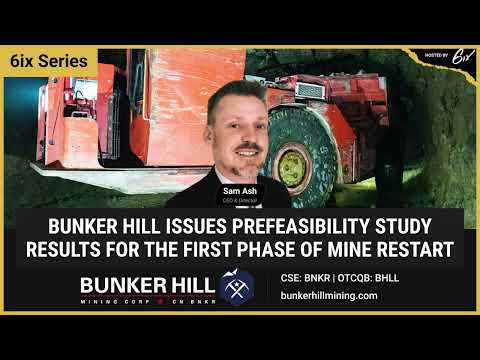
0:08 Hello, everyone. Welcome to Bunker Hill Mining's live investment summit today, hosted by 6. I'm pleased to introduce the CEO of Bunker Hill, Sam Ash, as well as their CFO, David Weins. Sam and David are going to walk us through a company presentation, and after we'll enter into a live Q&A session. As a reminder, you can ask questions using the Q&A panel found on the right-hand side of your screen at any time during today's presentation. And as always, this event is being recorded and is going to be available on Six.com in the coming days. Without further ado, Sam, I'd like to hand things over to you. Thanks a lot, Cam, and thanks for everybody for tuning in today, which is a pretty
0:39 important milestone for the Bunker Hill Company and the Bunker Hill Mine restart. We're going to run you through today some of the details of our pre-feasibility study that just we press released earlier this week and open it up for some questions. But really to start, we'll start with the top line numbers on what we think is a very compelling economic case for the Bunker Hill restart at a pre-feasibility level. And just to remind everybody, pre-feasibility, we're only carrying the measured and indicated material through in the economics. And so there's still, beyond the pre-feasibility, a tremendous amount of upside potential.
1:25 And this pre-feasibility study really, what it does is it focuses on the compelling economics to get the Bunker Hill mine restarted. And there we certainly expect to see a lot of upside as we move into production from here. So anyway, 52 million NPV at an 8% discount rate, 36% IRR, two-year payback. Still a very modest capex at 55 million over the next 16 months. Five-year mine plan, and that is based on an increased throughput from 1,500 tons per day in the PEA to 1,800 tons per day in the pre-feasibility. Still well positioned on the cost curve and generating strong free cash flow through that first 5 years in excess of 25 million in free cash flow with an EBITDA of around 40 million. And again, you know, there is still a lot of upside potential from here, both in mine life extension and the opportunities presented to us with focused exploration to bring, you know, more silver and the leverage that comes with silver into the mine plan.
2:36 You can see side-by-side the the PEA cash flow numbers on an annualized annual basis versus the pre-feasibility numbers And really what you're seeing here is a strong improvement in cash flow over that first five-year period in the pre-feasibility. And although it's not in the pre-feasibility, just indicatively you can see that there is a lot of upside potential available from resource conversion as we move forward in the in the outer years and we're certainly focused on achieving that resource conversion and bringing that material in to the economic picture. Here you can see, and when we talk about that, and we talk about what is the potential beyond the pre-feasibility, what's important to note is this is a graph that's showing and indicates the resource conversion that was achieved historically in the last 15 years of mine life. So you can see this is the historically reported reserves over the last 15 years of the mine life from 1967 to 1981.
3:46 And one thing that jumps out is the consistent ability of this deposit to replace reserves. And we certainly expect that to carry forward as we move forward. Let's talk a little bit about what's included in this pre-feasibility mine plan. You can see here, it again is only measured in indicated material and that really focuses us on what we call the the quill new guard mineralization and ore body. You can see that highlighted in the light red. And just to remind everybody, this is a very much a zinc dominant area of mineralization within the mine, and it is a great place to start. Roughly a third of that mineralization is above the water table and easily accessible from the development ramp that we've been talking about over the last few months that's well in progress from the Russell portal on the 5 level and extending down to the 9 level.
4:46 And again certainly it's open at depth, open along strike, and there's a lot of opportunity for resource expansion. Here at the mine site, how are we standing, you know, as law on the way to initiating this restart. Where are we at, actually on the ground today, right now. The Pend Oreille mill has been fully decommissioned and relocated to the Bunker Hill Mine Site in Kellogg. That was achieved ahead of schedule and under budget. The site has been cleaned up and is well prepared to begin the construction phase of this project. The water treatment test plant has concluded a successful testing regime, and we are actually able to move forward
5:39 and incorporate the continued use of the existing water treatment facility and our plans moving forward, which is helpful from a CAPEX perspective. And we've been making opportunistic purchases of underground mining equipment, and we believe that this is absolutely the right course of action. We're finding that in the used equipment market, there is a lot of excellent equipment that's in excellent condition available for a fraction of the price of acquiring that new, both from a cost perspective, but also from an availability perspective. We're Continuing to build the team. We've been talking for quite some time, so you all know myself, Brad Barnett. We've brought in Tom Francis, our general manager from Rio Tinto. He was most recently managing the Kennecott mine in Salt Lake City. CMC, our mine contractor, is continuing to operate and deliver results in excess of what we project.
6:43 And Hoffman Manufacturing is the team responsible for the demobilization of the Ponderay Mill ahead of schedule on budget. And they look to play a central role as we begin the construction of the processing plant here at Bunker Hill. Mine water continues to support us with water quality and water management as we move forward. And as always, we still are developing and maintaining strong relationships with the Idaho Department of Environmental Quality, the EPA, and all of our technical partners who I would like to give a lot of thanks to a lot of hard work. Mindtech on the mining side, Barr Engineering supporting us on the process plant and process engineering.
7:29 SGS, Rangefront, Yawcom, which is supporting us on the metallurgy side, RDA, Golder, Patterson, and Cook. We really have mobilized and have a very skilled team helping us out and advising us as we move forward. Project schedule, no change here. We're going to build this mine and be in production by the end of Q3, early Q4 next year. That makes us one of the only mining projects in North America that is actually going to be built, come online, and be generating cash flow in the next 12 to 18 months. And we're going to do that with a really kind of an industry-leading capital intensity from a capital expended by annual throughput perspective. You can see some of our peers in the Zinc space here.
8:28 First of all, we're likely the only project that will be coming online in the next 5 years. And we're going to do it at a capital intensity that sets us apart from the crowd.
8:43 So what's coming next after the pre-feasibility? When you look at the Bunker Hill, we still see a significant opportunities to create and unlock additional value. We have met additional metallurgical studies going on. The indications on the metallurgical studies that the PFS is based on, indicate that there is continued optimization and recovery improvements that can potentially be brought to bear. Throughput increases, we now have the opportunity potentially to look at throughput increases up to 2,500 tons a day, new technology such as ore sorting to improve head grade, and the big one is the focus on resource conversion from the inferred into the measured and indicated and ultimately into the reserve category for us.
9:34 Again, all of that is at relatively conservative metal prices, which really bodes well to the ability to add significant value beyond what we're indicating is achievable in this pre-feasibility study. And just to remind everybody on what's been a pretty accelerated journey since we started on this project in April of 2020, we have acquired the mine site, We have done the geologic and technical work to publish 43-101 resource. We've upgraded that several times. We've gone through the process of studying the project economics at a PEA level and now at a pre-feasibility level. We have built strong partnerships with the EPA.
10:20 We have partnered with a absolutely tremendous financing partners, Sprott Royalty and Streaming for the bulk of the restart financing. We filled out our project pipeline, adding, entering into a joint venture in the London Mining District in Colorado. We've solved the processing solution with the acquisition, demobilization, and transport of a processing plant from Pend Oreille. And we've achieved that ahead of schedule and under budget. And we've now put out a robust feasibility that indicates strong economics for restart of this mine. Looking forward, what you're going to see us achieve on a go-forward basis,
11:02 We're going to bring in the stream of $37 million which represents the majority of the financing required to move ourselves through the construction phase into production. Along with that, we'll be looking to migrate and upgrade to a TSX-V listing. And of course, on a monthly basis, we will be updating the market on our progress along that construction timeline. So one would expect to see from us regular updates on progress and status along from a standpoint of time and budget. And then you'll also see us looking to focus opportunistically on resource conversion to begin to expand the material that we can bring in to our pre-feasibility and into the reserve category.
11:59 And that's really it. It's a really very, very important milestone for us. It's strong economics. It's a rapid restart. It's everything that we've been working for, and we couldn't be happier about the results of this pre-feasibility. And it's really exciting to be able to share it with you all. And I would encourage everybody to read our press release. There's quite a lot of detailed information in the press release. We're working on finalizing the technical report, which we'll be publishing in the very near future. With that, if there's any specific questions that anybody would like to have for either myself or Dave, we're here and we're more than welcome to answer any questions. I really appreciate it, Sam.
12:44 As Sam mentioned, If you have any questions, please ask them in the Q&A tab on the right-hand side of your screen. First question from Kevin, what are potential obstacles for commissioning the mill on schedule?
12:57 Well, you know, potential obstacles for commissioning the mill on schedule are certainly paying attention and focusing on the execution. Along those lines, we have selected an EPCM contract management partner. They are now engaged with the engineering firm as we move forward into the construction-ready designs. So, that is certainly a focus of the team. And really, when you look at the, to put it this way, to answer your question in this way, When you look at what's on critical path, it is process plant construction and that's where the majority of our focus and effort at the moment is to make sure that we have robust construction ready designs and we move efficiently and effectively through that construction process.
13:48 Thanks Sam. Another question, what options are you looking at to increase throughput beyond 1,800 tons per day? How much do you think you can increase it and how would that impact your cashflow margins? All right, so to be clear, we understand where our bottleneck is right now. You know, the ultimate upsized bottleneck will be in the milling component of the processing plant And the technical work indicates that we can potentially run that throughput up to between 23 and 2,500 tons a day, depending on the bond work index. So that's our bottleneck. We certainly need to do the technical work to and study to understand from a mining perspective, will the will the mining support that level of production?
14:43 But but our bottleneck is clearly identified as mill through. Absolutely. When is it the When is your expected listing on the TSX? I'll let Dave take that. No, absolutely. So We are in dialogue with them right now. We're trading correspondence and updating them on where we're at. Obviously, the pre-feasibility study, they recognize that as a big milestone. And really, you know, the key, I think, enabler there is the working capital. Obviously, as of June 30, we published working capital, a positive working capital, should I say, for the first time, which is another major step. They recognize that and together with the advance of the stream that Sam referenced earlier, you know, it's certainly moving in a positive direction. I don't have an exact date on it, but certainly we're targeting that this year, which doesn't have very much left in it, obviously. So good progress on that end.
15:45 Great. What's the status of your MET testing and do you think recoveries will improve?
15:51 So the status of our MET testing is we certainly the pre-feasibility is based on you know multiple rounds of lock cycle testing. We're showing progressive improvement along the way as we work through those lock cycle testing. We saw some opportunities for further test work and study in the lock cycle testing, and we're following up on those now. All right, great. When do you expect the inferred material to convert to measured and indicated? And do you still expect this silver-rich material to increase cash flow like it did in the PEA? Yeah, so the first question, the conversion of inferred to measured and indicated. We would certainly expect that there is going to be a robust conversion from inferred to measured and indicated.
16:40 One of the key drivers to that is the accessibility with rubber-tired mining equipment to the larger
16:49 portions of the mineralization. We're working on that now. The first initial decline ramp that our mining contractor is busy driving right now, we'll provide that access. We're projecting to reach a significant milestone at some point in October, where we break in and have access to a much larger area of the mineralization. And at that point, there are several very interesting opportunities to, in a really pretty quick order, put in some selective drill holes to have significant resource conversion. From a silver perspective, You are right to say that in the PEA, there was a lot of Silver providing leverage to the economics late in the mine life.
17:41 You know, that material is still in the inferred category. It's still out there. It's later in the mine life because it is deeper in the mine and it's in the inferred category Because we have not yet put ourselves in the position to to add the additional Confirmatory drilling that would be required to bring that from an inferred into a measured and indicated category. So that potential absolutely still does exist, but it is deeper in the mind. And because it's inferred material, you're not seeing it in the pre-feasibility. Right, Okay. Frank wants to know what monetary assurances are required by the EPA and what is the percentage of those assurances of the total annual operating costs?
18:28 I see Dave doing some quick math in his head right here. So while he's doing that math and working out the percentages, I'll talk about the concepts of surety around that. So as we've talked about on multiple occasions now, there is a $17 million of historic water treatment bills that the previous owner of the mine had accrued over the past 20 years. When we acquired the mine, we also acquired the obligation to, you know, to fulfill that payment obligation. That was what the modified settlement and agreement with the EPA was all about. As part of that, there was, as part of that agreement, we agreed that we would provide financial assurance in the form of bonding to assure that those payments could be made.
19:32 We have that surety in place. And at this point, this is where I'm gonna turn it over to Dave. And if you could just remind me, what was the percentages for comparison that you were asking about? Yeah, thanks, Sam. And the only reason I was just pausing there on exactly how to answer the question, because it really doesn't impact our operating cost at all. You know, there is an interest rate that applies on the 17 million that we have now bonding for as a reference. But that's essentially 0.1% per year. That's not a typo. That's not LIBOR plus 0.1%. That is 0.1%, which is the prescribed interest rate at the moment. And historically, it's been a little bit higher. But it is a very low cost of effective interest rate. There is an interest rate that also applies on the bonds that we've put in place which is only which is sort of low single-digit percentage costs.
20:38 We'll see on our balance sheet as of June 30th which is public that we have about 9.5 million dollars of restricted cash which is currently securing some letters of credit that is securing that so what you're gonna see over time is that restricted cash go down and into unrestricted cash as we just sort of put the long-term arrangement in place but certainly you know the EPA stuff is not really a big theme in terms of securing those historic liabilities as it was up until even a few months ago. We've met all the deadlines that were put in place. The schedule is now been, you know, pushed out to be paid out of cash flow once the mine's up and running. Very pleased, as Sam referenced, with the partnership that we've reached with the EPA, and in fact the EPA are no longer even operating the central treatment plant. It's now the Idaho Department of Environmental Quality, and to sort of go on a slight tangent, but still answering the question, because part of the answer to the question could be probably how much is your water treatment? That's gone down by about 0.5, and that's in our financial statements as of June 30th as well. And you can see that we're now down to budgeting only about $80,000 a month when it used to be about $150,000.
21:52 So long answer to the question but really doesn't impact our operating costs going forward. All right Fair enough and I appreciate the depth to the answer. Gentlemen, that looks like all the questions we received for today. So I want to thank you for joining me. I also want to thank everyone in the audience, especially those who have asked questions. As I said, this recording will be available on six.com in the coming days. You can of course follow up with Bunker Hill Mining team using their contact information, which you can find on their website at any time. But, Sam and David, I want to pass things back to you for some closing remarks before we wrap up for the day. And over to you. Absolutely. So just remind everybody what you're looking at at Bunker Hill. You're looking at an absolutely iconic US-based mining asset, world-class mineralization.
22:41 You have a team that has, up to this point, brought it right to the cusp of coming into production. We've advanced in a very measured manner with technical diligence through the publication of a resource, preliminary economic assessments, now a pre-feasibility. We've made concrete steps in execution, delivering the Pend Oreille mill demobilization and relocation ahead of schedule, under budget. And we're now moving forward into what is really one of the most exciting stories in mining in North America right now. Taking an asset that it was a very short time ago, highly distressed and moving it rapidly through the production or through the development stages into production.
23:34 And just to remind everybody, we're going to be in production and generating 25 million a year of free cashflow by the end of 2023. So with that, we've got a lot of work to do. We're excited about it. And we certainly look forward to keeping everybody up to date on our progress going forward. Wonderful, Sam. Thank you for that. And with that, we're wrapping up officially. I hope you all have a good rest of your day. Cheers.