Transcript
Automated transcript · Written by software from the replay's audio. It can mishear names and figures; the replay is the record.
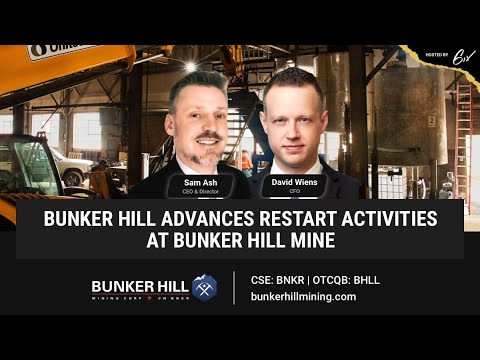
0:07 Hi, everyone. Welcome to Bunker Hill Mining's Live Investment Summit today, hosted by 6. I'm pleased to introduce our speaker today, CEO of Bunker Hill, Sam Ash. Sam's going to walk us through a few slides today and after we'll be taking some questions live. Remember, you can submit your questions using the Q&A panel found on the right hand side of your screen at any time during today's presentation. And as always, this event is being recorded, will be available to watch on six.com in the coming days. Without further ado, Sam, the floor is yours.
0:35 Thank you very much. And it's a pleasure to speak with everyone today. And this is going to be a little bit different of a presentation today, because you're going to see that we're beginning to make the transition from talking about what our plans are and talking about how those plans are actually going. So it's really exciting and it's a pleasure to be talking to you today. And we'll start off with underground development. So we have started the underground development and rehabilitation in preparation for production. What you see here is a picture of the first decline that we're doing. And this is a pretty important decline. It really unlocks the opportunity at Bunker Hill. 1,800 feet, and we will join up with an existing internal ramp. And at that point, we'll have roughly a third of the mineralization accessible for mining. And that's a big step forward.
1:33 So to get to this point, we did quite a bit of rehabilitation and we've been hard at work at that over the last few months. We have installed ventilation fans and we have active ventilation for the first time in Bunker Hill in over 40 years. We've brought in some equipment. We have an underground haul truck, jumbo, mucker, and it's really, can't say enough about the team, the CMC mining contractors and the work they're doing for us. One of the big things that I'm really happy to report is the verification and validation of our unit mining cost inputs. At this point in the project, and we're a couple of months in now, we are absolutely right on track with productivity rates and cost rates. And as everybody knows, the inflationary environment that we're in, having certainty around the estimation that we've used for those unit mining rates and productivity rates is a really nice thing to see.
2:37 So this project and this first piece of development, we'll be working on this until Q3 of this year, at which point we will join up with that existing ramp and we're really excited about the improved access that this gives us to roughly a third of the mineralization and roughly you know the first 3 years of our restart plan.
3:04 On the surface, we're also advancing on the water management. Just to remind everybody, right now, there's around 1,500 gallons a minute of water that comes out of the mine and reports at the moment to an EPA-owned and operated water treatment facility. As part of our restart plans, we are going to build a water treatment plant and take that responsibility in-house. And we're doing that primarily because
3:36 the studies show that we can achieve the same result for a reduced operating cost over the life of my plant. So what we've done is we have constructed as a part of that process a 20 scale fully operational water treatment plant. You can see some of the pictures down below and over the next few months we're going to be doing shakedown testing and pilot testing of a variety of scenarios and actually this time of year is an important time to be doing that because we're also dealing not only with the mine affluent but the effects of the spring runoff. So that's going very, very well And we're really looking forward to seeing the results that are coming back from that. In the bottom right-hand corner of that picture there, you can see the mine effluent, that the brownish color is what typically comes out of the mine. And you can see the clarity of the water once it's been treated in that pilot water treatment plant. So it's showing very, very good results. We can't be happier with the progress that we're making.
4:48 And it's really going to lead to the next step, which is a key part of the project, which is a reduction in the intensity and cost of that water treatment for the mine effluent. And then here at Bunker Hill around the surface facilities we've spent the last few months really making sure that we are ready for for the initiation of construction here at Bunker Hill. You can see the progression of the cleanup and preparation that has gone on over the last few months here at the site. If you look carefully on the bottom left-hand corner of the pictures, you can see that we've removed a building and we've removed a small 100 ton a day processing facility that was located here and all of this is in preparation both for a lay down to begin to accept the demobilized and relocated Pend Oreille mill, as well as setting the stage for some longer term infrastructure, like a concentrate handling and storage bin. So making a lot of progress here at site.
6:02 There's quite a bit of activity out there and the site is really looking like it is ready for that increase of activity as we move into the construction phase. Just a little bit about that construction phase and that project timeline, just to remind everybody, we are nearing completion on a pre-feasibility study. We expect that to come out in June. And just to remind everybody, that will be moving from a PEA to a pre-feasibility, and there'll be 6.7 million tons of measured and indicated material. A lot of the key parameters that were articulated in the PEA you will continue to see in that pre-feasibility.
6:58 We are still looking at a 1500 ton a day processing rate and mining rate. We are, as everyone knows, going to be relocating the Pend Oreille plant. We're in the process of finalizing the detailed engineering. We've begun the process of looking for and reaching commercial terms with EPCM contractor to do that work, that pre-feasibility. Some of the things that you will see coming out of that is the final decisions around some of the trade-offs, surface versus underground processing plant, or haulage trade-offs, and some trade-offs around our approach to paste and tails. We're still very much on track
7:48 on the development and the process plant construction side, mill demobilization and relocation is actually initiated, engineering work and the detailed engineering work is progressing very nicely. And at this point, we still expect mill commissioning and commercial production through Q3 and Q4 of next year.
8:11 And then I always like to talk about, you know, what's upcoming and what we can expect to see. Certainly at the top of that list is the pre-feasibility study. And then you're going to be seeing quite a few more conversations like we're having today, where we are briefing on the specific progress that as it relates to the Bunker Hill restart. Some of the upcoming things that I look forward to sharing with you, the results of the water treatment pilot test, the awarding of EPCM contractors, the completion of that and progress on the main decline. And then of course the mill demobilization and construction progress. One of the things that we are also actively working on and which is pretty important with that decline is the opportunity that it presents us to have access to the mineralization in advance of production and to explore pre-production revenue potential associated with that. We're pretty excited about that. And there are several conversations that are underway.
9:21 We will also expect to see the advancement of the 37 million dollar stream. That's going to be a key component of the financing that's going to take us through the construction phase. And just to remind everybody, although our main focus and priority is certainly Bunker Hill and the restart here, we do have the London Joint Venture. And as we've advanced the geology and our geologic understanding, done a lot of geologic modeling and assessment. We are more and more excited about the London Joint Venture and 1 would expect us to at the very least have a full summer field season there, looking to actually put hands on the rocks and advance that project from what we see is becoming more and more interesting from a mineral potential as we begin to understand the geology a bit more.
10:15 So with that, I know it's short, I know it's brief, but certainly it is, I'm very, very happy to be able to talk about tangible, concrete steps that we're achieving on the ground, advancing towards the restart of the Bunker Hill mine. And with that, I would be happy to answer any questions that anyone has this morning. Well, thank you for that, Sam. And to that point, as a reminder, if you'd like to ask any questions, feel free to do so using the Q&A tab found on the right-hand side of your screen. But Sam, we do have a couple of questions already. First one, are you able to take advantage of the currently high zinc price? Well, certainly, you know, the zinc price, if we just look at that, you know, there is quite a bit of strength in the zinc market.
11:02 It's come off a little bit the last couple of days, but it seemed to found a bit of a floor around the $1.70 range for zinc. And we certainly have an eye to that. And that's one of the reasons that we're so excited about the progress that we're making on that preliminary ramp. That's the key to being able to unlock some of that near-term metal price. That in conjunction with the conversations that we're having around pre-production revenue opportunities. So certainly we are advancing the project with an eye towards that in mind. Absolutely. What are your plans to realize value from the London Joint Venture? Well, when we look at the London Joint Venture, And if we just go back, there's some slides and presentations on our website that talk about the Lundge joint venture. But when you look at it, when you have an opportunity and you have the mineral endowment and you have the land endowment for a historic mining district that produced over 600,000 ounces pre-World War II at a head grade of 23 grams a ton.
12:09 And along that same structure, you have over 7 kilometer of unexplored strike length. That's a pretty compelling opportunity. And when we look at that, we are really quite excited about the opportunities that that presents. In addition to that precious component
12:29 of a gold opportunity, there is as well as we see opportunities both in silver and a base metal component as well. So, you know, just for reference, it's certainly in a very, very mineralized area of Colorado. It's just over the mountain from Leadville and about 7 miles, 7 to 8 miles away as the crow flies from the Climax molybdenum deposit with strong historic production. And the more we learn about the geology, the more that we are becoming excited about the geologic potential and mineral potential that exists there. Now that being said, we are absolutely advancing that opportunity on solid geologic footing. So we are going to be looking and focusin a good field season, doin doing some validation of records that we've digiti that geologic model throu absolutely.
13:34 Question from you know, he understan DEQ. Is going to be r in june. I'll be meeting and verifying that geologic model through this year. No, absolutely. Question from Tim in the audience. He understands that the Idaho DEQ is going to be reviewing Superfund in June. They'll be meeting with Bunker Hill to review current progress. In regards to this, do you have any comments for this visit by the DEQ board? Actually, interestingly enough, the Department of Environmental Quality, which is what DEQ stands for, the Idaho Department of Environmental Quality, is actually up in the Silver Valley now, and we expect to host them and show them a little bit in a little bit more detail what our plans and what our progress has been today. So we're really looking forward to that. We have a very good working relationship both with the IDEQ and the EPA and we're really quite excited here today to to host the IDEQ and show them some of the good work that we've been up to.
14:33 Great. A question from Philip. If the water treatment pilot test is successful, how much is it going to be to build a plant on site and what will the EPA do with their existing plant? Well, Look, we do expect that the water treatment pilot tests will be successful. And then, you know, when you're looking at it and when you scale up that project, you know, what I can say is it's, you know, our plan is a 1 in 20 scale. And as we scale that up, where I would direct everybody is to the CDAR and the estimates in the PEA. Those look directionally correct. And that's in the neighborhood of 2.5 to $3 million for a full-scale plant.
15:22 Now what will the EPA do with the water treatment plant? You know, we're in close conversations, you know, to make sure that, you know, that as we move forward, that we're working in partnership with the EPA. So all I can say right now is that there's ongoing conversations and discussions around that and when we have more to say, we'll certainly say that. But the point is that I would say is th with water treatment is I our mind. It's the key en challenge and metric that against and we're not goi is every step of the way with the EPA and the Idaho quality. All right. Thank from Roland.
16:14 What about t Will you be cash flow pos therefore not require any raises? Well, on the bala What about the balance sheet? Will you be cashflow positive in 2023 and therefore not require any further funding raises? Well, on the balance sheet side, I would direct everybody to our financials. I didn't bring Dave or CFO on today as this is a more operational update. But those financials were actually just before our most recent raise. So we're in a strong position to advance the project forward. You know, the $37 million stream with Sprott is a key part of that. Our projections are that we will be cashflow positive when we commission the mill in the Q3 of 2023.
17:02 And certainly, you know, we expect and it's always been our intent to restart this mine in the most capital efficient manner possible with an eye towards shareholder value.
17:18 Wonderful. OK. Another question. Why did management decide to place the mill above ground versus below ground? Well, actually, you know, that is still that that's one of those tradeoffs. And so, you know, there is still you know, there's still some fine tuning and that final decision will be kind of disclosed in that pre feasibility when we talk about that. But I can talk about some of the implications and different key points of that trade-off study. It's really a trade-off study around the complexity and the cost of constructing that plant in the underground versus the reuse of an existing surface facility. So, and in that goes considerations around ore haulage, around ore transport, around infrastructure and support.
18:15 So it was a fairly in-depth trade-off study, and I don't want to prejudge the outcome of that, but certainly that will be a key focus of the, and input into that pre-feasibility study. Great, Thank you for that. Question from Razel. Could you please comment on the metallurgical test work being done and when it's going to be completed by? Yeah. So we have had some metallurgical test work done, obviously, and we're continuing to work on that. So what we're working on now, and what I can say, is that we're quite happy with the recoveries, and we're in the phase where we're really beginning to fine tune, you know, the flotation performance, cleaner performance, and really make sure that we have that kind of full understanding.
19:15 That is currently underway and ongoing. And as soon as we arrive at what those final numbers are, you know, we'll certainly be sharing that. But from a recovery standpoint, we're really happy with where we're at and we're just fine tuning and optimizing the flotation circuit. Absolutely. Well, listen, Sam, that looks like all the questions we've received for today. So I wanna thank you, of course, for not only joining us today and giving us a great presentation, but also taking the Q&A session. I'd also like to, of course, thank everyone who's not only joined us, but submitted questions. If you didn't get a chance to ask your question or you've just thought of 1 now, you can always contact the Bunker Hill team. They're very easy to find. Lots of information on their website, BunkerHillMining.com.
20:02 But Sam, I'm gonna hand things back to you for some final words before we sign off for today. Absolutely, it's a pleasure to speak to everyone today. And just to remind everybody that what we have in Bunker Hill is a project that is one of the few project development projects in North America that has a clear line of sight to free cash flow in the next 18 to 24 months. And we are and have over the last 2 years delivered on everything that we've set out to do. And we are really poised to take the next step and take this iconic US mine back into production. And we have an eye to the future. You know, we and the executive team and myself, we came to Bunker Hill and the Bunker Hill mining company to focus on this project. But please, I would just encourage everybody, keep this in context.
20:56 We see this as the cornerstone asset of what we're ultimately achieving here, which is a multi-asset, North American focused, mid-tier mining company. And this and Bunker Hill and the work that we're doing here is the first piece of that puzzle. But we certainly have an eye to the future and are beginning to have conversations about what comes next.