Dr. Thomas Schulz
CEO
Replay available
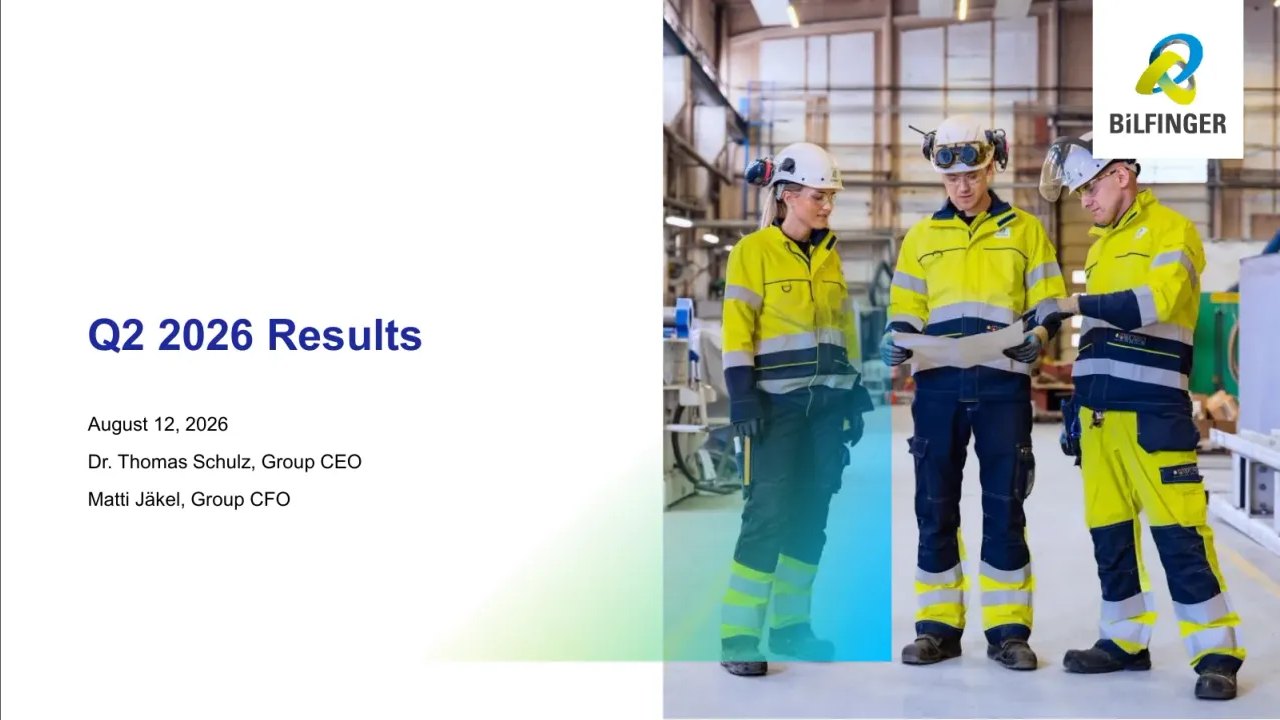
Bilfinger (Xetra:GBF) Q2 2026 earnings call, held 2026-08-12. Watch the replay and read the transcript on 6ix.
On 6ix: 6ix.com/event/bilfinger-se-unspadr-bflby-q2-2026-earnings-call
Automated transcript · Written by software from the replay's audio. It can mishear names and figures; the replay is the record.
0:00 Good afternoon, ladies and gentlemen, and welcome to Bilfinger's q two twenty twenty six results webcast. My name is Martina Karlkacke, and I'm here today with our CEO, doctor Thomas Scholz, and our CFO, Matti Eckle. We will start with a presentation today on the quarterly highlights and then open the call for your questions. You can ask your questions via telephone by pressing star and one on your keypad or via chat in the webcast as usually. During the presentation, all participants will be in listen only mode and the event will be recorded. I will now hand over to Thomas. Thank you. So hello, everybody. Welcome to our Q2 twenty twenty six result here out of Mannheim in Germany.
0:51 Let's start with the highlights. We had actually quite a good order intake in the Q2 with around EUR 1,500,000,000,
1:00 and that in a quite volatile market environment, especially with the Iran war. Our revenue has a quite good run rate, and we foresee that definitely with more dynamic positive dynamic towards the second half and the end second half of this year and then, of course, the end of this year. Our EBITA was not on the level as expected and actually moved down to 5.3%. Our earnings per share is up to €1.47 which is quite a nice improvement. And the cash flow for the market situation with the Iran war is to €48,000,000 quite a good one. Our outlook is confirmed, especially on the revenue where we see quite a dynamic in it and on the EBITA margin at the lower end of the range, but of course, within the range.
1:51 And from the April 1 on, our M and A Technicon is included in the figures. Before we go into the market and different business analytics and so on, something which is very important for us. It is the safety of the people we work with, our own people, suppliers, customers. And again, we had an improvement versus the Q2 twenty five on the total recordable incident frequency rate and a fantastic improvement on the lost time injury frequency rate which is close to nil. Actually our ambition is to be on both or nil, no accidents in work. And our organization is doing here a fantastic good job.
2:39 When we then go into the different industries, and we always show the four main industries for the Bilfinger Group. You see on the left side, the production index. Actually, the figures are from standard and pours in index to 2023. And the color code is, of course, corresponding with the more information per industry on the right side. Let's start with the Chemicals and Petrochem. Actually, by far the largest part of our top line, that changed. It's down to 21%, and the 21% in the revenue share in the outlook is slightly flattish, as we call it. What does it mean? We have, especially in Central Europe, Germany in the lead, quite a pressure in the market with cost reduction programs where we help customers, where we work with customers quite intensive.
3:34 But of course, the the size of the orders and the demand is smaller than we are used to. So in other areas like in North America and especially in The Middle East, it looks completely different. Then we come to the energy. Energy has a very good run for the Bilfinger Group, but energy as an industry we see quite positively for the years to come. It makes now 28% of the top line and actually replaced in a large extent that what we had as additional work in the chemical and petrochemical industry. The demand is quite favorable for that what we offer. For both industries, the outsourcing potential, the potential what we as Bilfinger have to take over, especially asset performance, maintenance, turnaround business from our clients and their organizations is quite good. That is what we, by the way, see in all the industries.
4:30 The next one is oil and gas. Stable, good development, 19% of the top line, good demand for us, good customer relation, and with some differences in the region, but especially the run for LNG and investments in The Middle East out of the situation what we have since end of end of February are driving here a good demand for the future. Then last but not least, our green ones, the pharma and biopharma, it's 10% of the top line. It's smaller business and a little bit more cyclical, but a quite good demand. Nevertheless, that this year with some European impacts slowed the growth a little bit down, but from '26 on quite a good outlook up to 2030.
5:20 Out of this, we go into some selected orders. On the left side, you see out of the chemicals Petrochem from one of our long term well established customers that we have the task to install an air preheating system with the pure target to improve efficiency. This is asset performance at its best and actually proves our high quality what we deliver to our clients. In the mid is Germany with energy sector. It's EWE Hydrogen. We are responsible for the engineering, installation and commissioning for the integration of a new three twenty megawatt production plant for hydrogen. On the right side, with our new M and A, we actually were successful in the second quarter to close an order with a mining company, a gold mining company for some mechanical, electrical and insulation work in the gold processing plant. Mining will have for the Bilfinger Group as well as data centers and other smaller industries an important role in the future and actually a bigger and a better dynamic.
6:37 Out of that into innovation. Innovation for us is important because we have a lot and we can offer to the customers a lot. It's a big differentiator in the peer group. It makes actually quite a lot of our good reputation. This time, we are proud to present to you the Bilfinger automated gas analyzing system. When you have large gas production sites, processing plants and so on, it can go over several square kilometer. To test the product, that means the gas and what you have in the gas. You use so called analytic gas bottles. These analytic gas bottles get the content of gas and then they normally take that together and bring it to an external laboratory to check how the content of the gas is, in other words, how good the quality is.
7:34 We offer a system, a mobile system, which can 20 fourseven do that on the site, there where you take the gas bottle and on top of it collecting the data digital and on top of it certifying the product what the customer is producing. This is a significant improvement for our clients in the gas industry.
7:56 Out of that, we come to the demand. And here you have our opportunity pipeline at the top left, and it starts indexed in April 2024. When you now compare the three times quarter two, twenty four, twenty five and on the right side in dark blue, '26, you see the difference. We are more or less on the same level in the opportunity pipeline. Opportunity means what do we have in front of us where we can bid on and where we have a good chance to get the order. And you see as a difference to the others that in the quarter two twenty six, the first and the second month was fairly low and the third month really showed an improvement. And that is what we mean that the quarter two showed at the end a significant improved dynamic.
8:53 But what you see too is that actually the order pipeline up to November, December in 'twenty five was slightly increasing and showing quite a good development for the business to come in 'twenty six. Then we had the winter downturn, a little bit longer and stronger winter than we actually calculated, which is only a few months or maximum a quarter, 1.5 quarter deferral time impact. But the Iran war at the end of the February actually brought hesitation, prolongation, deferral, postponing of necessary work as projects, maintenance turnaround in the industry in Europe and, of course, in The Middle East.
9:39 That is nothing which is canceled. It is a time effect what you always have, an unexpected bigger crisis. People are getting more hesitant. Our customers are getting more hesitant. They need more approval from supervisory boards. They crunch their budget multiple times instead of giving directly the order. So what we foresee is that the second half of the year creates a significant better dynamic and business environment for that what we have to offer. If we then look into the order intake, this EUR 1,500,000,000 for the second quarter twenty twenty six, the third best with and without Technicon, by the way, in more than twenty ten years for the Bilfinger Group shows that we already saw good signs at the end of the quarter two.
10:28 The backlog improved to the quarter one and, of course, to the year end and is slightly down to that what we saw in quarter two twenty twenty five. And with that, I would like to give to Matti, our CFO. Yes. Thomas, thank you. Good afternoon, ladies and gentlemen. I will run you through the group numbers and then the segment numbers to provide some more color on the reports that we have issued early today. Revenue is up 7% to EUR 1,450,000,000 for this quarter. The book to bill at EUR 1,030,000,000 better than what we have seen in the last three quarters, where we were below 1.0%.
11:16 And obviously, with a very huge order intake in quarter two twenty twenty five, we were at 1.31 But I come to the effects for quarter two last year, again, when we go through the segments. Gross profit is down by 80 basis points. Thomas talked about the temporary effects that the Iran war has on almost all of our industries and the delays that the uncertainty has caused, and that's delays not only in CapEx, but it is delays in OpEx spending. So and that translates into some sort of underutilization within our operations, and that's the main reason why gross profit margin slightly slipped to 10.7%.
12:10 Conversely, on the SG and A expenses, they were up EUR 2,000,000. That's related to the Technicon acquisition. But as a ratio, we improved from 6.3% to 6.1%, continued integration of the acquisitions that we had, continued efficiency or effects from the efficiency program, which gave us that improvement. Overall, profit margin slightly down from 5.5% to 5.3%. Obviously,
12:43 looking at our guidance, that's below what we had expected, but the reasons, I think, are fairly clear and should disappear in the second half of twenty twenty six. Let's take a look at the segments individually.
13:04 Orders received in Western Europe, four eighty two million. Last year, we won a big contract in The United Kingdom for a chemicals customer. That's an effect that we did not repeat this quarter. But if you look at it sequentially, quite an uptick over the last few quarters in orders received, underpinning the increased dynamic in the market. Revenue, flat at 1%, up to EUR $477,000,000,
13:39 book to bill at EUR 1.01 and the profitability, up 50 basis points in Western Europe. Here, we see, as I said before, further efficiency improvements from the integrations of the acquired businesses.
13:57 Over to Central Europe, which includes the DACH region, so the German speaking countries as well as the Nordic countries. Here, orders received minus 10% to 646%. Again, last year, we won a fairly large contract also for a hydrogen production facility, but much larger than the one that we showed earlier for EWE. So that makes up the difference and the change in the numbers. Revenue up 9% to EUR $664,000,000 quite nicely given the circumstances and the environment. Book to bill close to 1.0, showing a better dynamic than in the past quarters.
14:47 And the profitability down 90 basis points, 5.2 to 4.3. Particularly in the German speaking
14:56 countries, we saw quite some delays and quite some hesitancy in spending CapEx, but more so in OpEx, causing temporary underutilization throughout the operations across that geography. And lastly, segment International. Again, on the orders received, last year, a three year contract renewal in The United States, which happens every three years in the second quarter, did not repeat itself, but at minus 12% organically overall, minus 32% organically. What we have here included is the addition of the gold mine contract in Turkey that was also presented
15:46 a few minutes ago. Revenue, nice growth at 10% to EUR $3.00 2,000,000 and the book to bill, 1.15, also quite favorable and showing good dynamics in that market. Profitability, an uptick of oneten of a percentage point, 3.8% to 3.9%, 12,000,000. So despite all the issues that we have in The Middle East,
16:16 we saw a stable development in the profit margin for our segment International.
16:25 How does that translate into earnings per for the year or for the quarter, sorry, EUR 54,000,000 in the second quarter compared to EUR 48,000,000 last year 2025 in the quarter. So earnings per share are up at 15% to EUR 1.47. That has been helped by a lower tax rate in the second quarter.
16:52 For you who have been with Bilfinger for a longer period, that the tax rates may fluctuate from quarter to quarter depending on where we record income tax or taxable income throughout the various tax regimes in the countries. So that may fluctuate from quarter to quarter, as you can see here. But 54,000,000, nice profit for the quarter.
17:24 Cash flow at EUR 48,000,000 over 53,000,000 last quarter. So a good performance, but also lower because we didn't receive as many large contracts, so lower advanced payments. And we have timing effects when it comes to billing when our customers are hesitant not only with awarding contracts, then they also slow down on approving our invoices. Again, it's a timing effect that will disappear in the second half of twenty twenty six. Finally, a quick look at sort of cash, net liquidity and leverage.
18:13 You see a drop in cash in hand and you see a drop in financial debt.
18:19 We repaid large parts of our promissory note loan in German Schulzchein, Darling. I was told by our lawyers that's a huge difference. But then that's why we said a German law governed promissory note loan, so that everybody knows that this is different to what you understand in The U. S. Or UK by a promissory note loan. Anyways, it's debt. We paid back the debt. So that reduced net cash and that reduced the cash and it reduced the liabilities, financial debt. We reissued the same instrument, and we collected EUR 300,000,000 in early July.
19:04 So you will see the reversal of all of this when we get together back in the third quarter, EUR 300,000,000 increase in
19:15 cash in hand and EUR 300,000,000 increase in financial debt. Net liquidity typically is low in the second quarter when we pay out the dividend, which we did. And we also paid the purchase price for the Technicon Group straight after the closing on April 1. And that pushed up our leverage a little bit, but compared to last year, 600,000,000, now EUR 700,000,000, so not a big movement there. And that I hand back to my colleague. Thank you, Martin. So now to the group outlook for 2026. The outlook is confirmed. The EBITA margin is expected at the lower end of range and Technicon acquisition is included.
20:06 When we look into the revenue, we have a 5% improvement versus the first half of the year 2025.
20:13 And of course, the guidance what we gave for 5.4% to 5.9%, we are on a good run with the revenue. We, of course, target that what we said before. When we look into the EBITA, it's the same level, it's 5% EBITA. As we said and explained in the presentation, we expected more. But the second half of the year, regarding that, what we see in the market dynamics with all the things what we have on hand, It looks good that we are then in the guidance,
20:46 not outside the guidance, in the guidance, in the EBITA one at the lower end of the range. The free cash flow with 69 looks quite lower than last year, But of course, there is no repeat of a special case what we had out of the normal payment and cash inflow in the quarter one twenty twenty five. But with the run rates, what you already saw in the second half of 'twenty five with all the growth and all the activities, what we do gives clear indication that we are well in the range of $2.50 to 300.
21:25 To finalize a short feedback or short summary of that what we had in the quarter two. Orders were the third largest in the quarter since more than ten years. Revenue with 7% up. EBITA margin a little bit lower expected, earnings per share up, cash flow in the market conditions quite on a good level and the outlook, of course, confirmed. So with that, Martina, I think we can go to Q and A. Thank you very much, Thomas. Ladies and gentlemen, we will now start the Q and A session. As previously said, you can ask your questions via phone by pressing star and one or via the chat And I'm seeing that we have first questions lining up.
22:16 So the first question comes from Craig Abbott from Kepler Cheuvreux. Craig, your line should be open. Please go ahead.
22:25 Yes. Good afternoon. Can you hear me okay? Yes. Yes. Okay. Excellent. Thank you. Yes. Good afternoon, gentlemen. Yes, a couple of questions from my side, please. First of all, obviously, it's very reassuring to hear that you saw orders start to pick up at the end of the quarter. You showed us the opportunity pipeline really picking up in June.
22:47 But I'm just curious if you could provide some color on what has changed that has made your customers now also here in Central Europe to be more willing now to move forward with both their OpEx and CapEx investment plans. Is it just simply optimism that the Middle East conflict will soon be resolved?
23:06 That is the first question. And the second question is, if we look at your guidance and the implied EBITDA margin for the second half, it's pretty high, 6.7% versus 6% in H2 last year. And I'm just curious what gives you the confidence in the current environment, given where you're coming from up here H1 to be able to achieve this? Yes, Greg, I'll take the first part of the question.
23:36 The we see actually in global business, obviously, the same situation. If an unexpected crisis of a larger extent, in that case, the Iran war is happening out of the nothing, then you get a kind of a shock.
23:50 Customers are stopping a lot of things. They actually asked their supervisor about two, three times. They push back on acting. And in that case, in The Middle East, for The Middle East, of course, a lot of people were at home and not going back to the offices. In especially Western Europe, the roller coaster with the energy costs significantly up, then down, then subsidized, then all the very difficult to read outlook for the energy costs to go, customers were going on a break. And that last, as in all crises, a few weeks. And we saw then in and we got and I was you know that I'm going out quite often to clients. Then in June, we saw actually that the society in the industries got used to that roller coaster, used to we have a deal, we have not a deal, we have a deal.
24:45 And then, of course, looking into and knowing if they postpone maintenance, if they postpone turnarounds, if they postpone their project, everything gets postponed. Efficiency improvement too and to finalize the project. So out of that, there was then more push, more dynamic in the market to go on with things and to inform us in discussion with us when things will happen so that we can organize it. And that explains in a second the under absorption because the people we have under absorbed,
25:22 not utilized enough to make it like this, we need more than double in the months to come to organize that what the customers have a demand for it. And then you are, of course, from a profit point of view, in a different spot. But for that, I give to Matti. Yes, Craig. If we look at
25:46 how we set out the year for 2026 and if we look at the midpoint of our guidance, the profitability that we had intended was six percent, and that is what we said all along.
26:00 If you compare this to last year, that's a 50 basis point uptick. If I look at last year's second half, we delivered 6.0%. So that 50% basis point, that was already in the making and in the plan. So now because of some of the delays and a bit of an underachievement in the first half, we need to step up to the plate a little bit stronger and harder. And we
26:30 rely on what has not happened in the first half is going to happen in the second half. And when we go into over absorption, then everything we make there drops straight to the bottom line. You could see on our SG and A, we're better off than last year, and that will continue. So given that mix, that gives us the confidence to deliver to the lower end of the range at 5.8% with obviously an implied margin for the second half of twenty twenty six.
27:05 Okay. Thank you. I just have one quick technical question and I'll get back in the queue. If we look at the consolidation and other operations line, there were some large moves in that second quarter in both directions with both basically reporting zero contribution. And I just wonder, because it's pretty meaningful amount, particularly on a quarterly basis, just wonder, were there any special factors here and how we should think about these two lines developing in H2? Well, those lines, they do fluctuate a little bit. And we had a few
27:37 movements here in sort of opposite directions last year and this year. Nothing to be concerned about. Maybe one thing that I should add here is other operations. Our business in South Africa really benefited from a very high demand in 2025, first quarter, second quarter. That didn't repeat itself for various reasons. I'm not going to go into the detail. But that's normal fluctuations, and we find ways to compensate for that.
28:12 So we expect a more normal progression in Yes. Yes. Okay. Thank you. Thank you very much, Greg. We can continue with the question queue on the call. So the next question comes from Paul Scherter from Bernstein. Paul, your line should be open. Please go ahead.
28:36 It seems for me that Paul probably dropped out of the telephone call. So let's continue with the next person on the queue. That would be Mikael Kuhn from Deutsche Bank. Mikael, your line should be open.
28:54 Good afternoon. Thanks for taking my questions. It's kind of follow-up. So on, let's say, the postponed work in the first half, and I think we discussed it in the last call already, Let's say by how much can your clients usually push out those decisions? When are they actually like forced to come back? And
29:19 if you look at the opportunity part that obviously improved towards the end of the quarter, let's say, can you like give an indication on how much was just about delays and how much is like generally new projects that come into the market? Very
29:41 good question. Hi, Michael. At first, a lot of the business what we do is actually creating additional business and that comes on top of it. In crisis situation, business what we do doesn't get a lot of additional, if at all additional business. In crisis, the orders what we get and the work what we do normally is very much regulated to a smaller amount.
30:08 So these kind of additional work, especially in the maintenance part, asset performance part, that is what has to come in the second half of the year because it is very much impacting the efficiency. Then we have larger orders, new orders, projects. And the projects you can move, but you can't move it for half a year or two years or so because you have work permits and you have certifications and permits to do additional work on a respected, let's say, area or land or location. And if you don't fulfill
30:46 time milestones towards the authorities, your permit is gone. So one of the things where we always work with clients in the actually in the pre feasibility in the feasibility and actually in the pre engineering phase is the time schedule so that we really hit the milestones. Otherwise, our clients get the permitting problem with the authorities. That describes a little bit that we actually foresee quite a revenue
31:14 improvement in the second half of the year. We are in close contact with our clients to organize it. So from that point of view, our visibility on that is actually quite good. Maybe let me add, Michael.
31:32 We distinguish between discretionary spend and non discretionary spend. And on OpEx, you can delay to a certain extent doing maintenance work or fixing one thing or the other, but that really has limits, time limits. And we're not talking quarters or even years, we're talking months.
31:53 And so what we have seen in the first quarter, second quarter, some of the work has already come back and there's more to come in the second half. Understood. Thank you. And then maybe a smaller thing, I think in Central Europe, on one of the slides you mentioned some softness in pharma. I think for a couple of years you benefited quite a bit from onshoring efforts. Is that
32:24 wave already over or is that also rather a temporary thing in your view? Yes, we can be very specific with that. The figures are, of course, standard and poor figures. And they are two big markets in Europe where we are actually more or less not really in. And they had a setback based on taxation and other things. It's not Germany, it's not Austria, it's not Denmark and so on. And that has an impact on the overall.
32:55 And it is history, so it's past, it's over. And we didn't see it in our figures. So but from a pure reporting point of view, it, of course, is in the data of Standard and Poor. So the next question comes from Olivier Calve from UBS. Olivier, please go ahead. Hi, thanks for taking my questions. Maybe the first one just on your thoughts on organic growth going forward. If we see order intake remaining under pressure over the next few months.
33:41 And just to confirm that your forecast forecasted guidance assumes an improvement in orders in the second half. And perhaps if you could comment how much of your backlog you expect to convert into revenue this year? That would be question one. And then just secondly on the Technicon acquisition, I think good to see an order here from that gold mine here. You've had control for a quarter now, but just curious if you are seeing increased discussions as a result of your expanded footprint in the region, if you're seeing new customers or is that mostly with existing ones? And I just wanted to check if the organic order growth in international that was with that gold mine or not? Just out of curiosity.
34:37 Yes. I come with the second part at first. Yes, it is in the gold mine order. And the as we said for the Technicon, for the Turkish acquisition, we are not only having in the target Turkey, we actually have countries around Azerbaijan, Kazakhstan, Uzbekistan and so on in the focus too. But you need a base because we need people on customer sites. When you look into these countries, Turkey included, one part of the process industry, which is our main industry, is the mining industry in these areas. And their high quality work, digitalized, is very much appreciated. And we have a quite motivating model for customers in that area by with our training and education program to take local colleagues in and educating them on the BFLBYR standard.
35:34 So that makes us in the market expansion, which is one of our two main dimensions in the strategy execution, very attractive. So then if it comes to the order intake, the order intake, what we see in the second half of the year, as we always say, order intake fluctuates for us, goes up and down. But of course, we expect that the full year for 2026 is a quite positive development on the order intake despite the Iran war. Yes, Olivier. And your question on backlog conversion into revenue.
36:21 What we measure months to months to months is what we call the coverage. That is how much have we already realized in revenue and how much of the revenue that we forecast is already in the backlog. And that percentage tells us quite clearly where we are going in terms of revenue in relation to our guidance and our budgets. And that ratio is 90% at the end of the second quarter, and it was 88% last year. So to be very specific, it's not a number that we do publish all the time, but I think under the circumstances, it's the right thing to be very transparent here.
37:10 So what we have on hand and what we have placed is in line with previous years where we always hit our revenue guidance in the midpoint. So that gives us confidence, and I hope it does give you confidence that we're on a good track for 2026 when it comes to revenue. Okay. So in other words, you're confident on your visibility in the second half and you're not relying on incremental orders in the second half to hit the midpoint of your guidance? Well, have order intake month after month on our framework contracts and with others. But we already have 90% in the books already, which is a fairly high number compared to prior years. So confidence is there.
38:01 Yes. Thanks. Thank you, Olivier. We have a further question on the phone line. The question is from Andreas Wolf from Berenberg. Could you talk about utilization in H2 last year and the utilization you need to achieve the year on year margin uplift in H2 this year? So do we have to go above a standard 100% utilization? And if yes, how are you going to handle that? Yes. The it is in the business, the so called average or regular utilization, neutral utilization, as we normally calculate when we do forecast and so on. Then you have the term of the under absorption. That means you drop 1%, 23% below that. You have more people available than you have work, which then, of course, creates your pressure on the gross margin in our business model mainly.
39:05 But we have times from over absorption, which means as Matty rightly said, whatever we do in the gross margin drops directly through and is a profit creation. And in situations as we are in the second half of this year, we see that coming that we have over absorption. Over absorption doesn't mean that we need now armies of people more to do the work, it is actually less vacation time. What we took quite a big part already in the first half of the year, it is adding here and there some lower quality work with external partners and so on. And with that you run an over absorption, which is definitely more profitable than the regular absorption.
39:51 That is how we run that margin uplift. And we look of course into that what we have in the revenue, which kind of work we have in the revenue, what is our product mix, what is our geographical mix and with the new structure, significantly easier to do that. And then based on that, you can see how you run. Let's look into Western Europe in the second quarter where we delivered a 7.7% EBITDA. And that with a, let's say, not huge improvement of the revenue. So what did we do there? We were able more and more to deploy the right people with the right quality at the right time at the right location, and that makes our business more profitable. I hope that answered your question.
40:42 Seems so. Thank you very much. We have further questions, and we'll now take a question from the chats. The question is from Igor Seunin from Baader Alfawellian. I have a quick question on Technicon. Backlog is minus 2% absolute, but minus 8% organic. So it looks like the acquisition brought in a fairly large book relative to its revenue. Could you give a sense of the duration and the remuneration mix of that backlog? I'm just trying to understand whether it behaves like your maintenance business or whether it's longer cycle work. That's a very good observation, Igor.
41:28 We always like when people read all our publications, then we know it's worth the work that many people put it. No, it's really, it's a lot of people who spend a lot of time being or making Bilfinger very transparent. So yes, always, when you have an acquisition, there's a first time consolidation, and that is also true for backlog. In terms of the mix of work, most of the work that Technicon does resembles the mix that we have throughout the group. And in broad terms, we're talking twothree is maintenance business, give or take whatever is included, so the longer term work.
42:21 And then onethree is more the short term work or it's we call it project work. But the mix that we acquired with Technicon fairly much mirrors the Bilfinger business model. In numbers, the increase in backlog on the April 1 were DKK 115,000,000 that we received at the time we paid the purchase price. So I think that's in the financial report for the second half. So these are numbers that we have disclosed anyways. Thank you very much. I can read another question from the chat, which is from Davir Lewis from Amera Gistra.
43:13 The question is, you have ambitious midterm margin targets. How confident are you to keep improving the margin structurally in 2027 to stay on that trajectory? Very confident. When you look into Western Europe, already today on 7.7% EBITDA in the quarter two, they had some hesitation in The UK, actually in Belgium, Netherlands, too. So the when we look into the profitability of our industry sector, with a 8% to 9% EBITDA in 2030, we are not we will be not the best performing company. To make it fairly clear, we are under the top 20%, that is what we see. We have peers already having that as a target for next year and the year after.
44:03 We have areas in the world like in North America where the EBITDA margin is significantly higher than you have it here. And we can use all the different parameters to explain that why, but generally we have to lift up our profitability. We see that we can do that. We have a full fledged strategy on it. And we said that on the Capital Market Day at the beginning of December, if all the Bilfinger groups would perform as already the ones perform as we would like to have performing them, then we are more or then we are close to 8% EBITA in the whole group today. So out of that, it is a lot of work to do.
44:49 We do it step by step. We will inform you how far we are, what we do, and so on, and we will achieve it. That twenty six has to be a step up to sorry. That '27 has to be a step up to '26 is clear. So from that point of view, we are in quite good expectation what we will deliver in '27 as well as up to 2030. It's a good company. Thank you, Thomas. Just a reminder for the participants, you can ask your questions via phone by pressing star and one or via the chat function. There's another question on the chat, which I would read as well, which is from Moritz Welz from Discover Capital.
45:39 Has the structure of your received orders and the underlying contracts changed over the past few years in terms of margin profile? Are newer contracts more attractive than legacy contracts, less attractive, or the same? That's a very broad question, I would say. No, the structure let's put it this way. We look at various aspects of risk profiles, Moritz. One key element is remuneration. How are we getting paid for our work? Is it time and material?
46:25 Is it unit rates? Or is it lump sum? So three very generic forms of being paid remunerated for our work. With time and material, the lowest risk on unit rates, we assume productivity risk and on lump sum, we assume productivity and also quantity risk. That's very generic for the contracting industry. What we have seen in the last few years is an increase in the time and material, but also in the unit rates. And with unit rates, we feel very comfortable because we control the productivity and whatever productivity improvement we have and generate stays with us. On time and material, it goes to decline. So we like unit rates, and we have been able to change some of the unit for some of the time and material contracts to unit rates. When it comes to lump sum, we are a lot more careful than we were in the past.
47:33 We don't take any EPC work. That's a bad word in Bilfinger. Really, it's a bad word in Bilfinger. That's definitely a bad word, yeah. However, we work with our clients and we discuss, okay, let's look at the engineering phase. What can we do together in engineering? Because when the engineering is done, the risk on quantities is much, much reduced. And we don't have to put contingency on contingency on contingency. So while we still have onethree of our working projects, the underlying risk profile of the project contracts is much better than what we've seen in the past. And we do see that in the numbers, have a lot fewer, what we call, blowouts.
48:22 So contracts that really go bad. And that has improved our risk profile, it has improved our margin profile. So I would say it is how we work with the client to make the contracts attractive. Yes, there's clients out there that in their first proposal come and say, I want this one thing, you build it, you take every risk. We don't like that. But we don't tell the client, go away, we tell the client, here are some ideas to make it workable for you and make it workable for us. Definitely. And the when you look into the attractiveness, we have it actually as one sub lever in our strategy. We call it derisking.
49:13 It's a big part of that. We have a good organization with the new structure. We are closer altogether. And with that, the judgment which kind of risk we actually take with an order is very transparent. That is, as much as said, transparent to the client and makes it for us possible to avoid these, what we call, horrible or blow up or red flag contracts. Thank you. We have further questions. We will now take the question from Paul who had apparently technical difficulties, so I will read it out. We have recently seen very low water levels on parts of the Rhine following the European heat wave, which historically has created challenges for German chemical producers.
50:01 Are you seeing any impact on customer behavior so far in Q3? Specifically, does this create an additional headwind by delaying discretionary projects and turnaround activity further? Or could it actually support maintenance demand if customers use periods of lower utilization to bring assets offline? How should investors think about the net effect for Bilfinger? Yeah. At the moment, we don't hear that from the clients. We see that in media. And in that case, we have to admit that politicians, especially in The States, act quite quick. You know that we have that weekend or Sunday truck driving restriction, and some of The States actually lifted that completely to put more from the water to the truck, which is good. On the other side, we see in the Central European chemical industry some additional work coming out based of the Iran war and the reduced energy supply into Asia that counter that made it in the last few weeks and months more positive for some of our clients here in Germany and actually in Central Europe.
51:17 So to summarize it, it's here, it weighs a little bit. On the other side, it's more positive. Up to now, we don't see that impact. Thank you. We have further questions. So the next question we will take from the telephone line from Olivier Calve. Olivier, please go ahead for your follow-up question. Yes. Thanks for taking my follow ups. Just a couple left. You've just mentioned, Thomas, the likely refinery clients. I was just curious if you could quantify the rough share or exposure for you of those kind of clients in your chemicals business.
52:03 Then the second question, probably also for you, be on M and A, right, if you without being too specific, could comment on the M and A pipeline. And thirdly, perhaps for you, Matty, on free cash flow. So you did around close to €70,000,000 in H1. You point to the low end of the margin guidance, but you reiterated the full year free cash flow guidance. Just if you could help us out on the building blocks and the working capital benefits you'd expect in the second half. At first, to the refinery plants, we, of course, are not going in the details so much by country because here, when we talk about the River Rhine, it's predominantly Belgium, Netherlands and Germany, Switzerland in that part.
52:50 But you see that our share in chemical and petrochem is roughly 21 over the whole group. So the exposure is there, but the exposure with the impact, what we as Bilfinger got already since 2021, 2022 with very, very high energy costs for our clients and some plant closure, what we reported on in the last few years, shows that with whatever happens in that part, we actually countercompensate with more business out of energy especially. So it is, at the end, quite good in the customer relationship building. We have more single work to do. The orders are smaller and we help them in dealing that with shortage in water supply.
53:38 Of course, there is an end then to it too, but that is more what the market can tell you in that. But in our modeling, the impact is not we don't see that. M and A pipeline looks good. In some parts, it looks very expensive, to be honest, and in some other parts, very promising. In that way that we see some areas in the world like The Middle East definitely outperforming growth rates what we had in the model before based on making a whole area with a lot of countries like Saudi Arabia, UAE and so on more resilient for crisis situations and finding new routes for in and out power supply into their countries, which we as Bilfinger will contribute from and for it.
54:28 If we then look into when we say the timing effect in it, crisis is then more difficult to get people around the table to make a final decision on whatever it is, and that is what we see with the M and A too. Yes, Olivier. On the free cash flow, we have seen in the first half an increase in work in progress, so unbuilt performance, timing effects, as I explained earlier, that will resolve itself in the second half. So that's part of the working capital. We expect order intake to generate advanced payments as we always do, but a little more than we had in the first half of twenty twenty six.
55:19 On one large contract, we have built up considerable work in progress where we had to negotiate terms and conditions, and that was successfully done in July. So there's already a step up that will hit the second half of twenty twenty six in terms of free cash flow generation. So that gives us confidence. We have performed quite well on working capital management in the last so many quarters. We've seen those delays here. But as I said, we expect them to resolve themselves for the second half and quite confident on generating EBITA and also positive contributions from working capital.
56:10 Nothing out of the ordinary. You. Is Okay, but you confirm the full range of $250,000,000 to 300,000,000 Yes. You, Olivier. There's a further question on the chat, which I will read out. The question is from Gerard Otohurti from Metzla. Since the end of q two, given the on off nature of the peace process in The Gulf, has anything changed positively or negatively in time in terms of day to day business, willingness to move ahead on projects, return to some form of normality? Yeah. What we see is more actually, more workload in that respect for The Middle East to look into how to make the assets, what our customers have in that region, more resilient against similar crises.
57:07 Second, a lot of talk, and they actually act in that area quite well regarding, as I said before, what we call the inbound and outbound supply for the different countries in The Middle East. They look, to make it simple, they look for new routes to receive and to deliver their products and getting products from all over the world into. So the street of Hormuz will sequentially lose its big part of importance. They will do everything to balance that more, which means infrastructure in processing plants too, which is of course for us very, very positive news.
57:55 Thank you very much. I do not see any further questions are willing to be asked. So this concludes our Q and A session today. Thank you very much for your participation. Thank you. And for investors and analysts, if you have any further questions, as usually, please feel free to reach out to the Investor Relations team. Thank you very much, and goodbye. Thanks a lot.
Follow Bilfinger SE into a list and get an email when it puts out news.
CEO
CFO
Analyst, Berenberg
Analyst, Deutsche Bank
Analyst, UBS
Analyst, Kepler-Geoffreux