Paul Checketts
Director of Investor Relations
Replay available
BAE Systems (LSE:BA.) Q2 2026 earnings call, held 2026-07-30. Watch the replay and read the transcript on 6ix.
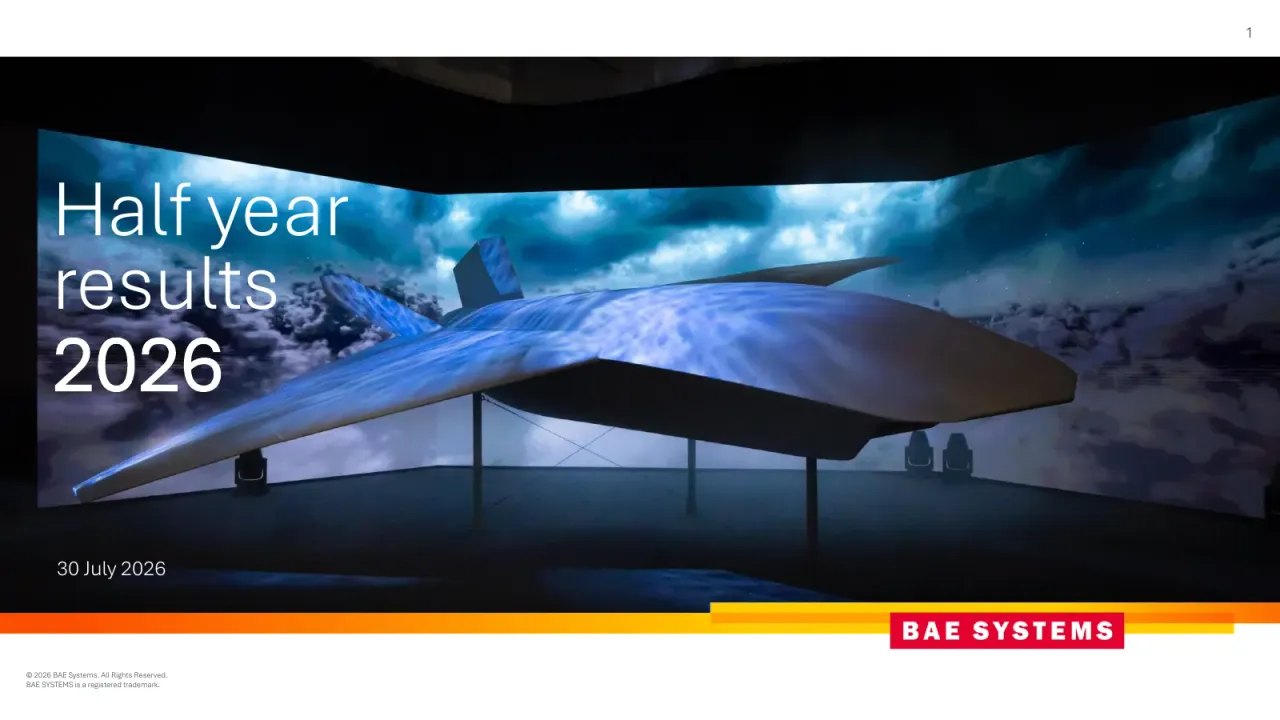
On 6ix: 6ix.com/event/bae-systems-plc-sadr-baesy-q2-2026-earnings-call
Automated transcript · Written by software from the replay's audio. It can mishear names and figures; the replay is the record.
0:01 Good day, and thank you for standing by. Welcome to BAE Systems twenty twenty six Half Year Results. At this time all participants are in a listen only mode. After the speakers' presentation there will be a question and answer session. To ask a question during the session you need to press 11 on your telephone.
0:26 You will then hear an automated message advising your hand is raised. To withdraw your question, please press star one-one again. Please be advised that today's conference is being recorded. I would now like to hand the conference over to your first speaker today, Paul Checketts, Director of Investor Relations. Please go ahead.
0:54 Good morning. Welcome to BAESYstems twenty twenty six half year results. I'm Paul Checketts, and I'm here with Charles Woodburn, our Chief Executive Brad Greave, our Chief Financial Officer and Tom Arsenault, chief executive of our Inc. Business. Charles, I'll hand over to you. Hello, everyone, and thank you for joining us this morning. Before we begin, I want to thank our employees, trade unions, and supply chain partners for the tireless work they do to ensure we deliver on our commitments to our customers. The world has remained highly volatile in 2026, and delivering reliably is vitally important given the increased threats to global security. There are three key messages I'd like to leave you with today. First, we've delivered strong results in the first six months with good growth in sales, profit, earnings per share, order intake, and cash. This strong performance leads us to upgrade our full year guidance.
1:51 We now expect earnings per share to grow by 11% to 13% in 2026 and free cash flow to be greater than £2,000,000,000. Second, the breadth of our business across geographies, domains, and product types puts us in an exceptionally strong position for both current and future opportunities in defense. And third, we are confident in the future growth we can deliver and the extended duration of that growth. We delivered strong outcomes in the first half of twenty twenty six. Sales grew by 9% on a constant currency basis, EBIT by 11%, and earnings per share by 13%. Cash generation was strong too with £1,800,000,000 of free cash flow in the half. We are experiencing high demand for our products.
2:38 You can see this in our order intake with £16,000,000,000 of new orders secured in the first six months of the year, taking our order backlog to a new record of £84,000,000,000. Our balance sheet strengthened further in the half. Having such a strong financial position gives us real strategic flexibility. It allows us to reinvest in the business and it supports continuing returns to our shareholders. These results further strengthen our track record of consistent delivery and demonstrate the effectiveness of our value compounding model. Just as importantly, they reflect the strength of a business that is well positioned to meet both current and emerging defense requirements around the world, which is what I'd like to turn to next.
3:24 Our business has an outstanding geographic footprint and strategic advantages it provides have been underlined again in 2026. Our established positions in some of the largest defense markets in the world give us an excellent breadth of opportunity and reduce the risk and volatility that comes with being more concentrated. Worldwide, governments are responding to geopolitical tensions with sustained increases in their defense budgets. In each of our markets, the work we've done to invest in and position our business means our existing proven portfolio of products and capabilities aligns well to customer priorities. We'll look at Europe and The US in more detail shortly. The UK's new defense investment plan will see almost £300,000,000,000 spent on defense by 2030 and commits to invest in both our long term programs and new disruptive technologies including next generation fighter jets, new autonomous collaborative combat aircraft, and other capabilities.
4:23 The geopolitical situation in The Middle East is likely to drive higher defense spending in the region. Our multi decade track record of partnership in The Gulf positions us well to support government customers there.
4:35 Australia is also increasing defense spending. We're already the largest defense contractor in Australia and we expect strong long term growth driven by the Hunter class frigate program and SSN AUKUS, where we'll deliver state of the art nuclear powered submarines. Two countries that are relatively small for us now, but where we see great potential are Japan and Canada. Japan is on a path to double its defense spending by 2027. It's a core partner of GECAP, and we're exploring how we can support the country in other areas of defense capability. Meanwhile, Canada has committed to NATO's three and a half percent target, which will drive a large sustained increase in defense investment. We're already working with the Canadian government by providing the warship design for Canada's river class destroyer. And in recent weeks, we have reached agreement to support the rapid delivery of an Arctic over the horizon radar capability.
5:32 And Canada has now officially joined the Global Combat Air program as an observer. Across the globe, our growth opportunities are significant and we're focused on consistently executing our long term strategy to deliver strong top line growth, margin expansion, and cash generation. These growth opportunities are particularly evident in Europe, which I'd like to turn to now. The continent of Europe continues to face an acute and growing threat to its security. As countries look to assume greater responsibility for their own security, most are significantly increasing the amount they spend on defense underpinned by their commitment to meet NATO's target by 2035 of 3.5% of GDP being spent annually on core defense requirements and 5% in total.
6:19 We're one of the leading defense companies in Europe and our business continues to go from strength to strength. Our equipment and services are integral to the defence of more than 25 countries across the region. We have great capabilities across multiple areas including combat air, land vehicles, missile systems, and drone and counter drone technologies. Growth in Europe continues to outpace the group overall. Sales increased by 30% in the first half and Europe now accounts for 33% of our total order backlog compared with just 13% of sales. This provides us with strong visibility of continued growth in the region over an extended period. To support our customers as they look to rebuild defense readiness, we're investing to support increased capacity, efficiencies and enhanced capabilities.
7:08 An excellent example of our critical role in the defense of Europe both today and in the future is MBDA. Since we spoke about MBDA at our full year results in February, its importance to the defense of Europe and allied nations has become increasingly evident. As Europe's leading missile systems company, MBDA combines a broad portfolio with a strong track record of proven products. They are well positioned in the areas where customers are accelerating investment to strengthen defense capabilities and readiness. In air defense, they provide capabilities across both land and maritime environments, including counter drone systems, short range air defense, and medium range solutions capable of addressing ballistic missile threats. In air dominance, MBDA supplies weapon systems for more than 10 combat aircraft programs including Typhoon, f 35, Rafale, Griffin and KF-twenty one.
8:02 The company also offers a comprehensive range of deep strike precision weapons. Taken together, these capabilities position MBDA exceptionally well to benefit from rising defense expenditure as nations increase investment in air defense and seek to replenish and expand their inventories. The strength of demand for MBDA's products is clearly reflected in their order intake. Prior to Russia's invasion of Ukraine, order intake was typically around €4,000,000,000 per year. In the first six months of 2026 alone, MBDA secured €6,500,000,000 of new orders equivalent to more than two times revenue in the period. As a result, the order backlog increased to €48,000,000,000 representing almost eight times annual revenue.
8:48 To meet growing customer demand, NVDA is significantly increasing investment. The business now intends to spend €5,000,000,000 between 2026 and 2030. This investment will modernize manufacturing sites, accelerate digitalization, substantially increase production capacity, strengthen the supply chain and support the continued development of next generation products and technologies. The combination of this increased investment, a record order backlog and a portfolio that is highly aligned with evolving customer requirements gives us confidence that MBDA is well positioned to deliver strong revenue growth for many years to come. I'll now hand over to Tom who will explain why we are confident about the outlook for our business in The US.
9:34 Thank you, Charles. Across The US business, our performance through the first half of twenty twenty six has been strong, reflecting our portfolio's excellent alignment with US defense and intelligence priorities. While a number of factors are shaping the final fiscal year twenty twenty seven top line budget numbers, we continue to anticipate substantially higher year over year defense spending, which bodes well for our aligned portfolio. The administration continues to focus on a few key defense priorities, including munitions production, drones and counter drone systems, space based capabilities, and the Golden Dome. We are developing systems and delivering products in all of these areas, and we continue to invest in technology and production capacity to meet the record demand.
10:22 Turning to munitions. Given the increased use of missiles and interceptors in global conflicts, the demand for munitions has significantly increased. There are 12 munitions that the Department of War has identified as critical, and we support 10 of those 12 priority programs. We've signed framework agreements with the Department of War and are at various stages of contracting on these multi year procurements, which depending on the program will double, triple, or quadruple our current production rates. On THAAD, or the Terminal High Altitude Area Defense Program, for example, we soon expect to receive a contract to begin procurement for 2,800 seekers over seven years, which represents a fourfold increase. The combined revenue across the multi year priority munitions programs represents a multibillion dollar revenue opportunity.
11:15 In the counter drone market, we continue to see very strong demand for our APKWS laser guided rockets. We're currently under a five year contract worth up to $1,700,000,000. In the recent months, the State Department approved potential foreign military sales for more than 40,000 additional units. This highly effective counter drone weapon is being deployed on an increasing number of platforms around the world. In a recent collaboration with BAESY Systems Air Sector in the Royal Air Force, we successfully completed integration of the APKWS onto the Eurofighter Typhoon aircraft, making this counter drone capability an option in all countries where the Typhoon is operated. In February, I highlighted investments we've made in our workforce and facilities since 2020, investing more than $4,000,000,000 to expand capacity by 2,000,000 square feet, advanced R and D, and grow our workforce by about 14%.
12:12 We are continuing to build on those investments. The U. Business expects to increase capital expenditures 40% year over year, driven in large part by munitions production acceleration. In our electronic systems reporting segment, we recently approved another $0.02 $5,000,000,000 for additional capital projects to support the production ramps on THAAD, AMRAAM, and Tomahawk. Turning to the space domain, national security and military space capabilities remain critical to the administration's focus on homeland defense, and we are well positioned in those areas. Sales in our space and mission systems business grew almost 30% in the first half of twenty twenty six over the same period in 2025. Our Elevation and Evolve product lines of spacecraft include a range of standardized high performing products.
13:05 They were developed in response to our customers' increasing need for more cost effective, capable, and rapidly delivered spacecraft.
13:14 The product lines allow customers to choose the best fit for their needs across low and medium earth orbit missions, as well as geostationary and cislunar applications. Combined with our cutting edge payloads and cost effective ground systems, our spacecraft products enable full mission solutions. Since introducing our spacecraft product lines last year, we have seen strong and growing customer demand. We announced last month that the EVOLVE spacecraft was selected by Vantor, formerly Maxar, for its next generation high resolution imaging satellites. This adaptable, high performing spacecraft line continues to be a discriminator across our diverse set of national security and military space missions. Our capabilities will also play critical roles in The US Golden Dome architecture, and we support a number of the key mission solutions which underpin it.
14:07 For example, earlier this year, we completed the preliminary design review on the $1,200,000,000 epic two resilient missile warning and tracking program, which will provide a multi satellite constellation and ground command and control system that will contribute critical capability to the Golden Dome. While strong demand for our products continues in The US, we are also exposed to increasing demand in Europe through our Haglans and Bofers businesses in Sweden. Our CV90 and BBS10 combat vehicles are in high demand across a number of European customers, and these franchise programs are key drivers of our record backlog in Sweden and our platforms and services sector. To meet this customer demand, we've made investments to significantly expand both our production capacity as well as our manufacturing capability in Aglent, which we expect to result in a 400% increase in production.
15:01 In light of the increasingly complex global security situation, BOFRs is experiencing strong demand for artillery and munitions like Archer, Triton, and three p medium caliber ammunition. Production rates in BOFRs have already grown by a factor of three to four across several product areas. BOFRs is also acquiring new facilities and expanding production lines. And in May, we completed the acquisition of a key Swedish supplier of precision mechanics and component machining products, which we're integrating into the BOFAR's business. This acquisition strengthens our supply chain and supports BOFAR's increased delivery of core systems. Across our portfolio, we are focused on delivering at speed and scale for our customers.
15:46 I'm really pleased with our strong performance and with how well we are positioned for long term growth. With that, Charles, I'll hand it back over to you. A theme I want to spend a few minutes on is the evolution of modern warfare. What it means for defense spending, capability requirements, and how this is not only fueling our performance today, but is also extending our runway for future growth. Let me talk you through that in a little more detail starting with some of the major programs we deliver. These are long term in nature and account for the vast majority of our revenue profits and backlog. They include combat aircraft, air defense systems, combat vehicles, nuclear power submarines, space systems, and the type 26 family of frigates. These platforms provide capabilities that are essential to protecting our societies, deterring adversaries, and supporting our allies.
16:35 They form the foundation of national defense and will remain critical for many years to come. Indeed, at a time when adversaries are building and fielding major military platforms at a rapid rate, the need for these capabilities has become even more apparent. They require complex and sophisticated engineering to design, manufacture, integrate, and sustain providing high barriers to entry. Throughout the life of these programs, we continue to invest in technology and innovation, enhancing existing platforms while developing the next generation of capabilities our customers will require. Let me bring that to life with a couple of examples.
17:13 In combat air, Eurofighter Typhoon has continued to evolve since entering service in the two thousands. The significant capability upgrades now being introduced will ensure it remains a highly effective platform for decades to come. At the same time, we are working with our partners to develop the next generation of air combat capability through GECAP, which is expected to enter service in the mid 2030s.
17:38 Together, these programs demonstrate our ability to both enhance existing platforms and develop the technologies that will define the future of combat air. The same is true in our submarine business. As we complete delivery of the astute class attack submarines, which will remain in service for many years to come, we are also designing the next generation SSN Orca submarine for operation by The UK from the twenty thirties and Australia in the twenty forties.
18:06 This business model provides long term visibility supporting sustained growth and value creation over time. Alongside these programs, there are areas of the defense market that are evolving more rapidly. These technologies are complementary to traditional defense platforms. They will operate alongside and in collaboration with larger, more complex systems. Areas such as drones, counter drone systems and autonomous capabilities are attracting significant investment in innovation with a growing number of companies competing for opportunities including new entrants from outside the traditional defence sector. While these markets are dynamic and competitive developing solutions that can perform reliably in demanding military environments remains an exceptionally complex challenge.
18:52 Our advantage comes from combining our deep mission and operational knowledge with advanced software capabilities, differentiated hardware, systems integration expertise, and the ability to scale production when required. In other words, we're not simply developing individual technologies. We're delivering mission ready capabilities that work in real world contested environments. Let me illustrate that with a couple of other examples. The drone market is attracting significant innovation ranging from low cost attributable systems through to collaborative combat aircraft. Our focus is on differentiated uncrewed capabilities where our operational understanding, software expertise, and industrial scale provide us with a competitive advantage.
19:38 That capability is already being demonstrated through NIAN, our long range deep strike uncrewed aircraft, is operating effectively in some of the most demanding and contested battlefield conditions in the world. It is also evident in Brontonacs, our collaborative combat aircraft, which we unveiled last week at the Farnborough Air Show. The program has been entirely self funded demonstrating our ability to invest in differentiated capabilities ahead of demand. In this evolving area, our combination of multi domain expertise, proven delivery and increasingly advanced digital and software capabilities creates a competitive position that is difficult to replicate and enables us to deliver trusted differentiated solutions across the full spectrum of modern warfare.
20:25 We've invested significantly in these rapidly evolving capability areas and we'll continue to do so as we build on the strong position that we've established. We expect enduring demand and the largest revenue opportunity to remain in complex high end defense platforms alongside a rapidly growing, but relatively smaller opportunity in affordable mass systems.
20:47 Having strong positions across both markets is a powerful combination and one that supports long term visible growth. Our ability to succeed across both established and emerging defense markets doesn't happen by accident. It's supported by relentless focus on improving our business which I'd like to turn to now.
21:11 A relentless commitment to operational excellence has been a defining characteristic of our business for many years. We are constantly looking for ways to work more effectively, improve performance and deliver greater value for our stakeholders. Looking back over the past decade, there have been distinct phases in our transformation journey. Our first priority was to address historic program performance challenges and ensure those issues would not be repeated. That meant putting the right systems, processes and culture in place. Our 3P framework saw us focus on strong consistent program performance, begin deliberately shaping our portfolio for value creation and resolve pension deficit funding which was holding back cash generation. Building strong foundations was essential to delivering consistent results for our customers, employees and shareholders.
22:02 Those foundations then enabled us to position the business for growth. You saw that reflected in 2022 when our growth rate accelerated supported by the deliberate actions we've taken and a changing geopolitical environment. Today, we're operating from a position of strength and we intend to build on that by continually seeking ways to become a better business. There are many examples of how we've already been doing this. We've invested in digital tools, increased production automation, and improved site infrastructure to strengthen how we operate and deliver for our customers. As part of our efforts to improve, we've been reviewing how we're organized and how we operate. As a result, we will streamline the business from five reporting segments to four and we will begin reporting under the new structure from 01/01/2027.
22:54 Integration of cyber intelligence and digital capabilities is now central to our operating model. So folding these into our other segments mean they'll be embedded in the business. And we will continue to focus on becoming a simpler, more agile and effective business in the years ahead. And now over to Brad for the financials. Thanks, Charles. Momentum continued to build in 2026 as we delivered strong results across the board. Orders of GBP 16,000,000,000 exceeded sales with backlog at GBP 84,000,000,000. Sales rose by 9% with double digit growth in ES, P and S and Air, while EBIT of £1,700,000,000 grew by 11%, taking return on sales up 20 basis points to 10.8%.
23:44 Earnings per share was up by 13% versus H1 twenty five on the double digit growth and profit and a lower interest expense from higher cash. Free cash flow was £1,800,000,000 largely on the timing of customer advances. These strong numbers are a product of the outstanding efforts of our worldwide teams who continue to deliver to protect those who protect us. Breaking down these numbers, starting with orders, our £16,400,000,000 of order intake featured several large items, including $2,500,000,000 Typhoon support for Turkey, dollars 2,100,000,000 for MBDA, 1,000,000,000 in F-thirty five orders and $1,600,000,000 for our SMS business. It's also worth noting that the half year order intake totals do not include several recent multibillion ton announcements, including the UK government's ongoing support for the GECAP program, the Arctic Over the Rise and Radar sale to Canada and today's Dreadnought submarine funding announcement, which is why we're in Barrow today.
24:48 With the pipeline of around £180,000,000,000 together with the £84,000,000,000 backlog, the group is positioned for continued strong growth well into the future. Moving to sales, the group delivered 9% top line growth, nearing £16,000,000,000 ES grew by 11% led by 29% growth in our space business. P and S grew by 12%, featured nearly 30% growth from Hagibels and Bofors on sales to Europe. The air sector grew by 11% led by ramps and GECAP and the 38 Typhoon program. Maritime rose by 4%, while cyber and intelligence grew by 3%. Turning to underlying earnings before interest and tax.
25:35 The group portfolio performed well, expanding half year margins by 20 basis points to hit 10.8% as EBIT grew by 11% to £1,700,000,000. ES EBIT of GBP 600,000,000 resulted in 15.5% return on sales, up 50 basis points on strong operational delivery. P and S EBIT grew by 11% with a return on sales of 11.9%. The air sector delivered £580,000,000 of EBIT growing by 16% for a return on sales of 11.9%, up 40 basis points driven by risk retirement.
26:17 Maritime's return on sales of 6.1% continue to reflect the early stage maturity with several first in class programs trading at relatively low margins within the sector. And finally, the cyber and intelligence sector EBIT of £107,000,000 was up by 14%, reaching 9% return on sales with strong performance from the CarenTech counter drone business in Europe. Our operating cash flow of GBP 2,100,000,000 featured net customer advances of GBP 1,600,000,000, predominantly in our air sector, with some of this expected to unwind in the second half. CapEx was GBP 400,000,000, reflecting continued investments to drive growth and efficiency. Our interest expense of GBP 187,000,000 fell due to higher cash balances, while cash tax was broadly flat, leading to a free cash flow of £1,800,000,000 Net debt fell to £3,200,000,000 Turning now to guidance, given the strong half year performance, we are upgrading our key full year targets as follows.
27:24 We expect sales to grow by 8% to 10%, up 100 basis points from previous guidance. We expect EBIT to grow by 10% to 12%, also up 100 basis points from previous guidance. We expect earnings per share to grow between 1113%, up 200 basis points from previous guidance. Free cash flow should exceed GBP 2,000,000,000, excluding any further material advances we may receive in the second half, but including burn down of existing advances.
27:56 We are upgrading the '24 to '26 cash target by £700,000,000 as we now expect to exceed £6,700,000,000 for this period. We have left the other three year guide unchanged due to accelerated cash earned in 2026 and the unwind of advances received. Finishing with capital allocation. We continue to prioritize investment in our business through our people, our capital expenditures, and our R and D. Our progressive dividend continues to grow with our two times coverage policy, while our strong balance sheet provides strategic flexibility and capacity for M and A. Our buyback program continues to be an important tool to return any surplus cash after all these outlays. This half year represents records across nearly all our key metrics.
28:46 Looking ahead, our backlog and pipeline, together with our drive to increase profitability and maintain strong cash flow, meaning we are well positioned to continue to set new records. Back to you, Charles. Thanks, Brad. As Brad outlined, growth continued to be strong in the first half and the business performed well.
29:04 Looking ahead, a key strength of BAE Systems is not just our near term growth, but the visibility we have over the longer term. Our order backlog and incumbent program positions total around GBP $260,000,000,000, around eight times our annual sales. This includes both defense tech products such as drones and counter drone where we're currently experiencing high growth and critical multi decade programs such as frigates, submarines, and air defense with long term embedded value.
29:34 Some of our biggest programs like the Global Commodore program and SSN Orca submarines don't reach full production until the mid 2030s and beyond. The combination of our order backlog, incumbent positions, and a robust new business opportunity pipeline due to rising defense spending gives us the visibility and confidence that we can deliver strong growth for an extended period. Bringing this all together, what does it mean for investors? The combination of our exceptional global portfolio of world class defense products and capabilities, proven track record of execution, increased investment in technology and innovation, and substantial backlog and significant new business opportunities gives us confidence in our ability to deliver sustained, visible and enduring revenue growth over the coming years with expanding margins and robust cash generation.
30:28 Combined with disciplined capital allocation, this reinforces our confidence in the long term strength of our value compounding model. Many thanks. And with that, we're ready for your questions. Thank you. As a reminder, to ask a question, please press 11 on your telephone and wait for your name to be announced. Our first question comes from Robert Stallard from Vertical Research.
31:15 Please go ahead. Thanks so much. Good morning. Hello? Yes. Hi, Rob. Can you hear us? Yes. Sorry. I can hear you now. Thanks so much. Good morning. A couple from me. First of all, Charles, on GCAP, we saw Canada join as an observer, but there's been talk about other, participants joining. Does this potentially put at risk the entry into service?
31:44 And then secondly, probably one for Tom. On the munition framework agreements, we've been getting some details from other U. S. Defense companies, for example, LHX saying they could have a high teens margin. Have you got any, additional information on what these agreements could mean for BAE? Thank you. Yeah. Well, I apologize if we do have any connectivity issues because we're up here in Barrow and had to do things rather at the last minute to get up here. So the phone connections are not as perfect as we'd like them. So apologies in advance. And if you don't get the answers through, just let us know and we'll repeat them. On GECAP, yeah, we're delighted to welcome Canada in as observers.
32:32 And your point on the time frame and the schedule and the initial operating capability is well made. And in fact, I think all three governments are very focused on the schedule. And when it comes to expanding additional the partnership, I think that is a key requirement is that it does not slow the schedule down. And certainly in the case of Canada, we had no doubt at all that
32:56 joining as observers was not going to have a negative impact on the schedule in any way, shape or form. But that is a key consideration for other partners. And then over to you, Tom, to talk about the framework agreement. Yes. Thanks, Charles. Good morning, Rob. So Rob, our we have a very similar situation with respect to the munitions ramps. I mean, we tend to be in the second tier. And so many of the announcements that have come out with respect to the primes on the munitions are a bit ahead of us in terms of backlog building. With respect to margins, we have
33:30 signed now five of the framework agreements. We have three more in negotiations. And then of those framework agreements that are signed, have a number of multiyear contracts in negotiations as well. As this plays out, I'd say across that set of munitions that we would expect to see accretive margins for ES and SMS over time. I'll leave it at that. Okay, that's great. I can hear you fine. Thank you. That's good to hear. That's good to hear. When we started and you couldn't hear us, I was slightly concerned there. But anyway, glad to hear you got all of that. Thank you. Thank you. Just a moment for our next question please.
34:17 Next we have Ross Law from Morgan Stanley. Good morning Ross. Hi. Good morning. Thanks for taking my question. So the first is just on the guidance upgrade. Can you just provide a bit more detail about the key drivers of that at different divisional or subdivisional level? And then secondly, on Drones and your Falcon Works business,
34:38 clearly a key growth driver looking forward. Interested if you could indicate what the revenue contribution from this business could look like over the medium term. Thank you. Very good. I think I'll put those over to you, Brad. Yeah, thanks for asking. Good morning. Yeah, the first half of the year you can see the strong results across Aire ES and P and S. And when you read across for the full year, the upgrades are really based on the strength of that performance on the top line. So what we see in the first half with European growth being so prominent with the 30% increase, that's really going to drive P and S up above where we thought it would be for the year. So that's one of the factors in that upgraded guidance. And yes, as we saw in the first half, space being up 30%, that's coming in higher than our expectations for the full year. So that's a factor of driving our upgrades on the top line.
35:36 And error is another one where it's coming in a little bit above where we thought it would be. So those are really the key drivers in the guidance upgrades. And on the bottom line, we're continuing to deliver with that top line performance. So margin expansion is on track. So that's really the key. And the second half, we do expect to have improving performance coming out of the Maritime sector too, which give us a change H2 versus H1. So those are the main ingredients. I think your other question, if I were you right, was on Falconworks. So Falconworks is a great portfolio of differentiated autonomy in there. And so we've got a range of different products from one way effectors all the way up to the phase of 35 product.
36:29 And the CCAs which you would have seen at Farmborough, the Brontonax, that's an exciting innovation through self funded R and D that we're really excited about. So over the medium term, we said this will be it should be over $1,000,000,000 in revenue and we're on track to hit those targets and that's I'll just leave it at that. Thanks, Brad. Thanks, Ross. Thanks very much. Thank you. Next we have David Perry from JPMorgan. Hi, Charles, Tom and Brad. Hope you are all well. I've got two questions, please. One of them, capital allocation.
37:21 Well, thanks for those comments about modern warfare and BAES portfolio positioning. So just going forward, of your peers has made an acquisition, just announced an acquisition nearly €4,000,000,000 on maritime robotics. Just wondered how you're thinking on buying technology startups versus returning cash to shareholders? That's one question. And the second one would just be conversations with Middle East customers right now. I guess, probably quite a few of them want more defense equipment, but they've also got a lot of economic uncertainty. I just wonder how you think this will all play out in the coming months and years. Thank you. Yeah. I'll maybe just take the second one first. And yes, as you said, there is a lot going on in The Gulf with the conflict. And as a result of that, and I think a key focus for our customers there is the sort of counter drone mission, which is why we were so pleased to be able to get APKWS onto the Typhoon platform as quickly as we did. And giving our customers more defensive capabilities for the airspace is a key requirement.
38:33 I'm also pleased to see that the kit that we have in the region has and is performing very well. So I think that positions us well for the future. On capital allocation, I'll hand over to Brad to give a more detailed answer. But we've been interested in acquisitions. We still are in some of the same sort of areas. It's finding the right opportunities around defense electronics, adding to our portfolio, the kind of deals that we've done in the past. And if we can find the right opportunities, what we would consider to be the right price point, we're still very much interested. But in terms of the overall capital allocation framework, I'll hand over to Brad. Yes. Thanks, Charles. And good morning, David. So the first thing I would say is that our priority is to invest in organic growth and accelerate that.
39:19 So that's why in this market in particular with multiples where they are, we feel like you get a better return on capital employed by really accelerating the growth that we have in that £84,000,000,000 backlog. So our priority is investing internally and you're seeing higher CapEx, you're seeing higher R and D. So those are examples of that organic investment. And then of course you know the dividend policy and strong balance sheet. What does allow us to do M and A if we do find the right targets at the right price. And that's a difficult equation right now given that it's a seller's market and a lot of these assets. So again, that's why our top priority is investing ourselves. If there's any cash left over, I think the buyback as you've seen has been a good tool for us and we've retired about 10% of our share count since we started those programs and we continue to use that as a tool in the toolkit.
40:16 And we are very pleased with the acquisitions that we have done. I mean, I think there's a couple of words on SMS brand, performance. Yes. In fact, if you look over the last several years, the acquisitions that we have made have been really quality additions to the numbers that you see today. Embed solid revenue growth. Space business is a great example of that. We're now we're seeing great exposure to the space budgets in The US and the intelligence budgets in The US. And that's driving growth at really rates of we're really pleased with 30% in the half year. And if you also think about the quality of that revenue we've added from the acquisitions we did from the Raytheon DTC spin offs to Bae Aerospace, these are all margin accretive acquisitions.
41:06 So we've added really good quality and durable growth on the top line, but at really accretive margins. That's been really important part of how we looked at acquisitions. Thanks, Brett. Thank you, David. Thank you. Thank you. Just a moment for our next question please. Next we have Alessandro Poppy from Mediobanca. Please go ahead. Good morning. Thank you for taking the questions. First one for Charles. The UK has published the defense investment program. I was wondering if you can have your view on it given the number of strategic decisions that they made, some of them quite controversial like going to a hybrid Navy or for example the preference of F-thirty five in terms of new positions over the Eurofighter iPhone even though there's a big upgrade there.
42:09 The second one on air clearly supportive of revenue growth and margins. Can you give us a bit more details about the production rates, especially for the Turkish contract? And I believe there were some retirements risk that have been taken out. Can you provide more color on that? Thank you. Yes. So I mean, we were very pleased to see the DIP defense investment plan out and announced a few weeks ago. I think there's still work to be done to translate that into programs. And I think what we're all looking to see is a clear pathway to the NATO 3.5% target. So there's a lot more work to be done. But in terms of some of the big handfuls from our perspective, we were pleased to see for example GCAP get the funding that the program required and now translated into a multi way multi government funding solution for Edgewing which is the joint venture which is delivering on GCAP. So from our perspective, we were pleased to see the dip but recognize there is still work to be done in the developing a clear pathway to the 3.5% NATO target. And defence is a long term game.
43:33 But I'm very happy that we've got a Prime Minister and a Defence Secretary of the new government here in Barrow today, which I think just by their very presence here and the announcement that they're making around the next phase of dreadnought funding is a clear indication of their commitment to defense and security. In terms of their production rates, I think as you know with Typhoon we were based on what was already in the backlog for Eurofighter we were roughly speaking doubling the production rate from the historic 12 to 14 a year to somewhere in the high 20s. And I think we're well on track to doing that. And in fact, we need to do that to meet our delivery commitments to some of the newer entrants to the Typhoon program such as Turkey A. And I think further we have a number of other opportunities in the pipeline.
44:33 And if we deliver more or if we are able to succeed with more typhoon exports we may have to go higher on production. Thank you. And also on the deep, was surprised to see that the allocation to autonomous systems was just maybe GBP 5,000,000,000, so a fraction of the overall allocation despite all the talks about collaborative combat aircrafts and hybrid vessels for the Navy. I mean, you surprised? Or are we going to see a bigger location for autonomous systems in the future? It's definitely a trend. I mean, it's a big step up from where we were. And I touched a little bit on my prepared remarks that some of the autonomous systems whilst an incredibly important part of modern warfare it's they end up working in a hybrid way with the traditional larger platforms. And some of the large platform programs are still for example nuclear submarines. These are expensive to build over time but they give a capability that is just not is you can't do with some of the unmanned capabilities. So it's that combination that we should be focused on. I think what was announced in the DIP is actually a big increase in the drone and the autonomous funding.
46:03 All right. Thank you. Thank you. Just a moment for our next question, please. Next we have George Migwider from Berenberg. Please go ahead. Good morning. Thank you very much for the questions. I've got two please. Firstly on free cash flow, you mentioned that the upgraded guidance doesn't include any large down payment in H2. If I just check if any of the big contracts that you received at the start of H2 came with any material down payments? And the second question is on GECAP. It's growing very strongly in the last few years. Can you just outline the revenue trajectory that you see for the program? Thank you.
46:52 Think Brad can you do both of those? Yes, sure. Good morning, So the free cash flow as you rightly point out, we don't include new material advances for the second half set of assumptions, we do include burn down of advances that we already have. And of those orders that you referred to that have recently been announced but aren't included in the H1 order book, none of those have advances attached to them. Of course, there's quite a big set of order opportunities that we're chasing in the second half. Some of those may have advances we don't know. It's hard to predict which is why we don't include it in guidance. So hopefully that helps. Yeah, on GCAP now that we've got maturity with Edgewing structure in place, we're seeing growth as we shift into this phase and I expect those revenues for us to be well over 1,000,000,000 for 2026 and it should ramp up a little bit as we move into this phase that we're in.
47:58 So yeah, it's been great to see the JV set up, great to see Edgewing really you know, standing on its own legs and we're really pleased with the progress there. Thank you. Thanks, George. Thank you. Just a moment for our next one, please. Next, we have Benjamin Hewland from Bank of America. Please go ahead. Yes. Good morning, guys. I hope, I hope everyone's well. I I had to, firstly, could could you provide a bit of an update on, what you're seeing in terms of NVDA and in particular on the €5,000,000,000 investment plan, what are you targeting there? Is it just capacity expansion?
48:50 Is there more investment in product? If you could just give us a bit of an overview on that. And then a quick follow on the Global Combat Air because obviously you've had the falling apart of the FCAS and I know you commented on it earlier not impacting the entry into service. But how potentially would it work because you, Leonardo, Mitsubishi, you've invested a lot of money, a lot of time, a lot of effort in designs, a lot of design IP there. Would you potentially have to yield some of that design IP to allow another country into the program? Or is it something like they can just take the design and they have their own final assembly line capability just from a intellectual property standpoint? How can you squeeze another country into the program? Thank you.
49:37 Yeah. On NBDA, I'll probably throw this one over to Brad, but I'll just start by saying that, as you know, much of the pacing sort of time frame for NBDA deliveries is associated with platform deliveries. The area that isn't and that is really driving growth at the moment is in integrated air and missile defense. And there frankly we could sell whatever we had available and more. So I think a lot of that investment is going in the short term here to build out capacity for the missile defense capabilities which as we see particularly in both Middle East and in the Ukraine conflict the importance of those capabilities and very specifically the interceptors for things like ballistic missiles, which MBDA has some, you know, superb capabilities around.
50:29 On MBDA, you wanna add in, Russ? Yeah. I mean, obviously, the €48,000,000,000 backlog that MBDA has, requires a lot of investment to deliver. So that €5,000,000,000 cuts across sites and buildings, infrastructure, projects that we're working alongside customers on, capacity uplift for machining, tooling, test equipment and digitalization of systems as we modernize sort of the under the hood delivery mechanisms of the company. So it cuts across all those things. And the idea is to just really deliver that €20,000,000,000 backlog quicker than or as quick as we possibly can.
51:15 And then on Combodaire and specifically the question on GCAP. So as you alluded to already, GCAP is moving at pace and particularly now with the international contract with Canada joining as observers. Have real pace in the program. When it comes to others joining, I mean, as we've said before and you know well Ben is a decision for governments. And key to all of that is not slowing down the program in any way shape or form. And I think the consideration will be around potential acquisition of aircraft. What will a new partner bring to the program both in terms of funding orders and capability? And I mean the window is as others in the partnership have said is closing, but it is probably just about still open now.
52:07 But it's closing given the pace that we have within the program. So as I said, the actual decision clearly is one for the government. Okay. Very clear. Thank you, guys. Thank you. Just a moment, please. Next we have Rory Smith from Oxcrap Analytics. Please go ahead. Good morning, Charles, Tom and Brad. It's Roy from Orscat. Thanks for taking my question. I'll stick to one just in terms of time, but it's really coming back to that capital allocation question, I guess, picking up where David left off. But in the face of the sort of rapidly changing innovation landscape in the defense sector, I guess thinking about CapEx and R and D and M and A is the sort of the first point.
53:00 But my question really is around how do you see your investments in, you know, going into sort of more venture capital and investing in early stage companies without buying them outright? Obviously, there's a big number out there, sort of €4,000,000,000 has been invested by Grimes so far this year. You've got a piece of that. You've also invested €25,000,000 in Expeditions and Lake Star. So I guess the question is why those two VC funds? Why that number couldn't be higher in the future? Just your sort of evolved thought process on that piece of the innovation R and D landscape would be greatly appreciated. Thank you. Thanks for the question, Rory. I'll hand that one over to Brian. Yeah, we've set up a whole structure called Launchpad, which includes a broad scope of activities that are all centered around innovation.
53:55 And part of that is investing in the plans that you mentioned. So Lakeshore and Expeditions was the first into that thread of strategy and we're really excited about those. Why did we choose those? I think the interesting thing and intriguing thing to us was A, they were Europe defense tech. B, they're really exposed to what we're seeing in terms of cutting edge requirements across the battle lines there. And so Eastern European defense and air defense and defense techniques, there's really pretty amazing innovation that's happening in some of these defense tech startups. We just wanted to give visibility into that and exposure to that. And the hope is that some of that innovation runs back into our technologies. And so it's a nice synergistic exposure that we have. Not only is it a good investment but it gives us really good visibility on what's happening in the broader innovation world and perhaps opportunities for us to incorporate into our own offerings.
54:53 So I think we'll see how those go and we're interested in doing more of that. And yeah, I think it's an exciting thread that that's opening up for us. And we also had a couple of years ago we took a stake in the business that we recently disposed of and it's an example of really good returns on these types of investments. But I think the intriguing thing for us is just learning from the state of innovation out there on the cutting edge. That's really fair. Thank you very much. Thanks, Rory. Thank you. Next we have Adrian Rabia from Bernstein. Please go ahead. Good morning. Thank you very much. First, if I can follow-up on P and S, please. You had another very strong health lag in the growth of us. So I'm wondering if you could talk about your expectations for the business in 2027 and maybe even 2028, please.
55:50 And then if I could follow-up on your comments about the impressive backlog in Europe. I was wondering if you could talk about the impact on your business profile in the coming years, which segments in Europe do you think will grow most and how do margins compare in Europe with the rest of your business? Thanks, Adrian. So on P and S, do want take that one, Tom? Sure. Good morning, Yeah, we are very, very pleased with the performance at Haglund. We will build almost 300 combat vehicles this year. We expect to be up over 400 next year and none of that includes a deal we're currently in negotiations on for a five nation CB90 program.
56:36 And that would be another 400 plus vehicles in its own right. And so some really good strong growth potential on top of very solid performance in the growing portfolio we have over there. I should mention BOFRS as well. I mean, BOFRS, as I mentioned in the earlier remarks, are performing very strongly also as the demand for artillery and their munitions continues to grow. And so just very, very pleased with the footprint there in Eastern Europe and The Nordics. Yeah. And they're obviously important parts of the Europe backlog that was the second part of your question. And I was just going to say, building on that Haglund's BOFA's MBDA obviously a key driver and our success with Eurofighter and adding to the Eurofighter partnership with things like countries like Turkey joining program, you know, continues to drive growth in Eurofighter.
57:36 So from our perspective, it's broad based, but those are some of the key pillars. Thank you very much. Thank you. Next we have Yassin from UBS. Hi. Thank you for taking my question. Yes, Yassin Moktadir at UBS. Just one from me, please, in the interest of time. So kind of following up on a couple of your comments previously, you know, relating to potential further typhoon orders and also, the outlook for CV90, whether there's potentially further orders to come. Brad, I think you mentioned that you see $180,000,000,000 in pipeline opportunities.
58:27 Could you maybe detail some of the key opportunities in that $180,000,000,000 that you're eyeing, please? Yeah. I mean we have a breakdown of the main components of that 180,000,000,000 things like F-thirty five and EW and support and touchscreen support, dreadnought that you've seen the announcements today, I mean SSN AUKUS, GCAP program and all these are pretty chunky elements of that 180,000,000,000 and I think that's just scratching the surface. But I mean in big handfuls those are some pretty significant ones right there. Yeah, it tends to how we characterize that is the roll forward of many of our incumbent positions on programs. And for example, as you will know, many of The U. S. Programs are just funded on an annual basis.
59:18 However, we have visibility of the program running much beyond that. So that's how we come up with that sort of pipeline number. Thank you. Just a moment for our next question please. Next we have Chloe Lemery from Jefferies. Please go ahead. Yes, good morning. Thank you for taking my question. I just have one if I may. So in maritime I noted the comment on the first in class obviously holding back the margin there. Had the Type 26 in mind, are there any other platforms that contribute to this?
1:00:03 And could you provide any indication on the timing when the headwind should be faced? Thank you. Thank you, Chloe. Do you want to touch on that Brad? I know you made reference to it earlier. Yeah, mean if you look at first in class as a term, I mean type 26 certainly hunter class in Australia, the dreadnought, these are all first in class programs. I think the delivery of these contracts, the phases that they're in now, we always recognize that we're going to be on a learning curve and experience curve. And we saw the first half results at 6.1% there. We do expect there to be an improvement in the second half and we should get pretty close to the guidance that we said at the beginning of the year.
1:00:55 And then as we move forward through the experience learning curve, we do expect those results to improve. So we are in the first in class and the reason why we say that is these are the challenging parts of the program and we do trade very prudently at these phases. Then as we retire risk and get the benefits of that experience curve, you start to see that margin improvement. We typically think that the maritime sector should be greater than 7% type raw sector and we're in a glide path to get there and that's our expectation. Very clear. Thank you. Thanks, Chloe. Thank you. Just a moment for our last question. Our last question comes from Oliver Brochet from Rothschild and Co.
1:01:46 Good morning, Charles, Brad and Tom. I would have one question on the electronic system side about these new defense primes and new space companies. Do you see them as a threat, as a risk of displacement for existing program? Or are they commercial opportunity and clients for this business electronic system please? Olivier, yes, very good question. I mean our mantra in Siberia is we disrupt ourselves or else we're going to get disrupted which is why we create these incubators such as Falcon Works or past labs in The US. But this is something we've been doing for quite some time but maybe over to you Tom to specifically talk about The US. Yeah sure. No, would be a really good question.
1:02:35 It's one we get quite a bit. I've been known to say that the defense ecosystem needs both the new entrants as well as the traditionals, and what we look at is an opportunity for partnering. Mean, we are working together on a number of programs with smaller startup firms. And to Charles' point, we continue to invest in technology ourselves to work to innovate and create the next generation of systems that'll feed into this environment, particularly in space. So, see it as a good opportunity, but we do recognize the need to stay on top of things and continue to invest to advance.
1:03:21 I hope that's it. Do you have any example of these opportunities for partnering that you've already concluded and can talk about? Yeah, mean some of what we do as has been mentioned is national intelligence related space. Unfortunately, some of this is classified work, but we do find ourselves with an interesting set of players there. And I think we're working together very well. I'll leave it at that. Okay, thank you so much. Thanks, Levy. Thank you for all the questions. This concludes our Q and A session and our conference call. Thank you for joining us today. You may now disconnect.
Follow BAE Systems PLC into a list and get an email when it puts out news.
Director of Investor Relations
Chief Executive
Chief Financial Officer
chief executive of our Inc. Business
at Vertical Research
at Rothschild and Co.