Jos Sclater
CEO at AVON TECHNOLOGIES PLC
Replay available
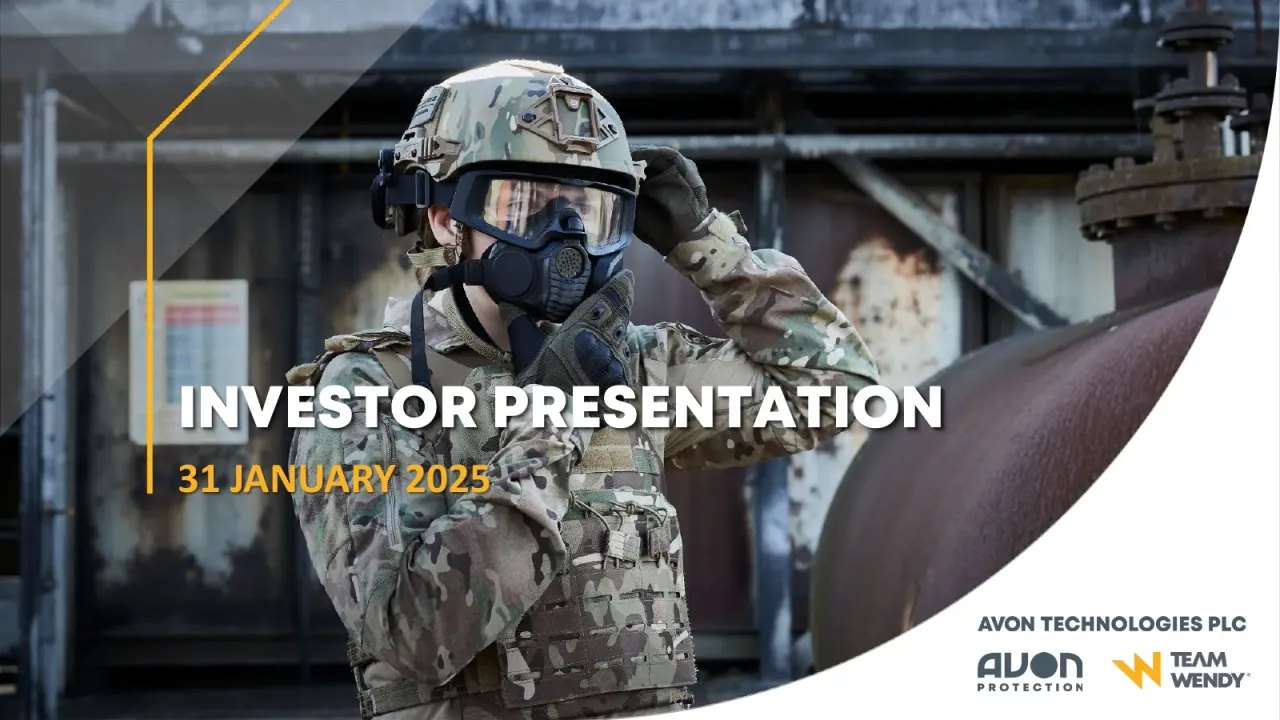
Investor Presentation hosted by Avon Technologies (LSE:AVON) on Investor Meet Company, held 2025-01-31.
On 6ix: 6ix.com/event/avon-technologies-plc-avon-investor-presentation
Automated transcript · Written by software from the replay's audio. It can mishear names and figures; the replay is the record.
0:01 Good afternoon, ladies and gentlemen, and welcome to the AVON TECHNOLOGIES PLC Investor Presentation. Throughout this recorded presentation, investors will be in listen only mode. Questions are encouraged. They can be submitted at any time via the Q and A tab that's just situated on the right hand of your screen. Please just simply type in your questions and press send. The company may not be in a position to answer every question it receives during the meeting itself. However, the company can review all questions submitted today and will publish those responses where it's appropriate to do so. Before we begin, we would just like to submit the following poll. And if you could give that
0:32 your kind attention, I'm sure the company would be most grateful. And I would now like to hand you over to the executive management team from AVON TECHNOLOGIES PLC. Joss, good afternoon, sir. Afternoon, and afternoon, everyone on the phones. Thank you for joining us. I'm Joss Slater. I'm sitting here in our factory in Wiltshire, and next to me is Rich Cashion, our CFO. And between us, we're gonna run through some slides, but really with the aim of hopefully getting some great questions at the end because actually, what we what we really like is answering questions and talking about our business to our investors and potential investors. We have started at the top in this presentation because there will be a mixture of knowledge about the AVON TECHNOLOGIES story. So for those of you that are new to the story, AVON TECHNOLOGIES is a very coherent group in the sense that it is completely focused on protecting people's lives. We make some of the world's best protective equipment.
1:31 And the way we protect people's lives is by providing unparalleled protection to those who protect us. And the unparalleled bit is important to us because from that, we mean that we have the best technology available for people to buy in protecting an extremely hostile and difficult situations.
1:55 We have two divisions. One of them is called team Wendy, which I'll talk about in a second, and one of them is called AVON protection. AVON protection has what we think is the world's best portfolio of air powered respirators that includes gas masks and filters and also, chemically resistant suits. We have contracts with we have contracts with the Department of Defense where we are the sole source supplier, And we also have a sole source contract with NATO under which NATO companies NATO countries can order from us, and we are the sole supplier to the UK MOD.
2:42 And also more recently, and we're very excited about this, to the Australian military as well, as long as as well as countless other NATO countries. We are increasingly broadening our user base out beyond military customers. In particular, our products are very popular with police forces around the world, particularly in America where there is perceived to be a lot of fentanyl in houses, and therefore, they wear gas masks when they go into any house, but also with ambulance crews. So we are quite diversified in our customer base. We are expanding our product portfolio all the time. In fact, only last week, we launched a half mask, which has less protection than a full gas mask, but does provide protection from tear gas and also from lead particles and other bad chemicals created when weapons are fired.
3:40 We also have a fast growing underwater rebreather business. This is a very specialized product that you can go to, up to six hours underwater, a 100 meters down. It's nonmagnetic so that you can, disarm mines. It doesn't produce any bubbles, so it's silent. And it is another level of safety above anything else in the market, and we are bit by bit winning the main Five Eyes and NATO countries around the world. Our other business is Team Wendy. Team Wendy also has an enviable portfolio of long term contracts, perhaps the most exciting of those being the contract for the very high end rifle rated helmet for the US military.
4:30 And we also have the sole source or sorry, dual source contract where we have 60% with the US military for their standard combat helmet called the ACH. We have a very strong order book from the DOD at the moment. They are going through a period of replenishment, and we expect that to continue for many years to come. In fact, our biggest challenge at the moment is ramping up, fast enough to meet the demand that we have. Beyond the US DOD, we also have a large commercial opportunity. We sell a lot into US police forces, also SWAT teams. And in the future, we'll be looking to expand outside our core North American market into Europe and other NATO countries, both in the police forces and SWAT teams, but also other militaries from friendly nations.
5:26 Again, we have the leading technology. I say that with, some evidence because the US Department of Defense is by far and away the most demanding customer anywhere in the world. And on both the high end rifle helmet, which we call IHEPS,
5:44 and the ACH helmet, we are the first company to have approved have the helmets approved with the Department of Defense. And in fact, we're probably over a year ahead on both helmets against our only competition with that technology. We are expanding the product portfolio. And, again, only last week, we launched a rifle tech helmet, which is a helmet that can save your life even against a sniper's bullet or a rifle bullet. That helmet is going to be launched into non US militaries and also police forces and SWAT teams around the world. It's fair to say that there was a lot of excitement at the trade show that it was launched at last week. We hope to see good orders for that.
6:32 Over to Rich. Thanks, Josh. So this chart gives a little bit of color on how the business is broken down. On the top pie chart, you can see that the the revenue split between the two divisions is roughly equal. AVON protection at 53% of revenue, Team Wendy at 47% of revenue. These numbers are all as at the end of f y twenty four. And then the two pie charts below just break out the proportion of revenue that falls into each of the key end market groupings. The key takeaways are, number one, AVON protection is already a very broadly spread business, which is entirely consistent with the philosophy of designing complex equipment to support a DOD requirement and then over time internationalizing that equipment and commercializing it. And then number two, the the the other other takeaway takeaway is Team Wendy is actually on the same journey, but it's significantly less mature as portrayed by the north of 80% that currently goes to North American customers.
7:32 We see a tremendous international opportunity for Team Wendy as well. It will take time to get it, but we are investing in the sales team now. And so we've got some fairly grand ambitions in that area. Interestingly, of course, nonmilitary customers are very relevant for both AVON protection and Team Wendy.
7:55 In order to better understand the trends in the markets that matter most to us, about a year ago, we commissioned some third party research to establish some growth growth rates in the markets that are important to us based on public spend data and a range of other data sources. And the two graphs on this slide show the direction of travel of expected demand levels with the US military in gold and other NATO countries in gray. The the bars on the left show the average spend in the 2019 to 2023 period. Then the middle bar is 2024, and and the the final bar is estimated 2028. And as you can see, there is pretty robust growth in both of those end markets. It's it's not gonna shoot the lights out growth, but it's it's very helpful. So in the three to 4% compound annual growth rate in in each each division.
8:50 And I suppose the key takeaway there is it's far more helpful to be swimming with the current than swimming against the current. So we are operating in growing markets. And interestingly, of course, non NATO addressable markets are also growing nicely. And this chart does exactly the same job, but for law enforcement demand in The US and other NATO countries. Again, you can see solid expected demand growth over the five years, reflecting the increased increasingly dangerous environment these offices are required to operate in and trends in other first responder markets, including firefighters and emergency medical support professions, do follow a similar pattern. And, again, other non NATO countries also saw decent growth. And then finally for me before I hand back to Joss, this is a slide that we first presented about eighteen months ago, and it's just a snapshot of what we view to be our medium term strategy. We have an interesting approach to strategy generation here at AVON.
9:53 First of all, the strategy isn't forever. So we expect this strategy to be in place for a sort of five or six year period. We expect the businesses that are responsible for delivering the strategy to come up with it in the first place. And so what we do is we enable those businesses through tools and education to develop a high quality executable strategy. This is all our own work. There's no consultants that have been involved. And when we first presented it, the the four limbs of the star are pretty much as you see them on this chart. The first one is strengthen, which is basically fix the broken stuff. The second one is transform, which is really all about improving margin, improving productivity, and ultimately growing capacity.
10:42 AVONZE is driving organic growth through new product investment, through targeted
10:50 approaches on markets which are absolutely in our sweet spot, but maybe we are underfocused right now. And then finally, the the revolutionized section around slightly more out there new product development addressing a market that either, a, doesn't yet exist or, b, is slightly more adjacent to what our core offering is. And the one subtle change, I suppose, that's been made recently now that this is eighteen months old is to all intents and purposes, we have completed the strengthen limb already. So all of the well, most of the broken stuff that was around when we joined has now been fixed. And so we have repurposed that limb to, say, strengthen through continuous improvement.
11:35 Continuous improvement is a philosophy that we we believe in deeply. It has been well embedded in the business over the course of the last year or so. It's not about cost reduction. It is absolutely about delivering growth, making the organization more capable, and ultimately creating a sustainable competitive advantage. And that's quite a handy point to hand over to Josh, who will now talk in a little bit more detail about what we mean by continuous improvement. Thank you, Rich. So we see continuous improvement as having three limbs. The first is all about developing our people so that they can improve the business.
12:20 And we do that through training them and teaching them and showing them we're very active on the shop floor ourselves, unlike some management teams. And we believe that if we harness all thousand people in the organization to improve our processes, then we will be unbeatable against our competition who tend to use just their senior management team to improve their processes. The second limb is just in time. This involves making product to the beat of the customer so that our product flows from raw material to finished product and then through to the customer extremely quickly. That cuts down inventory.
13:07 That frees up cash that we can invest into growth initiatives like sales and technology. It also enables us to deliver on time to our customers. And then the last limb, no defects, enables us to deliver not only on time, but extremely high quality products to our customers. And we take a view, which I'm not gonna claim to be revolutionary, but is harder to do than say, which is to always deliver on time to our customers with very high quality.
13:40 We chose continuous improvement based on our own experiences improving companies before we got here with continuous improvement. But, also, we have taken a lot of inspiration from the Danaher business system, a very similar system that was put into Wiremold. In fact, the person that originally put continuous improvement into Danaher became CEO of Wiremold, and the CEO of Danaher also is now CEO of General Electric. And all of those companies and us originally took inspiration from Toyota, who really came out with continuous improvement back in the sixties. Some of these companies in fact, all of these companies have been phenomenally successful. Just to give you one anecdote, Dana Her increased shareholder returns by four and a half thousand percent since its inception.
14:35 And Waimold actually had similar results as well over, its lifetime. We actually used the exact same consultants that Danaher and Waimold use who are Japanese, and they're not your typical consultant. In fact, they call themselves insultants. And you just get one person who helps teach our people on the shop floor by doing. We also use a guy called Art Barn who's written numerous books on continuous improvement, who was also at Danaher and Weimald. Nonetheless, although the principles are tried and tested, we have made them our own. Every company is a bit different. We have three pillars. I've talked about the fundamentals on them. There's cultural leadership, just in time and no defects. But if you look more at the yellow bars at the top, which if I could read them on the screen, it would be easier for me to talk about. But, the culture and leadership there is really we drive the culture and capability building that we want through a process called kaizen. They are typically well, they can be anything from a day to a week long.
15:47 We every factory does at least one week with our Japanese consultant, Shinu Jitsu. And during that week, they will run three different kaizen teams generally in the same week. But between those, we also run numerous other kaizens. So most plants actually run about two a week, and those are improvement steps. So we take a lot of small steps very fast, and those small steps all add up. And, also, every single kaizen the employees are learning, and that enables us to go faster and faster. Just in time, we're moving all of our factories from traditional batch manufacturing to flow. When we say flow, what we really want in a perfect world is that when a raw material comes out of the warehouse, we don't want it to stop moving until it reaches the customer.
16:39 That cuts inventory down. It puts quality up. It reduces waste. It's not always possible, though. Sometimes we have shared machines or we have, complicated product variations. Where that's in play where that happens, we use a system called pull where the downstream processes pull from the upstream processes. So the upstream process only makes what the downstream processes need. The advantage of all of this is it radically reduces the amount of inventory. And I think we took $23,000,000 of inventory out of the respiratory business in the first twelve months, and we continue to see inventory turns increasing, which frees up cash, which makes the company stronger and enables us to invest into growth.
17:28 On the no defects column, we are moving from the way traditional manufacturing companies do quality, which is to inspect quality at the end of the line to moving quality inspection into the line. So every single process in the line has quality straight after it. That creates instant feedback to the process before and significantly improves quality. And the more we look at our processes, the more we're realizing that we have a very large opportunity to reduce waste and therefore costs by improving quality in the processes. That does, of course, also lead to better quality products for the customer.
18:14 This drawing just gives, an overview of how our system works. The guy on the right holding the helmet is the customer. That customer sets or creates demand, and that demand is used to set the beat of the line. We call that beat the tak time. The line then runs to that tach time. And in this example, the product is flowing from the first operator all the way through to the third operator without stopping. One operator passes to the next operator, and there is an inspection in between each operator. In a perfect world, actually, the second operator, the first thing they would do is inspect the work of the first operator because that means that the first operator is not marking his own homework or her own homework.
19:02 And we are seeing quality go up and up through that instant feedback loop between one operator and the other. The customer, we put them onto a system called Kanban, which is where as the first offer makes the product, it sends a signal back to the supplier, and the supplier delivers more products to replenish our raw materials. And we want that delivery to be just in time, which means not late because it'll stop the line, and not too early because we don't like inventory sitting around in warehouses. This just gives you an idea of the type of results we're seeing at a macro level, half on half, productivity improved 30%, scrap has reduced by 48%, and inventory turns has increased 37%.
19:59 I would say, actually, our q one inventory in one of our divisions, has progressed a lot further than that already. The way our approach to Kaizens and improvement steps differs from a traditional company is illustrated on this picture. A traditional company will take its senior executives who will sit around the table. Maybe they'll meet every week, and they'll come up with a plan to improve the business. In this example, it's taken them three months to come up with some complicated Gantt chart plan. The way we do it is we do some training on the Friday or the Monday morning. We then plan what we're going to do.
20:49 And then on days two, three, and four, we get straight into doing. And that means that by the end of a week of a kaizen, we typically see significant improvement in all of our key operating metrics, quality, productivity, inventory turns, space utilization.
21:10 And one of the things we particularly like about continuous improvement is we don't see a lot of need for trade offs. We very often improve all metrics that matter to us in one week, and we are doing those week long kaizens all of the time.
21:26 We always like to put up a few examples. There are an awful lot of them because we are literally doing this every single month. This is an example from our Salem plant. I think it's been thirty years, twenty or thirty years, Rich. Yeah. That plant was a very traditional batch manufacturing plant. That meant that it was using way too much space, had way too many defects, had poor productivity. We have a tool that we call the three p process or production preparation process. In the space of week, we got a team together. We taught them how to use the three p process. We mapped out the movement on their plant, and then we got a plan together which involves moving everything pretty well. Every single piece of machinery in that plant will move over the next three months so that we can have flow through the factory. And interestingly, it's gonna free up so much space that we can now put a dedicated r and d center into that factory.
22:30 We also expect to reduce inventory by work in progress by 60%. We expect to improve productivity by 20%, and we expect to radically improve quality. It says here at 10%, but I think we'll get much better quality improvement than that, actually.
22:49 This is an example from a completely different factory in Cadillac. The the charts on the left and the right at the top show the number of operators and how much work they are doing compared to the TECH time or the product demand, which is the blue line. But the main takeaway here is that the process that we inherited, which has been running for at least twenty years, had seven operators. The poor person number six quite working quite hard. The others less so. What we worked out, though, is if the if we rebalance the work a bit, we can actually take an operator out, of the process. So now we have six operators still hitting the tach time, and efficiency on that line has gone from 69.5% to 75.5% in one week of work. And that's a line that's been there for twenty years, and people have well, have been working on the assumption that there was no improvement left.
23:56 Switching on from continuous improvement into AVONZE. AVONZE is all about growing above or faster than the markets that Rich described earlier. And we do see the order book expanding at a very good rate. I think we are pleased both to the order book and pipeline development. Recently, we won a contract with TALES for $10,000,000. We also won a sole source contract with the UK MOD to supply gas masks, which is for four years with five five option years or four option years. Four option years. We have a sole source contract with the USDOD. We're very excited to have won the Australian military because seven years ago, they misguidedly chose one of our competitors as their supplier of gas masks, but they have now, moved to us. And really excitingly for us, they have chosen our highest end gas masks.
24:58 It's actually the one we normally supply to special forces, but they have ordered it for their entire military. We are bit by bit winning NATO and Five Eyes countries for rebreathers. Most recently, we won Germany and New Zealand, and we are busy working very closely with three other NATO countries on their needs for rebreathers. And we recently won the US military under a contract called Dursko for supply their products for them. In team Wendy, IHEPS, we have a very large order book, including recently getting another $18,000,000 order of IHEPS. And on ACH, we have a large backlog of deliveries, and we have a contract going out for another three or four years. Yeah. Think it's just 29 deliveries. We also supply the US Navy with bump helmets. If you were to look down on a US Navy aircraft carrier, you would see every team has a different color helmet. All those helmets are supplied by us.
26:09 And we also made the pads for bulletproof or ballistic helmets. R pads, we think, are the best at protecting your brain from the shock or concussive impact of a bullet hitting the helmet. Interestingly, the trick with bulletproof helmets is to make a shell that can stop the bullet because if the bullet goes through the shell, then you definitely are in major trouble. But assuming you can stop the bullet, the next thing you need to do is stop the brain being shaken around so much that you get brain damage. Most recently, we have launched two new products. We've launched a new RifleTech helmet, which is probably the world's most advanced helmet. I think it's about two and a half pounds lighter than the previous version of this helmet, providing the same ballistic protection.
27:04 And we have just launched the MITRE half mast, which opens up a whole new market, and we are already seeing significant interest from special forces. Excellent. Thanks, Joss. In in this last section, I just wanted to pull together some of the some of the themes that we heard about and and kind of introduce a concept that we introduced for the first time about a year ago at a Capital Markets Day that we did as well. But starting from the top, we have got supportive markets. We've got some really good market positions in the markets in which we serve. We've got some market share data. North American market share is over 90% for respiratory equipment.
27:51 For head protection equipment, it's it's a lot lower than that because it's a much more fragmented market, but it's growing incredibly quickly as we have the largest suppliers of the US DOD for ballistic helmets. And the the new concept that I mentioned is that we we've broken the revenue profile of the business down into three discrete lumps. There's there's recurring revenue, which is spares and repairs related to equipment that's already in the field, and then ultimately replacement of that equipment with like for like, which is
28:23 quite normal if you sell gas masks to a military or to a police force, and then there are some new recruits. It's highly unlikely they would buy a different piece of kit for new recruits. And so that that to us is effectively recurring revenue of an installed base we already have. On top of that, we've got contracted growth. For example, Josh was talking about the good growth that we've got baked in through deliveries of iHips and ACH helmets into The US. That would that would count as contracted growth and indeed everything else that's currently in the
28:54 in the record order book that we saw coming out of f y twenty four. That would all be in that light gray contract growth section. And then you've got non non contracted growth, which is essentially it's pipeline. So where we can see an order pipeline, but we don't yet have a booked order. Or there's this concept of unicorns that we call or as we call them. These one off lumpy orders that do come along every now and then, they're quite difficult to predict. They make the business optically look lumpy. And the the worst thing we could do is get ourselves into a position where we where we become dependent on these unicorn unicorn orders. And so what we've done is we've worked quite hard on the cost base over the last twelve months to make ourselves comfortably delivering returns in our target range just just looking at that recurring and contracted revenue level. And, therefore, when we receive orders that are noncontracted or unicorn, it's it's creep effectively. It's icing on the cake.
30:00 So in summary, we have got a a solid underlying market growth rate that I shared earlier. We've got a very high level of contracted growth, particularly in Team Wendy, but also increasingly in AVON protection over the last year. Some of the new targeted product introductions that Josh was talking about with are growing that pipeline, the darker noncontracted growth section, and then the recurring revenue base, which, of course, is growing over time as the gray and dark gray sections grow, then so you get revenue falling into that recurring revenue base in the future, is very helpful and, of course, very sticky. And just tipping a hat to returns, having taken a lot of that cost out, combined with the continuous improvement activity that Josh was just describing earlier, what we're actually seeing is an acceleration of returns, the most important sort of returns that I think everyone should look at, and that's kind of the returns on the incremental capital in the business.
30:59 So the the other slide I just wanted to talk through quickly was around transformation. We're not lovers of transformation programs. They're they're difficult. They're complicated. They're quite disruptive, but they can affect quite a lot of change quite quickly. And so we've got four fairly well publicized transformation programs running in tandem. We've got the footprint optimization program, which is about rightsizing the the manufacturing footprint of the organization and locating it in a place that is strategically obvious and convenient for the customers. And in reality, what that means is closing a manufacturing facility in California and relocating most of the work to Cleveland and Salem on the East Coast Of The US, close to suppliers, close to customers.
31:47 This is a very impactful transformation program. 2025 is a very important year for that program.
31:53 So we're now getting to the point where we are winding down production in in California, and the move will be complete by the end of the summer. We track this project very carefully. We have a lot of milestones. We are on we are on track based everything we can see. It's not yet done, but there's no reason for us to believe that we're not gonna achieve that transformation activity on time.
32:18 As you as you work around the circle, operational excellence is all about the continuous improvement culture that Josh was describing, just describing, so I won't go into too much detail there. We spent quite a lot of time on functional excellence, which started with, I guess, taking excess cost out of the center. What wanted we to do was build up capability in the two operating businesses that we have in AVON Protection and Team Mendi. There is no sense in replicating that capability in the center if we can avoid it. So we've taken a lot of that sort of stuff out. And in certain areas, we we have have strategically reinvested in central capability. For example, HR wasn't represented on the group executive committee despite the fact that we have nearly a thousand employees.
33:03 That felt like a good common sense piece of investment. So we've we've created the HR leader role on the exec. And then finally, commercial optimization is partly euphemistic in terms of identifying opportunities for pricing and then taking them. More importantly, it's understanding that we have got a competitive advantage in where we do business with whom and how and formalizing that competitive advantage to make that competitive moat stronger and deeper. And so there's quite a lot of activity in those four areas.
33:35 Like I say, they're well they're well publicized. We have published numbers in terms of cost and benefit, but in in essence, all of the investment on these areas will be largely complete by the end of f y twenty five, and we fully expect that we will be conferring benefit of of around $10,000,000 per annum run rate in profitability from '26 onwards.
34:00 And then almost finally, medium term goals. We put these out for the first time a year or so ago where we were targeting organic revenue growth of at least 5%, margin of 14 to 16%, return on invested capital, like I say, I still maintain it's the most important metric of greater than 17%, cash conversion of 80 to a 100%, and leverage of one to two times.
34:26 The top row on that chart is the performance in f y twenty three, and the middle row is the performance in f y twenty four. And as you can see, we're we're making pretty robust progress against each one of those targets. And in a couple of cases, we've we've overshot them slightly. So revenue growth of 12% in the year, margin bridging quite nicely from the 9% in '23 up to that 14 to 16% range.
34:50 ROIC, again, bridging quite nicely towards the 17 and above. Cash conversion was particularly strong in in '24. It'll be strong again this year, but nothing like that, and we've given some fairly clear guidance. And then leverage actually became in below that one to two times. So a much, much stronger balance sheet. And I suppose the key takeaway for this slide is when we first put it up a year or so ago, these were medium term targets, and we expected to deliver them by the the end end of of f y twenty seven. We now believe that we will deliver them by the end of f y twenty six. So in summary,
35:26 we we do aim for superb execution and focus on continuous improvement, I think, will will will move us a long way towards that goal. We have supportive markets. We are swimming with the current. We have a stable base, and we are well underpinned with a strong strong order book and supported growth, and we have a very strong competitive moat. So we think AVON is in a good spot to move forward from here. And with that, I will encourage questions. Thank you. Perfect. Joss, Rich, if I may just jump back in there. Thank you very much indeed for your presentation this afternoon. Ladies and gentlemen, please do continue to submit your questions just by using the Q and A tab that's situated on the right hand corner of your screen. But just while the team take a few moments to review those questions that were submitted already, I'd just like to remind you that a recording of this presentation along with a copy of the slides and the published Q and A can all be accessed via your investor dashboard.
36:22 Guys, as you can see there, we have received a number of questions throughout your presentation this afternoon. And thank you to all of those on the call for taking the time to submit their questions. But, Rich, just at this point, if I may just hand back to you just to read out those questions and give your responses where it's appropriate to do so. And if I pick up from you at the end, that would be great. Thank you. Okay. No problem. Thank you. So the first question is any news on the rebreather contracts.
36:49 There isn't news that we've published beyond the German win. I would say that we're busy delivering on the German win. They wanted 205, I think it was, and we are delivering them in stages. We actually just sent them a delivery of 24 or 25 last week. We are working, though, with two European countries on just sort of dotting the i's and crossing the t's on a contract, but it's not yet in a announceable form, but we hope to get there fairly soon. We are also working with some other countries, but they're a bit earlier stage at this point. We'll let you know once we've got news on that. I think the next question is
37:34 with the recent contract wins, looks like in masks, how do we see that impacting revenue stability? I mean, we we think it's a bit of a bit of an old story that revenue is lumpy in this business. We've sold 3,000,000 masks into militaries and police forces around the world. We've never ever heard of a military or police force mixing different manufacturers' fleets apart from, in the case of Ukraine, that have been donated some by other companies.
38:13 But even in that case, we know that the Ukrainians have a view that the only masks that actually work in theater are ours, and they are extremely keen to buy ours or to be donated to them by friendly countries. So we actually see both divisions of having a nice stable revenue base. Save that, we do sometimes get fairly large one off orders, but we see those as the kind of icing on the cake as Rich described. And if that happens, then we'll certainly let you know, but they don't actually form part of our guidance. So if we get them, they're on top of what we guide to.
38:58 So we're delighted if it happens, but even without them, we should grow nicely. Would you consider doing a share buyback to improve liquidity? I'm not sure a share buyback would really well, ultimately, I don't think it would improve liquidity because it would actually take shares off the market, but I sort of understand the point. There is a capital allocation framework. We put it in the last results deck. Share buybacks are one of the tools we would use if we get to a point where we have a large amount of cash on the balance sheet, but then you should expect anything in the near term. No. I agree with that. I mean, the capital allocation policy is very clear. It's on the website.
39:45 It's in the annual report, and it's in the presentation deck from the last full year results. But it's very clear that the focus is on driving organic growth either by investing in continuous improvement, which by its very nature doesn't require much investment. It's it's it's really a function of using wisdom before money as as Josh says frequently. And with the with the excess returns that we generate as a consequence of that reinvesting into new product development and new product introduction to drive further growth. Yeah. Thank you, Rich. Is the Cleveland site site still on track? The answer to that is yes. That pro that program is still moving well. Brokers and commentators still think AVON's fully valued. Maybe some of them.
40:32 I think I think that's all a question of your perspective. If you look at multiples of this year, you could certainly form a view that we are fully valued. If you know our track record and you believe that we can deliver on our medium term targets or perhaps overdeliver on them, then I think we could well be very reasonably priced on a 2026 and 2027 view. The Donald Trump tariffs, I think, probably, overall, that's quite potentially positive for us.
41:17 We have American factories, which we make product for America. So we are the kind of definition of made in America, which Trump likes. One of our major helmet competitors in The US police market is actually a European company making their shells in Europe. So it would not be unhappy for us if they had tariffs put on their helmets, I would say. And, actually, even our raw material polyethylene comes from America. So the broader point around what Donald Trump may or may not do that may or may not benefit Us is is somewhat unknown because nobody quite knows exactly what's gonna happen. But certainly, the most helpful thing that he's talked about, which is more likely to have an immediate impact, is addressing corporation tax. He he's clearly set set out his tool as a business friendly president.
42:14 And if he can take corporation tax down as a large US earner of profit, that'll be quite helpful. Now there's another question. Is it realistic we could get our margins back to the low twenties? Yes. It's realistic, but we wouldn't necessarily want to do that because, we may well put the excess cash and therefore, in our case, expense because we tend to expense r and d back into research and development. So we we we obviously keep pushing to improve underlying margins. But if we can see technology that we can invest into to drive further growth at good returns on capital, then we would do that.
43:05 I would I'll I'll jump in there, actually. I mean, it's a good question around margins and how realistic is it that 20%, which is roughly where they've been before. On a like for like basis, we're probably not far away from that now, actually, and there's a broader quality of earnings conversation to be had there. We we we have a fundamentally different view on a number of elements of the p and l from our predecessors. We don't capitalize all of the r and d. We we have a hard and fast rule that we will capitalize r and d where we have a customer and a contract and where we don't, where we won't capitalize the r and d. We spend a significant amount of money on r and d every year. And and if you add that back to to the profit that we generated last year, you'd have very healthy margins, comparatively speaking.
43:54 But the broader point is we would far rather invest in R and D than boost the margin for a short period. There's another question. Can you talk about your market share and addressable market? Well, I mean, our market share does depend a bit by country, but our market share in gas masks in what we might term friendly countries is extremely high. There are some militaries that use a local supplier like France and Germany, but even those countries generally tend to use our masks for their special forces. So I'd say it's very high on market share. In America, it's probably 90% maybe.
44:42 In helmets, our market share's very low internationally. We do have the Australian military, but that's all. In America, it's higher. It's probably going to go up to about 60%. But in the police force market in The US, it's probably lower, maybe 20 to 30. 15 to 20. Yeah. So there's definitely more growth opportunities in US police force market, what we call the commercial market, and internationally in helmets. There is quite a lot of addressable market and market share data on the website in the Capital Markets Day presentation from February last year. I think the question alluded to some of that. It would probably be unhelpful for us to try and remember the numbers off the top of the tops of our heads now, but it's all available on the website.
45:31 There's another question on continued improvements. Could we add products or buy in? Mean, we funnily enough, we do continually improve our product development process as well. We do so we certainly see opportunity to develop new products. In fact, we have a sort of funnel of exciting new product developments. At the moment, especially in helmets, we have a huge amount of growth already in the order book, and we're effectively tripling the capacity of our Cleveland factory at the moment. So we are focused on that. But once we get through that, which we should do this year, then we will turn more attention to developing new products, and we will keep trying to develop new products even faster.
46:26 On the respiratory side, we are very busy actually working. The DOD, is talking to us about a couple of very exciting funded programs, which we hope we're gonna win pretty soon. We're gonna launch a powered goggle, hopefully, back end of this year or maybe the actually, more like the end of this financial year, I think, realistically. So that's exciting. We are developing a new range of chemically resistant suits, and we are seeing more and more interest in our chemically resistant boots and gloves. So there's plenty going on in respiratory. I'd say we've got more programs of record in the pipeline than we probably have for a very long time Yeah. Actually in both businesses. So, yeah, the technology development side is expanding quickly.
47:13 Would we buy other companies? We actually think we have a methodology that's repeatable and could improve any company. The way we improve inventory turns and free up cash is potentially exciting when you do buy other companies, but, actually, it's not our focus at the moment. We have so much growth in the businesses that we've got that we're gonna stay focused on that, at least for now. Good. And then one more question here. Your slide showed f y twenty four growth of 12%, but medium term growth of at least 5%. Was FY '24 an outlier, or are you adjusting very conservative future growth? It's a good question. But to in our defense, we were quite clear that FY '24 would be higher than that 5%. I think we guided to nearer 10.
48:01 And the reason for that is what we saw was the full year effect of next generation iHIPs deliveries. So in '23, deliveries kicked in in the second half. So what you had in FY '24 was the full year effect of those deliveries. Interestingly enough, we will have a little bit of a kicker in in in helmet business growth, so Team Wendy growth in '25 as well as ACH follows the same pattern, but there are some offsets elsewhere. So mid single digit growth for this year is consistent with the guidance. I don't think we've been particularly conservative with the guidance, but, clearly, if we if we have as much success as we think we should have in new product development and new product introduction, there's no reason to believe that that growth rate isn't robust.
48:51 And then lastly, Andrew, thank you for your comment thanking us for engagement with investors. We we always like talking to investors. We like questions about the business. We're always super happy to answer questions about the business. We think it is a fantastic business. In many ways, it was the dream job because we felt it was fundamentally an absolutely excellent business that could be improved to realize its full potential fairly quickly. And I think we're seeing that starting to come through now. And with Cleveland on track to take over from California, we should see a good margin step up next year. So things are moving in the right direction. Thank you. Perfect. Joss, Rich, if I may just jump back in there. Thank you very much indeed for being so generous of your time then addressing all of those questions that came in from investors this afternoon.
49:43 But, Joss, perhaps before really just looking to redirect those on the call to provide you with their feedback, which I know is particularly important to yourself and the company. If I could please just ask you for a few closing comments just to wrap up with, that'd be great. Wow. I feel like I've done closing comments, but I can do them again. If you go back to that slide you were just on, actually, it's not a bad one for closing comments. We have we have a big transformation program going on. It has very rigorous program management, which actually we've introduced and taught the business to do. That is derisking it. The program's also moving through its milestones, which is also serving to derisk it. As Rich has already mentioned, that will significantly improve margins next year, we think by at least $10,000,000.
50:34 We have favorable markets, so we do have a backdrop which is supportive of growth, and we think we can grow faster than those markets through the new product development that we've got and international expansion, and we are working on both of those this year. We do have a very large installed base of products actually, in both helmets and respiratory, but particularly on the respiratory side. And that installed base gives good earnings stability. And we have a very strong competitive moat around the company because we have the best technology in the fields that we play in. We have lots of patents around our products.
51:22 Interestingly, I was writing a submission on rebreathers the other day, and it we actually illustrated to the customer just how strong the patent portfolio is around that rebreather. Our argument being that it's gonna be quite tough for them to find a competitive product that does the same thing as ours. I think almost certainly impossible to find a competitive product that does that. And we have an enviable portfolio of long term contracts, many of which are sole source. So that puts us in a good position for many, many years to come. Perfect. Well, that's great. And thank you once again for updating investors this afternoon. Could I please ask investors not to close this session as you will now be automatically redirected for the opportunity to provide your feedback in order the management team can really better understand your views and expectations.
52:11 This will only take a few moments to complete, but I'm sure it'll be greatly valued by the company. On behalf of the management team of AVON TECHNOLOGIES PLC, we would like to thank you for attending today's presentation. That now concludes today's session. So good afternoon to you all. Thank you.
Follow Avon Technologies PLC into a list and get an email when it puts out news.
CEO at AVON TECHNOLOGIES PLC
CFO at AVON TECHNOLOGIES PLC