Alberto Lavandeira
CEO at ATALAYA MINING COPPER, S.A.
Replay available
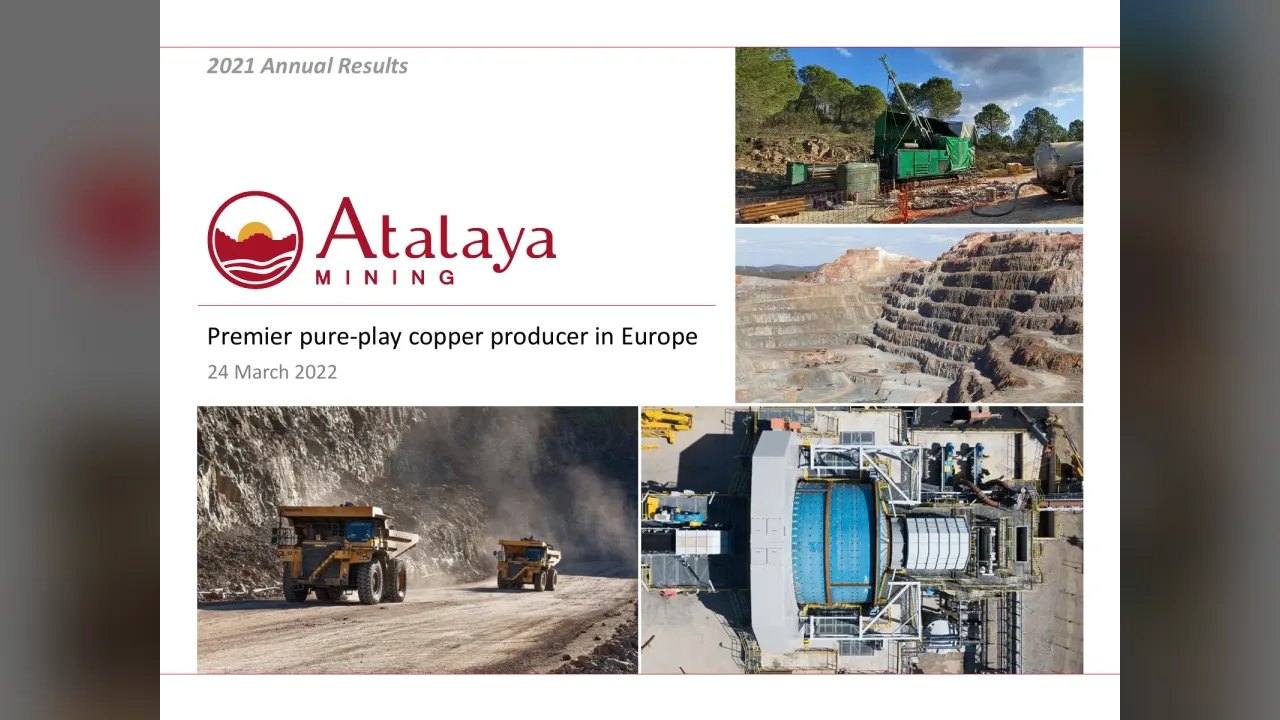
2021 Final Results hosted by Atalaya Mining Copper (LSE:ATYM) on Investor Meet Company, held 2022-03-24.
On 6ix: 6ix.com/event/atalaya-mining-copper-sa-atym-2021-final-results
Automated transcript · Written by software from the replay's audio. It can mishear names and figures; the replay is the record.
0:01 Good morning, and welcome to the ATALAYA Mining PLC twenty twenty one Final Results Investor Presentation. Throughout this recorded presentation, investors will be in listen only mode. Questions are encouraged and could be submitted at any time via the Q and A tab situated in the right hand corner of your screen. To click Q and A, scroll to the bottom, type your question and press send. The company may not be in a position to answer every question received during the meeting itself. However, the company will review all questions submitted today and publish responses where it's appropriate to do so. Before we begin, I'd like to submit the following poll. I'd now like to hand you over to Cesar Sanchez, CFO and Alberto Lavendera,
0:32 CEO of ATALAYA MINING PLC. Good morning. Good morning. Please go ahead, Alberto. Thank you very much. Welcome everybody. Good morning, ladies and gentlemen. It's a pleasure to be here again. We are going to go through the results of the last year, which were very good as you probably all know. And most importantly, we are going to be going through what's the future of this company and what are the catalysts. And we believe we can try to make a very short presentation and to leave ample room for your questions and to reply to those questions that have been pre submitted.
1:29 With me, I have Cesar Sanchez, who is the CFO, and he will be very happy to assist in the responses of questions related to the some specific financing number or the process that we are going through Hello, everyone. Go away from from Cypress, from to to read inside from Cypress. Going directly to what was twenty two thousand twenty one. Probably, you have already, seen the presentation. You have had time to read the press release, so I'm not going to be reading the whole thing. The important things I would say is that the plant, the mine continued to operate well over the design capacity, and now it's already two years in a row.
2:22 We produced a record of slightly over 56,000 tonnes of copper. Good all in sustaining capital cost of around $250,000,000 and this generated a very important cash flow and EBITDA. And we ended the year with a fantastic balance sheet. Besides those operational and financial results, we continue to deliver in our targets, in our promises. And the first thing is that we paid as soon as we could the Aster litigation, we closed our door, which finally has been concluded in March. As soon as we had money, we paid our dividend and we continue to improve the liquidity.
3:10 And of course, getting ready for the future. Getting ready for the future means confirming the reserves of well over ten years at Cerro Colorado, our only existing open pit. But most important, announcing that we are doing some other work within the Rettindo District called San Dionisio, Massa Malverde, which is around 25 kilometers away, and acquired some new exploration properties in the North of the parent melt and in the East of Rio Tinto. Besides that, mixing assets with ESG, we have been advancing the LX system and decided to build a plant, which basically will produce directly metals with electric systems, which is basically fantastic from the CO2 control.
4:08 We are also starting to build a plant of 50 megawatts of solar at our site, which is also essential when you look at the electrical situation, very worrying electrical situation in whole Europe. And of course, we published already our sustainability report, added a new director and we continue to advance in things like moving away from Cyprus, which is very important for us. So, as I said, as usual, delivering into our promises. This is really seen in graphs of the last six years. We said we were going to be growing and we continue growing production. You can see in the first graph continuously going up, almost doubling our production.
4:56 And copper production as a result of higher throughput through the mill also going up almost doubling. With steady recoveries, which have provided excellent economical results to the company. Those are expressed in Slide seven. And the most important thing is, of course, sales go up as a higher production and higher gold price as higher copper price. And the most important thing here is to see that how leveraged we are to the copper. Copper is going to stay higher for longer and looking at the average prices that we had last year, which were just around $4 per pound and we are now at $470 This generated basically €200,000,000 of EBITDA, which is roughly 50% of the sales.
5:50 And most importantly, this is real cash generation. Generation. It's not, let's say, accounting numbers, it's real cash. And you can see in the bottom part of the graph how our balance sheet has improved from being negative working capital during these last few years to a very strong cash position, net cash position at the end of the year after including and giving away EUR 50,000,000. Actually, this would have meant if we have not given this roughly EUR 50,000,000 dividend that we would have a net cash position of around EUR 100,000,000 in our company, which was not even EUR 500,000,000 at that time, market cap. And you can also see how we were able to manage the construction and the spending and the development of Rio Tinto.
6:42 During the first few years, you see with negative working capital, which means financing with minimum debt, financing with short term loans and with using the cash flow generated from our operations. So very prudent management of cash, but with very good result for the shareholders. The best result for the shareholder has been given the dividend in October. We declared it in October 2021, which was at that time, if I remember well, was almost 7% yield or 8%. And the most important thing is that we decided to as a Board to give an official dividend policy between 3050% of the free cash flow generated. So there was one question, which I can start already saying it, that when are we going to be giving the announcing the next dividend?
7:34 Before midyear, we will announce again looking at the results. And again, complying with this dividend policy that has been approved, we will decide what has to be done with the next dividend. Today, sustainability ESG is essential for everybody, but not only for everybody as an industry, it's for the world. And what I would say is even more important is to achieve the credibility to be able to develop new mines and to demonstrate that actually the mines, mining and specifically copper mining is not the problem, actually is part of the solution.
8:21 Consistent with that, we have published our first sustainability report and we are about to publish our second with full data, public data, which we submit to the key stakeholders and that will be available in our it is available in our web page. And and where we have taken into consideration the views of all our neighbors. It's very important nowadays to be in full symphony with the stakeholders, our villages around, our employees, even environmental groups that may be against us.
9:07 This is essential, and you only need to see what's happening in the new mines being developed or trying to be developed, how difficult it is if you don't have the support of the communities. We can proudly say that our approach has been understood and we are a very welcome neighbor. So this is what we did last year, which was fantastic and I'm very happy to repeat it. But everybody says, well, what about now? First thing I would like to say is that we have the bad tendency of fulfilling our targets. So we will try to continue with doing that. We will continue producing ore through the plant at a higher rate, strip rate of around two:one. Copper rate is around 0.42%, which is what we have in the mine plan.
9:59 And we will be producing between 54,056 tons of copper. This we expect a good year. The production will bias towards the last quarter, so the second or third quarter, simply for several reasons. We had some maintenance during the first quarter that we brought in advance. We also had some strikes in Spain, which are still ongoing on the transport, which gave us some issues with receiving line. So we decided to advance some of the maintenance that was scheduled, big maintenance that was scheduled in Q2 to give it to pass it to Q1 to take advantage of that forced stop for external sources.
10:48 Of course, the key issue here is the guidance of costs. I don't think anybody is not aware of the situation with the gas prices in Europe and the systems of electricity fix the electricity prices in Spain are linked with the marginal cost of producer, which is in this case is set by the gas prices. Until last year, we were enjoying a stable price of electricity, if around €60 per megawatt hour. But this year, we were exposed to the market and the market has gone up. So it's not easy to give our guidance. We have assumed scenarios from €100 per megawatt hour to €200 per megawatt hour.
11:41 The first two months in Spain, we have had an average of €210 per megawatt hour. So I know people were alarmed when we said that we may take actions. Obviously, we didn't want to see this peaks of €500 per megawatt hour because we would be working for the supplier of electricity or for Mr. Putin. So but thanks God, those alarming prices have only lasted for a short period of time.
12:17 I will go get a little bit deeper in the electric prices because we have lots of questions. But before that, I would like to point out that there are other investments going on at the mine, at company, which are all consistent with our growth. The first thing is to complete the power the solar plant. Second is the first phase of Helix. Third is a lot of exploration around us. I mean, we have we that's basically our future. And related to that future is to make a new a new dam or to start working in a new tailings dam expansion. And people should not be alarmed by that.
13:02 They should be encouraged because it means that we have very good hopes that all this exploration in Massawa Berode and Sandinicio will be passing through this existing installation. And of course, when we started this mine, we were looking at only 120,000,000 tons of ore. And now we are probably looking with our reserves and resources in these deposits based on public information, we are talking about over 300,000,000 tons of material that very likely will end up in this installation. So we are looking at our mine life extended around twenty years so far after having been working now for seven years.
13:45 Very important and very worrying is the electrical situation. People ask us, is this normal? What's going to happen? It's I wish I knew, but what we can look at the history is, Spain has had a in the lower part of the graph, you will see a price for €50 quite stable, euros 50 megawatt hour and only around mid last year when we had the gas crisis. And of course, after the invasion of Ukraine and so on, we have seen peaks going to the 200 level where we are right now with a small peak in March 2022. This is due to the setting of the production schemes in Spain, where well, in Spain, I would say in Europe, but Spain is linked with the same price of Portugal, where the marginal producer, which means the most expensive one sets the price for everybody.
14:50 This was quite good and quite valid. It has been working for years when the
14:55 prices of electricity on gas and coal did not change too much or oil. So it didn't really matter too much if there were certain peaks of production where coal or gas fired stations went up to, let's say, €60 megawatt hour, so you have few days with higher prices. But when gas prices multiply by 10 by 10, there's something going on. And this is not normal because the gas prices in The United States or in Korea, Japan are totally different when we are enjoying in Europe. The funny thing is that Spain actually only consumes around 15% of the gas
15:42 used by generation. We have a decent you can see in the charts the division between nuclear, hydraulic, lots of wind and solar. So it doesn't make too much sense in an unstable situation that these prices are set. And this is by gas. This is affecting the whole industry, it's not only affecting us. So something will have to happen. So one of the questions would be, well, what can we do? Well, there's a future market that anyone can check it in a place called OMIP. It's a futures market where the futures is, as soon as you go away three years, right now, as we saw it this morning, at $38.40 euros per megawatt hour.
16:34 That is telling us that the the future will have to stabilize. Actually, now, today, you could hedge and you could fix those prices. This is what we have done with the taken to the advantage of our small
16:50 low point, we have fixed with electrical company around 30% of our needs at a price around €50 per megawatt hour for around ten years. What we also doing building our power plant, our solar plant. Our solar plant basically is constructed around our installations. You can see in the picture shown in kind of bluish that the plant surrounds our existing processing facilities. And this will be planned to start in the first half of twenty twenty three, maybe, would say, between the first and second quarter.
17:41 We have had certain delays in permitting, but also certain delays in the supply of materials, because everybody is constructing all these kinds of installations. The net result of this is that this electricity basically will be net zero cost, but the reality, if we sold this agreement to the supplier, we would have a PPA of around €0.25 to €0.30 per
18:16 megawatt hour. Then the end result of this is that we can guarantee that starting 2023 onwards, we will be having an average price of electricity of around EUR 40 per megawatt hour, which is 80% of what we had last year and roughly five times less than we have today.
18:49 We are not stopping there. We are not stopping there. We are looking at installing further solar capacity in other lands that are not owned by us, but owned by the municipality of Nerva, which will allow us to to be exposed to this, let's say, able to sell electricity at a lower price, which could compensate any speed any peak. We have already a preliminary study of wind with four turbines of 4.5 megawatt each close to the San Dimitio Open Pit to the ATALAYA Pit, which will be able to provide us around 15% extra, all of it for self consumption, which means you don't pay taxes and you don't pay the extra costs of moving the electricity through the net.
19:43 And we are look also looking at several storage systems. Batteries are not economic from our preliminary numbers, but we do have two dams with quite a big difference of elevation with clear water and with lots of water. And somebody is doing a study of pumped hydro, where we could use the very low costs of solar during the day in Spain and especially where we are, where we have lots of hours of sunlight in in this part of the world and store water and pump it and generate electricity during the night. So very heavily looking at this thing because it's we believe this is the the the most important thing that we have to sort. So looking at 2002 is going to be very active. We are in lots of catalysts.
20:33 You're going to be having the solar plant. We are going to have the sustainability report. We will be providing soon the 40 three-one 101
20:43 evaluation or updating of the resources there after our drilling. In addition to that, we will continue with several rigs exploring in the area. San Dimitio is all the deposit, basically is the continuation of the existing Cerro Corralo pit and is immediately besides our installations and we will also be giving the update of the resource estimate calculated by independent group from Denver, which is being finalized and also will be published very soon. In the case of San Denisio, historic numbers show that we have a much better rate, so it should be quite important for our development in
21:33 at Rio Tinto. Total is in the permitting. We are taking it quite, I would say, step by step to make sure that we will have a slippage in this. So if it takes longer, it will take longer. We are working with the authorities, and we believe that this year will be the year. Besides that, we have we expect to have some news of the exploration results in the north part of the belt of Azomarena, which is separate from Rio Tinto and also get the same the first results of Elix at the end of the year. So plenty of activities to be looking at. What's our goal? What's our view? I mean, the first thing I would like to say, well, where are we going? Somebody asked, how are you going to be in three or five years' time?
22:20 When we came here, we always said we were not going to be a single asset. So one of the first things we did, even we didn't have too much money at that time, was to acquire TOTO. So we have an asset in TOTO, where we not only we have an existing deposit, but we have identified a whole belt, which we have secured. Go step by step first, stop using TOTO, demonstrate that this is a high quality, clean, concentrate, sustainable mine with good quality. And ATA, totally separate, we have put together slowly but steadily without too much commitments of CapEx and expenditures and buying and options, a quite important land package in one of the most prolific belts.
23:08 This is very relevant because we always try to do the agreements with a win win situation where we only pay when we get permits, where we only pay when with royalties, we only pay real cash if we are successful. We will carry the risk of exploring, but we ask the sellers to also carry the risk of of finding something or not. So we don't like to overspend. This big future is coming from Rio Tinto. We want to do we are preparing to do the same thing same view that Matsa Sunfire has, which is a processing hub at our installations of of Rio Tinto, which are shown in green in the center of the picture, where we will be bringing ore from the different deposits to the central installation.
23:55 Remember, have 15,500,000 tons of capacity and lots of grinding and sink flotation capacity. That's totally unused. So, with that, what's our goal? Easy to see, you will see a table in your presentation and at the left, you will see some graphs. While we are producing the 56,000 tons and where we see that in less than three years, we will be getting in the 70 range. And with total, we'll get another we'll basically get 200,000 tons of copper produced. In the lower part of the graph, it's a very rough, very blurred timeline of when these things are going to happen. But remember that when we said in 2014, we were going to build it in one year, we did.
24:46 When we said we were going to spend it one year, we did. Then we when we said that we were going to do a study, we did. And when we said we were going to expand and look for all the exploration, we did. So I think there are good chances of these things happening, as we say. What is the effect of this high grade zones or the satellite deposits? If you look at that table, and I will try to use I will try to use an arrow if I can, if I know. If
25:28 you look at this line here, point seven, you will see that this is a graph, which means that if we substituted one ton, 1,000,000 tons of material from our existing pit, which runs around 0.4% copper, and we substituted by something around 0.7%. And if we brought in 4,000,000 tonnes of the 15,500,000 it would add another 10,000 tonnes of copper without any significant investment. This is exactly what's happening when we look at our existing South Indonesia pit. South Indonesia historically has grades of copper and copper only of almost double the heavies in Terra Corrado in our existing mine. It means that just bringing, and this is just common sense, bringing between 4,000,005 tons, you can just add without any additional major investment at our installations, 10,000 to 15,000 tons of copper, while you are extending the mine life for another five years.
26:41 If you brought in some of the underground deposits of San Antonio, which have grades of around 1.6, 1.7, but there are smaller, let's say around 10,000,000 tons per of reserves, which means if you mine it in ten years and you only brought 1,000,000 tons each, you will also be adding another 10,000 tons. What this shows is that actually with the existing installation, our capacity is there to be able to produce the 70,000 range and that's our target for the next couple of years. So, in conclusion, we have a very active year going ahead. Important thing is to concentrate to copper, develop growth, develop new projects, deliver in what our promises and longer term, I would say strategic, we'd say concentrated multi asset, not only have our eggs in the basket of Redinto, look at something regionally, look at something if possible in Spain, because that's where we have our higher advantage, but we are not shy to look at new geographies where we can add value.
27:58 We will concentrate in copper, but we are not saying no to things like zinc and lead and silver, which also have lots of future in gold and are present in our belt. And another important thing that people ask us very often is that try to move to London at the right time, the main market for several reasons, but simply the main one being that the A market is good for smaller companies, but at
28:28 certain time, we believe this company is going to be over €1,000,000,000 and I think we have a place in the main market. And we are doing the right steps right now to start with that. So, with that, I would probably start with the questions and Fantastic. Alberto, Sisar, thank you very much indeed for the presentation. Ladies and gentlemen, please do continue to submit your questions using the Q and A tab situated on the right hand corner of your screen. I just want the team to take a few moments to review those questions submitted today. I'd like to remind you the recording of the presentation along with a copy of the slides and the published q and a can be accessed via your investor dashboard. Alberto, Cesar, we did have a number of presubmitted questions. If I may, I'll just read these out, and we'll start through those.
29:18 The first one I think you have really covered off, man. It says you've described that electricity prices in Spain are currently higher than normal. What is your long term expectation for electricity prices versus today just in case there's anything further further to add? Our expectations are thinking about by the future and by the history. Spain and Europe, I would say cannot afford higher prices. It's not normal that you have basically all or your 85% of production at sub 40 and due to the fact that something is happening with the gas, you are selling that at 200. So this will have to be set at what's normal, which is around €40 €50 per megawatt hour, which is the real cost with profit for what we have in Spain and Portugal.
30:05 And in some way, we'll have to decouple and remove and incentivize and or pay the companies to use this gas installations where they are needed as emergency. So the longer term are already marked, but what you see in the market in the OMIP, OMIP, which is already setting that beyond twenty twenty three-twenty twenty four, the futures prices that we could right now lock immediately could be in the range of 35 to 45 right now. So that's telling you something. Fantastic. Thank you. The second question we have here is I see the Nissan Denisio resource estimate will be released soon. Can you talk about how this deposit will be developed and when? Also, what is the production impact and capital cost, And what's the permitting process?
30:58 Okay. So, Indonesia really is the massive deposit under ATALAYA Pit. It has been mined in the past. Actually, this created Rio Tinto Mining Company, where they were mining very high grade copper and so forth. But of course, at those years, they only mined high grade. Why bother for something with around 1% when you had a 5% copper? So, what really we see in Zemniewski is there are some massive sulfides left, but most of it is related to the polymetallic, which has copper and zinc. At that time, they were concentrated in copper. But mostly and more important than the upper part the higher rate copper only material. So, what it will be, how it will be mined? Actually, it's quite straightforward.
31:46 It's basically expanding the existing pit. If any of you go into Google Earth and look for Federal Colorado or Corta Italia, you will see a hole, round elliptical hole of pit partly flooded, which basically will be expanded towards our existing pits. They will be basically be touching our existing installation. So what's the production impact capital cost and how it's going to be developed? It's quite straightforward. We use the same mining fleet. We use the same installation, the same processing facilities. Is at the same distance actually lower than what we are mining in Federal Colorado.
32:33 And what we need is to up to, I think, from year three or so, we have to remove the water, which doesn't give us any pain because we already done that when we were mining Cerro Colorado. Those of you who have been knowing this company for years remember that the pits were flooded. We had a 5,000,000 cubic meters of acid water, which we treated and used. We have a water treatment plant. So that will be one of the key components of the cost, which is around EUR0.5 per cubic meter water treatment. So it's not end of the world. And from capital cost point of view, for the first few years, basically, we'll only be moving up the road, which we'll be doing anyway, which is around €7,000,000 We'll do it doing it anyway for the expansion of Federal Colorado.
33:20 We have to remove some electric lines that are crossing, but we have removed lots of them to expand the plant. And the permitting is we expect it to be quite straightforward because we already have approval for the road, moving the electric lines with something that we do very often and expanded the pit is like expanding the same way we expanded the pit at Cerro Colorado. Remember that when we started here, we had 120,000,000 tons of reserves and right now we have two fifty million tons. So basically, this is quite straightforward. If it doesn't go away from the current footprint of the project, which it doesn't. So we expect it to be quite a simple thing and we're working on it already.
34:09 Fantastic. Next question we got here. Which project has the most potential to add value in the near term? San Denisio, Massa Valade, or Toro? Well, if I had to put my bets, would say San Denisio because the grade is higher and grade of copper is higher. Copper is we are producing copper. So it's something that we will see very soon in the balance sheet. Second, without any question Toro. Toro is a fantastic project, it has at least the quality or the size of the existing installation, but of course needs the permit and it needs to be constructed. I have no question that it's going to be permitted, but still needs to be built. MASA. ALBERDES is an exploration project that requires some underground development. So MASA. ALBERDES is a long term project, something that will add value, especially will add life, it will add expectations, it will take us beyond twenty years of life.
35:06 And I would even say there's a fourth parameter here that we are not even taking into consideration. I mean, only recently we started exploring and we already found things. I think with a good budget and in such a prospective ground, I would say that the perspectives of finding a new discovery in the next ten years are very high. So, another thing that would probably add a lot of value is that we discover new deposit in our land, which is something that I would not rule out. Thank you. Next one we have here is you have a big exploration budget for 2022, which project is the main focus for drilling? You're right, euros 10,000,000 is a very serious project investment, which basically will all of it will be drilling, because we have already been doing a lot of geophysics to define targets. So we already have the targets there.
36:02 Most of the targets are around Massawa Berde because we had the good luck of being able to test geophysics on top of an existing deposit that had been untouched. So we could see perfectly what was the reflection of the geophysics. So now with that reflection in that signal, we see okay, where is it duplicating or showing similar patterns. So I would say that the the main focus will be Massa Del Verde and the Rio Tinto East because the main volcanic trend continues towards the East Of Rio Tinto. And we also have a few anomalies there. And about 15 kilometers away from us, there's an old mine called Castillo De Las Huardas and used to mine 3% copper historically.
36:50 So I think we have to give a chance that if there's something found there, it could have something. Great. Thank you. What is the latest with Toro? Why is ATALAYA building a water treatment plant at Toro? Well, I will I don't know if I should start by the last part. It's very interesting. I mean, why should we build something that's historic, is a legacy, something that is not our problem. But you know, we gave we received a negative environment impact statement two years ago and we had lots of dialogue and we needed to change the perception that was used by the anti mining groups saying, oh, look at what happened in the past. They have done it bad in the past and this is going to be the same thing the future.
37:39 It's very difficult to explain them that the same way that people thirty years ago, their toilets were not the same quality as they are right now, their cars were not the same thing and the industry was not the same. Doesn't matter. The argument of showing pictures of the tailings, sorry of the small acid drains in green bushes and you see a gray red stain was always there and that was the picture they were using. Even if this red stain is something that you can even jump but with a small jump, it's not even one meter. So it's not really a problem, it's the picture. Also they were using the pictures and films of this tailings disaster of Brazil that happened three years ago. So you know what we said, we are going to change the perception of this. We are going to take care voluntarily and we will do it at a as a part of future cost like due to exploration.
38:30 We are going to take care of this historic legacy to show you that this is not really a problem and we are doing that. And actually, we're already very advanced in that and in a couple of months it will be ready. And all this has been done with the knowledge of the administration. They gave us the permits to do this very fast, moving very fast. So this is really what it is, is basically to show look, it can be done, don't tell us that we are going to be throwing any water into the river because we don't want to be shut down the next day after investing 200,000,000 It doesn't make any sense. So it has been done by pure consultation with authorities, with mayors of the villages, with fishermen, so that we could take away the arguments of the opposition.
39:20 Fantastic. And there have been lots of copper deals recently with high values. Matsa is one, also Kobar and Sierra Gorda. Alberto, what do you think this says about the industry? It's a fantastic question. It's a fantastic question. Well, it shows you two things. The first of all, it's not easy to discover new things. It's not easy to discover minds. It takes a long time to build. And it's showing you that big companies are the only ones that are developing mines and have the capability, technical and financial capability. So how companies are going to be exposed to copper? They see the future and one of the ways they do is buy production. This was the case of Sierra Gorda, was the case of Glencore selling a minor asset and also Sunfire and Maza.
40:16 What's it telling us? It's telling us that the copper price will have to go much higher, much higher to incentivize new production coming fast and in a big wave, because right now the market is there. We have seen the energy crisis in Europe, but also elsewhere. Everybody is trying to decarbonize and all of this requires more copper. We are seeing huge installations of green energy being built by China in the Gobi Desert, wind and solar that requires huge amount of copper. Where is the copper going to come in a green world? It needs new mines.
41:02 It will require this is telling us that all these companies are seeing higher copper prices. Otherwise, it's not going to happen. It's a fantastic indication of what we are going to be seeing in the future, That's due to higher copper good to hear. Can you talk more about the other solar and wind projects that you're studying? Well, I mentioned a little bit, simply adding more solar. You know that the solar distribution of sun distribution everybody understands that is very light during the sun rays in the dusk and is at the peak at midday more or less at 03:00 or so. So, this is different in winter and summer, but it's more or less a Gauss curve, which means that your peak is basically your maximum that you can demand at a certain time. But if you built additional installation and additional surface, what you can get is that that Gauss Bell B much larger and you would be using 100% of your solar more hours during the day. What do do with the excess during peak hours?
42:22 You sell it and you sell it or use it for all the things like basically cheap, very cheap energy to pump. To pump or to generate hydrogen or to all the things like that. If we had LX working at that moment, we could produce cathodes and have electric wind in at that moment. So this is what the reasoning behind solar. The other things like wind is simply because there's lots of wind power in Spain. Spain is big in this industry and we started the studies what are the patterns of winds. In our case, we're not in a fantastic wind, but there's lots of wind farms in the area and we saw that if you are connected to the grid, if you are connected for your self consumption and not to the grid, you don't need to have such a high speeds.
43:10 The good thing of wind is that provides wind also during the night, naturally is more during the night, which means we can also reduce our reliance on the external grid. Then what we want is to make sure we have not only green power, which is very nice, but we have reliable and cheap power. I think the question we have here, yes, you had did answer that in the meeting when the next dividend will be declared. Next one we've got here, you've described option for managing electricity costs. We've talked about that several times during the presentation and Q and A. What can you do about other areas of cost inflation? Cost inflation, look, we have been very careful in buying things that are other consumables like balls, reagents and so on out of the season before this and we are looking elsewhere.
44:01 Some things are not enjoying these prices because the steel price is not the same in Spain and elsewhere. So that's what we have. We have a big stock of consumables. We cannot do too much of electricity. We cannot do too much of diesel because it's the market. How we can manage the cost of diesel? Basically modifying the mine plan a little bit so the contractors use less transport, basically the distance try to shorten the distance to the dumps now in spite of having them a little bit longer in the future. So we changed a little bit our mine plan. We also to reduce electricity costs, we are using more explosive to fracture more because so far although the explosive had also gone up quite a lot, they have not gone up so much as electricity.
44:54 So small things that we can do to optimize to lower operating costs. Fantastic. And the final question we have here is what is the process for moving the parent company to The UK? I think Thessal is there probably can give you the whole the whole details and is working very actively in it. That's it? Yeah. Yeah. Thank thank you, Alberto. Yeah. So the the process is so so we we we've been working with the with the legal advisers to to see the best, you know, way and the quickest way to get to to The UK. And and and we're thinking that is just establishing that UK a UK entity, which will acquire all the share of the system, the SIPREO entity, and and and then we will do the IPO on on AIM as a first step before going to the main market. So that's the idea. The process will take between three to four months. We're now finalizing the duty be done on on the moving to The UK just to ensure that we understand all all the tax consequences, accounting consequences, service consequences.
45:58 And and we are expecting to get the dividends done within weeks in order to start hopefully proposing to the shareholders in in in in the next AGM in sort of during this year. That that's that's the that's so it's just basically establishing a UK entity, which will acquire all the shares from the existing. Fantastic. Thank you very much indeed. Alberto, we have actually seen quite a few questions come in during the meeting itself. If I may, Alberto, perhaps just ask you to click on the q and a tab. And where appropriate to do so, just read out the question and give you a response Yes, can read the question and go through them. I think that some of them are very interesting. Some of them we have kind of replied. But look, when will the company release when we release the results of the forty three-one hundred one, will we that we have already said. When will the company release the details of the 40 Three-one Hundred 1 San Luis San Antonio? Soon. What I mean soon is we're talking about weeks finalizing, let's call it.
47:07 Somebody is asking about the last year we said we are going to possibility of hedging the forward prices €85.90 euros What happened? Well, what happened is that the prices shot up and the future prices have also gone up substantially. So, for example, the results of Q2 right now hedging for the future prices are around SEK $2.50 and for 2023, if we wanted to hedge was 133. So basically, it couldn't be done. And had to go with that. And this offer, there's a possibility of giving us a lower price for the second part of the year, but basically increasing the rest of the year.
47:55 So basically, it would be giving us a loan that we'll pay later. We believe that we will watch the market. We hope the situation of Ukraine unfolds and we will be able to lock lower prices in the future. Right now, I'm reading in a second the prices for 2,400 for the whole year are 87, in '26 already 50, 28 are 42, unfortunately still 22 is still in the $2,023,000,000 is still 133,000,000 range, we believe is too high. David, given the energy prices, there is scope to increase the 50,000,000 I've mentioned, yes.
48:44 Confirming dividend policy, We confirm that we will continue. Hardcore ruling will Astra drop any future litigation, yes. We don't care if he litigates or not, he has nothing to litigate. He will have to leave the security. We continue paying a marketing fee. Yes, under a certain amount of material, although it's fixed until we deliver all this concentrates, we believe I think it still has three years or four going on. Management incentives, it is important, recent board selling to finance options. Well, this can be misinterpreted, but let me tell you, it's important to mention this. The reason for selling is because we management has very short periods of open periods that we cannot sell because we are always in blackout periods.
49:40 This otherwise, these options would lapse. So that was the only way for some of the management to be able finance the purchase. Myself, for example, I exercised the options and I paid with money and I did not sell any shares. So I believe so I have paid the option and I have I'm a happy holder of additional 150,000 shares. So it was simply a matter of that the management left it to the very last minute because the options were expiring and we were entering in a black period. So that's definitely replies the question. You are not hedging any production currently as far as I'm aware. Can you explain the rationale behind this, particularly against backdrop of potential sharply higher costs? Are you expecting the higher copper prices? And in relation to that, what is the copper price that you're basing your budgets on?
50:36 Yes, we are not hedging. And we have been asked to hedge several times at four dollars at $3.50 when everybody thought it was going to be much lower. If we had done that at that moment, we would have been killed. Right now, at least part of the losses of energy costs had been in some way compensated by electricity and higher copper prices. Today, are 4.70%. I should remind that we only one year ago, we're not even at 4%. So I think we need to be exposed to this unless we hedge the whole thing. If we hedged copper energy and exchange rate, probably yes, then you lock certain numbers.
51:21 But otherwise, locking copper and then exposed to all the things that can be very dangerous. Do we expect higher copper prices? Yes. I don't know when, but yes. The only copper that's coming on the world is the right now is Congo, Kamoa, Kahulua, and two other projects that have been built, significant projects that are being built in Peru, Quellaveco, and in Chile, Quebrada Blanca later in the year. But beyond that, there is nothing. So only to remind that the studies of supply demand last year are showing a deficit of around 1,000,000 tons of copper per year and the International Copper Study Group from Lisbon, which is very conservative deficit during 2021 at 475,000 tons of copper.
52:18 What does it mean? It means that in spite of people saying that two years ago that the copper price was going to go down. And despite of the copper price having exploded up, we have not seen any additional production and we still we are in still a big deficit. Another important argument against hedging at this moment is the potential squeeze of margin calls. We have seen what has happened with some people trying to fix prices of commodities like copper and gas. And I would not even know what has happened with coal and having to post margin cash, this can destroy a company.
53:17 Why am I a little bit scared of this is that the stocks are very low and we only need a huge problem in Congo. We only need a problem in in Chile in one of these big mines and this can happen anytime that suddenly there's no copper and because the demand is there, the copper can shoot like I have seen shooting in 2005 with a nickel going from two and a half to 20 for good reasons. So I believe that the coppers are going to go up. As per our budget, I think we made our budget at $4.15, if I remember well. So $44.30. So we normally use for the budget process, the forward curve at the time that we do the budget.
54:03 That's normally the q four of the previous year. And then we normally do quarterly forward price at the average. There is an interesting question here that are you considering any projects to recover mineral from historic tailings? This is something that has somebody has published and is not with our knowledge or agreement. We have a partner called Rumbo, which has 50% of the gold tailings. The gold tailings contain around 0.35 gold and around 30 grams of silver. In theory, that's almost like 1,000,000 ounces, but the recovery is very questionable due to being very refractory and very difficult. So unless the gold prices went up, it would not be economic. Somebody is saying that they have a fantastic system and they are going to be using the system, which is a system of basically leaching the whole thing with nitric acid.
55:01 I'm not sure if people know what how you can leach with nitric acid, you can leach everything including the tanks and the pipes. So only plastic holds it and titanium. No, we are not considering that at this moment, although we don't rule it out if gold went to $200 or silver went to $40 an ounce. Is there likely to be any progress in total? Well, I've mentioned that we expect some news this year. What is our current estimate of free cash flow for the full year 2022? Very difficult to say that in the light the energy prices. Look, our operations are going to be similar to last year. And for whoever has made a question, each we consume 24 kilowatt hour per ton, that means around 370,000 megawatt hour per year.
56:02 It means that going from what was last year costs of electricity, which are around 60, rough numbers, to 110 these first two months, the difference is one hundred and fifty one hundred and fifty multiplied by the hour consumption, it means that this if this electric prices stayed the whole year, it would eat around EUR55 million of our bottom line. Against that, you have to add a better exchange rate, which will help and you have to add a slightly better copper price if it continues like it is right now. So I will only need a crystal ball to know what's the electrical prices.
56:51 Other inflation is diesel, in a certain way explosives, all of them related to the oil and electric price, but without the big influence of the electricity. Michael is asking when could Massawa Berde begin initial production? Hard to say, but I think we could probably get some production from the polymetallic in around three years' time. When? Because we need to develop a ramp to get to the deposit called Mahanales. We are getting the permits probably later this year to drive underground decline and the ideal situation will be to have the helix working at that moment because it's polymetallic.
57:38 So the earliest I would say three years, maybe two years and a half or three years, but we have lots to chew in San Dionisio and San Antonio. Marcos is asking about conservation M and A opportunities, pipeline conservation of Rio Tinto area and any recent approach to ATALAYA. Started by then, no recent approach to ATALAYA, but I'm sure we are in the radar screens of everybody because we are very good or showing very good value. And certainly, there is a good consolidation potential at Rio Tinto with Sunfire being here. But remember, we also have Las Cruces with a polymetallic deposit of around 40,000,000 tons further to the east.
58:23 We have a couple of private companies drilling and making some nice interesting results. We have some private companies in Portugal. We have a public companies with Lundin in Neves Corvo and two other juniors drilling in Spain Global and Merita. So there's lots of activity in the Parrot Belt. I mean, I don't rule out that something happens with Tonno six, not necessarily with our neighbors, Sunfire, but with the six or seven. Consolidation is answering this question. It's basically the potential to use some synergies since there are some of these deposits are very close and obviously we have a very big installation where we can handle more copper if or more material if it was needed.
59:18 It's very important to be in production. Juan C is asking just to check, could you give us the IRR you expect on the renewal investments that you are doing in considering, please? I don't remember the IRR, but I do remember, I mean, specifically in the wind. I do remember the cost of solar, which is has gone up a little bit due to silver and costs, but even so it was a payback of six years. And my life of sorry, the life of these things is around 25. So, it's not a fantastic huge return, but it was a quite decent return. The important thing is we can you can finance this with loans from main Spanish banks with no recourse except installation itself at a very low interest rates. But the return is quite good and it's very straightforward.
1:00:18 There's no question they're economic. Are you able to provide an update of the LX process? Well, all we the key equipment, electrical cells, anodes, cathodes, civil have been ordered or are in the process of being ordered and started. So we have not started physical construction itself in the ground, but all of the equipment and everything has been ordered and paid for. So we believe at the end of this year will be okay. In the meantime, the company doing test work with existing pilot plant to test production of zinc, production of copper and so on with existing installation to so that this the production activities will be better when we start.
1:01:15 Juan B. Boras, what's meant with the right time for moving to the main market? Is it really the deciding on The UK necessarily as the first step, Fesar? Is it needed to really be the in The UK first? No, I just simplified the process quite a lot. I mean, having been being that, yes, cyber identity means that you need to compliance with the CPU company law. And then doing the process of listing in in in the main market being in the CPU law, my greater the as Medicaid might assume that this is a UK entity, but it's not it it just simplifies things.
1:02:05 If you apply the recently paid prices for all our Sunfire acquisitions or per ton on a couple of multiples of companies, would that mean what would that mean for the share price of ATALAYA? That's Uli asking about that. Well, very high, I would say very high. Probably, yes, probably double that we have, which is probably the next question, which is fair to assume that this translate into a theoretical price of €800,000,000 100,000,000 for ATALAYA 800 yes. I think these are the two questions at the same time. If you look at the theoretical undiscounted cash flows, our share price should be much higher, especially when you add Toro and when you add San Dimitio and so on, really the numbers are very high.
1:03:07 If you look at transaction multiples, yes, our share price should probably be double than that. That's probably a great time to end it, Alberto. Thank you very much, Cesar, well. Thank you very much indeed for answering every single question we've had through from the attendees today. So thanks for posting those. Just before we redirect your attendees to give you some feedback, Alberto, perhaps just a few closing comments, if I may. Well, I would say thank you very much for the support. I think this company has each time more and more got more support, more shareholders. They see the value. It gives us also lots of, let's say, power to continue delivering and continue growing this company. We don't like to be still as you've done in the past and we really would like to see this company growing and getting better, because I could recognize lots of these names in the questions and they are shareholders, which like I am. And this company, believe it has a great future.
1:04:08 So I want to take the opportunity to hang in thanking everybody for their continued support through the bad times. And now that we are in better times, we have gone through bad times. So this electricity is only one more. We will succeed. Fantastic. So, Alberto, that's absolutely fantastic. Thank you again for updating investors today. Could I please ask investors not to close this session? It should be automatically redirected to provide your feedback in order that the management team can better understand your views and expectations. This will only take a few moments to complete It's greatly valued by the team. On behalf of the management team of ATALAYA MINING PLC, we'd like to thank you for attending today's presentation. That concludes today's session. Thank you, and good afternoon, gentlemen. Thank you. Thank you.
Follow Atalaya Mining Copper SA into a list and get an email when it puts out news.
CEO at ATALAYA MINING COPPER, S.A.
CFO at ATALAYA MINING COPPER, S.A.