Alberto Lavendiera
CEO at Atalaya Mining
Replay available
Atalaya Mining Copper (LSE:ATYM) Q1 2026 earnings call, held 2026-05-26. Watch the replay and read the transcript on 6ix.
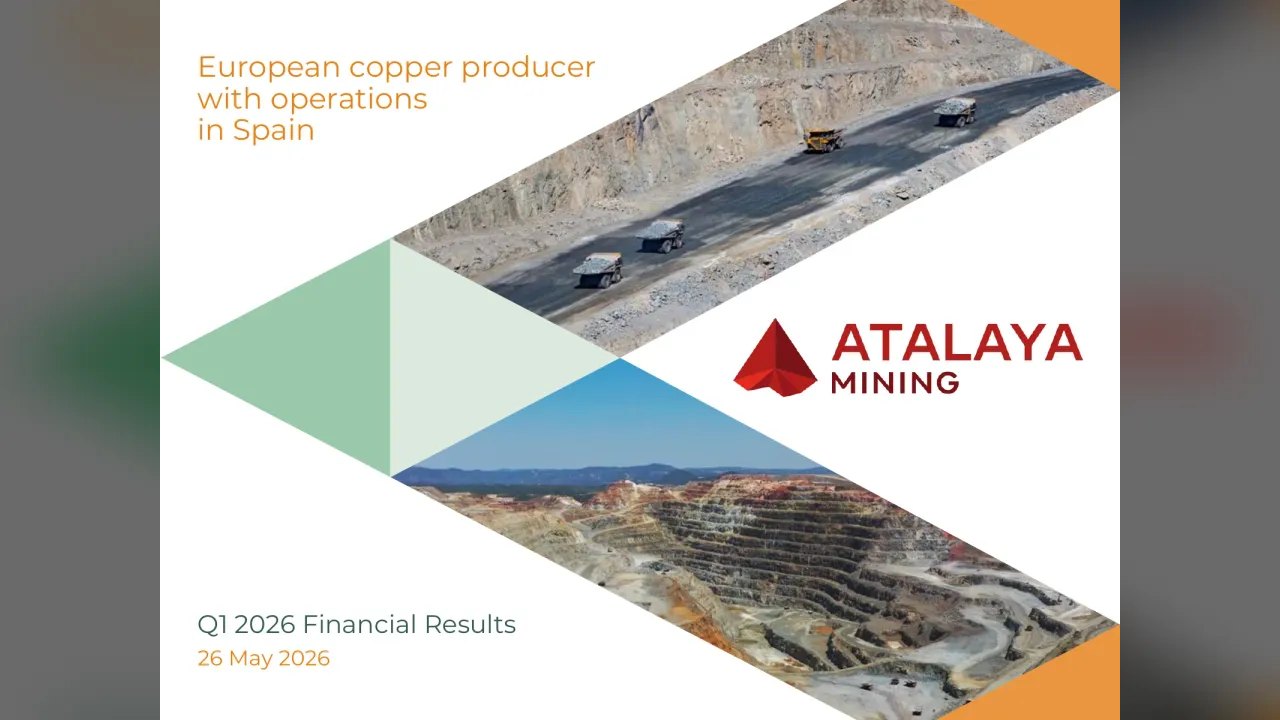
On 6ix: 6ix.com/event/atalaya-mining-plc-atym-q1-2026-earnings-call
Automated transcript · Written by software from the replay's audio. It can mishear names and figures; the replay is the record.
0:00 Good day, ladies and gentlemen, and welcome to Atalaya Mining Q1 twenty twenty six Results. At this time, all participants are in listen only mode. Later, we will conduct a question and answer session through the phone lines and instructions will follow at that time. I would like to remind all participants that this call is being recorded. I will now hand over to the CEO of Atalaya Mining, Alberto Lavendiera, to open the presentation. Please go ahead.
0:28 Many thanks. Good morning, ladies and gentlemen. Thanks for being here in the conference call to review the financial results for the first quarter of twenty twenty six. I will be using the presentation that's going to be in the web page and I'm with Pessa Sanchez, the CFO of the company that can answer any question the review of the slides. First quarter production had already been announced and as you'll remember it was was below plan. It was below plan because we had a wet heavy rainfall event higher than basically the whole previous year during late January and whole February.
1:25 But since then the end of the quarter and the first part of, well I would say most of the second quarter, so during April and May, we have exceeded our plan and we have recovered some of this shortfall during Q1. So we are trying to recover those losses and the cost performance even being with lower production was within our guidance. This means that in relation to the full year guidance, we will discuss this later with more detail, but we believe that's going to be unchanged because we see that we are going to be very very close to what we have guided before.
2:23 But we had a good EBITDA, we generated €48,000,000 EBITDA which was excellent and probably ahead of expectations. It was impacted by lower production but it had the positive impact of better high copper prices, better copper prices, actually we achieved very good realization prices, good silver credits and low treatment charges. In the following pages I will be saying a bit more about the financial performance in our growth projects. There are a few other comments in the page six of the slide of things that have been going on during the quarter like the acquisition of almost an 8%, 7.3% stake in Lara exploration in Brazil and a few other things.
3:25 Continuing with production results and you will see that the mill performed quite well but the rainfall impacted grades because we could not access the places where we were mining normally, so we had to rely in stockpiles and this really affected the production.
3:53 But even with that lower production as you can see in slide eight, we had very good financial results, although the revenues were lower, our the operating costs were also lower. The main reason for this as I said before was the high copper prices and lower TCs, RCs and we ended up generating 29,000,000 almost €30,000,000 of operating cash flow. This operating cash flow was more enough to cover our investments in Lara and the CapEx of around €20,000,000.
4:39 So after all this our balance sheet is extremely robust, extremely strong, we have almost €300,000,000 of cash and net cash of around €266,000,000 which of course includes the proceeds of our capital raise back in late January of around €150,000,000 but even with this low production we generated possible cash in spite of the investments even with this bad production results. And the reason for this is that we have kept a quite good control of the costs.
5:25 The cost performance overall in the first quarter is consistent with our full year guidance. Cash costs of $2.52 and all in sustaining cost of $3.20. If you compare that with year '25 you will see it's slightly higher but not much higher and if you compare it with '24 you will see that it actually is better than we had. The reasons for that as you can see in the details broken down in page nine is that we did have high mining costs and higher mining costs due lower production but also more importantly also with effect of unfavorable foreign exchange rates and also higher diesel prices have started to bite in this, I would say February, March and continue in April.
6:33 However, you will see that the byproduct rates which means silver have been negative almost double than what we had previous years, so very strong silver credits and also very low treatment charges. You will notice that treatment charges are negative. The reason of this is that we have been making some shipments into the spot market that have been sold at negative disease and also we have also benchmarks for the contracts that we have linked with long term contracts.
7:18 The benchmarks of TCs are quite low, much lower than previous year. This is also important because going into the future because most of or all of our legacy of tech agreements are expiring and they're expiring in a moment where the concentrated market is very tight,
7:45 which means we still have ahead of us an important period of production of concentrates in a moment where the traders and the smelters are ready to pay to treat our concentrates. We believe that this is a this uncommitted offtake is a is a hidden asset for Atalaya. In other words we could, if we wanted to, we could even capitalize in getting some funding if needed through the existence of this uncommitted offtakes both for the case of Rio Tinto and of course for our new project growth project in total.
8:38 All in sustaining costs of $3.20 are consistent what we had in '24 and slightly higher than what we had in '25 but of course this is as I said is due to to the lower production.
8:58 We normally benchmark our only sustainable with the rest of the industry and we are keeping of course keeping within the range going up relative to previous quarters but still within being quite competitive. Looking ahead of the guidance, we said we had a lower first quarter, but we were able to recover some of this shortfall during during April and and May. So right now we thought that looking at the planning ahead that we continue to expect our guidance for 2026 within the guidance between 50,054 tons of copper.
9:54 Now to be prudent we are saying and we believe we are likely going to be in the low end of that in the 50,000 range but we will continue to make efforts to recover as much of production and be able to get that higher.
10:17 In relation to costs as I said before we have so far we have achieved our guidance and it's consistent to what we had said. The only question that we have here is the uncertainty that we have around The Middle East.
10:34 We are constantly quantifying the potential impact. The potential impact here it comes mainly for the price with the price of diesel. Price of diesel has gone up I would say 20% in the last in Spain, in the last few months and explosives could be affected a little bit, not much, but could be affected a little bit due to the prices of gas which is linked with the price of ammonia with and the price of ammonia is linked with the price of explosives.
11:06 But the potential impact of the diesel is the one that is could have an effect on our costs. We have quantified that and we, if things continued as they were this year we could have an effect of around 15 to 20¢ in
11:30 the cash costs and not in costs. The reason for this is that we, for example, very simple numbers last year we consumed around 30,000,000 liters at our Rio De Janeiro operations so basically an increase of $10.15 cents or 20¢ will mean multiply the extra by the consumption you will get the extra cost that will be suffering
12:07 to the high diesel prices. Of course we expect that this this complex will be resolved in a favorable way and because
12:19 it looks like it looks like that's the way that the world is going to need it. And we don't expect really any other effect of this conflict. In the case of the energy, electricity, actually due to the high rain events in Spain, the price of electricity that as you know in Spain is very much linked with solar, wind, water, nuclear has been quite low and actually the effect of the higher gas prices has not been
12:57 asked in previous years and we don't expect that to have any high influence in the the costs that's why electricity really has not changed much. In relation to the CapEx guidance we have not made any changes and of course we had to do some developments
13:21 or in the case of per stripping obviously the effect of the diesel prices would have some effect in the CapEx guidance as well. Going to these investments that we are doing, one of the things we are doing is getting to the high rates of the San Denisio satellite deposit. You can see now what's the development of the San Denisio,
13:48 the pre stripping is advancing quite well and you can see in the picture we the idea is to get into mine some higher grades through through '26. Of course, the the stripping of 20,000,000 tons more or less in '26 could be affected with high diesel prices if this was the case.
14:15 We also continued to make some progress in the Massimo Verve development. Here we have a couple of rigs drilled in the red area, the copper area, we are finding very good rates there and we are getting ready after having acquired all the land and all the permits, we are preparing all the surface installations, we are preparing the explosives magazine and basically we expect to start the real escalation of the rub later in the year having gone through the contractor selection and of course subject to final board approval. In the meantime we'll continue drilling this zone to better understand the area that we are going to be lining initially.
15:03 We continue to do some work also in preparation to construct a line to recover the sink and lead. We do have around 130,000,000 tons of polymetallic deposits known and drilled within San Dionisio, San Antonio and Massal Valley which compares to around 190,000,000 tons of copper only ore. The copper only has lower grade and get better recoveries, the polymetallic has higher grades but also requires a specific circuit to recover it. The specific circuit, I've said this in previous times,
15:50 it basically is adding in a circuit to recover sink and lead, trying to maximize the use of the existing installation with a CapEx that this stage is around 80 to €90,000,000 which we are trying to optimize as we speak. We also have some drilling ongoing in in San Antonio which is is very shallow polymetallic deposit very close to Rio Tinto and we have there one rig and we also have one rig in Massa Del Merle and we continue to do some other exploration within the Rio Tinto East area and other parts of the Rio Tinto Belt. We continue to focus in potential opportunities within
16:42 Rio Tinto area, within the Pirate Belt because we believe this is what can give more value to the company. But obviously the important thing is the permitting of TOTO. TOTO during this quarter has had some significant changes.
17:03 We have had several meetings with the authorities finalizing the documentation, clarifying things before final reports were issued by different departments and actually the Minister Industry Maria Jesus Lorenzella she was saying that she was confident that the EIS, the environmental tax declaration will be ready before summer. Still not clear if before summer is before the June 21 or before August but the reality is that all the projects, excuse me, all the reports that have had to be produced, have been finalized
17:57 and we have been, we know they are all positive which means the environmental fact statement can only be positive and it looks like it's in the final stages. But very important also is the mention from the president of Galicia and from the high ranks of the Galician government that there is a strict commitment commitment to exploit the critical materials and the mining opportunities that are in Galilee. Announcing the launch of tenders for free licenses, announcing social measures in order to get some of the profits of the mines into the surrounding communities and really at the end the bottom line is a very proactive, very proactive measures from the militian government to to support mining and of course including including Toro.
19:03 At Toro, we are we have basically completed most of the front end engineering, we are advancing with tail engineering, we are buying we are buying some land or getting options of some other land in order to get fast access to the to the plant site in order to start construction as soon as possible. We have been negotiating with the main equipment suppliers for final tenders and ready to award the key equipment in order to shorten the the construction period. We have also strengthened our our teams. We have built a assay lab.
19:55 We are infill drilling around the pits that are going to to be the first starter pits. We continue to operate the water treatment plant. We are building field offices for the construction, so very confident that the plant, so the project will be approved and we are making prudently some preparatory works. We like Toro because it's going to be producing over 30,000 tons of copper, it's going to be our second producing asset, it has a low capital intensity, its costs are going to be around 50¢ lower than Rio Tinto and we believe it has a huge upside in the deposit itself and its surrounding belt around Togo.
20:59 With all this concluding, Atalaya is very well positioned to grow. We are getting ready to get to our focus of around 100,000 tons of copper equivalent which would come from Rio Tinto in the $5,060,000 range with total in the 30,000 or more range and with the zinc and lead as copper equivalent in the range of around 20,000 tons extra. The key components of this growth are all brownfield and we have the teams and we have the balance sheet. We are very fortunate that we have a very good balance sheet and the teams to build it and the important thing here is that we are ready to deliver this in a very short time frame, we're not talking about five and ten years, we're talking about three years or so.
22:03 And I think this concludes my my presentation. I would like to open it to some questions for me or for Thesser. We will now begin conference line questions. Your first question comes from the line of Laura Chan from RBC Capital Markets. Your line is open. Hi, good morning. Thanks for the call, Alberto and Cesar. Just a couple of questions on my side. So the first one, how much of the Q1 production shortfall has been kind of recovered post the quarter? And what gives you the confidence that the guidance range is achievable? Are you really getting into those high grades at Saint Deniso already? Should we see that grade uplift come through? And just you can I'll move on to the Yes.
22:56 Second We are getting from around 2,000 tons, 2,200 tons in the minimum shortfall. On the guidance, we have recovered around 800 already. So we are we are short around 1,400 more or less from our plans. We have obviously this follow-up daily follow-up. And yes, according to the planning guys that we have had to switch from one places to the other, some places to the other. But according to the plan, we will we would be there in the in the range if everything is fine in the range of 52,000 tons. But let's say, assuming everything goes okay, is the plan.
23:45 Okay, understood. And you also mentioned that your legacy contracts are coming to an end. Could you just give an update on how you're thinking about spot versus benchmark mix going forward? Are you just willing to sell most of the concentrate on spot to kind of perpetuity? Is that how we should be thinking about it? I think, you should be seeing us, looking at the spot tenders. Last last year or beginning of the year, we had a tender with, five or six off takers and the smelters. We tended 200,000 tons of concentrate, 100,000 for this year and 100,000 for next year. And we got negative, TCs, three figures.
24:35 And with two we divide that with two important traders, not first class traders. We believe that that's the way we are going to continue to do it in an open tender for everybody and with very clear, very clear specifications so that we can benefit. We are all the relief that this situation with the smelters is going to to be there for quite a long time, certainly not one or two years due to two reasons. The smelters are still surviving nicely with the high prices of sulfuric acid. Now much even much higher with the conflict of of Iran, but also due to the high prices of of gold and silver that they recover as another port. So the smelters are not going to close due to lack of funds plus the premium of copper cathodes.
25:30 And we believe that the situation with negative disease is going to last for quite a while until new production comes in, which is not that straightforward. So we plan to to end up our existing roll out our existing contracts, which are finalizing all of them between this year and next year and continue with this, with the spot tenders or limited tenders saying, okay, we tender out 200,000,300,000,100,000 and and we lock in these negative prices for one year, two years. Okay, understood. I'll pass it over to someone else.
26:15 Thanks so much. Thanks Laura. Your next question comes from the line of David Redcliffe of Global Mining Research. Your line is open. Hi, good morning, Berto and team. So my question is on the operating costs as reported in the income statement. Last year reported costs were about €72,000,000 This year, there's EUR 60,000,000. There's not many people kind of reducing overall costs. So could you help bridge the gap here? I mean, overall total material movement was down, what, 2,000,000 tonnes, so that might be EUR 5,000,000. So what's the balance item here? Is it higher capitalized stripping at Cerro? Is it the TCs? That would be helpful.
27:02 Tessa, do you have the breakdown there? I believe first of all is lower amount of material for sure. Then that's the main question. Maybe plant costs have been slightly lower actually than previous year due to the lower electricity prices. I don't think that these are these TCs, RCs included? I'm not sure if the TCs, RCs are included in the first line. I think they are in the second line. Yeah. You have you can you give a breakdown to to David, Cesar?
27:49 So I I don't have the full breakdowns with me now and but happy to work on it. But the the the main reason is you you spoke about absolute terms and these are related to volumes as we have been producing less volumes and in terms of TCRCs, they are protected from revenue. So in this case they are added to the revenue. So you won't see that on the operational cost. As we go, let let me go a little bit more detail on operating cost and I'll get back to you. No, the main reason is lower volumes, slightly lower distances and that's the main reason. Maybe also some part going being capitalized depends on the amount produced because if we are producing less normally we capitalize a percent proportion of the excess that goes on top of the strip rate, the average strip rate is capitalized and you will see it in the all in sustaining costs.
28:56 Okay, now that'd be good to get a bit more clarity around that. And then maybe as a follow-up, given the events state of engineering at Toro you were talking to and then the early preparatory works you've already undertaken, are you still confident about costing of the project? Because the obviously, the capital intensity is quite low. So just wondering if there's been any movement either way there? Well yes, are seeing a slightly higher CapEx in our final numbers when we look at everything. I think we'll be in the range of 300,000,000 instead of $2.60 to €70,000,000 we'll be in the range of 300,000,000. This is the last estimate. This is the last estimate that I have assuming there's still a contingency of 2.5 I think we had.
29:51 It's also true that with the higher certainty of costs, the contingency should be lower. So I don't think we'll see much more than that. I think we'll be in the range of €300,000,000. So yes, there was some inflation relative to the past but not much. The main reason of this is that once you go to final equipment tenders, the people know that's the final one and the prices actually are getting more tight in the big mills or in the filters or the gyro crusher.
30:37 And then another thing is that's quite a big difference versus others, other projects that are located in the middle of nowhere, is that you are within an area with a heavy industry and construction, where you have concrete plants within a few kilometers, have very good access to ports, good fabrication, you don't have any camps, people go and assemble things like and the next day they will go and assemble something for any other industry. So, inflation from that point of view, has been quite modest. Brilliant, that's great, thank you, I'll pass it on.
31:24 Your next question comes from the line of Richard Hatch from Berenberg. On this DIA approval, when you say before the summer, so how should we sort of think about that? Is that within the next six weeks or so? I'm just conscious that we've sort of had this promise for a number of, well, well over a year, and I think the market is sort of getting to the point where it's becoming a sort of cause of frustration for some corners of the market and also perhaps something that is the tail that wags the dog from other sides of it. So it'd be good to kind of try to get get a a clearer understanding of your exact time frame frames of this, and, you know, what is the impact as well if you don't get the permit by the summer? Does that mean that now it's a September story and that pushes first production out by a quarter. Can can we just talk a bit about that?
32:22 You are 100% right. It's not not only the the market is frustrated. I can tell you we are very frustrated also. We are extremely frustrated. The difference between now and then is that we knew that there were some reports, specifically the water report that was being prepared and they came back with questions of last minute and Adish asking for additional clarifications and so on and forever and forever. Now the reports are final and contain the word positive, which means now the only thing that's pending, it's the environment pack declaration preparation, which basically is a summary of all the different reports around '27 with our summaries, which we have already provided and put everything together in what they call environment's back statement or in Spain is the This shouldn't take more than four weeks even working very slowly and that's why the minister has said that she expect this before summer.
33:39 Before summer meaning the real summer which starts in June, late June, or before, this is what we expect, or before summer which is, let's say, holidays in August. If it delayed over August, I would say yes, we would see a delay of the whole thing. The main reason for this would be that we would not be able to start the movement, the topsoil removal and geotechnical final works for final concrete foundations of the mills during the summer period, and we'll have to go into September period or October, which is more rains and it's always complicated things.
34:27 But we are quite confident that from what we have seen and what the discussions we have had, and I have been personally there in meetings, that this is, they are working on this declaration which will probably be before the end of June. This is what we have been told. That's great. Out of our control. Hate to say that I have been wrong so many times that I almost feel embarrassed because I am from this region. I am from this area it's embarrassing how bureaucratic it can be, but it looks like now it's real. Good, okay, let's hope.
35:14 Then secondly, just very quickly on the Q2, How should we be thinking about the capitalized stripping in Q2? Should we expect an increase on that $0.42 a pound? Or should we expect it to be flat, lower? What's your view? Flat, I would say. I think it will be Q2 will be should be very similar to Q1. Okay, clear. That's me. Thank you very much. There are no further questions on the conference line. I want to hand over to management for closing remarks. Many thanks. Well, thank you for being here. Thank you for your continued support. And we look forward for a good second quarter and the rest of the year.
Follow Atalaya Mining Copper SA into a list and get an email when it puts out news.
CEO at Atalaya Mining
CFO
at RBC Capital Markets
at Global Mining Research
at Berenberg