Kate Kuehl
Head of Investor Relations
Replay available
Archer Aviation (NYSE:ACHR) Q2 2026 earnings call, held 2026-08-10. Watch the replay and read the transcript on 6ix.
On 6ix: 6ix.com/event/archer-aviation-inc-achr-q2-2026-earnings-call
Automated transcript · Written by software from the replay's audio. It can mishear names and figures; the replay is the record.
0:00 Hello, everyone. Thank you for joining us and welcome to the Archer Aviation's Second Quarter Financial Results Conference Call. After today's prepared remarks, we will host a question and answer session. If you would like to ask a question, please press star one to raise your hand.
0:18 I will now hand the conference over to Kate Head of Investor Relations. Please go ahead. Welcome to Archer's earnings call. This is Kate Keywell, Archer's Head of Investor Relations. Today, we will be making forward looking statements that are based on current assumptions. We don't undertake any obligation to update those assumptions as a result of new information or future events. Risks and uncertainties may cause our actual results to differ materially from those contemplated by these statements. For more information about potential risks and uncertainties, review the risk factors in our SEC filings.
1:03 Today, we will also be discussing both GAAP and non GAAP financial measures.
1:09 A reconciliation of those measures is included in our earnings release from today. Now, I'll turn it over to Adam. Adam? Thanks, Kate. Today marks an important inflection point for Archer. So let me spend some time walking you through the rationale for the exciting transaction we announced with Boeing earlier today. We entered into agreements to acquire three highly innovative Boeing owned companies, Whisk Arrow, In Situ, and SkyGrid, in exchange for Boeing taking a strategic equity stake in Archer. We anticipate closing the transaction by the end of the year. This partnership will help accelerate the evolution you've heard me talk about for a long time. Archer has diversified aerospace and defense platform with a physical AI product portfolio that will span air taxis, unmanned aircraft systems from group two to group five, purpose built AI for aviation, and the vertical technology stack for autonomous flight.
2:09 Let me walk you through how we got here. I founded Archer with one goal, finding the most efficient path to commercializing air taxis, and built a world class team to do it. We remain incredibly focused on this goal as air taxi will always be core to our mission. And midnight is well on its way. We went from an unknown in 2018 to the front of the pack on FAA certification today. Defense, as I've been saying for the last eighteen months, is becoming one of the largest near term markets for the BTOL industry. We first announced our partnership with Androl at the end of twenty twenty four. Palmer Lucky, one of the founders, had come to me with a concept for an autonomous, dual use, loyal wingman for attack reconnaissance helicopters like Apache, and they chose Archer's team to build it alongside them.
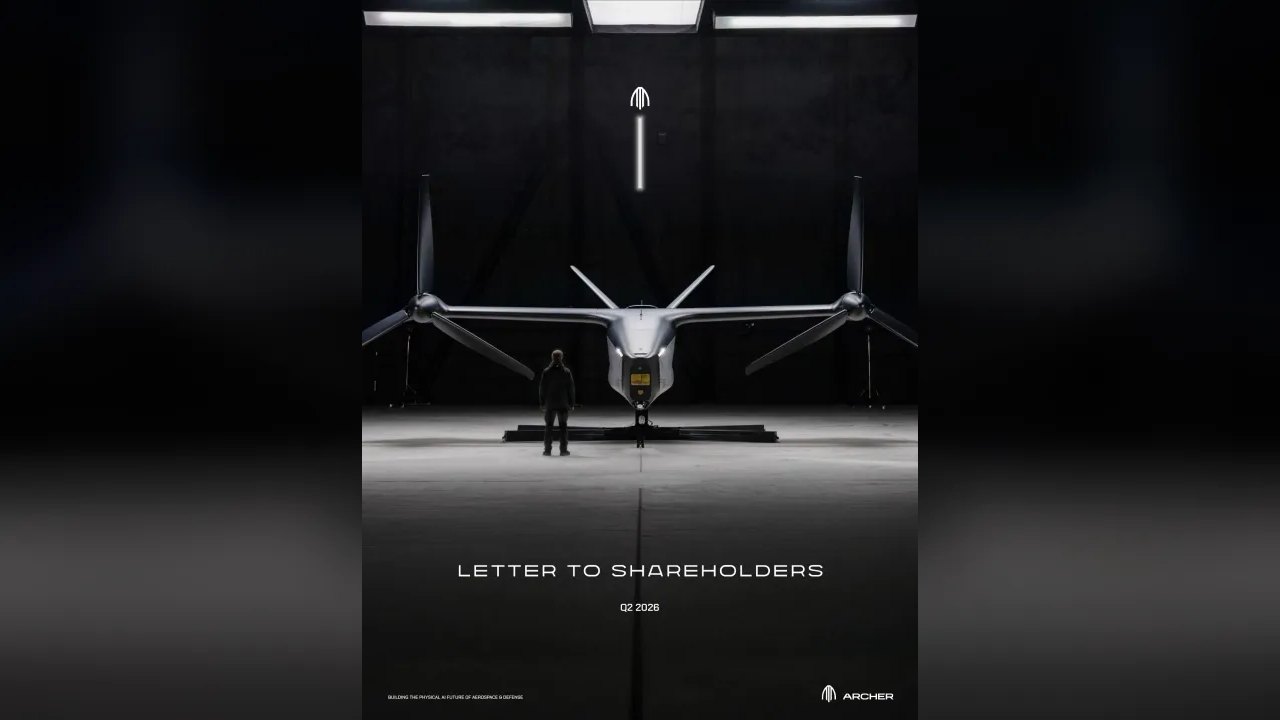
2:59 Since then, our teams have been building this aircraft together. Archer took all our learnings from years of eBTAL development, airframe design, rotors, powertrain and actuation systems, knowledge from the midnight program and put it into something new. A clean sheet, autonomous, hybrid aircraft platform for both commercial and defense. Last month at Farmborough, we jointly revealed the Halo Thunder platform, and I'm confident it is revolutionary, not evolutionary. Unlike what many others are doing, this is a clean sheet, first principles approach targeting both commercial use cases, including logistics, humanitarian, medical, and maritime, as well as multi decade defense programs of record with allied forces.
3:45 This is why for the past year, we've been assembling a world class Halo Thunder team focused on developing this platform. With this transaction with Boeing, we can utilize Whisk's incredible talent to round out that team. Wisk traces back to Larry Page, who gave this industry its start nearly twenty years ago. And they're right down the road from us here in Silicon Valley. Their engineers have spent nearly two decades building some of the most advanced autonomy, flight control, and sensor technology in the industry, designed from the start for autonomous flight. The opportunity is clear to me. Deploy and harden the technology on Halo Thunder first, then fold it into future iterations of the air taxi when the FAA is ready to certify autonomy. I'm confident that our planned acquisition of Whisk can accelerate the Halo Thunder program at a fraction of the time it would have taken us to achieve the same results organically.
4:39 As part of this transaction, we will also acquire In Situ, one of the most trusted and reputable intelligence surveillance and reconnaissance, ISR, drone manufacturers in The US. It is profitable today with over 200,000,000 in annual revenue across 35 countries. They have built more than 4,000 group two and three UAS to date. Those UAS have flown nearly 2,000,000 flight hours autonomously, giving it one of the largest datasets of its kind. And that data will feed directly into our autonomy development. In situ will give Archer an immediate sizable revenue base to grow from. The key driver of this transaction was the relationship we've built with Boeing, especially former Whisk CEO, now VP of product for Boeing Commercial, Brian Yudko.
5:26 Boeing is synonymous with American built aviation, and the deal structure shows how leaned in they are on our future together. All stock with a lockup, a collaboration across many new fronts, committed future equity investments in Archer, warrants that exercise prices far in excess of our current price. For both companies, the core of this deal is the opportunity to jointly drive innovation across aerospace, defense, and autonomy and deliver long term value for shareholders. I wanna thank Kelly Wortberg and the Boeing leadership for the trust and belief in Archer as the right long term partner. Importantly, I've tasked my team with integrating these companies in a thoughtful synergistic way that will not structurally increase our overall cash burn. The focus is clear.
6:12 On the other side of this deal is a stronger Archer with an end to end physical AI platform for aerospace and defense. Last quarter, I called Archer a dual threat company, a nod to our air taxi and dual use autonomous VTOL aircraft program. This quarter, we shared more on the strategy for the third key pillar of our diversification approach, purpose built AI for aerospace and defense. We introduced the world's leading aviation specific foundation model. Zee is a unified intelligence platform built on ADS B, ATC communications, maps and charts, aircraft movements, terrain, and weather data. And just last week, we announced that Zee has delivered a breakthrough in aviation safety, highly accurate real time prediction of airport surface trajectories.
7:02 To bring this technology safely into the aviation ecosystem, our teams are working with the government agencies and customers to rigorously validate Zee in the real world. We couldn't be more excited to pair Zee with SkyGrid. We believe together those technologies can deliver a next gen air traffic management product that can play a critical role in modernizing air spaces around the world. I see a clear path to significant AI revenue, and the team is heads down building toward it. Now let me circle back to midnight. Through it all, air taxi remains a top priority, and the program made tremendous progress this quarter. This quarter, we flew multiple piloted aircraft on an almost daily basis across our fleet. And oftentimes those aircraft flew multiple times a day in testing across piloted VTOL and CTOL flights, including our first intercity flights here in California.
7:56 And over the next few months, you can expect us to begin flying in the LA area based out of the Hawthorne Airport and subsequently commence operations under the White House's EIPP later this year in Texas. We also continued our industry leading progress against our FAA certification program for midnight. I believe we remain the only industry OEM to be out of policy and in the fourth and final phase of the FAA's type certification process with a fully accepted means of compliance. Notably, this quarter, the FAA approved our quality management system, which hardens our ability to perform FAA for credit conformity findings across the aircraft, as well as its components and systems. We're actively working with the FAA on for credit testing this year.
8:45 On the infrastructure front, we co launched ACES, the American Consortium for Electric Skyways alongside Beta and Macquarie. It's an industry first approach to deploy interoperable charging infrastructure across The US and align OEMs on a unified approach, which is critical for scale and to lower cost for consumers. I'm proud to take this on arm in arm with Kyle and the team at Beta and look forward to welcoming many others who want to join the mission. We are executing all of this from a continued position of financial strength with $1,600,000,000 in liquidity. I started Archer to change the way the world moves. Nearly a decade in, I've never been more confident or more all in. With that, I'll turn it over to Priya.
9:32 Thanks, Adam, and good afternoon, everyone.
9:35 Building on Adam's remarks, the last few months culminating with today's transaction announcement are truly an inflection point for Archer. With the planned acquisitions of Wisk, Institu, and SkyGrid, coupled with our recent unveiling of Halo Z and ACES, we're rapidly advancing our diversified multi platform strategy across air taxis, UAS and AI to lead the next generation of aerospace and defense. We strongly believe we are uniquely positioned in the sector as we look ahead, both in terms of product portfolio breadth and depth, as well as both near term and long term revenue generation potential. In situ today is a profitable business generating more than 200,000,000 of revenue in air.
10:23 That, in addition to our existing air taxi platform, our Halo Thunder platform, and aviation focused AI solutions will significantly change the profile for Archer and our path to meaningful revenue in the years to come. We're not just an air taxi company anymore. In parallel with our focus on growing our top line, we remain focused on managing our net cash burn. We expect the planned acquisition to bring meaningful synergies across all platforms, Midnight, Halo Thunder, and Z. We will remain disciplined about investment across each of our platforms. Let me share the framework we will use to maintain that discipline quarter over quarter. First, advancing midnight to certification and scaled operations remains a top investment priority.
11:12 We expect to generate near term revenue through early operations, both in The US and internationally, and scale thereafter following certification.
11:22 Second, for Halo Thunder, our group five UAS platform with Andro, we've already been investing in technology development over the past twenty four months. And as Adam discussed, we're excited about the potential for the autonomy capabilities from Wisk to further accelerate that development timeline. We are focused on getting this platform to market as soon as possible as it carries a total TAM greater than $100,000,000,000 in the decades ahead. Midnight and HALO development timelines with their individual peaks and troughs align well, allowing us to stay focused on efficiently and synergistically leveraging our engineering talent across AirTaxi and UAS platforms. Third for Z and its product portfolio, our near term goal is for our AI solutions to be revenue generating and profitable as early as next year, with the potential for significant ramp in the back half of twenty twenty seven and beyond.
12:21 Finally, we expect in situ to contribute positive free cash flow after closing, allowing the business to operate on a self funding basis and potentially offset spend in other areas of our business if we are able to grow their business as we expect. Taken together, this framework gives me the confidence that we can grow the top line across our business while post acquisition close and through integration keep cash burn relatively flat from where it stands today.
12:51 Now let's switch gears to the results from the current quarter. I'm happy to report on very strong financial results for Archer. I'll focus on three key highlights. First, we continue to maintain a very healthy balance sheet with $1,600,000,000 in liquidity at the end of Q2. Second, we grew revenue to $5,000,000 for Q2, which is a 213% increase over last quarter. This was driven by our growth in operations at the Hawthorne Airport in LA. Third, we met our spend guidance. Q2 adjusted EBITDA was a loss of $177,000,000 which is on the lower end of our guidance range of $170,000,000 to $200,000,000 and only a slight increase quarter over quarter.
13:39 These results are an early indication of our ability to grow the business while staying measured in our use of cash, which is exactly what we must do in this next phase for Archer. For Q3, we estimate our adjusted EBITDA loss to stay within the same range of $170,000,000 to $200,000,000 as we continue to mature the midnight flight test program, including our operations under the EIPP, continue development of Halo and advance our AI solutions. Looking ahead, in addition to these key priorities, our focus will be on closing the transaction with Boeing as soon as possible with a target of end of year and then integrating the business efficiently and effectively.
14:25 It all comes back to the old adage, execution matters, and we are committed to delivering against the framework I laid out, maturing our diversified product base to fuel a growing top line all while controlling spend. And with that, I will turn it back over to the operator. Thank you. We will now begin the question and answer session. Please limit yourself to one question and one follow-up. If you would like to ask a question, please press star one to raise your hand. Your first question comes from the line of Savi Syth from Raymond James.
15:20 Please go ahead. Hey, good afternoon, everyone. Just with the announcement of HALO and Thunder. Can you hear me? Yeah. Back now, Savi. Okay. Great. Sorry about that. Could you with with HALO and Thunder platform versus the Midnight platform, was wondering if you could kinda kinda compare and contrast, like, some of the technical differences there and kinda what it might mean kind of from a parts procurement, production scaling, as you work on those two kind of platforms in parallel, and just how much you can kinda share between the two.
16:13 Yeah. Hey, Savi. This is Tom. Happy to answer that. The way to think about Halo and Thunder is this is a clean sheet new platform targeted at a totally different mission than midnight. So this new aircraft is targeted at flying heavier payloads much further, much faster than we can do with Midnight, and that's all around this different market that we see both in the defense side, you know, we're partnered with Andrew, on on the civil side. And so in order to to do that, though, we've been able to leverage a bunch of the core, I'll call them, like, technology building blocks that have been put together for midnight. So those are things like our batteries, electric motors, etcetera. But then, obviously, the one new piece of technology is the hybrid system in this aircraft. So by going hybrid, that's how we're able to unlock the ability to, you know, travel much further, faster, more payload, etcetera.
17:05 In terms of how we're executing on this, you know, it's still early in the development of the Thunder Halo platform. Target is to be in the air next year and then working towards customer deliveries in '29 and kinda scaling, you know, 2030 kinda from there. But progress has been tremendous so far. Interest has been fantastic. So really excited about it. That that's helpful, Tom. And just maybe with kind of the the acquisitions announced today, I was wondering if you and this is a broader question just beyond Halo Thunder. Just how do you envision kind of day one to day three sixty five kind of post merger and kind of getting the engineering teams from kinda the different businesses to start kinda working together and and when you can start kinda realizing some of the synergies or some of the kinda the benefits in in accelerating some of these developments.
17:58 Hey, Savi. This is Adam. So if there ever were two eVTOL companies that could come together, it would be Archer and Wisk. And the reason is we both built, 12 tilt six architectures, but we approached it from a different perspective. So Archer focused on finding the most efficient path to commercialization while Wisk focused on autonomy and advanced flight controls. And so there's really nice overlap, but there's also complimentary aspects that that make a lot of sense for these companies coming together. So there's gonna be an exploratory period to figure that out. We see it as an incredible enhancement in capabilities, and so we're excited to dive in. And there's also a lot of capability overlap and synergies working with in situ as well.
18:45 So Archer obviously has a lot of experience in VTOL products and new VTOL products. And so as we look at the ISR drone market, that is a large but growing significant significantly market. And so there's an opportunity to take a lot of our core technologies there and keep building for that market as well. So it's still early in a lot of exploration, but that's just a general framework of how we're thinking about it. Helpful. Thank you. Your next question comes from the line of Andres Sheppard from Cantor Fitzgerald. Please go ahead. Hey, everyone. Congratulations on the quarter and thanks for taking our questions. It was great to see everyone at the Farnborough Air Show last month.
19:31 Adam, lots to unpack here and certainly a lot of great developments. I guess it's clear that Archer no longer is an EV toll company, but really an aerospace defense and advanced air mobility platform. So I guess my first question, maybe to build on the last question is, in terms of the synergies and overall structure for the company, what are the key synergies that investors should be aware of? How will you prioritize the eVTOL business with the drone business? And what are you most excited about today's announcements? Thank you. Thanks, Andres. There's a lot of synergies here across the platforms, but there's also a really nice strategic rationale here where you have the large market of civil passenger carrying aircraft that has an incredibly large TAM, but also, I would say, some, you know, difficulty predicting exactly how fast it will scale and exactly when it will scale.
20:31 And so we're going through obviously the certification process, which is very rigorous and we're doing very well at that. And so as we've looked at accelerating our path towards revenue, the defense side of the business become becomes very attractive as there are pathways to launch autonomous products in in in different airspace that are just much easier to get to market more more quickly. And so if you can if you think about sort of the portfolio strategy here, there's ability to generate revenue, generate cash flow, use that cash flow to help really get us to profitability much sooner and reduce our burn across the civil markets, which can allow the overall strategy to build much better products and build a much bigger company for the long term while minimizing the dilution.
21:17 And so, again, this is still early days in us, you know, figuring out the exact strategy on how to deploy it, but I think that general framework is how we're thinking about it. And the enhanced capabilities we get, from the the Wisk platform, In Situ platform, and SkyGrid platform gives us a really nice go to market that we did not have before. Excellent. Thank you so much. That's super helpful. Thanks, Adam, for all that color. Maybe just a quick follow-up coming back to your recent unveil of your first dual use aircraft jointly built with Andorra. Just help us understand how are you thinking about commercialization of Thunder and Halo and how might those be complementary to Midnight? Thank you. Thanks, Andres. So we're building the core platform, the base platform, which we call Halo.
22:09 And that will have all of the kind of basic functionality that that aircraft, you know, needs to operate. We can then take that aircraft and give it to Anderol, which will ultimately missionize that aircraft. And so that's something that that Archer is not doing. That's something that Anderol is going to be doing for the ultimate end defense products. There, of course, will be different programs of record that that platform will go after on the funder side. But on the Halo side, there are customers that we will go after that have needs that have a similar use case without any of the defense capabilities. So think search and rescue or offshore energy, areas where you need to carry more payload much longer distances than what the midnight platform would be. So we've already announced an early customer, which is Meroveni, and there's been a ton of inbound, and we've had a lot of interest with existing customers we've been working with to find new solutions.
23:06 So the goal will be to find ways to take that platform and build it as quickly as we can, but also really try to minimize the the spend on that platform by leveraging a lot of the core capabilities that we've already built from the Midnight platform. So like another great example, you know, is the flight control system where we are leveraging a lot of the work that we had started with Midnight, but now we can also enhance with Boeing. So ultimately, the goal is a low cost platform that can really scale significantly. And by having civil and defense capabilities, you get really both those benefits. Excellent. Thank you very much. Congrats again. Exciting new times. We'll pass it on.
23:52 Thanks. Your next question comes from the line of James Kirby from JPMorgan. Please go ahead. Hey, good afternoon, guys. Congrats on the transactions. Maybe just following up, asking a different way from previous question. Where do you see and fit you fitting into the longer term portfolio at Archer? And maybe just could you just speak to the extent you can on the revenue growth drivers in that business? In the ISR world, the revenues that you see today are largely a result of the macro environment and the sales that happened from years ago.
24:40 So when you look forward from here, it seems very clear that there will be an increased demand for ISR drones, not just overall, but even new capabilities. And so there is a broad set of new products that are being requested, and I think there is a huge market growth potential across the broader ISR world. So in the very near term, there will be revenue and cash flow that will be generated from the existing product portfolio, but there's a whole new suite of products that can be built, that could be expanded, and generate a significantly higher revenue given the macro environment we live in today. Okay. Got it. I appreciate it. And then for my second question, I I wanted to ask you to unpack the collaboration agreement with Boeing a little bit more. It seems from the shareholder letter and the press release that they'll retain the Wisk autonomous stack for their future aircraft potentially.
25:43 Does it go further than that in the sense of what you guys have been building at Archer with, you know, the z platform and now SkyGrid on top of that as well as what you're doing with the Halo Thunder platform? Does Boeing all is there more avenues behind just the Wisk autonomous stack? So the transaction was set up where Archer will own the IP, but we will share the IP back with with Boeing as it relates to products built specifically around flight control systems, autonomy, and several other areas. The concept is really one of partnership. So Boeing took all stock in the transaction. They locked up the stock, and we will work together on through a collaboration agreement on enhancing and developing that product portfolio and also future products. Boeing, of course, has an entire suite of plans on both the civil and defense side, so there are lots of areas that I'm sure that they are interested in in developing.
26:47 From the Archer perspective, it gave us the ability to have a head start on a lot of the core autonomy stack, the pathway to certifying the autonomy stack on the civil side, and a pathway to deploying the flight autonomy on the defense side. And so it really is a win win here where by Archer developing this platform across flight controls, flight control computers, full autonomy, Boeing can benefit too. And by them taking all stock, it's really a win win across, you know, across the transaction. That's great. I appreciate the questions, Adam. Thanks. Your next question comes from the line of Austin Moeller from Canaccord Genuity. Please go ahead. Hi, good afternoon. So for the in situ acquisition, should we be thinking about this from the context of Boeing already manufactures a variety of like Group one through Group three or Group four drones under that product line and also the EOR, IR gimbal payloads that go on them.
27:52 And you can now combine those products with the Group five Thunder drone and also incorporate the Gimbal payloads onto Thunder, the green version of the Thunder airframe that you could sell commercially or internationally to other MODs? So in situ manufacturers the drones themselves. It's not being manufactured by some other Boeing entity. It's all contained within in situ. And Archer will start, you know, producing those drones and looking at ways of scaling up the capabilities there. As it relates to other companies and working with other companies, I think right now we're gonna be focused on really building just the core products that In Situ sells and really trying to grow that fleet and not really trying to push that to some other customers like our other partners that Archer has. And so that's gonna be the core focus is how do we get that portfolio in a really healthy spot? How do we take advantage of the macro environment that we're in where there's an increased demand for these types of products and really try to increase the manufacturing of group two, group three, group four drones that they manufacture today.
29:08 Okay. And if we're thinking about the the road map to getting to Thunder first flight in 2027, just given it's a dual tilt rotor design, can you just talk about some of the, the puts and takes and, challenges to to get to that point next year? Yeah. Hey, Austin. This is Tom. Well, like like I was mentioning to Savi earlier, while the aircraft looks pretty different, you know, standing a 100 feet away, if you look under the skin, the platforms, the systems onboard are really similar. So, again, flying with the same battery technology, same electric motor technology, same flight control software. In fact, we literally took the actual code that flies midnight, put it in the SIM for Halo, and the aircraft flew beautifully without any control designs to to that platform, which obviously we'll go do. So, you know, certainly, there's a lot of hard work for the team. We're excited about partnering with some of the new folks joining, you know, as part of this this deal and feel really good about it.
30:10 Awesome. I'll pass it back there. Thanks. Your next question comes from the line of Amit Dayal. Apologies. Your next question comes from the line of Edison Yu from Deutsche Bank. Please go ahead. Hey, thanks for taking our questions and congratulations on the deal today. First thing I want to ask is, you've obviously picked up quite a few assets over the last couple of years, right? You think of OverAir, you think of the Lillian patents. I guess, what is the vision here on putting together all these assets? And I think with WIT, you obviously have a lot of autonomy stuff. So just could you maybe share the vision? You have all these assets that include you got some of them for a very good price. What is the vision on putting these all together and what we will get?
31:04 Thanks, Edison. This is Adam. So some of the previous acquisitions we've done that focused a lot on the early patent portfolios that existed in the eVTOL space were a result of companies that were either shutting down or going out of business. And so I think that was pretty different where there were groups that had spent hundreds of millions or in some cases greater than a billion dollars developing IP that was available for us to pick up at a very low dollar cost. And in fact, we're heavily competed, you know, across the, you know, the EVTalk community as there were some very interesting IP there. As it relates to Wisk, In Situ, and SkyGrid, that is a it's a totally different and unique value proposition. A lot of this just came about as there are products and platforms that I think are actually more valuable as it relates to Archer than might have been in the hands of Boeing.
31:57 So for example, Boeing is focused on some of the big biggest platforms in the world. So big platforms like an f forty seven or seven thirty seven. In situ is a much smaller company, but that impact to Archer is substantial versus the impact even if in situ five x would have minimal impact to Boeing. So our investment in that platform can have substantial rewards in the very near term. And so in a lot of the cases that these assets actually can perform much better on our side. The same thing as it relates to air traffic control. So air the the ATC product SkyGrid is highly attractive to us for two reasons. One is it's a there's a macro environment where air traffic control needs to get, you know, you know, upgraded.
32:43 And two, we've been building this foundation model z that's highly complementary to that product that really can enable that product in a way that they couldn't have done by themselves. So by combining them together and allowing Archer to focus on it, we can get to market in a new space that is, I think, going to be ultimately very valuable, but we'll start out small. Again, probably more difficult for a larger company to go after just because of the size of the starting base. Gotcha. And just follow-up on on Boeing. Obviously, Boeing is now a a partner, very big investor in in onshore. How how does one think about the the future areas of collaboration? I don't know if you can elaborate more than what was announced in press release. It seemed like this is pretty long term.
33:29 You know, they they clearly entrust you guys a lot. Any kind of color you can provide there? Thank you. I don't wanna speak for Boeing and speculate on you know, from their perspective. But what I'm hopeful is that Archer can be a great partner to Boeing. And by building a lot of these advanced capabilities and really taking the torch and completing the task on a lot of the products that they had built, and then sharing some of that IP back with Boeing to enable some of their products, I think that would make it a true win win, and that's really my goal. That is it. Thank you. Thanks. Your next question comes from the line of Amit Dayal from H. C. Wainwright and Co. Please go ahead.
34:16 Thank you. Good afternoon, everyone, and congrats on today's announcement. Really interesting setup for you guys going forward. Adam, can you maybe just provide some additional color on what allows you to keep the burn rate contained despite recent developments with Andrea and now Boeing? Sure. So I can't say much as it relates to the transaction just given where we are in that process. But as I mentioned before, if there ever were two companies that could come together, you know, these are really attractive because we have architecture to start. So there's a lot of great synergies there where we can be working on. The second is we do have multiple programs. And on the defense programs, you know, the goal is to have, you know, programs ultimately one where r and d dollars can be created. And then In Q2 also provide the platform to generate cash flow. So And when you put all the stuff together, we're going work really hard to do this, but the goal is to keep the cost structure similar.
35:10 Understood. And then just a follow-up. In terms of the next set of milestones for Halo Thunder, can you maybe give us some sense of, you know, what some of those catalysts could be? Yeah. Hey, Matt. This is Tom. So like I mentioned, we're working hard to get the aircraft in the air next year. And, obviously, you know, in the background, there's work going on on the kinda customer program side that I can't get into details on. But we're pretty confident we'll be in the air next year. And then, you know, the idea is the the whole idea of going to market with the defense product first, or I should say the defense variant of the dual use vehicle, is that the certification pathway is much more straightforward. So, like, this first vehicle will have a, you know, military specific airworthiness, and then we'll incrementally be increased from there as we get into civil markets. And so that really just provides a great setup to take this technology that's already been hardened on midnight and get it out there, you know, in flying products very rapidly.
36:12 Understood. Thank you, guys. That's all I have. A reminder, if you would like to ask a question, please press star one on your telephone keypad. At this time, I would like to turn the call over to Adam for our retail questions. Adam, please go ahead. Thanks. There's been a lot of questions on Archer's priorities, commercial versus defense and how should we think about which will be the larger revenue driver and profitability.
36:58 So we are certainly not taking our eye off the prize on midnight. Midnight is core to our platform here at Archer and we will work on that platform and get it to market. But defense does give us a pathway to deploy products faster and that does come with revenue and learnings. And now with In Situ, we'll be generating substantial revenue in a high growth industry which can help bridge the path to getting to profitability sooner. And so with Thunder, we'll look at the Halo Thunder platform. We're looking at several multi decade programs of record with allied forces, but the commercial markets will remain the larger market, and we have not taken our eye off the prize there. At this time, there are no further questions.
37:45 I will now turn the call back to Adam for closing remarks. Apologies. We actually have one more question from the line of Savi Syth from Raymond James. Please go ahead. Okay. Thanks for the additional question. Could you kind of briefly talk about, you know, I think Priya mentioned that maybe software generating kind of revenue and profitable by kind of the back half of next year. Just generally kind of what needs to happen on that line to kind of get that generating cash flow? Sure, Savi. So I think part of this has to do with Z, which is our Archer's Aviation Foundation model. And so a way to think about it is, America's aerospace moves over 3,000,000 people per day, and it's built on systems from decades ago.
38:38 And the data behind all those flights are siloed from cockpits to towers. And so Zee turns that data into single intelligence layer that gives pilots, airlines, operators a window into the future. So think better decisions, safer, more efficient operations. So these like the brain and we're building products that will span three markets, pilot applications, air traffic management, and airline operations. And we've designed it to be built anywhere that aviation is needed, whether it's in a cloud or on the edge, which is fully offline. So it's not theoretical. These are already discussions we're having with government agencies, industry partners, and in early deployments. So the goal is to take those products, send them out into the market. We've seen a lot of interest in them and start producing revenue and ultimately profitability.
39:27 Got it. And then if I might, just on the VIPP and and flying in LA, just wondering kinda the the kind of the progression there, you know, what milestones you need to kinda meet flying in LA before you start working on EIPP? Just any, high level kind of flight testing update. Hey, Savi. So first, just real quick at the high level testing update. We've actually we've flown over a 150 piloted test flights, and we're flying up to five times a day and many flights over 50 miles, and we're flying between airports now. So and, of course, we're on track to full transition later this year. So lots of great progress on the, piloted flight test front. With regards to EIPP, you know, as we talked about last quarter, you can expect us to begin that, initial EIPP operations later this year, and that plan is largely on track.
40:21 And so we'll start with CTOL, and then we've got more aircraft coming on at the end of this year and beginning of next year, and then we'll we'll roll further as we go. So I think that probably captures, your question back to you. It does. Thank you. At this time, there are no further questions. I would now like to turn the call back over to Adam for closing remarks. Well, thank you everyone for joining the call today. It was an important day for Archer, I think a broader industry. I'm grateful for everyone here at Archer for all their tireless work. And I also want to say how appreciative I am of Kelly Ortberg and the Boeing team for their trust throughout this transaction that we announced this morning. So thank you, everyone, for joining, and we look forward to sharing more over the course of the quarter.
41:09 This concludes today's call. Thank you all for attending. You may now disconnect.
Follow Archer Aviation Inc. into a list and get an email when it puts out news.
Head of Investor Relations
Analyst, Raymond James
Co-Founder and CEO
Analyst, Cantor Fitzgerald
Analyst, J.P. Morgan
Analyst, Canaccord Genuity
Analyst, Dutch Bank
Analyst, H.C. Wainwright