Tom Devine
Vice President of Investor Relations and Finance at AirJoule Technologies
Replay available
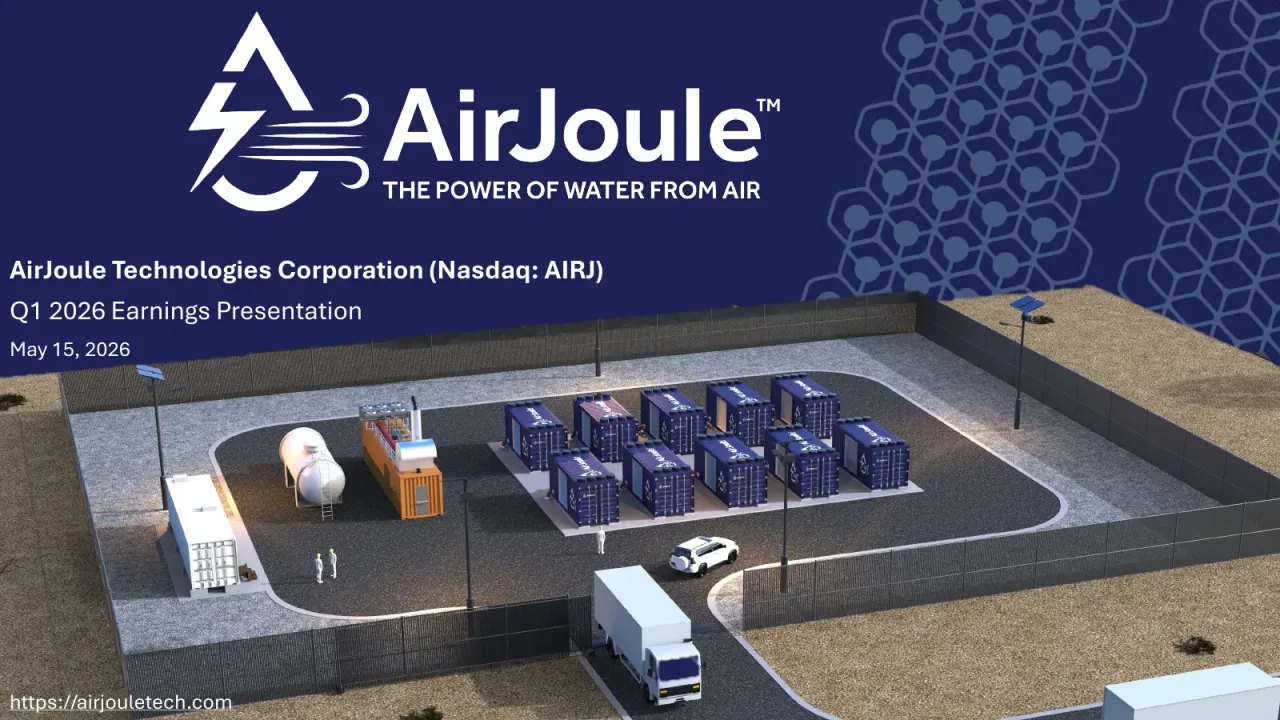
AirJoule Technologies (NASDAQ:AIRJ) Q1 2026 earnings call, held 2026-05-15. Watch the replay and read the transcript on 6ix.
On 6ix: 6ix.com/event/airjoule-technologies-corporation-airj-q1-2026-earnings-call
Automated transcript · Written by software from the replay's audio. It can mishear names and figures; the replay is the record.
0:00 Greetings, and welcome to the AirJoule Technologies First Quarter twenty twenty six Earnings Call. At this time, all participants are in a listen only mode. A question and answer session will follow the formal presentation. Please
0:19 note that this conference is being recorded. It's now my pleasure to turn the call over to your host, Tom Devine, Vice President of Investor Relations and Finance. Thank you. You may begin. Thank you, and good morning. With me today for our first quarter twenty twenty six earnings call are Matt Dror, Chief Executive Officer Pat Eilers, Executive Chairman Brian Barton, Chief Commercialization Officer and Stephen Peng, Chief Financial Officer. During this call, we will be referring to a presentation, which is available on the webcast platform and on the Investors section of our website. I would like to point out that many of the comments made during the prepared remarks and during the Q and A section are forward looking statements that involve risks and uncertainties that could affect our actual results and plans.
1:06 Many of these risks are beyond our control and are discussed in more detail in the Risk Factors and the forward looking statements sections of our filings with the SEC. Although we believe the expectations expressed are based on reasonable assumptions, they are not guarantees of future performance and actual results or developments may differ materially. And now I will turn it over to Matt Joar.
1:28 Thanks, Tom. Good morning, everyone, and thank you for joining us for our first quarter twenty twenty six earnings call. On our last earnings call in March, we framed 2025 as the year we built the foundation for commercialization through our initial deployments at our joint venture with GE Vernova and 2026 as the year we move from those one off deployments to productize commercial sales. We are executing against that plan. So far in 2026, we've made disciplined progress on the AirJoule core platform, completed the build of our first AirJoule Prime full scale system at our Newark, Delaware facility and continued advancing customer engagements toward commercial pipeline building in 2027 and beyond.
2:13 Before I describe that progress in more detail, I want to spend a little time on the macro. The water resilience tailwinds we discussed on prior calls have not slowed. They've actually accelerated. Water scarcity is becoming more central to industrial planning every quarter. In recent weeks, multiple hyperscalers have abandoned multibillion dollar data center projects in the face of community opposition tied to water access. Institutional investors representing more than $1,000,000,000,000 in assets have pressed those same companies for site by site disclosure of their water use. When the largest cloud operators in the world walk away from projects of that scale over water access, the signal to the rest of the market is unmistakable.
3:05 At least a dozen U. S. States have introduced data center moratorium bills this year and Bloomberg has documented that roughly two thirds of the data centers built in The U. S. Since 2022 sit in areas already under measurable water stress. Drought, regulatory pressure and the accelerating water demands of compute and infrastructure are all intensifying, not abating. This is exactly the problem AirJoule was built to help solve. Now let's discuss how AirJoule fits into this picture, particularly with respect to data centers. We applaud the work the industry has done to drive water consumption down. Closed loop systems, direct to chip cooling and continuous improvements in water use effectiveness or WUE are real progress.
3:57 The most efficient WUE levels we see today are on the order of 0.1 liters per kilowatt hour at the most advanced hyperscaler facilities. However, these facilities are hundreds of megawatts or even gigawatts in scale. So the absolute volume of water consumed is still substantial and requires significant water permits. Beyond the initial draw to fill the system, there are continuing requirements for closed loop water replenishment, humidification and domestic uses. For the millions of gallons of water that even the most efficient data centers still consume, AirJoule can reduce dependence on multiple supply and aquifer access through on-site water generation.
4:47 Turning back to our progress so far in 2026, on productization, our AirJoule core platform improved performance and durability through systematic optimization of airflow, thermal management and contactor coating process. The core design is essentially locked. On certification, we've advanced our UL and water quality work to ensure our systems are compliant with the most stringent regulatory standards. Brian will share more on that in just a moment. On our flagship PRIME platform, our first full scale AirJoule PRIME system has been built at our Newark, Delaware facility and is now operational. This is a meaningful milestone. The Prime is a system we engineered for scale from day one, and we'll spend more time discussing it shortly.
5:36 On commercialization, we're seeing strong customer demand across an important range of markets, and Brian will walk through where we are deepening the most active engagements. On the balance sheet, our combined cash position supports our operations through 2027 with no debt, and Stephen will provide more detail in a minute. The bottom line is this. We're on course. We developed our technology and are now a product company. Our internal organization reflects that with strong product engineering leadership and every work stream aligned to a product roadmap. We are doing this year what we're doing this year lays the foundation for scaled commercial pipeline building in 2027 and beyond. With that, I'd like to turn it over to Mr. Pat Eilers, our Executive Chair.
6:27 Yes. Thanks, Matt, and good morning, everyone. Before Brian walks through our product and commercial update, I would like to share an update on governance and our progress in The Middle East. As disclosed in our proxy statement filed on April 15, effective 05/28/2026,
6:49 Max Baucus will be stepping down from the AirJoule Technologies Board of Directors. On behalf of the entire Board, I want to thank Max for his service to the company. Max served six terms in the U. S. Senate, representing Montana and served as U. S. Ambassador to China. He has been a tremendous Director since our formation. He brought a depth of experience in public policy, international affairs and industrial strategy that has been invaluable as we have built AirJoule into the company it is today. We are grateful for his contributions and wish him well in everything that comes next. I'm also pleased to announce that Stu Porter has assumed the role of Lead Independent Director of the Board and will also serve as Chair of our Nominating and Governance Committee.
7:46 Stu has been active and engaged Director since the company's formation and his leadership in these new roles will strengthen our governance and support our path to commercialization. Turning to The Middle East, concern about water security in the region continues to grow given the region's dependence on desalination. AirJoule remains actively engaged with UAE government and regulatory leaders to build awareness of how our technology can bolster water infrastructure resiliency through distributed AirJoule placements. UAE leadership has signaled a clear intent to lead on water security through innovative technology, and we believe the AirJoule value proposition is a strong fit.
8:39 Our commercialization path in the Middle East region begins with the initial proof of value installations at potential UAE clients. From there, we will plan to scale across The UAE, the broader GCC and Global South markets that can benefit from those referenced deployments. Through the balance of 2026, we expect to build AirJoule's profile in influential industry and thought leadership gatherings, often in coordination with the Global Climate Finance Council, NASDAR and the UAE Ministry of Foreign Affairs. These efforts will lead up to our participation in the UN Water Conference, which will be co hosted by The UAE in Senegal in Abu Dhabi in December 2026.
9:35 With that, I'll turn it over to Brian to discuss our product and customer progress. Thanks, Pat. I want to walk through four areas this morning. Our core platform, which will have two product variants, our first prime build and our commercial engagements. And then I will close with a brief look at the rest of 2026. Starting with the AirJoule core platform. 2025, we made a deliberate decision to focus our build activity on the core platform because core and prime share a common sorbent chamber architecture, which means every core deployment also de risked the path to prime. This year, we have improved the performance and durability of the core system through systematic optimization across three areas: airflow distribution, thermal management and contactor coating.
10:27 The first generation core design is now locked. We may make minor dimensional adjustments as we finalize manufacturing, but we're at a form factor that we can scale.
10:37 We now have updated product spec sheets available on our website at aeroduilletech.com, I and would encourage anyone interested in the technical specifications to take a look. We're planning to launch the core platform in two product variants targeting two distinct markets. The first is the AirJoule core AWG variant with the target commercialization launch of late twenty twenty six. The primary customer focus for core AWG is the U. S. Military and small residential deployments. With the U. S. Military, we are collaborating through our existing Cooperative Research and Development Agreement or CRADA with the U. S. Army Engineer Research and Development Center. The CRADA brings together AirJoule's waste heat to water platform and ERDC's tactical water recovery research to deliver resilient water supply solutions for forward deployed personnel.
11:32 The second variant is the AirJoule CORE DH with a target commercial launch in 2027. CORE DH is materially the same product as CORE AWG, the same hardware optimized through process configuration and controls for dehumidification application. This variant targets the global installed base of conventional desiccant wheel dehumidification systems for humidity control between 3050% relative humidity. I want to spend a moment on the dehumidification opportunity because this is the first time we are presenting concrete performance data publicly. AirJoule's metal organic framework sorbent regenerates at 60 to 70 degrees Celsius compared with 120 to 150 degrees required for conventional desiccant wheels.
12:24 That difference is fundamental. It enables heat pump driven regeneration in place of electric reheat or natural gas. Our initial performance data shows up to approximately 40% energy savings versus incumbent desiccant wheel technology in our target operating ranges, and we expect further improvements over the next few quarters leading up to the product launch. Our initial target markets for core DH are dry storage and cold storage facilities operating between 3050% relative humidity. Last year, we announced an MOU with a defense contractor to collaborate on this dehumidification application. This engagement has informed our core DH development and we expect other markets and applications to follow.
13:13 Now let me turn it over to AirJoule Prime. As Matt mentioned, we have hit a meaningful milestone with the completion of our first full scale AirJoule Prime system, which is now operational outdoors at our Newark facility. We will provide a meaningful update on its performance on our next earnings call. AirJoule Prime has been engineered for scaled manufacturing from day one. The Prime contains 16 vacuum chambers sourced from established suppliers at low cost. With the balance of the bill of materials made up of off the shelf components such as valves and pumps. The only custom component is the sorbent coated contactor, which we are manufacturing in house. The overall design of Prime is set. Further refinement will be limited to sorbent level improvements and individual component tuning.
14:06 All of the work we did across twenty twenty five to optimize core, particularly the thermal management and the airflow, directly informed the prime design and it's expected to translate it into prime performance. The prime is designated or designed to deliver up to 2,000 liters per day or less than 200 watt hours per liter when paired with low grade waste heat, with a maximum power draw of just 12.5 kilowatts and configurability across waste heat sources from 60 degrees Celsius and above. Over the next several months, we will continue to optimize this system in Newark. This first prime unit is planned for deployment in Europe as part of our Net Zero Innovation Hub collaboration. We are also building another prime system to serve as our internal showcase unit at our network at our Newark facility, supporting customer demonstrations and proof of value engagements throughout the year.
15:04 Regarding product certification, we will pursue UL certification of the AirJoule systems for electrical components, while water quality certification will be addressed on a case by case basis depending on the customer requirements and their location. And importantly, our products already meet FDA bottled water standards and will be compliant with California Water Quality Standards, which are the most stringent regulatory standards in The United States. We believe that designing for compliance with the most demanding applications positions us well across the rest of our addressable market. Let me turn now to customer engagements that lead to a commercial pipeline in 2027 and beyond. First, hyperscale data centers. As we've talked about previously, AirJoule's value proposition for data centers is that we can utilize low grade waste heat to produce pure distilled water on-site.
15:58 On-site water generation delivers operational resilience and supports water stewardship and community license that hyperscale operators increasingly require. We're currently working with a leading hyperscale operator on a detailed evaluation of AirJoule Prime's economic and technical performance at discrete data center locations. This work has deepened our understanding of the value that AirJoule can deliver when tethered to waste heat. Building from this understanding, we recently published a white paper articulating AirJoule's economic benefit across both water cooled and air cooled data center configurations. AirJoule can help address the water permit constraints for new data center construction by generating distilled water on-site from atmospheric humidity.
16:47 And given that a 100 megawatt data center can generate 3,000,000 $5,000,000 per day of revenue, AirJoule CapEx can be recovered in just days of avoided permit delay. We're also building momentum through the net zero innovation hub for data centers. Waste heat reuse from data centers has emerged as an important regulatory priority in Europe under the EU Energy Efficiency Directive, and we are in close conversations with the consortium's members to address that need. As referenced earlier, our first prime unit is planned for deployment in Europe in conjunction with the NetZero Innovation Hub to demonstrate AirJoule's integration into a data center and its ability to convert waste heat into pure water.
17:34 Second, residential development. We are deepening a co development framework with a global partner targeting water scarce U. S. Residential markets in The U. S. Southwest. The Southwest is increasingly an environment in which residential development projects are restricted due to a lack of water security. Our AirJoule platform addresses that constraint directly. And during the first quarter, we completed deployment of an AirJoule core system at the Red Dot Ranch Foundation site in Pascadero, California. The pilot validated off grid water generation that supports Red Dot Ranch's climate positive housing development. Third, water delivery and distilled trucks distilled water. The global water distribution market is approximately $50,000,000,000 and in many U. S. Markets distilled water sells for above $1 per gallon, driven not by raw supply, but by logistics of trucking water from distant wells to the customer.
18:35 In collaboration with a waste heat partner, AirJoule's waste heat to water economics can result in operating costs below $0.10 per gallon, positioning us favorably in this supply chain. We have early stage conversations underway with waste heat providers, distributors and end users about future collaborations. And finally, The Middle East. In January, we announced an exclusive distribution agreement with 10x Investment across six Gulf countries, The UAE, Oman, Qatar, Saudi Arabia, Bahrain and Kuwait.
19:10 We are pacing deployment activity to align with regional conditions and the availability of production ready hardware later in 2026. Putting it all together, we're excited about the opportunities ahead of us. We're seeing growing traction for our data center application, opportunities in the residential development space continue to deepen with our co development partner and the launch of our dehumidification product is attracting interest from customers. Through the rest of 2026, we will complete the commissioning of our first prime system at Newark and prepare for its deployment in Europe via the NetZero Innovation Hub. We will deliver our first commercial core systems. We will publish additional dehumidification performance data and build out customer engagements for the core DH variant.
20:01 And we will continue to build the deployed base and contracted customer relationships that support scaled commercial activity in 2027. With that, I'll turn it over to Stephen for the financial update. Thank you, Brian. I will walk through our financial results for the first quarter of twenty twenty six and then provide some color on our outlook position. Before turning to operational highlights, I do want to address one item in our results. We recorded a non cash impairment charge of approximately $55,000,000 flowing through our AirJoule JV equity method investment line. This follows last quarter's adjustment and like that charge is accounting related. Our fair value assessment of the JV investments ordinarily performed annually, but given the decline in our share price last quarter, performed an interim assessment.
20:49 Because the test is measured as of quarter end and our share price was a trough on that date, the assessment resulted in a write down for the quarter. I would note that our share price has recovered meaningfully since the close of the period. Also want to underscore what's unchanged. This charge has no impact on cash, no impact on the operational performance at the JV and no impact on our broader commercial trajectory. The JV's technology development, customer pipeline and execution against milestones continues to track in line with our expectations as you've heard on this call. Turning to our financial results. For the first quarter, AirJoule Technologies reported net operating expenses of $3,600,000 This is inclusive of $800,000 in administrative and engineering expenses reimbursed to us by the JV under a statement of work.
21:35 Our net loss for the quarter is $49,800,000 The primary component below the operating line was the loss from investment in the AirJoule JV of $63,100,000 driven primarily by the impairment I mentioned. This is partially offset by a $14,700,000 tax benefit. Turning back to the joint venture. The total JV operating expenses for the first quarter was approximately $5,500,000 and the JV received $10,000,000 in capital contributions from AirJoule Technologies during the quarter to support ongoing productization, manufacturing and commercial deployment activities. AirJoule Technologies ended the first quarter with $31,100,000 of cash on the balance sheet. Combined cash across the systems with the JV was $35,000,000 with no debt. Our guidance for the full year 2026 cash spend at the AirJoule Technologies and JV is unchanged from our prior guidance.
22:28 And our liquidity is sufficient to fund our operations, the JV and our planned commercial deployments through 2027. Looking ahead, we expect modest pay deployment revenue at the JV during 2026, with more meaningful commercial revenue beginning in 2027 as our core product completes our certifications and our first prime deployments also come online. We maintain strong flexibility in managing our capital position and balance sheet. We'll also remain opportunistic
22:55 and disciplined in evaluating any financing and strategic opportunities that enhance our balance sheet and also support long term value creation. With that, I'll pass it back for the Q and A portion of the call. Thank
23:26 Our first question comes from the line of Amit Dayal with H. C. Wainwright. Please proceed with your question. Thank you. Good morning, everyone. Thanks for taking my questions. So congrats on getting the first fully assembled unit ready.
23:41 My question, I guess, is just pretty basic, I guess. What will it take now for the customers to potentially pull the trigger on placing orders for these units? Do they need some type of pilot deployment before they place larger orders? Mean, you could walk us through the sales process from here to potentially getting these deployed in the field? Thank you. Thanks, Amit, for the question. We actually see a couple of different ways that customers can convert. Some of them do want to see pilots. Some of them are happy seeing this system operational with real world performance data. And of course, there are also customers that are hungry for water, so to speak, that are eager to move forward as well. So we're having a range of conversations with various different customers,
24:36 taking them through that process and every customer is unique in terms of what they need to see in order to pull the trigger. Understood. Thank you. And then as you sort of make some tweaks and improvements to the assembled unit, like how much more improvement in performance, etcetera, could you do you think there is that you could extract from these levels?
24:59 Yes. Looking forward to being able to answer that question more fully. With the system just now becoming operational today, we're looking forward to starting the optimization process and what's called the shakedown of that process so we can really see the initial performance and then how much further we can drive it with various improvements. Improvements can range from individual component optimization, say, for example, fans and pumps, optimizing their efficiencies
25:29 as well as sorbent level changes, which are things such as like the thickness or the quantity of sorbent that's in each contactor. So we can expect to see tweaks and improvements to performance over the coming months, and we'll provide a more meaningful update on our next quarterly. Understood. And then just last one maybe, this fully assembled unit, are you potentially going to place it in a customer site or are you
25:58 improvement?
26:02 Yes. Good question. We will discuss the details of this unit's deployment in a future call. We haven't disclosed or communicated the specifics around that, but it will be deployed. Our next question comes from the line of Jeffrey Campbell with Seaport Research Partners. Congratulations
26:28 on all the work and the developments. I guess my first question is now that the core and the prime designs are stable, can you provide some color on your roadmap to reduce unit costs?
26:43 Yes. Thanks, Jeff. The primary activities on reduction of unit costs are early occurring throughout the remainder of 2026. And these are kind of similar to my previous comment, things like finding the most cost effective and quality and efficient pumps and fans, as well as some other kind of components that are throughout the system. So that work has begun for core and is beginning for prime. And we anticipate to be able to move substantially through this process over the coming quarters,
27:16 leading up to the launch of the core AWG system at the end of the year and then fully completing that process, obviously, before the launch of the prime and the DH unit. So we'll provide a more meaningful update as we move through that. It will take time to validate quality and performance of the different components we have inbound, but that's substantially the bulk of the activity.
27:42 And as long as we're at it, I thought I'd ask, is this sorbent that you want to use now stable as well? Or do you still look at other MOFs perhaps maybe from research that's happening at GIV? Yes. We're exploring alternative mops within the standard research kind of pipeline so that we're aware fully with all sorbents, mops and non mops, that can have an impact on our core performance. I mean, I'd like to say we're moth agnostic, and we want the best technology in our product as possible. But today, the the sorbent that we have scaled and is available in large quantities at a cost effective price, it's performing very well. And it's setting the benchmark for us in terms
28:28 of any other material would have to deliver substantial performance to validate its position in a variant of the product. Maybe it's little bit feel a little bit early, but probably not the way you guys look ahead. I'm just wondering if you could tell us what kind of planning or working you're doing towards the contract manufacturing shift in 2028?
28:52 And are you still targeting that year? And when in the year do you expect that to begin to really ramp up? Yes. We've had the initial conversations with contract manufacturing assembly houses, so to speak. And as we've shared you know, previous calls and materials, our system is largely off the shelf components. And so, you know, there are assembly houses or, you know, contract manufacturing partners that are perfectly positioned to take our assembly instructions and scale to provide the volumes of the primes and cores that we need. So we've begun those conversations. We're, of course, not ready to disclose or any details around the maturity,
29:34 but we are still planning for when that will happen so that we can be prepared. 2028 sounds right in terms of like the volume scale that we're anticipating and into future years. But we're really leading with a customer pull in terms of volume and then capability to meet that volume will match. Okay. Yes, that's enough. I'll take the rest of them offline and give it back to the queue. Thanks. Thanks, John.
30:04 Thank you. Our next question comes from the line of Alex Fuhrman with Lucid Capital Markets. Please proceed with your question. Hey, guys. Thanks very much for taking my question and congratulations on all the progress that you're making towards commercialization.
30:20 Now that you've got the core design essentially locked here, can you tell us what still needs to be done here to finalize the design for prime? It sounds like the underlying technology behind the two systems is essentially the same. Are you hoping to have a better sense of how core performs in the field and then use some of those insights to tweak the final design for prime?
30:45 Yes. Thanks, Alex, for the question. Substantially, the engineering was completed through the core because effectively, it's the same sorbent chamber architecture that we just put 16 sorbent chambers into.
31:02 Moving forward with the prime, then we'll be optimizing that core engineering design. So we don't see any substantial engineering modifications. And then there could be things here as as we start to shake down the system. But moving forward, core will not really inform prime. We have prime now in our hands. And so we'll start to shake down an optimization and then treat it independently as it moves forward. Okay. That's really helpful. Thanks. And then you mentioned a number of different use cases in end markets on the call. Obviously, is a big one that could be commercialized pretty soon here.
31:47 Data centers are of course a big one here as well. You mentioned residential deployment. Where are you kind of seeing the most demand now and how do you prioritize
31:58 going after these different end markets?
32:02 Is it fair to assume the AI data center opportunity is for the most part tied to the larger prime system?
32:11 Yes, that's a fair assumption, Alex. And we've talked a lot about data centers and large scarcity and our ability to impact that market segment. And we're having substantial conversations with that. And I think that there's significant you know, pull into that direction. You know, one other comment on this is that different markets take different time. Like, there's different regulatory frameworks and different about proof points and validations before different markets, you know, will embrace and adopt in a meaningful volume way.
32:42 You know, for example, data centers are gonna move at a different pace than than US residential, than US Military, you know, then desiccant dehumidification, you know, core DH products, for example. So we're trying to manage all of those different go to market timing dynamics here as well. Okay. That's really helpful. Thank you.
33:07 Thank you. Our next question comes from the line of Ryan Pfingst with B. Riley Securities. Please proceed with your question. Hey, good morning guys. Thanks for taking the questions. Maybe a follow-up to the last one. For the core deployments expected in the fourth quarter, which customer do you think is most likely
33:30 first to place an order? Or is a better way to think about it, multiple customers are ready and just waiting for the required certifications to be completed?
33:45 Yes. Thanks, Ryan. In a lot of ways, the initial core deployments are still positioning customers that are principally interested in prime, although there are core customers as well for the for example, core DH that product is going to go to market through pilot programs and that kind of thing and convert customers on core. We also talked about U. S. Military engagements and really providing them with core AWG products. So
34:24 hopefully that provides some color here. We'll disclose more in terms of who's actually engaged in due time with be do
34:38 we're And that. Something that we're see an agreement to come together in late twenty twenty six? Or is that more of a 2027 event?
34:57 Yes. Can take that. Ahead. Thanks, Brian. Brian has been answering the questions that have come in so far. He's leading our joint venture and he's also our Chief Commercial Officer. So he's answering a lot of these questions. He's also a PhD in chemistry. So one of the things that these questions denote are you guys are asking about the differentiation between core and prime. And what's really critical to this last question, the water purchase agreements, is the utilization of waste heat. You get a much, much better opportunity when you're actually recovering that waste heat that's available everywhere and your energetics go down to such a large degree that the levelized cost of water is impacted less than it is when you're out there dehumidifying because we have a standalone heat pump system when we're for the dehumidification project. So I think that's a really important delineator between core and prime.
35:57 So I think with respect to the last question, Ryan, on water purchase agreements, I remain most excited about that. And when you use waste heat to drive that cost down and you also, as Brian talked about in his prepared remarks, you tie that into distribution within a 100 mile radius. There's numbers of sites, whether they're data center or other sites where waste heat will drive our regeneration costs down and therefore water costs down. So I see the water purchase agreements this year coming at least planning for the planning to get the commitments as opposed to including in parallel, I should say, with equipment sales for the prime. Appreciate that. Brian, you were going to add to that, please.
36:47 No. Thank you, Matt. Ryan, anything else? Okay. Thank you, Ryan. Thank you. Our final question this morning comes from the line of Sean Milligan with Needham and Company. Please proceed with your question. Hey guys, thanks for taking the questions and all the updates today. Just wanted to touch base on the slides. You have a slide that has the CapEx for AirJoule relative to the CapEx for the data centers for 100 megawatt siting. I thought that was pretty interesting. Can you kind of talk about is that sort of the siting density that you're thinking about when you talk about having these discrete conversations with data centers?
37:33 Or like would initial sightings be lower? And just kind of like trying to get a sense for is that going to be a standard sighting for data centers? Sean, I think you're asking about the capital size of the deployment of these sites? Or Yes. So like the slide that says 1% to 3% of total facility build costs would represent AirJoule CapEx. I guess that's pretty sizable relative to like what I was So I'm just trying to get a sense for is that based on like citing, like you mentioned talking to a data center customer with discrete citing opportunities. I'm curious like what's informing that sizing that you're giving in that slide? I see. Thank you for that question, and this is an important topic to be clarified.
38:21 So on the slide here, we're mentioning the the 3,000,000,000 to 5,000,000,000 total CapEx for 100 megawatt data center. What we've done is we've looked at the amount of water that that data center needs in totality. And if you replaced all of the water with AirJoule CapEx, it would be a 1% to 3% of that total build. So you know, this is kind of like a a worst case or maybe a best case scenario in terms of the volume of water that would fit the bill of these types of deployment sizes. So as you anticipate, like, we're you know, this would be a very sizable project to replace 100% of a data center's water demand. And I don't anticipate that out of the gates at any initial project.
39:08 Okay. And then the customer that you're talking to, is it like are the conversations being driven more by water issues where they're citing their data centers or just kind of the ability to get more efficient at the data center? And I guess it goes back to just I'm curious how much of this is like where future sites could be opened up versus kind of just getting more efficient at current sites? Yeah. Most of our conversations are around new data center builds where they have, you know, permitting and pushback in in water scarce regions, right, where they they're having, you know, some trouble securing the permits that are necessary. And, you know, AirJoule comes as a solution to to get the project back on track. And so that's that's kind of where where those conversations live. I mean, you know, you could anticipate if you're building a data center and you have all the water you need, then we're you know, you're not our customer. But if there's water scarcity or quality or regional pushback, then those are where we can come in.
40:17 Great. Thank you. Thank you. Ladies and And gentlemen you don't mind, I'll just add one more comment to Brian's. This is Pat Eilers. So these data centers as well, there's a whole sustainability aspect to it as well as an insurance opportunity with distributed water. It does provide resiliency and sustainability, which is not lost on many of the hyperscalers as well, even if it were not the primary source. So that's just additional color on the data center opportunity. Thank you. That concludes today's question and answer session. I'll turn the floor back to Mr.
41:09 Twerk for any final comments. Thanks, Melissa. Thanks everyone for joining us this morning. The first quarter of twenty twenty six was a quarter of disciplined execution against our 2026 objectives that we outlined in March. Our core platform is maturing. Our first prime is built and operational and we're seeing strong customer demand across the range of markets. I'm super excited that we are scaling our commercial pipeline for 2027 and beyond. The productization of Core, the Prime development in Europe via the Net Zero Innovation Hub, the launch of our dehumidification platform and the customer engagements Brian walked through this morning all support this exciting path. We really thank you. Thank you. Ladies and gentlemen, this concludes today's conference call. You may disconnect your lines at this time. Thank you for your participation.
Follow AirJoule Technologies Corporation into a list and get an email when it puts out news.
Vice President of Investor Relations and Finance at AirJoule Technologies
Chief Executive Officer at AirJoule Technologies
Executive Chairman at AirJoule Technologies
Chief Commercialization Officer at AirJoule Technologies
Chief Financial Officer at AirJoule Technologies
at H.
at Seaport Research Partners
at Lucid Capital Markets
at B.
at Needham and Company