Adam Borgatti
Senior Vice President of Corporate Development and Investor Relations
Replay available
Aecon Group (TSX:ARE) Q2 2026 earnings call, held 2026-07-31. Watch the replay and read the transcript on 6ix.
On 6ix: 6ix.com/event/aecon-group-inc-are-q2-2026-earnings-call
Automated transcript · Written by software from the replay's audio. It can mishear names and figures; the replay is the record.
0:00 Good day and thank you for standing by. Welcome to the Q2 twenty twenty six Aecon Group Inc. Earnings Call. At this time, all participants are in a listen only mode. After the speakers' presentation, there will be a question and answer session. To ask a question during the session, will need to press 11 on your telephone. You will then hear an automated message advising your hand is raised. To withdraw your question, please press 11 again.
0:28 Please be advised that today's conference is being recorded. I would now like to hand the conference over to your first speaker today, Adam Borgatti, Senior Vice President of Corporate Development and Investor Relations. Please go ahead. Thank you, Didi. Good morning, everyone, and thanks for participating in our Q2 twenty twenty six results conference call. Joining me are Jean Louis Servranques, President and CEO Jerome Julia, Executive Vice President and CFO and Alastair McCallum, Senior Vice President, Finance. Our earnings announcement was released yesterday evening and we posted a slide presentation on our website, which we will refer to during the call. Following our comments, we'll be happy to take questions from analysts and we ask that you keep to one question and a follow-up if necessary before getting back into the queue.
1:14 As noted on Slide two of the presentation, listeners are reminded that the information we're sharing with you today includes forward looking statements based on assumptions that are subject to significant risks and uncertainties. Although Aecon believes these expectations reflected in these statements are reasonable, we can give no assurance that these expectations will prove to be correct. Turning to Slide three, I'm pleased to share key highlights from the quarter. Aecon delivered an all time record for revenue in any quarter with second quarter revenue of $1,600,000,000 increasing 25% over the same period last year. Adjusted EBITDA improved significantly in the quarter to $82,000,000 compared to $41,000,000 last year, driven by year over year margin improvements in the construction segment.
2:00 Aecon entered into an agreement to purchase the convertible preferred equity investment held by Oaktree Capital in Aecon Utilities. The $320,000,000 purchase price implies a $1,200,000,000 equity value and a $1,500,000,000 enterprise value for Aecon Utilities. Backlog at June 30 was $10,500,000,000 underpinned by a diversified mix of long term projects with appropriate risk balance and does not yet include Aecon's share of significant awards, including those under collaborative and progressive models within or post quarter that will be added to future backlog.
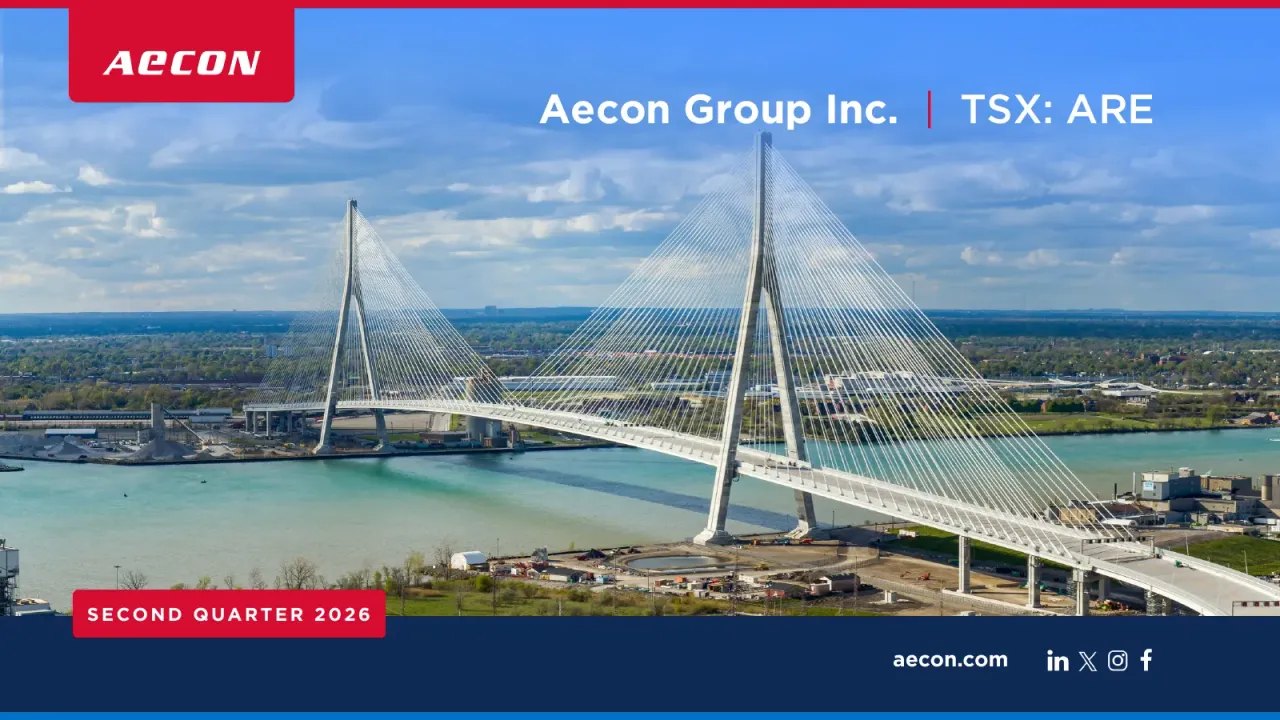
2:36 The Gordie Howe International Bridge reached substantial completion in the second quarter and open to traffic earlier this week on July 27, a remarkable achievement by Aecon and its partners. And an amicable and mutually agreeable settlement was reached in the second quarter on one of the remaining legacy projects to resolve disputes fully and finally. Aecon reinforces its positive outlook supported by the expectation for double digit revenue growth for the full year 2026 based on our strategic positioning and sectors with attractive demand profiles, growing recurring revenue programs and a healthy pipeline of project opportunities. And with that, I'll hand the call over to Jerome. Thanks, Adam, and good morning, everyone. I'll speak to Aecon's consolidated results, review results by segment and address Aecon's financial position.
3:26 Then close with a summary of the utilities pref share purchase transaction. Turning to slide four. Revenue for the three months ended 06/30/2026 of $1,600,000,000 was up $329,000,000 or 25% compared to the same period in 2025. This represents the highest recorded revenue by Aecon in any quarter in its history and approximately 80% of the revenue growth in the quarter was organically generated. Adjusted EBITDA of $82,000,000 doubled compared to $41,000,000 last year and operating profit of $36,000,000 compared to an operating profit of $2,000,000 in the same period last year. The improvement in the period was driven by higher gross profit of $78,000,000 compared to same period in 2025.
4:12 Q2 twenty twenty six diluted loss per share of $1.58 is driven by a fair value adjustment on the preferred shares of Aecon Utilities of approximately $128,000,000 recorded upon reaching the agreement to purchase the shares. This adjusted the carrying value to the agreed purchase price of $320,000,000 Adjusted diluted earnings per share in the quarter, excluding this fair value adjustment was $0.33 an improvement compared to the adjusted diluted loss per share of $0.10 in the second quarter of last year. Financial results in the quarter were impacted by negative gross profit of $4,500,000 from the legacy projects. On an LTM or trailing 12 basis, the negative impact from legacy projects was $36,000,000 Backlog of $10,500,000,000 at the end of the second quarter compares to backlog of $10,700,000,000 at the same time last year.
5:07 New contract awards of $1,300,000,000 were booked in this quarter and $2,700,000,000 were booked year to date. Now looking at the results by segments. Turning to Slide five, construction revenue of $1,600,000,000 in the second quarter was $335,000,000 or 26% higher than the same period last year. Revenue was higher in all sectors with the largest increase of $138,000,000 in utility operations driven by a higher volume of electrical, gas and telecommunication work in Canada and The U. S, including contributions from the acquisitions of KPC and ARC completed in the first quarter of twenty twenty six. Urban Transportation Solutions increased $93,000,000 driven by a higher volume of subway and rail system work, as well as closeout activities on Ontario light rail transit projects that achieved substantial completion in 2025 and are now fully operational.
6:06 Nuclear operations increased 80,000,000 due to a higher volume of refurbishment, decommissioning, new build and engineering services work at nuclear generating stations across North America. In civil operations, higher revenue of $22,000,000 was mainly from an increase in the civil component of power and rail projects, foundations work and international major project work. Turning now to Slide six, Construction segment adjusted EBITDA of $90,000,000 compared to $40,000,000 last year with an adjusted EBITDA margin of 5.5% compared to 3.1% in 2025. The increase was primarily driven by an improvement in gross profit margin in urban transportation solutions and civil and the gross profit impact of higher volumes in utilities.
6:55 These increases were partially offset by lower gross profit margin in industrial and nuclear operations and higher MG and A to support our ongoing growth in operations. Turning to Slide seven, concessions adjusted EBITDA for the quarter was $11,000,000 compared to $60,000,000 in the same period last year, driven by lower management and development fees on concession projects that achieved substantial completion in 2025, partially offset by improved operating results at Skyport in Bermuda. The book value of our concessions portfolio at quarter end was over a $250,000,000.
7:33 Turning to Slide eight. At 06/30/2026, Aecon held core cash and cash equivalents of 129,000,000, which excludes 500,000,000 of cash representing Aecon's proportionate share of cash held in joint operations. In addition, at 06/30/2026, Aecon had committed revolving credit facilities of $1,000,000,000 of which $3.00 $2,000,000 was drawn and $4,000,000 was utilized for letters of credit. Combined with our $960,000,000 EDC performance security guarantee facilities, our total committed credit facilities for working capital and letters of credit requirement total $2,000,000,000 Net debt at 06/30/2026 was $672,000,000 Aecon has proactively opted to include the $320,000,000 repayment agreement for the preferred shares of Aecon Utilities in this figure.
8:28 Net debt to trailing twelve month adjusted EBITDA was 2.2 or two times excluding the negative earnings impact from legacy projects. Aecon has no debt or working capital credit facility maturities until 2029 except equipment loans and leases in the normal course. Aecon generated free cash flow of $3.00 1,000,000 in the trailing twelve month period ending June 2026 compared to negative 10,000,000 in free cash flow in the same period last year, a significant improvement in cash generation. In the second quarter, Aecon's Board approved a quarterly dividend of $0.01 $9.02 $5 per share or an annualized dividend level of $0.77 per share. The dividend will be paid on 10/02/2020 to shareholders of record on 09/22/2026.
9:21 Now before I turn the call over to Jean Louis, I'd like to briefly comment on the announced buyout of the pref shares in Aecon Utilities on Slide nine. Partnering with Oaktree in the fall of twenty twenty three, Aecon Utilities has delivered significant growth through organic expansion and four strategic acquisitions, strengthening our capabilities across electrical transmission and distribution, substations, metering, telecommunications, and utilities infrastructure. During that time, electrical infrastructure has grown from approximately a quarter of the revenue to nearly half today. The business has expanded from almost exclusively operating in our core Canadian market to 25% of the revenues now being generated in The United States.
10:08 Aecon Utility now generates over 1,200,000,000 of pro form a annual revenue with over 70% derived from recurring long term master service agreements and has established a platform position to benefit from long term investments in grid modernization, electrification, digital infrastructure and data center work. The transaction allows Aecon to fully participate in the future growth of Aecon Utilities, while significantly simplifying our ownership structure, enhancing financial flexibility and strengthening integration across our business. Upon closing, Aecon will have full economic and strategic control of a large and diverse utility infrastructure platform supporting our comprehensive power and utility services offering across Canada and The United States.
10:59 Finally, on a personal note, I'd like to thank the Oaktree Capital team for their partnership and support over the last several years. It's been an absolute pleasure working with you, and together, we've built a stronger, larger, and more diversified utility services platform. We're excited to continue that momentum forward.
11:15 At this point, I'll turn the call over to Jean Louis to address our business performance and outlook. Thank you, Jerome. Turning now to Slide 10. Aecon continues to drive growth through a balanced and diversified work portfolio across the Nuclear, Civil, Utilities, Industrial and Urban Transportation sectors.
11:43 In the second quarter, the Construction segment saw a broad based increase in revenue across all sectors. Power and Utility Services collectively represent over 55% of Aecon's nearly $6,000,000,000 in trailing twelve month construction revenue.
12:06 Our concessions portfolio also continues to grow and diversify. The Goryau International Bridge now is operational and Aecon holds a 20% interest in its equity and thirty year operations, maintenance and rehabilitation activities.
12:26 And earlier this week, an Aecon partnership announced it has executed an agreement for the 150 MW Simcoe battery energy storage system project in Ontario, in which Aecon Concession is an equity partner. Aecon will also serve as the exclusive EPC provider for the balance of plant works. The project complements our ownership position in the Oneida Energy Storage project and demonstrates Aecon's credentials in grid scale battery delivery. We've completed an ongoing work representing approximately one GW of Ontario's delivered or planned battery energy storage capacity.
13:18 Turning to slide 11, demand for Aecon services remains strong. With a strong secured backlog, growth in recurring revenue programs in utility services, and a healthy bid pipeline, Aecon maintains its focus on improved profitability and margin predictability, while continuing to improve the risk profile of our business.
13:48 Trailing twelve month recurring revenue was over $1,000,000,000 at 06/30/2026, with recurring revenue from utility services increasing to $868,000,000 from $668,000,000 last year, an increase of 30%.
14:12 Turning to slide 12, I would like to take a moment to recognize a truly historic achievement for Aecon. The Gordie Howe International Bridge project achieved substantial completion on June 9, marking the successful delivery of one of the most significant infrastructure projects in North America.
14:37 Just last week, Aecon had the opportunity to participate in the official opening celebrations, culminating with the opening of the Bridge to Traffic earlier this week.
14:53 Together, the entire project team successfully navigated complexity and overcame challenges, including a global pandemic, always remaining focused on safety, perseverance and world class execution excellence. It is the first new Canada US border crossing in more than sixty years,
15:19 spans 2.5 kilometres, requires over 20,000,000 work hours by close to 16,000 workers, and showcases Aecon's ability to deliver complex infrastructure projects.
15:37 On behalf of our leadership team, I want to thank the thousands of Aecon employees, partners, suppliers and stakeholders who contributed to making this project a success. It is an incredible accomplishment and a significant milestone in Aecon's history. Turning to slide 13, we've recently announced several significant project awards and strategic developments that strengthen our multi year growth profile and reinforce Aecon's position in some of North America's most attractive infrastructure markets spanning nation building, defence, power generation, transportation
16:29 and water infrastructure. These include the nine thirty two MW Greenlight electricity centre in Alberta, which will support a major data centre for META the Robertbank Terminal 2 in British Columbia, a priority nation building project that will increase container capacity at the Port Of Vancouver the Winnipeg Biosolids Facilities Project
16:57 and the Macktaquak Life Achievement Project in New Brunswick. These projects align directly with our strategy of pursuing complex infrastructure programmes with appropriate risk allocation, long term visibility, and strong partnership structures. We continue to advance a broad portfolio of major projects, including the Arctic Over the Horizon Radar program, the Pickering Nuclear Refurbishment, the Darlington New Nuclear Project, the Cascade Energy Facility in Washington State, the GO Expansion Civil Works program, the Hamilton LRT and Urban Redevelopment, and The US Virgin Islands airports.
17:54 These are progressing under collaborative and progressive delivery models that support improved risk allocation and execution certainty. This project represents billions of dollars of potential work, and when layered with Aecon's $10,500,000,000 of backlog and recurring revenue programmes, provide long term growth visibility and match in Aecon's over one hundred and fifty year history.
18:29 Turning to slide 14, Aecon expects double digit revenue growth in 2026. Our expectation for a broad based revenue increase in 2026 and further revenue growth in 2027 is underpinned by the major projects in development that I just spoke to. Contributions from strategic acquisitions in the industrial and utility sectors,
18:59 ongoing strength from an extensive portfolio of small and mid sized work programmes, and the ramp up of projects under multi year lower risk contract models in new nuclear construction and mass transit and mobility. In the Concessions segment, there are several opportunities to add to the existing portfolio of Canadian and international concessions in the next six to twelve months to support trends in ageing infrastructure, mobility, connectivity, energy and population growth.
19:42 Aecon's deliberate shift toward a greater weighting of improved risk adjusted work programs, in combination with a strong focus on operational excellence, is anticipated to support a stabilization and gradual improvement of adjusted EBITDA margins in the Construction segment in 2026.
20:08 Our overall outlook for 2026 continues to be very positive. We are excited about the momentum we have built in the first half of the year and remain focused on executing our strategy to drive long term shareholder value.
20:30 In closing, I want to thank our teams across all our operating sectors for their unwavering 'safety always' mindset, as we deliver critical infrastructure projects across Canada, The United States, and internationally.
20:52 Thank you. We will now turn the call over to analysts for questions. Thank you. And our first question comes from Sabahat Khan of RBC Capital Markets. Your line is open.
21:24 Great. Thanks and good morning. Just wanted to get maybe starting with a high level one. You noted a lot of larger projects, there have been a lot of headlines around the Canada National Building, nation building stuff. Can you just talk about maybe as you're having discussions with these customers, are you able to get a bit of a cadence on timeline just in terms of how those projects will come along? Will you be able to staff for them, get the right people in right places? Are you starting to get some level of visibility on how that work might start to flow? And then maybe just talk about how,
21:54 from a preparation side, getting the right staff in the right regions, etcetera. So maybe just an update on how those bigger projects are building up for Aecon. Thanks. Yeah, I will take this one. Yes, we can. Most of these projects are progressive design build collaborative projects, so they just begin with the development phase that can be from twelve months to twenty four months.
22:23 And we have, when we advance to the development phase, more and more visibility about the real execution of the work, the timeframe, the scope, the budget. So yes, we
22:43 are just getting more and more secure with those projects, what we call the sovereignty projects. We are extremely careful and focused on our capacity to deliver those projects. You probably have noticed that we are very careful on not having all those projects on the same geography, on the same sectors, on the same timeframe. It's balancing tactic, and we think we are quite well about being able to execute those projects perfectly.
23:28 And then just for my follow-up, guess, maybe as you maybe might be a bit one more for Jerome, but just in terms of the margin profile as these larger projects are building up, your outlook commentary shared a bit more specifics this time. Just talk about your confidence in sort of the margin progression through H2, what you're seeing and then what you guys are seeing in the backlog that you've built around the margin profile. And I know it's early, but any sort of directional commentary you can share on that for '27? I think your commentary notes growth into 27 on the top line, but curious on the margin side as well. Thanks and I'll pass the line. Yeah, tons to unpack there Saba. Before I start talking about the margin profile, I think it's always critical to reground around the risk associated with the work that's being executed because the two go hand in hand. So starting on that point, we are working on much better quality programs from a risk perspective than we've ever had. So if you look at the LTM period, the amount of work that we've done, roughly 7% of the work was on nonfixed price. And then the fixed price work that we're executing is increasingly under more collaborative models. So I think the overall risk in the enterprise is is dropping.
24:40 And what we committed to with regards to margin in our outlook, which started in q four of twenty twenty five was a stabilization. And, you know, we had the six as an adjusted construction margin, the legacy projects, was roughly 6% at the end of q four, 6% on a trailing twelve month basis in q one, and then again 6% on trailing twelve month basis in q two, all while significantly growing revenue and all while shedding risk against the programs that we're working on. So that is like just a clear net positive with regard to risk adjusted returns for Aecon. As far as the guidance on gradual improvement, like, we really mean that trying to improve things in a very slow and measured way given the the bulk of work that we have in front of us and where we stand on the programs that we're executing. We're very early on in programs in nuclear and urban transportation solutions, and the traditional construction access curve means that you will generally see the benefits accrue later on in program life.
25:37 I'd also note that gross margins and backlog margins are improving and one of the areas that's an offset today is MG and A, which we're doing as far as investments to improve our delivery capacity, which Jean Lee mentioned. So I'll just say, margins have been stabilized, we've done a great job with that, Revenue growth is improving. The risk is improving. So it's just a net positive. With regards to 2027, we're not providing an outlook on on that one. So we're, we're we're not gonna front run it. I think the general direction of travel is probably consistent with what we've seen in twenty twenty six's outlook, which is, you know, stabilization followed by improvement. Just given the bulk and the size of work, you know, we're really focused on maintaining the appropriate risk cadence across the entire portfolio. So not a perfectly direct answer on the last part of the question, but hopefully a little bit of color on where we're thinking things could go.
26:33 Thanks very much. Thank you. And our next question comes from Frederic Bastien of Raymond James. Your line is open. Hi, good morning everybody. Good morning. I have a couple of questions. First one regarding the Evergreen project that you secured. It's a fairly sizable project. Congratulations on winning it. But I was wondering if you could discuss the risk profile associated with that project. I do I did notice that it was an EPC project, so fixed price projects, would love to get your some comments on your comfort level around that particular project.
27:19 Thank you. Okay. Frederic, I'm going to check this one. I imagine you are speaking about the green light project with Tambina, I mean, the combined cycle gas turbine. Yes, my apologies. Yeah, yeah, no problem. Power is a strategic focus at Aecon. You have noticed, I mean, we are now a little more than 55% of our revenue. It's about distribution, it's about transmission, it's about substation, it's about battery storage. Have noticed this SIMCO 150 megawatts that we have just disclosed a few days ago. Power generation now. So the power generation market, on one side, you have the nuclear.
28:14 We are extremely present and strong in nuclear. I may come back to this after. On the other side you have the renewable projects, where we have attacked this through battery storage and some transmission. We are not in solar panels and we are not in wind machines. We think that this has been commoditized and it was not the right time to enter it. In between nuclear and renewable, you have a spot which is gas turbine generation. This is going to be the strong spot during the ten years to come, and Aecon had to be within this spot.
29:02 On another hand, we are not speaking about first of a kind when we speak about gas turbines. There is something like 500 gas turbine projects under construction every year. So the contract model is EPC. What we decided to do a few years ago when we realized that we needed to be there, was to strengthen our capacity to be able to catch this kind of project. Different way of doing it. We have acquired United in The United States, specialists in power generation and in EPC delivery. If you go to their track record, it's impressive. We have secured partnerships with one of the best engineering companies with combined cycle, which is TecnikasRevulidas, they have built more than 60 of those kinds of projects.
30:01 In addition, this project is in Edmonton, quite close from our industrial base. The client, Pembina, is quite well known from us, I mean we have been working with them, we know them perfectly, and the output of this power plant is secured by a power purchase agreement with Meta. Last point, long development phase, we have been working in perfect collaboration with our clients and our engineering partner during more than twelve months. So before we close this job, we had a very, very good knowledge of the scope, the price, and the risk.
30:51 In addition, most of the long lead equipment have been ordered and are going to be supplied with the corresponding warranty and liability by the owner. So this was the target and the product to catch. We have been patiently building capacity and core competency to be able to execute it securely, and we just consider that it's a very good catch for Aecon. Have I answered your question? Yes. Thanks for the very detailed answer, Jean Louis. I appreciate it.
31:40 Next question is on labor availability. Obviously, you were quite successful winning several contracts in recent months that provide good visibility into future growth. How are you thinking about scaling your workforce to meet this expected demand, what risk do you see around labor availability going forward? I would say there are two different issues. I mean, the staff and management teams and the trades. So far, we have not seen shortages of trades. We have a mid and long term agreement with major trade unions.
32:25 When we are open shop, we also have a very strong geographical presence. So we do not see at this stage issues so far. As I've said a few minutes ago, we are always extremely focused on the balance of our activity geographically, sectors, time for execution, so that we don't unduly overload one aspect. Regarding staff and management, it's a constant fight. You probably remember we have created Aecon University a few years ago, we have a project management academy, we are training, we are recruiting, we are trying to reward as good as we can all our management.
33:27 It's a constant fight, but it's one of my most important five on my desk to ensure that we always have the capacity to execute this backlog that is growing. Thank you. Thanks, Zhongli. That's all I have. I'll pass it over. Our next question comes from Benoit Poirier of Desjardins. Your line is open. Good morning, everyone. On the concession obviously, you've been successful to secure the agreement with CIMCO, so currently in a predevelopment.
34:19 But I was just curious to know maybe a little bit more about the pipeline of opportunities for concession these days. So obviously, you've been quite successful to grow construction, but I'm just curious whether what are the kind of the opportunities you see on the concession side to grow this segment? Thank you. Good morning Benoit, Jerome here. We really the concession business continues to perform really quite well. So as noted, Simco was successfully secured that builds on our expertise with regards to battery ownership, but also execution of battery projects. You know, as only mentioned in his prepared notes, you know, under delivery or delivered, Aecon's had roughly a full gigawatt of battery storage systems in Ontario, which I think is probably something akin to a market leading position. So we have a lot of confidence in that, that aspect of this, you the execution.
35:22 The team's continuing to work on the airports in The US Virgin Islands with regards to progressive development, so that's that's going according to to expectations. Additionally, you would have seen in the notes, Aecon Concessions is developing a network asset for a third party client. And on that front, the construction side of the house will be building the asset for concessions ownership. There'll be an intercompany elimination, so there'll be a a negative drag on concessions EBITDA. But then, you know, concessions will be able to then onward, use that asset to to generate long term income, against a strong credit, counterparty. So from our perspective, we're we're really pleased with the work that Concessions is doing, you know, very much aligned with the long term vision of that platform, which is to grow, diversify, generate long term cash generating assets, be able to get development style returns, all while generating also construction revenue and profitability for Aecon and provide an additional source of capital unlock for our clients. So I think overall, you know, the $250,000,000 of book value of equity is obviously worth more than that, but we'll continue to look to invest in this platform because it generates a normal and unique returns for Aecon and shareholders.
36:42 That's great color, Jerome. And maybe on the CapEx side, you mentioned that we should see a slight uptick in terms of CapEx as you grow revenue. What about the kind of CapEx we might see going forward as you further grow construction revenue? Yeah. So we're very focused with regards to capital deployment. So there's two ways to think about it. One is the raw dollar CapEx, and then the other one's the finance leases. Right? So those are both different forms of capital. Our our longer term objective is to try to maintain good capital intensity and operating leverage with regards to the capital equipment deployed. We're very selective when we deploy CapEx and, you know, whether it's equipment, machinery, properties, fabrication facilities, that it needs to generate certain minimum return thresholds for shareholders.
37:39 And so, yes, capital is going up, but when you're going to business at a, you know, north of 20% rate, that shouldn't be unexpected. But we're also really careful about not kind of falling into the trap of just buying equipment to try to generate higher EBITDA because, you know, that equipment needs to be maintained and needs to be depreciated. And so we do think about things from a return standpoint. So capital is going up in line with revenues, a little bit less than revenue. And from that standpoint, I think it shows good operational discipline from our teams. Okay. Maybe just a quick follow-up. You call out in the MD and A tariff and fuel also in terms of potential risk. I was curious to see if it's material these days or I suspect not, but any color on the tariff and fuel maybe whether it's an impact or not?
38:35 Mean, certainly creates operating volatility. Generally speaking, we work pretty closely with our clients to understand where pricing risks exists on commodities like diesel, you know, unleaded fuels, various input costs. We try to manage those risks contractually through purchasing approach, or or through, you know, potentially hedging programs. So or or pricing. And so this this type of volatility, think, is the the new normal in our world. It's, it's it's increasingly been in existence since, you know, the the COVID pandemic, and, it's just something that that needs to be thought of carefully and managed. We call it out because there's there's these kind of special risks associated with, you know, momentary spikes and then, you know, the the pricing mechanisms may not catch up immediately.
39:24 But right now, the one thing we'll note is, you know, a significant portion of our business is tied to construction in place to very local business. And so when we're operating in our Canadian markets, is very much focused on Canadian supply chain, Canadian labor, right, utilizing Canadian equipment and resources. In our US, it's the same approach. Our international operations probably have a little bit more exposure to that because things need to move around in order to access the slightly more remote locations in Caribbean areas, but that's all kind of contemplated in the bid structure. So it's it's a lot to think about. Candidly, the local nature of what we do makes it a little bit easier for us than some of the other companies out there. So we're grateful for that piece, but it doesn't mean we can take our eye off the ball. Thank you very much for the time.
40:14 Thank you. And our next question comes from Michael Tupholme of TD Cowen. Your line is open. Thank you. Good morning. My question is regarding the nuclear business and opportunity. Wondering if you can provide a bit of an update on not only the opportunities that you've already highlighted that you've become involved with such as X Energy in The US, but also some of the new opportunities that you're looking at and specifically focused here on the new build side, so be that SMRs or large scale reactors. Yeah, will do it. Our nuclear revenue is around C1.7 billion dollars I mean, between 7075% in Canada and between 2530% in The United States.
41:16 In Canada, you know where we are strong and this is all those program of major component replacement. We are now full steam ahead on the third reactor of Bruce after having delivered on time, on budget, the first two ones. Pickering is also ramping up. We are finalizing the development phase and we should come to execution phase quite soon. We are advanced on the small modular reactor globally, like 16% of progress on this job. So this is something that everyone knows on this call. The US is a little newer. What are we doing and what are we going to do in the future?
42:07 The real market at the moment where we are focused on, it's not the new build. I mean, it's still early. The only new nuclear under construction in North America is Darlington, SMR one. There's not at the moment, I mean in The United States, the market is about life extension and what they call in United States, MPU, which is extended power upgrade of the 80 to 90 reactors that exist in The United States. It's about refurbishing a steam generator and major components of all those reactors to operate the power output.
42:59 We are getting stronger and stronger in this market. On other end, we are working more with the Department of Energy, this is federal work and we like it. We have a look at the new build, you know about this cascade project, which is the first tranche of four x energy 100 reactors, but it's just ramping up very, I would say, very slowly. The last point about the future I would like to highlight is about fabrication. We are extremely strong about fabrication in Canada. It may be about the steel composite element for the new build to come, for example the SMR number one. It's also about module assembly. I just remind you that we have been building some modules for waiting hours a few years ago and we are in discussion to optimize all our processes, to modernize our workshops, our tools, our robotics.
44:09 This is probably one of the points of the future. Okay, perfect. Thank you for that. Second question is regarding the updated outlook commentary specifically for revenues. So now calling for double digit revenue growth in 2026 and then additional growth in 2027. Obviously, very strong top line growth in the second quarter and acceleration in terms of the rate of growth relative to what you saw in the first quarter. How should we think about the revenue growth opportunity in terms of rate of growth in the second half of the year? And then, in addition to that, as we look a little further out, as we think about '27, what's the right way to think about that growth opportunity?
44:59 So the change in the outlook, which is rightly noted went from, we said '26 was gonna exceed '25 and '25 was an exceptional performance by the way. We thought it prudent to adjust it to note the double digit level of growth. In particular, just with what we're seeing, the backlog program that we have in place of $10,500,000,000 through recurring revenue, what I described as the book and burn cadence of the business is all quite positive in addition to the recent awards that we've seen. So with regards to specific guidance, always shy away from that. We'll note as it stands today in the next twelve months, there's roughly $4,000,000,000 of what we describe as secured backlog.
45:45 That's that's executable. In addition, we know there's been two additional projects that have been, that will be added to backlog in q three that have been announced, which the Greenlight Electricity Center and then the Winnipeg wastewater, phase two biosolids, program. So, you know, don't wanna give, like, a a specific number. I think one of the items was just we want to note that the where we saw, you know, street views on on revenue was was likely a little bit light. And so we just wanted to encourage people to really get a better understanding of, you know, our conservative nature to backlog reporting and the fact that, you know, we have been very successful in organic revenue growth. All tied again around, you know, being able to secure projects with really appropriate risk adjusted, you know, returns. So the the one item that's just worth noting is we remain very focused securing work that has good risk, balance to it, work that is executable.
46:41 And, you know, any given level of margin, we are going to drop risk. And at any given level of risk, we're gonna take more margin. But overall, we're pretty happy with the work that we've been securing and how that work looks to be burning off over the next, you know, call it twelve to eighteen months. Thank you for that, Joe. Thanks, Mike. Thank you. And our next question comes from Chris Murray of ATB Cormark. Your line is open. Yes, thanks folks. So just maybe following on, on that revenue question. I guess what I'm trying to understand is just to your point about the kind of the risk adjusted return on some of these projects. I'm just trying to also understand a lot of these are earlier stage. So I'm just I'm trying to understand if this is kind of a function as we think about this revenue growth, but also relative to the margin.
47:32 Is there something going on with, call it, larger procurement? Or is there are you just being cautious on early stage reserves? I'm just trying to understand as these things evolve, it's just kind of phase of project that plays into what we're seeing with the dynamic? Or if there's something else to be kind of aware of in terms of what's in the backlog, that quality of revenue, and how it plays out over the next couple of years? I will begin and maybe Jerome, if you want to add something. I mean, backlog is about quality and quality. If we have this backlog today, it's not by chance. We do not wait up at Aecon on a Friday morning to say, hey, we went from £5,000,000,000 to £10,000,000,000 and most probably we are going to grow it again.
48:27 We have a strategy and we are extremely focused on delivering our strategy. This backlog is highly diversified Again, it's not by chance, it's because we add targets for new businesses, we add targets for US and international, we add targets about our proportion between fixed price and variable price, which makes it probably the best risk balanced backlog that we ever had in the life of Aecon. There is more to come, I mean, in 2027. You have understood that we are under development phase on a few projects that will come to execution. I mean, we can speak about Matterquake, we can speak about Robert Bank, we can speak about Arctic over the horizon all this will, at one moment of time, materialize in revenue.
49:29 Most of those jobs, as I was explaining a few minutes ago, have a very thorough development phase before we go to execution. So, terms of predictability of our future margin, we are in a much better spot today. Maybe, Jerome, you want to add something regarding profitability and margin level? Yeah, and so on that front, I think the question behind the question, Chris, is given the typical construction S curve on project delivery and how early we are on several major programs, is that potentially influencing margin cadence that we're seeing today?
50:20 The answer is yes, but not in a very material way. Right? So our general approach is consistent with industry best practices. We are thoughtful about the level of margin recognition that goes through our accounting system, the amount of contingency that we have available on projects with regards to execution uncertainty when it's appropriate. And, you know, obviously, that's, you know, that bulk of contingency is larger at the outset of a project than at the end of the project. In an ideal situation, you're releasing that into profitability. So it's it's like a small factor, but I wouldn't say it's one that's kind of super material. And then on the, you asked question about whether, you know, procurement, is is influencing things or or swinging the margin profile and the answer is not really, right? Like, we are a counterparty and delivery partner of choice for very large major capital programs across North America.
51:17 That's always going to involve in procurement of material and subcontract resources. That's always been part of the mix for us. And that's always been part of the, you know, the the approach to our our margins. So I'd say there's there's nothing kind of materially shifting on either of those two factors. It really is more around the approach to risk and then the better stability and long term visibility we have on earnings and cash flow generation at Aecon. Okay. Thank you. My next question, just it was interesting in the notes and then the adjusted numbers. We saw some costs associated with a new ERP program, which is something I don't think we've seen in a while from you folks. Can you talk a little bit about what that program is all about? What it brings to you and what you're trying to achieve?
52:04 And is this some sort of new way to cost? Or is it does it give you a different tool set? So any color would be appreciated. Yeah. It's I I was I was wondering if was gonna come up. So, maybe I'll launch off with saying that general perspective is that the the systems, technology infrastructure that we have at Aecon is is top tier. It enables us to to deliver, you know, the vast multitude of projects that we have, on the books. It allows us to work in, you know, the secure environments required for defense and nuclear. This this, you know, additional call out is really around the deployment of additional best in suite systems within the Aecon ecosystem to allow us to continue to, you know, not only kind of maintain that leading position, but, you know, effectively try to be, you know, actually at the top of of systems with regards to project management, integration, data governance, AI, and and all all all the various items that we view as candidly, like, it's gonna be largely table stakes probably at some point, but it's definitely one where you have to you have to be part of it when you think about digital twins, integrated design delivery, scheduling, you know, the the engineering work that we're doing with regards to United and how that all ties into, you know, eventual project delivery on the programs that we're on and the programs that are coming. Right? So I think one of the things that we're very mindful at Aecon is, this is a this is a unique time
53:36 in in the construction market with regards to really strong demands. We understand resourcing is gonna be constrained. We wanna make sure that we are in front of that. One of the ways to make sure that you get best efficiency and productivity out of your teams is to have the best tools available for them. That's what this is tied to. I think I'd also note that this was something that we started, you know, last year, as far as the, you know, the assessment and early implementation. Now the specific reason why it's being called out as an adjustment factor, in our in our financials is we try to improve comparability with our results and our peers, which are largely US traded. And in The United States, GAAP accounting effectively allows all these costs to be capitalized. And so here, if we were taking that approach, you know, this would have all folded into the CapEx program and no one would have seen it.
54:28 However, we think number one, it's important to give people the line of sight into where this money is being spent because it the m g and a line. And then number two, probably also helps to give confidence to, you know, our investors and our teams that, you know, we are investing in the future to ensure long term stability, execution capacity so that we can deliver on what is a very meaningful amount of work that's ahead of us over and above the secured backlog. Okay. Great. And then just maybe just for modeling purposes then. So I guess Q2 was about just a hair over $4,200,000 So should we just be expecting that's kind of a normalized run rate? What's the duration that we should be expecting these costs? I assume that just will be over and above on your MG and A spend.
55:15 I mean, it's a it's the the number is included in the m g and a number, and that's why I got it back to get to the adjusted EBITDA figure. Right? And so from my standpoint, like, we're not gonna provide guidance on the the total program size. It's it's very reasonable. Right? Like, we're we're we're builders and we're constructors, we're we're always mindful from a from a cost standpoint. So we're not looking to make a meal of this whole thing. So we're not gonna provide guidance on timing or or quantum. That being said, like, we're you know, the amount that we've spent in the quarter, you know, it's not it's not kind of like capital and material to Aecon, and I I'd say it probably stay in that that area code. Okay. I'll leave it there. Thanks, folks. Thank you. I'm showing no further questions at this time. I'd like to turn it back to Adam Borgatti for closing remarks.
56:02 Thanks, Didi, and thanks, everyone, for joining us today. As always, welcome any follow-up questions or comments. Feel free to reach out to the IR team, and have a wonderful rest of your summer. This concludes today's conference call. Thank you for participating and you may now disconnect.
Follow Aecon Group Inc. into a list and get an email when it puts out news.
Senior Vice President of Corporate Development and Investor Relations
Executive Vice President and Chief Financial Officer
President and Chief Executive Officer
Senior Vice President, Finance
Analyst, RBC Capital Markets
Analyst, Raymond James
Analyst, Desjardins
Analyst, TD Cowen
Analyst, ATB Cormark