Jelena Arsic Van Os
CEO at ACCSYS TECHNOLOGIES PLC
Replay available
Preliminary Results hosted by Accsys Technologies (LSE:AXS) on Investor Meet Company, held 2026-06-22.
On 6ix: 6ix.com/event/accsys-technologies-plc-axs-preliminary-results
Automated transcript · Written by software from the replay's audio. It can mishear names and figures; the replay is the record.
0:00 Good afternoon, ladies and gentlemen. Welcome to the ACCSYS TECHNOLOGIES PLC Preliminary Results Investor Presentation. Throughout today's recorded meeting, attendees will be in listen only mode. Questions are encouraged. Please submit them at any time. Just use the Q and A tab situated on the right hand corner of your screen. Before we begin, we'd like to submit the following poll. I'm sure the company will be most grateful for your participation. I'd now like to hand over to the management team, Elena, to meet. Good afternoon.
0:22 Afternoon. Hello there. Good afternoon, everybody, and thank you very much for joining us today to see our full year '26 financial results. My name is Elena Arsic Vanossa. I'm CEO of the company with the company since June 2023. I am coming with a quite long experience in multinational
0:46 in chemical industry in the companies that are operating all around the world, and I joined the AXS in June 2023. And hello, everyone. So Sam Vora. I'm the CFO. I've been with the company for just over one and a half years. I joined the board in September 2024. I've worked in UK listed businesses for over twenty years, primarily in the manufacturing and engineering space.
1:15 Today, we are going to take you through the first of all, a short overview on the company because I I believe some of you maybe do not know ACCSYS that well. Then we will have an overview of financial performance for the year, business review, and we will give you also the outlook at the end. So AXS PLC is a company behind ACCOYA and Tricoia. We see ourselves as a industry disruptor in a high performance premium sustainable wood product. We are having a proprietary technology that is protected with more than 300 patents that are protecting the process of aqua production, but also product and a trade name as well.
2:02 We take a fast growing wood, that is a radiata pine that grows to the full, range in twenty to twenty five years, and we make an an a satellite wood out of it called akoa. And akoa for akoa, we are giving a guarantee of fifty years when exposed to the elements and twenty five years if it is in the ground or in the water. This is the most durable wood available today in the market space. And when we are saying we are giving a guarantee, that is a guarantee against rot, insects, and it is quite stable, the most dimensionally stable wood. So if you would put a paint of it, you make a window out of a and put a paint on it because wood is not shrinking or expanding when when it is exposed to the to the environmental elements, then that paint can stay for extremely long time. Many companies today are giving up to fifteen years guarantee on a coating if it is painted on on ACCOIA.
3:16 We are having today also quite a number of sustainability credentials, and we are certainly in SAP top 20% of the companies in the sustainability SAP index space, which is quite achievement for the company of our size. We do have a three production location, two acetylation plants, one in Arnhem and one in Kingsport in The US. In the Arnhem Netherlands, which is our longest standing site, we have four reactors with 80,000 cubic meters of current volume capacity. This plant is operational since 2007. And here, we are acetylating wood and for the usage and sales in European mostly in the European and UK markets.
4:13 Kingsport USA is a joint venture of of called The USA. It's a joint venture with Eastman Chemicals, where AXS is holding 60% equity share in the joint venture. It is operational since September 2024. And in this financial year, we have a first time a full financial year for the ACCOIA USA. It operates two reactors, so half the capacity of what we have available in Arnhem in The Netherlands, 43,000 cubic meters, and it is focused predominantly on serving North American markets. That means USA, Canada, and Mexico. We also have a coloring facility in Barrie in Wales It was acquired in in 2021.
5:04 It is it has a two impregnation vessels, an annual capacity of 14,000 cubic meters. It showed also increased efficiency over the next few years, and we are seeing a Koya color being one of the fastest growing products for AXS in the last year. A Koya a Koya acetylation process is a patented process. It starts with the wood and a and a chemical called acetyl anhydride that is similar to vinegar. So you you can imagine acetylation as if we would just put it in a simple words as a pickling of wood under specific pressure and temperature condition.
5:49 After acetylation, which in which basically transform wood on the cellular level and limits its interaction with water, We when we are satellite, after that, we have to dry it, and then it can go to the to the final customers. With this, I will bring you to the overview of our of our financial year '26, which was quite a significant year for AXS. We call it year of significant prox progress because company was able to show very strong top line growth and at the same time improving the profitability and improving all the, if you like, all the metrics that we measure ourselves on.
6:37 We had we've seen 21% of increase in total ACCOIA sales volumes, and the group revenue went up to €153,000,000, keeping the gross profit margin above our target level of 30%. And our adjusted EBITDA increased to 21,200,000 from 10.8 last year and approaching 11 well, approaching 12% target that we gave ourselves for the end of next financial year. Excuse me. And basically doubling the profitability in one in year on year, if you like. At the same time, joint venture in the first year of full financial performance had excellent
7:30 improvement in revenues, in profitability, and in volume. Joint venture moved from 11,000,000 of dollar loss in the last financial year to basically breakeven in EBITDA. Looking at as as as at the joint venture as a start up, if you like, facility since it is the first year of of operational performance. 60% increase of volume in North America was significant given the conditions of the market, the building material market is in the last three years quite subdued, and we were able to show, as you're going to see also in the next slide, every year substantial top line growth and at the same time increasing the bottom line efficiency as a company.
8:24 As I said, cash and funding, we show our reduction in leverage ratio from 4.4 times in 2024 to less than two in this financial year, and we also recap refinanced refinanced completely on improved terms in October 2025, bringing a second bank. HSBC was our second bank that joined the ABN AMRO, which is our traditional bank in this refinancing cycle, and we are quite happy with the outcome. Due to the substantial improvement in profitability, our underlying basic earnings per share show 2.1¢ positive result coming from 5¢ loss in the last financial year.
9:14 So we are very happy with this outcome, and we are looking also to progress this further as we go as a company. I would like to make your attention on the our focus strategy and delivery on our targets that we set out in f y twenty five on the back of financial year '24, which was a transformational year, if you like, for AXS. In the last three financial years, we were growing our volume run rate from 65,000 in f y twenty four to 97,000 in f y twenty six, 16% year on year progress in a quite difficult market environment.
10:02 At the same time, our adjusted EBITDA margin, the so the quality of our earnings improved significantly from 3.5% to almost 12% in this financial year, but also in absolute terms, we moved from 4,700,000 to 21,200,000 in f y twenty six. Gross profit margin, our target is above 30%. We are this year so in the f y twenty six, we landed at 30.9, which is nicely above the target that we that we put for ourselves. And then, of course, quite important leverage ratio in operating cash flow cash flow conversion, leverage ratio that moved from 4.4 in f y twenty four to below two, and this below two also include convertible loan notes that we have. Without them, we are actually ending up at a leverage ratio in FY twenty six of 0.74, which is quite comfortable for the for us as a as a company.
11:09 Operating cash flow, our target is 75%, and we ended up the year on the target. So so good good progress good progress for for us. Focused strategy is all about getting access to be more fundamentally strong, operationally efficient company that is providing a continuous value to its shareholders, to customers, to our employees, and also to society. We are ending our phase one of the focus strategy in the next financial year, and we basically reached the targets we set at the end of this FY '26. I'm going to now move it to Sam so that he can walk you through the details of our financial performance.
11:58 Great. Thank you very much, Elena. So I'm going spend the next few minutes also talking about the financial review and performance for FY 'twenty six. So this slide summarizes our key financial metrics for the year, and it really highlights the strong financial performance we saw over the year. As you can see on the left hand side, volume growth was very substantial with the AXS Group, which excludes the joint venture, doing 13% like for like volumes at just over 60,000 cubic meters for the year. The joint venture, which only started operating in September 2024, doing 16,853 cubic meters, and that shows the 60% volume growth for the North American market for the year against what is still continues to be a very challenging bill of materials market, not just in North America, but also in Western Europe, our two primary markets. So total sales volumes were up 21% for the year. Revenue, as Elena mentioned, was 153,000,000 And then when combined with 60% share of the JV's revenue of £30,000,000 so that means gross, the JV, I think you did €50,000,000 of revenue, then total aggregated revenue was €183,000,000 which is up 24% year on year.
13:19 Our profitability measures were up substantially. Underlying profitability EBITDA, excluding the JV, was up from €16,800,000 to £21,100,000 up 26%. The JV was EBITDA profitable at £100,000 a swing of £6,100,000 from the previous year. And hence, the metrics that Yunaida mentioned earlier, pounds 21,200,000 adjusted EBITDA, 11.6% margin, which is just slightly behind the 12% target that we set ourselves for March 27, end of phase one of our strategy. So overall, profit after tax from a statutory perspective was £6,500,000 and as you heard earlier, 0.1 earnings per share.
14:06 Operating cash flow was at our 75% target level, up 11 percentage points on the prior year from a conversion perspective. Free cash flow after CapEx of £5,600,000 was £10,200,000 and you heard before that our leverage ratio is now below 2x. So I'll now go into more detail about revenue, gross margin, profitability and net debt. So in the previous year FY 'twenty five, before the JV started operating, Arnhem, the Arnhem facility sold to North America. So for the purposes of a comparable like for like performance of FY '25 to FY '26, we're adjusting for those sales that took place in Arnham in that year. So 3,802 cubic meters of volume was sold, which represented €10,300,000 of sales.
15:03 And it was 7% of volume, but 10% of gross margin and 13% of EBITDA. So when you adjust to that, then group revenue grew by 20% like for like, and we saw really strong growth in all regions with strong pricing discipline. Because we are a prime a premium product in operating in a a premium niche of the market. We are able to increase our pricing each
15:33 year unlike competitor products who are having to reduce their price just to maintain market share. So our price increased by 1.7 percentage points over the year contributed just over £2,000,000 of incremental revenue, which is effectively dropping down to the bottom line 100%. We saw a really favorable sales mix with our Akoya Color premium product growing by 51% during the course of the year. And that really benefited from strong demand, but also the decision that we took last summer to effectively double the capacity in Barrie, which gave us that flexibility to scale up at very short notice with a fairly minimal expense. We've actually just added additional people costs, and there was no incremental CapEx.
16:23 So the licensee and royalties relates to our return that we get from the joint venture. We now get a fixed percentage of their revenue. So every dollar that they sell extra, we get a percentage of that. Plus in in the first financial year, we also got the the final installments of the licensee. There was an original €5,000,000 licensee that was paid for by the joint venture, and that was paid in three tranches, from when the contract was signed to when the plant was completed and the final tranche we received in FY 'twenty six, which is when the final operational performance test was concluded. Other revenue relates to acetic acid sales.
17:08 So acetic acid being the byproduct from the production process. Anhydride comes in, acetylation process takes place, acetic acid is a byproduct, and we sell that back onto the chemical companies. And tricoid panel sales, this is where we actually buy tricoid panels from the two OEMs that we sell tricoid to, and then we sell those onto the customers. And the level of revenue was pretty flat year on year with other revenue. So overall, very strong performance with 20% like for like revenue growth, which is very, very pleasing. And what this means from a gross profit margin perspective, and again, when we adjust for the 7% of volume that was sold to North America in FY 'twenty five by Arnhem, so adjusting for the EUR4 million or 10% of the gross margin for that year, then we actually saw 130 basis points increase in gross profit margin in the year.
18:06 And we saw that through that strong pricing discipline, as I mentioned before. Volume and mix has now outweighed volume that was transferred. So that favorable sales mix plus the substantial increase in volumes. We're getting the licensing and the royalties. And then when we start thinking about our raw material costs, so 61% of our bill of material relates to the cost of raw wood, which we primarily buy from New Zealand, and and then the net cost of the acetyls. So it's the cost of the anhydride less the the revenue that we get from the byproduct acetic acid. So what we saw in the year from a wood cost, which represents 34% of our bill of material, is that we saw higher appearance grade raw wood costs, but that was partly offset by cheaper wood chip grade costs. So really relatively flat cost gross margin movements in our raw wood cost. And when it came into net acetyls, we saw a small favorable benefit to our gross profit margin because we are actually using a lower amount of anhydrides in the production process compared to the previous year. We had a favorable supply mix because we have about two thirds to 7% of our anhydrite supply is in long term contracts, but we have the ability to flex that and buy in the spot markets where pricing is different as required.
19:37 But also, we saw some FX benefits as the euro strengthened against the dollar by about 7% in the year, and one of our suppliers is a U. S. Supplier who invoices us in U. S. Dollars. So it's really pleasing to see that improvement in gross profit margin, and we remain above our strategic target level of 30%. So when we look at adjusted EBITDA for the year, we saw a substantial increase of four thirty basis points to 11.6%, just shy of the 12% target that we set, and that's a 96% increase in in EBITDA. So operating cost discipline and and keeping a a very tight control over our operating costs. So these are costs below gross profits and more of your SG and A costs.
20:29 Is something that we're very, very laser focused on. In FY24, we undertook a restructuring programme, a transformation programme, where we took costs out of the business, primarily at the corporate level, and we are still maintaining those the benefits from that program two years later. So nearly €1,000,000 savings from that transformation program. You can see there that we've invested 3,700,000 in operating costs during the year, but that was really in headcount increases. So the number of heads that we have at March 26 is actually the same as at March 24, but we've rebalanced the mix of headcount in the organization.
21:15 So we've taken out a substantial number of corporate costs or back office related costs, but we've replaced those by investing in sales and marketing, revenue generating FTE, but also additional operational costs in the plants to support the volume growth that we're seeing. So we no longer have any exposure to the facility, and so hence, there were no costs related to in FY '26. That business was put into liquidation in December 2024 and is completely off our balance sheet. And then we saw that £6,100,000 swing in profitability from the JV to GBP 100,000 EBITDA, which really helps our adjusted EBITDA margin grow to 11.6%.
22:05 So from an overall segmental perspective, if we look at the first green bar on the left hand side, this shows effectively the operational assets of the AXS Group, so the Arnhem and Barry facilities. And we increased our margin there by 110 basis points to 16.1%, And that was really driven by sales volume growth, that favorable mix with a much higher color mix sold during the year, operational efficiencies in the plant, but also the returns that we're getting from the joint venture through the royalties. Corporate cost is effectively the cost of the corporate side of the head office. It's the cost of being listed to the board, the listing cost, plus the group functions that we need for because we're a we're a we're a listed company. And those corporate costs were 3,600,000 for the year, which were down 100,000 for the previous year, but down €1,000,000 compared to FY '24.
23:01 So corporate costs now are 2.3% of our revenue, and they were 3.4 percent of revenue in FY 'twenty four, quite a significant reduction. So the middle dark green bar of underlying EBITDA shows AXS Group, which is a FESI corporate and the operational businesses, showing 150 basis points improvement in our profitability to 13.8%. And then when you factor in the positive swing in EBITDA of the JV, you can see the overall near doubling in profitability to GBP 21,200,000 and that increase in margin to 11.6%. So then just turning to net debt. So you heard it earlier that we reduced our net debt leverage ratio from 2.5x to below 2x, but really quite substantially, that is a lot lower than the 4.4 times we were at March 2024.
23:58 We saw a working capital outflow in the year, and that was really driven by inventory levels, primarily because of the growth of the COIOR COLOR, where we saw 51% growth in demand.
24:12 So the additional capacity that we put in place in the Barrie facility led to high levels of work in progress for Color, but also we built up finished goods ahead of the key decking season, which takes place after the end of our financial year. We also increased our level of support and ramp as for ACCORE USA as the business ramps up. So with 61 60% volume growth that they saw in the year, they needed high levels of raw wood. And we we keep on average about three and a half months of raw wood in stock at any one point in time and about one and a half months of finished goods as part of our working capital cycle. So total working capital outflow of GBP 8,800,000. We'd expect in this new financial year FY 'twenty seven that to be in the range of GBP 3,000,000 to 5,000,000.
25:02 CapEx investment was just over £5,500,000 and over half of that was really dominated by two large projects. So one where we increased our acetal storage expansion, so able to hold more acetic anhydrides and acetic acid, which has operational benefits. Yulain will talk about those later on, but also making HSE improvements for our staff in the Stacker Hall, which cost GBP 600,000. Net interest increased by GBP 5,000,000, of which GBP 2,800,000 was interest paid, which relates to interest payable on our debt facility, but also on finance leases, and GBP 2,200,000 related to interest that was accrued on the convertible loan notes.
25:47 Subsequent to the year end, of those convertible loan notes interest, 2,500,000 is going to be issued in equity in the month of July, and that will have the effect of saving the company GBP 2,500,000 in cash that would otherwise have had to have paid out in cash interest. And hence, we'll also take GBP 2,500,000 immediately off our net debt, further strengthening the leverage profile of the company. Tax received was actually a receipt of GBP 700,000 after we concluded the APA agreement that we have with the Dutch and UK tax authorities during the course of the year. And hence, cash flow was GBP 10,200,000, up from GBP 8,800,000 even when you factor in those two large CapEx projects that we undertook in the year.
26:35 And our free cash flow margin improved by 20 basis points to GBP 6,700,000. As Yuno mentioned earlier, we completed our refinancing in October last year with ABN AMRO and HSBC for a GBP 55,000,000 facility, and that secures our funding through to October 2029 on more favorable terms. And those new terms effectively mean that we're going to keep about €2,000,000 of incremental cash each year that we would now keep ourselves as opposed to repaying the banks.
27:07 But the key thing is really our our capital allocation priority in the effort after the second year of phase one of our strategy remains on deleveraging the balance sheet. And then just in summary from from myself before I hand back, it was a really strong financial year, and we are up in terms of profitability improvement, volume growth and revenue growth plus deleveraging, and we're very, very pleased with the performance. And I'll now hand you back to you, Elena, who'll talk you through the business review. Thank you very much, Sam. So let me take next couple of slides. I will take you commenting a little bit on what is happening on on global markets and how do we perform in our geographical context and also a little bit more detail on ACCOIA USA.
27:56 FY twenty six was quite a challenging year for the building material markets with some sectors still showing resilience.
28:07 Global construction demand showed was subdued in f y twenty six due to continuous inflationary pressures across all markets and then additional tariffs impacts in The in The US. Forecast is also showing that those slower activity is going to be continued driven by geopolitical uncertainty. Projects are getting delayed, and the constant consumer confidence is, of course, not not improving, impacting the demand itself. ACCOIA operate in a luxury segment, in a premium segment, which is a little bit less sensitive to the borrowing costs while, you know, new build is very sensitive to it, and new build will remain slow until the rates ease.
29:07 On the other hand, luxury segment renovation and refurbishment sectors are showing a greater resilience in FY '26, and this is exactly where ACCOIA is actually playing a bigger role. If you like, 30% of our volume is going into the timber and joinery products in specifically in the in The UK and some European countries, and this is where we saw quite a strong demand that was supported by a very good performance of our product if you compare it to anything else, but also sustainability and natural material design trends. There is also quite a lot of regulations in Europe that are linked, but also in The US that are linked to the imports of the tropical hardwoods and responsible forestry practices that are helping us as a sustainability driven company to to grow faster than some traditional wood wood species.
30:14 If we look a little bit more what is happening with the with the refurbishment and renovation sectors, here specifically, we had the better performance, as I mentioned, in the windows and doors segment, specifically in UK and in Ireland. In North America, we are growing quite nicely in a luxury residential segment, where, as I said, the segment is shielded from the higher cost of borrowing. And if you also look at the general trend in The US on wood material products, we are seeing constant decline in cedar and hardwood products, so less sustainable wood species are in their decline, while the modified woods, terminally modified woods or chemically modified woods or engineering woods are showing a generally quite a good growth trend as in in specifically in The US from 2025.
31:22 And what you see here that ACCOIA that performed a 60% growth in The US in the last financial year is actually overperforming the all the other wood species and is showing, basically to gain a market share in this very, very important market for us. Looking at our geographical exposure, all of our segments showed quite a good growth in the financial year 2026. The Greater Europe had the bigger biggest percentage, 21% growth, predominantly was driven by very strong performance in DACH regions, so Germany, Austria, and and Switzerland.
32:09 We also had a strong growth in Benelux and in Northern Europe. So that helped a lot to this nice to this nice market share gain of ACCOIA in those regions. UK and Ireland was robust with 12% predominantly in the, as I said, windows in those sector. And the rest of the world, which is for us mostly New Zealand and Australia, were slightly slower due to some consolidation of our distribution network in the area. But all in all, the total group sales volumes increased 13% year on year, and then with North America included in a full joint venture volume, 21% year on year, which is quite significant compared to the pretty flattish and very soft building material markets across the world.
33:08 If we look in a little bit more details on the performance of our joint venture, now here, we are looking at it as a stand alone basis. As I said, ACCOI USA is a joint venture. ACCSYS 60% equity equity of share of equity and 40% for Eastman, which is our major producer of acetic anhydride. If you produce a coya, you have unit two raw materials. One is the radiata pine, so wood, and the second one is a acetic anhydride. So Eastman is the largest producer of anhydride in the world, so it is not strange that we went into partnership with them into the largest and the biggest wood market in the world. Our factory in Kingsport is located on Eastern Side, and we have a pipeline supplying us with anhydride.
34:01 And then in the process of acquired production, we are making vinegar as a byproduct. We are selling them this vinegar back to Eastman. They will make acetic anhydride out of it and sell it back to ACCOI USA. So it's a very cyclical process making the factory to be extremely efficient, more efficient than our factory in in in Arnhem, and that is also providing an opportunity to extract more value mid mid to long term. All in all, Koei USA showed a volume growth of 60%. It was driven by a solid demand, mostly by our long established distributors. But also in the year, we were adding new distributors.
34:49 Our first distributor direct distributor in Mexico was added in the year, and we also strengthened a relationship with the three leading US windows and doors manufacturers, which is quite helpful because of our target us targeting this segment as one of the important ones for the for the midterm growth. Revenue in ACCSYS moved from €18,100,000 in FY twenty five to €50,500,000 in FY '26. Significant growth following a very good volume performance, but also a favorable sale I mean, sales mix. We took a proactive we were exposed to the tariffs in The US in November f y twenty six, but we took active and managed this quite well with the with the pricing in the market and also with some help from the mills where we are purchasing wood wood from.
35:53 So all in all, very, very strong joint venture performance. The best one is their early the delivered EBITDA profitability with €10,200,000 or $11,000,000 dollars year on year improvement, which is which was which we were quite pleased pleased with. Now here, I would like to showcase a couple of very nice project that we delivered this year in in in Akoya. On top left side, you will see a luxury home in Canada that is completely cladded with with the Akoya. It comes all the wood came from our distributor Sierra Forest. On the middle, you will see the Edelman Fossil Park and Museum in The US that that has this beautiful Akoya cladding, which was produced by Risson Timber, one of our good strong partners in the region.
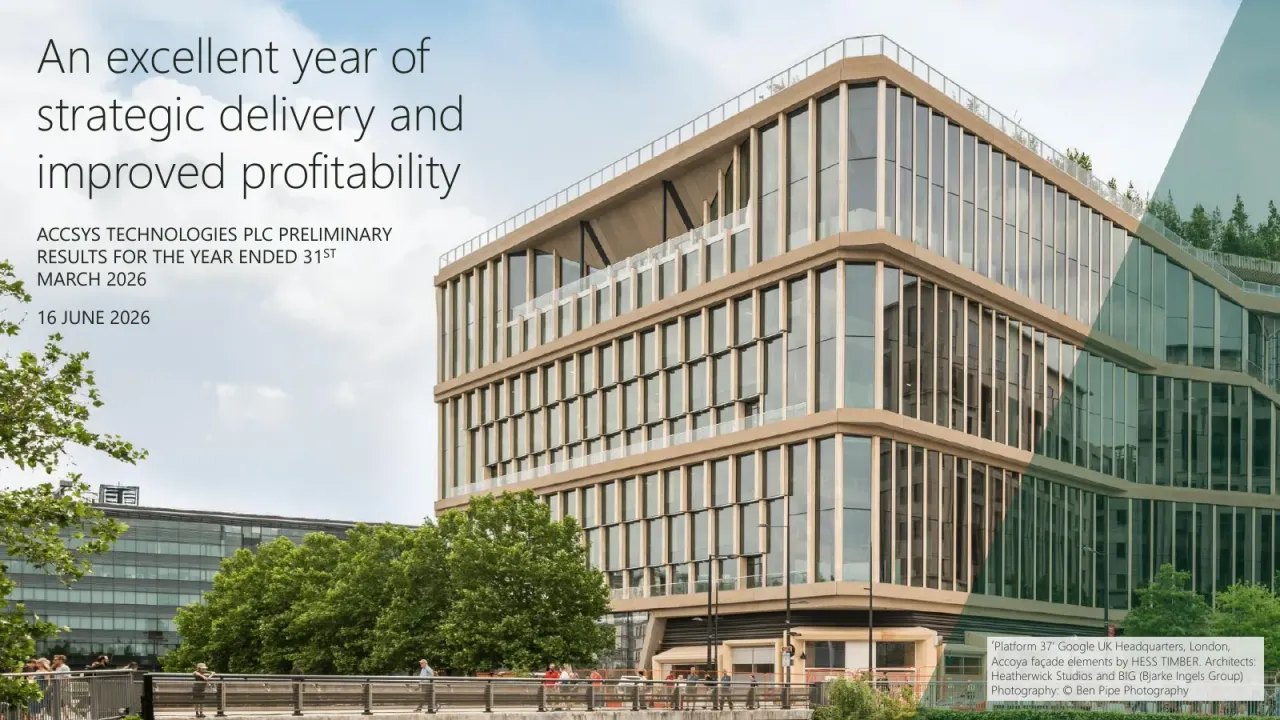
36:52 Then we have also some other commercial buildings, like a store headquarters in in Spain with ACCOIA cladding or tinside Lido in The UK, where ACCOIA was used in multiple applications. And, of course, last but not least, we had the Parkinson UK charity garden in Chelsea show in in London that got a BBC, viewers award, for, it looks absolutely stunning. We donated a COIA for this project, and, Queen Elizabeth the second Memorial Garden in Regent's Park in London is having a COIA benches today. One of the largest projects that we don't have here on the pictures, but you saw it in one of the previous slide, is a Google headquarter on the King's Cross in in London that is having a coir cladding a coir facade on the outside, but also coir use on their rooftop garden.
37:51 So we are extremely, extremely proud of all of these fantastic projects and looking forward to see some new ones in f y twenty seven as we go. A couple of words on our operational efficiency in our site in Arnhem. As Sam was mentioning, we continue to be run quite efficient operations. We retained 800,000 of cost savings from the financial year '24 business transformation program. At the same time, we also invested 2,600,000 in acetyl storage expansion project that is giving us basically 5% increase in available capacity because now we are able to feed reactors sim detail simultaneously, and it is helping us in in our efficiency improvements also on 8% reduction in CO2 emissions intensities.
38:53 That's quite in line with our AXS-one cares sustainability targets for FY thirty. In Barrie, as Sam mentioned, we had a 51% increase on a core color year on year. We were expanding by adding the second shift to accommodate the capacity increase, and we also invested in in kilns to improve their efficiency, the energy usage, and throughput, which help us to accommodate the growth in in a COIA color. We will continue as we go also to have the operational efficiency focus because company as an industrial company, you do need to improve every year to fight back inflationary pressures that are coming every year in every single location we operate.
39:45 R and D, last but not least, we do see ourselves as an innovation leader. This year, we have 30 new patents granted in f y twenty six. We have already 300 patents in 45 countries, so this is a nice addition that is protecting core technology, but also some new developments that we are having, that we are making in our labs. We also look working on ongoing developments on a coir range expansion and also work on new wood species as well as a new fire retardant solutions, which are quite crucial for us in the in the applications. And as is mentioned already, there is a plenty of companies nowadays that are providing coatings with warranties of up to fifteen years on ACCOIA. So fifteen years basically without maintenance if you buy a proper paint and you apply it on ACCOIA, which which is quite significant value creator for many, many customers that we have in our portfolio.
40:52 This brings me now to the outlook. The as a group, we will remain focused on innovation, market share gains, and increase to increase our capacity utilization and drives further sustainable improvements in profitability. And while we are pretty much aware of the macroeconomic conditions that are remaining uncertain with the additional inflationary pressures arising from the conflict in The Middle East that is every day changing, we do believe that we are well positioned to manage the potential impacts through our product differentiation, through our geographical diversification, and also our pricing discipline.
41:38 The board continue to monitor those developments very closely, and we are responding as as appropriate. And while having all of this dynamic macroeconomic backdrop in our mind, we do see trading is going to be in line with the board's expectation for the full year '27, and we are on track to deliver against our phase one of the focus targets. With this, I would just would like to give you a short overview of why do we believe investment case. We are market leading market leader in sustainable products. We do own proprietary technology with a very strong IP mode.
42:26 We operate in large and growing addressable markets and that are underpinned by a very strong brand. We do have established manufacturing footprint as an only company in the world that is having acetylation factories. And why is that important? Because if you know that to build a acetylation plant, even a smaller one, you need at least €150 of CapEx that you need to put forward. And even if you do that, there is a significant knowledge, technology knowledge that is necessary to operate those plants successfully. We have now already two in the two largest regions, and as a company, showing this nice top line growth, showing this significant improvement in our profitability.
43:15 At the same time, we are entering in the next phase of growth with the potential to deliver further significant shareholder value, and we are working very hard as a team to add and increase the value. With this, we are going to this will conclude our presentation, and we will now be open for questions. Great. Thank you very much indeed. Ladies and gentlemen, please do continue to submit your questions just using the Q and A tab situated on the right hand corner of your screen. I just want to remind you that participants' presentation will be available after today's meeting. Sorry about that. Elena, thank you very much indeed. As you can see, we've had a number of questions from investors today. Thank you to everybody for Over your to you, and I'll pick up from you at the end. Thank you very much. You see, we are a little bit impatient to answer. That is a pretty quite a nice question.
44:13 There is a question from Matt. Are you seeing increasing specification by architect and designers? And what does that mean for future growth visibility? Architects and designers are very, very important for us because this is where if you are working with a project like Google headquarter or this store office building or museum Edema Museum, it all starts by a specification. So we do have today specific specification sellers. So people who are interacting, their full time job is to interact with architect firms presenting and and show showcasing the ACCOIA as a solution for the for their projects.
44:59 And we have them in, of course, operating in The US, but also in in Europe. We do work quite in we also organize very often lunch and learns for architects. We invite them to come and see and listen to the presentation of ACCOIA. It also helps their professional development in a sense. So it is a pretty much a win win. We do have a pipeline of the projects. What does it mean for the future growth visibility? We know on which projects are COIA is specified. What we do not know exactly is when those projects are going to start and when they're going to be finished. In today's environments, the commercial projects are are more more or less better organized, but sometimes with the private projects, they do get postponed due to the all the, you know, market conditions that we that we were talking about.
45:55 But all in all, we are working two and two plus years before the building is actually extracted on specifying ACCOIA and already getting us on the architect's on the architect's list. There is a there is a question on operational leverage. How much operating leverage remains in the business as utilization increase across the network? Well, I mean, really, I mean, we we have a gross margin of target of above 30%. And really, as volume grows up, grows, then we will be above 30%. I mean, we were at 30.9% last year. And you saw this slide which showed the trend over the last two years.
46:43 But really, as the plants fill up, Arnhem last year was 75%, the North America plant was 40%, then that gross margin does increase. We expect when The U. S. Plant is nearing capacity for that gross margin to be around three or four percentage points higher than the Arnhem plant, primarily because it's a more modern, better designed, better engineered plant, but also the way that chemicals are brought in and and and removed is far better because we have actually have a closed loop pipeline system. So we are physically connected to the Eastman anhydride plant. So anhydride comes in, you know, through the pipeline and goes the acetic acid goes out by pipeline back to the Eastman plant, whereas in Arnav, we have tanker deliveries.
47:34 So as utilization grows up, we would expect the gross margin to be a couple of percentage points higher than where we currently are. There is a question from Matt again. AXS is reaching an inflection point where strong volume growth, improving margin, positive free cash flow and a profitable US operations are all coming together. What do you think investors are still underestimating about the long term potential of the business? Well, I think thank you very much, Matt, for this question. I think it's quite it's quite relevant. I personally think that that one thing that investors are probably still having in their mind is the risk of AXIS of being a company exposed to unfinished large capital projects in the past that made company quite vulnerable.
48:33 And probably knowing the, you know, AXS from that past makes for some investors doubting and wanting to have more proof points than what we are already showing. When we are saying when you're saying AXS is reaching an inflection point, we believe that we actually already passed that inflection point. And why is that? Because today, company does not have any unfinished large capital projects. That that chapter of company history is is finalized. We now have two large operating sites. We have a a strong commercial team. We are showing strong top line growth. We are showing the strong improvements in the profitability, and we are building much, much stronger company going forward forward. So we would say that we are entering next stage of our growth.
49:30 And many many investors are actually seeing this. From the moment that we published our focus strategy in January last year, our share price basically doubled. And it is going in steps, and we do believe that there is still space for it to to grow. Is North America con if North America continues to scale success successfully, how large would their business ultimately become relative to Europe? Do want to make Yeah. So, I mean, it's think that there there are two points there. One is about the size of the total addressable market, and the other one is about capacity. So the first one, addressable market. So the North American market addressable for our wood products, so focusing on windows, doors, decking, and cladding in North America is 8,600,000 cubic meters per year.
50:25 That compares to 1,900,000 in in Europe. So North America is about four times the size total TAM compared to close in Europe. And even with that plant at capacity of 43,000 cubic meters, it's only about half a percent of the of of the addressable market. And then when we think about capacity, well, the Arnhem facility has four reactors with an nameplate capacity of 80,000 cubic meters. The US plant has two reactors with about 43,000 cubic capacity. But the important thing is The US plant was designed with modular expansion in mind, so it has space for six more reactors in place going up to a total of eight, which would mean with eight reactors about a 160,000 cubic meters compared to 80,000 cubic meters in Arnhem.
51:22 There is a question from Chris. The business significantly outperformed broader construction markets. How much of this is structural versus cyclical? Well, I we do believe that, as I mentioned in my previous slides, we operate the the the contribution that we saw this year from the markets was in refurbishment, renovation, and the premium luxury segment mostly coming from The US. For us, it feels much more structural than cyclical. You may say we are a little bit less sensitive to the to the cyclicality of the overall building sector, but we are not completely shielded from it.
52:08 As a as a company that operates in the in the building material industry, we see those cycles also coming and going in FY '24. We had a significant impact when the whole industry went went down, so we felt it at the end as well. So we are not completely immune, but we do have some, as I said, diversification product wise, but also geographically that is helping us to manage manage the exposure. There is a question from Tony. Very impressive. Please help me. I see the projects you highlight, but surely given best treat to wood based product, pressure impregnated timber, your products have sub substantial advantage, or am I wrong?
53:01 Surely surely for gold products such as patios, the ACCOIS solution is no brainer. Investors need to understand this because it will deliver very big growth. Sorry so long. I am a shareholder. Okay, Tony. Thank you very much for your for your question. Indeed, our wood is one of the most durable wood in the not one off. It is the most durable wood available today in marketplace, And it is durable because of its resistant to rot, and it's resistant to to different insects, if you like. So it is it is quite a sustainable solution. So the customers or people who use the COIA once, they come back and use it quite often.
53:55 We see that with architects. We see that with manufacturers. It basically buys you a total peace of mind, if you like, for many, many, many years. And that is why the company is growing so fast compared to the underlying market. So I'm looking I think those are the all the questions that we received for today. So with this, let me just conclude with saying thank you very much for your interest in ACCOIA Technologies PLC. We are the company that is fully transforming. We are growing, and we are delivering. And thank you very much on your attention today. That's great. Thank you to you both for your time this afternoon. Ladies and gentlemen, if I could please ask you not to close this session as we'll now automatically redirect you for your feedback.
54:48 On behalf of the management team of ACCSYS TECHNOLOGIES, thank you for your time this afternoon, and enjoy the rest of your day.
Follow Accsys Technologies PLC into a list and get an email when it puts out news.
CEO at ACCSYS TECHNOLOGIES PLC
CFO at ACCSYS TECHNOLOGIES PLC