Transcript
Automated transcript · Written by software from the replay's audio. It can mishear names and figures; the replay is the record.
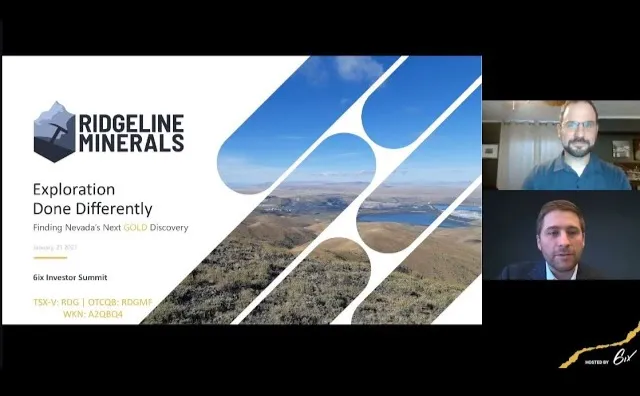
0:11 Hi everyone and welcome to Ridgeline Minerals Investment Summit today hosted by 6. A look back at 2020 and what is ahead for 2021. I'm pleased to introduce our speakers for today. We have President and CEO Chad Peters and Vice President of Exploration, Mike Harp. Together, they will walk us through a company presentation and then take us through a live Q&A. As a reminder, you can submit your questions on the Q&A panel on the right-hand side of your screen at any point during the presentation.
0:40 And as always, the presentation is being recorded and will be available to view afterwards on SIX.com. We also have a copy of today's presentation available to you in the handouts tab for you to download. So now without further ado, I'll hand it over to you, Chad. Thanks, Dasha. All right, everybody. So thank you for taking the time to attend today. We've had a pretty exciting, I guess, kickoff to being a publicly traded company. We went public in August of 2020. It's been a short 5 months with lots of news flow, lots of drilling at multiple projects. Mike and I wanted to take a moment here and walk through what we were able to accomplish in our drilling programs last year, talk about our plans coming up for 2021. And this is one of the few times that Mike's been able to join me here.
1:26 So you guys get an opportunity to hit him with as many questions as you can. So I'll get us started and then we'll pass it over to Mike when we start talking about the rocks.
1:36 There we go. So we got our obvious disclaimer here. So why invest in Ridgeline Minerals? So for those of you who are not familiar with the company, We're a Nevada-focused gold-silver explorer. We have a 125-square-kilometer exploration portfolio, which is one of the largest exploration portfolios held by a junior anywhere in Nevada. Our 4 projects are in the Carlin and the Battle Mountain Eureka Trends, 2 of the core trends that have produced 90% of the gold that's ever come out of Nevada. So, a very exciting place to be. And I think we have a unique structure as a company. So, my co-founder to the company was Steve Nielsen. He's the owner of a drilling company. So, we got together. We wanted to find a way to reduce risk to shareholders, which at the time was only us, and put more money into the ground, make a discovery early. So what we did is Steve co-founded the company along with me, and he provided a 50,000-foot drill contract for 3 years, or 50,000 feet, so whatever came first.
2:32 So that's been a huge competitive advantage for us. It's allowed us to raise money at progressively higher valuations, consolidate some grand big land positions by joining forces with companies like EMX Royalty Corp. And it's already resulted in a significant new shallow oxide discovery at the Salina Project, so we're really excited that it's working for us. We're gonna keep on doing the same thing heading into the new year, and you know we have a great team backing it, so I have Mike on the call with me today. You know Mike was part of the gold standard team that discovered over 5 million ounces on the Carlin trend. This is not his first rodeo, he lives down here in Nevada with me. I myself was part of the Premier team, which I led the discovery of almost 2 million ounces of high-grade gold at the Cove deposit and was part of over 10 million ounces of discovery with Premier's Canadian team back in the Red Lake and Ontario districts.
3:22 So we're heavily aligned with our shareholders. I own 17% or sorry management owns 17%. I own 7.8% of the company. We've participated in every single financing as a group. I've put 150,000 of my own cash into the company and I'll continue to do so as much as I can. So we're heavily motivated to make this a success. As far as capital structure, We've been able to maintain a really strong capital structure, even though we founded the company in a rather difficult time in 2018 for juniors. We have 48 million shares outstanding, 58 million fully diluted, and a really great mix of management, public companies, institutional ownership, and a heavy retail following. So With that kind of share structure, we're really poised to, you know, with continued success with the drill bit, we could really take off. So we have $3.5M in the Treasury as of the end of 2020, which sets us up for a very aggressive start to the year. So We can really move these projects forward, especially with our drilling contract.
4:22 We have 4 projects, and I'll give you a little overview and then Mike's going to get into the meat of them. We have Carlin East, Bell Creek. They are core land positions right on the North Carlin trend. They're sitting beside the Gold Strike and Leaville mines. These are 2 of the biggest mines in Nevada. We're talking 10 plus million ounces at Leaville and 40 plus million ounces at the Gold Strike mine. So we're definitely in the right area. At Swift, we have high grade underground target, district scale land position, directly adjacent to the pipeline mine and on trend of the Cortez district. So that's produced over 35 million ounces of gold, or it has over 35 million ounces of gold just in reserves right now. So and then to top it all off, we have our Salina project. It's down in the right down here in the south southern corner of the South Carlin trend. This is a shallow oxide play. It's our new discovery.
5:08 It's looking very exciting and it's actually turned into more of a silver story, so we'll get into that in a little bit. So we'll start with Sleen, actually. It's a 35 square kilometre land package. Oxide, open pit, silver gold target. 100% owned. We did 3 phases of drilling in 2020. Resulted in over 22 drill holes, plus trenching, soil sampling, mapping, you name it. We did the whole baseline suite of data collection before we went and drilled. We were looking for a Gold mine and we found a Silver deposit. Our 2020 drilling returned a highlight intercept of 36.6m of just under 90g Silver equivalent. We've been able to show pretty exceptional continuity across this discovery so far. I'm going to hand it over to Mike and let him walk you through it and why we're excited.
5:58 Hi, good to be here with you guys today. Like Chad said, Salina sits on the South Carlin trend. Our analog mines in the area would be Alligator Ridge, Bald Mountain, and just to the north of us, the Golden Butte Mine that McEwen Mining owns. And what we found here, like Chad said, is exceptional continuity at the pilot Gilmette contact. So a non-receptive shale with a receptive limestone unit. As to date, what we've been able to prove at Salina is that Salina has scale and some pretty good scale to it as well as the exceptional continuity that we're seeing through this unit. So we had 3 phases of drilling out here at Salina this year. The first phase of drilling was focused on the real flashy outcrops of jasper we saw in the gill meadow along the northeast faults.
6:45 And we had some success along that underneath of our trenching and continued our face into our phase 2 which was testing along our West Northwest faults, which would be our juniper and tyrant areas and really focused on where those faults, which tend to carry a lot of gold in a carlin type system on a West Northwest fault where it intersected those Northeasters. And that's where we really started having success on this project. So as we stepped along strike along both of these fault directions, we really started to hit some stellar grades with the highlight intercept that Chad mentioned out of hole 21 down on the southern portion of that GT shape. What this drilling did even into our phase 3 expanded both to the north and the west to 1.2 kilometers east, west, and then 0.7 kilometers open both north and south and to the west.
7:40 And so when you look at that small inset map on the top right corner, you can see that This is a target rich property and the new discovery is just a small portion of a larger exploration plan as we move into our sonic revival and broken egg targets that exist at similar host horizons on the project. So what we really did here was we applied our exploration model, very data driven, and we put those holes in the best locations we could, and it took 22 holes in an area that hadn't been drilled to really define and expand this GT footprint. So what we're gonna do first is we're gonna look at cross sections A to A prime, which would be straight across what we call our chinchilla zone.
8:25 And here through the cross section, we see that excellent continuity as we were able to drill these holes along strike of the Northeast fault system. With our data driven program, the Chad said we used our gravity, which showed that we should have near surface oxide that we could get with our RC drilling contract, fairly easy. So these 22 holes were done rather cheaply, quickly, and really expanded along this, what we call the Baraja zone down in the Gilmette limestone, which is the red unit you see coming down here, or down through the gray unit.
9:05 And right in this area, you see a structural intersection. And this structural intersection is really important because this is what allows these rocks to be broken up, smashed and allows these mineralizing fluids to enter the area. So looking at this, we see a hole 22. This was a 400 meter step out east, or I'm sorry, west of our drilling and 600 meters north of our intercept in hole 21. And these large step outs are still hitting this mineralization.
9:38 The only thing that we saw out of hole 22 that was different than all of these other holes was we had a severe sample loss of up to 66% on average through this zone. And moving into this next slide, you'll see what our ship tray looks like. Now, in my experience on the Carlin trend, I've come across this issue before. And in this hole with 66% sample lost, we had a 70% reduction in grade. And there is a correlation between grade and the amount of sample that you're able to get out of an interval. So this was a concern for us. So we are going to twin this with a core hole. And 1, we're going to try to show that there's excellent continuity of the system and that the grades are still there. We just lost most of our material and to start getting a better look at what our system looks like in a court in a court type situation.
10:29 So the next section I'm going to show you was, I'll just pop back real quick, will be B to B prime. And looking at B to B prime, we see this is 600 meters south of the section that you just saw. And B to B prime
10:44 holes 19 and 21 were the best holes that hit in this area. And really what we saw is a closure of the system to the Southeast. And that's the only place that we've seen the system really start to close off. And what we think is going on at this moment is this Chinchilla fault that runs north-south is offsetting this deposit. And so it's not so much that it's been closed off, it may have been jumbled around and moved. And that's really what we're trying to understand on the property now is the effect of some of these other faults that hadn't been seen in any past work done on the property.
11:20 What's really exciting to us... And I think it's good to point out, Mike, and I think a good point to that is we're doing this wide-space drilling, right? So that's part of the issue is, you know, you do these wide-spaced holes and something misses. You don't have tight enough infill drilling to actually, you know, so this goal this year will be to start some in tighter infill drilling to better understand some of those offsets. Sorry, go ahead. Correct, absolutely. And so that's what this image is showing. So
11:44 as we started testing these structural intersections, we found that all of these parallel West-Northwest faults really had the ability to carry gold. And that's why we moved down to what is the Tyrant Fault intersection and where we saw some of these higher grades. So what our focus next year will be is to continue to find these shallow intercepts, but also as we move west, there's the Chainman Sandstone, which is a host at the Bald Mountain Mine. So as we move west, we have this large arsenic plume that you can see in the soils on the surface of this cross section that's out in pediment. So we're seeing excellent continuity in these soils at surface and in our drilling. So we're really excited about the fact that the chainman can also carry Gold. It shows that it's carrying the highest arsenic and anemone intercepts on the property or in the soils.
12:31 And so that has the chance to have stacked zones, which really brings our economics into a better position when we have the chainman hosting gold, possibly the Joanna and the pilot hosting gold, and then the lower gold and silver zone that we have in the Barajas area. And so that's really what we're trying to prove in our next round of drilling is that continuity as we move west and north along strike of these structural intersections. So here's what excellent continuity would look like in a drill hole, RC drill hole out here at the property. And it's much different than how it looked in hole 22 in the previous slide where I showed you that chip tray. Here you see a nice ramp up of oxide mineralization and grades where you would expect with the highest oxide mineralization through the center portion of this interval. And so that's really what we're out here looking for and why hole 22 really didn't fit into the rest of the model at Salina.
13:33 So moving forward into this year, we will be moving north into what we call our Sonic area and trying to connect that back with our Chinchilla and moving west and trying to bring the Chamin into play with our next round of drilling. Did you have anything to add on that, Chad? No, I think that's great. I mean, I think what Mike and I get really excited about and it's funny, because when we first picked this project up I was actually looking at it, optioning it off to another company. We just had too much ground. It cost too much. I brought Mike out for the first time into the project and he came back to me and he said, you dropped this project and I quit. It was kind of like, okay, well, that's a fairly strong statement. Maybe we'll take a look at it. It's been a great, it's really taken off for us. We're really excited about our 2021 program. We're going to start in the spring. I think we can show that this thing has considerable potential to grow.
14:23 You know, oxide deposits in Nevada are kind of the backbone of the state. It's what made the mining industry here. And, you know, silver, a silver gold deposit is somewhat unique. There's There's 1 comparable in Nevada that I can think of, which would be the Cora Rochester mine. Just to put a bit of perspective on this thing, the average grade life of mine at Cora Rochester is a 200 million ounce silver deposit. The average grade Gold is 0.09 grams per ton. The average grade Silver is around 13 grams per ton. That's a silver equivalent of right in and around 21, 22 grams per ton silver equivalent, life of mine head grade. You look at what we're drilling in and We're seeing considerably higher grades than that. I mean, even our worst hole that we're kind of apologizing for at hole 22, as far as grade, it still falls right into that wheelhouse of the average grade of the only operating Silver mine in Nevada. So I think there's a lot of potential here for this thing to grow and our team's really excited. So looking forward to if anyone has any other questions about it heading into the Q&A.
15:20 Yeah, and totally agree with that. And just a side note on that is most of what is the chinchilla zone that we hit is undercover, under alluvial cover. So these are buried targets and there is a lot of potential as we move out into the basin from Salina into our higher priority targets along these northeasters and west northwest intersections. Yeah, definitely lots of covered potential for sure, so we're excited. So, Bell Creek, so I'll walk into that a little bit for you guys. This is a very strategic land position for us. It used to be part of the Carlin East land package. I'll show you where they are in location here in a sec. We actually ended up splitting them apart because Barrick is now drilling adjacent to the boundaries of both projects and they're 2 different targets. They're 2 different stories and we really felt it was necessary to break them apart to really fully understand what the potential was.
16:07 The project has a shared boundary with the Banshee and Wren deposits. You can see right here in the red outline. What's really significant here is we own 100% of the mineral rights. These are private fee grounds, which we have in yellow at Bell Creek. It's private ground, doesn't cost us anything to hold, but a very modest lease payment to the underlying owner. And Barrick just started drilling the sinkhole Breccia target, which is that dashed white line right there. They drilled that in Q3 of 2020. That's only 250 meters from the edge of our property. I mean, this is the biggest gold mining company in the world drilling drill holes right off the edge of our property. And, you know, we have and it's it's you know, we have 100 percent ownership. So that, For example, the red outline is the Ely Gold Royalties Company. That's their royalty outline. That is now valued by Laurentian Bank at $41 million US at a 7% discount rate. That's just for the royalty and it's valued at $41 million US. We own 100% of the land package directly adjacent to us. We think this is a potential for it to be a game changer for the company and it really comes down to seeing what Barrick's up to on that side of the property. Once we get results back from that on their quarterly report, we'll make a decision on are we going to drill it, what's the next step for the project? But I think it's a very exciting story for us. This is a good example. Here's Mike. Mike and I hopped the fence and went and put a state, a drill hole stake on our side of the property boundary. And you can see there's the drill hole right here. It's only 250 meters away from the edge of our property boundary.
17:33 And we're, you know, it's, we see it as kind of a, you know, a bit of a strategic lottery ticket for us, right?
17:38 Good results from Barrick could be a game changer for us. So we'll see what comes out of that in the next month and a half, 2 months, and then we'll decide how Bell Creek fits into our exploration budget for 2021. Now we have Carlin East, which is directly adjacent to Bell Creek. It's the larger land package of the 2. It's 35km2. It's a high-grade underground Gold target. It had very little drilling on it for 30 plus years, was previously owned by Newmont. We were able to pick it up in 2019 and significantly expand the land package. One thing of note is Nevada Gold Mines recently made a discovery just to the south. This is about 2.5km away from the edge of our property. They just announced in Q3 of 2020, they announced a new discovery. They drilled 21 meters of 35 grams per ton gold. So at 827 meters, that's the same depth as what we hit in CE 1901. We hit host rocks with this hole in 2019 at 790 meters. So we know we have the same depth to target. We didn't get that hole as deep as we would have liked, so we need to come back in and we're going to drill the crash zone target in 2021. You can see right here, this is where you kind of have everything we call it the crash zone because Mike and I are really original.
18:49 And that's where all the faults are smacking together. And so we're really excited to give that a shot. It's the same general target as the North Leveville target. And Newmont, or as Barrick continues to drill, they're just going to keep stepping up this fault zone towards us. They're de-risking the story for us. And so we're being very careful and selective about when we put drill holes into this thing. We want to glean as much information as we can from Barrick before we go out and spend some high dollar money to go and put in deep holes out here at Carlin East.
19:18 Here's just a slide from Barrick's most recent quarterly report. And I really want to point out, here's that same, there's the discovery hole right there. We're 3 kilometers to the northeast.
19:30 And it's really important to point out, here's that, whoops, I'm using the wrong end of the pen here. It's really important to point out this AA Prime. That's what this target would look like up on our project. You look over here, just to point out, they're drilling, they hit 82m of 23g per tonne gold. That is as good as it gets anywhere in the world as far as grade, right? So, you know, we're really excited to test this target. You know, even Barrick's CEO, Mr. Bristow, made a point of saying that these results highlight an exciting step in realizing the significant growth potential both to the north and west of Level. So we happen to own ground to the north and west of Level. So I think it's a great spot to be. And I think that 2021 is going to be a very exciting year for both of these projects. So I'm going to get into SWIFT here and then hand it back over to Mike so we can get into the rocks again.
20:18 Swift is probably our favourite project from a technical perspective. This is one of those projects where you take out a group to tour it and the bankers love Carlin East because you can literally look down from the hill and you're looking into a 40 million ounce gold mine, which isn't a bad thing. You take out geologists, they love SWIFT. They pick it every time. It's because it has all of the key characteristics of what you want to see for a buried carlin-type system. It was owned by Barrick for 20 years, Placer Dome before that. And it just never met, never got the exploration love it deserved, I guess you could say, right? When you've got a big company, things fall out of the bottom and this was one of those projects. We were able to swoop it up. We completed just under 3,000m this year. I should have updated that, but oh well. It's only 7km from the Nevada Gold Mine Zone pipeline complex, which is over 20Moz.
21:06 I'm going to hand it over to Mike. Go ahead, Mike. Get into the geology here. For sure. In the Cortez district, it's controlled by a really through-going west-northwest feature that we call the Cortez Structural Corridor.
21:21 And anywhere this corridor rips across this area and intersects a North-South trending type fault, that's where you start to see these major mines in the area. So Formwile, Gold Rush, Cortez, Cortez Hills, all of those mines are hosted in what is known as the Devonian Wind Band Formation. There's satellite deposits and smaller deposits in the Horse Canyon above and in the Roberts Mountain below, which is the classic host on the Carlin trend, but on the Cortez trend, the wind band formation is the key component to all of these mines. So where this West Northwest Cortez structural corridor intersects these North South
22:03 faults and these rocks are in play, you tend to get a mine. And so what makes Swift as exciting as it is, is the fact that we are the next structural block to the Northwest of pipeline and gold acres. And there's already a small oxide mine in the upper plate in the Elder Creek mine adjacent to our property. So there's gold system, like Chad said, already kicking around there. And we are on the big structural break in the area that tends to define gold mines in the Cortez district. So taking a look at a zoom in of the Swift property and where we focused most of our drilling this year, this was wide space drilling and no drilling had been done here for over 20 years. So this was kind of an unknown and just a forgotten about area.
22:49 And the one thing in the only hole that we know that hit was MCK 99.5A that was drilled by Phelps Dodge, and it's the only one that got to lower plate. And when it did, it hit 16.8m of 0.72g per tonne gold right at that contact, but it was in the Roberts Mountain. It was missing the thrust or the wind band. And so what we were trying to do here is prove that we had our host rocks and we were actually looking for Roberts Mountain. The significant thing is, is we are interpreting what we hit from holes 1 and 2, the only 2 holes of our 3 hole program that actually completed to target. They hit what we are interpreting as the wind band formation and into the Roberts Mountain, which is extremely significant since the wind band hadn't been hit over here and the areas that we drilled these wide space drill holes had never been drilled previous.
23:39 So the strongest structural feature in this area is the goat anticline axis or the goat anticline and its axis rips across the eastern portion of our property. Most of these West Northwest faults that are really hard to track on the surface are parallel to this goat anticline axis. And the goat anticline remains untested at this property, which is one of our highest priority targets. That's also real close to where the Elder Creek mine
24:07 has its pit. So most of the historic drilling, like we said, was shallow, didn't get to target. And so what we like is the fact that We now have the host rocks as well as the intrusive material that most, if not all, Karlin trend deposits have associated with them. And you need to be distal to these deposits in order to have a Karlin type system. If you're too close to these pink zones in here, in these intrusives, you're probably not gonna get gold mineralization because it's too hot. And so what we were focused on is this blue unit, which is the Wenband Formation. And as you can see, hole 2 appears to have drilled a complete section of this, intersected what we're calling our fallen city intrusive, and then came out into the Roberts Mountain. And at that contact, we had 0.2 meters of 0.22 grams per tonne gold with 860 grams per tonne silver in what looked like an electrum type or bis-newtonite type mineralization
25:05 in this interval with bismuth near 5,000 parts per million. So that is extremely significant. The other thing that we see is a large arsenic plume off to the west side of our property where those historic holes hit. And those arsenic plumes tend to be where you're seeing this plumbing coming up to surface through non-receptive rocks, which would be that like peanut butter color brown unit. So we're seeing arsenic plumes. Our downhole
25:31 geology and geochemistry is showing that these minerals are kicking around. And the only sad story we have here at SWIFT this year is one of our favorite holes, SW2003, failed to come down and hit target. It got lost in the DDF fault zone with some severe caving. So we will be coming back and we'll be drilling from that area again as long as expand as well as expanding out into our high priority goat anticline targets where we should have a really good situation. One thing I'd like to address, and if there's any GEOs watching right now, is the faults themselves. They are very much laid over. These were likely high angle faults, but with the tilting in the Shoshone range, these have tilted the entire range over, which makes these a little bit harder to target. As you can see, 99.5A fault gapped into Roberts Mountain and missed the wind band.
26:28 And so we hit the wind band so we know it's here. So now, applying this tilting model, you can see that these fluids can travel long distances and show up at surface far away from where the actual target is. And so, knowing this now, with this knowledge, we're going to attack next year into our goat and declined targets and start offsetting from the known intercepts we had in the historic Phelps Dodge holes. No, that's a great point, Mike. And you know, one thing that really got us excited is, you know, when we drilled these 2 holes right in the center, hole number 1 and hole number 2. You know, we hit the core of the heat system or the heat engine for this thing, right? Every major Karlin type deposit in Nevada is directly associated with a big buried intrusion, right? It's the heat engine, it drives all the fluid flow, It's what's necessary to create a big gold mine.
27:18 These holes proved that we hit right into the core of it. It's too hot right there, right? We
27:24 saw a lot of high temperature mineralization. They were all the right host rocks. We saw some narrow high-grade stuff, but it was just too darn hot. So what we're excited to do is, like Mike said, as you get away from these systems, they cool down and it starts precipitating Gold. And we actually have direct evidence already that that is exactly what's happening. Right. As Mike mentioned, we have these interesting hits out here at the Mill Creek target. They're roughly a kilometer and a half to the west. Then you look over to the goat anticline. Whoops, wrong button. And you look over to the goat anticline here. It's 2 kilometers away. You have an
27:55 open pit gold mine, just a little crack at surface. It's not a significant mine by any stretch, about 60,000 ounces of gold, but it shows that there's an active gold system churning away at depth. That gold didn't just drop there from the heavens, it came up from below. And so what Mike was saying, it was a really important point that he made, is when these fluids are flowing up these laid over fault structures, They're flowing up these low angle faults and then bleeding up into the upper plate. So what we're chasing is that buried kind of blind target as you might want to call it. And I mean, the best place to look for a gold mine it's underneath the gold mine, right? I mean, that's the first step. So we weren't able to permit the goat anticline in time to drill it in 2020. We're really excited. That'll be definitely our first step in 2021, be coming out, testing those targets. And the goat anticline target is 5 kilometers long. It's never had a drill hole on it. So I think that's when you look when you're not.
28:45 Oh, go ahead.
28:47 It is permitted now. We are permitted and ready to go on the goat and applying for this next year as it is one of our highest priority targets. Another note on the Elder Creek mine is the 60,000oz was not the end of the ounce endowment of that mine. They stopped because of metallurgical issues. So there is still more Gold there indicating a stronger system than they may have realized when they were actually mining. Yeah, it just transitions to Sulphide. That's a really good point, Mike. So, you know, when you look at SWIFT, you know, Mike and I look at it and if you're talking about Blue Sky, you know, Upside, what we've been able to put together here is a really compelling story.
29:21 If 1 good drill hole here, we'll completely change the company. To be honest, all of our projects, I like to think, have that ability. We've already seen excitement at Salina and Swift and Carlin East and Bell Creek all have their own upside and their own rights. We're really excited about what 2021 looks like. When we're talking about upside, I've already gone through it, but what we'll be focusing on this year at Salina is we just recently acquired a historic drill hole database. Mike and the team are currently validating that data. It's going to be very complementary to our existing data that we've collected ourselves, help support additional targets outboard of our new discovery. And I think that's going to have a lot of excitement for us in the coming months. We have this district-scale potential at Swift, which we've already went through. Porton Kicker there, we've hit the wind man. That's a very significant point to make. We now know we have
30:13 the right host rocks. It's just a matter of vectoring in on that high-grade mineralization. And we have strategic land positions at both Bell Creek and Carlin East. We're expecting news out of them February 18th. That'll be their Q4 2020 results. We'll come out of Nevada Gold mines and we'll see what comes out of that. Aggressive programs at all of our projects. Very motivated team. I think that, you know, we're currently trading at, this is an opportunity to get into a company that's trading below their IPO price. So I think we're a compelling opportunity and we're looking forward to answering all your questions. So thank you. Thank you. Great. Thank you so much, Chad and Mike. We're going to transition now into our live Q&A. The first question that we have is for both of you. So Mike and Chad, during your careers, what have you each learned about exploring in Nevada that you bring to Ridgeline?
31:06 Mike, why don't you take that first? My experience working with GSV and the shallow oxide deposits and some of the deeper projects we had, which would be like North Bullion and some of our outline targets we were working on before I left the company for Ridgeline. What I took away from that, what I bring to the table there is expanding those shallow oxide deposits, Really keying in on those structural intersections and
31:35 putting the drill holes in the right place the first time. The team I came from was also very data driven and the things that I learned from them on the expansion and moving towards development of a pit, as GSV was doing, was extremely important for this and allows for Celina to be right in my wheelhouse, at least for the initial parts of the program, and working with a fantastic project geologist, Gabriel Aliaga, who's on our team. We've really done some good work there but working on deep targets as Chad has as well and putting the drill hole in the right place the first time not always the easiest most geos would know but really dealing with tough drilling conditions on the Carlin trend, all of those things
32:20 really helped add to the team. And that experience is something that I feel has already helped this year. You know, it took 22 holes in 6 months to make a discovery at Salina. And that's just applying those skills that I learned from a great team that I was part of back then. No, absolutely. And I have the same, you know, lucky enough to work with a great team at Premier. That group made a lot of discoveries. I was able to be a part of it. And my focus in Nevada has always been deep high grade, right? So that's where my experience is, is making deep discoveries under covered blind targets. So that's why Mike and I are such a great fit, right? We both have this varied experience, both making discoveries in Nevada, but on different types of deposits, different depths, etc. So it's a very complimentary skill set I think that we bring to the table.
33:05 Great. As a reminder to everyone, just continue submitting your questions under the Q&A tab. Our next question is, how did you come to partner with a drilling company? That was an interesting story. One part about Nevada that is difficult is it is bad drilling conditions here right like and you know you you can drill for much cheaper in Canada typically. So I saw that firsthand at Cove, saw what it took to take a project from discovery, from a cost perspective, all the way to a PEA.
33:40 I wanted to be able to cut that off, reduce that risk a little bit for us heading into a company. When I went to Steve, I said, look, let's found something. Let's put a company together that is drilling focused, put some money in the ground. And so Steve, in return for an equity founding stake in the company, Steve agreed to a three-year drilling contract at a 60% discount to market rate drilling. So Just to put it in perspective, our Phase 2 drill program cost us $1033 per foot at Salina. Our Phase 3 program cost us about $19 a foot because we started extending some holes a little bit deeper. You put that into a bigger perspective. If I was to go in there with a regular drill contract, I'd be paying close to double that. So it allows us to, you know, we did 22 holes for under a million dollars this year, and that also included geophysics, soils, trenching, and geo salaries. So, yeah, It's worked out well for us.
34:32 Great. So James has a question. How close are you to putting an inferred resource on Celina? What is the timing and cost?
34:42 Second question is, if drilling continues to work out, is the plan to monetize Celina to fund exploration
34:50 at the other 3 projects? Right. That's a great question there, James. So I would say that our focus at Salina is a little bit different than, you know, a lot of juniors, they hit a little discovery and they start poking holes within 100 feet of that discovery hole and just try to generate news flow. We're not here to do that. We're trying to prove that this thing has the scale to be an open pit mine. So we're going to continue with our wide space drilling. We are going to tighten it up a little bit, But I would say that by the end of the year, we'll be close to an inferred resource, but it's more important to us to define scale and continuity than it is to come out and say, to drill a tight space drill on only a portion of a deposit and come out with a resource, right? So I'd like to show that this, the larger potential of this project and then look to monetize that, whether it's taking it to an inferred resource or not will be dependent on the market and the site, you know, our success with the drill bit. But ideally, you know, we find a partner, sell, you know, sell Selina for a great premium, this, you know, get the discovery premium and we'd use that for those funds to fund our deeper exploration at some of these really
35:54 high potential projects like Swift and Carlin East. So it's trying to, I guess we're going to use it as a jumping block for our bigger plan. Great. Do you need to add, Matt? No, no, that was it. Yeah, exactly. That's what I see it as, the vehicle to get to those deeper targets, because Selena does have the potential to be worth a significant amount that really could fund those projects and get those deep holes into those exciting targets that we would like to get to. Yeah, and our, you know, our, you know, I guess Mike and my philosophy right from the start was to never get married to projects, right? So, we see the value at Celina.
36:29 Typically, You know, you look at the Lassonde curve, if you take a project all the way to PEA, your company is probably going to be worth less than when you started. You know, you need to, you know, so we want to get, we want to hit that discovery curve right where, you know, at a premium for the company and use that money to grow. Great. So your exploration to date has been to work across all of your projects. Why that approach as opposed to working 1 hard to make a discovery before moving on to the next?
36:57 Well, I think one of the things that's really important to remember is exploration is not easy. There may seem like there's a lot of new discoveries right now because all these, you know, tons of companies have been funded over the last month with this nice little run or 6 months with the run in gold, but it's incredibly hard to make discoveries And usually 1 project has a very low chance of being your big success. So we went and found 4 projects that all had great potential in their own right. And what we're doing is that early stage work to show which one of them is our flagship. Right now, Selene is looking incredible. We could drill a great hole at Swift and we could very quickly move our focus to that, in which case that's where our model kicks in to monetize one of those assets and move forward with the other. It's really just a statistics game and trying to minimize risk to shareholders, whether it's through the drill contract or our projects.
37:51 All right. Victor is asking, when do you want to start drilling swift? Tomorrow, if there wasn't snow, Victor. That would be the easy answer. Ideally, as soon as we can get out there logically without having to fight mud or snow drifts, which SWIFT can get some pretty good drifts, but we'd like to get out there as soon as possible because of what we learned this year. We have 2 NOI permits in through the BLM and we are finishing up a BMRR plan which allows us the acreage to do this work out there. We're kind of chomping at the bit to get out to Swift. It will be one of our prime targets this year. And it really comes down to weather. Yeah, hopefully, you know, hopefully May, June, we could comfortably get out there without, you know, we've seen 25 foot snow drifts up at the tops of the hill sometimes, so we're a little, got to have Mother Nature cooperate.
38:47 Yeah. Could you please put into context the Silver grades you're hitting at Salina, and what are some comparisons in Nevada? Maybe I'll take that, Mike. So probably the best comparable, there's not a lot of Silver rich open pit deposits in Nevada, right? You can, I think the best analog would be the core Rochester mine, which I referenced earlier? It's about a 200Moz open pit, you know, shallow, so low strip, decent metallurgy. You know, For example, we get about 74% Silver and 81% Gold so far. They see around 90% Gold and close to, I think, 80% Silver. So, very comparable. And the grades they have there are about 21g per tonne Silver equivalent. So we're about, I would say on average, we're about 3 times that grade in a Silver equivalent range.
39:37 So it outcrops at surface. We see incredible grades. I mean, our trench number 4 at surface ran 38m of 115g per tonne silver equivalent. That's right at surface. You can go out there and knock a chunk off of it. That's where an open pit would start. So that would probably be the best analog. And as long as we keep hitting, I think those kinds of grades, it could be very exciting. All right, Victor's next question is, which deposit mine is the analogy of Salina? I might. I think maybe that's probably, I guess, that's kind of 2 pieces. So the Alligator Ridge mine, which is 10 kilometers to the west, it's hosted in the exact host rocks that we're seeing our grade in. So from a, call it a geologic perspective, Alligator Ridge is maybe an analog. The difference would be as we're more silver rich. So From an economics potential, you'd probably look to core Rochester for an analog of what that might look like from a geologic potential where alligator ridge, golden butte, the nearby mines to Salina.
40:42 Agree totally, yes. Perfect. And so since you've done so much wide space drilling at Celina thus far, what are the drilling widths planned in 2021? Why don't you take that, Mike? Like in regards to like stepping out from the existing drilling? The drilling widths plan? Oh, I don't think stepping out. Yeah. Yeah, yeah. So most of what we're going to try to do this year at Salina is try to isolate them, continue to work on the shallower oxides that are along the range front as we go up into the sonic area, but the step outs are gonna remain pretty large. So they're gonna be plus 200 meter step outs. As mentioned in the presentation, we just got a whole bunch of data that we're absorbing.
41:31 So there may be some holes that we need to twin up there. And then as we step out into the basin, we're gonna be looking at 300 to maybe even 500 meter holes with the hope of getting shallow oxide out of the chain man formation as it comes into contact with the Joanna, and then going for those deeper targets as well and looking for those stack zones. So it's gonna be a blend of shorter, maybe 100 meter holes that are closer up by the range front, and then, you know, 300 to 500 meter holes as we step out into the basin, looking for those stack zones. So it'd be kind of a mix in the long run. And we'll probably, you know, some of our better intercepts like, you know, 21 hole 7 had really high grade silver. We'll start doing some tighter space, you know, 50 meters, 100 meters to try to define some high grade core. So it's kind of 2 prong approach, right? Like Mike's saying, the main goal is to prove scale. Secondary to that, we'll also be doing some tighter spaced infill to get us a little bit closer towards that inferred resource level of confidence and hopefully grow some of the high-grade zones.
42:35 Agreed. And we do have some built paths that are still in good locations to really tighten up that drilling in the discovery area this year, or what we call the chinchilla year. So as you go deeper to find gold in Nevada, what sort of grades should we expect to be considered as a discovery? Oh, that's a good question. It probably would vary by every geologist you talk to in Nevada. But I know Mike and I always say, we wanna see a new discovery. I'd say we'd probably wanna see greater than 10 grams per ton, right Mike? Over a decent intercept. Yeah, 10 grams per ton as you start to get deeper. I mean, the shallower stuff, 1 to 5 grams is fine. But yeah, as you start to get deeper, you wanna see plus, at least plus 6. That's some of the numbers that Levo would use in their exploration, plus 6 grams.
43:24 And then better off, better than 10 for sure. Yeah. To make it worth it going down there as long as there was some meat on the bone shallower to come down to those higher grades. Yes. All right. So you said that you would let Nevada gold mines do all the work next door before working on your Bell Creek and Carlin East Province. And you will wait for the right time. So what do you need to see from your neighbors to determine the right time? Let's hopefully no Nevada gold mines folks are watching. We kind of gave away our strategies. You know, these are deep holes, right? Like at Carlin East, we're talking, even with our drilling contract, we're talking 180 to $200,000 US to drill a single hole. So as all goes back to our data-driven kind of approach, if Nevada Gold Mines is drilling similar types of targets in only a few kilometers away on the same fault zone, we're gonna glean as much information as we can from them first. That really helps give us an idea of, okay, well, do we wanna shift our drill holes 500 meters north, or do we wanna steepen them up, or all that? It just gives us a higher level of confidence that when we do spend, you know, shareholder money, it's going in the right spot.
44:38 All right. The next question is, how much have you spent at Celina to make this discovery? That's a good one. So we've actually only spent a million dollars Canadian, right on, pretty much right on the nose. That includes acquisition costs, land fees, geologist salaries, you name it. For something that is quickly shaping up into Nevada's newest oxide open pit discovery, We've spent an incredibly low amount of money to get there, so we're pretty happy with how that's worked out. It's because of that that Salina moved up on the notch after exploration last year. Because it was being drilled so cheaply and we were seeing such good results, it kind of pulled a little bit of the money its way that maybe wasn't supposed to go there, but you have to follow up on those kinds of results.
45:26 Yeah, we planned on drilling Carlin East in 2020, but between Barrick and Nevada Goldmines drilling right beside the edge of the property and the success we're seeing at Salina. It's a really good point. Is, you know, it just didn't make sense to be spending $200,000 for a high risk deep drill hole when for that same amount of money, I could, we could go out and drill 5 or 6 drill holes at Salina and advance the discovery. All right, Jeff has a question. Is the plan at Salina to do step outs first or twin the low recovery hole with a core? Why don't you take that one, Mike? Yeah, that actually is gonna just depend on when rigs would get out there, Jeff. And so if we can get the core rig out there first, I'd like to twin that hole, and show that that continuity is there, as well as maybe try to isolate or target the better position on that tyrant fault, which we did not hit with whole 22.
46:16 It kind of sailed over the better part of the intersection where we would have liked to be and if we wouldn't have run out of time due to weather we probably would have thrown a second hole down there probably at a steeper angle to try to get in there. But if the RC rig is available first And depending on what we get from the data that we just absorbed, either 1 can go first. Personally, I would like to see the core rig done first, or the core hole, I'm sorry. Mostly to see the rock and kind of how much this rock has been altered and actually see it in place because we've only seen it in our RC chips. And there's a potential in core to get more of the fines or maybe even gold bearing clays that we might be washing out in RC. So to really understand what the guts of this thing looks like, twinning that hole, and maybe putting a core hole down by hole 21 as well, which is our best intercept, to really start to understand what this thing looks like, as well as the grade that it's carrying.
47:15 So it's kind of hard to answer your question. Personally, the core hole. I'd say that's the right one. All right. Victor has another question. Do you have a plan to raise money this year? So we have 3.5 million in the treasury right now. So we have enough to, especially like Mike said, I mean, we can make we can stretch 3.5 million out to, you know, 50 plus holes at Salina if we chose to. Right. So we have more than enough to advance Salina really aggressively as well as selectively advance Carlin East or Swift with the cash we have in hand. And we're trading at essentially almost all-time lows right now, so we're not interested in doing a raise at any point soon. We think that the drill bits can approve that we have a long ways to go. And, you know, but we'll always be, I think any CEO would tell you that we're always open to financing if the right deal and the right terms are there. So we'll just stay flexible.
48:17 So when you were working with EMX to acquire your projects, what excited you most about each at the time, and have you seen anything different since working with them? Oh, I started reviewing, geez, I started looking at those projects in 2018, and I passed them by Mike before, just as I, cause I'd known him for years and said, what do you think of these? Well, he was still with a gold standard and he goes, these look incredible. And so we really got into them. And what I loved is They were right on core trends, especially Swift and Carlin East. And the lack of exploration, that was a big thing. At the end of the day, discoveries take a lot of drilling. And these projects were wide open. They were projects that were up to 50 square kilometers in size that had like 2 or 3 drill holes on them that went down to the target rock. So we saw incredible potential, especially in the deep stuff. And that's what really drew us in to start.
49:12 Anything to add, Mike? Nope, that was it. Perfect. So why is hitting a wind man formation at Swift so significant? How about you take that one there, Mike? It's significant because that's the main host on the whole trend. And previously on this property and any of the historic drilling that was done there, nobody had hit it. And so it was considered missing or just, you know, by the rock units themselves wasn't going to be there. And so it's significant because that's the main host. We've hit it, it was altered. If it wasn't some sort of scarn alteration or horn felsing, it was decalcification of that unit, which is really exciting for us. Like Chad said, And I said earlier, we think we are too close to the heat halo of those intrusives.
50:05 So we having that unit automatically upgrades it with potential for a larger scale deposit, as well as knowing that the horse Canyon and the Roberts Mountain are both there around it. They also host little deposits as well. But it's always, and the Cortez, it's always been the wind band and it's interaction. And it's the one that has the ability to have the 20 plus million ounces in the district. So, Yeah. And it's also good worth mentioning that, you know, they, you know, previous operators wrote off Swift because it didn't have wind ban with only like 2 or 3 drill intercepts across a 50 square kilometers. So I, you know, they didn't really, it really didn't get a fair shake and then got written off. So, yeah, it's upside for us. Yeah. All right. So in closing, with so many opportunities to make a discovery, what are your priorities in 2021 across your portfolio?
50:58 All right. That's a big one. Well, we're still, I got a board meeting next week to finalize the budget. But with 3.5 million, like I said, we're pretty well cashed up to really be aggressive. So Selena's gonna be our primary focus. We get the best bang for buck out of there. We're gonna show that that thing can grow considerably. And I'd like by year end, we'd like some big companies to be taking a serious look at this thing as something that could go into production. So that's our focus at Salina. Swift will be selective testing of both the Mill Creek and the Goat Anticline targets. Those are high priorities for us and we're really excited to give that a whirl. And then Carlin East, I'd love to get, I don't know, Mike, 2 to 3 holes kind of rated as a target. Yeah. Yeah, into that crash zone, there was a historic hole that was drilled in that area that was seeing highly elevated associated elements with the gold systems and carbon types. And so that was encouraging for us and we're seeing the most alteration on the property in that area. So yeah, at least 2 holes in there to start to get an idea of what we're dealing with in that area. For sure. Especially with those deep targets, it's about being very systematic with your approach, right? Because it does cost a lot. So we're going to be very systematically advancing both of our deep assets. We hope to make a discovery at any one of them this year, while also advancing kind of Selena and lockstep. So should be an exciting year for us.
52:19 Great big plans for 2021. I just want to thank you both so much for walking us through your presentation and the Q&A. I also want to thank everyone who submitted questions. If you didn't get a chance to get your questions answered or if you've just thought of 1, please remember to fill out the survey right after the summit and leave your contact details and the Ridgeline Minerals team will reach out to you directly. You can also find more information on their website, ridgelineminerals.com. And so I'll pass it back to you, Mike and Chad, for any final closing statement. You know, you pretty much covered it, Dasha. So, you know, thank you for taking the time, everybody. Mike and I are both available anytime you want to contact us so please feel free to reach out. And, you know, if anyone wants to dig into it even further, we're just in the middle of updating our verify models right now at all 3 projects or 4 projects. So you'll be able to really dig into what we've done with all the drilling, make up your own mind on whether you think it's exciting or not. But so I guess that's probably it for now. Thanks a lot.
53:19 Thank you. Great. Thanks.