Transcript
Automated transcript · Written by software from the replay's audio. It can mishear names and figures; the replay is the record.
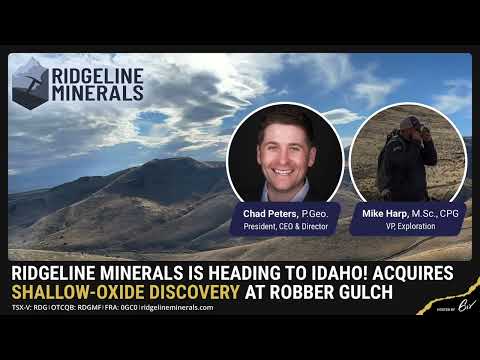
0:07 Hello, everyone, and welcome to Ridgeline Minerals Live Investment Summit today, hosted by 6. Today, I'm joined by Chad Peters, President, CEO, and Director, as well as Mike Harp, Vice President of Exploration. Chad and Mike are gonna walk us through their company presentation today, and after we move on to a live Q&A session, where we'll be accepting and answering some questions. You can submit your questions using the Q&A panel found on the right hand side of your screen at any time. And as always, the summit is being recorded and will be available to watch afterwards on Six.com. Without further ado, Chad, I'm going to kick things over to you to get us started. Thanks, Cam. So, thank you all for joining
0:39 us today. We're excited to be doing a quick rundown of our Robert Gulch acquisition, why we're excited. I think a few of the most common questions we received in the last week has been, you know, first, why Idaho? And then followed by, okay, how does this fit into your portfolio? So I'm going to talk a bit about the strategy, why we made this acquisition. And then we're going to let Mike get into the weeds on the rocks a bit with you. So we'll get started. So there we go. A little disclaimer. You should know by now if you've seen a presentation from Mike and I, there'll probably be some forward looking statements, but we'll try to keep them to a minimum. So going back to the strategy of this, this acquisition, right, our project pipeline, If you're familiar with the company, some of the key assets we've been running with since we went public include Swift, Salina, Bell Creek and Carl and East. Now, Swift is a tier 1 asset, that project that Nevada Goldmines picked up from us in an exploration joint venture agreement in September of 2022.
1:36 This is a $20 million earn in with us receiving 25% carried interest on the backend if a discovery is made and they hit their milestone payments. So this is a huge asset for us, big upside. Our flagship asset being Salina. We're going to be spending about $1.4 million US this year starting in the spring. That's a really exciting CRD discovery that we hope to expand with this program. And then we'll follow that up with our strategic holdings at Bell Creek and Carlin East. We're not spending any cash there as far as exploration this year. We're just holding the ground as NGM advances both their REN deposit Maiden Resource, which is directly adjacent to the Bell Creek project, only 500m away, and Carlin East, which is directly on trend of a world-class discovery that was paid by MGM in 2020. I think the best drill intercept was 40m at 32g released last year.
2:22 So that's our existing portfolio. So how does Robert Gulch slot into that? Well, what really got us excited about Robert Gulch is this is an emerging district in Southern Idaho. Probably the best analog to this exploration play would be Liberty Gold Black Pine deposit, which is also a Carlin type oxide, shallow oxide system in the exact same host rocks as Robert Gulch. Now this is a drill ready oxide discovery and it's very cheap for us to both acquire and to advance. So we're spending more about 1.4M at Salina this year on exploration. That'll be about 5,500m of drilling. We can then follow up with about 600,000 US in exploration dollars going into the ground at Robert Gulch. That'll be about 1,100m maiden drill program in the fall. So really our main priorities this year for exploration are Salina and Robert Gulch that we'll be advancing ourselves. We have our SWIFT project fully funded by NGM and Bell Creek and Carlin East as I mentioned, very strategic holdings. We're going to see how that continues to advance as NGM advances the assets directly adjacent to us.
3:20 So just a little bit of background there. So let's get into to Robert Altsch. So this is a 9.3 kilometer land package, as I mentioned, Carlin type oxide open pit Gold target. And it is 0.5 comprised of both 0.5 BLM ground and 0.5 forest service ground. Just for perspective, the Black Pine deposit, that is 100% forest service ground. So there is permitting risk potentially associated with any forest service. Not that you're not going to get the permits through, but it can be a little bit more time consuming, right? So, what we really like about Robert Gulch is all of the known drilling and discovery at Robert Gulch is located on the BLM ground, which is has an active permit
3:59 that we could go out and drill tomorrow. There's upside on the forest service and we also have a permit submitted there, which we anticipate to be approved in the second half of 2022, but we can go out and start advancing this project immediately. One of the first things that drew us to the project would be this huge soils anomaly, right? This is a little bit grayed out here, but just to point out, as I mentioned, location-wise, we are in the same county as the Black Pine deposit. You can see our other projects located in Nevada. And we're only 88 kilometers to the northwest, same horse tracks, same general structural setting. And that's what was immediately drew us to this thing. When you look to the soils anomaly, for example, this is a Gold and Soils Contours that Mike spent hours working on in his basement there.
4:48 He'll get into those a little bit, why we're so excited, but look at the size of this thing. From here to here, you have 3.5km of strong Gold in soils, which shows that you have a
4:58 large Gold system right near surface. It's almost a kilometre wide as well in this direction. Very large, robust soils anomaly and the old operators of this project actually went in in 2021 and they trenched multiple intercepts of pretty impressive Gold at surface. Trench 1 hit 52m of 0.26 and 48m of 0.26 Gold at surface in one of the poorer host rocks. You move about half a kilometre over to this area here. Trench 3 hit 189m of 0.43 Gold, including 45m at 0.88g per tonne Gold. That is significant oxide Gold right at surface. Trench 2 hits 60m at 0.4g. These are some of the things that really drew Mike and I when we first looked at this project because of its similarities with Black Pine. Black Pine is actually a sea of low grade, about anywhere from 0.4 to 0.6 grams per tonne Gold, with a high grade core that Liberty Gold has done an incredible job of making new discoveries by drilling beneath the existing system and down dip. And we see that same potential here. Yeah, and that's what I really like about this one is that not only that large soils anomaly that continues along some of the more controlling structures, but more importantly is we have drill intercepts that correlate with that soil grid. The only thing that the property is missing at this point is an extensive geophysics array, which we will be working on this year, but we don't have any geophysics. So to have good soils, good rock chips that show continuity of the system,
6:30 as well as drilled intercepts that definitely correlate with those soils at surface and those rock chips is really what's exciting for me. And we have very similar structural controls to say Black Pine or Dark Star, which is another Penn Perm hosted project that I had the pleasure of working on when I was with GSV. And that was another million-plus
6:53 ounce deposit in the Penn Perm host rocks. And so here we are in a new district, big soils anomaly, and classically what was a poor host, the pen perm rocks with a drill intercept, with one of the better drill intercepts when you put that thing together of over 175 meters of continuous mineralization at 0.1 grams per ton. Yeah, no, for sure. And then like that's, you know, I think that's an interesting thing, like, you know, Early stage exploration is a really difficult business. Finding a project that has Gold at surface, consistent Gold at surface is tough enough. But when you can acquire a project like we did for US$50,000 and acquire a $250,000 database with multiple drill holes that not only show thick oxide gold intercepts with good continuity, but also correlate with the surface anomaly, which is incredibly untested at surface. I think it's a great opportunity. So like some of the historic drill highlights that Mike mentioned, you know, AC4, which is located right here, and we're gonna show you some cross sections here shortly. The AC4, that hit 12 meters of 0.9 grams per tonne within 57 meters of 0.34 grams per tonne with that hole bottoming in 25 meters of 0.25.
8:03 So that hole was still open in the 1980s when they drilled it. They didn't keep it going long enough. And that's an obvious choice for us to come back in and drill that hole deeper and hopefully hit a thicker intercept with the next drill program. And I think, you know, another thing that's worth pointing out is, you know, when you say like, you know, why are we excited about wide intercepts of 0.3 grams per ton, right? That's low grade, no doubt about it. But the whole point is, is with this anomaly of this scale and this size, there's only been 6 drill holes in this area. Every single one of those drill holes hit gold at surface, including 18 meters of 0.17 all the way out here. Sorry.
8:42 And, you know, Gold Lion, who drilled the program last year, they drilled 4 holes, every single hole hit. Hole 3, for example, hit 12 meters of 0.65 starting at surface. Hole 4, 6 meters of 1.46 grams per ton starting at surface. And that hole was TD'd at 6 meters. They actually shut their program down in the middle of the program. They had a shift in focus and to another project. And they left that whole case and ready to go with the entire 6 meters from surface running over a gram per tonne gold. So we know there's potential for higher grade cores to this system. And the fact that there's only 6 drill holes in this area that actually tested the right host rocks Followed by what I think about 12 or so holes out in this area Mike that never even hit the right host rock They actually drilled a shallower host rock that isn't historically a good host So we're gonna switch to a video right now Mike's gonna walk you through that in 3D so you can kind of see what I'm arm waving here and going on about.
9:36 So while he's switching and you guys are looking at this image, please, the green hatched patterns are volcanic cover, post mineral volcanic cover, and that actually obscures the larger soils anomaly. As we move on to that forest surface ground, which would have been that blue line you saw on that plan view map, that remains untested and our highest grade rock chip at surface of 6.4 grams is just south of that along a continuity, the continuity of the soils grid underneath cover, and we see it bleeding out underneath this cover. So there's the possibilities for a lot of buried targets, but this volcanic cover is very spotty across the property. If you'd advance the slides there, Chad. You bet. So there you see the green hatch patterns. That's really breaking up that larger soils anomaly.
10:25 And then if you could pause right here into the geology. So as we start to fade into the geology here, you'll see that green correlates with mapped volcanic cover at surface, but we have all of our host units exposed across the entire property, which is really nice. And so our project geologist, Gabriel Aliaga, has put together this wonderful video of our model at depth and stitched together all of the old logs that were done both historically and just recently
10:57 by Gold Lion, stitched those things together, used the original USGS map and some of the mapping done by other contractors that have been pulled in over the ages. And we really came together with this full thrust model that seems to hold water and really makes sense of that surficial geology. And so that's what you're seeing here as we cut in. And so our long section goes like pretty, it's an odd cross section here, but it kind of bends across the property to show the whole strike length of the system. And you see that as we have, as we are on our west side of our property, south and west side of the property. We have very shallow targets that we can test, like Chad said, immediately. But when you look under that post volcanic cover, you can see that it remains untested in the Wallstrom Hollow which is the darker blue before it gets into that really dark gray unit below.
11:47 It remains untested under that post mineral cover and what I like about that is we're still seeing 0.4 and 0.2 at what would be the contact with that wallstrom hollow or we're seeing also in drilling to the north at the heart of that radar zone that that drilled zone right there at the center. That zone right there, they drill into that with those drills, drill holes. So we're open to the south at shallow depths, which allows us to really add some ounces to this thing and look for high-grade intersections at shallow depths where we know we have some faults mapped. One of the things that we will be doing this year is boots on the ground mapping, confirmation and alteration mapping to really understand the surficial expressions of this system. Right now, that is directly tied just like it is at Black Pine or at Dark Star to silicification.
12:32 So these silicified bodies
12:34 tend to carry the grade. And we're seeing that in the drilling and in the old logs that we're able to digitize and bring into this model. What also is exciting is that we see as we move north, we have that poor host. And we see that same host unit, or that same unit at Black Pine, this sandy unit, doesn't really carry grade, can sometimes, sometimes doesn't. It's when you get down into that Wallstrom Hollow and start to see those limestones interleaved with these
13:04 calcareous siltstones. Those are what are really holding the grade at Black Pine. And we see those same rocks here. And as you're moving to the North and the East, they are getting deeper. But what that does is bring us closer to one of those better structural intersections. And as you can see in AC1, in this cross section here, you're starting to see those grades up against the next unit above that poor host unit, which would be
13:29 the Badger formation. That is looking to be a decent host, at least at the contact with this calcareous sandstone of the third fork. And they never tested the wallstrom hollow. And that's why these holes are too shallow. Good geology was done on these holes. They just weren't allowed to go as deep as this target would have allowed for. I think it's worth, sorry to cut in there, Mike, but it's worth mentioning, just look at the continuity of grade, right? In the known drilling, every single drill hole hits up to 80m intercepts of continuous grade, which show you can
14:00 get black pine type thicknesses, right? You want to see, you know, 50 to 100 meter intercepts of continuous grade. We have narrow high grade intercepts. And like Mike mentioned, over at AC1, every single one of those drill holes has sniffs of gold in it, even though it's a horrible hole. So what are we going to find when we track that system down dip into these covered targets that have had 0 exploration worked out on them in 30 years. And even look at like the trenches, Trench 1, Mike, like even those trenches are showing continuous low-grade gold within that poor host. I'm just really excited to get down deep, use what you learned at Dark Star and try to target some of these deeper targets. And oh, and by the way,
14:38 the known strike, like you said, we have over 2 kilometers from the left-hand edge of this cross section all the way to our known discovery of grade at surface. So if we can find a bulk tonnage oxide system at surface for 2 plus kilometres and then start chasing it down dip, that's how you build huge tons and really start getting into a multi-million ounce deposit. So that's what drew us to this project in the first place. So sorry, go ahead. Yeah, no, and this cross-section really shows its similarity to what I experienced at Darkstar. So not only these solicit resistive bodies that are coming up these faults, these strongly mineralized faults, You see an exposed core, which would have been the main Dark Star deposit, right? That was discovered, easy to find right at surface. You see that exposed low-grade core. And then as we continued our drill program at Dark Star from that main exposed area of low grade, that's how we targeted in on the deeper target at Dark Star, which was also suspiciously in a syncline, which we see at this property, but in a syncline along a steeply dipping fault that channeled that mineralization.
15:42 If you could pause right there, Chad, and maybe back just a little bit, Can you go back a little bit or? I can sure try. Let's see. So when you look at this, you can really see that covered target and how our wallstrom hollow unit comes closer to surface, both on our South and our West sides. And it's kind of in a weird transition, but that's really, you're seeing that, that mineralized intercept. And that mineralized intercept is not only along those thrusted faults that we can see, but at the intersection with the West Northwest. This is the same setup as Dark Star. It's where you get those blowouts in these pen perm rocks at those fault intersections that you really start to see grades increase. So looking at the cross section here, as opposed to that longitudinal section, you really do see that continuity that Chad was talking about. You see the rock chips that surface as they relate to that, that zone that's been drilled, and every one of those drill holes has gold in it, albeit lower grades, it shows that at certain contacts in certain beds,
16:38 like we saw at Darkstar, that they can and will host higher grades. So right now we're seeing anything between 1 and 2 grams in the drilling, up to 6 grams in surficial sampling, continuous grades across all of that, and were open to the east and that depth. And if you look at this cross section, whole RG11 off to the right side, which is a fairly good distance away, in the poor host unit is starting to show a ramp of that gold. If you use RG RC 21, that gold line drilled to the west, you can see that's right what was happening before they dropped into that zone. And we think that this might be one of the better structural intersections as we're moving to the east this way into those deeper cover targets where the system's preserved and capped by that characteristically terrible host. Which would be- And just to point out scale, right? You mentioned scale, Mike. I mean, it's 1.2 kilometers from the edge of RG 2101 to RG 11. So like when we're talking scale of this system, that's why we're excited, right? To make a big open pit, oxide open pit, you have to be able to evidence scale. And we see that in spades here at the project. Now the question is, can we go in after that high grade that Mike mentioned along that contact and start expanding those intercepts into better zones. And so that's the interesting thing is that, you know, Gold Lion saw very similar things to what we're seeing, you know, maybe different structural understanding, but they saw very similar things and they did like the project. They had to bail out of the project for another project that they wanted to, well, 2 other projects that they were more interested in. So they just had, they changed their focus to that. I saw this and saw Darkstar right away. It
18:08 felt like I was back at home. And the reason that being is the penperm rocks, that supposedly terrible host that seems to keep popping up between Darkstar, Black Pine, some of the other prospects we've looked at in the Penn Firm host rocks, they're fantastic. And they can really do big things like a Carlin system can, at least on a Penn Firm scale. So we're looking between, you know, a 1 million to 1.5 million ounce oxide deposit close to surface, you know, maybe with some higher grade pods in there that really start to change things, but working from that known, shallow expression into the unknown, where you can have a starter pit of low grade and get down into higher grades. And that's what you see here. That's what we see here. And there's a lot of potential in that way. So, you know, some of the more historic operators, you know, that were in here even before Gold Lion, they were restricted on depths they could drill and nothing against them. They actually did really good geology and what they saw lines up with what we know. So pulling that data in was really, really important. Always data mining the old data and, and, and taking the facts that they had, not their interpretations all the way, but some of those facts, and put those facts down on the map and then reinterpret with with new knowledge. So yep. And You know, like the average, I think out of the 19 holes, the average depth is 184 meters.
19:19 And you know, which is very shallow for modern days like today. And you know, you look at like even the metallurgy that you see at both Black Pine and North Dark Star, for whatever reason, these pen perm deposits, they seem to heap leach amazingly. Like they're both, I think Black Pine is over 80% oxide recovery and I believe, wasn't North Dark Star like almost 90% there? Almost 90%, yeah, in the heart of it. And a lot of that is due to the fact that this isn't straight jasper oil rock. This is weak to strong solicification and decalcification of these rocks. And you can really see those things as you're at those metrics as you go through the deposit. When we were drilling Dark Star, we knew we were in the best when we were in the more strongly solicited. But that also restricted a lot of the gold to these little crackle brecciations and on fractures and in bugs where it was totally leachable. And that's what gave it. Black pine has something very similar going on as well, which is why they see those recoveries from anywhere from the low 80s into the mid-90s were on their better end as well.
20:21 The Penn Perm rocks just seemed to be good like that. That's why you get 0.5. If we can get this thing up into getting thick intercepts of 0.5 gram per tonne or better grades, starting at surface, with what we hope will be excellent metallurgy based on the analogues that are known in the same host rocks. We're talking about something you don't need to go find. If you go up to Northern Canada, for example, you need to drill
20:45 80-90m of a 1.5g per tonne if you're going to make a heap leach or a milling scenario in Northern Canada makes sense, right? Your cap nexus are massive. It's a different thing down here in Nevada and Idaho. I mean, the average grades of these deposits are much lower grade and they are able to make great money at them, right? So that's where we see this opportunity at at Robert Gulch is to grow on that. So just kind of like looking down the entire strike length of the property, you can kind of see that structural setup. And one of my more exciting targets is that covered target you see to the northeast with the highest soils anomaly. The soils anomaly is right at an intersection of a west-northwest, which you can't see on this, we simplified the structural model, but at a west-northwest it splits post-volcanic cover, so we know it's there, and with that thrust. And so that would be the deeper buried target that we're really excited about a North Dark Star like analog or the deeper portions of Black Pine where they really started to hit fantastic grades with the surficial expression being what we see to the closer portion of the cross section towards us where you can see the AC4 hole, the best hole on the property.
21:57 Another thing that's really great to point out is when you look at the topography here, Look at how all the mineralization is on this shallow ridge. All of the soils, the mineralization, there's a nice little anticline and that anticline dips all the way out and kind of curves around like a horseshoe towards the covered target. It's being offset by faults the whole way. And we're talking about a great geometry for if we continue to prove out this oxide Gold near surface, you got a beautiful hillside that is essentially completely mineralized from surface down to about 80-90m. Good topography for a mining scenario, right at surface, known discovery. Just throwing this all together, we're really excited. So we want to get out on the ground, do some more mapping like Mike said, and then also do this CSAMT geophysics survey, which I think is hopefully going to crack this project open for us. So- And the CSAMT was critical in the Dark Star discovery.
22:48 Once we understood the deposit, what we were
22:50 drilling, and the geology after we had mapped it, we ran the CSAMT and we could see the resistive silica bodies coming up the main feeder faults. And we were actually able to identify our mineralized zone beneath the more strongly silicified upper unit there. That's what I'm seeing here. So on that northeast where that high soils anomaly is on this particular image, there are,
23:12 there's a large, almost at least 50 meter zone or 500 meter zone, I'm sorry, probably up to a kilometer of barren silica, probably moderate to strong silicification of these limestones sitting at surface. And that's what North Dark Star was covered by, was these buried deposits underneath these strongly silicified upper units that were just more receptive to the silica and not so much the gold mineralization where all the gold had dropped out before the silica had propagated up with the hydrothermal fluids. Yeah, so that is our quick... Wow, we did that in 23 minutes, Mike. That's probably a record for us so far. But yeah, so that's the project for us. We're really excited.
23:58 This project is right up Mike's wheelhouse and he's just going to run with it and go find a bunch of gold for us. We're really excited. If anyone has any questions, we'd love to answer them for you. Great. Thanks for the presentation, gentlemen. I'd like to remind everyone in the audience that yes, we are entering the Q&A portion of today's summit. Please feel free to ask any question you like using the Q&A tab found on the right hand side of your screen. But with that, let's launch right into it. James in the audience wants to know how many meters would you like to drill this year at Robert Gulch? What are drilling costs and are they similar to Selena? I'm sorry, I miss that I was reading questions while you were talking, can you please repeat?
24:36 No worries, Chad. James just wants to know how many meters you'd like to drill this year at Robert Gulch, what are drilling costs and are they similar to Salina? You bet. So We're going to be drilling about the plan is we're budgeted for 1,100m right now, which is actually a pretty substantial kind of maiden program that'll get us 5 or 6 holes to kind of in the main discovery area, deepen some of the existing holes and then head to the south along the forest service ground. So costs are going to be, we're not going to drill RC, we're going to drill core and our strategic drilling contract is only for RC drilling. So we're probably looking at paying for the shallow hole somewhere in the $40 to $50 all in cost per foot for core drilling. Be about the right number. Okay, great. Bill wants to know that besides Black Pine, are there any other gold mining projects close to Robert Gulch that could be potential buyers or JV partners?
25:24 No, there's nothing near Robert Gulch. This is kind of a virgin area right now. Lots of old prospects and stuff like that, But no real active exploration or mining that we're aware of. Yeah. OK, great. Jeff says, your excitement about this project is clear. With such positive results and the small capital requirements for several years, why did the previous company walk away so early? Mike and I, we kind of touched on it a little bit there. But I mean, obviously, you have, we'd have to talk directly with the Gold Lion guys to get the full story. But our understanding from the brief conversations we had with them months ago now during due diligence was just they had 3 assets. They're only a couple million market cap company with the treasury was dwindling as well. So they had to kind of make hard decisions on what are we going to focus on. And their 2 other projects are close to their, they're a bunch of BC geologists. So they understand sheer hosted and vein systems very well.
26:18 And so those other 2 projects are in Northern Idaho near the Canadian border and they're more shear-hosted vein type systems that's right up their wheelhouse. So, Robert Gulch being Carlin type, they're kind of first stab at a Carlin type. They just felt their odds were better if they dropped Robert Gulch and move forward with the other assets. And honestly, I actually introduced the Robert Gulch guys to, or sorry, the Goldline guys to Robert Gulch through EMX 2 years ago. We couldn't, at the time we were going public and we just didn't feel it was appropriate to bring on another project during an IPO. So we passed it on to the gold mining guys. But now that we got it back, we think we jumped on it pretty quick. Great, thanks, Chad. Bill has another follow up question. But how does Robert Gulch compare and contrast with the projects Integra is working on in Idaho? I would say there's not really any comparison there, Mike, would you say? No, it's a different, different. Yeah. Different deposit type there. Epithermal vein system, high silver. Yeah, yeah. And we're black pine from everything Mike and I have done. And we can look at it's a really close analog to to Black Pine.
27:21 Structurally and lithologically, a lot of the Black Pine stuff. It's it talks about like normal faults, the list of nature of these normal faults and where the gold is clustered is very similar to what we see here. Yeah, oxide and and and what is it very low silver to I don't think black pine has really any silver to speak of. So that would be our closest analog for now. Okay, fair enough. Jim in the audience wants to know who initially drilled Robert Gulch in the 1980s. Yeah, go ahead and bite your mic. No, no, no, you go ahead. I think AC1, AC holes were Eben-Esco, right? Yeah, yeah. And then the other ones are... Cordex, wasn't it? Cordex, thank you. Yeah. And the Cordex guys, I always love finding an old Cordex project. They had a ton of success in Nevada and you'd be amazed how many projects they looked at in Idaho as well. But so they did some, that most of the Cordex drilling was focused on the sandstones and they didn't drill deep enough. They were looking at the right things but they didn't drill deep enough to test the host rock. Yeah. Great.
28:18 Okay. Phil has another question. Is the company cashed up for the year, given a $2M exploration budget and corporate costs? No, we're not. But we're doing all right. We got $2.3M in the bank. So it's not like we're in any, you know, we're not in a rush to go raise money, but certainly to execute both at Salina and Robert Gulch, we're going to need to do a raise at some point in the first half of 2022. And we hope that we can do it at a better valuation than we're at right now. Okay, great. Vanessa wants to know what the longevity of this project looks like. How does this area compare geologically to sites in northern Nevada as well? And finally, is there a future in mining jobs with this project? Do you want to handle that one, Mike? Yeah, long run. So when we made the Dark Star Discovery in 2015, it took the exploration till about 2017, 18 to really get the hooks into everything that was going on there between switching to core drilling and really starting to drill it out and understand the deposit as a whole and move it towards an inferred resource.
29:21 So at least on the exploration, and the exploration is 3 to 5 years, especially with how many targets are here and logical step outs from known mineralization into these under explored targets, I would say at least 3 years on the exploration side up to 5. And then at that point, it would probably be drilled out or understood enough if it's continuing to show success, maybe a couple more years after that. But if you're on the exploration side, that tends to be where you would transfer things over to a different team. Right, okay, thank you. Yeah. Thanks. Bill also wants to know if you could review the terms of the deal for the audience. Yeah, for sure. So, very simple deal. It's a five-year earning agreement.
30:10 Total work expenditures and cash payments total $1.4 million US over that five-year period, of which 1 million of the 1.4 US is deferred until year 5. So essentially, the first 4 years of the deal are $100,000 per year, both in just total in a mix of cash and work expenditures. So that gives us a lot of leeway to put the money in the ground, focus on making a discovery. And if 2 years in or so, 18 months in, if we don't like what we see, we drop the project and move on. We're certainly not going to push a dead horse uphill, but if we can make a quick discovery, it's a very, very cheap deal that's back end loaded. And yeah, we like to deal a lot. Okay, fair enough. Chad, another question we've had is, we all know about Nevada, but may not know as much about exploring in Idaho. What makes Idaho an attractive mining jurisdiction for Ridgeline to move into?
31:00 I think when Mike and I looked at this, we wanted to get into Idaho for a long time. And just from, you know, the Carlin trend and the rocks that hosts the Carlin trend, they didn't stop at the Idaho border, right? They continue up same, same as you see in Northern Nevada. And we see it as just really under explored area, You can still stake ground, do low cost acquisitions like Robert Gulch on properties that have multi-million ounce potential. That's a much harder thing to do in Nevada right now. I mean, Mike and I have kicked the tires on too many projects to be fair in Nevada that are shallow oxide. And most of them just don't show the scale to actually grow. Whereas what we see in this, you know, Robert Altsch and some other projects in Idaho as well as for shallow oxide, there's serious growth potential. Black Pine's a good example of that. So is Integra. And, you know, if you want to go after deep high grade, I still think Nevada's, you know, we got multiple projects where we can go after monster high grade deep deposits But it's nice to offset some of that deeper risk with these shallow type projects and in Idaho isn't as staked over You know, it's not so landlocked with with companies all over the place And that's the nice part about it. But any of the good stuff that would be left in Nevada, shallow oxide like this, is either undiscovered yet, and possibly penned perm rocks, just saying, or they're landlocked, or they're too small of a property position to make a discovery and do anything with?
32:20 I see a good question from Pat Rogers here in the Q&A here. He says they were part of the original discovery of the property with the Evanexco. They mentioned that one problem is the people drilling the AC series of holes was that after making that initial discovery, the additional result drilling around that revealed very disappointing results. And that's a fair question. I would say that in the 1980s, yeah, those kinds of grades would be considered very disappointing results, right? They wouldn't make the cut any day of the week. From what we've seen, we like the continuity, the thickness of the intercepts, albeit low grade. And we don't think that necessarily where that drilling focused is the core of the project. Like we said, Mike, actually, his favorite target is these covered ones down at depth to the northeast. There's multiple structural intersections that have never had a drill hole on them. So we like that the AC holes show evidence of system, that Robert Gulch holes support that and show some higher grades as well near surface. The next question is, can we vector in on higher grades and other targets?
33:19 Oh, fair enough. Thank you. Greg in the audience wants to know what geophysical surveys are you planning on running? CSAMP initially, we can effectively put some good lines across that and it's really good at finding, since silica is our main alteration product for this, silica argillation, it's going to see the silica and the CSAMP, that resistive body, as the silica plume comes up. It was very effective at Dark Star And we're able to run that line by line. We get data daily. And so we can really gear that into what we need to see. Or if we're not seeing anything out of that CSAMT, we can stop it right then. We've also talked about magnetics for the area. Not only to look for intrusive material, but to pin down certain structures, tight-spaced magnetics.
34:06 And we did talk about gravity, but if the CSAMT shows us some really positive things, at least not initially, we understand it pretty well. But the CS would really help us target the mineralized faults and help us step out of our known into the unknown and run that corridor. And one of the things we really like about this is with the work the Gold Line did and the other historic operators, we only have to put about 75 grand worth of geophysics into this project and it's completely drill ready to go. So it's already permitted very minor cash commitment to get the, I think, get our targeting to a point where we're really confident with some of these deeper intersections at depth and- Good road access, good road access. So there's not gonna be a lot of road building.
34:51 We can just do pad building. So that's a positive. Yep, absolutely. Vanessa has a follow-up question. Is mining permitting harder to get pushed in Idaho versus Nevada? It can be. Certainly there's higher, I think the difference, the major difference between Idaho and Nevada is there's far more forest service ground that's administered in Idaho than in Nevada. So BLM ground, it's much easier to get a BLM notice of intent, which is a 5 acre exploration permit. That's something you can get in about 30 to 45 days, allows you to do early stage exploration on the project. Now, for a service, you need to usually either do an NOI, which is difficult because you can't really put a drill program onto an existing NOI with the Forest Service. You can just do surface work, sampling, etc. What you can do is a categorical exclusion, which takes about a year to get the permit through. But after that, you actually get far more disturbance than you would with a BLM notice. What we have is a good mix.
35:46 The known discovery and most of the strike of this system is actually on BLM ground. We have high-grade rock chips to the south, like Mike was saying, which is on forest service. And luckily for us, Gold Lion actually submitted the permit back in 2021, early 2021. So we're actually gonna get approval for that categorical exclusion to go drill the forest service, probably in the second half of the year. So one of those risks that we saw, which was, you know, can we get out and actually drill this thing on the forest service is actually already kind of mitigated by what Goldmine did before they dropped the project. So I think it shows how much they like the project. I mean, they fully intended on drilling this thing and it just came down to dollars and they had to drop it. So, but to answer the question, it's going to be a little bit more difficult dealing with both of those permits. If we had to submit that forest service permit, we might be a little bit more hamstrung, but the fact that it was already running, but it can be difficult there. But, you know, they're both, they're government agencies, as long as you understand what you're supposed to be doing and you give them what they need, usually stays fairly seamless.
36:45 Yeah. Fair enough. So Let's fast forward a year from now and in a perfect world, but what would you have hoped to have found at Robert Gulch? Perfect world. We want to come in with this maiden drill program, show that this thing can have continuity and can actually grow and hit higher grade intercepts. So 18 months from now, 12 months from now, I hope we have a brand new discovery that's showing significant growth potential. Yeah, at least showing that those thicknesses continue to stay mineralized and hopefully an increase in some of those grades. You know, nothing substantial. And you know, we're at a 0.2 to 0.3 right now. If we could get that into the 0.5 to 0.9 range, that would be great. Anything higher than that would be phenomenal. But the idea here is to get our feet wet, not spend too much of our budget, get a couple holes in there, understand what we have, and get the geophysics done, and then move forward with our mapping and everything like that.
37:40 Get the data we need that we're missing at the moment and put the whole picture together. But we got to get some drill holes on this thing because it is so drill ready and it is so close to surface and we have some pretty compelling targets at the moment. Okay, wonderful. Well, gentlemen, with that, that's all really the questions and time we have for today. So I'd like to thank everyone in the audience, but of course, I'd also like to thank you, Chad and Mike, for coming on today. If you didn't get a chance to get your questions answered, if you think of 1 after the summit, you can find Ridgeline Minerals information here on this slide that is currently up or at their website, ridgelineminerals.com. But with that, Chad, I'm going to hand things back to you for some closing comments before we truly wrap up for the day. Yeah, you bet. And thanks for having us, Cam. So I'd say right now, we have our webpage up and going for the Robert Alts property. I just got that up and rolling this week.
38:28 So feel free to go in there. There's all of our maps and for more information on the project at our website at ridgelineminerals.com. You're welcome to reach out at our info at ridgelineminerals.com email. And I will also put in the chat function my email as well. So you'll be able to feel free to reach out, ask Mike and I any questions, and we'll be happy to get back to you. Yeah, all the information on the deal itself, all the nitty gritty on the NSRs and everything's also, also there. Wonderful, gentlemen, well, thank you for coming on again. And with that, I hope you have a good rest of your day. Cheers.