Transcript
Automated transcript · Written by software from the replay's audio. It can mishear names and figures; the replay is the record.
0:08 Hello, everyone, and welcome to Contact Gold's live investment summit today, hosted by 6. We're joined today by Matthew Lennox-King, Contact Gold's CEO. Matt's going to walk us through company presentation and after we'll move on to the live Q&A session or we'll be accepting questions. You can submit your questions using the Q&A panel found on the right hand side of your screen at any time. As always, the summit is being recorded and will be available to watch afterwards on SIX.com.
0:30 And with that out of the way, Matt, I'm going to hand it over to you to kick things off. Great. Thanks very much, Cam. Hello, everybody, and thanks for joining us for our most recent contact Gold Summit here with 6. Today, I'm excited to take you through our 2021 drill program at Green Springs, which is what we're looking at here on the screen, giving you an idea of what we've done, what to expect coming down the pipe as far as results over the next few weeks and months. As always, I will be making some forward-looking statements and would ask that you draw your attention to the cautionary statement. So CONTACT is really based around the belief that we can create a lot of value chasing or exploring high-quality oxide gold projects in a tier 1 jurisdiction.
1:22 And to us, that's the great state of Nevada. We think that it really is not peerless, but it has very few peers as far as a place that you can explore, make discoveries, and ultimately develop high-quality gold mines and create value. So we have 2 key projects, the first of which is Green Springs, and that's what we'll be talking about today. Then we also have Pony Creek, which is on the central part of the Carlin trend. It's a large Carlin type gold system that we're looking to get back on the ground at in the second half of the year. We are fully funded for our current drill program and costs through the end of the year. And that gives us the ability to execute at both Green Springs and Pony Creek.
2:12 At both projects, our focus has been and continues to be on discovery and deposit definition. Both projects in the oxide component have delivered and we believe will continue to deliver really compelling intercepts that ultimately we think will lead to some very compelling deposits over time.
2:36 Alright if we look at the team, this is the team that started the company, has a long track record of success on the ground in Nevada, as far as discoveries, deposit definition, and ultimately transactions as well. I think we're very fortunate to have Vance Spalding as our VP Exploration. He has a long history in the state, numerous discoveries to his name, and I think has unique expertise that lends itself to exploring and ultimately being successful at Green Springs. Looking at our cap structure, Recent trading range is around 10 cents Canadian, with 240 million shares outstanding. That gives us a market cap of approximately 24 million Canadian.
3:25 In US terms, roughly 19 to 20 million. As at our last financials, which were released 2 weeks ago. 3.7 million on the balance sheet. Again, that has us fully funded for all current activities. Analyst coverage from Coremark Securities in Toronto with Brock Colterdon. And if we look at the main shareholder breakdown, Waterton, one of our founding shareholders owns 42%. Management and insiders own 4%. Myself, I own 3.8 million shares of the total. Institutional investors account for about 27% of our shareholders. Newmont has a 3% stake related to a previous strategic investment made by Goldcorp prior to that transaction, leaving our float or retail shareholder ownership at roughly 24%.
4:24 So we come to the great state of Nevada. We have our 2 key projects here, Green Springs at the southern end of the Cortez trend, and then Pony Creek on the central part of the Carlin trend. So the Carlin and Cortez trends are the 2 major gold producing areas or regions in Nevada. Typically the deposits there are hosted in limestones and related units. We'll see that story, that theme hold true as we come into Green Springs. Nevada is very well set up for mining. It has a long track record in the space, first with silver, now with gold, and is one of the major gold producers on a global basis.
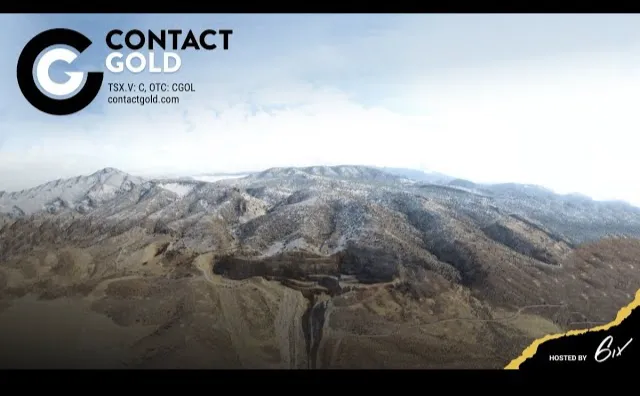
5:13 So as we start off in Greensprings, we can see we're looking at pretty typical Nevada topography. So very flat valley bottoms moving into small mountain ranges. So this is your basin and range top topography. And then as we come to Green Springs itself, we're looking at a small past producing heap leach operation from the late 1980s. A very small amount of gold was produced by today's standards with about 74,000 ounces, but the grade is pretty exceptional at 2.3 grams per ton. To put that in today's context, the average grade of an open pit heap leach operation in Nevada is about 0.4 grams per tonne. So our focus here at this past producing asset is to rapidly expand the footprint of Gold mineralization.
6:03 This is something we're accomplishing along the mine trend, but then also stepping out into new target zones that we have defined and have not been drilled before Contact Gold's involvement. There are 2 key rock units that we're interested in here. One is called the Chainman Shale. The other is called the Pilot Shale. The Chainman is the old mine horizon. And we think in both of these units across the property, we have pretty compelling opportunities to make new discoveries, expand the footprint, and ultimately define a high-quality, high-grade oxide project. As far as where Greensprings is located, if we look in at the local scale here, we're located 10 kilometers due east from Fiore's Gold Rock deposit, which is roughly a half million ounces, and that's at feasibility stage.
6:58 To the north of Gold Rock, Fiore also owns the Pan Mine. Now that produces about 40 to 45,000 ounces per year. Grade is quite low at roughly 0.4 to 0.45 grams per ton. And there are broad geologic similarities between Gold Rock, Pan and Green Springs. In 2021, which is really the nuts and bolts of what we're going to be talking about today, we've already completed 59 drill holes for 7,500 metres. This was drilled really across the property on the key target areas. We've already received and released results for 6 of those drill holes. The headline intercept is really in keeping with what we've come to expect at Green Springs with 1.45g over 47m from the mine trend. And again, like most of our results or the bulk of our results at Greensprings, that is oxidized.
7:57 2020 to give you a flavor of what we may expect from the 2021 results from here on out. We typically saw between a gram and 2 grams, upwards of 30 meters along the mine trend. So that's that 3 kilometer trend that we're actively exploring. And then Also at the alpha zone, which is to the north, in the northern part of the property, again, really nice grades of over a gram, thicknesses from 20 to nearly 40 metres and really strong cyanide solubility recoveries as well. So when we look at Green Springs, we're really looking at 2 separate sets of targets. The first is the mine trend, and that's defined here by the red arrow. We're looking at near surface or outcropping zones of gold mineralization along that 3 kilometer trend.
8:51 In some cases up to 70 meters thick. And this is where we can do the high confidence, relatively low risk exploration of expanding that footprint. To the north, we have some key areas starting with the Alpha Zone and the Tango target. And I'm just going to see if I can do some scribbling for us. In red. So up here, we've got Tango. Very exciting target. Had never been drilled before this year. We've put 19 holes into Tango. The Alpha Zone and what we call the connector again, very high potential for new discoveries there as well. And we were actively drilling that this year.
9:40 So we'll step through the mine trend first. We're gonna look at a long section. So a slice through our 3D model, looking at what it looked like at the end of the 2020 drill campaign once all those results came in. So in the near surface, we can see everything in pink on these drill traces in that 3D model is represented greater than a gram per ton of Gold mineralization. So along this 3km trend from the South to the North, we have good continuity in that near surface. And what we're looking to do within these areas, like the gap, where we've actively been drilling, and this northern gap here, is really improve that continuity, connect these zones into one big, consistent, comprehensive zone.
10:34 Now we're gonna overlay the 2021 drilling on top of this so same view same scale and we can see where we've done some deeper drilling in this northern gap and we've done the same thing down here in the southern gap and part of what we're looking to do there is test this pilot shale horizon. So, that's the second unit. So, we have the the mine Stratigraphy up here that we've been testing and drilling, delivering great results. We think there's excellent potential for a new discover. Read at this pilot shale horizon, so we've been drilling those holes deeper to a depth of 150,175 meters to test that horizon.
11:20 Other key areas where the mine trend remains open, certainly to the south, where we have about 1.5 kilometers of strike length or potential strike length before we hit our southern boundary, and then also off to the north here as well. So a lot to be done here at the mine trend and we're very optimistic that we'll be able to deliver some exciting news here in the coming weeks. We're now going to come from the mine trend. We're going to come up to the north and specifically to this area here that are just outlining in pink from Bravo, Alpha and Tango.
11:58 So these are outline or frontier targets. Bravo itself represents the northern end of the mine trend and the transition from the mine trend stratigraphy to the pilot shale. So to our second unit, which we think is a very compelling exploration target. Bravo is well oxidized, meaning potentially processable by heat bleach methods. And then we're gonna step over to Alpha and up to Tango here. So this entire area is about 1.5 kilometers of strike length. Alpha itself is shallow, near surface, typically has really good oxidation,
12:47 which leads us to Tango. So Tango is a brand new target, roughly 500 by 500 metres. We've drilled 19 holes there so far this year. Results are pending for all of those. This is an area where we have greater than a gram per ton in rock samples at surface. We have extensive oxidation. We have extensive solistication, really all the elements you look for when you're designing or compiling a new drill target. Of note, we also drilled in the connector zone here, which is a zone that we, or a target, we did target in 2020 with limited success, but we've reinterpreted the rocks, we've reinterpreted the structure, and we think there's an excellent opportunity for a new discovery in that connector zone as well.
13:41 So we'll take a bit of an aerial view here of Tango. So now we're looking down to the southwest. We can see in the yellow outline here, the Tango target proper, so that 500 by 500 meter target zone. In blue, we see the drill sites, or at least some of the drill sites that we drilled this year. And as we follow this light brown or tan color down the hillside through the switchbacks on the road, we ultimately get to Alpha and then onto Bravo as well, which represents the northern end of the mine trend. So if we come back to Greensprings, take a property-wide view, those 59 drill holes we can see here are in blue on the map. So those are the drill collars from this year's drill program.
14:32 We can see where we've been targeting the Southern end of the mine trend, where we've been drilling some of the gap zones in here and here, and also targeting some of the higher grade zones that we hit last year, really incrementally increasing that footprint. We can see the collars or the drill holes up at Tango and Alpha here in the north, really representing that discovery potential, the blue sky. Now we can see some of our undrilled targets that will hit in future programs like Whiskey and Foxtrot. So all told 59 drill holes, 7,500 meters were completed in the first phase of drilling in 2021. And we expect those results to continue to come in over the month of June, July and likely through August as well.
15:23 While that's going on and prior to any future drilling, we'll be completing additional surface work as far as mapping, sampling, interpretation, really to further refine our targeting ahead of any future drill programs here at Green Springs. So as far as milestones and catalysts for 2021 and Contact Gold, Really the key one here is that phase 1 drilling at Green Springs, the 59 drill holes really completed across a number of those high potential targets at Green Springs. We do anticipate those draw results coming in really from late May, as we've already had a few out, through the balance of the summer into September, and that would likely dovetail with the start up of another program.
16:15 On a corporate note, by Friday of this week, we should have completed our redomicile to Canada. That's a step to streamline our corporate registration from Nevada to British Columbia, and will make reporting potential M&A and financing, more streamlined and straightforward. When we look at Contact, we see a company very well positioned for what we think is a rising gold market. We've certainly seen the gold price move. We've seen some of the gold equities start to perform again. And we believe with 2 high quality oxide gold projects in arguably the best gold jurisdiction, we're uniquely positioned for that market And with Greensprings, what we've been able to deliver over the last 2 years, and certainly what we believe we'll be able to deliver over the coming months, we're very excited with the prospects for contact gold. So with that, thank you very much for joining today.
17:20 I will turn the control back to Cam and happy to answer questions. Thanks Matt, that was great. I'd like to take a moment and remind the audience that at this time you can absolutely submit any questions that you've thought of if you haven't already to the Q&A tab on the right hand side of your screen. And to get the Q&A begun, Matt, Bill Dorr has asked, are you currently drilling at either site and if so how many drill rigs are being used? Yep, great question, thanks Bill. We've actually just wrapped up drilling at Green Springs for the time being. We sent the drill back to the contractor last week. We'll take a pause for likely a month or 2 here as we get all those results in from this program, and we'll look to get back on the ground once we've received the results, interpreted them, and can prioritize exactly which targets will need the most immediate follow-up.
18:16 Thank you. We've also received a few questions ahead of time ahead of the summit, so I'd like to definitely make sure that we cover some of those. First question in this list is why was this Green Springs program so far under budget and yet able to produce many more meters than previously? Absolutely, that's a great question. So This year we switched drill contractors and the rig and the expertise of the drillers allowed us to operate much more efficiently in what are some reasonably challenging ground conditions at Green Springs. So rather than having holes or the drill getting stuck, trying to drill through some of the mineralized zones, we didn't have those delays and eliminating those delays, being able to be that much more efficient really brings the costs
19:04 down. Right. Another question that's come in ahead of time is which green springs target are you most excited about? Yeah, for me, it's really the Tango target that I think the ability or the ability to, first of all define a large scale target like that in multiple data sets of geology, geochemistry, geophysics, and then drill it, you don't get that opportunity on trend, so on the Cortez trend often. So I'm really excited to see what we're able to do or generate as far as results up there. Ideally, it's a new discovery. Right. Ronaldo de Oliveiro Filho asks, what is the cost per meter?
19:52 Yeah, absolutely. So because we're operating in the US, we'll give it to you on a cost per foot basis. With the contractor, It's $14 per foot. So that would be called $52 per meter for reverse circulation drilling. OK. Paul Wilson wants to know, do you think the redomicile has hurt the stock price? And if not, any other theories on why the stock is so depressed? Thanks. Yeah, great question. So I don't believe that redomosylus had an impact. It certainly, it's more an administrative event than than anything else. Look, we did issue a lot of stock in September of 2020 as part of a recapitalization financing.
20:42 And in that, I think we had a number of more fast money or hedge fund type investors than we would have normally. And I think as we saw a general weakness in the gold equities in the fall and early in the new year, I think that certainly had an impact selling from that. But we're optimistic that building off this base where we are now, and with the results we expect to be able to generate over the next weeks and months, that we'll start to climb out of that. Thank you for that. Trevor Hever wants to know what is the geology or ground condition that makes drilling difficult? Yeah, great question. So in this type of environment where you have a lot of fluid flow and alteration in your limestones and shales, that can generate or create a lot of, a lot of or some subsurface caves. And Typically you'll get voids with clay and perhaps some silica there and drills, generally speaking, like a consistent environment. So when you have a lot of variability like that, it can get challenging.
22:01 Right. Ken wants to know what the company's current cash position is and if you have any plans for future financings. Yeah, again, another great question. So we're sitting on roughly 3.7 million Canadian as our last financials. At the moment, we don't have any immediate plans to go to market and raise additional money, though that said, we are an exploration company, so we do naturally need to go back to market periodically to raise money. But we don't anticipate doing that in the very near term. Alright, thank you. Another question that's come in ahead of time is, what is the objective in the gap drilling? Absolutely. So, If we think back to the long section, the gap is an area of relatively little drilling, past drilling, either by contact goal or by previous operators.
22:58 Really, our goal is to come through and explore it, test the rocks at surface or in the near surface, see if we can connect that part of the mine trend, but also drill a bit deeper down to our second target horizon, which is called the pilot shale, and ultimately get continuity in that part of the mine trend. So really looking for a new discovery. Okay. You tested the connector target between the mine trend and alpha in 2020. Why try again? Great question. So I'm just going to slide back to this map here. So this lower circle, oval in red that represents the connector target so we can see the 2. Blue drill holes from the 2021 program. We can see the green hole from our program last year.
23:51 And essentially what we see is that there is a large fault. It really goes right up this. Valley here and so by stepping on the southern side of that fault. With the drill. We're now in a in a different geologic environment. More compelling, Evidence that surface on D. We're confident that that will translate into success in drilling as well. If we are successful, as we believe we will be, that also opens up a lot of ground to the South, continuing to the South of that fault for additional exploration. Another question that's come in. Do you see any producers taking interest in exploration companies in Nevada? Yeah, as far as equity stakes, that comes and goes.
24:42 As far as Newmont, Barrick, Nevada Goldmines, Agnico Eagle. I think that most of the producing companies of size, majors and mid-tiers do keep a pretty close eye on what's going on in Nevada because you can obviously discover, develop and build projects there relatively efficiently. There's a really good framework. And also there's some great size potential there as well. I think that the last point there is that in Nevada, you can still have a very high margin operation if you're mining a low grade Gold deposit. If we look at Silver Standard or SSRM, for example, their Marigold mine is on the order of 0.4 to 0.5 grams per ton.
25:31 Their own sustaining cost is fantastic. I think The quality of the deposits and the quality of the labour force and processing technology really makes Nevada very attractive. Thank you. Another question has come in ahead of time. Did you get to test the Foxtrot target? We didn't get to test Foxtrot this year or in this phase of drilling. We'd like to test it later this year. A lot of the meters, even with the more efficient program that we were able to run, ended up going to Tango and the connector target rather than Foxtrot. We saw pretty compelling opportunities or reasons after drilling the first few holes at Tango to keep going there, rather than stepping out to the next new target.
26:22 Okay. Will there be another drill campaign before the end of the year at Green Springs? Ideally, yes. We think we are really onto something here at Green Springs. Obviously, we'd like to get all our data back, interpret it, prioritize the follow-up and design that program. But based on what we've seen so far, we're excited to get back and always looking to drill more Gold at Greensprings. Fair enough. Another question that's come in is, is another drill program needed to get a resource estimate? Yeah, that's a great question. It really comes down to, I think, how successful we are at some of the regional targets. So Tango, Alpha, and so forth. If we have, If we make discoveries in this area, I think that's where our drill meters will be allocated to expand them, continue growing them.
27:16 If for whatever reason we don't make discoveries, well then you can come back to the mine trend, focus more on resource definition drilling and push the mine trend to a resource sooner rather than later. Thank you. This question did come in ahead of time. When will the repatriation be closed so that stock can be bought without having to do the transmittal of shares? Yep, absolutely. And that's a great question. So that's due to close on Friday this week. And the full transaction will be done post-trading on Monday. So on Tuesday morning, the new Q-SIP will start trading and things will go on quite seamlessly. That said, someone could buy stock today in the market and not be subject to having to do transmittal of shares or anything like that.
28:08 It would simply be done DTC through their broker, broker dealer. Okay. Thank you. You have new royalty owners at Pony Creek. Does that change anything? In the short term, no. And so the new royalty owners, Sandstorm, whom we know well, we used to rent office space from them actually, acquired a suite of Nevada royalties from Waterton, including a royalty on the Pony Creek project. So in the short term, it doesn't change anything, though I would say we do have a good relationship and have had for a number of years with the Sandstorm team. We will see what develops over time there. What will the decision point be for drilling at Pony Creek and is there a budget to do so? If so, how many meters?
29:02 There is no current budget for Pony Creek to a program this time. We are very motivated to get back there. Part of the balance is if we continue to hit and be very successful at Green Springs, I think that's where the meters need to go. That said, we're always looking for different ways to fund or finance a program at Pony Creek. Ideally, we can get back there in, let's say, Q3 or so this year and test some of what are very large-scale, high-quality targets that we've not been able to get to yet. Okay, fair enough. Well, I think that's all the questions that we have today at this point. So I'd like to thank everyone in attendance as well as you, Matt, for the presentation. To the audience, if you didn't get a chance to have your questions answered or if you think of 1 after the summit, don't worry, we'll be sending out a short survey where you can leave your contact information and the Contact Gold can reach out to you directly. You can also find more information, of course, at contactgold.com.
29:59 So, Matt, I'd like to hand it back to you for the final word. Great. Thank you very much, Cam. And thanks to everyone for attending today. Look, we're very excited about what we've been able to build over the last few years at Green Springs. We think this year's program, the 2021 program so far, will be the most impactful one that we have carried out at the project level. And really look forward to, hopefully, delivering some new discoveries to you over the next few weeks and months. So please watch this space. We're very excited and thank you again for your time. Wonderful. Well, I hope you have a good rest of your day, Matt. And to everyone in the audience, I hope you do as well. Cheers. Thank you.
30:45 Great. Thank you. Thank you. Thank you.