Automated transcript · Written by software from the replay's audio. It can mishear names and figures; the replay is the record.
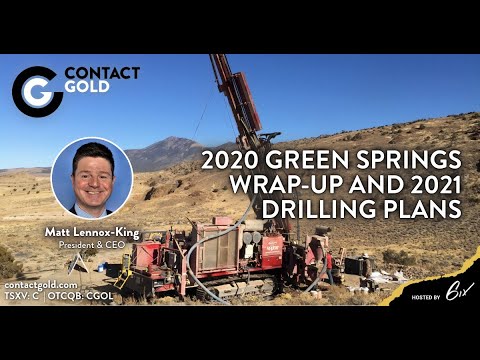
0:30 And as always this presentation is being recorded and will be available to watch back afterwards on six.com. So without further ado, I'll hand it over to you, Matt. Great. Thanks very much, Dasha. Pleasure to be here again with you all this morning. Today, we're going to be going through a wrap up of our 2020 program at Green Springs, which was very successful. Certainly some exciting developments there. And then we'll also take a look at our 2021 outlook for the project, what we intend to do and where we intend to do it. So as we get rolling, just as a reminder, we are listed on the Toronto Venture Exchange with the symbol C and in the US on the OTCQB symbol CGOL.
1:17 As per usual, here's our cautionary statement. I will certainly say some things that could be construed as forward-looking statements as we go through the presentation. Since our inception back in 2017, Contact has been 100% focused on Nevada and the prolific Great Basin. Most of this goes without saying, but Nevada really is one of the top global jurisdictions for gold exploration, development and mining. There's been over 220 million ounces mined and produced and recovered in Nevada over its long mining history. That accounts for nearly three quarters of U.S.
2:05 Gold production. And depending on the year, Nevada is typically the number 4 or number 5 global gold producer. Here we have it as the third most attractive state-level region. The most recent Fraser Institute survey of mining companies actually has Nevada at the top of the list now, which is certainly a sentiment that we as a Nevada-focused company wholeheartedly share. One of the key things here for us is that Nevada, in spite of its very long mining history, continues to deliver really meaningful and in some cases world-class discoveries. That would include Barrick's Gold Rush discovery, which is well over 10 million ounces today. The Long Canyon discovery made by Frontier Gold roughly 10 years ago.
2:54 And last but not least, the discoveries made by Gold Standard Ventures on the central part of the Carlin trend in recent years. We'll be dealing 100% with our Green Springs project today. So just for reference, that's at the tail end of the Cortez trend. That's one of the major gold producing trends or groups of deposits in Nevada, and certainly 1 that we feel has a lot more to deliver on the discovery front. Just looking to the north here across Greensprings, This open pit here that you see in the foreground is called the Charlie Pit and we'll certainly reference that as we move through the presentation.
3:41 At its core, Green Springs is a high-grade oxidized gold system. We're looking at outcropping or at-surface gold. This is Karlin type gold mineralization. That's gold found or hosted in limestones and related sedimentary rocks. In this case, we're looking at 2 in particular. One is called the Chainman Shale, one's called the Pilot Shale. Both are important host rocks at other deposits and mines in the region. In the immediate region of Green Springs, We have Pan and Gold Rock, which are both owned and operated by Fiore Gold, another venture listed, in this case, Gold producer.
4:26 And then to the north, we have Kinross and their Bald Mountain mining complex with Bald Mountain proper, and then to the south, the Alligator Ridge series of deposits. Green Springs itself, it's a past producer. It produced a small amount of gold in the late 1980s at a really attractive grade, so 2.3 grams per ton. That's one thing that really pulled us in here. Originally, back in 2019 and subsequent to acquiring the project, we've had tremendous success on the exploration side of things. In 2020, we drilled 41 drill holes for nearly 5,800 metres. Results are still pending for 7 holes, so even though we've announced our start of drilling for 2021 at Green Springs, as of this morning, we do still have results to come from the 2020 program.
5:20 Really the theme that we saw developing at Green Springs in 2020 was the ability of the project or the team to routinely deliver broad or thick intervals of well-oxidized gold mineralization at grades above a gram, above 2 grams, and in the case of the Bravo Zone, over 10 grams per ton. Well-oxidized shallow at surface gives us confidence that as we continue to drill, continue to develop green springs, we will continue to deliver results on par with what we saw in 2020. At the start of 2020 drilling, the historic Green Springs mine trend measured about 2 kilometres.
6:10 Not bad. That encompassed the 2 Charlie pits and extended down to the Echo Zone, which is where we see the drill rig in the middle of the slide. With what we accomplished with the drill in 2020, we've extended that mine trend to roughly 3 kilometers. In the immediate foreground here we see the Zulu Discovery Zone And as we layer on all the zones and targets, we can see that the mine's trend stretches from Bravo through Charlie, Delta, Echo, and down to the Zulu Discovery. The Other targets of note that I will talk about today are Tango, which is an exciting greenfields target in the north, and Gulf, which is again another earlier stage target off roughly a kilometre to the east of the mine trend.
7:01 With that in mind, there are really 2 distinct groups of targets that we see here at Green Springs. One is that mine trend that we see developing. It's over 3km long of the oxidized gold mineralization running, as we said, from Zulu up to Bravo. It's really characterized by thick intervals of high-grade oxidized gold mineralization in the surface or at the near surface, hosted in the chainman shale. So that's where we see a lot of these high-grade intercepts, like the 10.7 grams at Bravo. Beneath that, we also have the pilot shale target, and I'll show you this on some cross-sections a little bit later in the update. That's another key target for us, and we think there's a lot of potential there for new discoveries in 2021.
7:51 Outside of the mine trend we get into our frontier targets. So the key among those the most developed or well understood at this point of time is the Alpha Zone that is hosted in the pilot shale, the second of our 2 key host rocks here. We're looking at grades typically north of a gram, thicknesses 22, in some cases up to 50m, of well-oxidized near-surface gold mineralization. With the work we've done in, that we did in 2020, we have a really good understanding of the structural setting. So what the controls are to that mineralization and how we're gonna step out along that. From alpha, we come to tango, whiskey and foxtrot, which are all large geochemical anomalies.
8:40 So in this case that's large golden soil. So you take the sample, you send it to the lab, you get a gold value. They're also underpinned by geology, geophysics, structural analysis, and we're certainly very optimistic for new discoveries from those targets. Finally, we come to Gulf, which has been drilled in the past. We see nice grades, perhaps narrower thicknesses of oxidized gold mineralization at surface and also have that key pilot shale target beneath the Gulf. So we'll look at the mine trend here. We're looking due west. We have a 3D representation of gold mineralization along that 3km mine trend. You can see that we're starting to build continuity from Zulu through Echo and Delta up through Charlie in the centre here and out to Bravo.
9:34 As far as what we're looking at, all the pink drill intercepts on this image represent grades above a gram and everything red is greater than half a gram. So we are dealing with a really nice concentration of high grades along this mine trend. You can certainly see some areas for infill and expansion to better build out the regional potential here at the mine trend. So we have what we perhaps not very imaginatively called the gap. And then in the north, we also see this area where we have shallow vertical RC drilling from the 1980s that we really don't, we don't believe that that's addressed the target or the potential there adequately. One of the key areas as well is extending this to the south past the Zulu Discovery where we have about a kilometer and a half or a mile to our southern boundary. So that's wide open.
10:32 Down here at depth you see a couple small drill intercepts beneath Charlie and beneath Bravo. This is all in that pilot shale,
10:42 certainly not home run grace but does give us a very good indication that there is gold potential down at the Pilot Shale horizon. So the mine trend will start in the north. We'll look at Bravo where we're dealing with 2020 results. Some of them are around a gram over 20 meters. We certainly have our high grade hit, which is a bit of an outlier, at almost 11 grams over 4.5 meters. At Bravo, which is hosted in both our key rock types or host units, we do see very strong recoveries, roughly 99% from cyanide solubility test work, gives us a great indication that in a development scenario, this could be processed by a heat bleach methods.
11:31 The focus for 2021 is stepping out on that high grade zone, getting better continuity at the higher grades and ultimately expanding the size of Bravo. At Charlie, roughly 10 days ago, we had 2 great results out of the northern part of Charlie at 2.3 grams over 33.5 metres, a gram and a half over almost 20 metres. Great confirmation shows us that there's a lot more to do at Charlie as well. Looking through Bravo to the north, we can see our 2 host units juxtaposed or in contact with one another at surface. On the right hand side of the slide, we have the pilot shale hosted mineralization in the near surface, and then to the left of the fault we have our chainman or MC hosted mineralization here as well.
12:24 These 2 faults which are the dashed lines are certainly very important here and they're well understood and give us a very good framework to keep growing the Bravo zone. At Charlie, this case we're looking to the west, so across the mine trend. We can see our regular well-behaved stratigraphy here where we have the chainman or MC hosted mineralization in red. We can see the 2020 drilling here with nice thick intervals with strong grades across all those drill holes. Beneath that we have the Joanna limestone, which is typically not a good host to gold mineralization. Beneath that we have the pilot shale.
13:10 We can see here where we have the southern fault. We can see 3 of the drill holes from 2020 that did intersect or intercept gold in that pilot shale horizon gives us really good data to follow up on that and ideally make that next discovery down at the pilot shale. We're looking southeast across the mine trend in this image here. We can get a good look at the Charlie zone. We can see the very small delta pit from the historic mining. We can see Echo. Here we pick up the Zulu discovery and we can see that wide open chain wind potential off to the south. Now Echo and Zulu form the southern end of the mine trend as it currently is understood and defined.
14:00 Zulu being the discovery or the step out from Echo. Echo itself is characterized by high grades, so north of 2 grams in most instances, and thicknesses up to 70 meters. It forms part of that north-south mine trend where we're working on building continuity between the zones. It is hosted so far entirely in the Chainman Shale. We'll look at this in cross-section. Again in this case we're looking west So this is really a longitudinal section. We can see our typical host rocks with the chainman shale underlined by the chainman limestone, ultimately the gold zone in red and pink, and then the Joanna limestone beneath that.
14:48 This is a very good way to look at the relationship between the faults, which are the dashed vertical or sub-vertical lines, and grades and thicknesses. Typically, When we are proximal or adjacent to those faults, we're seeing our bigger thicknesses and higher grades. And I'd also note that whole GSE 2009 is pending and we expect those results to be available to us in roughly the next 10 days or so. We'll now look at the frontier targets. Stepping to the north and east of the mine trend, starting at alpha, which we have addressed already. That's been drilled in the past. It's pilot shale hosted, typically well oxidized, thick intervals up to nearly 50 meters in some cases.
15:42 And we now have a very good understanding of what the controls are to that zone and how we're going to step out along those in 2021. Next up is Tango, and we'll go into a bit more detail on Tango on the next slide. And again, we have Whiskey, Foxtrot and Golf. And We'll call it a supporting role on the frontier targets. For Alpha and Tango, we're looking at a satellite image with golden soil geochemistry overlaid. You can see that even at the 50 parts per billion contour, which is the red, we do have a very large footprint here at Tango, so well over 500 by 500 meters.
16:29 At Tango, we also have high grades, gold grades in rocks up to a gram and a half. And This all comes from the pilot shale Gilnet Limestone, which is that key second host
18:29 at Gulf, which again, gives us a great indication of where we're going to go next with the drill. So really, to wrap a bow around the 2021 program, it's all about following up on the really successful 2020 program, continuing to reinforce the property-wide potential that we see at Green Springs. We really believe that Green Springs is a lot more than a series of discrete zones, but ultimately a big, well-mineralised Gold system with some very nice grades in it and the potential to really start to demonstrate some very nice scale here in 2021. We're looking at a March drill start and that news went out this morning. It's going to be RC drilling as a start, which is fast and efficient and certainly cost-effective.
19:19 Priority targets out of the gate are going to be Tango, which has never been drilled before, so that's the opportunity for a new discovery out of the gate. The pilot shale target beneath the mine trend, again, an opportunity for that next discovery here, stepping out on Zulu or the southern end of the mine trend, and last but not least, following up on the Bravo high-grade hit from last year's program. We've also completed 2 geophysical surveys over the last number of months to really build out or round out our targeting toolbox. So that's a gravity survey and a magnetic survey. And we are also continuing to advance permitting here, both for exploration, but also for future programs.
20:09 So, your key milestones and catalysts. As I mentioned in the introduction, we do have 7 drill holes remaining from the 2020 program, and we'd anticipate having those out within the next 2 weeks as results continue to come in from the lab. Drill release, or the press release announcing the start of drilling went out today, so that'll continue on through March, April, May, and ideally on through the rest of the year. And we'll start to see those results coming in, I would anticipate, in the next 3 to 4 weeks. Lab turnaround times do seem to be improved over the fourth quarter of last year. We are also looking at scenarios that would allow us to get back to our Pony Creek project in the second half of the year, Although I would say watch this space on how that evolves.
21:07 So 2020 was a great, very successful program. Green Springs, we hit on all the target zones we tested. We delivered a new discovery at Zulu. It's also given us a clear focus and a clear pathway to expanding on the known zones at Green Springs. We know where we're going to drill for the next discoveries as well. And We think over the year we'll continue to reinforce and continue to see the evolution of Green Springs as a large, well-mineralized Gold system. We're very excited. It's great to be back on the ground and drilling for those next discoveries. As always, the website has a wealth of information at contactgold.com.
21:55 You can also follow us on all the regular social media channels. So thanks for your time. And I believe we're over to question time now. Great, thank you so much. There are lots of questions here, so I feel like it's a great time to jump right into the live Q&A. The first question was emailed in and it is, which target will drilling start on? Drilling will start on the Bravo zone and that will be to follow up on that high grade hit from last year. All right perfect and when will you drill Tango? Yeah so that'll be within the next few weeks. The team has started building the road up there, which will take a little bit of time. So I would hope to be up there in about 3 weeks with the drill, if not sooner. Oh, wow, Great.
22:46 All right. Well, Robert is asking, have you been approached by any other companies for a merger or buyout? And especially from Fiore Gold? Yeah, so it's a great question. I wish the answer was yes, and they're offering us an incredible premium and we're going to crystallize some returns immediately for shareholders. As a matter of course, we have good relations with all our neighbors. We talk to the Fiori team regularly, we talk to the other larger and mid-tier companies in Nevada as well, but I wouldn't say that there's anything pending on any of those fronts. Sure. Bill is asking, do we have a projected timeframe for the final 6 holes from the 2020 drill program?
23:36 Yeah, absolutely. So, that should be out in the next 2 weeks. We're just waiting for some of the final bits and pieces to come in from the lab, but it'll be out in the next couple of weeks. All right. All right, well, Mattias is asking, is a share consolidation, for example, 5 to 1 being considered to make the share structure tighter and more attractive? At this point in time, no. We do have 240 million shares outstanding today. I think the typical trading pattern when you do see a share consolidation absent an M&A transaction is typically the equity will trade down a little bit out of the gate. So that's something we'd like to mitigate.
24:24 And we have seen examples of companies like Gold Standard Ventures or Liberty Gold Going through significant market cap appreciation with higher share counts than Contact currently has. Got it. The next question is, when could Green Springs get to production? That's a good question. So from a permitting point of view, you'd likely be looking at a minimum of 2 years, if not more. A typical time frame to permit an open pit oxide operation in Nevada would be somewhere around 5 years. The pan mine took 2 years. Long Canyon took significantly longer than that.
25:11 So it's a bit hard to say. Yeah, let's say 5 years if you started the process today. Got it. All right. Thank you. Well, next question from Mateus is as Waterton owns a very large part of the company, how much input do they have in terms of strategic planning and how to move the project forward? Yeah, that's a great question. And certainly 1 that does come up on a pretty regular basis. Waterton's role in the company is really as any other equity shareholder, In spite of, as you said, owning quite a lot of the company, they don't exert any particular influence or try to direct the way we're taking the company.
25:57 It's certainly a good relationship. Great. Bill is wondering, how many of the zones have you found promising amounts of silver in the results? Again, a really good question. It's really Tango is the first area that we've seen out in Green Springs that does have any appreciable silver in the results and that's only been in surface sampling so far. There is a historic silver district a little bit to the north and east. So perhaps we're seeing some sort of overlap between the system up there and the system at Green Springs. All right, thank you. With great results from the trail at both Green Springs and Pony Creek, why do you feel the share price remains depressed?
26:45 Again, a great question. I think part of what we're seeing right now is really since the end of August, certainly the Gold price has declined. We've also seen companies like Barrick essentially do a round trip to where they were this time last year. Gone through many companies, Contact Inclusion went through certainly a lot of market cap or market growth through the summer and early fall. And most companies have essentially done a round trip. I think a lot of it is macro-related. Maybe one of the new discoveries we're targeting at Green Springs will break us out of that and we'll start to outperform.
27:34 How much more drilling will be needed to do a meaningful resource estimate at Green Springs? And then the same question regarding Pony Creek. Yeah, let's focus on Green Springs. So Green Springs, We're really starting our second drill program here. We did drill a little bit in 2019, just after we acquired the project. 2020 was the first meaningful drill program at Green Springs in a number of years, really since about the early 1990s. So there's a lot of catch up there. We're targeting a big program here with success. I would say, you know, a year from now, bringing in new discoveries, better understanding the hybrid zones, you could be in a position where you'd be looking at a meaningful resource.
28:28 All right, and at Pony Creek? Pony Creek, again, that would depend on us getting back on the ground. A little bit more up in the air. I think the key catalyst at Pony Creek will not be a resource but would be new discoveries. At Pony, just like at Green Springs, We have a number of really large scale targets with. Really good gold and soil anomalies. High grade golden rocks that have never been drilled in spite of being right in the middle of the carland trend, So I would suggest that that's where the value creation at Pony Creek could come from. And then following on that, a resource down the road. Great. Thank you. Ralph is asking, will you be looking for funding within the foreseeable future? Maybe likely the future. Yeah. So as an Explorer Co., you know, we do always need to raise money.
29:27 You don't always get to choose exactly when you raise money, as far as market cycles, is the market up or is the market down? But we will need to raise money again to fund our programs. Yeah. What's the relationship or interplay with Pony Creek and GSV? Yeah, so that's a great question. So Pony Creek sits, I'm sure as the person who's asking the question knows, sits immediately south of Gold Standard Ventures railroad project. So that's at feasibility stage. When we step back and sort of take the 35,000 foot view, what we see is really a district that stretches from Newmont, Rain and Emigrant Mines, down through Gold Standard ventures and down through Pony Creek.
30:17 You're dealing with the similar or same host rocks, the similar or same faults that control or are responsible for the Gold deposits in all 3 instances. Overall, we see a big district. Gold Standard Ventures recently has had a management team change. So Jason Atiu is the new CEO. He's come in with a new team. And I'm sure they'll have their own views on how the district may or may not fit together. They're great neighbors, certainly a good relationship. They're focused on their pre-feasibility and feasibility studies, and we're focused on getting back on the ground at Pony Creek later in the year. Thank you. Chris is wondering, what does 1 meter of drilling cost and are you fully capitalized for 2021?
31:10 Yeah, we're fully funded for the drilling that we intend to do out of the gate here. In RC drilling terms, I'll answer it in American and then I'll flip to Canadian. So we're roughly $25 a foot for RC drilling, so we'll call that roughly $75 per metre. That's the straight-up drilling cost. We typically budget north of $100 a metre for reverse circulation drilling. Things can impact that, like quality of the drill crew, how difficult the ground conditions are. Great. Robert is asking, when you say 2 grams over 35 meters, is that depth or horizon?
31:57 Horizontal. Yeah, so that's the vertical – that's the thickness. So from the top of the intercept to the bottom of the intercept. Perfect, thank you. And David is asking, do you have any strategic investors? Do you have a percentage breakdown for shareholders, institutional, retail, et cetera? Yeah, absolutely. So that is on our corporate presentation on the website. When we look at the major breakdown of shareholders, roughly 27% of our shareholders, or sorry, 27% of the equity is owned by institutional shareholders. Roughly 4% is owned by insiders. Roughly 3.5 is owned by Newmont.
32:44 41.85 is owned by Waterton, which leaves a balance or other of about 28%. Great, thank you. So what do you expect the SA results turnaround will be like? I know we addressed it a bit. Yeah, yeah. So in 2020, there was definitely a crush in Nevada. Some companies were waiting in excess of 60 days or 2 months for their assay results. I know some companies that are waiting for results from 30 to 40 drill holes still and we're at early March now. I'm anticipating 4 to 5 weeks for our assay results from submitting it to the lab and getting a final signed-off assay.
33:35 Ideally, we do a bit better than that, but we'll see. It all depends on the value, the volume of drilling taking place in Nevada and how busy the labs are. Certainly, the lab that we've been using for the Green Springs drilling has improved their turnaround times in recent months. So we're optimistic, but to be safe, let's say 4 to 5 weeks. Right, thank you. So we're on our last question here. So if anyone has any more questions, please submit them now. Any plan to drill Pony Creek this year? We're working on that. We'd certainly like to. As a $30 million market cap company, you can't do it all the time.
34:24 I still have very high hopes for Pony Creek for making those next discoveries and moving it up the development curve. But that's a bit of a work in progress right now, but it's certainly something that we would like to do in the second half of the year. Great. Well, thank you so much, Matt, for taking us through your presentation and the Q&A. And thank you everyone for joining and asking all these great questions. If you think of a question after the summit, we'll be sending out a brief survey where you can leave your contact details and the Contact Gold team will follow up with you directly. You can also find more information on their website at contentgoal.com. As always, this is being recorded, and so you can re-watch it on six.com afterwards.
35:11 Thank you so much. I'll pass it back to you, Matthew, for the final word. Great. Thanks, Dasha. Thanks everyone for taking the time out of your busy day to hear our update on or I guess update and wrap up from 2020 and what we're looking to do in 2021. Thanks for the questions. I'll attend to get I think get as much out of those as you do. So again, look for a busy and we think very successful 2021 at Green Springs and thanks again. Great, Thank you.