
Key Takeaways
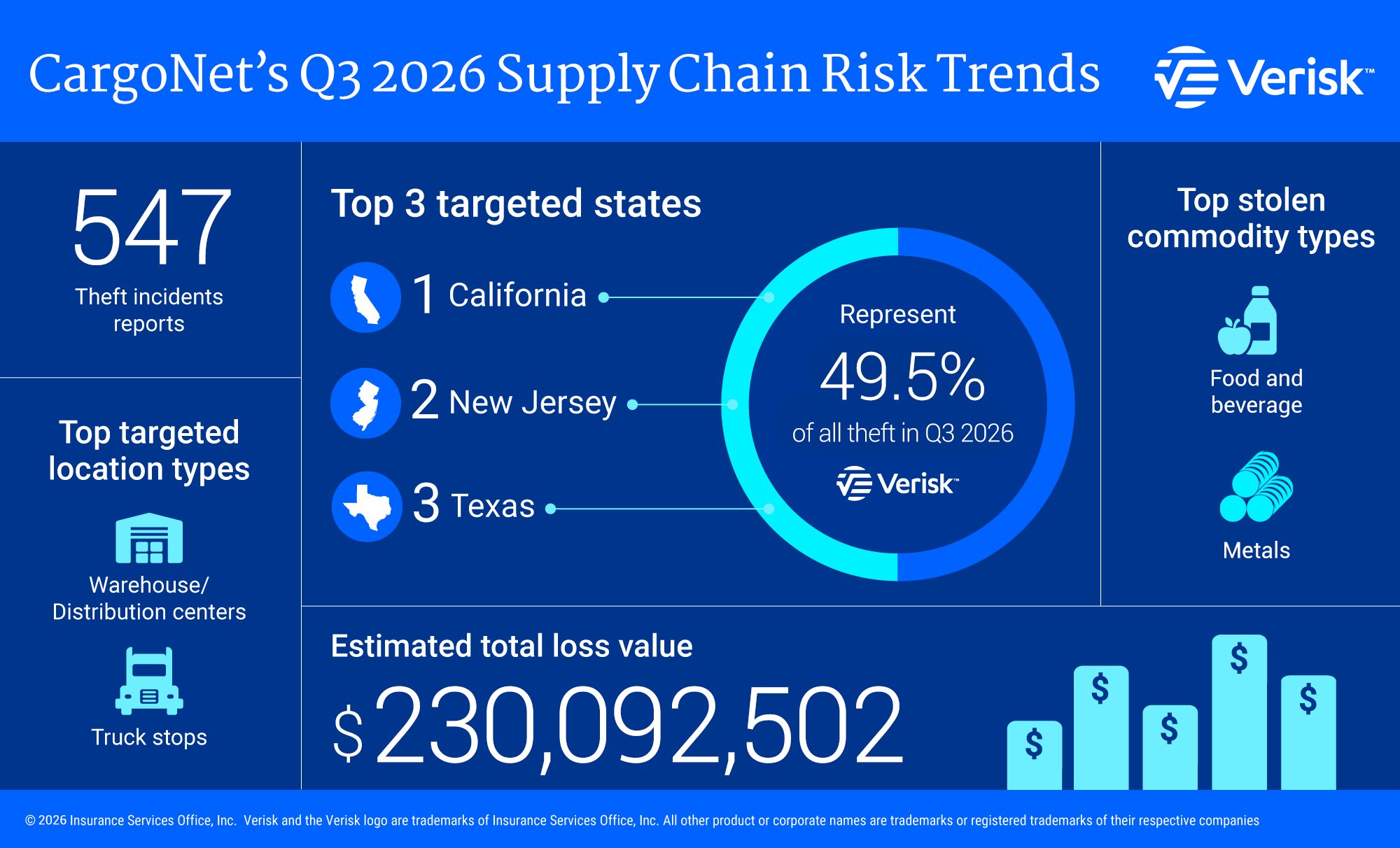
- Verisk CargoNet recorded 547 supply chain crime incidents in Q3 2026, down 33 percent year over year and 19 percent from the previous quarter.
- Fictitious pickups declined just 6 percent and accounted for approximately one-quarter of reported incidents, up from 18 percent a year earlier.
- Estimated losses totaled $230.1 million in Q3 and $718.9 million through September, a 39 percent increase from the same period last year.
- Nineteen thefts with documented values of $1 million or more were reported in Q3 2026, compared with nine in Q3 2025, with many involving high-value electronics and data center materials.
- Food and beverage remained the leading commodity category, while metals declined only slightly and cosmetics incidents increased.
- California, Illinois, New Jersey and Texas accounted for 57 percent of quarterly incidents.
JERSEY CITY, N.J., Nov. 04, 2026 (GLOBE NEWSWIRE) -- Verisk (Nasdaq: VRSK), a leading data analytics and technology provider to the global insurance industry, today released its third-quarter cargo theft analysis, showing a sharp decline in reported supply chain crime but a growing financial toll from theft.
Verisk CargoNet recorded 547 supply chain crime incidents across the United States and Canada from July through September of 2026, a 33 percent decline from the same period in 2025 and a 19 percent decline from the second quarter. However, estimated losses for the quarter totaled $230.1 million, up 12 percent from $205.1 million in the third quarter of 2025. Despite the decrease in reported activity, fictitious pickups, which are generally described as incidents in which deception is used to obtain a shipment, remained close to last year’s level.
Fictitious Pickups Account for Growing Share of Cargo Theft
Fictitious pickups accounted for 138 incidents in Q3, compared with 147 in 2025, raising their share of reported activity from 18 percent to approximately 25 percent.
The year-to-date figures also show continued financial exposure: estimated losses reached $718.9 million through September, up 39 percent, while reported incidents fell 25 percent, from 2,755 to 2,072. The average value of stolen commodities across incidents with a documented value increased by approximately 72 percent, from $261,115 to $448,456, over the same period.
"We saw mixed results in the third quarter with a decline in reported incidents and fictitious pickups remaining close to last year’s level, but the estimated financial impact grew significantly,” said Keith Lewis, vice president of operations at Verisk CargoNet. "Understanding cargo theft requires looking beyond incident counts and focusing on broader trends, like what is being stolen and where theft is concentrated."
Food, Metals and Cosmetics Remain Notable Targets
Food and beverage remained the leading commodity category with 94 incidents, though down from 178 in Q3 2025. Within the category, nonalcoholic beverages accounted for 22 incidents, meat products for 21 and alcoholic beverages for 12.
Household goods declined from 95 to 49 incidents, and electronics fell from 69 to 46, with computers and accessories remaining a prominent target, accounting for 20 incidents compared with 24 a year earlier.
Metals were the second most frequently reported commodity category, with 63 incidents, down only slightly from 68 a year earlier. Copper accounted for 34 of those incidents.
Personal care and beauty incidents declined overall, from 44 to 39, but reported cosmetics thefts increased from nine to 14.
The results illustrate how theft patterns involving individual products can remain persistent, or increase, even when broader commodity and overall incident totals decline. Additionally, ahead of the holidays, these categories are particularly notable theft targets.
Cargo Theft Remains Concentrated in Illinois, California, Texas and New Jersey
Geographically, California accounted for approximately one-third of all reported incidents, with 182 events, down from 261, while New Jersey declined from 66 to 46, Illinois from 52 to 40, and Texas from 105 to 43.
Together, those four states accounted for 57 percent of the quarterly total. County-level reporting highlighted concentrations in Los Angeles, San Bernardino and Riverside counties in California, as well as Harris County, Texas, and Cook County, Illinois.
Deception-Based Theft Remains a Persistent Threat
Earlier in 2026, Verisk CargoNet documented increasingly complex fraud schemes involving compromised business email accounts, internet-based phone systems and transportation industry applications. These methods can allow criminals to impersonate legitimate companies, obtain shipment information or redirect freight already moving through the supply chain. The persistence of fictitious pickups underscores the continued threat these schemes pose, even as overall reported incidents decline.
Lewis added: “We’re seeing criminals combine digital deception with traditional theft tactics to identify, intercept and redirect high-value shipments. Data center materials are among the valuable commodities attracting attention. As the value of the cargo being targeted increases, strong identity verification, shipment visibility and communication across the supply chain become even more important.”
Looking ahead to Q4, seasonal patterns warrant attention. Verisk CargoNet has historically observed increased theft activity during the fourth quarter and into the new year. Activity could escalate as criminals seek to exploit extended facility closures and reduced staffing during the upcoming holiday season. Verisk CargoNet will monitor whether the recent decline in reported incidents continues through this period, with particular attention to fictitious pickups and high-value commodities.
About the Analysis: Verisk CargoNet, a Verisk business and leader in cargo theft prevention and recovery, has collected and analyzed reported cargo theft incidents across the U.S. and Canada since 2010.
Methodology: Comparisons are filtered by report date and use equivalent cutoffs: Q3 2026 data through October 23, 2026;
Prior-period figures may differ from those previously published because of late-reported incidents.
About Verisk
Verisk (Nasdaq: VRSK) is a leading strategic data analytics and technology partner to the global insurance industry. It empowers clients to strengthen operating efficiency, improve underwriting and claims outcomes, combat fraud and make informed decisions about global risks, including climate change, catastrophic events, sustainability and political issues. Through advanced data analytics, software, scientific research and deep industry knowledge, Verisk helps build global resilience for individuals, communities and businesses. With teams across more than 20 countries, Verisk consistently earns certification by Great Place to Work. For more, visit Verisk.com and the Verisk Newsroom.
Attachment