
- Australians spend 85% of their waking day not moving
- Almost half of the population (47%) is At Risk or Endangered for movement
- By 2035, the At Risk or Endangered population is set to climb from 47% to 54% - an estimated 13 million Australians
- To highlight the issue, ASICS has released Human Nature, a new nature documentary narrated by the award-winning Sigourney Weaver, exploring how our modern-day habitats are quietly changing the way we move.
SYDNEY, Sept. 30, 2026 /PRNewswire/ -- Ahead of World Mental Health Day, ASICS is issuing a conservation warning for movement in Australia, as new research reveals people report spending 85% of their waking day not moving with almost half the population (47%) failing to meet recommended activity guidelines.

In response, ASICS is introducing the world's first Movement Conservation Status. Developed with experts and inspired by nature conservation, this draws from research involving 34,000 people across 31 countries (including 1,000 Australians) to classify movement levels as Active (150+ minutes a week), At Risk (30-149 minutes a week) or Endangered (fewer than 30 minutes a week), based on recognised physical activity guidelines.1
Australia's movement status
The findings reveal Australia ranks 10th out of 31 countries studied for Active movement levels with almost half (47%) falling short of the recommended 150 minutes of moderate activity a week.
The outlook is concerning, with modern life conveniences, such as online shopping, social connection and home delivery all easily accessible from the sofa.
If current trends continue, by 2035 the proportion of Australian adults with movement levels classified as At Risk or Endangered is projected to rise from 47% to 54% - equivalent to an estimated 13 million adults.
Just 15 minutes can help make a difference
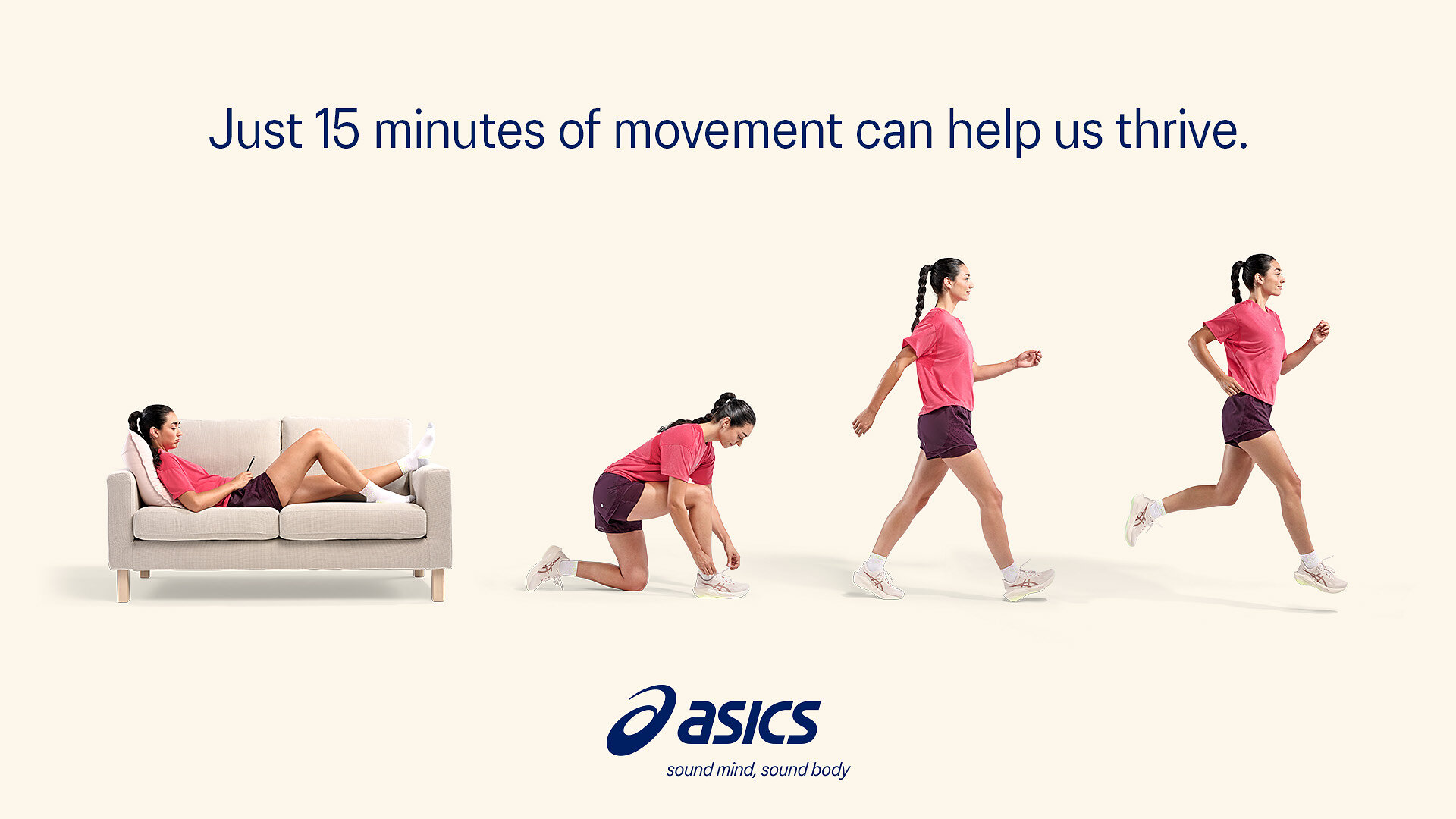
There is good news. Small amounts of movement can make a real difference with ASICS research showing that just 15 minutes of movement can help deliver a measurable uplift in mental state.
A new nature documentary
Human Nature takes a playful look at humans in their increasingly comfortable and convenient modern-day habitats. Returning to nature documentary narration, Sigourney Weaver lends her distinctive voice to the short film, which explores how sofas, screens and convenience are quietly replacing everyday movement. With a twist on the traditional conservation documentary, Human Nature shows how modern life is changing the way we move - and reminds us why movement is in our nature.
Watch Human Nature here: https://youtu.be/tTuMUWlVFZI
Movement levels are linked to our mental state
Australians whose movement is classified as Endangered report significantly lower State of Mind scores (58/100) on average than those whose movement is classified as Active.
Globally, young people are particularly at risk with more than half (57%) of 18-24 year olds reporting they fail to meet the recommended activity levels with 92% saying they experience negative consequences as a result, including low mood, increased stress and poor sleep.
Modern life is designing movement out
The research suggests modern convenience is quietly designing movement out of everyday life. Today, we can eat, work, shop, socialise and entertain ourselves without moving an inch. Almost two-thirds of Australians (61%) say it's easy to spend an entire day barely moving, while almost half (49%) say they could comfortably not leave their home for three or more days.
And staying in has a cost. Australians who very often go a full day without leaving home have average State of Mind scores of just 55/100, compared with 69/100 for those who venture out of home.
Technology is accelerating the trend. Four in ten Australians (39%) regularly complete errands online rather than in person, while 36% often socialise via phone or video instead of face-to-face. Among 18-24 year olds, 32% now use AI to complete tasks they would previously have done themselves - the highest of any age group.
Mark Brunton, Managing Director of ASICS Oceania, says: "Today, almost half of Australians are moving At Risk or Endangered levels. We believe it's more important than ever to remind Australians of the power of movement. Even just 15 minutes a day can make a meaningful difference to both body and mind."
This World Mental Health Day, ASICS is encouraging all Australians to take 15 Minutes to Thrive, moving for just 15 minutes to help support body and mind.
To find out more and join the movement, visit asics.com/movementconservation
Notes to editor
ASICS' global State of Mind study, conducted in July 2026 among 34,000 participants across 31 markets: Australia, Brazil, Canada, Chile, China, Colombia, Denmark, Finland, France, Germany, India, Indonesia, Italy, Japan, Malaysia, Netherlands, Norway, Peru, Poland, Singapore, South Africa, South Korea, Spain, Sweden, Taiwan, Thailand, Turkey, UAE, the UK, the US and Vietnam. 1,000 members of the general population were surveyed in each market (2,000 in the US, UK and China), nationally representative by age, gender and region.
ASICS worked with Professor Brendon Stubbs to develop The Movement Conservation Status drawing on internationally recognised guidelines for weekly physical activity, including those from the World Health Organisation, Sport England, NHS England and US Physical Activity Guidelines.
1The Movement Conservation Status classifies weekly self-reported movement into three categories: Active (150+ minutes), At Risk (30-149 minutes) and Endangered (fewer than 30 minutes).
Imagery
Australian Report Findings
- In Australia, people report spending 85% of their waking day not moving.
- 47% of the population have movement levels classified At Risk or Endangered.
- People whose movement is classified as Endangered report significantly lower State of Mind scores (58/100 on average) than those whose movement is classified as Active (67/100).
- If current trends continue, by 2035, the proportion of Australian adults with movement levels classified as At Risk or Endangered is projected to rise from 47% to 54% — equivalent to an estimated 13 million adults — with consequences for body and mind.
- 61% say it is easy to spend an entire day barely moving because modern life is so convenient, and 49% say they could comfortably not leave their home for three or more days.
- People who very often go a full day without leaving home have average State of Mind scores of 55/100, compared with 69/100 for those who never do — and are six times as likely to be moving at Endangered levels (42% vs 7%).
- Four in ten (39%) regularly complete errands online rather than in person, while 36% often socialise by phone or video instead of face-to-face – rising to 48% of 18-24-year-olds. Among 18–24 year olds, 32% now use AI to complete tasks they would previously have done themselves — the highest of any age group.
SOURCE ASICS