
Asahi Kasei, a diversified global company, has developed a novel pre-doping technology for high-voltage lithium-ion batteries (LIBs) with silicon-based anodes. This technology enables lithium carbonate to serve as an additional lithium source at lower voltages, reducing the permanent capacity loss that typically occurs in silicon-rich cells during the first charge–discharge cycle. Going forward, Asahi Kasei will work closely with customers worldwide to explore practical applications of the technology through proof-of-concept (PoC) evaluations.
This press release features multimedia. View the full release here: https://www.businesswire.com/news/home/20260820776456/en/
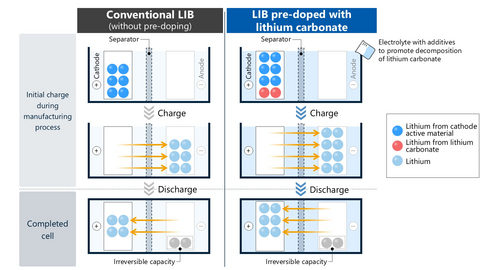
Conceptual illustration of the novel pre-doping technology
With the growing adoption of electric vehicles (EVs) and humanoid robots, LIBs are being required to deliver ever-higher energy densities. In response, development efforts have focused on partially replacing graphite with silicon-based materials in the anode and on increasing the operating voltage of cathode materials.
However, silicon-based anodes suffer significant, irreversible capacity loss during the initial charge, severely limiting the battery’s lifespan and total energy density. Compensating for this effect requires greater amounts of cathode active material, which in turn leads to higher material use and higher costs.
Asahi Kasei focused on lithium carbonate, which is relatively inexpensive and has an established track record of use as a lithium-ion battery (LIB) material, as an alternative to existing methods. However, because the decomposition voltage of lithium carbonate is far above the nominal operating voltage range of LIBs, its use for lithium pre-doping applications has tended to be difficult.
The lithium pre-doping technology developed by Asahi Kasei uses special additives in the electrolyte to promote the decomposition of lithium carbonate at typical cell voltages of standard LIBs. This allows lithium carbonate to be pre-added to the cathode as a sacrificial lithium source, which is decomposed during the initial charge to supply lithium. The use of low-cost lithium carbonate substantially improves energy density. Internal tests with an NMC (nickel-manganese-cobalt) cell having an anode of 90% graphite and 10% SiO showed a 10% increase in energy density. Furthermore, this technology improves cycle life at low cost per Wh (watt-hour), can be applied without significant modifications to existing battery manufacturing lines, and is expected to be broadly applicable across a range of cathode and anode material systems.
Asahi Kasei plans to license this technology and offer flexible collaboration frameworks that support a phased approach tailored to each customer’s development stage. This strategy is part of the company’s medium-term management plan (MTP), which includes its Technology-value Business Creation (TBC) initiative. Through TBC, Asahi Kasei seeks to create value from its extensive intangible assets—such as patents, know-how, data, and algorithms—by providing them in various forms, including licensing. Through this licensing-based business development, the company aims to conclude at least 10 new license agreements during fiscal 2025–2027, with a cumulative profit contribution of ¥10 billion or more by around 2030.
About Asahi Kasei
Asahi Kasei is a diversified global company that contributes to life and living for people around the world. Since its foundation in 1922, with businesses in ammonia and cellulose fiber, Asahi Kasei has consistently grown through proactive portfolio transformation to meet the evolving needs of every age. With 50,000 employees worldwide, the company contributes to sustainability by providing solutions to the world’s challenges across its three business sectors: Healthcare, Homes, and Material. For more information, visit https://www.asahi-kasei.com/.
View source version on businesswire.com: https://www.businesswire.com/news/home/20260820776456/en/