Pierre Madelon
at Jefferies
Replay available
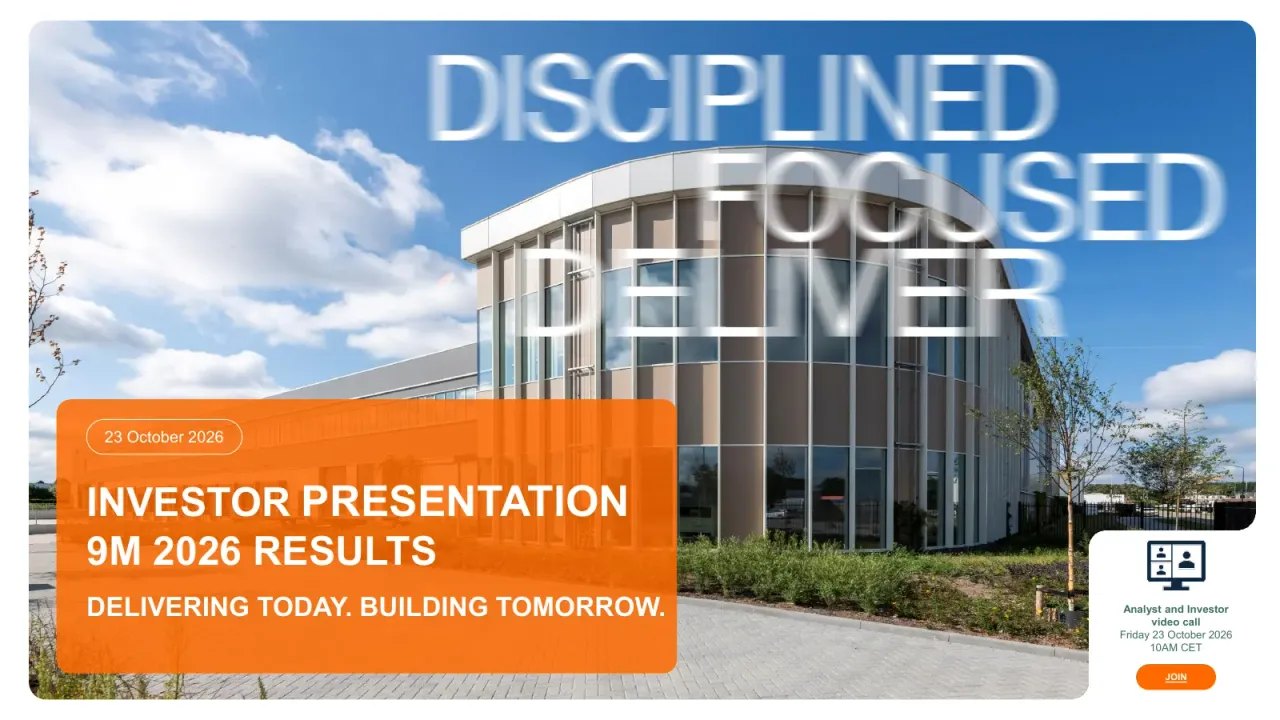
Warehouses De Pauw (Euronext:WDP) Q3 2026 earnings call, held 2026-10-23. Watch the replay and read the transcript on 6ix.
On 6ix: 6ix.com/event/warehouses-de-pauw-nv-wdpsf-q3-2026-earnings-call
Automated transcript · Written by software from the replay's audio. It can mishear names and figures; the replay is the record.
0:00 Yes, a difficult choice this morning between the Catena and the WDP call organized at the same time. So, thank you for joining us. But, let me start with the key message of today. Delivering today, building tomorrow. Our key highlights. Nine months into Blend 2030 plan, we have made significant progress in putting the building blocks for future growth in place. We continue to secure new developments, redevelopments, acquisitions of attractive returns of 7% NOI yield, which we enriched with a new A really unique land bank of 1 million square meters of land from Zwolle to Toulouse, securing the next phase of developments.
1:13 We are scaling up in Germany with a 250 million portfolio taking shape, supported by our local teams on the ground. We are preparing an early entry in Italy with the first investments, while Spain is in startup mode. And on top of all of that, we have proposed you the unique EU merger with Argan, transforming WDP from a Benelux Plus to a core Western European logistic platform. And importantly, We have also strengthened our balance sheet through our recent successful 400 million ADV.
2:10 So, we have the opportunities, the teams, and the financial capacity to execute our ambitions with a clear vision for tomorrow. And while building For tomorrow, we continue to deliver today. Our EPS is up 5%, supported by continued strong operating performance. Our occupancy remains high and our platform continues to capture demand across our markets. And we confirm our full-year guidance This with a strengthened balance sheet.
3:04 But what gives us the confidence looking ahead that is the combination of continued demand and our ability to translate that demand into growth and investments? We secured 500 million euro of new investments Our pipeline in execution stands at 800 million with a 7% NOI yield and over 90% pre-let. And importantly, we are continuously replenishing that pipeline. We remain convinced of the long-term fundamentals of European logistics.
3:52 Our clients need resilient and efficient for their daily operations. Without the right logistic infrastructure, products simply cannot reach the right place at the right time. And this has been showcased by recent large transactions in different markets. And with the supply chains becoming more regional and European, our clients increasingly need European partners who can support them across borders. And that is exactly the platform we are building.
4:38 A leading 20 billion euro plus European logistics platform that can offer these solutions to our clients based on robust fundamentals of our sector. So, in short, We are delivering on our commitments today and focused on successful execution. So, then now it's time for Q&A. And to start, we hear three questions popping up a lot of times in our contacts with the Invector community.
5:23 Our exposure to France, and how we look at it, the exit rights within the legal framework of the cross-border merger and with property values. So, we will answer them in advance, directly. First, our exposure to France. For us, the strategic rationale for France is absolutely clear. France is one of Europe's most important logistic markets and a cornerstone of a leading European logistic platform. It is Europe's second largest economy with almost 70 million consumers.
6:15 It has a substantial industrial base and it is one of the largest logistic markets on the continent with 18 million square meter of warehouses. And importantly, it has access to power with nuclear energy, with a nuclear energy infrastructure of 70% of the needed electricity, providing a cost advantage. Besides that, its geographical is unique, connecting north to south in Europe as well as east and west, supported by an extensive multi-model infrastructure network.
7:11 With the ongoing investment plan 2030 of the French government, 50 billion euro will be invested in the regionalization of supply chains Re-industrialization and in strategic infrastructure. For WDP, France is therefore not simply an additional market, it is a link in our European platform. And through Argan, we have a unique opportunity to establish leadership with a high-quality portfolio. A resilient tenant base and strong exposure to everyday consumption.
8:04 Of course, we are cognizant of the current political and fiscal challenges. Street protests, government budget deficit, rising country risk, premium, and the upcoming elections. We recognize these risks and take them seriously. We invest for the next 30 years and not for the next 6 months. Political cycles come and go of the structural need for modern, efficient logistics infrastructure remains. We are investing in infrastructure that is essential to our clients' daily operations.
8:53 So, Our conviction is clear. France combines the scale of a major consumer economy with internationally competitive industrial sectors and substantial long-term investment in manufacturing, energy and transport infrastructure. These structural strengths support sustained demand for modern logistics Yes, on the exit right, let me If you walked through it, how it works. In fact, the background is an EU legislation to prevent investors in one country being forced to receive shares of another country in a merger. Therefore, the need to provide a cash alternative.
10:06 The cash alternative should be the value of Argonne, standalone, prior to and independent of the merger, with strong reference to the share price trading of Argonne preceding the merger announcements. What are the ways to exercise it? Investors should attend the AGM and vote no, so that means maximum 33% can vote no, because the merger should also be voted yes, with a minimum of 67%. Next, investors should file the paperwork after the AGM of Argonne of 20 November, within 10 days, so prior to end of November. Only full participation should be offered to the exit rights, there can be no partial contribution.
10:51 Next, the shares will be no longer liquid as they will be blocked on an account, and the exit right will be paid 2 months after the merger closing, so up to 5-6 months after the EGM. And also, the exercising of the exit rights will trigger a capital gain tax as opposed to swapping to WDP shares which is tax neutral. Another point is the conditionality. The exit rights is only exercisable when the merger then completes, plus no liquidity is available once standards for the exit rights of the shares are blocked and not to be transferred. What is the potential theoretical financial impact? Then it's about 26 million Argonne shares times We have carefully analysed with our boards prior to entering the transaction what it represents.
12:05 on a probability-weighted risk and a look-through risk. So there, first of all, not all shareholders typically attend an EGM. Secondly, there is also already 20% plus overlap in the free flow, so excluding the reference shareholders between WDP and Argonne shareholders, so you may think, or may expect, they will be the same. and hence we have considered a maximum look through risk probability weighted of 10% of the shareholder base of Argonne maximum or 150 billion euro which is then to be seen on a combined balance sheet of 13 billion and would have an LTV impact of plus 1.2% but We have liquidity available, this can be managed, this is very manageable, and also it will be even EPS accretive at that moment. So that's first on the exit price.
13:08 Then the third question, which popped up regularly, is the question obviously on property values and yields. There we can say, yes, the recent run-up in rates, and more generally, De Pauw Nv, Alexander Makar, Johanna Vermeeren, Joost Uwents, Michiel Assink, Mickaël Van Den Hauwe De Pauw Nv, Alexander Makar, Johanna Vermeeren, Joost Uwents, Michiel Assink, De Pauw Nv, Alexander Makar, Johanna Vermeeren, Joost Uwents, Michiel Assink, Mickaël Van Den Hauwe below seven times now, and 2.4 billion liquidity.
14:17 These two are more than ever the most relevant. Thank you, Mick. Thank you, Mick. Thank you, Joost. This brings us to the Q&A. If you wish to ask a question, either via the chat, and I will address them, and in seconds, I'll guarantee this by phone, P-files, found key files on your telephone, P-files to enter. if you wish to withdraw. And we have the first question coming in from Anna from Morgan Stanley. You are now unmuted. Hello, good morning. My first question is, again, on France. Well, first of all, thank you for sharing your London view on this big opportunity there.
15:04 However, in the short term, the situation, as you said, is likely to remain a bit uncertain for longer. What are you seeing at the moment in France? Do you see tenants staying put and avoid making decisions and maximizing utilization rates? And do you expect that will change after the election? And how do you see that might impact valuations of the French property portfolio over the next 6 to 12 months?
15:34 First of all, we see very good resilience in, let's say, the French logistic market. The problems are, let's say, on the streets, in the shops. But, let's say, you can say, even the example of Carrefour, where you say, okay, Carrefour said, look, we can have a problem if we cannot sell our goods. and they can do a profit warning but it has no impact and it has nothing to do with the logistic infrastructure on the contrary even after a difficult weekend let's say they need to be able to deliver on Monday so it has no impact on the supply chains of our clients on the contrary they need to be let's say more resilient than ever So today, and even, let's say, you can say we enter a difficult 12 months, but like I said, France and the portfolio of Argan is fully lit. And even in our portfolio, where there are still some vacancies, we feel that there is still demand for those spaces. So logistically, it's totally different than, let's say, what we see on the streets of France and on let's say on valuations
17:07 Nick answered and in France and in general let's say valuations, the markets It's based on the Euro swap rate and not on government bonds. We see in fact that the cost is unrelated to France in itself because in general the cost of capital in Euro has increased and investors do not fund on the back of French government bonds. De Pauw Nv De Pauw Nv It's not because there are problems in the shops or in, let's say, the points of delivery that you have and can change your logistic networks.
18:18 That takes years to adopt logistic networks. And now, for example, the food retailers, they are now adopting and integrating e-commerce into their logistic infrastructure and their logistic network. And that is, let's say, what happens in the corona, they are now implementing it in a structural way. So that takes years and therefore is for them even more important than some retail points. Thank you. And then my second question is related to indexation and market rental growth. So it's clear that inflation is rising all across Europe and now standing about 4% in certain countries. Do you think that will flow into your rental income next year? How much that could impact? And how would that compare to market rents? Do you think that just because of this inflationary impact, we will see next year market rental growth accelerating more than originally expected? Or do you expect that we have another year where maybe your reversionary potential De Pauw Nv, Alexander Makar, Johanna Vermeeren, Joost Uwents, Michiel Assink, Mickaël Van Den Hauwe It's too early to give guidance on it, still a lot of moving parts of course, we will
19:59 come back on that in end of January, because also the inflation forecasts themselves are moving every day, it's dependent on the length of the conflict, but yes, it will certainly improve the life on the back of indexation going into next year. and yet we can capture that indexation and our central scenario with respect to rental values is that we have seen the market improve as well. We believe that in the short term market vacancy rate in general has peaked. There is much less construction activity. Pipelines are drying up sort of speed. and we believe that it's reasonable to assume that as from next year ERVs move back in line with inflation, yes.
20:57 Great, thank you very much. Thank you. The next question is coming from Steven, from ADN as well, here now, and here is Steven. Hi, good morning, thank you for taking my questions. One factual one, what percentage of yeast maturities in both 26 and 27 have been renewed or relapsed so far? We have mentioned in the first release, so for the 10% of readers maturing in 26 over 95%, and around 95% have been either renewed or are reflected in the occupancy rate of 97.2%. And for 27, we are now working on 27, that's too early to say. Okay, and then to get more color on the investment market and what it means for you. So what type of investments are in pipeline?
22:00 That's one. Two, can we expect WDP is more or less likely to step up investments given the current environment? I know you were quite bullish before. And third, are terms of acquisitions improving already? Well, I think, Steven, first of all, we have... What to do? Let's concentrate first on what we have done. Like we have mentioned at the ABB, we are, let's say, finalizing a lot of new investments announced first. So we will finalize those new investments announced during the ABB.
22:50 we are and further above that we will secure three lefts on our own land bank and indeed in the meantime we will first do the merger with Ardan so I think we have more than enough work on the table and now we need that first to execute so let's concentrate first on what is on the table, like for example in Germany and Italy. Okay, that's very clear. Thanks. Thanks, Steven. The next question comes from Eduardo from .
23:35 Good morning, everyone. Quick question for me on development economics. We've seen replacement costs rising. I'm curious to know what you're seeing in your pipeline. How much have they risen, I would say, over the past six months, even year to date? And then secondly, where do you see room to increase rent to protect your profit margins going forward? Do you see that being at risk or threatened at all, considering the replacement cost movements year to date? Thank you. So I assume you mean by replacement cost movement that construction costs have gone up? Correct, yeah. Yeah, perhaps you can. Yeah, I think I say it should be normal given that oil prices are higher now and that has an impact on certain materials. So yes, there is an impact on materials, but today with the fact that there is much less worked for the general contractors at the construction companies that say they take those extra costs on their behalf. And today we feel that indeed there is much less that the constructors have a much smaller pipeline.
24:58 And for example, even today, we have to finalize construction The pricing for a construction, well, I guess I would say almost every constructor online to say, look, I really want to do this job. So globally, on the total cost of a construction, we see no higher prices. I would even say for the moment, even the contrary. But let's say that construction prices are flat. that there is a plus in material, but a minus in other elements. The fact that there is no pipeline makes that, let's say, they have today no power to re-invoice it to us.
25:50 So that leads to the fact that we can achieve the target NOI yields at the accepted market rental levels, which are still much higher for a new development. then for the existing portfolio which is also good for future rental growth. Understood. And if that weren't the case, so if you could not protect your yield on cost, would you reduce your development pipeline deliveries or would you still develop and ensure that you have lower margin but you have an asset that you've delivered? How do you think about the priorities here? Understood, thank you. But obviously, the opportunities where we focus on to ensure profitability are more than in the value-add segment and in the development is, let's say, activating the increased nice land bank reports.
27:13 That's where the value lies. Very clear. Thank you. The next question is coming from Lynn from LBC. Hi, good morning everyone. I have two questions. First of all, how do you look at the continuation of your optional dividends given your current cost of equity? For next year, that's foreseen as a recurring program which we do each year. We already do it for 15 years and that's currently foreseen as usual. with the same type of conditions.
28:00 But we have no idea what the cost of equity will be in May next year. Yeah, okay. And then maybe second one, I was just wondering if there's already an update on the tax ruling that you need to go ahead with the merger with Ardon. No, no update yet, which is also fully logical because this is following its normal process with the tax authorities and we expect it to be announced or just before or after the new year is our anticipation. Okay, perfect. Thank you. And the next question is coming from Pierre Madelon from Jefferies.
28:46 You're now unmuted. Yes, thank you, good morning, and thank you for taking my question. Actually, I have two questions. So the first one, if you can give us the pro forma April TV post with Aragon, and maybe also taking into account the 150 million potential cash outflow for Aragon minorities, and also, if you have already a view, actually, a potential mark-to-market of Aragon's portfolio value, because as we saw recently, French Shield, in France, expanded by 50 pips in almost two months. The first part, I did not hear, sorry, it's the proforma, what? The proforma.
29:35 We said that, I go back to what we rise for, and the rise is that, including that the consolidation impact of Argonne, including The exceptional dividend and including 250 million targeted disposals during the course of 27 will have an overall impact on the LTV of plus 1%. And we do not comment on the market of our grand portfolio because of two reasons. Until the merger we are still two independent companies. and secondly, we never speculate on values, we just need a general comment on property values and that holds true for all the geographies in which we are And if you really want to have a sort of sensitivity to be complete, then I can say that a 25 bps change in the portfolio of yields of Argan would have an impact on the combined group of 0.7% LTV, just to give you some sensitivity in there.
30:47 Okay, that's super useful. Thank you. And my second one is on the merger and the AGM that is coming at the end of the month of November. If I'm not wrong, the threshold for the merger is 75% for WDP. Did you already receive some pushback from investors that would make you think that they would vote against the merger? Or if you can give us a bit more color on your discussions with investors. You mean on the side of WDP, eh? Yeah, WDP, yeah. and we feel the full support of that
31:56 Okay. And maybe one follow-up question, maybe if you can also give us more color on the reason why, or maybe how it happened actually, why the Lelan family did not participate to the IDP. The Lelan family, because they simply cannot do it, because we're seeing in the merger documentation that there is a full standstill Both companies and shareholders can not invest in the other one. So there are no related kind of merger process that you prohibited that there is a freeze and that you cannot invest in one another until the merger is done. Okay. Okay, that's good. Thank you very much.
32:41 Thank you. And then we have a few questions on the chat. The first is coming from Kenneth from Baratis. To what extent is there any redo cost from the recent CAFU results? Well, that's what I said. It's not because there is a profit warning from Carrefour that Carrefour will adapt their logistic network. On the contrary, even when there are problems in the shops, they need to deliver even more. And adapting or changing a logistic network takes years. and let's say there is a network that is optimized and it's not
33:24 because there are problems in the retail points in, let's say, Paris that they should stop delivering Normandie, for example. So there is apps on the contrary and it proves like also, for example, with Ahol de Leze and Ahol de Leze and a cyber attack. Last week on their logistic infrastructure, well, it had a direct impact on the availability of goods in the stores. And that showed again how important the logistic infrastructure behind the shops and the delivery points is. So on the contrary, it shows how important that logistic network is behind and that profit warning will have no impact on the logistic network of customers, for example, and also not for the other ones.
34:21 Meanwhile, we have another speaker queuing, so Fredrik, you're now muted. Hi, good morning guys. A lot of good questions have already been raised. One on my side, or two maybe on my side. Looking at your 2030 guide, which implies roughly 6% EPS growth by 2030, how do you see, sequentially, that EPS growing? Do you think it will be more back-end loaded than front-end loaded? How do you see it? That would be the first question. And then maybe the second question would be on Sweden. I have obviously a 10% stake in it. How do you assess this participation against, I don't know, maybe the need to find some liquidity at some point with regard to the exit price, etc., because nobody is speaking about this liquidity that you have. But how do you see and how do you assess this participation today?
35:23 Thank you. I can answer shortly on the participation. You know that my, let's say, strategic participation and there is nothing changed in that strategic rationale. On the contrary, it helps us to offer solutions to clients from, let's say, now even Helsinki to Madrid and Rome. So it is and it stays strategically and we have more than enough where we have 2.4 billion liquidity if there should happen something with the exit price which we absolutely don't think so and on the way to the 2030 plan Mick can answer but in general we can say that we are nine months far and probably with everything which happens now let's say the route De Pauw Nv, Alexander Makar, Johanna Vermeeren, Joost Uwents, Michiel Assink, Mickaël Van Den Hauwe De Pauw Nv, Alexander Makar, Johanna Vermeeren, Joost Uwents, Michiel Assink, Mickaël Van Den Hauwe 2030 targets have now been secured and additionally given micro uncertainties and changes since when you set that guidance what gives you the confidence to continue towards that
36:53 path is also linked to the question of Frederik, that's why I read it out loud here. and then on the investments in the 2030 plan and is based on 500 million investments per year so we did 26 I would say and the pipeline provides visibility for the next 18 months so then you can see how much is already secured and on the execution and uncertainties I can give the best example like Lozioos alluded to also with the situation in 22 then we came with a plan early in 22 and after three months we all know what happened at that moment that also had a severe impact and we worked hard and we worked towards the target but through a different pathway and going back to Frederik's question Is it more back-end loaded? That's something we cannot answer today.
37:55 We never said it would be a linear execution. We aim for that, but we cannot promise that, of course. That depends on a number of factors, but we are still confident in the 2030 targets. But as always, what do you need to do? You need to be agile and adapt yourself very quickly when there is a changing market environment. What have we done? We have now focused immediately on more value-add and developments, which is reflected in the high NOI yields at 7%, which are in tune with the higher cost of capital and our balance sheet is also strong and provides optionality and that is what we need to do, being agile and shift very fast to protect profitability and next to that I will also make a comment in general that our clients and operations are healthy, market supply demand is balanced and we have the ability to capture also inflation and the long-term fundamental drivers, the demand drivers of our sector are intact.
39:07 So I hope that answers the question and volunteer Going back to Frederik's question on Catena, I don't understand really on liquidity, because we have a superb liquidity of 2.4 billion euro. So something relevant in that respect. Yeah, that's okay. Thank you. Thanks, Frederik. We also covered all the questions in the chat, so I will say the word again. Thank you everybody and let me conclude with one final thought. Yes, we have positioned WDP to perform in different market environments.
39:58 If interest rates stays higher for longer, we have our adaptive balance sheet ready and financial discipline to continue delivering. If conditions improve and opportunities accelerate, we have the financial capacity, the teams and the platform ready to act in existing and new markets. That's the agility we demonstrated when markets changed in 22 and it remains one of WDP's key strengths today. the 20 billion euro European logistic platform of tomorrow with a clear vision, a clear focus on delivering above-average growth with a below-average risk profile.
40:56 And, by the way, don't forget to vote at the upcoming EGMs of Ardant and WDP in favor of our unique EU merger. Thank you in advance and enjoy the weekend.
Follow Warehouses De Pauw SA into a list and get an email when it puts out news.
at Jefferies