Transcript
Automated transcript · Written by software from the replay's audio. It can mishear names and figures; the replay is the record.
0:07 Hello everyone and welcome to the Nevada Lithium live event hosted by 6. I'm pleased to introduce the speakers for today, Stephen Renschlit, the CEO, and Jeff Wilson, the VP, Exploration. They'll be discussing the recent results, providing a corporate update, and after that, we'll be accepting questions. As a reminder, you can submit your questions in the chat at any point during the presentation.
0:30 As always, this event is being recorded and will be available to watch shortly afterwards. Without further ado, I'd like to hand things over to you, Steve, so that we can get started. Super. Thanks a lot, Max. Thanks everyone for taking the time to listen to us. Obviously, I'll start with the obvious, which was that we drill a monster of a hole at Bonnie Clare. No problem saying at all, it's the best hole that we've drilled there to date. I actually have no problem saying, I think it's the best hole that's been drilled in Nevada. Our teams have been doing some work to sort of corroborate that, but we can't find anything that when you look at it over, you know, essentially the thickness by the grade that can match it. And of course, as you saw by the market reaction, nobody really cares. I guess we should have hoped that it was uranium that we hit. And this is just the way the market's right now.
1:21 I've talked to people a lot about this, seen this many times over the course of 30 years of investing in natural resources. And when I talk to investors, I just say, hey, this is where you have to stay the course. I think that the demand supply fundamentals are still in place. And we'll get through this. In the meantime, we have a world class asset that's getting, in my opinion, even better. I've got Jeff Wilson with me, our VPX, obviously a geologist, and I'm not gonna steal his thunder. I'm gonna give you a little bit of an overview from the way I look at it, and we'll turn it over to Jeff to get the nuts and bolts for those who wanna do that. And I'll just give you a very quick update, I think, of what we're doing. Not a full update per se. I think it's going to be in another, say, month or 2, because we're going to know some things better, but enough just to give you a flavor of how we're looking at things.
2:15 So again, if you think about Bonnie Clare and think about the lithium there, just think about a peanut butter sandwich that's on its side, right? So you can see the top piece of bread, you can see the peanut butter in the middle and the bottom piece at the bottom of bread. The top piece of bread where there's lithium close to surface at surface, conducible for open pit, but that's really not what we're interested in right now. We're looking at this stuff that's deeper. You go down below the peanut butter in the middle and you get to that second piece of bread where we've been finding these, you know, very, very wide intercepts, 200 meters this time of plus 4,000 ppm lithium. And if we continue to move to the east, we've been finding that essentially, not only is that piece of bread getting thicker as we move to the east, the amount of lithium within that second piece of bread is also getting greater. The concentration's getting greater.
3:07 That being said, that second piece of bread down at the bottom is also continuing outwards in 3 directions, to the north, the south, and east. And when you have sort of a confirmation hole, like we just got, again, I'll let Jeff talk about this a little bit more. We feel very, very secure in saying, hey, we've got a wide open, high grade mineralized zone. That of course is orders of magnitude higher, 234 times higher than what we have in our PEA resource. And again, that PEA resource, you know, arguably is one of the largest in the world. Doesn't matter if you call it the third, second, whatever it is, because as you all know, in the PEA, we have more than a 40 year mine life at 30,000 tons of lithium carbonate.
3:53 All else being equal obviously higher grades are good news right for every ton of dirt that you move around the amount of lithium in there is being taken to a plant to basically be recovered. So the economics we would expect to get better, grades we would expect to get better. I don't want to go too far out on a limb here because there's a lot of intricacy in this whole thing. Remember that our PEA resource was predicated on 10 holes, based, I think, up until 2022. And there was a combined about 2,300 meters of drilling at that point in time. Couple of the holes were down to 600 meters or 2,000 feet ballpark, But a number of them were also shallow. Some of them were also reverse circulation. The grades we've seen when we twin a hole with a diamond core like we've been doing tend to get higher by about 15%.
4:47 And of course, some of those other holes were very shallow and not they're basically not getting anywhere down to where we've been with these last 2 holes. Remembering that the first hole the first core hole of the 2023 season when we went down to the geological basement. That was part of what we had promised to do with a set of new shareholders that we had who were interested in brine. So we wanted to learn some science. And that went down to about 2,800 feet. Of course, what we found there was from 2,000 feet, where we'd normally been drilling to lately, it was down to 2,500 feet, we were still in mineralization. So what'd we do on this last hole? Well, we said, well, let's go to 2,500 feet. Well, we went to 2,500 feet. Guess what? We're still in mineralization. I would argue stronger mineralization than before.
5:33 All of this is to say that this is a very dynamic environment and what I've asked all our technical folks to do is to sort of think about this holistically as we make decisions about the work program going forward. I've seen a lot of instances over the years where folks would basically develop assets, I don't say in too much of a hurry, but essentially things weren't as well thought through as they could be and I want to introduce the concept of sterilization here. And I'm going to use it very loosely because typically it means you might build a plant over top of part of your resource and then you can never get to it, etc. But let me just sort of open it up a little bit more to say, we want to reasonably try to situate, center, however you want to say it, you know, the resource at Bonnie Clare. You see that we've been moving farther to the east. As the basement has been falling away, getting deeper, we've been finding higher intercepts and higher grades. We don't think we're at the center of the basin, which what our technological guys tell us is where we would expect to see sort of the best, creme de la creme.
6:41 That being said, we're not gonna turn this into an open-ended science project either. There are time constraints in the real world for investors, strategic investors, off takers, etc. That make a big difference. So it's a balancing act is what I'm trying to tell you. And I think at this point in time, we're going to take a little bit of extra time. I'm still trying to get this 24 timeframe at the end of that for the PFS to come through. I think we can pick up some time later in the summer if we need to. But you've been hearing me mention about if we push it into the beginning of 2025, it's specifically because of something like this, where essentially the news is so good. I don't want to be stupid about this and not incorporate it in the in the optimum way into what our plans are.
7:28 I think at that point in time, from a geological perspective, in just about 2 minutes, I'll let Jeff dive into this. Let me just say a few words about everything else that's been going on. I've been talking about metallurgy for a while, and we've been pursuing lithium hydroxide. We've come very close, but we're still not there. Without going into all of the details, I think that we're at a reasonable stopping point right now with regards to hydroxide, to where we can pick up later on if we want to and get it. But we can't get it right now. It just doesn't look like it's gonna happen. I think it's fine because we've hit the battery grade carbonate, as you all know, that was in February a year ago, very big deal. If we need to pick up with the optionality of the hydroxide in a little bit, I don't think we're gonna get dinged for it.
8:17 I think, again, this is just sort of a reasonable compromise between timing, funds, other things that are coming in, particularly like this deep mineralization that we're seeing right now. Is it going to necessarily behave the same way, metallurgically? There are all these questions that need to be asked. Don't know if the answer is no, don't know if the answer is yes, but it literally takes time to go in and ask all those questions. So we're gonna basically ask Hazen to start writing a report. It's gonna take time to get it done, to have edits, see where we go, and see how it'll be addressed in a PFS. In terms of marketing, we've been active. I know the share price doesn't indicate that, but the reality is we've been as active as we can in terms of getting the word out about what we have.
9:05 I think from the indications that I'm getting, as an example, I'm going to PDAC, trying to get one-on-one meetings have been successful. It's interesting to me that some of the people who are getting back to me who say that they want to have meetings about battery producing metals, et cetera, so this would be your lithium, your cobalt, nickel, things like this, will decline immediately and say, no, lithium's in a downtrend right now. This isn't our thing. Again, to me, this is sort of the difference between investors and traders. Everything that I'm seeing still with regards to demand is coming in much much higher pace than the supplies of lithium can come on. Of course we've all seen some of the news lately. Albemarle you know Chinese was a leopard. I forget. You know the lithium producers that got the very bad environmental characteristics, all of this sort of stuff. You know, the news that you're seeing is indicating that we're getting close to a bottom.
10:02 I still maintain that it really wouldn't matter if they cut production now or whatever because as you go forward a couple of years, there's just no way that they continue to build that base quickly enough to come up with the demand numbers that are going to be needed. Obviously, investors don't agree with me now. But again, this is sort of where I think long term investing really can help you sleep better at night. So that's the market. We'll be at PDAC. We'll be doing 1 on ones. We'll be going out in Toronto to see people. I'll be in Zurich later in the month to talk to the European Centre of Investing out there. And then we'll see it from there. There are obviously other conferences coming up etc. And I think again it looks like the lithium market is starting to heave a little better. We don't expect it to turn on a dime, but if carbonate prices are going to start to stabilize here, it strikes me that this would be a logical place where we would just sort of start to see an updraft for basically all producers, developers, explorers. I mean, I really can't think of anyone that's standing out in terms of holding on to its share value for any length of time. So I don't think we're being singled out. I think, unfortunately, this is general market malaise.
11:16 And whether it's interest rates being cut or other big announcements about cuts to lithium production, you know, at that point in time, we should start to start to see a little buoyancy under the stock price. So, You know, over the course of the next couple of months, we'll give you more details on, you know, what we think the 2024 work program is gonna look like. You know, as I said, we're gonna be making adjustments based on all this latest news. We wanna make sure that we incorporate this in the correct way into what the plans are going forward. This is all good news. You know, again, Bonnie Clare is an absolute beast and we have not found the center of gravity yet on this thing. So we have a lot to talk about. You know, I want you to have faith in all our technological people. They have excellent reputations and skill sets.
12:05 And as we can tell you more, we certainly will. So at this point, let me turn you over to my colleague, Jeff Wilson, who can tell you more about the nuts and bolts, how he's understanding what we're seeing with this last hole, perhaps the last couple of holes and how they all tie together. So, Geoff, you there? Yeah, thanks very much, Stephen. And I'll apologise in advance for not being quite as polished as Stephen. He's the man who sells the vision as the VPX. I'm not necessarily accustomed to the spotlight. But broadly speaking, what we have here is a very encouraging hole. For context, we understood there were 2 layers of mineralisation at Bonnyclare, 1 between the surface and 400 feet, which gave us about 1000 ppm, and we had a barren sandstone under that. And then we had another layer, which we had thought we understood, which again was running around 1000 to 1500 ppm, but bottomed out at 2000 feet.
13:14 So in fall last year, we did this big hole, which gave us, you know, 1000 feet, 1100 feet at 3000 ppm. And it really gave us the first inkling that we were
13:29 sitting on top of what would intersect a much larger, higher grade, thicker interval of mineralisation. So, and we looked at that last year. On the back of that we stepped out 450 metres to the east and sunk another hole. Now, you know, 1 hole is great but it doesn't really show very much except that you found something. And so this second hole We really wanted to demonstrate that you had continuity of that high grade. And in fact, that's what we've demonstrated with this second hole. Again, the 3000 ppm material, it's at least 1000 feet thick.
14:19 And then you've had a much higher, a much thicker load of 4000 and 5000 ppm material. So we have the headline number 680 feet at 4,154 ppm lithium, including 160 of 5,054 ppm lithium. So what you have with this hole is a confirmation that we are really seeing a thick horizon of, or a thick layer of very high grade mineralisation at Bonnie Clare.
15:04 And that will certainly provide food for further investigation over the next year or so. Now of course you're combining that with the ongoing drive to pre-feasibility, but I think it behooves us to investigate this much higher grade
15:26 horizon, because, you know, grade is king in mining, and certainly all things being equal, it's fair to assume that this would translate into much more robust economics.
15:44 Am I missing anything, Stephen? No, no. I mean, that's pretty much how we're thinking about it right now. So, you know, at this point in time I think we should certainly take advantage of having Jeff here. Max, if there's any questions, why don't we just start right away and we'll just take them as they come. Yes, sounds good. Thank you for that. So question here, wording for early 25 was added to the latest report regarding the PFS. Does it go still to shoot for the timeline of late 2025?
16:18 You're cutting out, Max, but I'm pretty sure I understand what you're saying. This is about the PFS. The reason we added about early 2025 is there's a couple of decisions. It's a big decision tree, right? And some of them are out of our control. One of them, you know, the PFS writers, authors are looking for certain things with regards to the borehole mining. Will they need extra tests? We're waiting on basically some studies that are going to help us determine next steps, things like that. And then there's this added factor here, which is these high grades that we're seeing. And to Jeff's point, it's sort of, again, they certainly deserve to be examined further. We want to incorporate them, obviously, into a PFS.
17:05 The question is, is how best to do it? So that just requires additional analysis. And all I could tell people is just try to remember sort of the logistics of what's going on here. Because first of all, not everybody's in one place. Not everybody belongs to the same company. Everybody's got different thoughts on things. Right. I mean, these are these are essentially all unknowns when you think about it. So you've got a bunch of experts who are trying to coordinate and basically compromise and get all this stuff together. And my point is, is that nothing takes 3 days. Right. It takes time to get this done. And these are the kinds of things I'm talking about. So, you know, as I have always tried to be transparent with everybody, you know, I'm saying, all right, and at 2024, I think it's still pretty good. I still think we can do it. Don't be surprised if we're at the end of, say, the first quarter of 2025, or somewhere in the beginning of the first quarter of 2025.
17:59 In the grand scheme of things, is that gonna be something that I think nobotyl Lithium would get dinged on? I think, no. It's a reasonable type of thing. I'm just trying to basically alert people as early as possible. I know everybody likes to have the check marks on the milestones. I get it. I was an institutional investor for 3 decades. But the reality is particularly in today's environment, everything as you all know from permitting, to financing, to just exploring the unknown, getting information like we just got here, one thing leads to another, leads to another, leads to another, and you've got to track it all down and make sure it all makes sense before you can positively say, hey, we're going to have something done at such and such a time.
18:46 In the grand scheme of things again to me, right, as I've always told everybody, strategic investors and in this case I mean OEMs, battery makers, all these, how quickly can you get the lithium to us, right? And that's why I say we can't have this turn into a science experiment either. So I just want everybody to be cognizant that sure, if we, you know, we have to take a couple more months to do something, that's one thing. It doesn't mean that we're off to the races and, you know, hey, we'll get back to everybody in 3 years after we're done drilling. We're not saying that. But I think it's a prudent thing
19:18 to do here is to take this new information into account so that we make the best choice for what we need to do in the relatively near future, which is that PFS, in my opinion. So sorry, that's a long-winded answer to probably what could have been a short one. I think that's a great answer, Steve. Question here regarding when to expect a go slash no go regarding the borehole mining process. I think that we're, well, First of all, in the context of this, we're still waiting for a bunch of reports that then have to be essentially given to the PFS authors. And there are 3, let me put it to you this way, because occasionally I'll read some people's comments and things like that online.
20:04 There's more than 1 entity who's dealing, you know, in all of this, we've got Kinley exploration, there are the borehole mining folks, we've got bar engineering, they have the, you know, a lot to do with this, essentially the, the composition of the soil and how things are gonna act. And then we've got GRE, Global Resource Engineering, who's gonna write the PFS, and they did our PEA. So there's coordination of all of this. So when Kinley gets done, they've got their piece, Barr is feeding into, Barr might also feed into GRE. All of this is gonna take a number of months. And I think I've been pretty consistent in saying is, you know, I expect, you know, we're at what now? We're at the end of February. I still think that we should, we're going to be allowing it probably at least 3 months, February, March, you know, maybe 2 and a half months, something like that, 2 to 3 months before we know what the next step, pardon me, is going to be necessary with a borehole mining. But That to me is sort of the logical fork in the road where we know what to do next.
21:06 Perfect, thanks. To what extent are the ramp up or is the ramp of your operations dependent on Nevada Energy getting power to the area with the new green line? At this point, I don't think it is dependent upon it. That would be great. I know that's, I think, is it a 500-volt line? They're talking about putting right overhead. The way I've always thought about this, again, we're in the perfect place for alternative energy down there, whether we generate it or not, or buy it up from the Hoover Dam off the grid, whatever the deal is gonna be. My thoughts have always been to get a big infrastructure player involved with us, frankly, because you don't have to go that far away, right? You go 50 miles north, you're at Silver Peak, you go another hour, hour and a half, I think, north of that, you're Clayton Valley.
21:54 All of these projects, eventually, and I'm a believer that they're all gonna come to fruition because the world's gonna need the lithium and Nevada's gonna be the centerpiece of the US lithium industry, that energy is gonna be needed. Now, some of them like Thacker, if they burn sulfur, that's great, They can generate some of the electricity. You know, there's a lot of different paths that we can take. So I don't think we're dependent on any one of them. However, I would love to see those lines come across right next to the other lines that we have on the property. Few projects can boast the infrastructure that we
22:28 have. Yeah, perfect, thanks. Do you know in what mineral or minerals the lithium is hosted? And I'm assuming this is relating to the newest results. This is a Jeff question.
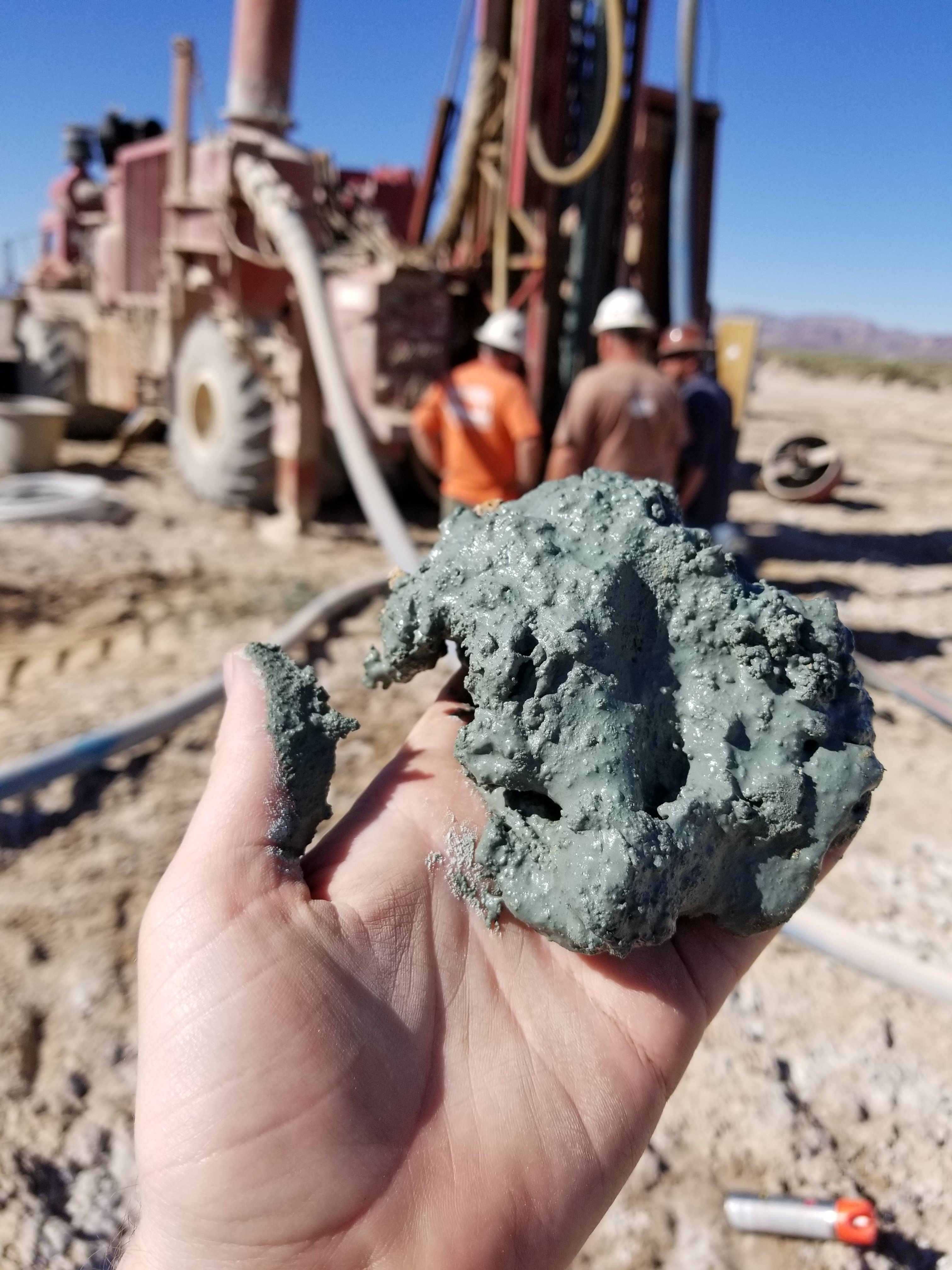
22:45 At the moment we're still not clear. We've done XRD and it's really within the finest fraction of the sediment. The sediment. There's no obvious species that it's associated with, maybe some muscovite, but we're assuming that they're either adsorbed as free ions onto the surface of small grains, or it's some kind of simple
23:23 lithium compound such as lithium carbonate or lithium chloride or something like that. But we do know it's there and we know we can get it out without too much trouble.
23:37 We're not the only ones with this problem but it's something to do, it's just a part of the
23:48 clay, claystone-hosted deposits. Of the clay, sort of, hosted, claystone-hosted deposits. It's not entrained in clays. We don't have a whole lot of clay, but it is associated with this very fine-grained fraction of the rock column. And I think, right, Jeff, when we say problem, it's a problem of the identification, because we've talked to a number of labs about trying to do this, and I guess it's just lithium is so small, and these grains are just so small, they really have a tough time seeing it. I mean, again, I'm a layman, but that's the way I think about it. I mean, if you're comparing us to say, for example, a pegmatite in the Northwest Territories, you can see the spodumene sticking out of the rock.
24:35 So people assume, well, where's the lithium?
24:38 In our case, it's in there and it's part of the trital diagenetic story of the sedimentary basin. It's there, but it's not associated with any particular mineral that you can see using conventional petrographic techniques. Okay, yeah, hopefully that answers your question there, Tristan. In the future, where do you plan to process your ore? Well, I'm assuming that means when the plant is built. I mean, one of the beautiful things about this project is that we're going to be producing a battery grade material, carbonate. We know we can already do that on site, right? So for newer viewers, you know, let's just make, let me make sure we understand because this is a huge differentiation
25:36 of us and others. We're not producing a concentrate that's got to go off somewhere to get upgraded. This is literally, we're going to bring this material up from underneath the ground at Bonnie Clare, stick it in one side of a plant that's on site, and do the processing there to end up with, at this point in time, 32,000 tons of lithium carbonate that we can ship right to a battery plant somewhere in Texas, the Midwest, Nevada, you know, wherever it is. I've said this a number of times before, I fully expect that it's gonna stay in the US so that end users of this lithium can take advantage of the Inflation Reduction Act tax credits.
26:16 But be that as it may, if it were to go elsewhere, it would be a material that could go right into a battery. So it does not need an intermediate processing step. It will be done on site. Perfect, thank you. It seems the high grade hole was something of a surprise. What in the geology made you hesitate to think that this was not going to be as good as it was?
26:39 Well, everybody hopes for high-grade, you know, geologists are eternal optimists. You know, But money is what it is. With the best will in the world, geologists don't get all the free money they want to go drill everywhere they want. So up to last summer, it was kind of assumed that 2000 was kind of the end of it and so it wasn't really a priority. Towards the end of the year we wanted to investigate the possibility of brine at depth in the basin. So this is the one which was done to basement BC 2301C.
27:30 And it was, you know, just one of these things we blew right through this high grade zone. And so I can't pretend it was it was our plan. It's just one of these happy, happy byproducts of the big drill hole. And that was why the second hole, the current one, BC 2303C, was so important to demonstrate that it wasn't just a one-off
27:59 in the last hole and that this had legs and lateral continuity, which in fact it seems to have. And if I heard that question too, Max, I just, I think I heard it correctly. I don't think there was an indication on our part or that we thought that it wouldn't be as good. I think what the surprise was, was that it actually got better again, deeper, higher grades and thicker intercepts, just sort of one of those things like, wow, where does she end? So, I don't think there's any context that we could say we thought we might be disappointed. I think it was just we're sort of surprised about the magnitude of how good it was. Yeah.
28:45 Okay, great answer. Thank you for that.
28:48 Thank you both. Are there any oil and gas companies interested in helping with the extraction process?
28:58 The answer is I don't know because I haven't spoken to them. I've spoken to some ones you would obviously recognize before conferences and things like that. I would say if I were waiting for a catalyst, that wouldn't be it quite honestly. It doesn't mean I'm not going to try. It seems to me that a lot of what the oil and gas companies are doing right now is they're obviously working on their DLE projects, trying to extract lithium from their own hydrocarbon reservoirs that they've already developed. Because in a perfect world, That's the panacea, right? The infrastructure is already there. If they can get their operating costs low enough, they can just essentially strip the lithium out from whatever is down there. Now I will say, I'm pretty sure people are gonna be coming back, who I originally talked to, who thought they had more than enough to do for long periods of time because you're starting to see these DLE projects have problems with regards to operating costs.
29:57 Or again, I always talk about the Salt Sea and the operating environment, they're just being so harsh. So the point is, at this point in time, I wouldn't count anything out quite honestly. I just, I think DLE is not commercialized. Again, those projects tend to be delayed. So commercialization is coming closer to us in terms of production, all that kind of stuff. I think we'll be talking to, again, all sorts of OEMs, other strategic users of lithium before, you know, we're done with Bonnie Clare. Yeah, I don't see, at the moment I don't see much overlap between the mining method and the extraction method there with the oil and gas producers.
30:42 Okay. In the near future, will you have any holes, any more holes to report? No, that was the last. We came after this hole. We came, we moved the rig. Said, really, did it make sense to try to get another one in before the bad weather came in for the winter? And honestly, again, this would have been the type of thing that we may have sunk a hole, quite honestly, had we not done that, that maybe was out of position a little bit. This is all part of the deliberation that I think we're going to need to take going forward. So if you're in Nevada Lithium to track holes, I would just argue I don't think the market's rewarding anybody for that kind of thing right now. What I would ask is whether or not you like to be involved with the non-sexy part of the Lassonde curve. This is where we're at.
31:33 By the time we start releasing holes again it's going to be a number of months. But we'll have other things like our conclusions on the technical reports, things like that, which in my estimation are every bit as important at this point in time as additional holes showing intercepts like this. I mean, again, let's put this into context. We already arguably have one of the largest resources in the world. You know, how these latest results augment that resource remains to be seen. And I hate to make promises just because I've seen that blow up in people's faces too many times. However, I think you can sort of tell from just looking at those intercepts and you know looking at where these new holes are again within the PFS resource upgrade area, right? So logically, you know, they should have an impact on that. I think this is all, you know, this is all good news going forward. And, you know, the idea here is not to just keep drilling and coming up with these types of numbers. Some point in time, these things have got to be turned into the next step in a viable project, because again, the end users, they want this lithium as quickly as possible.
32:43 I think that's a beautiful way to answer it and a great way to close it off. So that's all the questions that we have for today. So thanks Steve. And oh I think we have... Oh okay yeah, Erica's just saying that she hopes to see you in BD soon and If you have any questions about the area to let her know, okay, I'll be talking with her soon. Okay, sounds good Yeah, so thank you Steve Jeff for the updates and the Q&A session I also want to thank everyone who submitted questions again Today's recording will be available to watch in the coming day or so. So feel free to look out for that. And you can find more information on Nevada Lithium by going to their website. So before we wrap up, just passing things back over to you, Steve, here to close things off.
33:30 Well, hi everybody. Again, just keep the faith with regards to lithium. I've seen this a number of times. I don't think EVs are going away. I hope you don't think so either. This is such a messed up supply-demand structure right now. I don't see how we can go anywhere but up over time and this is just going to increase the incredible value we already have with this project. So if you've got the time frame, if you've got the stomach for it, stay with it. I am very, very confident going forward that we have a tiger by the tail and I'm telling you we know how to get value out of this. Perfect, thanks again to everyone for participating and I hope you all have a great rest of your day.