Automated transcript · Written by software from the replay's audio. It can mishear names and figures; the replay is the record.
0:49 Thanks, Kyle, and thanks to 6 for the great introduction today. And I'm looking forward to talking about our results from Timmins. TFT Resources going for gold. I think it's an exciting time not only for the gold space, but for juniors like TFT that are putting out great results. Just a caution, I'm a geologist, I'm an explorationist, I'm an optimist, I will make forward-looking statements. And please, I would refer you to the website or to this slide for a review of those. When we think about GFC, we're a North American focused gold explorer. This is a team that's done it before. Our thesis is district scale opportunities and what I'm going to talk to you about today about Aljo, which is on Goldarm, is one of our district scale opportunities. And also about Muskego, which is another district scale opportunity, both in Timmins.
1:38 So you'll see a thesis as you move through the presentation today about where we're really focused. Timmins, it's a world-class belt, home to multiple operating world-class operations and most of all, real high caliber ore bodies. This is why we work where we do. And the final point at the bottom here is, You know, when you think about GFG, be aggressive, be disruptive, be advancing your projects, be active. And all those pieces are really, I think, what distinguishes GFG in this junior gold space. Before I go on to the technical details of this presentation, which is the nuts and bolts of Aljo and why 23 grams over 7 meters is really exciting. Just a brief overview, we're about a 30 million market cap company. We would have around $3 million cash in the bank in June words, time frame.
2:32 This is a team that's done it before, myself and Rick and Anderson, Mark, we're all Xcode resources. Anybody that's followed Clode know there was a very strong discovery called Santoy Gap and it translated to a lot of shareholder value build back in 2015 through 2016. Left side of this slide is ownership structure, very key. Find companies that have really strong long-term shareholders. So I would put our base on par with anybody's out there. We've got Alamos, exceptionally credible mid-tier producers, our largest shareholder. Groups like the Lundin family have backed us for a long time and then some very large high net worth retail investors in the US as well. So a very good compact shareholder base, pretty large groups that we can wrap our hands around. On the upper right here is the chart. You can see we've had some traction here over the last month, both from a volume perspective and trading perspective. I think we can continue this. I think we have great results that we put out today and I believe that we can follow these up and continue with the momentum.
3:38 Quick snapshot on the exploration spaces is ultimately why gold exploration. We might ask ourselves that when the juniors universe is struggling as it is, but my thesis is relevant discoveries are still extremely valuable. And those positive stories out there, the Great Bears and the Snowlines and the Ruperts, those are relevant discoveries that are still unlocking massive value for shareholders. Big discoveries, relevant discoveries are still highly sought after and GFT is a team that A, has done it before and B, is really aware of the challenges of what's driving that graph of lower discovery trends over time. We're looking undercover. We're looking in highly productive belts. We're looking with advanced technology and we're a team that's found it before. And I think that's a very positive recipe for success in the junior exploration space.
4:29 Now, when I think about exploration, this is a map that shows our land position in Timmins. This is an area where you have immense infrastructure developed, controlled by majors like Newmont and IM Gold and McEwen and Alamos Gold, all have big pieces of infrastructure here. And they're here because of endowment. This map is about 150 million ounces of historic Gold production and our current reserves and resources. I'm going to talk to you about Gold Arm today. It's east of Timmins, it's along the Pipestone Break and it's a land position that we would have added back about 3-years ago. Really fascinating results that we're publishing on Aljo. You can see the number of mines owned by McEwen or Agnico or Newmont or Pan American that surround us there.
5:16 Also going to touch base on Penn and the Muskego Target out west of Timmins. So those are the 2 core areas. But I love this area because there's lots of big gold deposits, lots of infrastructure. And I think the presence of extensive cover means there's a lot more deposits to be found. I'm going to speak to you about Muskego, which is an area out in here. And that rectangle doesn't look big on this map, but I've just circled an area that's 10 by 10 kilometres. It's a huge area out there. And one of the areas we're finding some really interesting results. So surrounded by majors, Timmins is a great place to make the next relevant discovery and things like Aljo and Muskego are very capable of driving very large shareholder returns as we move through this exploration cycle.
6:01 Speaking of news flow, this company has maintained activity over the last 24 months on par with any of our peers. We're publishing very strong results. And as you look through these results, most of these are economic hits. If they're a gram to gram and a half, these are shallow systems that would make a cutoff in a pittable scenario. If you're looking at 3, 5, 10, 20, 50 grams, these are more underground style intercepts and what you see is we've been putting continuous news flow over the last 24 months. 23 over 7 is the result we published today. 14 over 7 is the result we published back about 3 weeks ago. They are amongst the best holes ever published by GFG and When you combine them in a single hole, they are certainly the best hole ever filled by GFT.
6:51 I'm going to talk to you about Aljo specifically today. We've moved east of Timmins, about 15, 20, 30 kilometers. It's a big land position. Our land position here is about 30 kilometers across. We would be on the Pipestone Deformation Zone, which is one of the 2 main controlling features and gold structures in the Timmins Camp. We would sit west of Fenn Kibb, a very sizable deposit. Mayfair Gold controls that and Monetta sits, the old Monetta, which is now Stellar Gold, sits just off the map on the right. But importantly, even just within this map, you see a lot of mill opportunity. The stock mill complex owned by McEwen, Holt Holloway is by Agnico just off the map to the right and to the west of us, which is being left on this map would be both the Dome Mill and the Pan American Mill and the main Timmon Mine complexes.
7:44 I love Goldarm, It's a great property. It's regional in extent. Aljo is a great looking target. I'll touch base on Montclair. Carr is an interesting one where we haven't even put a drill hole in it yet, but it's one that the team is really excited about as well. So just to locate yourselves, Aljo on the east end of our 30 kilometer land position. And it's where we put the drill results out this morning. Now, what was Eljo? Eljo was a historic gold mine from the 20s and 30s. And it sits over in this environment in here. It was acquired as part of our land consolidation thesis back 3 years ago, 2 and a half years ago, we were at the Gold Arm property together. Historic producer, not a lot of ounces, you know, 20, 30,000 ounces, very high grade. As you're seeing in the results that we put out today, there is some very high grade vein systems present in this area, and still only mine to a relatively shallow depth.
8:37 We tested this program in this property first in 2023, and we had some good results. Economic intercepts at a shallow depth, good looking vein systems, stacked vein systems, and this all led us to come back with a more aggressive program in 2024. And those are the results that we're putting in talking about today. Locating yourself again, the Pipestone break would be this structural corridor as I'm drawing it down through here. The porcupine duster would be immediately south of that. And so we're sitting in the hanging wall or just north of these main structural breaks. It's an ideal setting to make a very relevant discovery and very good infrastructure in this area. This is the slide I wanna spend most of our time talking about today.
9:25 And what we've demonstrated here is that an old mine has a lot of legs underneath it. That's the simple part of the story. So the left is a plan map. The infrastructure that was developed here was in the 20s and 30s. And you can see some of these underground mine workings in this environment. And they're predominantly of 2 orientations, both northeast oriented, but also north northwest oriented. And what those really tell you is here there's 2 main vein orientations that are controlling gold. And some of those are mined down to relatively shallow depths in the 20s and 30s and tested at also a very limited interval down in the late 80s. And so I show you that hole in this cross section as well.
10:13 So GFG started here in 2023. We drilled what would be this hole here underneath the mine workings and it came down into a really nice hanging wall zone that was outcropping its surface. It wasn't part of the historic mining. We came underneath the mine workings and saw some good numbers. Here's 20-30gm product material and good BG through that interval back in 2023. Then we drilled down through into the footwall environment and actually started seeing new vein systems developed down here, 13gm or 4m. Even that hole demonstrated the character of this system. 345 different vein systems, very good grade presence of visible Gold in a lot of those veins and an underexplored football environment. So this was very encouraging when we look back at 2023.
11:00 So we came back here in 2024, when we drilled 5 holes in 1700 meters in June of this year. And our thesis was, look, there's lots of room to grow this along strike. There's lots of room to grow this at depth. Let's design a program that allows us to see scale potential for these stacked veins both laterally and to depth. Let's design a program that allows us to see scale potential for these stacked veins both laterally and to depth. And let's design a program that helps us understand the geometry of these veins, what their orientations are, what the controls are, what the grade distribution is, and what the continuity is. So that's what we set about trying to achieve in this program. Hole 24-12 was the first hole drilled of this year's program, and now we've had 2 press releases on it. And even when we logged this hole, we could very clearly see this was quite a special hole. I think we had 9 or 10 different occurrences of visible Gold down the hole, which just in itself is a representation of the system. Often you might see 1 VG bearing vane system or several but when you start seeing these stacked distant vane systems and they're all hosting visible gold it's a very very good sign of the system and so we drilled hole 12 and we initially released the first half of it. And we released that about 3 weeks ago. It was 14 grams over 7 meters.
12:24 And that would be this interval up in here. Very nice intercept, visible gold, stacked veins, and quite a broad mineralized envelope of veining as well. That would relate to some of this hanging wall veining and entrenching. Hanging wall would be an interpretation would be that way. And we kept drilling this hole. So it was great to see that intercept we published in the first drag holes. Now, today we publish the remainder of this hole and it's even better than the first intercept we published. 23g over 7m was the intercept related to the down dip of the historic mine workings. And that would really sit right on this intercept here. And the yellow here are kind of mineralized envelopes. You see them deeply dipping to the southeast in terms of our exploration model.
13:17 You see a number of these porphyry dykes that are quite integral in terms of controlling the mineralization. And here we stepped down 80 meters and found an exceptionally good hit. And interestingly, when we relate it back to a hole from the 1988, this was 10 over 10, which, you know, this is no dollar in economic yet. So we're proving continuity on dip here with the intercepts we published today, and that is truly an astounding hit, best hole ever drilled by GFG. Now we talked yesterday on a BG session with 6 and some of you may have listened and we talked about the presence and abundance of BG and what to make of it here. So I'll certainly flag there's a 210 gram intercept over 0.8 meters.
14:02 That's certainly the highest grade section that was at an abundance, probably 50 or 60 grains of visible gold. Very nice intercept. Surrounding that, we kind of had half gram, 1 gram material. Now we composite that at a given cutoff. For us, it's 0.2 in terms of where we quote them. So I would say there's an envelope that has some lower grade material and there's certainly higher grade portions to it, within it, and that's a characteristic of this system. What I really like is just the number of vane systems and how they're showing continuity. And even when we go further down this hole, we continue to understand more about the system. So I would flag this was a 13 grams over 3 and a half meter intercept from last year. And we saw it tied to this diorite dike at depth. And when we look at the depth continuity of it, lo and behold, we had another VG occurrence down here. I didn't grade super high. I think the peak assay on that was about 2 and a half grams, but it was a VG bearing vein. And those are exceptionally positive and it's proving continuity. So what have we really shown here? Okay, we've shown there's 3 main vein systems that we're starting to understand the geometry of.
15:12 We've tested them down to about 200 meters depth. So we're still actually pretty shallow in the big scheme of an underground mine. Lots of room to grow this thing to depth and lots of room to grow this along strike as well. The pending holes that we still have in the queue are both off to the West in this environment and off to the East, where we did our best to step out on the system and try to understand the scale and character and orientation of these AIM systems. That's really the focus of today's release and this was to showcase, we drilled further in a dip scenario underground beneath these historic mine workings and we had our best intercept to date.
16:01 I think we have some more very positive results coming in the queue as we look out for our further step out holes as well. Anytime you can show 10 plus gram material over mineable widths, those are exceptionally economic. So I would take these 2 intercepts here, which are in the sort of 150 to 200 gram range in terms of gram meter products, those are exceptional and they are high quality, high grade, shallow intercepts that we're finding in this system. So really encouraged by what we're seeing both in plan map, the distribution of the veins, the orientation, where we're furthering our understanding, and then in section, which is in depth view, where we see these things still have reasonably good continuity, and we're starting now to piece them together. And if you can step down 80 meters and say, look, there was 4 VG varying veins in there, and we track 3 of them down to here, you know, very encouraging and no doubt that you know, I think there's exceptionally strong potential, we will continue to outline these shoots as they move to depth and look to grow them along strike as well. So as we mentioned in the press releases, stacked veins and strong continuity with very good grades. Those are all exceptionally positive characteristics of a good gold system.
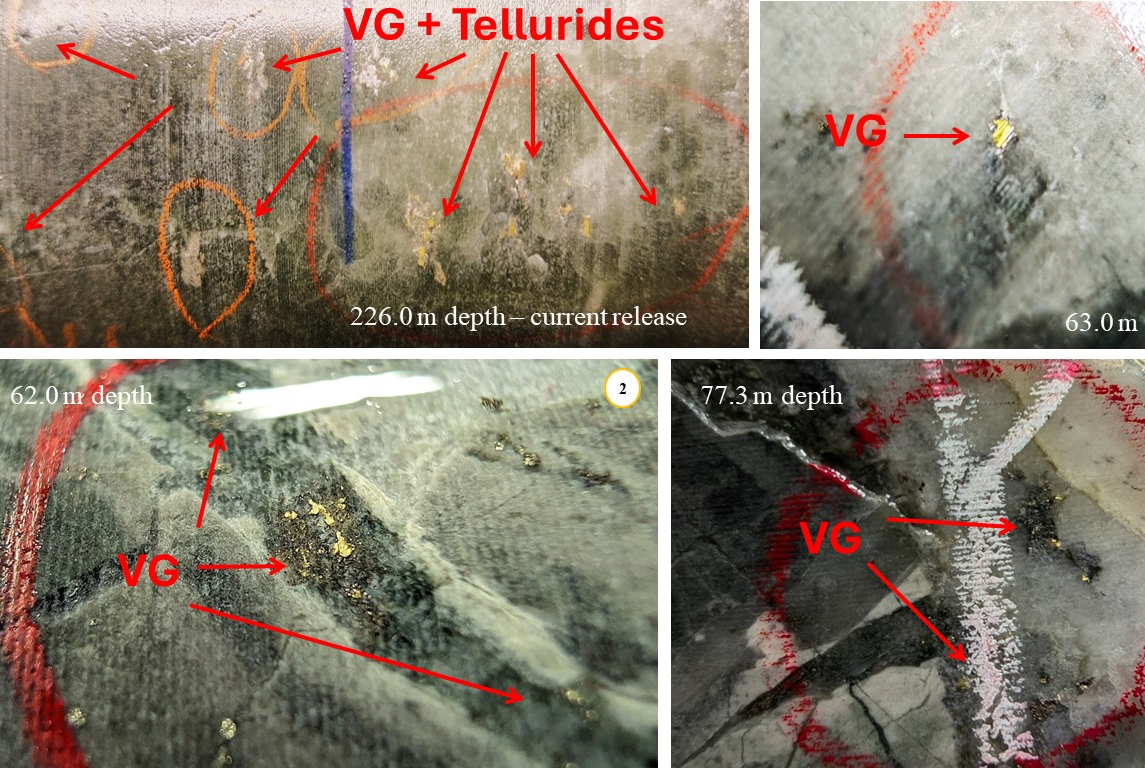
17:18 Just to talk about some of the details of the system here, and I wanted to throw up these 4 core photos because they're the ones we first showed at this release. And it really does show the nature of the vein systems here and I would flag, you know, the 62 and 63 meter 1. So, you know, here's an example where, you know, it was a relatively narrow chloride filled fracture. This particular occurrence actually had about 10 grains of gold and some modest grains of telluride. And this was only in the sort of 3 to 5 gram range. And that does actually happen quite often where you have a really juicy looking vein. You don't quite get the grades you think. And that's gold. But I take a lot of just the presence of that, the abundance of the gold and the character to it where you see it both in the wall rock and in veins. And this is actually a gold grain integral metalluride.
18:15 I should have shown a scale bar on there, but that grains about 3 millimeters across so exceptionally strong grades good grade In those ones that we're selling in a 3 to 5 grain gram range now when you start seeing you know 50 plus grams You know so this particular sample up here. I think was around 75 to 80 grams. That was 15, 20, 25 grains of gold. You can see the distribution, some coarser, some finer. You can see these sort of sharp walled vein systems. This is really, really encouraging. And that was what we would have published in the hanging wall zone in the first intercept that was published back 3 weeks ago. And then today, we actually published what the assays were on this one. And this is about a 215 gram intercept you know and and when you look at the distribution of gold through here you probably had about 50 grains but you had some of the very quick course you had a strong integral to tell your ride you know just a really exceptional looking intercept where even when we drilled it it was very clear that this was going to be 100 plus ground material and lo and behold it was about 215.
19:27 You have some shoulders to it that are modestly lower grade but still definitely part of the Gold system. So this is all really exciting to GFG, where you can look and show a mosaic of visible Gold pitchers. You have the assays on here, 3, 5, 10, 70,215, and these are all economic. These are all above 200m depth. And that's the most encouraging thing about this thing is there's still lots of room to grow it yet. So I'll flip back to this plan section here for a second here and say, we can grow this to the east, we can grow it to the west. We have depth continuity that is wide open directly beneath very high grade intercepts. I have little doubt when we step back here in October and start the drill turning again, we'll continue to outline good intercepts both underneath this mine and by the looks of it what we've seen along the strike and the pending holes as well too.
20:17 That's Aljo and that's the exciting part of the news release we put today. I wanted that to be the focus of this session. We have Montclair, this is a system, gold system that's about 25 kilometers west of Aljo and here's a plan map of it, lots of good intercepts on it, down to about 350 to 400 meters depth. Same sort of stratigraphy, meaning half a kilometer to a kilometer north of the Pipestone Break. And again, both this bulk tonnage and high-grade angle, lots of dual styles of intercepts. You have some replacement ore here and you also have some high-grade vein systems present. We're working on modeling here and doing some metallurgical testing on Montclair and that will guide our next step forward on this target. As we look to the pipeline, and this is also the exciting thing about GFT is 800 square kilometers of ground. And when you look and think about Timmins, we are the largest landholder outside of Newmont in this belt.
21:16 And I'm going to talk to you about Penn and Dory briefly because these are exciting portions of our pipeline and there's great work going on in those 2. I would flag specifically the Muskego target area. The map in the upper left is 60 kilometers across. This is the Penn Gold property. Borden would be another 30 kilometers west and we itself was just west of the highway that goes down to Go Gamma. So very truckable into Timmins. We've worked this property for a number of years called Penn. Most recently, we came across some really interesting data in the bottom of some of our sonicles. Geology map on the bottom. The symbols we're showing you are till samples. In most cases, the triangles are till samples. The squares are where we drilled sonic holes through to get further material for till sampling. And lo and behold, one of those hit bedrock mineralization.
22:13 And when we look back and plotted this all up, lo and behold, we're outlining a structural corridor here that we mapped 4 years ago when we first acquired this property. We're seeing bedrock samples of very interesting gold numbers underneath a very extensive swamp. We call it Mosquego because this swamp is 4 kilometers wide and about 10 kilometers north-south where there's not a single outcrop. Nobody's looked at these rocks before and we're finding very, very interesting both gold values in till, but also gold value in rock. And I'll focus in on Muskego 05, this sample in the western part of it, and 2 and a half grams in bedrock. We weren't looking for bedrock. We weren't targeting this hole to look at anything except the till data, and we found gold in bedrock underneath the swamp. And just the chance of finding that is very low.
23:07 So we would have to say, this is very, very encouraging at this stage. Now, at the bottom of that till hole, We've got a little sample of rock that was about 3 quarters of a meter. That rock graded 2.5 grams. And when we started breaking it down and looking at the pieces, here's the mosaic of what that rock looked like. A couple of things I want to point out here. This is a shear zone. Very high strain. This is where gold fluids move. It's heavily sulfidized. This bright material on these core samples is pyrrhotite. And the pyrrhotite is a very good indication in this environment of gold. And lo and behold, when we looked here, we saw visible gold. So here we stepped out into the middle of a large swamp.
23:55 No historic work really been done under this area because of the extensive cover. This is the reason we go and explore areas like Penn is because of this cover. So this is the preserved opportunity. 2 and a half grams. So we're like, well, where was the gold in this sample? And these black domains in this are actually quartz veins. Lo and behold, there's visible gold in the quartz veins. And we actually took a photon assay of each of these samples and they graded between 1 and 10 grams. So if you just scan the whole surface you got somewhere between 1 and 10 grams and that really did confirm the assay. And then we took another technique and we said, let's just take and look very selectively about seeing if the Gold is tied specifically to the Pyrrhotite. So we took an XRF and we just ran a sample on it.
24:43 It's not quantitative, it's qualitative. Just basically, Is there Gold there? Is it high grade? Is it low grade? It's certainly not an assay by any means, but it's a reflection of how much Gold is there. We zap these little red circles and in those areas you can see it's 19g, 17g, 14g. That's just in a local, very small scale sample. But this is extremely encouraging given that the context we have here is we're underneath a large-scale swamp. We know it's in a structural corridor. We know that corridor is tied between 2 main regional structural breaks and we know the rocks are very reactive and now we know they're hosting visible Gold. With that Gold you have Tungsten, Bismuth, Telluride, base metal associations like zinc and moly that we can see both in the till profile, but also in the gold. This has the workings to shape itself up into a very, very strong regional target.
25:40 Muskego is something to pay attention to in our pipeline. It's never been drilled, expect us to step out and test this likely Q1 of next year, but a very, very exciting pipeline target that we're advancing. South of the Penn property is Dore, and Dore is also a large scale, regional scale land position. We covered it till last year. Each of these triangles is a large 10 kilogram sample. They're shaded both on size and scale for the number of grains of gold that are present in this area. And really this is how we filter 200 square kilometers of ground. So if we see a grouping of till samples and I would take this example out here as a prime example to say you know here's 10 till samples in an 8 square kilometer area that are all highly anomalous in gold. There will be a source of that, and it will be in a proximal environment, likely within a kilometer of those samples. We see structural corridors and lithocontacts that are lighting up in till. That's extremely encouraging.
26:48 We see multiple of those associated with this felsic volcanic rock, the yellow stratigraphy down here. So early days for Dore, but when you start seeing Attil's signature you know there's gold systems at work. And all we're trying to do at this stage is find a new gold system. And Dore has more gold systems to be found. Penn, we've demonstrated now with Muskego, has a really unique Gold system that we're going to step out and drill test. And what we're showing at targets like Fonclair and Aljo is that we also have advanced targets that will move towards resource in our pipeline as well. So overall, GFT is an exceptionally large landholder in Timmins, in one of the most productive belts in the world.
27:37 We just put out today exceptionally high grade results from Goldarm that reinforced what we think of that system as being a stacked vein array that can host high grade, very shallow systems. We also are talking about what we're seeing at Pan Andorra being very high-quality exploration targets that can advance towards the discovery stage. And think about the map here. We're sitting between IAMGOLD and Evolution and Newmont and Alamos. This is why we work in this belt. Great endowment, great infrastructure, lots of peers here and lots of preserved endowments. So we're gonna go and spend about $2.5 million in the ground. This year in Timmins, we still have a fair bit of powder left in that budget. And by that, I mean, we'll drill about 4,000m in the remaining H2 of this year, focused Alga, also on Carr, doing the work on some of the other targets, Lake Montclair, advancing Muskego to a drill stage and refining it through both geochemical and geophysical methods, and taking something like Dory and getting it to something that might be a drill-ready stage as well. So this is really exciting for the portfolio in Timmins.
28:47 This is a junior that is truly making unique discoveries and high-grade discoveries in a very, very well-established camp. So very much something to focus on and we expect to be very active for the remaining portion of the year. Briefly, the other aspect of the portfolio we control, we've recently divested a rattlesnake to a company called Axcap Ventures or Patriot Gold Vault. And we have a definitive agreement as per our announcement several weeks back where we would sell this over staged cash payments for a cumulative value of 3.3 million. We will be a relevant shareholder of Patriot Volt Gold or Axe Cap. We will also take a fair bit of cash out of this on at present also on closing with a further payment in 2025 and a milestone should they make relevant discovery.
29:41 So here's a good example pipeline project maybe it didn't fit our niche or where we wanted to spend our dollars and our strategy in terms of working in the Abitibi. But we've partnered with great people here. They're going to take this asset forward in a US-focused portfolio, and we stand to benefit from the work going into the ground and as a shareholder as well. Overall, I've tried to summarize today about why I invest in GFG. I think this is a relevant question to ask everybody. Quality people, truly district scale assets. We've got a technical team that's found ore bodies before. We've also developed them and mined them and made good value return for our shareholders. Good strong shareholder base, always key and I'm always thankful to our investors, the likes of Alamos and the likes of groups like the Lundin's and even high net worth individuals that have supported us both in the market and through our financings.
30:32 Got a good balance sheet. We can continue to fund a very aggressive program in Timmins. And I think this is a really great example of a well-funded junior doing excellent work in a well-endowed belt. And With that, I will wrap up the presentation and happy to take any questions you might have.
38:48 and have a good conversation with them. Carr is an interesting target where it sits south of the Pipestone Break. It sits in a different type of rocks. It's in the Porcupine sediments and it's an intrusion hosted target, but there's a very strong Copper-Gold signature with it. It's a different model, but there are some very high grades of both Copper and Gold in very regional preliminary first pass drilling. It's an interesting target area. It's in the right area where you know high fluid flow. You're on a big break. You're sitting next to mines and you're in an area where people really haven't spent that much time looking. So, CAR is a target we continue to advance and work forward with. And even at Muskego, there's an example of historic work where there was an airborne survey flown in 1989 that covered a vast, all of the Penn property and land extent twice that size.
39:44 So we can pull all that EM data, airborne conductivity data, and use it to target now that we have another piece of data, we're like, there's gold in that shear zone there, it has a conductive signature, what's the conductive continuity around that target? We have all that data. Now, we didn't have to spend it, we had to download it and model it. So for 5 or 10 grand, we get an exceptionally good data set by using that historic EM data. So lots of examples all across our targeting pipeline of using historic data to generate new targets or to qualify and quantify and prioritize our current targets. Thank you for that response, Brian. I'm just reading this Second question here in the chat.
40:32 Good stuff, GFG is a true exploration company. How is your team continuing to make discoveries in Timmins? I might've missed it, but you have a blueprint that you intend to use at your other targets like Carr and Muskego. Now you did just touch on a lot of this, but if there's anything else you could add to it? Yeah, if there's anything that we would have learned out of this, Mosquego is revisiting our data sets. And so we would have had a regional data set across the Mosquego target from 2018. And we also knew it was a bit of a gap in our data, but it was a target, a concept that would have sat there and said, we have 2 regional shear zones here. We've got a perspective area where we have a lack of data. So it was actually going back and continuing to revisit the data and pull other pieces of the data out of it where you're like, okay, well, we actually have a really unique Pathfinder signature here, tied to this, this till profile in Muskego.
41:30 And then we go back and we're like, oh, well, actually, no, there's actually a bedrock sample that grades very well. And we had that sample for like 2 years, and it just was not prioritized in the data set. And sometimes companies get, we get on a data generation mode, and you don't spend enough time thinking, looking, analyzing and it's another set of eyes. So I would strongly point to my peer here at DFT, Andrus Carlson, who he went through that dataset, pulled it out as a target and said, what about this? And what about this? And what about that? And here's how it fits together. And here's why we need to go do something here. And so it's revisiting the the data sets you have. It's using those it's recognizing the gaps in your data where Muskego was there, but it was actually a Gap in our data. It was in the 20 to 30% of our property that we weren't filtering with first-batch geochemistry.
42:22 So it was lots to learn, lots to go back on. A target like Chabot is out there on Penn. It still sits there as a strong gold and till anomaly. It's got economic gold intercepts along strike. It's an interesting target area where, you know, we need to continue to revisit ones where maybe another set of eyes on a target reprioritizes things. And this is part of exploration. Sometimes you'll be at a target for the third time before you see something that you might like or that changes in it. And many of our targets move up and down our pipeline regularly. Well, Brian, we have one more question in the chat, but I think it's a good question to address for you to sum up with closing remarks here. The individual saying that some of the concepts are rather confusing as he's a new investor to exploration stories. He's wondering if you could recommend any basic resources and my advice is you get in contact with the company themselves.
43:25 But I'll leave it with you for closing remarks as well and to address that question. It's a good question because conveying a technical concept like gold exploration and the various data layers does inherently get quite technical and isn't always everybody's profession like us as exploration geologists. So it's hard to convey it in a 30 minute presentation. I would urge you to, you know, there's webinars that you can sit and watch and understand. I'd also urge you to contact the company. You know, I think any company that's worth investing in would be happy to take half an hour with the shareholder and say, or potential shareholder and say, let me really help you understand this a little bit more or talk to this target in a different level.
44:16 Sometimes we have to at GFG say, call Mark, because Mark's the non-technical communication guy. I'm the technical communication guy. And together we can convey and talk about our programs differently. And that's a really niche skill set to talk simply about something that's quite complicated. So I think there's good webinars out there. We've done lots of them in trying to talk about methodology. I think 6 does a good job of trying to educate investors on what to look for, what not to look for, what are some of the pitfalls in this space and I think use management to the best of your ability to educate yourself on what matters. So all of those things would be helpful.
45:06 I'll wrap it up for today saying I would thank everybody for their interest in TFT and please do reach out. Our website's got some good information on it, tftresources.com. Mark LePage or myself or Anders Carlsen are more than happy to take time and educate or talk to investors. So please call us at the office here in Saskatoon. And if you