Replay available
Union Bank of India (NSE:UNIONBANK) Q2 2027 Earnings Call
Union Bank of India (NSE:UNIONBANK) Q2 2027 earnings call, held 2026-10-19. Watch the replay and read the transcript on 6ix.
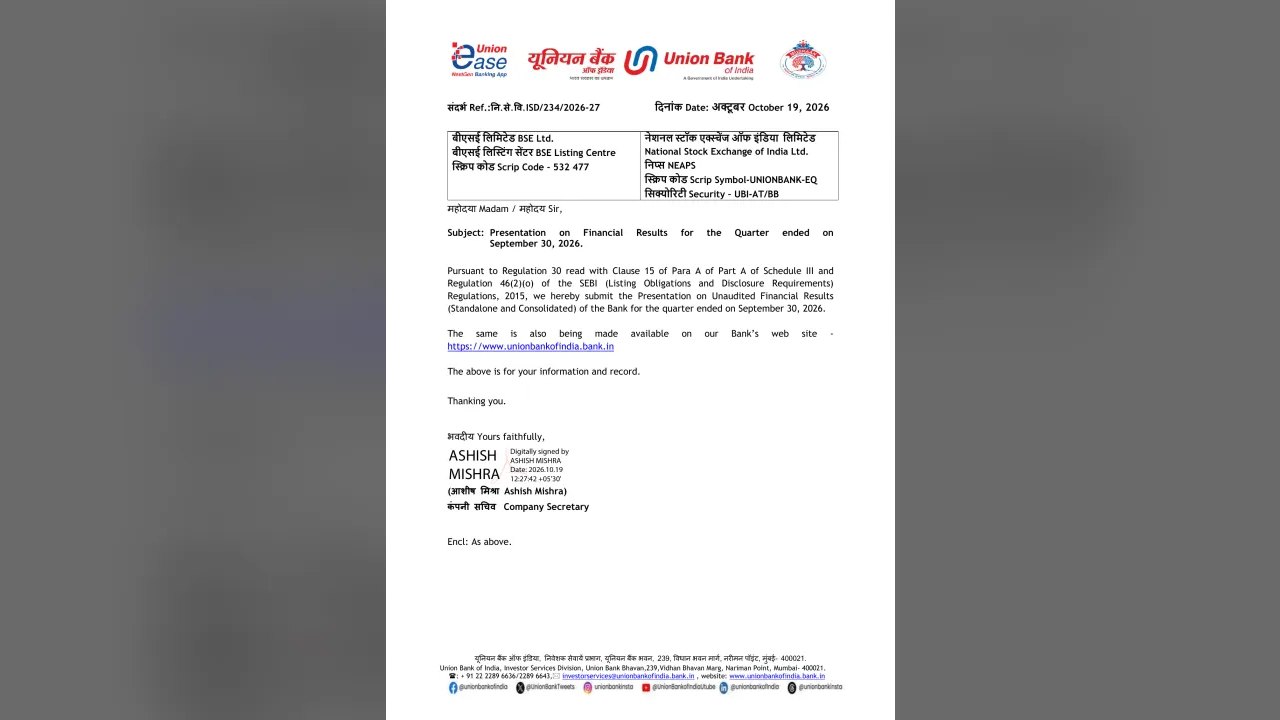
- Company
- Union Bank of India Limited (NSE:UNIONBANK)
- Period
- Q2 2027 earnings call
- Date
- Mon, Oct 19, 2026, 8:20 AM ET
- Replay
- Watch the replay on this page · 1 h 26 min
On 6ix: 6ix.com/event/union-bank-of-india-unionbank-q2-2027-earnings-call
Replay
Transcript
Automated transcript · Written by software from the replay's audio. It can mishear names and figures; the replay is the record.
0:00 Ladies and gentlemen, good day, and welcome to Union Bank of India Earnings Conference Call for the period ended 09/30/2026. The bank is represented by the Managing Director and CEO, Sri Anish Pandey Executive Directors, Sri Nitesh Ranjan Sri Ramasubramaniam S Sri Amrish Prasad and other members of the top management. As a reminder, all participant lines will be in the listen only mode, and there will be an opportunity for you to ask questions after the presentation concludes. Please note that this conference is being recorded. I now hand the conference over to Mr. V. B. Sahai, Deputy General Manager. Thank you, and over to you, Mr. Sahai.
0:48 Thank you, sir. Good afternoon, ladies and gentlemen. I, V. B. Sahai, Head of Investor Relations, welcome you all to the Union Bank of India earning ConCall for the period ended 09/30/2026. The structure of the ConCall shall include a brief opening statement by our respected MD and CO, sir, and then the floor will be opened for interaction. Before getting into the conference call, I will read out the usual disclaimer statement. I would like to submit that certain statements that may be discussed during the investor interaction may be forward looking statements based on current expectations. These statements involve a number of risks, uncertainties and other factors that cause the actual results to differ from the statements. Investors are, therefore, requested to check this information independently before making any investments or other decisions.
1:42 With this, I now request our MD and CEO, sir, for his opening remarks. Thank you, and over to you, sir. Am I audible to the coordinator? Yes, you are. Please go ahead. Thank you. Thank you. So thanks to Mr. Sahai and to coordinator. And good afternoon, everyone, and it gives me great pleasure to welcome all of you to Union Bank of India, your bank financial results announcement for the quarter ended 09/30/2026. With this, I have also concluded my first year in the bank and happy to interact with you for last four, five quarters.
2:27 So before I take you through our performance, first of all, my all the best wishes on the today, Durga, Sumi, Navi and all festivities, which are lined up in the month of October and November. With this, let me briefly set the context and share a few remarks. So let me begin by saying that in Q2 twenty six, twenty seven, our country, our Bharat, our economy and the banking sector have continued to demonstrate remarkable resilience despite persistent global headwinds. This is supported by strong domestic fundamentals, product macroeconomic management and timely policy interventions.
3:12 We need to acknowledge that the half year 'twenty six, 'twenty seven was GP affected by West Asia conflict apart from Alino effects and AI led disruptions, with varying channels of impact on our macros and market via oil prices, overall inflation, trade linkages, logistics, capital flows and market movements. I would like to acknowledge the consistent support extended by the Government of India as well as our regulator, Reserve Bank of India, both in mitigating the impact of external disruptions. Major sales, safeguarding and supporting businesses, particularly MSMEs, have helped preserve confidence across the country and the financial system.
3:59 The RBA's policy measure to attract dollar flows, including the FCNR and ECB scheme, bolstered liquidity within the banking system. As a result, the banking sectors continue to demonstrate strength with credit system credit and deposit growth standing at around 19.417.8% Y o Y, respectively. Against this backdrop, your bank, the UNIONBANK has also shown a sustained pickup in business growth. We continue to execute the strategic priorities that we have consistently highlighted in our previous various interactions. With a sharp focus on aligning our advances growth with overall banking system with while staying cognizant of long term business sustainability, profitability and stakeholder value creation in an uncertain macro environment.
4:51 As we have interacted earlier, we have very clear five defined strategic pillars: efficiency, robustness, quality, sustainable growth, profitability and customer sensitivities of doing business for both customers and employees. Let me dwell in between on these five pillars. With the efficiency, we clearly mean the proper capital deployment, technology deployment, the human resource development, building efficiencies in banking operations. So creating efficiencies in whatever we do, how we can create the efficiencies. When we talk about robustness, it is a good compliance culture in a bank, not any stance based.
5:38 And a strong cybersecurity posture, resilient monitoring systems, quality credit book and so forth and so on. So third is the quality and sustainable growth. So we pursue and we have been talking on this topic that how when growth will couple with the Union Bank business, how the quality will be maintained. I think this gives some color on that as well. The next point is profitability. Yes, when we talk about profitability, so interacting with various press people, investors, analysts, we come to know that there are various points which we can showcase. So one was the core ROA. So this time, our presentation clearly shows what is the core the return on assets.
6:30 That is excluding the TWO and the treasury income. And similarly, ROARWA, which is one of the good parameter to discuss upon is also the showcase. So if you see, the last pillar is customer centricity with ease of doing business for customers and employee support. So when we are combining all these five pillars, we are working upon the same. And today's result is in line with those pillars. So while maintaining as far as the various things, which are the best as far as the Union Bank is concerned, like profit, like ROA, like the stress SMA level, which is the lowest in the bank up till now in the history after the one commission.
7:23 Similarly, our ROE and NIM, which has rebound well from 2.64 level to 2.86. So I think we have given a very clear picture that how things there are certain initiatives which we have taken last quarter, which we have also showcased probably I am very sure that the presentation and this presentation you all are having with you. So at the Union Bank of India, our commitment remains anchored in our guiding principle business first and compliance always. We aspire to remain a trusted partner for our customers, investors, regulators and all stakeholders while contributing meaningfully to the Indian banking ecosystem. Equally important, our workforce of over 74,000 employees continues to embody our enduring philosophy, good people to bank with.
8:16 In fact, some of the transformational initiatives we undertook this year, such as UNIONBANK, where all developed in house. So I think this is very, very important. It is the state of the art, unique in the industry and at a minimum cost. And I think the shortest period of time will be six to seven months, this entire infrastructure and the unit is built. I will detail it shortly. I am also pleased to share that during the quarter, the bank received several prestigious recognition. One is in the Rajvasha, Kirti Pruskar, our Union Bank has got the prize from the Honorable Home Minister hence in the event held in mid September in Levy Mumay. And another is the secured third rank in the overall East 9.0 Q1 FY 'twenty six-twenty seven performance ranking among the top 12 public sector banks, reflecting our continued focus on customer centricity, operational excellence and digital transformation.
9:24 Let me, in a brief, cover up on the financial performance. So profitability, net profit for Q2 INR 5,537 crores, registering a growth of INR 30.31 crores Y o Y. Our OP is INR 8,108 crores, reflecting a robust growth of 19%, almost 18.99% precisely. As consistently communicated to investors, and there was question that if you grow and whether able to take deposits or maybe various questions that whether the NIM will sustain. So we improved further from the last quarter of 2.80 to 2.86 and remain above the full year FY 'twenty five, 'twenty six level of 2.70. With the initiation of rate hike cycle, certainly, we believe it will be constructive to the banking industry and to us also, which we can deliberate further.
10:16 Additionally, the CNRB, let me acknowledge, complement the Reserve Bank of India who came with this perspective. And it is not only the liquidity or maybe the dollar inflows to the Indian economy. But I think the major benefit is the ALM because our almost 70% is the five year term. So it is giving a very good sustained resource for next three to five years. So coming to our profitability, return on assets is 1.38, which we have eased further up. Return on equity at 17.21, capital position we stand at 17.94, CET1 is 16.05 I think now almost most of the part of CRAR is based upon CET1.
11:12 And these levels provide significant growth headroom while maintaining strong resilience against any external shops. Asset quality gross NPA declined by 87 bps, Y o Y to 2.42%. Net NPA improved to 0.42%, down by 13 basis points Y o Y. PCR remained strong at 95.20 Our credit cost continued 21 basis points, reflecting discipline in the guiding standards, effective recovery efforts despite persistent geopolitical volatility. The improvement was supported by a sustained moderation in slippages. The slippage ratio improved to 0.72 compared with 0.91 in the corresponding period last year. Yes, the gross slippage during the quarter stood at INR $190.09 crores, which were more than offset by a reduction of INR 3,086 crores by the recoveries and upgradations.
12:05 Coming to the deposits and liability franchise. Our deposit grew by 6.88% Y o Y basis and the cash flow ratio was stable at 35%, improving significantly from 32.56% a year ago, demonstrating the success of our ecosystem banking initiative, which we have talked many times during our interaction. On a year on year basis, our combined RTD and CASA business is what we say is our first priority, is nearly grown by INR 1.11 lakh crore, registering growth of 11.41%. Also, if we take the color of our deposit, the share of various companies, so CASA and total term deposit increased to 80.3% from 77% in September 25.
12:54 So let us talk about average to terminal deposit ratio, which remains at 99% and which is very, very good. And corresponding, if we take CASA to terminal average to deposit is around 95%, 96%. So let me say that the bank, which we told efficiency to build efficiency, we are working on average figures. So let me again reiterate that, yes, your bank, Union Bank is working upon the average figures rather than much of the terminal figures. So our global advances continue towards a healthy momentum at 18.53% YoY and domestic advance grew by 17.36%. And coming to the RAM, it is global level 55.45%, where domestic is 57.43%.
13:44 And if we take the impact of shedding of 33,000 crore of IVPC, which shed off and also some of the low yielding assets, I think the actual growth is more than 20%, 21% in that range. So retail advances grew by INR 11.24 crores, MSME by INR 22.39 And this is the way in which we are going for a sustainable growth in various quarters to quarters. So as a green shoot in private sector CapEx, we are seeing the next phase of growth in economic activity, whether it is data centers or AI infrastructure, nuclear, renewable power and select conventional sectors like steel manufacturing, I think these are picking up, including pharmaceuticals.
14:31 So this is giving a good sort of a comfort to the bankers that the going ahead as well, there is a good phase of credit growth in economic activity. So coming to the vision ahead for Union Bank of India, the journey ahead is not only about growth, it is equally about transforming the way we operate and serve our customers. As we navigate short term uncertainties, our focus remains only on long term sustainable growth and strategic transformation. We are pursuing this transformation through a balanced combination of intelligence, automation and human oversight. Various unit issues were detailed in a comprehensive. So actually, to all my friends who have joined, my request is in our website and various JEM portal and all, you will find an RFP, Project Muscar, known as Project Muscar, which encompasses, I think, nine pillars. I think very, very different from last fifteen, twenty years, which you would have seen any bank coming with various RFPs.
15:30 So this RFP is covering nine pillars and what sort of five pillars we are talking, the same sort of pillars are being talked in this RFP as well. It is unique in its sense. And certainly, it will create a not much impact. But let me tell you, friends, we are already working on this, which we have showcased in our analyst presentation. And two of the pillars, which we thought initially are already completed in which Union Sudarshan is one. And other pillars, which even shown 90% sorry, nine pillars. And there is the work already done. So it is not that we are waiting for any consultant or any to come and start the program. So from moving from one pillar to nine, in many of them, we are somewhere from 20% to 40% of the work is already done. So actually, we are very poised to complete that project, which is, I think, I would request all of you to please see Section three of Page 30 to 35 in that RFP.
16:35 So the objective is straightforward to move from reactive management to proactive and intelligence led banking and managing the things. Another important pillar of our transformation journey is robotic process automation and where a high value of mobility will rule based activities to be executed automatically with a greater speed, consistency and accuracy. So we are now close to 100. We are now we started this and now we are almost close to 100. But by March 27, we expect to cross maybe newer around 200. And by next March, not this, but '28, want to cross somewhere between 400 to 500 processes. I think that will give a lot of ease of doing business, a lot of accuracy, consistency and customer service. I think that is the whole purpose of this. We also had a cross functional team in the concept of Garage, which is prioritizing various operational technology related issue, which is why field functionaries and we are improving day to day processes.
17:38 We also have established central reconciliation. Actually, it is also part of an RFP. But let me brief you that this is headed by unit is headed by CGM at Hyderabad, almost more than 200,300 people working over there, our in house and also some of the outsourced. But the entire reconciliation because once we become robust, it will lead to business. That is what correlation we have seen in our bank that we see improving the compliance and assurance function, it has a direct impact on the business growth. So I think that is where we are moving into that direction. I would therefore say that the Union Bank of India is steady building the necessary capabilities, strengthening our data architecture, enhancing workforce skills and creating the right balance between technology adoption and human oversight.
18:27 In conclusion, I would like to express my sincere gratitude to our customers, shareholders, investors, Board members. My Board has really helped us, and all of our stakeholders for their continued trust and support. And I would also like to express my gratitude to all our investors. Whenever we had interaction, we have always gave a solution to our to include that in our to do list, where we from quarter to quarter, month to month, we have tried to improve upon those. So I think my gratitude to all of you for being with us and giving us a lot of solutions for improvement as our India, our Bharat enters into next phase of our economic growth, the banking sector is well positioned to support this transformation and your bank, Union Bank of India is determined to play a much meaningful role in this journey. We will continue to combine resilience with innovation, scale with efficiency and technology with human judgment.
19:27 So thank you and over to you, Saiji, and thanks and over to coordinator and all the investors for the interaction, please. Thank you, sir. Amit? Shall we open the line for questions? Yes, please. Thank you. We will now begin the question and answer session. The first question comes from the line of CA Doctor.
20:17 Ashok Ajmeraj from HCOM. Please go ahead. Thanks for giving me the opportunity. Congratulations, Ashish, Survi and the entire team of the Union Bank of India for the fantastic set of numbers, sir. In fact, you are this presentation beyond the numbers and presentation, your verbal communication of more than twenty minutes now has really given the great highlights about the bank and what the bank is going to do even in the future also, which is one of the best opening remarks so far in the four, banks, whoever declared their results. My compliment to you, sir, from the same. And you have, in fact, clarified most of the questions which were there in the minds of analysts like me.
21:03 I have a few observations and some few data points and some information and some action plans on some of the items which I will just narrate. Sir, the credit growth has come back now in the bank in last one year of your tenure. And before that, the four, five quarters, mean, all those shortcomings you've removed and the bank has again come back and brought it to older glory. But going forward and even looking at these numbers also, the deposits are still a little bit lagging in spite of the opportunity of raising the deposits by way of this U. Dollar dispensation by the RBI, FC and R and other things. So and that is making our CD ratio also very, very high, one of the highest 88.13%.
21:55 So on that front, what do you think like this kind of CD ratio is okay or it may go to even 90% or whether you still feel that the deposit growth needs to be accelerated to match your credit growth? This is my just first question and I would welcome your answer, sir. Sure. Thanks a lot, Ajmera for your queries. And we always take your queries as an improvement and to further how to make the bank more better. So coming to the deposits, as you said, in our case is lagging. So certainly, this last two, three quarters, we are in the discussion.
22:41 And let me tell you that earlier, our deposit growth used to be either negative or it was below 3%. And now this time, it is 6.8% and almost 7%. Further, we are not able to deposit. So I will give your reply into two, three pillars. One is our first priority is CASA and RTD, no doubt in that. So we have actually garnered INR 1.11 lakh crore of Indus 2. So this is our priority for sure, and we are maintaining 35% around. Even from June to now, INR 10,000 crore of CASA is there, which is a sluggish period, if you see June and September.
23:26 And from December and March, it is a period where the most of the funds are released as far as the various budgets are concerned. So we have taken. Now the question is that with resources, we are sitting at almost 18% of the CRAR and more than 16% of the CET1. So we do have a very good leverage. The most important, I believe, the parameter to see the deposit and credit growth is the LCR and the NSEFR. LCR, if you see in my presentation, is 120% average we have maintained in the entire quarter, which clearly shows that we are 20% more than the prescribed regulatory guidelines.
24:14 NSFER is also on a much, much comfortable side. So absolutely, we have not faced any issues on the liquidity. So we have maintained very well. The next is what other resources are available to the bank for raising the funds for deploying into the credit. Those are refinances from various refinances, the infrastructure bond, the ESPs, certainly, we are not looking for the QIP assets. And the third is the green bond and the other things, Tier one and Tier two capital. These are also the funds which are subscribed, but will not come into the deposit, which will remain into the system and which you can deploy for a better quality of the credit growth. Now I think when we require, we increased from 2.5% to 6.8%, seven percent range. So certainly, I will assure all that absolutely, that is not an issue. So when we increase from 2% to 2.5% to 7%, then also we have maintained our NIM and all the efficiencies ratios.
25:21 Now coming to the U. S. Dollar, since beginning the last quarter as well when it was asked to us, we were very clear that we aimed at $2,000,000,000 to garner under the special window scheme of RBI of U. S. Dollar FCNR. We actually garnered 2,250,000,000 So absolutely, that is not an issue. And our total all in cost, including everything is around seven and forty three bps is the margin 40 bps 40 plus bps is the margin with our foreign branches. So I think we are well within cost into that. And coming to the CD ratio, we always said that for let us see that domestic CD ratio or loan to deposit ratio is something different and the global is something different.
26:14 Global is always higher and domestic is always lower. So if you take the domestic, we are at around 84%. So we always believe that somewhere between 80% to 84%, 85% is a quite comfortable range. Subject to, it is not very specific some range for every one fixed size for all. It is for the various banks to banks and their capital structure and their other efficiency ratios. So we have well within the range of all the ratios, all the liquidity ratios. We have we are well within the range of, say, 84%. And that's the reason that you can see that this time, only after listening to the analysts, which all of you, they subjected they guided us that why don't you come with a core ROA because the treasury income has gone down like anything, almost 50%, 46% precisely has gone down because of the market condition.
27:15 You all know much better than me. So I believe that the core ROA has moved 41, 42 basis point to 1.03 and the ROA in general is 1.38. And ROARW is also one of the figures, which is generally people told that why the UNIONBANK is not showing where you are having the very good. So it is at 2.48 levels. So I think that all the investors that we are in the credit growth and to support that credit growth, whatsoever deposit growth is required or maybe the raising the money in terms of infrastructure bond or a green bond or a Tier one, Tier two or anything, we will be going for it to fund that, and we'll be substantially covering the liquidity ratios as desired by any of the participant in the industry.
28:17 Very well explained it. My second question is on the total impact of the ECL provisioning and especially with the yield hardening and if there will be I think STM mark to market also will have to be provided for. So what is the revised number of the ECL and the impact of the ECL overall in the how many basis point it can be over a period of time. Coupled with that, the benefit of the rate hike or recent rate hike by the RBI, how many basis that can offset the overall ECL impact, like maybe the profitability may increase by seven, eight this point because of the rate hike, which is going to be factored in. And already whatever the repo linked credit, I mean loans are there, the rates must have already gone up, whereas the deposit rates are not going to go up matching soon.
29:09 So overall, what will be the impact? And how are we prepared for the ECL provisioning, sir? Yes. As Manaji, earlier also, we had shared the ECL impact on us. And somewhere in the range of INR 5,500 crore, we had said, will be the impact of ECL or Union Bank of India. But I'd also like to add here that since the quarter of March, we have till now added around INR 1,000 crore of additional buffer in provisions, INR 700 crores we did in March, INR 100 crores in the quarter of June. And this quarter also, 200 crores we have kept as a additional provision, which as of now appears to be that we'll be able to use for the ECL provision. So that is INR 5,500 crore is our total estimate.
29:54 Of that, 1,000 crore, we have already provided for right now. INR 5,500 crore, if you look at from the impact on the ROA, we have around, I think, 8 lakh crore of RWA. So from that perspective, seventy percent seventy basis point is the impact on CET, if we absorb separately, but you are also looking at our profitability numbers per quarter. So one quarter profit itself is quite sufficient to bear this ECL provision despite RB having given multiple years. The second part that you asked about the impact of the bond yield, I think these are very moving parts. First is that as on date the balance sheet, what is the impact on ECL, which I shared. The remaining things are moving, Something will be positive, something will be negative.
30:45 For example, as you said, that the bond deal, obviously, it impacts the valuation of the bonds. But at the same time, when the interest rates are rising, and you are very much aware that it will first give us advantage in terms of increase in the net interest margin. So I think these moving parts, they offset each other generally. We should be at this point of time, should be taking 500 crore as the possible impact of ACL, of which bank has already created a buffer of around INR 1 point crore. Yes. Just to supplement, we talked about in my address, we talked about five pillars. Actually, what Nitesh, I'm saying is absolutely true. In today's dynamic world, disruptive world, all these things will be happening somewhere or the other in bits and pieces.
31:41 So certainly, if you have to be robust enough to absorb the shocks and keep moving your business and profitability with robustness and sustainability. So in sustainable way, probably I think we need to work upon those five pillars, which we are working. That is what actually he also mean to say that these are the things which will keep on happening. Sometimes it will come down, it will move up. But the theory is that now if you see our presentation today, the treasury income has gone down by almost 45%, 46. But our core fee income has increased by 22.90, that is almost 23%. So we are actually concentrating on very, very core business of the bank and to build the robustness within the efficiency from the core business itself.
32:32 Yes, sir. Hello? Hello? Yes. I think there is some disturbances. Hello? Yes. Yes. We are there. Over to you. Sir, your your views on this drought impact, sir, now the the conditions are deteriorating on the rents monsoon front and the droughts are being declared in every state drought conditions. So how do you see have you taken that into consideration, started working on it that how may it may impact our business either from the normal recovery front or from the additional credit expansion front? So how did drought conditions are going to affect and how are we going to tackle this situation, sir?
33:23 So actually, that will not only affect our bank, but it will affect the entire banking industry. So it is right now, we are not seeing any adverse impact on that year. Let's see what happened in the next quarter. But yes, the government is also very proactive, and they are taking the measures for protecting that year. So whatever the government initiative will be taken, we will be participating in that. And previously, also, whatever the debt waiver or whatever the government initiative has been taken, we have actively participated in that, yes, sir. So as such, we do not see any adverse impact on our balance sheet, sir. Okay, sir. Thank you very much for answering all my questions and giving such an elaborate presentation, sir. All the best to you all.
34:11 And yes, I'll come back again if the time permits. Okay. Thank you very much, sir. Thank you. Thank you. Thank you. Next question comes from the line of Maruk Adjanya with Tata Capital. Please go ahead. Yeah. Hello, sir. Congratulations. Sir, I had a couple of questions. Firstly, on savings deposits, the growth has been very good. Are there any institutional deposits here, or they are all retail? Are there any bulk or institutional deposits? Yes. It is mix, but we are actually much targeting on the premium saving account and the salary accounts. So we have seen almost 1.8x sort of an increase in these two, three parameters.
35:08 And institutional, I would say that there are some government accounts which are to be opened on a larger scale in the savings bank only. It is as per the mandate of the various state and central governments. So comprise that as well. So that it includes both on the retail part in saving as well as on the institutional part. But the institutional, we do not have the bigger chunk, say, some INR 5,000 crores, 10,000 crores in saving of some distributors like that, we do not have. So it is basically for your party, I believe we should take that mostly it is retail and even if it is institutional, it must be in a lower range of amount only, not the higher, very higher range.
36:04 Got it. But any quantification how much is institutional? As of now, like we're not keeping that data. So if you want it, we can reflect offline. But overall, savings bank deposit growth was 12% and overall quarter growth was 14.7% Y o Y. So I think we can give separately. Yes, that is. See, I would tell you that there are certain the Panchayat accounts and that rural development, ground level block accounts and all those are there, which we are seeing as an institutional. It. Got it. That's so helpful, sir. Sir, just one more question. I know it was asked earlier, but because bond deals are sticky, what will be the onetime impact of valuation of HTM when you transit to ECL?
37:02 Right? Because that impact onetime is irreversible. That's why we want to know the quantum. I know for that, bond yields have to stay high. If they come off, then there's no impact, but just asking. Yes. See, we have one doubt something first is that on the Stage one, Stage two, Stage three that around INR 5,500 crore odd amount is going to come. Now there are two other parts, one is on the staff and other is on this HTM. But see, there are certain clarifications and other things are there, which are in under discussion at various some workshops are also happening. So we have also kept some adviser or consultant on this and all those things.
37:55 So we are working upon and all the banks are in discussion with that. But one thing which I would, Madam Maruka, I would like to give a comfort to you that what sort of things will come now bank is in a position right now to I would not say they absorb it or something, but let us understand that the way in which the banks, the industry itself is generating the profit and the sound business in terms of GNPA, NNPA, ROA and all those things. Particularly, if I take your Union Bank, then the all the things are on a very positive front, positive side. So I think we are in a position to absorb those things without any much hiccups. That is much comfort level. But specifically, if you are asking, we have month out, we have month out on various permutation combination as far as the various interpretation and understanding.
38:59 But it is not prudent right now to come up with those figures because it's still under discussions. And there are some workshops happening and also all the banks and all are discussing. But at the same time, as an investor, I certainly feel that you should have a comfort level on your bank that whatsoever even the other side of the scenario also, we are in a position to absorb it very swiftly going forward. Got it, sir. Sir, and my final question is that would you have any comments to offer on potential M and A in PSU banks? No, that is the same I am hearing like you are hearing. I also don't know much. Sometimes I also ask investors what exactly are you hearing. So I don't have anything.
39:51 But when we talk in my address, you would have heard the five pillars. So the thing is that our total focus is that quarter to quarter, how to take the bank into the next level of robustness. Robustness in terms of all the five pillars. Now I am not restricting that robustness only on the compliance and assurance and other things. But and also, if you build really on those five pillars, so certainly, maybe this year, next year, next to next year, five years, we do not know the disruptive, the world which we are living in, what is going to happen when. But at the same time, we know one thing that how to make the bank more better and robust so that any eventuality, any disruption, any shocks, any adverse shocks, we will be in a position to diffuse swiftly.
40:55 That's so perfect, sir. You so much. Now look, in the meantime, I've got the breakup of the selling portfolio. So overall, the growth Y o Y was 40,278, out of which 75 retail selling growth, 20,027, only 25% was institutional selling growth, 10,249. So the growth is very sticky because majority comes from the Next question comes from the line of Jay Prakash Mudra with ICIC Securities. I have a few questions.
41:45 First is, it's around four ROA, right? So you've given four ROA for the first time. I believe have you removed treasury and TWO recovery, but it looks like the interest on IT refund, you have also deducted. Is that the understanding correct? Or apart from treasury and TW, is there anything else also which is not there? Okay. Only TWO recovery and treasury. These two things we are doing. Sure. And sir, now on write off amount, actually, sir, if I see our last two, three years, the pages have reduced materially.
42:35 The write off amount, we have done at around 3,800 crore in first half. I just wanted to check, sir, how much of would this be, let us say, management driven? And how much is because of the timing or regulatory time line? I mean, how much is prudential and how much is timeline driven? And the reason why I'm asking is if, let us say, if you're focusing on poor ROA, then bank can actually reduce the write off amount because the recovery from write off anyway is not getting accounted in core our way. And if you reduce write off, then actually you can save on credit cost. So that is what I was trying to understand of this first half write off, how much is prudential and how much is time driven?
43:30 Yes. See, you can answer the because see, why let us understand, Munrahi, that how various parameters mean to us and mean to others. Here, when we are saying core ROA, now actually we are trying to when you start building the efficiencies, you want to be more robust, resilient. And so you create and try to benchmark again your own standards. So when core ROA, we have taken, it is not like the to write off or not to write off and all those things. It is very, very clearly that we are continuing with the same run rate, which we are continuing the last half year, not this one. The last we had one bigger account that is why the amount was more. But if you see the last two quarters, we are continuing with the same run rate. And we have told very clearly that our target is around 3,000 crores as far as the TWO write off is concerned.
44:37 Recovering TWO is concerned for the full year. And the total recovery, we want to be more than 50%. So certainly, in that range of 10,000 crores to INR 12,000 crores, Certainly, we are aiming and this return off also we are aiming in the same range. The treasury income, which has in and probably will continue. So that is the reason that the ROE is 1.38, which has increased even there is a decrease of 46% in treasury income and the one or two account, which we got resolved through NCLT route in the last half year of 2526. But in the same time, all the three ROA now we are monitoring that is core and the general ROA and the ROARWA.
45:30 So I think that is not an issue that where we have to write off or not to write off that the things of clearing the balance sheet, once you are good enough on the now you can see that almost all the parameters in Union Bank, particularly, we are at the highest levels, whether the net profit or operating profit, NII, whether it is ROE, ROA and all the other things. So even then, after that only, so not impacting anywhere, we have taken out INR 200 crore this quarter and added two additional provision. So it is now INR 1,000 crore standing strong in our balance sheet. If I take that, the GMPA comes around 0.31 levels and the PCR moves to more than 96%.
46:19 So I think there where we are coming from, and that is what we are depicting and we are discussing it here that our purpose of benchmarking ourselves is a bit different and trying to improve from there. Over to you, Munaji. Right, sir. Sir, okay. So let me ask you, sir, this credit cost we have given is 21 basis point, right, which is a reasonably stable number and a benign number. But going ahead under ECL, you will have a little bit bump up in standard FX provisioning. Would you believe that I mean, could that jeopardize the core ROA of 1% level? How do you see a, the rising standard assets provisioning because under ECL and could that have a bearing on 1% core ROA that we have shown here?
47:18 Yes. See, ACL, which we talked about is around INR 5,500 crores, which we are now discussing and talking about last one or two quarters, and we told we are comfortable in that INR 5,500 crores. Now other two things, I think, let us see other two parameters. One is lowest of the SMA figures in Union Bank history after a month commission. It is, I think, 2,822. INR 28,200. INR 2,822. So above INR 5 crore. Yes. So I think that is the where it is the lowest.
48:05 The credit cost, the stimulus cost both are lower. And let us see one more thing that there is a good credit growth. Now your credit growth you are seeing in the terminal figures because now most of the turning we have done and we are doing, still we are doing, but then most of it we have done. So if we take that charging, that is IBPC 33,000, 36,000 taken out, then some almost INR $50.60 crores, 70,000 crores, INR 70 we have taken it out and all those things. The credit growth is quite good, more than 20%, 21%. But at the same time, if you see the figures on the retail side, our 700 and above CIC score has moved up from last. So I think I'm only saying last one quarter, But you can see last four quarters, it has moved quite up. Now coming to 25% and above external rating.
48:59 So almost 94%, 95%, I think that has also improved last quarter. So these two figures shows that we are underwriting quality assets, number one. Number two, the monitoring is really very good using technology, analytics and feet on the street and building the culture where we create a good quality assets and at the same time, profitable assets. So that is the reason that, again, it has improved. Core RO has improved from, I think, 41 or 42 basis points from And last now we have started monitoring it. Now coming to the impact of the CLE, even if it comes, we will be in a position to take care of it.
49:45 That is where and still, we have two more quarters left. So I think we are in the right direction. We are in the right track, and we will be in a position to certainly handle all those situations. Sorry, sir. Actually, my question was not very clear. Sir, this INR 5,000 crore is actually no problem at all when you transition. My question is, on a recurring basis, so right now, credit cost is still 21 basis point. Under ECL, because now the Phase II assets will need more provisioning than under IRAC. So standard assets provisioning will go up. Do you suspect that core ROE can... Are ongoing basis incremental, correct?
50:33 Yes, sir. Yes. So actually, that is all better in discussion and in working. So as we move close to the March, I think we'll be knowing all those figures. But by chance, that is the first itself on a transition date, say, thousand five hundred odd, odd I'm using can be plus minus something here and there. So even that, we are in a position to take it too forward safely. So I think ongoing also will not be much issue because even ongoing will depend upon on the actual SMA figures, restructuring book figures and all these figures only. So that is why I was trying to tell you that even ongoing incremental as well in a portion, but the actual figure is still to be worked out and these are discussions happening at the industry level and the IVA level.
51:28 And that is what I told when Ajmera Sahib, I believe he was asking me or Madam Maruk, I think, I'm not very sure. I think Ajmera Sahib, then he asked. So there are various discussions happening and once clarity comes, so then I think the figures will be in front of you. But at the same time, I think we are in a position to move swiftly where the onetime as well as we believe that with these figures, ongoing will not have much of the impact. Right. Understood, sir. So that is clear. We will await as and when we get more clarity. And secondly on growth, right? So now we are doing reasonably well.
52:13 We have stepped up on growth. What is your sense, sir? Where would we be ending the year? Would it be last time, I think you said we will be slightly above system. Does that still continue? Or what is your outlook on growth with respect to industry? Industry is also now 18, 19. We are also 18, 19. What is your sense where should we end the year? As per the system credit growth, we'll be moving as per that only. Right. And is there anything on the bulk side, we have seen slight increase in the bulk deposit. Now this is the entire book has been reset, right? So you do not have any material issue in growing the bulk deposit because previous to this quarter, we were actually shedding a little bit of bulk.
53:04 Now should bulk deposit be business as usual? Is that the understanding? Or there was some opportunity wherein you increased bulk and going ahead bulk may still be lower? What is your thought process? See, the bulk as per definition is known about INR 3 crore, correct? INR crore. So that we generally term it as a bulk deposit. And below fee crore as per RBA prescription, it is a retail term deposit. So bulk deposit even in today's world, when you finance infrastructure project and within which you do an LC, say, percent, 70% of the total term loan, There also, I'll see 10%, 15% margin is there, various bank guarantees are there, it is in that. So generally, let me tell you, bulk doesn't mean that you are going for a high cost or maybe a differential rate and all those things. It means about INR 3 crores. So we are going to accrue and certainly, when we say the credit growth to be in line with the industry, we will fund it first through retail and term deposit, CASA and retail term deposit, then various other channels and certainly, deposit.
54:19 Now comes the bulk news, let's say, above 50 crore, 100 crore, 200 crore. So we are also taking that. But at the same time, earlier, we used to take even INR 2,000 crores, 4,000 crores, 5,000 crores from single party, but that we have reduced. So now we have bifurcated. So sometimes we take INR 300 crores, 400 crores, INR 400 crores, 500 various maturities, and certainly, I'm going back to my earlier commentary, where the financial institution we were trying to avoid. So still, we are continuing with that. That financial institution, we don't prefer much, but non financial institution, we take it. So we from 2%, 2.5%, we have moved to 6.87% growth. So we will be moving in that line only as far as the deposit is concerned.
55:09 All right. Thank you, sir. I have few more questions. I'll come back in the queue. Thank you. Thank you. Next question comes from the line of Sushil Chokshi with Indus Equity Advisors. Please go ahead. Congratulations to Team Union Bank of India for excellent performance. Greetings for the festive season. Sir, my question is India Prime Minister's call is VIXIT Bharat 2047. UNIONBANK and Indian Banking System needs to transform for the new initiative, new businesses which are emerging in the globe, and India also needs to catch up. The trade businesses for the new initiative led by hydrogen, maybe AI, GPUs, data center, and many such EV mobility, value chain, solar value chain. I'm not talking about module, but value chain, such businesses.
56:08 And some of these businesses are commenced by PE or new entrepreneurs who have technology, and they are backed by PE. All financing, which is coming from certain individual investors who have given the initial capitals. Such transformation of businesses are emerging well. How are we placed to Ghana business in such segment? And what initiatives will we take to understand this business to grow well along with that? Yes. I think very pertinent question, Sushil ji. And certainly, when we have to meet all of us, the big suit Bharat dream of 2047, we need to be in that league. And that moving into that league needs understanding of the new lines, new initiatives, new businesses.
56:58 So certainly, as of now, Union Bank is quite good, clear in terms of renewable energy, solar, BESF, that is battery storage systems and all. And the data centers and other things we are already on, we have even under it and some good sort of papers, and we have even downsold. So almost I can give a color to you that almost, I think, last nine to ten months or eleven months, we have underwritten almost INR 90,000 INR 95,000 INR 1 crore of good papers, and we have downsold. So that is the way in which we are moving. Now coming to the some more new streams, which are coming in like hydrogen, like the nuclear.
57:51 So these are the new things which are coming in. And we are also doing employee skill development plans. So certainly, we are trying to engage with the various rating agencies because they are somewhere better in understanding the risk, understanding the models, understanding the projections and understanding the various other factors to underwrite. And we are also working upon this automation. It will take some time, obviously, that how we can have external data. So still, we are using, but mostly, it is not very automated, but then we are going through AI and other things, where we can use all these data points across the world to do the proper assessment of the proposals.
58:44 So most of the things which you said, we are into those lines of underwriting, which other banks are also doing, but then our bank is also doing it nicely. But coming to the hydrogen, nuclear and few other more things, we are analyzing. Actually, we are in discussion with some of the partners even in this line of business. We are also in discussion with some of the rating agencies of the world class that how they see these businesses, how they rate these businesses because they also rate having the same parameters, and we also do the appraisal assessment on the same basis. So jointly, we are trying to have some idea and some models with them. So I believe your question and I would not only say, Shashi, when we talk about 2047, we only will not talk about the corporate.
59:41 But let me tell you the businesses, particularly the commercial banks, commercial banks, public sector banks. We may be probably, we'll see the UPI and ULI joining hands and moving into the automated system of analytics, automated system of the cash flow system of the credit dispensation and the monitoring. And otherwise, having the growth rate, particularly to meet the 2,030, 2035 and 2047 objectives will not be that much easy. So that is why, again, that Sudarshan, which we told you that and not only to you, but I would invite all the investors who are listening to this con call that in Bombay, you are invited to see this UNIONBANK SUSHM.
1:00:36 And now we are also working upon many things. And all RFPs are already there, which you can see. But we are working upon some more things. I would not divert right now. But as we move forward by next one or two months, three months, you will be seeing some initiative where we are working to build the capabilities in the credit administration, I will use the word rather than credit sanction, credit appraisal and credit disbursement and credit monitoring. So I would use a better word as a credit administration, how we can better entire ecosystem so that the disbursement has been passed, credit growth happens fast to meet 2027. By the same time, quality is maintained, which is most important for any of the regulatory entity.
1:01:25 Basically, you are indicating that long term financing for nuclear power infrastructure, data center, construction may not take much time for data center, but these rental discounting fifteen, nineteen year kind of project financing you are open to. I might want understand that. We have already done. We have already done. Okay. Sir, now my next question is, you know, India is growing. Lot of Indian corporates are growing globally, and domestic also, m and a will start. In one of our peer larger banks call, they said they are aligning with some foreign banks on financing for m and a. What is our vision on M and A financing, sir? Yes. See, we have done a few deal on M and A.
1:02:14 And we are already in talk with some of them and also our this requires actually creating a desk within the large corporate vertical and risk management with a proper skill set to underwrite or maybe to assess the proposals which are coming under the hydrogen or the nuclear or maybe the other merger and acquisition, which we are already. And that is where I said that we need one or two months more along with some RFPs to build in technological as well as human capability to underwrite and create this. So we are working upon that. But I believe that things will move in a right direction. And already, most of the things which you have talked actually, if you have talked about data center, I think we have already under retention six, seven good proposal, good quality papers, AA, AAA sort of papers in the data center. So we have that capabilities.
1:03:13 So we have to further skill it to hydrogen and other sort of energy or maybe the other business lines, which are going to come. And coming to this that is why I said this FCNRB will help three years, five years for the asset and liability. And let me tell all the investors and the social to you as well that we have issued this bond, foreign currency bond of $100,000,000 And now we are listed in the stock exchange, Gift City, NSE, Gift NSE Stock Exchange. And it is a trade. Certainly, now we have already opened a way to take the money for a longer term through that route.
1:04:04 So that is actually not an issue when we talk about this foreign currency bond. So it is like MTN program, which we can always enhance and go forward as a allowing some more batches of 200,000,000 300,000,000 Also, we will not like to right now much discuss, but already we are in talk with some of the very good worldwide agencies for some the funding lines in a very good perspective on the green energy side. So but then not the right time right now to discuss more upon that. But we are in discussion. And certainly, when we move towards this sort of an appraisal systems, we will be needing that and we'll be utilizing those opportunities to capitalize on that.
1:05:02 My last question in this round. Based on whatever I could sense from your conversation, we have a good credit pipeline where large ticket corporate book is concerned. Can you indicate what kind of growth will you do in ramp? She will tell on the on the pipeline. We are having more than 1 lakh crore in the pipeline, sir, for the large corporate, which is basically into the infrastructure and likely to be disbursed in next one point five years. So we don't have any problem in building further pipelines and all this. We are having a good credit process in hand also. These are what I'm saying is the other sanction pricing.
1:05:52 So Shushil, just to add on to what Amradi has said. So we are across the field. So as Sajal is also mentioning, we are trying to go into different fields, including the EV mobility. You have spoken about EV mobility and other area. And today also, what we see that we have got around a good amount of proposal, which is under pipeline, which is around INR 64,000 crores. So INR 1 lakh 20,000 crores, 25,000 crores of sanction that we are holding for disbursement and around the 64 crores, 68,000 crores of sanction in proposals in pipeline, which are going to be sanctioned or maybe within March time. So in a pipeline side, we are comfortable with the sanction that we getting.
1:06:38 So we don't find much challenge in getting the good amount. And as Sarva was also mentioning about the underwriting. So we have done many underwriting. And after doing the underwriting, the capability that capability is there with us. So even the other banks are also taking exposure from us. So we have downsold many of the proposals after getting the attention. So right now, there is a question. Thank you for answering all my questions, and good luck to the Union Bank of India. Thank you. Thank you, Shashuji. Thank you. The next question comes from the line of Arjun Kumar with one on one. Please go ahead.
1:07:37 Mr. Kumar, please go ahead. So I want to know in the other income, why there is a fall in 10% Y on Y and 5% Q on Q? See, there was a reduction on account of reduction in treasury and technically, written off recovery. $5.45 crore on these counts were on a Y o Y basis and on a sequential basis, the other fee income noninterest income got reduced because of booking of PSLC commission in Q1 of INR $2.17 crore, which was not there in Q2. Next question comes from the line of Paramus Subramanian with Investec. Please go ahead.
1:08:34 Yes. Hello, sir. Thanks for the opportunity and congrats on a great quarter. Sir, just wanted to understand on firstly on PSLC fees, why is there no PSLC fee in this quarter? Because we understand, I think some of the large private banks are still reporting a big shortfall in PSL. So the opportunity is there. That's my first question, sir, if I can come back. See, PSLC income we book depending upon our private sector portfolio, and we keep on working on it, assessing the portfolio going forward. And wherever the room is available, we sell our portfolio and book the income like we did it in Q1. And if the situation permits, we will be doing it in the this quarter or the quarter going forward.
1:09:23 Yes. We have an excess also this time, but we wanted to be more comfortable on the excess side of the PSL and then move forward. And earlier quarter also, we have if you see the SMS, that is small and marginal farmers and agriculture, both portfolio we have sold earlier. So absolutely, that is not an issue. So we are already this time also, even now also that is issue is not there. But then we wanted to assess properly and then move ahead. Thank you. Mr. Subramanian, please return the queue for more questions. Next question comes from the line of Mahan Sahaj Singhgania with ICICI Securities. Please go ahead.
1:10:11 Hi, sir. Thank you for the opportunity. I wanted to understand in the PWO recovery part, is there any one off lumpy recovery from Maharashtra state government or PSU or something like that? Or is it all small recovery only? No major no likely recovery. PW recovery, Maharashtra government debt waiver is not the part of that recovery. These are all small, small efforts. And one we go in crores we received in this period. So no major bigger charge. All small only we are doing. Maharashtra government accounts were not written off. That is what Mr.
1:11:00 They wanted to know. You. Mr. Sahaj Singhani, please rejoin the queue for more questions. Next question comes from the line of Ashleigh Sonjay with Kodak Securities. Sir, first question is what is the problem exposure that you have in the states of Maharashtra and Karnataka? And second question, the growth in gold loans seems to have slowed quite a bit now. It's growing at only about 7% Y o Y. So any reason for that? And along with that, if you can share the breakup of gold loans between retail and agri? So I think this what was the question Maharashtra in Kanakkar? It's one.
1:11:46 I think we need to work it out and give, but not much because and you know because the Andhra Bank was actually merged with us, and we had a very good portfolio in AP and Telangana. And it is more of an asset G, almost, I think, our asset G portfolio itself is more than INR 35,000 approximately. So that is why various questions were now about draw and all those things. So we have not faced any of the issue on those lines as far as the agriculture is concerned. Up till now, coming to the gold, actually, objectively and purposefully.
1:12:31 We have not grown aggressively in the gold. The purpose is not any negative because our LTV purposefully, the LTV we have kept not so good conducive to the market and the rate of interest also. And we wanted actually to digitize the entire journey, including the SSS role and the audit role and how everything can be digitized, how inspections can take place and the gold pouch and everything. So that's the reason that we try to build. We are actually building it very properly. It may take one or two months more before embarking upon the next phase of a growth. Because if you see the Union Bank per se, earlier years, we have grown very fast. So always there is better to have some consolidation phase and to move to the next with all those sort of robustness.
1:13:32 And until and unless you build technology, both in assessment and monitoring, probably I feel that it will not be prudent to scale up the business in a very nice manner. So that's the reason that we have not grown much. But yes, we are in the business and we want about retail and agri, probably, I think we can take safer side, fifty five and thirty four and fifty five. Yes, 55 is agriculture. Thank you. Mr. Sanjay, please reach out in the queue for more questions. Next question comes from the line of Rohan M. With Equal Securities. Please go ahead. Good afternoon, sir, and thanks for the opportunity on good set of numbers. So just wanted some clarity on the one offs in OpEx, if there is something there? And also in 1Q on call on ECL, you had mentioned that the total ECL impact will be INR 11,300 crores, of which 5,500 crores was provided.
1:14:35 So when in this quarter, we are talking about INR 4,500 crores of residual provision, the total INR 1,000 crores that has been quoted from 4Q 1Q and 2Q, that is what you are adding in INR 5,500? Or is there a change in that total number of INR thousand crores? Just wanted to that. No. So actually, what you are asking is not very clear. But second part, I think I can understand and clarify again that as per our estimate, the ECL impact will be INR 5,500 crores when we transition. And to take care of that impact, since the March quarter, including the current quarter, we have created additional provision buffer of INR 1,000 crore to take care of the requirement of INR 5,500 crore transition amount. The first part what you asked is not very clear, if you can repeat.
1:15:24 On the second part also, I was asking that in 1Q, you had said that total ECL impact will INR 11,300 crore, of which you had already provided INR 5,500 crores? No, no, no, no. That is not see, again, whatever we have been saying since March is the same thing, that around INR 5,500 crores of transition impact. And to take care of that, since March quarter, we have been creating additional buffer. I think now I understood, probably there is some miscommunication. So first, we build INR 600 crore additional, 100 then INR then INR 100, then INR 200 crore this quarter. So total INR 1,000 crore and it is not part of your profit, it is not part of your PCR, not part of your any TCRR.
1:16:16 So we have kept this 1,000 crores while maintaining the best of the profits and the other ratios for the Union Bank. So I think that some miscommunication. Our transition will be for INR 5,500 crore. And as Mr. Mundra was asking, ongoing is still that all work has to be done. It is under discussion. Some interpretational issues are there. That is the reason that even the advisers and the consultants are put by all the banks into ECL and the industry body, we all are in discussion. That will take time. But as far as your question is concerned, so it is INR 5,500 crores, our approximate working plusminus maybe INR 100 to 100 crores here and there. But INR 1,000 crores, we have kept aside since last three, four quarters to meet out this ECL only going forward.
1:17:15 Thank you. Mr. Rohan, please rejoin the queue for more questions. Next question comes from the line of Vanch Solanki with RSP Ventures. Please go ahead. Yes. Good evening, management. So my question is that you told us you have had $2,250,000,000 of SG and deposit. So how much of the SG and A advances do we have given against this deposit? What's the number? Liberty. 70. Liberty. Liberty. Yeah. Yeah. How much? 70% is... Approximately 70% is through leveraging. Okay. And also one last suggestion from my side that you will know, giving the bifurcation of other income is a percentage fees and commission and all. But from last 0.5, maybe you have stopped the bifurcation of other income.
1:18:16 So please, if you can restart the thing. That's not my fault. Yeah. But I guess we'll consider. ILC, LG, and all that. Next. Thank you. Mr. Solanki, please rejoin the queue for more questions. Next question comes from the line of Nitin S. Darmawat with Aurum Edge. Please go ahead. Yes. Thank you for the opportunity, and congratulations for a good set of numbers. Also, you for patiently answering for almost one point five years of ours now. My question is about the guidance. Considering the fact that there is an interest tightening cycle, which has started now, So will there be any impact on our ROA and NIMs going forward? And what do you see where the trajectory is heading towards the end of the financial year?
1:19:23 See, with the increasing rate cycle, always it is constructive as you have seen. So let me come back to the December when the repo was cut by 25 basis points in March, we suffered by almost 16, 17, which came down to 2.64. And after that, there was no change in stance in the repo. And but from there, we built 22 basis points up till now, and we are sitting at 2.86. So without any rate stance change. Now only it has changed, and the impact has to come in the coming quarters. So coming to the first thing is that since we could manage improving the names and ROA without any stance change for last, I think, nine months from January 1 till September 30.
1:20:22 So we always believe to work hard and then come back with some good set of improvements in the efficiency. That is what we touched in my address also on the five pillars. So now since rate hike is there, we are confident that it will be have a positive constructive role in the NIM and ROA going forward. But at the same time, it also because our repo linked book is almost 53%, 55%. So it has to be conveyed and it is conveyed. But at the same time, to make the asset quality, to keep the asset quality right and have the competitiveness in the market at the right product level and the product range level.
1:21:14 Two things are different, product is different, product range is different. And which is core, so we have kept improving our rating above INR25 crore external rating, which you have seen above 94%, 95% and CIC score, which we have further improved by 1% this time. So I think keeping in view all these things, we are hopeful, not hopeful. So certainly, we will be in a position to inch up on a better side on the NIM and the ROA side or efficiency ratio. Let me put differently. So we expect that what sort of ratios and figures we have shown this time, we would like to defend and improve it further.
1:22:01 So I think there's a small sentence we keep on saying since January that we would like to defend and keep on improving from here onwards. So we still are there to it. You. Mr. Darmawat, please rejoin the queue for more questions. Thank you. That was the last question for today. We have reached the end of question and answer session. I now hand the conference over to the management for closing comments. Okay. So thanks a lot. The last quarter was happening sort of a quarter for the entire banking industry, entire economy as such as far as our country, our Bharat, our Indian economy is concerned.
1:22:58 So we saw the advent of FCNR. So we saw various things coming into play. And even there were negative side, geopolitical conflict, West Asia conflict and the oil prices coming down, moving up. And again, the rate hike cycle being towards mode. So I think these are the things. And but at the same time, with the due interventions at the right time with the right perspective by both the government and the Bank of India, I think the economy could sell through and the entire banking industry, we could sell through. And as a Union Bank, certainly, the numbers are in front of you, and we could adhere to what we said. It's a very simple thing.
1:23:56 And here, again, when we move to the next quarter and move towards M27, we certainly believe that keeping in view the same set of circumstances going ahead. The team is doing good. Team is working well. And we still say that the numbers which we have shown, we like to defend it and move it further better. So with this, thanks to all of you for giving your precious time for this meeting, and we always welcome our investors that you give solutions to us. And with your solution, we note it down actually, and we try to work upon that too so that we come with some more improvement next time. And as I said, I invite all of you for our unit to union solution. It is very unique of its kind in the next Bombay Stock Exchange.
1:24:53 So it is one of its kind to see. It is very pervasive. And probably what we are seeing here, you will be in a position to understand. And our RFP, which I shared with you is already in our website, Section three, Page 30 to 35 in Project Muscal. I think that also gives some color. And there is something in pipeline the next quarter on the new initiatives. But still, we are waiting for some more conditions to happen from the various economic participants, and we will be in a position to share with you in between as well whenever the things happen or maybe next quarter when we meet you. Till then, we are thankful to you. We are grateful to you, and we are obliged in Jai Bharat. Thank you.
1:25:48 Thank you. On behalf of Union Bank of India, that concludes this conference. Thank you for joining us. You may now disconnect your lines.
Follow Union Bank of India Limited into a list and get an email when it puts out news.
Latest news releases
- NSE:UNIONBANK — Union Bank of India has informed the Exchange regarding a press release dated October 19, 2026, titled "Press Release on the Financial Results of the Bank for the Quarter ended on September 30, 2026". · Mon, Oct 19, 2026
- NSE:UNIONBANK — Union Bank Of India Limited Press Release Jul 15 2026 · Wed, Jul 15, 2026