Vijay Kumar Murali
Managing Director at TruAlt Bioenergy Limited
Replay available
TruAlt Bioenergy (NSE:TRUALT) Q1 2027 earnings call, held 2026-07-29. Watch the replay and read the transcript on 6ix.
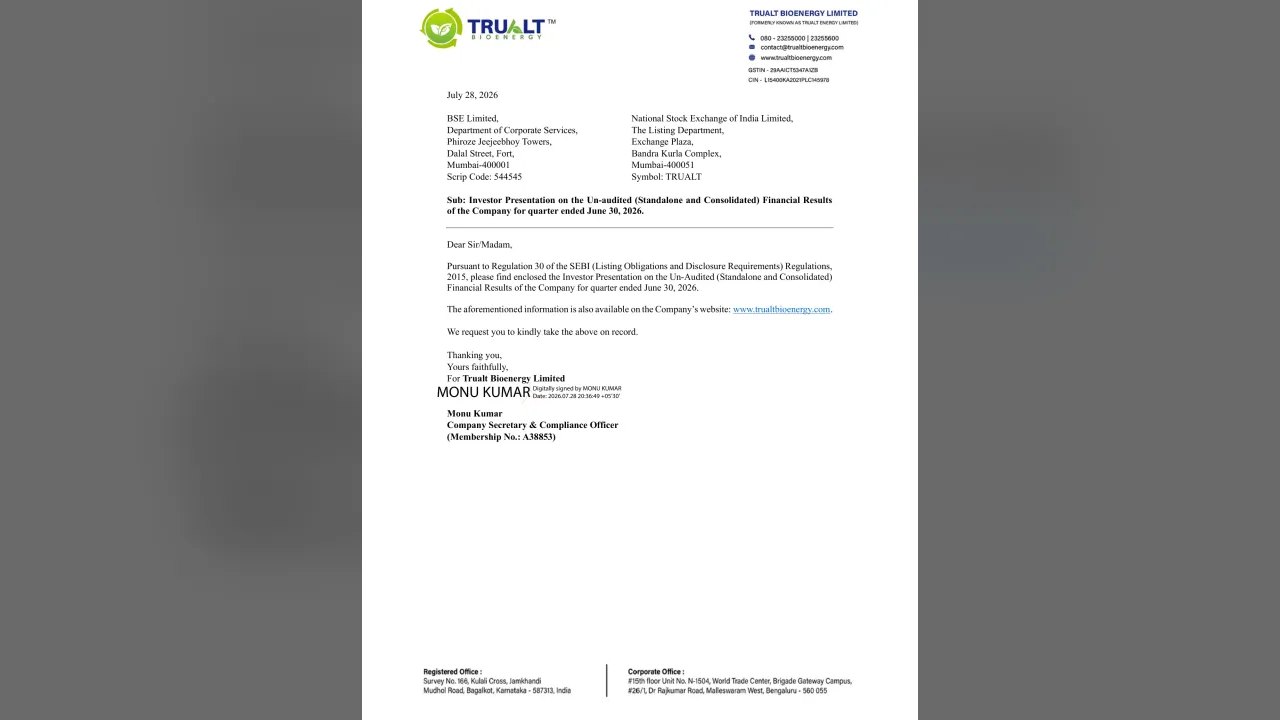
On 6ix: 6ix.com/event/trualt-bioenergy-limited-trualt-q1-2027-earnings-call
Automated transcript · Written by software from the replay's audio. It can mishear names and figures; the replay is the record.
0:00 Ladies and gentlemen, good day, and welcome to TruAlt Bioenergy Limited's q one FY twenty seven investor earnings call. As a reminder, all participant lines will be in a listen only mode, and there will be an opportunity for you to ask questions after the presentation concludes. Should you need assistance during this conference call, please signal an operator by pressing star then 0 on your touch tone phone. Please note that this conference is being recorded. Today on the call with us, we have mister Vijay Kumar Murali, Managing Director and Mr. Anand Kishore, Chief Financial Officer. I now hand the conference over to mister Vijayakumar Muralgesh Nirani, managing director. Thank you, and over to you, sir. A very warm welcome to all the shareholders for the first earnings call for the financial year twenty twenty six, twenty twenty seven. I must report that we have had a fairly good quarter, thanks to the company's decision to convert three out of our five units into dual feed plants and for timely... For completing the CapEx in a timely manner as of quarter three last financial year.
1:06 During this quarter, we were successful in operating three out of our five plants to the maximum of its capacity and were able to produce close to eight and a half crore liters of ethanol and achieve sales of close to eight and a half crore liters that gave us a revenue of close to $4,640.30 odd crores. Thanks to the price of the maize and rice during the beginning of the season And with the support of the working capital buildup, we could successfully secure enough raw material that could give us an increase in the bottom line. We also had ample stock of ethanol during the March quarter, which is now being sold, thanks to the orders that we had in hand.
1:55 With the current capacity, we were able to only operate at about 60% of capacity utilization. It is fairly better than the last two years, but we still have a lot more of opportunity to increase the capacity utilization to... By another 20 to 25% at least. And the company strives to reach that capacity utilization in the coming quarter... In the coming quarters. To increase the capacity, as we are all aware, there is a court case that gives us an additional of fifteen four liters of ethanol. That matter still seems... Stands open, and we're trying to get that implemented. With that, our capacity utilization could go as high as 90, 95% for the balance of the two quarters.
2:45 That said, q three of this... Sorry. Q two of this financial year should also see a healthy numbers because we have close to about 11 to 12 pro liters of sales plan, and that should give us a fairly good growth in performance in the quarter to come also. With regards to the compressed biogas business vertical, we've had a similar achievement in terms of operations as well as financials, where we could clock a revenue of close to INR 11 crores and the PAT of about INR 4, INR 0.5 crores, giving us almost about 40, 45% of PAT margin. The same is expected to continue in the quarters to come. Taking this learning, we had begun construction in three out of our four planned locations under a JV with Sumitomo, under a subsidiary company called TruAlt Sumitomo Gas Private Limited.
3:44 Happy to report that three out of the four plants will near... Are near commissioning and would be put to use hopefully by the quarter three of this financial year. And quarter four, we should start seeing some revenues from these three out of the four plants. In our second JV company, that is with Gale, we've had six locations that are identified. We are in advanced action to procure the land and to begin construction, hopefully, in the month of August onwards. That should give us another six plants, giving us a total of about 72 tons per day of additional capacity from, hopefully, q four of this year, and revenues to be seen from auto one of the next financial year onwards.
4:32 In terms of the sustainable aviation fuel business, we are in advanced stages of the fast feed that is a front end engineering works. We will now be calling for EPC contracts... EPC quotations, post which we will give out orders to the EPC contractor and post procurement of the land from Andhra Pradesh government begin construction works on ground. Also, we are very, very happy to report that we could successfully achieve about 150 crores worth of viability gap funding from the government of India under the PMG one Yojana. This will give us ample support in terms of the economic viability and encumbered risks to a certain extent.
5:19 With regards to our fuel retail business, we are seeing a lot of growth in... Or rather, we are seeing a lot of opportunity in the flex fuel vehicle adoption, wherein a lot of two wheeler companies, be it Honda, ABS, or other companies, including Yamaha, have all launched their flex fuel two wheeler bikes. And the car companies like Maruti, Toyota have also launched commercially their flex fuel vehicles. Government of India was also proactive in declaring the price for e 85 and higher blends like e 22, e 25, and e 27. This gives us great confidence for increasing our capacity utilization in the base to come and for adoption of scientifically proven ethanol blended fuels for the consumer in the year...
6:15 In the days to come. So our fuel retail network, we have already established seven outlets and another four to be commissioned, hopefully, by the end of this quarter. And because of the Middle Eastern crisis and the variance in the crude prices, we still see a lot of dynamics in the fuel prices. The delta is ex... Though we have identified about 76 additional locations, we have not begun construction or we have not begun the franchisee works in the additional 75 fuel retail outlets owing to the Middle Eastern crisis. As soon as there is some benefit or rather some stalemate or rather the work seems to recite, then we will have...
7:01 We will take up, you know, fast manner the construction construction of these 75, 76 additional outlets. With that, I say that TRUALT is now a completely developed company with its ethanol vertical fully in place to yield maximum output, hopefully, to give at least about five to five and a half cro liters of ethanol production capacity on a monthly basis. With the gain in the working capital limits, thanks to the IPO that we did and the working capital limits that we could secure from the procedure of the IPO, company is fairly in a good position to have or build up enough raw material at a decent price to yield fairly good margins in the days to come.
7:49 With that, I ask our CFO, mister Anand Kishore, to take you through the financial performance. Good morning, and thank you for joining us for the TruAlt Bioenergy Limited's earnings presentation for the first quarter of financial year twenty six-twenty seven. On behalf of the management, I sincerely appreciate your continued interest and confidence in the company. During the quarter, we witnessed a significant improvement in revenue, profitability and overall financial performance supported by a higher production volume, improved plant utilization and continued contribution from our diversified Bioenergy portfolios. With that, I will take you through the financial highlights of the quarter, followed by an overview of operational performance and key strategic initiatives. During the Q1 FY 'twenty seven, we booked the top line of 626.90 crore in the ethanol segment with a growth of against the previous quarter with a buffer of 106.3%.
8:46 The EBITDA stood at $1.47.3 crore with a growth of 129% as against the previous quarter. The profit before tax stood up at 78.4 crore as with a growth rate of 1253% on yearly basis. And the pad ended up with 59.3 crore as against the 4.7 crore of previous quarter by showing a jump of more than thousand percent. On basis of our margin analysis, the EBITDA margin stood at 23.5%. The PPT margin stood at 12.5. The bank margin was at 9.5%. We were able to reduce the finance cost to revenue at 7% as against 12.4% of the previous quarter. The employee cost to revenue was reduced to 1.9% as against the 3.7 of the previous quarter.
9:37 On the cost structure front, the raw material contributed 53.2% of the revenues. The inventory consists of 7.6%. The employee consists of 1.9%. The finance cost consists of 7% of the revenue, the depreciation consists of 4% and other expenses consists of 14.4%. On the segmental front, the withdrawal contributed INR 615.7 crores in the revenue and CVT consists of INR $6.11.2 crores. The segmental PBT consists of INR is INR all comes from INR 73.3 crore, and CBD is INR 5.1 crore, which is a total of INR 79 crore in terms of profit before tax in approximation. On the balance sheet highlights, the segmental asset is 3,003 thousand $5.54 crore and segmental liabilities is 2,074 crore. Balance is in the form of equities with asset coverage ratio of 1.81 times.
10:30 The key ratios of the company were basically EBITDA margin of 23.5%, PAT margin of 9.5, asset turnover of 0.67x, return on asset on an annualized basis is 6.3%, finance cost coverage is 2.78%. The debt equity ratio on the solvency level was at fairly well within control of 0.59. The DSCR stood at 1.36. The TUL by T and W was 1.28. The liquidity front current ratio comes to 1.82. Return on capital employed is 20.35%. Operating profit margin is at 14.24... 14.42%. Net profit margin at 9.45%. Return on equity at 14.42%. The the... These are revenue drivers, but due to... In the recent the fact that there has been higher non productions, there is a true plant utilization, there is a dual feed operation as our MD told, the better operating efficiencies, and the growing contribution from CVG during the quarter to quarter.
11:25 The better margin drivers were on the account of better operating leverage of the company. There was improved product mix with the with the green base added on. The strong gas utilization of the company, the higher absorption of the fixed cost, we were going be increasing the top lines. With this, we can say that we have delivered a strong first quarter with revenue crossing INR $6.25 crore and a profit after tax increasing more than one full year on year basis. EBITDA margin improved to 28.5%, reflecting enhanced operating efficiencies and improved capacity utilization. The successful transition of our facilities to multi field operation positioned us as a well capitalized and diversified stock opportunities by enhancing the challenge and profitability. We remain committed to disciplined capital allocation, sustained cash flows, and creating a long term value for our shareholders. Thank you.
12:12 Thank you. We will now begin the question and answer session. Anyone who wishes to ask a question may press star and one on the touch tone telephone. If you wish to remove yourself from the question queue, you may press star and 2. Participants are requested to use handsets while asking a question. Ladies and gentlemen, we'll wait for a moment while the question queue assembles. The first question is from the line of Shubhi Gupta from three Netra Asset Managers. Please go ahead. Hello, sir. Good morning. So my question is that since we are shifting to dual feed model, how is that impacting our, you know, COGS and costing and margins? And what is the target mix for the feed?
13:01 Yeah. So if you'll see the dual composition, the margin as it grew basically on the grain based trend. If the... We just went to the two reasons. First is when we were only with the sugar based content of raw material, there has been a a profit margin of 6.7% cheaper compared to what we are running the... Compared to the mid base. Less, there is a additional revenue of a DDGS comes from this, which is a byproduct, and that doesn't require any cost in card to this basically. So this give us a better edge in terms of only when we are cutting the soil base and a contributor here when we have generated additional close to 60% of the segment. 50% of the segment has come also from the grain base, where we have been able to save the cost... Net profit margin to the extent of 6.7 efficiency better than compared to the sugar base.
13:54 Secondly, the yield also is here high. If you would see the yield in case of a sugar base content, it is in a 317, whereas the yield on the green base will work up in four fifty. Okay, sir. So my second question is that CVG revenue grew, but the EBITDA margins have dipped. So what is driving this? So there is nothing driving this. If you see q one of FY twenty five, it is almost in the same line. A little bit cost had been incurred on the employee expenses because we are expanding the CBD plant with a with a JV with a gain of Energy where the additional employees are being added to the client level and the corporate level also. This has caused a minor increase in the employee expenses that has somewhat impacted the profitability margin, not much. There's a onetime cost of repairs and maintenance that is taken at that also. But it's almost in the same range.
14:49 Okay, sir. Thank you. Thank you. The next question is from the line of from Lotus Wealth. Please go ahead. Hello. Am I audible? Yes, ma'am. Yeah. So congratulations on a good set of numbers. So my first question is that our gross block asset turnover on current quarterly run rate is approximately one. So what do you anticipate it will be going forward? I'll ask my follow-up later. Yeah. So in a generic situation, we have... We can manufacture close to 55 crore liters, Shilpa. So with 55 crore liters at today's average price of 67 rupees, it should give us about 4,000 crores. So asset terms should be somewhere around 1.8 to two times, but we have just achieved 1%... One times now because our capacity utilization is only at 60%.
15:48 Okay, sir. And what are your CapEx plans for your 2028, and what would be the estimated gross block at that time? So in the ethanol space, we don't have any further CapEx plan. It's a fully commissioned and now just to be utilized. In the CPG space, we are already under... We have we have undergoing the CapEx of about 700 crores under two JV companies. That is with Sumitomo to do four CPG plants of 20 TPD at a cost of 330 crores, and with Gale to do six CBG plants of 10 TPDs each at a cost of 425. So these CapEx have already begun, and they're underway. So by q four of this year, we will start seeing revenues from that. Okay, sir. And anything planned for next year, 2027 and 2028?
16:40 That is for the aviation fuel. There is another CapEx of about 2,000 plus planned, and it's already... We've declared that also, but the CapEx will begin as early as, let's say, in the next two or three months. We're waiting for the EPC contracts to be awarded right now. Hopefully, by end of twenty twenty eight, that's in FY '29, we'll see revenues from the SAF business also. That's a CapEx of about 2,000 crores. Okay, sir. Now can you give any turnover there for the SAF? Not immediately. The plan turnover there would be an asset turn of one times for SAS. Okay, sir. So from 2029, you'll get revenues from SAS also. Right? And just one last thing. The CBC CapEx of $707.50 you talked about, that is completely out or that including gain and investment also?
17:38 That's the gross cost, ma'am. So 51% is held by us in both the JVs and 49 with the partner. And these are all funded on a seventy thirty debt to equity ratio. Okay, sir. Thank you. Thank you. Thank you. The next question is from the line of Sanjay Manyal from DAM Capital. Please go ahead. Hi, sir. I have a few questions on if you can give a breakup of what is what is the ethanol volume we did this quarter and how much is from B heavy and how much is from juice and maize and brook rice? So total sugar based content was 4.37 crore liter volume wise, and value wise, it's considered on two to 77 crore. The grain based volume was used at 3.92 crore liter, and in terms of value, it's 314.
18:32 If you have asked for a B and C, the B molasses measure consists of INR 3.345 crore liter and balance of minor amount is C molasses that is INR 0.06 and it's INR 0.32 crore liter. Sanaji, this this quarter also was almost a fifty fifty blend with grain and with sugar. Going forward in the next quarter, we hope that that will be more of grains. Right. Also, if you can give, you know, what I believe in three point nine would be largely maize because maize prices have been benign. What is your outlook on the maize prices? I mean, what is maize prices currently? And what kind of EBITDA per liter you are making in all different feedstocks, maize based ethanol?
19:22 So during October to January or, let's say, mid of February also, we saw the maize prices hover between 18 rupees, say, and 17 rupees also to between $21.22 rupees. So we booked a lot of quantities during that period itself. And at that price bracket, we are making almost about 15 to 16 rupees. But realistically, the price of maize is always Howard around 22 to 24 rupees. And as on date, it is at around $25.50. So at $25.50, the the margins come down drastically. It comes down to almost 6 to 7 rupees a liter. That's the margin contribution we get. But since we have we are holding ample stock since the early days, that is giving us the driver for rather the margin growth that we are seeing.
20:12 Right. And I mean, so but so we have done approximately, you can say, almost INR 8 crore liters during the quarter. Ideally, for the full year, should we take... I mean, this run rate, I believe, will go up in second half. So should we take, like, 40 odd crore kind of a number per means 40 odd crore liter ethanol which volumes will do this year? Sir, our expectation would be to do a little higher than that. But if you go by the orders in hand, we have 44 liters of orders on hand. Okay. And that includes the OMC plus private every... Everything put together, ENA, everything? That correct. That is correct.
20:59 Thank you. Thank you very much. Thank you so much, Sanjay. Thank you. The next question is from the line of Tanmay Jaweri from Fintech Capital. Please go ahead. Hi, sir. Congratulations on your set of number. It's encouraging to see the business leading momentum again after our transformation. Sir, my first question was if you can just give me a bifurcation of the quarterly revenue among E and A, E and G and A? And what would be our average realization rate for E and A and E and A for this quarter? So the two out of product, the revenue... The... As you can see, the... From b molasses, sale has come to 201 crore, $0.32 crore.
21:51 CMA loss is 3.9 crore, male basis 97.06 crore, rice basis $1.69.0 crore, and E N A E N A U racity 37.02 crore, and DDGS is 46.34 crore. These are the major drivers. Okay. Okay. So DDGS will increase in q two once we have more of the. Right? Oh, yes. Yes. Yes. It's only earlier we had guided that the 15,000 spillover should be completed around September. And right now, you have mentioned 44 crores of guidance that is for FY '27. So does that include this 15 crores? And if you can provide any timeline for those 15 crores spillover? So the 44 doesn't include the 15 plus bill over, sir. And the 15 plus, we've been fighting tooth and nail to the... With with the OMC.
22:48 And we're hopeful that it should come through any time now. So I am not able to give a timeline as of now, but we're making all efforts to get that information. Okay. So one last question on the SAS initiative. In the previous calls, we had mentioned that we were in discussion with few airlines as well as an aircraft manufacturer for potential collaboration and equity stake. So can you share any progress on those discussions? So the aircraft manufacturers... So we are also... They're... We're still in the the working groups right now, and we are confident that there are about six companies that we are individually discussing with. This includes an aircraft manufacturer, two airline carriers, and three oil and gas companies, which are very large. There are international oil and gas players and one domestic oil and gas company.
23:48 In total, we are in discussion with... And also the seventh company is Sumitomo where we already have an MOU where they want to explore to be a partner in the aviation field. So in total, we have seven companies where we are exploring the best partner for us to set up this SAF plan. Right. And, sir, post September, October, when is the new billing starts for the next sheet and all sizes? What kind of targets are we looking for? Internally, we must we must have planned something. As on this, sir, it's hard to give out that number yet. So we are taking the base case, whatever we got last year to be a base case. So there was a unfair means of allocation.
24:35 But even at that conservative side also, are hopeful that we should be able to do at least INR 44 crores in the year to come. But let's say anything about that is what could be our expectation. Thank you. The next question is from the line of Vineet Thakur from Plus91AMC. Please go ahead. Hi. Hi, sir. Thank you for the opportunity. Sir, could you shed some light on what was the revenue? What was our margin we... Retail segment and why there's been drop as well from last q four to q one in that margin. Sorry, Viniji, we are unable to hear you well.
25:24 I'm not. Can you repeat you repeat the question? I will. Because you're not able to I was asking, sir, what was... So that that margin has fallen drastically from last quarter to this quarter. What would be the reason, sir? I am getting has fallen? In details, said, ma'am. Back March is from March quarter to now. Yes. So from March quarter to now, there's been increase in the holding cost. That is the interest cost has gone up if you see. And our other costs have also gone up. So other costs include the distribution, the sales and distribution where the cost of transportation was affected a little. And also our cost of employees has gone up. We have now hired close to an an additional of about one eighty people for the new three CPG plants.
26:13 So that also has contributed to a decrease in the cost margin. And also the raw material holding cost, so the finance cost has also gone up. So on three accounts, that is the transportation cost has gone up. The finance cost has gone up, the cost of human resources has gone up. And, sir, what are the utilization currently for CVG plans? We are at about eight... 78% capacity use there, sir. Gotcha. Okay, sir. And, sir, could you give me the margins? We did... There is a foreign margin of CVG. I heard that there was a onetime cost, but what would be a sustainable margin going forward? So CBG, what we have... We've been seeing so far is a bit of greater than 60% and the fact margin of close to 40 to 50%.
27:09 If you ask me, it seems to be the long term case. But if there is any policy change tomorrow, it could go on a higher side also or it could go on a lower side also. But that's only subject to any change in policy. But as on date, we don't see any change in the margin profile for CBG. Okay, sir. And, sir, I read up under the the blending program of CBG with CNG. What kind of delta are we looking at for our firm for that if that poll... The percentage has increased? There's a lot of disruption. Sorry. We could not able to hear I was saying I was saying, sir, that I read in the CBG and CNG blending program and started in 1% of CBG has been blended into CNG.
27:56 I was wondering what will be a delta for our company if the percentage has increased and what kind of revenue potential you're looking at. No. The target for government of India is to use 5% of for CBG blend with CNG. But just to keep you informed, that is just a promotional target. Be it use of CBG or CNG, these are... The chemical compound is the same. Right? It's unlike ethanol and petrol. This is CBD. Correct. A standalone fuel. So government of India wants more of indigenous CBD production and consumption to happen. So I... If if the the consumption keeps increasing, it's a good thing for the government. We cut down on our imports. So if you ask us for our capacity, the blending targets shouldn't hold any impact for us. So off takes are anyways ensured by our JV partner, that is Gale.
28:50 So we shouldn't have any concerns with the blending profile or anything. Okay, sir. And, sir, once the plan time, I will be doing at least 40% of utilization of the the gain and to meet our plans. Right? Once the line which is gonna be We can genuinely not hear you at all. So there's a lot of disturbance with the connection. I'll... So I was saying that, sir, in CVG, the first year, we're closing beyond 40% for game and Zoom meeting plans in the year one. Right? That is the next financial year, you mean? Yes, sir. So... No. It could be a little higher. So we have estimated it to be about 60% at least for the year one of capacity use, and that's a conservative approach we are holding.
29:37 Okay, sir. I'll I'll I'll join... Rejoin the queue, sir. I'll get into better networking and rejoin the queue. Thank you. Thank you. The next question is from the line of, an individual investor. Please go ahead. Hello. Good morning, sir. Yes, sir. Yeah. But my question is on, like, for CVT, I was going through some articles. There was a bottleneck around procuring raw material for that. So, like, we are expanding into CVG plant in multipoles. So what kind of raw material are we limited do we see for that? Your question is what kind of raw material we plan to use for the next CPG plan that we're doing. Is that right? Right.
30:24 I'm gonna leave you on that. Okay. Availability of that. So for the... Every location we have identified is in a cluster of sugar complexes or ethanol complexes. So wherever we have identified locations to set up is only where we have at least three times the raw material required within a distance of 30 kilometers radius. So availability of either or which give us good yield of both fertilizers as well as CNG or CBG, those are our raw materials. And at least three x of the required raw material is what we are estimating to have. Okay, sir. And other question is around, like, few days that are some talks are going around, like, international exports for ethanol we are looking at. So are these real talks or it's like something in mind only?
31:23 These are discussions that are actively happening, especially the discussion I know is Japan and India have a a mechanism to reduce their carbon footprint. It's called JCM, joint credit mechanism, where countries like Japan, countries like Singapore, most of them are having targets to use ethanol with their petrol blend. So there is demand for India to supply these ethanol, and there is demand for export to be opened also because currently, we seem to have slightly larger volumes available. Okay, sir. Okay. And other thing, one more question I was wondering like some of our have entered into long term contracts with OMG.
32:10 So can't we also do one deal of that kind of contracts for multiyear, like, to more contracts? So you mean with the public sector OMCs or the private sector OMCs? Public sector OMCs, sir. No. So we are already under a long term offtake engagement with the public sector OMCs. In spite of that, Satyam ji, there is a tendering mechanism that happens. And under that tendering mechanism only, we get allocation of quantities for that year to supply. Okay, sir. Thank you. Thank you. Thank you. Next question is from the line of Suyash Kaina from Singularity AMC. Please go ahead.
32:58 Thanks for taking my question. Can we talk about what kind of government assistance are needed in the CBD business? As you said, maybe the raw material, we have self sufficiency because where we are located and our legacy history in the sugar sector and understanding of that. But maybe what other assistance is needed to get the full revenue realization as we're getting today in the first time that we are active, and how can it scale to the other, you know, 10 to 20 plans that we might bring up with these partnerships that we have logged in. Of course. Thanks for connecting,. And with regards to CBG, many of the companies in the country are still in the learning curve.
33:50 And we've had multiple stakeholder meetings with the government, with OMCs, as well as with many industry potential participants. And each of us have had multiple demands from the government. One very important one for the success of this sector for all in general is an assured off take from the or from the government side. Right now, because of this... All these plants are located in rural area, off take has become a challenge. And luckily for us, what gives us the the mode that we carry is the tie up with the partners where they're ensuring more than 80, 90% of sales on a daily basis. So if most of the people can solve the problem of sales, I think the sector is going to be a a big success.
34:44 In terms of raw material, each of these different feedstocks have different unit economics. Be it from it's different, from it's different, from from biomass is different, and from Napier is different. There is only one single yardstick that government use under the program, but we hear rumors that there is a new program called coming. I'm sure you're aware of it also. And in that program, there are multiple corrections or changes that we hear will benefit the industry. So once that comes out, we are hopeful that it should better the margin profile for us. That's the expectation that we carry also. But that that takes care of the CVG output. Right? The... There are the byproducts of FOM and the realization that we get from MDA.
35:41 Can you talk a little bit about the scalability of that? And what... If if we can do anything to improve the realization versus depending on the government again, right, which can go back and forth in terms of policy of FOM and MDA. Are there things that are in our control to improve the realization from these byproducts? I understand your CVG point and hopefully, deal partnerships and the likes of that will help for the CVG uptake, but that doesn't solve the complete problem to get to... To sustain the 50, 60% EBITDA margin that we have today. No. No. No. No. No. So when we began, sir, our price of solid FOM that we were selling was at around 500 rupees a ton, and liquid, we were giving it at free of cost.
36:27 Today, if you see the price of solid, we are selling is almost at about 2,500 to almost 2,800 rupees a ton. And we also have some long term offtake contracts with companies like Rashtriah Chemicals and MCF and IFCo, Jayakistan. We're also in talks with companies like Coramandel wherein there is an interest from these buyers to buy solid fertilizers at almost 6,000 rupees a ton. So if that happens without being dependent on the policy for MBA or the subsidies, we still will end up achieving at least two x of the revenues that we're achieving in the solid side. With the liquid side, there still needs to be a lot of improvement in terms of the NPK values and the mineral content in it, and we need to bottle it in a certain fashion so that the farmers can use it in a spraying mechanism.
37:21 Unlike right now, they are doing a flooding of these liquid fertilizers in the farm... Farms. Because they're flooding it, the price also of the product is very low. So we need to do a little of market development in terms of liquid. But solid, I'm sure we will end up achieving a little more... I mean, a a larger benefit if we give it to the b two c sort of... I mean, b two b customers. Also, are discussions happening with Ministry of Fertilizers for keeping this MDA in a different tangent to promote organic fertilizers. This is still in very early stages. So we are hearing rumors that there could be a entire new policy for the subsidy for MDA also.
38:06 But as far as we are concerned, we are trying to be less dependent on government policies and be independently viable without the subsidies. Good. Thank you, sir. Thank you. The next question is from the line of from. Please go ahead. Hi, sir. So do we have the required pipeline infrastructure for the CDG plans made to TRUALT of Sumigap? And what does Sumitomo bring to the table as a partner in both CVG and SAH? Just one second, Sriramji. Our apologies, everyone. I think we had some issue with the connection.
38:55 Now it seems to be better. Sri Ram, sir, you had a question. Yes. So my question was, like, we have the required pipeline infrastructure for the CBD plants that are built to the TRUALT SIMVAS. And what does Sumitomo brings to the table as a partner in the both CVG and ACF? With regards to other pipelines, we have a cluster. So there is a scheme called DPI from the government of India. It's called direct pipe injection. And in that earlier, the scheme provided for 50% of the pipeline cost would be borne by government of India and 50% to be borne by us. But we hear in the new scheme that the policy is completely changing, and the entire pipeline lane would be done by the government of India.
39:47 So as of now, most of our plants are in... Within 50 to 60 kilometers of distance from the injection points. So since we have the IPs very close by, it is good. It is easier for Gail also to do the optics. And right now, we are using cascades to transport the gas from our factory to the injection points. Eventually, it will take time for us to lay those pipelines or rather for the government to lay those pipelines, but that is completely being done by Gale or government. And with regards to Sumitomo, we seem to believe that they have one of the investor companies, which is into CGD networks. And in the area that we are operating these nine CPG plants, this CGD network is a CGD licensee.
40:39 And for them to have a backward integration of gas availability, they seem to be interested in having this... I mean, in investment in the CBD business. Sir, and may I know the... When when the loan related to the pledge shares will be repaid? Sir, so, basically, the... This loan is not against the place here. That is called that. This loan is as a... Given as a... This sale is given as a collateral against the loan. So, basically, these are the term loans which we have availed for our... It's a small plant in the beginning when we were establishing a 2,000 k l p d and as well as for a dual feed integration.
41:26 Now we are in the process of getting released this last year. We have requested both the lenders, SBA and Renata, whom we share to release it on immediate basis. They have started acting on our proposal also, and they are doing the root... Needful. Hopefully, in this quarter, we expect this... The charge to be released. Sure. Sure. And my last question, is the SEM blending target is sustainable to the airlines because, like, it seems to be price or price costlier than the actual ATS? So if you look at the international air turbine fuel prices today, it is still hovering around 210 rupees to 220 rupees a liter, whereas the subsidized domestic ATF price is around $1.25 to $1.30 rupees.
42:13 The realistic price earlier used to be about 100 to 110 rupees a liter, so there is already a 20, 25% jump for domestic price and almost two x jump in the international fuel prices. So our expectation of SAF prices at about 1.8 times or about... Give or take about $1.80 rupees a liter to 200 rupees a liter. So that is still within... I mean, cheaper than the international prices because of the Middle Eastern prices. But, eventually, when we keep scaling up our capacity utilization, we expect the price of SAF also to come down and be more viable for the aviation fuel... I mean, airline companies or airline carriers. There is also this carbon benefit that airline carriers will end up gaining, and that carbon benefit will offset their cost of carbon taxes in certain European countries. So it's a mandate that is literally will have to use.
43:12 Understood, sir. Thank you. Thank you. The next question is from the line of Nikhil Gupta from Vayu Capital. Please go ahead. Good morning. Thank you for the opportunity. Most of the questions are answered, but just wanted clarification on the CPG business. So I think you mentioned in the previous question that 51% is owned by us. And so is it a fair understanding that, let's say, 1 rupee revenue will be divided in the same fashion after and similarly, the profit as well. And the 700 odd CapEx is our number of the total CapEx overall.
43:59 No, sir. It's the overall growth CapEx of about 760 odd crores to set up in total of about 132 mega tons per day of CBG. So if you look at the trend, we are achieving about 4.5 crores per ton of revenue. So if we do about 132 tons additionally, in the same range, that should give us the revenue numbers in the days to come, and then similar margins is what we expect, but that's at peak level. Right. So so let's say the ATTPD with our partnership with Sumitomo, so we will only be able to report 50% of the gross revenue whenever we're able to achieve. Right? 51.
44:46 51. Oh, okay. Makes sense. Thank you so much. Yes, sir. Thank you. The next question is from the line the line of from Autumn Investment and Infrastructure Limited. Please go ahead. Hello. Am I audible? Yes, sir. Yes. So I have a question on the feedstock for CVG. Basically, now that you mentioned that the government is coming up with a policy to allow many feedstock for CVG production. So just wanted to understand from an internal perspective, are we ready from a technological standpoint, if at all it makes sense for us to, let's say, set up a CVG plant purely on grass, for example.
45:32 So do we have those technology tires in place? They're all there, sir. So what has happened is there are a lot of new technology vendors that have come in the market, and most of them give their own technology. So in terms of technology, there is readiness in the market. But a lot of people, because they're doing r and d, the yields... The rated yields are not being achieved. It was the same case for us also. It took a lot of learning for us individually and internally to get the best deals, and then we're repeating the same model across that CPG infrastructure. That's with spend cost and with. Correct. When it comes to, though technology is available and can be grown in barren lands, I personally don't see the value there because you would require close to 500 to 600 acres of land to run a 10 tons of...
46:28 Or 12 tons of output plant. Okay. So it's a lot of landmarks being tied up to achieve what $40.45 crores of revenue. Right? It's... Don't personally see value in that. Correct. And within the existing feedstocks today, which feedstock according to you is the best? I mean, the one that we're already doing or you may want to shift to some other feedstock or have a dual feedstock sort of set up some... At some point of time? So our... Let's say our fundamentals have always been to do the easier things first. And for us, the easiest option is to do and spend to us because they have a lot of COD and BOD in them, and the content is also quite high.
47:15 So for us, it's easier to digest these kinds of raw material and get more yield of gas. Also, get alternate revenue from sale of fertilizers here? Yes. This is higher revenue and which is why we are doing this. Correct. So today, if I'm sort of revenue share is what exactly in the CBD out of the CVG revenue? We we are recording that in the same segment. Right? We are. We are. In the CVG business, if I were to give a a revenue split up, we achieve about 58 to 60% of revenue from gas sales and about 40% of revenue coming from FOM and LFON put together. Okay. So when you say the the revenue potential is one to 1.1 times of the asset, that includes both.
48:07 Sorry? It would be 0.8 to one times of the... Would be the asset, sir. So that includes both gas as well as the phone? That's right. Ah, okay. In the same proportion? So it would depend on the places because gas... Price of gas is static. It's at 84 rupees a kilo right now. And if we have longer distances to sell, we lose about 1 or 2 rupees in transportation, whereas the price of FOM vary. So it has a big delta. If you ask us, we have sold a few bags to a company... A large government company, fertilizer company at almost 8,000 rupees a ton also. This was a onetime order. And we are selling in the open market at 2,500 rupees a ton also. So the delta is that high.
48:57 Correct. And and what is it... What is the technical composition of the FM that comes out? Is it higher nitrogen? No. The NPK value is above sub 6%, and Okay. It has a lot of other organic nutrients in it. I don't have it handy right now. But what we usually do here is we add our fly ash in the boiler. So after burning the biomass in boilers, we get the ash. It has very rich potash content in it. So when we're doing a fertilizer harvesting or production, we mix this ash with the FOM, and this gets a NPK content of higher than nine or sometimes 11 also, and that gives a higher revenue to us.
49:43 Correct. And I think it is a potash content which is enabling the higher prices, if I'm not mistaken. Not really. So so far, a lot of people do not have a larger understanding on the spec of the product itself. Oh, okay. We are now educating them. But because for us, ash is again another waste product. And for us to create a better product for our farmers, we are mixing the ash and increasing the NPK value. Got it. And the 6% NPK content allow you to qualify it as organic, right, if I'm not mistaken? So for this to be qualified as organic, it is not on the NPK value. It is more on the how the the the fertilizer is manufactured or produced. Production process.
50:30 Okay. That is right. Okay. Got it. Thanks The next question is from the line of Pratamesh Sawant from Abacus Asset Managers. Afternoon. I just wanted to understand, of the 20% EBITDA margin that we have on the ethanol segment right now, what percent would you attribute to the, you know, the co products and what would be to the core ethanol? What would byproduct, basically, is is it the form of DDGS, which is which is around 47.34 per of the total revenue of $6.30 karat. And other is c o two, which is a minor amount of 1.89 karat. And some other content is is in the form of 8.750 crores of other components.
51:25 Over and above that, suddenly, we have interest, surpluses, and PLI. Altogether around 22%. So net net, it should be at about eight, 9%, 9%? Oh, more than that. It should be about nine to nine and a half percent, sir. Okay. Okay. And, sir, going ahead, like, if we see this capacity utilization improving, what kind of margins are you expecting vertical? Let's say, excluding that, the 15 crore or 15 crore liters of the. So the skill is to buy the raw material when it is at its cheapest. And since we are still sitting on a lot of volumes, if you have seen our inventory levels in our balance sheet in March, as well as currently, we are holding a lot of volumes of grains, which we have secured at a range of 18,000 rupees to 21,000 rupees a ton. Of course, there's some carrying cost involved with it, but it is still much better than the current prices of about 25 rupees or 25,000 rupees a ton. That gives us this higher yield. So the next quarter and, hopefully, q three also, we should be seeing decent margin profiles because we have had... We we could pick raw material when it was cheapest and stock it.
52:38 Okay. Okay. Got it. And, sir, lastly, on, you know, the outlook per se for the CBD, if you have to see further from there, what are the what are the underground are that you can see where, you know, the collection material... Collection of raw materials, but, like, which is helping... Which, you know, which could help scale this vertical further going there. You mean what is helping the CPG business? Is that right? No. It's only on the industry perspective. You know? So supply chain, how is it developing so that, you know, the CPG as a vertical can grow faster, not just for you, but for the country as such. As a result I think off takes would be one important aspect. And, see, if you ask me, sir, I'm not sure because I'm... I failed to read the negatives in this. Because for us, we've been seeing very healthy margins, right, unlike others.
53:32 So whenever I see the industry and then people complain about x and y and zed, I don't have anything to complain because we've been able to operate it. So I am not too sure what betterment should be done. But, of course, minimum things like ensuring the short off takes, giving better promotion for FOM. These are the generic things that I could say. But if you want to scale this business going ahead, what would be a bigger challenge? Like, supply chain or the optics? So, again, when it comes to feedstocks, right, if we're doing it with and rice hut and things like those, supply chain of the... I mean, raw material is also a challenge, and the optic is also a challenge. But when you speak of products coming from and, I don't see a big challenge currently unless tomorrow everybody plans to start up their own CVG plan, which I'm highly unlikely because for a plan to be viable, it needs to be of a certain scale. Let's say, at least about 10 plus tons would be the minimum size that you would want to set up.
54:42 So multiple of the sugar companies in the country wouldn't be able to set up because they won't have enough raw material within their vicinity. So whoever has this early more advantage will benefit in the and space. And each of these raw material has different demand, so I'm not exactly sure how to answer this question. Okay. Fair. Thank you, sir. Thank you. The next question is from the line of from Choice International Limited. Please go ahead. Yeah. Sorry. Just most of the questions are answered. I just wanted to understand. Did I miss all of... Probably, what is the realization for SAFN could be considered? Maybe it's still far away, but I just wanted to understand.
55:31 For SAF, sir, our expectation is that we get a sale price of about $1.80 to $1.90 rupees a liter. That's the offtake price. And with that, our margin profile that we expect should be at around 24% to 25%. Okay. Okay. Agree. Agree. Agree. Thank you. Thank you so much. Thank you, sir. Thank you. The next question is from the line of from growth adviser. Please go ahead. Thank you for the opportunity. My question is regarding the restatement that happened in March 26. What specialty drove the 10.5 crores in the other expense under the index eight? Which line item it was? Can you explain that?
56:24 So that is basically all the was recognized and it was a rule 43 GST reversal, which was... Which was supposed to be in the PL account in the March quarter As as per the India India's guidelines, because it is identified during the present quarter, the impact on this, 10 crore amount was to 4 crore, and the impact of this, has classified into the other recruiter during the quarter as per the India reporting standard. To be precise, I think this was an oversight from our... The tax consultants. We could have increased our tax margin by 4 crores. So instead of 89 crores of tax during last year, it would have been 93 crores. So because we have not classified into the past quarter, it will be automatically transferred to the reserve and surplus, which is a part of other equity.
57:16 And since this, because last quarter, we have not added back this quarter, our other equity reserve and surplus has increased into the... In net... In terms of network. Okay, sir. Got it. Thank you. Thank you. The next question is from the line of from Genuity Capital. Please go ahead. Hi, sir. Thanks a lot for the opportunity. So just some clarification questions. So firstly, you have mentioned that we are going to close to 44 crores of data in 2010 in. So keeping realization to 68, so we are saying we will do close to 3,000 crore revenue from That number you have to work out. We can only tell that volume and orders we have and with whatever MDF tool.
58:04 So we can't limit on those points, but what do you... What is the order in hand we have already disclosed? What is the future card we already disclosed, so realization will be close to 68 to 70. Right? It should be about 67 to 68 on average case, sir. Understood. And, sir, on the CBD front, like, since we are already at 78% utilization. Right? So we can expect for FY twenty seven to ten to twelve or run rate or q o q? It should be in a similar range itself. So that's the expectation we carry. Understood. So just one more thing. Any update on the 15 odd gross either on the code case that is there is no one?
58:51 No. We are still trying to implement that, sir. So... Because the and the policymakers are in a different fix altogether, we've not been able to get their attention, but we're confident to get that implemented. Got it. Okay. Thanks a lot. Thank you. The next question is from the line of from plus ninety one AMC. Please go ahead. Hi, sir. Thank you. Most of my questions have been answered, sir. Sir, when could we re... When are we targeting a full utilization for our ethanol plants? Sorry. I didn't catch that, sir. Sir, I'm asking what... When could we reach our full utilization on our ethanol plants?
59:37 54 kilo liters that we Full utilization would be an annual sale of about 55 kilo liters, So that will give us a revenue of close to about 4,000 crores at the current prices. And our effort will continue to be to achieve that number. So right now, we are reaching somewhere about 40, 44 crore liters. Our effort will be to reach that number hopefully in the next ethanol supplier. We're making all efforts to be less dependent on government policies and create more point of sale so that our capacity can be fully used. Sir, what about the private oil change that you were dealing with for ethanol supply? Are we increased allocation to them as well, or is is that going to be not a very fruitful era? You... Fruitful fruitful for us anymore?
1:00:29 Private ones, because the relations are quite lower as compared to government OMC's. Right. So now that there is a mandate by government to supply around 95, so that's a much higher quality fuel. There is a mandate for all the private OMCs to blend 20% ethanol. So these guys are very cost conscious, and they try to cut down on all cost wherever possible. In terms of volume, we'll be able to supply. In terms of price, we will have to plan our margin profile in a manner where we supply to the private and end up still achieving at least 10 or 12 rupees of margin contribution per liter. That's the challenge that we will have, and we have plans to doing that.
1:01:17 So we had an inventory of private agencies, which had not been liquid in last quarter. Is there any update about that as well? Yes, sir. So we have now started liquidating. I think out of the total eight crore liters that we have had, we have sold almost about three crore liters. Now the five is to be sold. Hopefully, in the fourth quarter of the year, rather third quarter of financial year, we will be targeting to sell that. And so what are the utilization for private overseas? It is at about 60 rupees 50 paisa. Okay, sir. Thank you so much, sir. Thank you, sir. Thank you. The next question is from the line of, an individual investor. Please go ahead.
1:02:02 Oh, hello. Sir, do you expect any increase in ethanol prices from the government end? Sorry? Do you expect any increase in the prices of ethanol? Oh, I would wish for it first, sir, but I'm not sure that there could be any increase in the prices right now considering the inflation levels in multiple fronts because of the war. Okay. I don't expect any increase in the prices. This is my individual opinion. But any increase that comes is a bonus for us. And can you do... Like, what are your plans to delever your balance sheet? Because as we can see, like, on an annual basis, approx $1.80 crore is going as a finance cost.
1:02:53 So there... Are there any plans to delever your balance sheet? Yes, sir. We have plans to do that. And, in the next call, we... Or maybe in the next few days, we'll be able to give a plan for it. We're still in the works on doing that. Okay. And on the last con call, you said that you you are going to do some advertisement or something, but still, we haven't seen anything on that point. Advertisement on the field, you mean? Advertisement about your company or the the sector. Alright. No. We've already started the... We have empaneled a certain individual who is a good strategist, a media strategist, and we're trying to create a road map for it, and we will be beginning all these advertisements.
1:03:42 Because of... Well, you know, what is the the situation in the country with the ethanol backlash and stuff like those, there have been certain delays in implementing them, but eventually, we'll get there. Okay. As a shareholder, I would really like to do, like, fundraising or something so that you can delever your balance sheets or anything. Because as we can see, the share price are not going anywhere from the listing day. So hope... As a individual shareholder, we hope, like, you do something to delever your balance sheet also that as an industry shareholder, we get confidence in holding your share for long term. No. I'll take that as a positively, and we'll work on achieving something of that sort. Like I said, sir, there is... There are some plans we're planning to implement to deliver the the the finance cost.
1:04:36 Maybe in a few days, you'll get to see that. Okay. Thank you. Thank you. Thank you. Thank you. The next question is from the line of from Kerguna Research. Please go ahead. Yeah. So good afternoon. Is my voice audible? Yes. You are audible. Yes, sir. Yeah. Congratulations on the good set of number. First of all, first of all, if I'm correct, we are targeting 50% capacity utilization for q two FY twenty seven. I right? Because we have scheduling maintenance in q two as well. So can I say that? So right now, sir, we don't have plans to stop for maintenance. We have about 11 or... Crore liters of supplies to be given out during the next quarter.
1:05:27 So in this quarter, we have done 8.29 cruel liters of sales. That is in q one. Q two, we expect the sale to be at around 11 cruel liters. That's the orders that we have in hand. So we won't be stopping for annual maintenance. Alright. And so the last year, the conditions of offtake were quite sloppy. So is the condition the same for this year? No. Last year, we had actually taken a plant under shutdown for integration of our dual feed plant. So we had lost good two quarters there. But now that we don't have any CapEx or any works going on, so we still have... We only have to concentrate on maximizing capacity utilization. Alright. And lastly, so you talked about some team last few quarters back. So when can we expect it to roll out publicly?
1:06:21 To be honest, sir, we have actually... We have been chasing the policymakers rather trying to find out more about it. The answer we get is that it could come out anytime. So I think just passing on the answer we get to you is it could come out anytime. Alright. That's it from the side. Thank you. Thank you, sir. Thank you. The next question is from the line of from Ashikah Stock Services Limited. Please go ahead. Thank you for the opportunity, sir. I have a question. That lot of solar companies have been actually setting up their ethanol plant. So do you think it could be a concern for your business? And what would be the demand supply scenario now in the ethanol segment?
1:07:08 And do you think that you have the upper hand over the sugar companies in the ethanol production? Okay. So we don't see any further investments in the ethanol space as we see as we speak, sir. Most of the capacities that were supposed to come have all come up. And at the max, there would be three or four plants that are nearing commissioning, and that could create another volume of about eight to 10 cro liters per annum. So that's the max growth that we see based on the numbers available in public forums. So we don't see any further capacity additions in the ethanol space. Your second question was on?
1:07:54 On the demand supply scenario, what is what is the demand supply scenario of currently? Is it? The demand supply, sir, India has a total installed capacity of about 1,800 crore liters of ethanol output. And for ethanol blending with petrol, they have a demand of about 1,200 crore liters, and there is a private demand of... In the alcovy industry for almost about 200 cro liter, and about 300 cro liters of ethanol is required in the chemical industry. So net net, 1,200 goes for blending, 300 goes for chemical industry, and 200 goes for the. So demand and supply, if you look at it, it's almost at part as on date, at 20% blending. If the blending goes up, we will need more capacity.
1:08:46 Okay. Okay, sir. Sir, my third question is about that. Do you have any upper hand in the production of ethanol over the sugar companies? Because they are integrated. The benefit that we would have now is access to our group company that can assure a 100% of the required raw material at a stable price. That is one backup we have. Along with that capacities, all of them are running on biomass based boilers. So our cost of fuel is also lower than in other competition. And the third thing is because since last last year, three out of our five plants are dual feed. We can consume any raw material which has the cheapest price and yields the highest margin. So these are the benefits that we have.
1:09:36 Okay. Okay. Great. Great. Sir, my last question is regarding the green hydrogen that you have a plan of setting up of the green hydrogen also. So any progress on that front? To be honest, we have a technology tie up with Indian Institute of Science for biomass oxygen gasification technology, where we can extract green hydrogen at a much cheaper price as compared to through electrolyzers. But since there is no market for green hydrogen or there is no supply chain for green hydrogen as on date, we have not progressed on it. Okay okay okay. Thank you, sir. I got all my queries.
1:10:22 Thank you. Thank you so much, sir. Thank you. Ladies and gentlemen, due to time constraints, we will take that as the last question of the day. And now, now I would like to hand the conference over to Mr. Vijay Kumar Nirani for closing comments. I once again thank all our shareholders for trusting in TruAlt and participating in this journey along with us and for your, valuable questions and comments to us in steering this company towards a more successful journey. We take all your inputs, very positively, and we continue to work in the interest of the company and to increase the share value for the company, for all the holders including us. We thank you again for joining today. Thank you. Thank you. On behalf of TruAlt Bioenergy Limited, that concludes this conference. Thank you for joining us, and you may now disconnect your lines.
Follow TruAlt Bioenergy Limited into a list and get an email when it puts out news.
Managing Director at TruAlt Bioenergy Limited
Chief Financial Officer at TruAlt Bioenergy Limited
managing director at TruAlt Bioenergy Limited
at three Netra Asset Managers
at DAM Capital
at Fintech Capital
at Plus91AMC
at Singularity AMC
at Vayu Capital
at Abacus Asset Managers