Automated transcript · Written by software from the replay's audio. It can mishear names and figures; the replay is the record.
0:32 Without further ado, I'm going to hand it over to Tony. Thank you very much, Jane. And I'm excited to be here to provide everyone with an update on what's been happening at Trilogy over the summer. The last time we did an update with 6 was in June, so I look at some of the events that have happened during the last several months with obvious pride in terms of receiving the record of decision on the road, which we'll talk about, and also in terms of providing a feasibility study on the Arctic project. Let me start by giving you a brief introduction about Trilogy Metals. As Jane said, my name is Tony Giardini. I'm the President and CEO of Trilogy. Trilogy is listed on the Toronto and New York Stock Exchange under the ticker symbol TMQ.
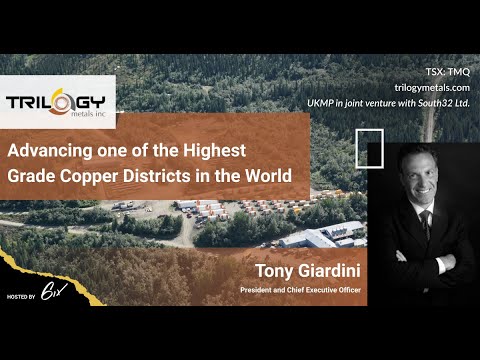
1:22 For more information about Trilogy, I encourage you to go to our website, TrilogyMetals.com, where a copy of this presentation and other materials will be available. Let me start by this cover slide, which shows a photo of the camp at Boronite and the headframe at Boronite from exploration that was conducted in the 50s. What we're talking about are assets in Alaska. We're talking about high-grade exploration development assets that have actually been explored since the 1950s. When I get into more detail, I'll provide you with an update of not just what's been happening recently, but where we see things unfolding going forward. Let me start by pointing out that I will be making forward-looking statements and this slide and the next sets out what the meaning of those forward-looking statements are, so I draw your attention to that.
2:17 In terms of Trilogy's interest in the Ambler Mining District, they're significant. The district holds approximately 8 billion pounds of copper, 3 billion pounds of zinc, and over 1 million ounces of precious metals. As I indicated at the outset, we're located in Alaska, which is a great jurisdiction to be located in. There's a strong rule of law there, obviously, but there's also a rich mining history there. And there's checks and balances that are in place that provide a very good framework for us to move forward in terms of advancing our projects. When we talk about the Ambler Mining District, what we're talking about is high-grade copper and zinc deposits with precious metal credits. We're fortunate to have 3 significant partnerships. I'm going to talk about each of those today.
3:04 Those partnerships are Sub 32, NANA, which is a native corporation, and ADA, which is a state development agency located in Alaska. I'm also going to highlight some of the significant exploration upside in the district. And we'll talk about our 2 advanced projects, Arctic, for which we have a feasibility study, and I'll get into more detail on that, and also Boronite, which is an advanced exploration project in the district. In terms of our share capitalization, we're in a very strong fiscal position. We're fortunate that we have $12 million in cash at the corporate level. We have no debt. In addition, we have 50% of the cash at the JV level that's effectively being pre-funded on our behalf. So the JV has approximately $145 million in cash, and I'll speak more about the formation of that JV in a couple of minutes. So Our see-through value of that is roughly $72.5 million.
4:03 So if you look at our cash position in aggregate, it totals roughly $85 million against a market capitalization of $262 million, which effectively equates to a valuation for our share of the Ambler Mining District of roughly $180 million. And I'll compare that to what the value is of just Arctic when we look at the feasibility study details that we'll be discussing in the next few minutes. We have a large institutional shareholder base with major shareholders having been involved with the company right from the beginning. Electrum has been there right from the outset as has Bob Holston-Poulsen. And overall, The shareholders that are listed on this slide control approximately 65% of the outstanding shares.
4:50 It's interesting to note South32 owns 11.6%, and I'll speak a little bit more about South32 and their involvement in the district as we move forward. As I mentioned, there's 3 partnerships I'm going to discuss, South32, NANA, and the State of Alaska. Let's start with South32. South32 originally approached Trilogy 4 years ago, approximately about forming a partnership with respect to exploration development in the Ambler Mining District. The basis for the original agreement was that SO32 would fund $30 million of exploration over a three-year time period and have the option, but not the obligation, to form a JV at the end of the expenditure of that $30 million. In January of this year, the formal JV was established, which is called Ambler Metals LLC, and South32 contributed $145 million into that JV.
5:46 So if you look at the investment that South32 has made to date, they've invested $145 million in forming the JV. They've invested $30 million in terms of exploration expenditures that they funded, and they own 11.6 percent of the stock. So in total, so far, South32 has invested over $200 million in terms of its investment in the Ambler mining district. South32 is a well-known company, a $6 billion market cap based out of Alaska, or out of Australia, but with significant operations around the world. And their most recent acquisition was of Arizona Mining. And So Trilogy and the Amber mining district constitutes their second major acquisition and their first really focused primarily on copper.
6:39 So we are very fortunate to have such a strong partner of Cell32. The JV as I said earlier was formed at the beginning of this year. And what we've been doing is establishing a JB management team. We've hired a president and CEO of that JB management team earlier this year, Ramzi Faraz. And we've just recently hired a CFO. And we're in the process of finalizing, bringing on board a BP operation. So the management team is starting to fill out. We've transferred all of our personnel in Alaska that were previously Trilogy employees under the Ambler Metals LLC umbrella. And Ambler Metals LLC will be governed by a board which consists of 2 members from South 32 and 2 members from Trilogy that will provide oversight in terms of the next steps on the development of the Ambler mining district. So we're in a great position. Things are advancing as we had hoped with respect to the development of Ambler Metals and the JV moving forward.
7:41 When we established the JV, we contributed a total land package of 172,000 hectares as is indicated on this slide. As you can see there's different colors there. The red color shows the original claims that were acquired from Kennecott back in 2003. The green area shows the contribution of NANA which I'll speak to in a minute. And the blue area is the area of interest that covers anything within the JV. So anything that is found or developed, explored for in that blue area constitutes part of the JV and would be shared 50-50 by Trilogy and South32. In terms of our partnership with NANA, NANA is an important participant in the mining industry in the state of Alaska. They're located in the north.
8:34 The Native Corporation is located in the northwest part of the state. They have a rich mining history. Nana owns the ground on which the Red Dog Mine is located, and the Red Dog mine is operated by TEC. Red Dog, as you may know, is the largest zinc mine in the world. And in many ways, what we're doing is we're trying to advance the Ambler Mining District on the same basis of how Red Dog was developed. And Red Dog, in order to move from a development asset into an operating asset, required infrastructure to be built, primarily a road and port. That was funded by ADA. And we're looking at exactly the same model in terms of how the Amblin Mining District is going to unfold.
9:21 And so we look at a lot of the parallels of what happened at Red Dog and having NANA as a partner in terms of moving forward with the development of the Ambulant Mining District puts us in a very strong position. NANA has 14,000 slash shareholders residents in the northwest part of the state and we have a very strong relationship with NANA both in terms of NANA as a native corporation, but also the Northwest Arctic Bureau, which governs the residents of the area. So we look forward to continuing our relationship with NANA, and we look at the benefits that they're going to receive, which are going to be jobs as the Amber Mining District is explored and developed, procurement opportunities that will unfold, and fiscal benefits that will accrue to NANA and the residents of the Northwest Arctic Borough.
10:27 Our third partnership is with ADA. ADA is Alaska Industrial Development and Export Authority. And as I mentioned when I was discussing NANA, ADA was key to the development of Red Dog Mine in that they provided the funding for the development of the road from Red dog to the sea and the development of a port. So we're looking at a similar type of arrangement with ADA moving forward, namely that we're talking about a 211 mile road that would go from the upper Cobuck district to existing infrastructure, the Dalton Highway, which then connects at Fairbank to a rail and with the rail service taking concentrate to Anchorage where existing deep sea port already exists.
11:12 So the Ambler access road is really the missing link that unlocks the value in the district. And what we're looking at is a road that would be developed in phases. The initial phase would be an ice road. The second phase would be what would be called a pioneer road. And then the final phase would be an all-weather road, initially as a single-lane road with pullouts, and then eventually as a double-lane road in time. And the key to the development of a district is the development of this road by ADA. And what we're looking forward to is the next phase of moving forward in advancing the road. So where are we at in this process? Well we were very fortunate that ADA received the record of decision on the road earlier this year in July. That was a process that took a long period of time, extensive public consultation, EISs that were prepared and drafted in a preliminary draft and final form, and obviously public commentary periods. So now that we have a record of decision, we look at the next 3 phases which is the detailed engineering, financing, and construction.
12:19 We're already in discussions with ADA on ways of helping to fund the detailed engineering, and we have an MOU for an initial small expenditure associated with that detailed engineering, looking at arriving at a detail, an MOU that will cover the full cost of that detailed engineering being shared by Amblin Metals and by ADA. And then what we would look to is the next phase, which would be a tolling arrangement, which would provide for the financing and construction of the road. And we see engineering construction taking approximately 3 years. But as I mentioned earlier, there's 3 phases in that road, being the ice road, the pioneer road, and the final road. So our ability to move forward with the development of opportunities in the district isn't necessarily, ultimately, it's ultimately based on the final road being there. But that's really needed to ship concentrate. And we don't need that to commence construction once we make the decision to move forward with any of the projects in the district.
13:21 This slide really shows where the road is expected to originate from and going through the district. You can see that there's 4 deposits in the district that have been identified by 8-01 looking at the economic rationale for the road. Those include Sun, Smucker, Arctic and Boronite. Sun is privately owned, Smucker is owned by Tech, and Arctic and Boronite are owned as part of the Amblin Metals LLC. We'll talk about the number of exploration opportunities in the district as we move forward in the discussion, but it's important to point out that the road puts it in a strong position to be able to move forward with Arctic initially and then boronate at some future date. And some other points that I'd like to just highlight with respect to the road, it's expected to be a private industrial use road only that would be used for the development of mining opportunities within the district.
14:19 And as I said, it would be constructed over eventually a three-year time period once the decision to progress on the detailed engineering process begins. In terms of the Arctic project, which is the most advanced project within the annular metals, we already have reserves of 43.4 million tons at 4.2% copper. That's a high-grade deposit in anybody's books, and that puts us in a very strong position in terms of advancing this project. Now the feasibility study that was produced earlier this year in August that we released the results was a trilogy feasibility study. This study was commenced after we had prepared a pre-feas in 2018. And at that point, we made the decision to move forward with the full feasibility study, not knowing whether South32 was going to exercise this option to form a JV.
15:17 And obviously with SOS32 exercising that option, what we're going to do now is take the results from that study, turn it over to the Ambler Metals team, where we expect they will look at optimization
29:20 going forward. And following up on that, how is South32 like to work with? We've had a great relationship. We're very fortunate that we have a partner of the quality of South 32. Obviously, South 32 is a spin out from BHP. And as we noticed through this whole process with COVID and protocols, they've been a spectacularly good partner to work with simply because they've got real mining expertise and worldwide operations and they can bring significant expertise to bear. So part of the value creation opportunity in the district is how we're going to extend our exploration success there. We've had a lot of success in the past, but how do we extend that? And we're going to be leveraging off of a CELS32 team in terms of how we do that.
30:13 So I would say the relationship has been exceptionally strong. CELS32 has set up part of its corporate team here in North America based out of Vancouver. So we have direct access to that corporate team and they're part of the senior management team. So I think we feel very well served by our relationship with South32. Now, next question is from Hugo. He would like to know beyond these partners you've mentioned, do you have institutional shareholders? Well, We've highlighted who those institutional shareholders are in terms of the funds that are involved with Trilogy. So Trilogy, just a bit of a history lesson, Trilogy was spun out of Nova Copper in 2012.
31:01 So anyone who was a Nova Copper shareholder at the time received a pro rata share of the investment in Trilogy at that point. The company was known as Nova Copper, subsequently renamed to trilogy. So Electrum, which is the largest shareholder of Nova Gold, is also the largest shareholder of Trilogy as a result of the spin out. And the good thing about our relationship with Electrum, Baupost, Pulse and a number of the other funds is that they've been there from the beginning, and they've been extremely supportive. The last time we did a fundraising was in 2018, and all of the major shareholders participated pro rata, and so they've been very strong supporters of us. I think more than anyone, they have a strong appreciation of the incredible value that exists in the district. Having Arctic at just 1 deposit with the copper equivalent grades that we have in a safe jurisdiction with significant exploration upside is, they understand the scarcity value associated with that.
32:06 So I think they're here for the long haul and they're here really to see the development not just of Arctic but more than likely Boronite and some of the other opportunities in the district. Excellent. Now let's talk more specifically about some of the projects. About Boronite, what work will you be doing at Boronite? And to follow that up, Dr. Alan Johnson would like to know, is the shaft at Boronite still flooded? So the plan at Boronite right now is really to look at all of the work that we've previously put into the deposit in terms of exploration work. So we're in the process of bringing in someone who's an expert in boronite type mineralization, and we want to really stand back and consider the work that we've already done to determine what the next steps are going to be as far as the exploration program.
33:06 In terms of the shaft, I believe it have been de-watered, but it's really not so much about the shaft any longer simply because we're looking at an open pit scenario. And although there is a proposal for underground development, it likely would involve the refurbishment of that shaft but new infrastructure. So the shaft looks great on the photo, but it doesn't really have a lot of utility value in terms of how we're looking at how we ultimately plan to advance boronite moving forward. Gotcha. Now, here's another question from Dr. Alan Johnson. He'd like to know, how would you get a concentrate to tidewater and where would you establish a port facility? Right, so right now, what we're contemplating, and I'm just shifting back through the slide, so I'm sorry if I'm making everybody dizzy as I do this, but it's easier sometimes to be able to look at the photo.
34:04 And so let me just find the slide that actually shows the different options that were considered. So on this particular slide, which reference points slide 12, you can see that we're actually coming inland and connecting to the Dalton Highway, and then traveling on the Dalton Highway, which was a 2 lane paved road to Fairbanks. And then there's rail facilities from Fairbanks to Anchorage. So what we're anticipating right now is that to transport concentrate from the upper Cobalt to Anchorage, it would cost approximately $270 per ton of concentrate. And that's assuming that, you know, the 211 mile road obviously is built. The other option was to go in the other direction towards where Red Dog's port facilities are. And there's a couple of reasons why we've chosen not to go in that area.
35:00 One is just it's more environmentally sensitive, going from the upper Kobok the other way in terms of caribou migration. So that was a consideration. The other consideration also was that the Red Dog Mine only ships for roughly 3 months of the year, and the rest of the concentrate stays at Red Dog and is shipped when the shipping season is open. So the advantage that you have by taking the concentrate to Anchorage is that there's already an existing port facility in place, it's a deep water port, And so you can ship year round. So there's a huge working capital advantage to being able to take your concentrate from the upper Cobalt to Anchorage. And even though, you know, there's a $270 per ton cost associated with that, the advantage on the working capital side is far more significant in terms of the benefit we would have, and it gives us a lot more options. So that's how we're looking at it. We're really looking at tapping into existing infrastructure that already exists. We're looking at the 211 mile road really being the only piece of the puzzle that we need to unlock the value in the district.
36:13 And speaking of logistics and transportation, I believe the next slide in your deck speaks about the Napa Road permitting process. Bud would like to know when will the road be completed? So the the road is actually being developed by ADA and Ada is a proponent for moving the road forward. And the plan, of course, is to, the record of decision was received by Ada, and it's well supported in the state of Alaska. I would draw people's attention to a Department of Interior press release that accompanied the record of decision and talking about the record of decision. And I would encourage people on the call to just look at the feedback that we had from the politicians within the state of Alaska as part of that record of decision process. So the next phases are the way we've detailed them out in terms of detailed engineering, financing, construction, and really those are ADA phases. So our work will be on coming to an MOU with ADA on the detailed engineering funding.
37:19 And that's something we're clearly prepared to advance from an Adler Metals perspective, because we think there's lots of opportunities to kickstart the process by moving forward on that detailed engineering. And then we would enter into negotiations about how the tolling arrangement would be. And the idea would be that the ADA would arrange a financing, would arrange construction of a road. It would be repaid over a green bond period of time with tolls that would be paid by the different mines that would be developed. For example, in the Arctic feasibility study, we've assumed that over a 12-year life there would be $20 million a year of toll charges that will be paid. So $240 million of tolls will be paid over the 12-year life. If that mine life is extended beyond that, obviously there will be more tolls that will be paid solely by Arctic.
38:14 And In time, of course, other deposits, whether they're Boronite Sun or Smucker, would also contribute tolls and contribute towards the financing and construction of the road. So we're looking at it from a phase point of view, where, as I said earlier, we look at a pioneer, ice road, pioneer road, single lane road with pullouts initially, and then ultimately a double lane road. And the single lane road with pullouts would probably suffice in terms of Arctic development, but you probably want to have something more robust if you look to more development within the district over time. Thank you for the detailed explanation, Tony. Obviously you're building or setting up a lot of infrastructure here to get things going and like you mentioned earlier, you're keeping in mind some of the environmental impacts such as making sure you're not interrupting the caribou migration paths. Julia, sorry, Philip is wondering, are there any other environmental concerns with the projects you're working on, specifically with a tailings facility?
39:18 Well, that's a great question. And we haven't started obviously the permitting process for the mine at this point. And as I said earlier, we expect to start that. So all of those particular points in terms of the permitting process will need to be covered off in the EIS preliminary draft and final EIS. And we've looked at the tailings facility already twice as part of a pre-feasibility study and as a feasibility study and we've had independent engineers sign off on that. But of course the next phase of work that Amblymetals will be doing will be to once again consider the thought process with respect to the tailings facility and location of the processing plant and whether those are logical and make sense. So there's a lot more work to do in terms of the specific infrastructure and I think part of the tailings question will also have to factor in potential opportunities for some of these satellite deposits to be processed through Arctic in the future and whether there's sufficient tailings capacity, those will need to be considered. But that's all going to be part and parcel of the permitting process that we expect to kick off once that optimization work is done. And our expectation is, particularly in the world we're living in today and some of the tragedies that have happened on the tailing side, is to not put people in the environment at risk.
40:47 As I said earlier, NANA is a key partner with us, both from an economics perspective, but also from a people point of view in terms of their residents slash shareholders being in the Ambler Mining District and residing in villages adjacent to the Ambler Mining District. So we want to make sure that we continue to have their support. So we're in constant dialogue with NANA and we're very focused on, as you pointed out, caribou migration and impacts on caribou migration, subsistence hunting and fishing. Those are key considerations in terms of how we look at the development strategy for the mine Arctic going forward, but for the district as a whole. Specifically to the feasibility study, Emily would like to know when will that be available to the public?
41:37 The feasibility study is expected to be posted in the next couple of weeks. It's what's called a 40-3-1-0-1 study, which we require for regulatory purposes in Canada. So it will be posted to the Canadian regulatory site, which is called CDAR. So it could be downloaded from there, but we'll also obviously have a copy on our website, which will have all the pertinent details. So I would expect it would be in the next couple of weeks. You mentioned a little bit earlier, Tony, some of the things happening in the world right now. Simon's curious on your perspective on the demand and supply for minerals over the next decade and beyond? Well, I think we're in a spectacularly good situation with the Ambler Mining District because what we're talking about is we're talking about high-grade copper.
42:32 And so our footprint is much smaller than a number of the other deposits that are being developed out there. So if you think about, you know, Arctic as an example, 4.2% on the 43 million tons that we have, there's lots of deposits that are being developed in other parts of the world that are much lower in terms of copper grades. So from an environmental footprint, having high-grade copper gives us a huge advantage, but also economically it gives us a huge advantage. From a demand side, certainly in terms of electronic vehicles and electrification of a grid, or electric vehicles, excuse me, and electrification of a grid, there's expected to be significantly more demand coming forward for copper.
43:20 And when you start to look at the timeline for bringing on new copper production, it does take a while for new mines to come in to be permitted and to be developed. And we're also seeing the impact of declining grades. The other side that obviously affects copper is scrap recycling. And so that will continue to be a large part of the equation. But just looking at the fundamentals, it looks like there's going to be a significant deficit in terms of not just mine supply, but scrap supply that's going to evolve over time. And so we think copper is a great metal to have from a production perspective, But we're very fortunate in it that it's not just about copper for us. We've got zinc, we've got lead, and we've got gold and silver. So we ran our economics for the feasibility study at $1,300 for gold and $18 for silver. So using contemporary gold and silver prices, it brings those costs down even further. Or said another way, you end up having more copper equivalent pounds of production.
44:32 I asked one of my colleagues to do a little desktop analysis for me of what would Arctic look like as a gold mine. And if you converted all the other metals into gold to kovat ounces, it would produce roughly 450,000 ounces of gold, which is a good size gold mine. That's the spot prices, a good size gold mine. So, you know, we're blessed that we've got a high grade deposit in a safe jurisdiction like Alaska, which with a rich mining history, yes, we have to be very focused on our footprint and how we move forward in terms of development. And we have to be very focused on our footprint and how we move forward in terms of development. And we have to be very focused on our partnerships, particularly with NANA and ADA and South32. But we're in a strong position in that we're well funded. And so we've got high grade copper to move forward. So I think the fundamentals are strong on the copper side. I think where we're sort of looking at is, which is probably ballpark 6 years out in terms of being in a position where we could be in production. I think when you look at the fundamentals for the copper market, I'd say the Erebon box.
45:36 How about gold in terms of production? Richard's asking, what's the expected first production of gold? So the feasibility study on a life of mine basis, and I don't have it on a year by year basis but that will be in the feasibility study indicates roughly 32,000 ounces a year for gold production and 3.4 million ounces a year for silver production. So if you take the silver production and convert it at roughly 70 which is the typical ratio depending on where prices are. It converts out to about 82,000 ounces of gold, equivalent gold production on a stand-alone basis a year, which is significant for a 12-year mine life with, as I said earlier, the ability to look at extending opportunities beyond that. So I've highlighted in this particular slide, you can see there's 3 adjacent targets, Horse Creek, Sunshine, and Chunyak, which will go a long way towards hopefully extending mine life at Arctic at some point in the future. Plus, there's 3.5 million tons of inferred material at Arctic that haven't been factored into the mine plan as part of the economics that we've already run.
46:49 Let's perhaps switch gears a little bit. Stephen Banker would like to know a little bit more about the team at Trilogy Metals. He asks, can you discuss the credentials and the backgrounds of the new CEO and the CFO who were hired to lead the venture? Sure. So the CEO, Ramsey Faraz, was a senior VP at Newmont most recently. He was there for 8 years. His focus is project development, and he's relocated to Anchorage. And in fact, I think he's moving into his house today. And he's gonna be leading the team. And his job is to really focus on those 3 relationships that I mentioned, so 32, NANA, and ADA, and look at how we move this project forward in a responsible fashion.
47:40 The CFO is Alaskan. She previously worked for BP, and she's gonna be new to mining, but not new to natural resource industry. So she'll have the benefit of having, being a native Alaskan and understanding the dynamics of operating and working in Alaska. And The VP of Operations, who hasn't been named yet but will be coming on shortly, is also keen on getting back to Alaska. He spent a lot of his career there. He's in the lower 48 now, has been involved previously with Red Dog, understands obviously the interesting environment in terms of having worked with NANA. But once again, someone who wants to be in Alaska, working in Alaska and bringing forward the development of a district. So that's the crux of the management team that's being built out at Amblin Metals at this point. And then what we're doing is we're taking the rest of the trilogy team that was already there, including the exploration permitting and other personnel and bringing them into the Ambler Metals team.
48:47 And then what we're going to be looking at doing is creating opportunities to bring additional employees into Ambler Metals, hopefully from NANA, hopefully from Northwest Arctic Borough that are adjacent to the opportunities in the district. We were dismayed that we couldn't have a field season this year because those jobs that we provide at camp and for the field season are very important to the communities and it was unfortunate that with COVID we had to make a difficult decision of not advancing but our plans are to be back up in the Adler Mining District in May and once again create employment opportunities for residents, shareholders in the communities.
49:34 Great, thanks for that, Tony. Our next question is from Bill, and perhaps with this blessing, I'm just going to reword it a little bit. Bill wants to know how does Trilogy Metals stock compare to some of your peers and perhaps what are some of the upcoming catalysts that might impact? Yeah. Yeah, I think it's, you know, at least when you look at stock price comparisons, it's always a time period that you look at. It's interesting, we just had, we're just part of an inaugural TSX 30, which is the top 30 performing stocks over the last 3 year time period. So Trilogy was, I think, number 12 in that, over that 3 year time period.
50:19 So we've had a very, very strong run in terms of where we were and where we are today. I think the stock has somewhat plateaued in the current price environment. And when we look at the valuation, just coming back to how well capitalized we are, there's certainly, in our view, a disconnect between how we're being valued and the tremendous value in the company. And I'm just looking to go back to the share capitalization slide to just highlight that point. So if you look at our market cap of roughly $260 million and you strip out the cash at the corporate level and our share of the JV cash comes out to about $180 million related to our interest in the Amber mining district, which by the way is less than what South 3ET paid for. And if you look at the value of Arctic on a standalone basis being at current prices $1.4 billion, half of that to Trilogy $700 million against a 180 market valuation before you factor anything for Boronate or any of the other tremendous exploration potential in the district. I think you start to see the picture. This is very undervalued in terms of where we're at. And we do have a feasibility study, whether it's a Trilogy feasibility study or Amblin Metals feasibility study, it's a feasibility study, which shows that Arctic is a viable project. So it's about
51:50 unlocking value in the district, which we're well on our way to doing. It's about ADA ultimately moving forward with the development road, which is happening. And I think it puts us in a strong position, and we compare very favorably from a valuation perspective to some of the other copper assets out there. And there aren't a lot of high-grade assets in safe jurisdictions. I should know. I just spent the last year working in Africa for Ivanhoe Mines, which might have the best copper asset in the world in terms of grade, but it's a challenged jurisdiction in terms of where you're operating, whereas we're benefiting from being in Alaska, high grade, open pit, well funded and ability to move forward. And yeah, I think there's lots of opportunity for the share price to move higher.
52:39 That's great. I think we've got time for a couple more questions. Emily would like to clarify, is Smucker a trilogy or Ambler Metals prospect or a TEC prospect? Smucker is owned by TEC. I think you can see from the slide which shows the, I'm just going to pull it up here. There we are. Smucker is on the far left. So the way the AMDIAT, which is a road that's being proposed, extends right now, it doesn't get as far out as Smucker. It's almost there, but it's not there. And my recollection is, in terms of the resource, smucker is high grade, but it's roughly 11 million tons at 5.2% copper. So it's a high-grade deposit, but it's basically a quarter of the size of Arctic. So when we look at our development plans going forward, we're very focused on Arctic, We're very focused on the 3 deposits that we already own, Horse Creek, Sunshine, Shunak, which fall into that. And then we're focused on the exploration potential in and around the district.
53:57 And as I said earlier from that VTEM survey, we've got lots of prospects. So Smucker is a tech deposit that tech will have to sort of consider how they want to move it forward at a point in time. And similarly, Sun on the right-hand side here is a privately owned deposit, which once again, not inconsequential, 11 million tons at 3.7%, but it's really a quarter of the size of Arctic and, you know, doesn't have the same prospectivity in terms of the targets that we've already identified around Arctic. And for the Arctic and Boronite projects, Juliana wants to know, are they going to be developed by the traditional EPC or EPCM model? I think we'll have to wait and see. It's a little early in terms of where we're going to go on that, and that will be a decision that will have to be made at the Emblem Metals level. My expectation is that we've brought in 3 engineering firms to look at the feasibility study, but it's something that we'll have to discuss with our partners in terms of what happens next on that side. But I think we'll look at all options.
55:06 Yeah, and lastly, I think just a clarification question from Christian. Does Trilogy actually own 50% of the 427,690 acres of land in the area? What we have, and it's a good question, what we have is we have the mineral interest in the district. We actually don't, I don't believe we own the land, but that's something that I will have to clarify and maybe the best way to get the answer. Who was that that asked the question? But they can contact. Yep, that was Christian. So maybe, yeah, so Maybe what Pat can do is to reach out to Christian, we can just clarify on that, because I don't know exactly as far as, what constitutes ownership of land versus ownership of a mining interest in the district. But I'll ask Pat to get back to Christian with the specific answer on that.
56:01 For sure, great. I think that does take us to the end of our Q&A session and we're almost at time for our summit today. This is actually a great segue into talking about how you can reach out to Trilogymedals.com in order to get more information on the website or reach out to the team directly through info at Trilogymedals.com and they'll be happy to answer any of your questions such as the one that you had there Christian. I want to first of all thank you Tony for taking us through the presentation and answering all of our questions in such detail. And of course, thank you to everybody in the audience that has asked questions. If you feel that you didn't get your question answered, or if you have more questions afterwards, of course, contact Trilogy Metals team in the ways that we have just described.
56:49 Right after the summit there is going to be a short survey so if you would like to provide some feedback about how our event went today or if you would like to leave your contact details you're able to do that as well. Remember Trilogy Metals are trading on the TSX and the New York Stock Exchange under the TechCare TMQ. So I'm going to hand it back to Tony for the final word. Well, once again, I want to thank 6 for the invitation and opportunity to provide a corporate update. You know, I just want to basically say it's been a really important year for Trilogy. 3 events have happened. We formed the JV with SO32. ADA received the record of decision on the road, which has been a long process and really is a key downlocking value in the district. And we reaffirmed that Arctic is a world-class opportunity in terms of high-grade development in the district.
57:41 So we feel like we're in a strong position, we're well capitalized, we have lots of district exploration potential in Alaska, And we're looking forward to providing further updates in the future. Trilogy Metals traded on Toronto and New York Stock Exchange, ticker symbol TMQ. Please visit our website, trilogymetals.com. Thank you very much for your good questions and for your attention. Look forward to updating you in the future. All right. Thanks, everyone. Take care.