Dr. Marla Dubinsky
CEO at TRELLUS HEALTH PLC
Replay available
Full Year Results hosted by Trellus Health (LSE:TRLS) on Investor Meet Company, held 2025-06-03.
On 6ix: 6ix.com/event/trellus-health-plc-trls-full-year-results
Automated transcript · Written by software from the replay's audio. It can mishear names and figures; the replay is the record.
0:00 Good morning, and welcome to the TRELLUS HEALTH PLC investor presentation. Throughout the recorded presentation, investors will be in listen only mode. Questions are encouraged, they can be submitted at any time by the q and a tab situated in the right hand corner of your screen. Just simply type in your questions and press send. The company may not be in a position to answer every question received in the meeting itself. However, the company can review all the questions submitted today and publish responses as appropriate to do so. Before we begin, I'd like to make the following poll. I'd now like to hand you to CEO, Marla Dubinsky. Good morning. Good morning. Thank you so much, and welcome everybody,
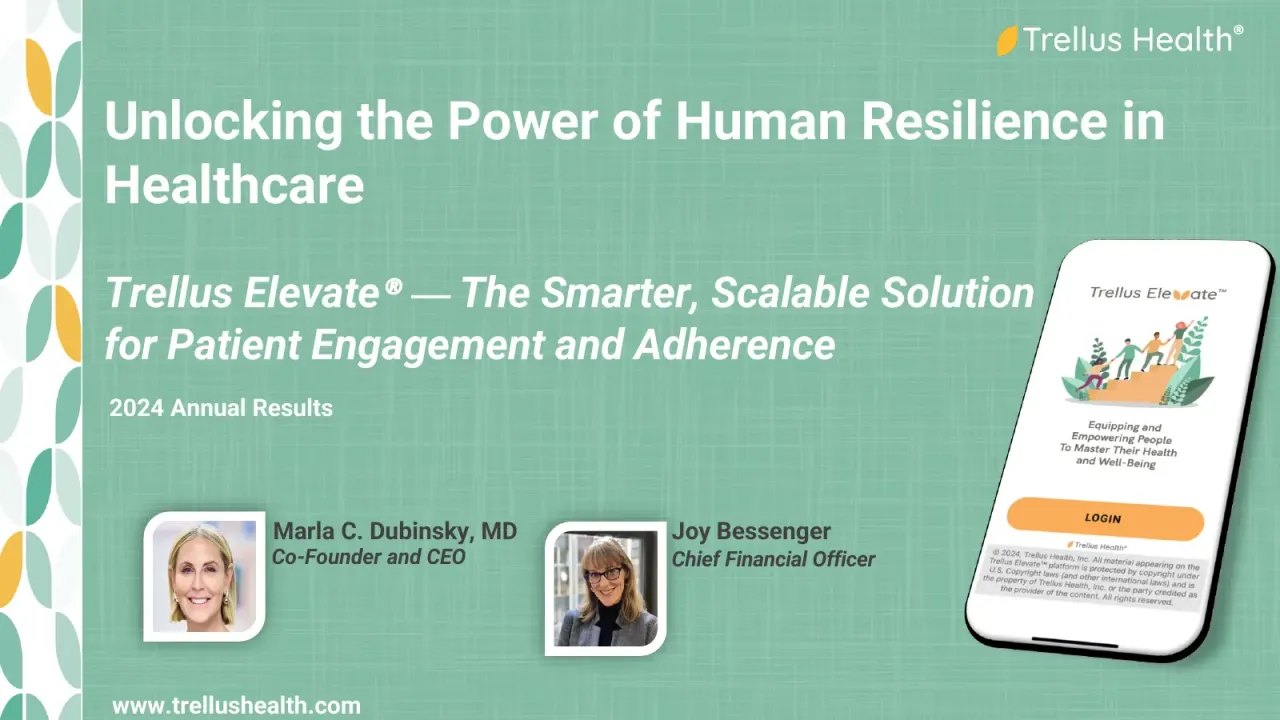
0:33 to the investor meet for TRLS Health, our 2024 annual results. And I'm accompanied today by our CFO, Joy Bessinger. Good morning, everybody. Right. So let's move forward. So here's our disclaimer slide. So to level set, I just wanna remind everybody sort of what TRLS and what our purpose and how we were built for scale. TRLS HEALTH is a healthcare company that's transforming the chronic condition management space through our proprietary resilience platform, which really is our differentiator with the goal of improving patient outcomes, reduce the cost of care, and really drive value across our three key partners, which are in the clinical trial space, pharma, manufacturers, as well as pharmacy distribution, and health plans. As I noted, our key differentiator really is our proprietary platform that is solely built and intended to improve people's engagements in their health, improve the adherence to these chronic, medications that individuals with these conditions need in order to, manage their condition because there is no cure and deliver better outcomes, and value. Why does that matter? Because often when patients are seen just through their medical history or just by definition through the medication they're taking, There really isn't that gap that is being filled with the human element of these chronic conditions, is our ability to bridge the critical gap between mental and
2:04 physical health, really helping people build that resilience, confidently engage in their own health, and improve the long term treatment success and the long term success of their health with these chronic incurable conditions. Our approach is really key and distinguishes ourself that we have a human and a health, and a technology approach. We have, as noted, our proprietary resilience based methodology that we have licensed exclusively from Mount Sinai, which is where we first tested this, model and approach to chronic condition management. We've got a very flexible and agile, customizable technology platform. We have personalized digital tools, and, of course, we have that missing element of the human factor where we have human led resilience coaching.
2:50 So just to start off with the highlights from 2024, we signed and launched our first commercial scale pilot with a large US health plan, and we had also extended our enrollment for this health plan to enable to enroll people over an extended six month period. We have signed two licensing agreements with pharma for licensing of our proprietary assessments as well as our some of our resilience content. We've strengthened our board with two key, really, appointments this year. We had Kevin Murphy, junior, who was appointed as our nonexec director and chair who brings extensive US health care and specialty pharmacy experience, and then as well as a nonexec director, Brian Griffin, who also brings extensive US health care and pharmaceutical and pharmacy distribution expertise.
3:42 We also added a key team member to our c suite, miss Kathleen Williams, as our chief innovation officer who also has decades long experience in health care product development, engagement, and expertise in this space. We, as a platform that delivers health care, obviously, important that we have privacy and security security, and we received and maintain our site SOC two type two certification, which is industry standards for really system security and reliability. And we have sustained our operational scalability while extending the cash runway into October 2025. In terms of our post period highlights, in January, we signed our agreement with J and J, Johnson and Johnson, to support a pilot in The US for individuals with moderate to severely active inflammatory bowel disease who are enrolled in their patient support programs for the various J and J therapies that are specifically treating individuals with inflammatory bowel disease.
4:48 And we just recently actually launched the program as we had a implementation phase to get all of the, processes and tech in play, and then, launched it, just a few weeks ago, actually, which was timed with them actually launching their Crohn's indication. Originally, they had had most this newer therapy that had come out for ulcerative colitis and now got recently approved for Crohn's. We've expanded it to access for both Crohn's and ulcerative colitis, which was important for TRELLUS. We renewed our Pfizer licensing agreement, which again is pharma licensing our resilience content put within their own patient support program services as opposed to j and j where we are providing that ancillary support.
5:36 All of our services, Pfizer was specifically licensing our resilience education content. We've also expanded and adapted our platform to new verticals, which we'll talk about in just a moment. We've also, at the same time, deepened and advanced our pipeline and ongoing commercial discussions across all the verticals and as well, of course,
5:57 recertified for SOC two maintaining those standards. I'm gonna now turn it over to Joy. Before we get deeper into sort of the why and and who our clients are and what we're doing, I'm gonna turn it over to Joy to just update our 2024 financial highlights. Thank you, Marla. We actually we since we had announced in a company trading update in early March what our cash position was. For net cash, 04/30/2025 is 2,500,000. At the end of the year, it was 4,300,000. And our company's cash runway is still extended into October 2025, which is what we put out in the trading update earlier this year. Our adjusted EBITDA loss is 7,200,000, which is in line with our expectations versus a 5,800,000 loss year over year, and we have revenue last year at a 114,000.
6:49 In June, it was 50,000. Year over year, was 19 k. We've also announced current revenue run to through May 30 year to date is 340,000. That is current contracted revenues only. Capital investment today in technology platform or companion software is 9,600,000. It was 9,400,000 in June and 9.2 at the end of the year previously. As we've talked about before, we are starting to be able to lower our capital investment into the software and large SaaS platform because we have made that investment, and now we're able to expand into these other verticals and launch new programs with very little additional cost.
7:35 And that has allowed us even as we've ramped up for j and j and continue to build up commercial traction. Debt disciplined cash management continues, and we have reduced by 22% our average monthly burn from 635,000 last year to 500,000 monthly year to date. We continue to be on
7:56 track with that. I do think it's worth stating that the average burn of 635 actually encompasses a range between $7.40 and $5.80. So that really shows you that not only have we been very good about our cash management, we have also been very consistent in this new year at 500,000, and we continue to look for opportunities to achieve further cost reductions. Back to you, Marla. Thank you. So after the highlights and sort of talking about financially and operationally, let's just remind everybody a level set as to why we're doing what we're doing. And at the end of the day, it all comes down to money. And really, the current model, whether you're in the NHS system or The US healthcare system or any healthcare system globally, we know that chronic conditions are on the rise, specifically those that are related to underlying inflammatory or autoimmune diseases.
8:52 Because within that space, which is really where TRELLUS is able to have its most value, is you take individuals that are diagnosed young, lifelong, chronic, incurable, inflammatory, and immune diseases that, again, I say are on the rise. They need expensive lifelong medications to sustain their disease and try and keep them away from the hospital and surgeries. And, also, there's a very high mental health comorbidity. And once an individual has developed anxiety and depression, a lot of, the stress, around having a chronic incurable condition that is dependent on this medication, me taking it regularly, not missing a dose, for example, that creates a lot of worry and stress.
9:40 And that is where individuals who develop these anxieties and depressions are often feeling the meds are not working, stopping the meds, ending up in the operating room, and the cycle starts all over again. So we talk about there's a lot of waste both in time, money, and opportunity at the expense of outcomes. Now, typically, the way we deliver support for people is we wait for them to develop anxiety and depression and say, oh, wait. I've got something that's gonna put you back to functioning in society. And we'll talk in just a minute about the distinguishing quality between what we deliver in that sort of holistic space compared to some of the other tools that are out there. But essentially, across the board, whether it's people with chronic conditions that are in trials, whether it's people with chronic conditions that are using a drug that's approved, it doesn't really matter where in that patient's journey that we are that we know that the system is broken. And we need to empower people Mhmm. To be able to better self manage, better engage, and better adhere if we're gonna actually bend this cost curve. And that's sort of where we're really focused. And the title of the slide is intent.
10:55 Driving costs regardless of the current model, delays in getting drugs to market, delays in people getting on drugs, and dropouts, meaning clinical trials are not being done or happening because we can't get patients into the trial, and patients are not retaining on the trial. So in totality, there's a problem, and this was sort of the concept of why we feel we've got a really important solution. And when we talk about what's the solution, again, it goes back to our differentiator, and that is TRELLUS HEALTH Just to remind you the three core components of our solution and why we the the value is is quite clear is we've got the science powered platform that is proactively identifying people who are at risk of mental health comorbidities, at risk of going to the A and E, at risk of not using their medications, we are able to measure that, then deploy our very important sort of behavior changing tools and close the mindset gap. Because what we know
12:02 is that the mindset matters as much as their medical history. And so a lot of AI is trying to identify people who are at risk of something in the chart, in the medical record. The medical record is not able to automate the individual's mindset, and that's why the system is broken, is we are not looking at the individual's mindset, attitudes, and behaviors that they bring to their condition and their therapy in order to instill change. And we have both this human and tech component, and we use technology to make our humans more efficient. So what does it mean to be resilient? And I've heard the term resiliency in the face of often, like, positive psychology and employee resilience, and that is an important concept.
12:53 But the resilience in in the chronic condition space is a little bit different. In a sense, what we do, if we take the column in the middle, and we are able to measure the low resilient behaviors that are actually happening in our patients, we can categorize those into five targets that we could change, and they're under that resilience target. If someone has low disease acceptance, they are not going to adhere to their to their medication. They won't understand that this medication is actually the reason why they feel well. If they cannot regulate their emotions or their clinical symptoms, that leads to frequent symptoms and lack of follow through with the health care system with their medications.
13:39 If you have no hope or optimism, and you are pessimistic, this drug is not going to work. It really won't work because you're probably going to not be motivated to take it, and you're not gonna stay on it. If I don't have access, if I can't logistically
13:55 get to a clinical trial site, or I can't even get to my doctor's appointment, that is isolating and loneliness. Therefore, individuals have difficulty engaging with their care team and staying on track. And if you're not self effective and you're not confident that you are actually going to get better, patients are not going to adhere to their treatment plans. And I think at the end of it, when you look at what the negative impact is, everyone can understand where TRELLUS can solve for the issue of high health care utilization, being low resilient behaviors for health plans, able to help people stay on their meds once they've been prescribed a med, and help people stay on clinical trials and get them into clinical trials to be hopeful that this is the next drug that is actually going to work for them. So that this framework has really allowed us to apply our methodology to multiple different populations, same method.
14:54 And that's what's really unique about our methodology is it's adaptable and flexible to the outcome of a client. And so if a client wants a patient to be more adherent, we know exactly what are the behaviors we can measure and identify and fix. And that's really the unique nature of why we although we started, and those of you who have been with us from the beginning, we started in the health plan space, and being able to be a value based care partner to health insurance companies to be able to say, hey, use us to wrap around your members that are diagnosed with IBD in particular to start with, and we're gonna wrap around, and we're gonna save you money like we did at Mount Sinai. And that was sort of our we got introduced to the concept with United and where why we were within their value based care innovation modeling into where we fit in in that space. However, what we saw very quickly within the individuals who were from the United program is that one of the most important tools and empowerment that our patients felt when they were on the platform, they had hope, they had optimism, they were more confident in their medication, and they stayed on their medications.
16:10 So what we were learning literally as we were seeing change instill on the patient population is what we were able to see that indeed, what resiliency does is it actually improves the individual's ability to engage and adhere and persist to their meds. We knew immediately that another important key partner for us would therefore to go directly to the pharmaceutical manufacturer instead of working through the health plan. Why don't we partner directly with the pharma who have these patient support programs that wrap around their drug. Right? And they're they do offer things beyond just the treatment. And one of the ways that we're partnering with J and J and the reason why we our contract is set out as fourth is that we are there that when an individual with inflammatory bowel disease is prescribed a J and J therapy and enrolls in their patient support program services, they will be offered TRELLUS HEALTH PLC as part of their services.
17:19 Now many of these patient support programs, particularly in The United States, offer a multitude of services, patient financial assistance, drug programming, getting drug in patient's hands, which is very important. But the missing link was really this empowering using resiliency to bridge the emotional and physical gaps to keep people on their meds. So it's very clear that if engagement and adherence is the outcome of our resiliency programming, we are able to keep patients on their meds, which translates to refills and persistency. And that made sense for us in our PSP business. It also made sense that if we're helpful post commercialization,
18:04 what about pre commercialization? What about in the development landscape? Don't the same principles of resiliency apply such that if I'm resilient and my doctor thinks that I should be in this clinical trial, if I have the right mindset, that'll help me understand why this trial is important for me, why I shouldn't be motivated to participate, and more importantly, why should I be motivated to persist on the trial and retain all the way to completion. And we know that those are huge bottlenecks for pharma across the board. We've got the pharma bottleneck on recruitment and retention. And just as a reminder, on average in larger trials, it costs pharma sponsors about a $100,000 a day.
18:53 The every day that the trial is beyond what it was set enrollment recruitment timelines. More importantly, it's a day less on market. So if you add that totality together, you can imagine that if our pitch and our ROI in what we're delivering to the trials clinical trial space and our partners is that we get you through your recruitment timelines faster, get your study completed faster, and actually have the right people in the trial that are gonna influence your data, you can imagine,
19:26 sort of the light bulb moments as to how the ROI is very clear. Similarly, I noted in the patient support space, it's very clear that if I can keep as a pharmaceutical manufacturer, someone on my drug longer, engage with me as customer loyalty, keep doing refills and persist on my drug, that's a very big market differentiator. And they could say to those that are actually, they're trying to get paid for their therapy, say, Listen, we have partnered with a third party, TRLS, that is actually designed to keep people out of the hospital. And therefore, we are a better therapy in theory. Right? Let them have that discussion that they're delivering value to the health plan and making the ROI clear to the health plan is paying them for that drug, and we're there to help facilitate that. And we become the value based enabler, so still operating in the health plan space, but a little bit different and partnering with pharma who are then having the discussions on value with the health plans, an important distinguishing, quality there.
20:35 In terms of what I thought now is before we get into a little bit more around the background, because I think it's always important to gain these nuggets as to why we're doing what we're doing, in our three verticals, I thought I would just have Joy sort of walk through for all of you sort of how we've also grown and have a new approach to how we're pricing really to give a much more sustainable approach. Thanks, Marlena. So just very quickly, what we have discovered with J and J and subsequent ongoing conversations is we have a real model to build sustainable and scalable revenue. What we realized compared to the health plan, the original health plan pilot, which was a per engaged member per month model.
21:21 First, if you're getting paid by click, you're gonna need very high volumes, and that really didn't takes away from the pro the value of the program we offer. And the other thing is people use the platform and the programs differently. They're customized to the person in their very specific challenges and take them in a certain work order. So some people will log in four times a month. Some people will log in once, talk to their NAV, and then go up and actually apply what they've learned to the real world. So what we have found with J and J and the other conversations we're having is we're getting an upfront implementation fee to customize the program for the client's specific needs, and then we're getting a monthly management fee, is the same amount whether we have five people on or a thousand people on.
22:14 Within some of these contracts, we will hit a certain number and then the monthly management fee increases. But what it does do for us is it covers the cost mostly of us running the program for each client. And that is true across all of our verticals. What we've also seen is that pharma's generally from end to end, they're very open and supportive of milestones and pay for performance fees both in the PSP and the clinical trials. So I think as we've grown, we've actually seen that this is the best way to price the model, and we know from market response commercially that this is a way forward that they're very comfortable with structuring deals and doing business, not just in the pilot, but as we move forward with them.
23:02 And then we get a a much larger licensing fees we expand. So it's a very nimble and sustainable approach, and it really provides us for the first time, I think, with a real view to what our long term revenue and growth opportunities are. And Marla's gonna give you a little bit more color about how we're gonna get there. Yeah. Thank you. Just a reminder as well because after, you know, we talk about what we plan on doing, what is your real value? Like, what's the asset and what are you really selling to to clients is just the fact that this is definitively a unique and differentiator of how individuals with chronic conditions are approached. And that typically most of this cognitive behavioral therapy apps that are out there, for example, you can only deliver them to people who've already gotten anxiety and depression, Right? So it's too late. That's that reactive sort of concept of waiting for people to get sick physically and mentally and then saying, Oh, let me put you back to functioning in society.
24:01 But people want to do more than function. They don't wanna be defined by their symptoms or their chronic condition or the med that they're on or the pharmacy they talk to. They want a different model. So what our, scientific cofounder has done is really taken all the best of what we talk about in terms of human flourishment in a strength based psychological model, and then sort of blended that with the key points of what we call a deficits model, which is what the cognitive behavioral therapy, put that together into one resilience model, which is really the first resilience based model to be applied specifically and only for chronic conditions that are that overlay of high risk of mental health comorbidity and a high pharmacy and medical, medicine spend. And that was really the unique aspect of what we bring to the table.
24:54 And just a reminder, how do we feel confident in it and how did we do it and remind me why this works is this is born out of what we saw and published originally when we came to the market around the fact is that when you measure someone's resilience, you figure out how low beyond below our threshold of 70 to be defined as resilient. Figure out what are those attitudes, beliefs, and behaviors contributing to this low resilience. Fix it. Deploy them to a training program, and lo and behold, as shown here, the teal is their baseline, meaning before the program. The gold is one year after the program, and the blue is two years. And we're happy to say that we just published two weeks ago our two year data. And although, yes, there's a slight increase compared to the yellow, when you look at the decrease from day zero, long after they came out of the program, they developed their resilient mindset and off they went, we still had a sustained improved outcomes, ED visit reduction, and hospitalization.
26:01 And that is what our clients want to see, that this is not just a transactional twelve week app that actually while you're on it, you look really great and you're feeling really good, but there's no change in mindset. And no one customized that CBT to your personal attitudes, beliefs, and behaviors that are associated with your mental health. They're just treating a symptom. And it's a really unique differentiator that, you know, I as you know, you've heard me keep wanting to repeat because it is something new, and sometimes we need to educate a little bit around it to ensure that we're giving the most value to you as to understanding of what we're actually delivering and talking to clients about. So at a very simple level, because we're often asked by our clients and and folks we're talking to, like, how does it really work? What is this? Well, what it is, trying to make it as simple as possible is you have a page, you go fill out step one, your own personal resilience assessment.
27:01 We get a score. You meet with our our expert, elevate navigator, which is our team member that actually reviews the score with you, finds out more some of the challenges that are surrounding why you answered your assessment in a certain way, get you to download the app. And step three is go into the program and thrive and get all of your personalized resilience training all in one secure platform. And that's sort of the the operational at a high level. And one thing to be clear is that no matter who our
27:33 client is, we deliver the same three steps. That's the that's the good part about it is that we have our process, but the questions we ask may be different if it's a clinical trial participant versus a p you know, a patient support program patient versus a health plan patient. But the core, it's the method and the platform that is delivering the results of what happens when you empower people with resilience. And the other, you know, notable nature of it is that when we get people to speak to our navigator, they completed their assessment online, they go and speak to their first human contact with an individual at TRLS who is an expert on resilience, that nine out of 10 people press click now, I want to join. And that is a very high engagement rate. And in addition, our customer surveys, which is the CSAT, which is their satisfaction sorry, customer satisfaction, that that call alone generates a 4.8 out of five rating. That is, again, a very high satisfaction for a digital application program. And it's really important to understand that our human led team and the first person you meet becomes the individual that is sort of like your Sherpa and your guide throughout the program.
28:58 We also know that in a very short period of time,
29:01 when you're resilient, you are more confident. When you have more confidence, your behavior change. And we know that if we can improve people to be confident about a clinical trial, to be confident that their medication is working, to be confident they can keep their disease in remission, health care utilization drops dramatically, mental health rates drop dramatically, and people stay on their medication. It is it is a known this is a known sort of correlation and association, and it's all tied to greater resilience. And that's why us developing a resilience platform designed and tailored specifically only to people with these chronic immune and inflammatory conditions whereby prevention of mental health is critical to keep people away from the ED and from their hospital, from the hospitalizations, and in some of these conditions, surgery, which is really mission critical. Right? So I'm gonna hand it over to Joy who's gonna wrap up, sort of, again, highlight our go to market strategy and share with you our attraction and upcoming milestones. Thank you. Well, as Marla has already thoroughly covered our key customers and growth markets for pharma services and distributions that includes both large pharma manufacturers as well as specialty pharmacies and PBMs, are part of the health plan sector. And clinical trial services is a focus for us as well.
30:29 What we understand going forward to continue to grow the business is to further embed TRLS elevate into pharma patient support programs and clinical the clinical trial ecosystem from both the recruitment side and retention side and long term extension studies. We are also continuing to drive value based innovation for health plans with a real particular focus on self insured large employers. And importantly, we're very confident about this because we were founded out of the fact that Mount Sinai itself is a large self insured employer, and they absorb the cost of care for their employees in a way that a company that contracts with the United, for example, does not necessarily. And the key differentiator that we offer is a scalable and very validated resilience platform, and we know it transforms engagement and enhances adherence and persistence and drive sustained outcome improvements as we're gonna show you with our two year data.
31:26 For traction upcoming milestones, we're not going to give specific timelines because I think everybody listening to us knows that we're out of the prediction business. We're terrible at it, but we also understand our pipeline. So our key partnerships right now is obviously J and J. In the licensing space, we licensed to AstraZeneca content for an assessment for them to use in their clinical trials. And then we just renewed our Pfizer plan. We have licensed to them some educational content. And we continue to have the largest health plan. We continue to have members on the platform and going through the program. Upcoming milestones, we're gonna continue to execute on J and J, and we have a focus on expanding that program.
32:11 We're further strengthening our position across pharma patient support programs, And we're diverting across multiple chronic conditions. So IBD has always been a foundational therapy for us, but we understand that there is a lot of expansion for us in immunology. And I think it's worth saying right now that clinical trials is our first truly disease agnostic program. It is designed for anyone going into a clinical trial whether they have cancer, whether they have any of the autoimmune diseases. So it's a great proving ground for us. I also think it's worth noting, I think Marlo talked about it a little bit before, but we also believe not just diversifying across multiple chronic conditions. Most specialty therapies don't just treat IBD or don't just treat an autoimmune disease, they treat a handful of autoimmune diseases. We can also expand our product outreach not just to the disease state, but to a drug and wrap around the five indications that might be covered by that drug. So we have a very clear path forward. We really look forward to coming back telling you more about it. Excellent. Take us home, Marla, as they say. Here we go. So, again, you know, just to continue to talk about, you know, how our methodology and our platform is driving value.
33:35 And sort of this graphic just summarizes sort of the key highlights where we are as a company, with our growing commercial traction, our ability to expand and start to have, you know, important discussions about how we apply resiliency, particularly as Joy noted, into the recruitment and retention. I just want to, for for clinical trials is that this is really working with big pharma who are trying to get their drug, for example, in phase three. So the drug is already past the phase two moving to phase three. So big pharma are running these global development programs. And not only did we come out with a tool and a program, the assessment as well as the tools that we do to help people get more motivated and engaged for clinical trials? As Joy noted, it doesn't matter what drug we're testing or what trial name, and it doesn't matter what disease state you have that the drug is being tested.
34:30 But as well, it it's also a global opportunity for us because right now, in the patient support programming and our health plans, yes, as you know, we've been focused on a very large market. I just wanna remind even in our, as noted, our foundational or gateway disease with IBD, fifty percent of the world's population, that would be probably any autoimmune disease to be fair, it could even be more, lives in The United States Of America. So for for in the clinical trial space, the IBD and any other inflammatory disease state, The US is their largest market for enrollment. However, because of the complexities of, some of the recruitment that's happening in The US, not only are we gonna help The US, we're also gonna be available across global because our platform, as we're working towards GDPR, etcetera, is we'll be able to be more global, which I think was also one of the things that we hadn't really focused on in the past is our ability to now be agile across conditions, now be agile across therapies.
35:37 And also with our AstraZeneca licensing, are we actually got our resilience proprietary assessments translated into 57 different languages, which means we will be ready. So I think there's a lot, and you can tell probably from our passion and our excitement around this, is we're at really a really exciting point where TRELLUS is now taking our unique superpower and applying it across the entire end to end for pharma, including any of the distribution, the services, the pharmacies that are actually delivering the drug to our patients. So I'll stop there and open it up for review any questions you may have, and really thank you so much for for meeting with us today.
36:27 Thank you. Yeah. That's great. Marla, Troy, thank you very much for presentation. What I'll do at this point is I'll just bring your cameras back up for the q and a. Ladies and gentlemen, please do continue to submit your questions. Just placing the q and a tab that's situated on the top right hand corner of your screen. Just while the company take a few moments to review the questions that have been submitted today, I'd like to remind you the recording of this presentation along with a copy of the slides and the published q and a can be accessed via your investor dashboards. As you can see, we have received questions throughout today's presentation. What I'll do is I'll just hand back to you, Marla, to run through the questions, and I'll pick up from you at the end. Sure. So one of the questions was a little bit, which I think we did start to address. I just wanna talk about what what other chronic conditions do we plan to scale the platform? And I sort of I think both Joy and I sort of hinted at the ideas that we're gonna be living in a space whereby there's a disease state that Joy mentioned that a drug applies to whatever indication. I'll use an example of therapy that is out there now in the immune space, a drug called RINVOQ, which is an AbbVie product. It's approved for eight different immune conditions. So I'm using that as an example.
37:34 Similarly, if you look up J and J, you could see what their portfolio is in the INI, we call it inflammatory and immune space. The drugs apply across four to five different different conditions. So as you want to sort of understand for us and help, you know, come along the road with us is exactly that, that we understand the path. We know that you start with a defined population, a defined number, and a defined therapy. Right? That's how we started, and that's sort of where we are, and that's sort of disclosed publicly around what we are doing with changing. But to imagine that what's next is can we go beyond a certain set of number of people we can deliver it to with a condition? But more importantly, can we take that one drug and expand it across all of its indications if it works in IBD? Right? So you could see that, you know, it's not just there was a strategy reason, by the way, IBD is an important no matter if you talk to big pharma, AbbVie, Takeda, Lilly, and, J and J, who you talk to, I and I is their path really, you know, for it. It is a it's believe it or not, it's very common, but it's increasing globally.
38:47 Right? That's the other thing. It's becoming a global problem. Diet, westernization, unclear what the underlying reasons for this. But the globalization and the fact that we have something that could attach itself to a drug or a condition, I think, Peter, that sort of lends itself to an understanding that we have a plan. And that's why I wanted to highlight on the clinical trial side the importance of us having translated assessments. If we're actually gonna be screening people to see who's resilient or not, that needed to be in every language, not just English. So there is a path for it. Joy, the question which I think is fair is what's the typical contract length and renewal sort of rates as you go through and when you're creating sort of milestones and ways to go beyond the first Mhmm. Contract?
39:36 So, actually, I'm just gonna paint some broad strokes. So with with J and J, for example, we understood that it was that first foray into having a monthly management fee. Most of our and then an opportunity to have a licensing fee. Most of the pilots that we're going to do, and just to be clear, pilots aren't about size anymore in The US. I mean, sorry, in TRLS. It is what all pharmas across the globe like to call your very first contract with them. And often what we're seeing is we're having flexibility built into contracts and during negotiations so that we don't have to run for the full length of the pilot before we're able to expand the contract.
40:22 When you expand the contract, you often go into multiyear. Usually, three years can be longer, can be a little shorter, but it's definitely longer than a year. And you have mapped out you've added in milestone payments and performance
40:37 performance based payments as well, and your licensing fees will generally be much more generous than in the pilot situation. So I think we have, again, a real insight into what the business and the growth of the revenues will look like in a sustainable way, but in an awesome, importantly for us, a predictable way, a way that we can project and feel comfortable with those projections. And I look forward to being able to talk about this more next time in front of you. Yeah. And to be fair, the rest of the questions were sort of around that, which is, like, when are we gonna have a little bit more clarity on, you know, the sustainability Mhmm. And also Yep. What we're exploring as we noted the three forty and sort of what are some of the plans around financing or fundraising. So maybe at a high level, you can see. I think what
41:26 we can say is, which was what we said in the press release, with the board's full support and having crunched many, many numbers for the board and for ourselves as we went through the process earlier this year. We are reasonably confident we are going to be to bring in more funding to continue to execute at this moment of really exciting growth for us. And we are continuing commercial discussions and exploring our both our commercial interfunding options, all of them, and there's still not done turn, and we have backup plans on our backup plans. And we really do look forward to coming back and being able to talk about that more at a later time. Yeah. And thanks for those questions.
42:11 Those are great questions. Thank you, everybody. And, you know, again, thank you all for, you know, hearing more about what we're doing and how we're taking what we originally started the conversation with, and we've actually made it into a much larger conversation, which speaks to the agility, I would say, of us understanding when if one vertical isn't giving the sustained fiduciary responsibility back to our shareholders and our investors, TRELLUS has the resiliency. And by the way, when you're more resilient, you're more confident. So there's a direct link. So, you of course, like you say, we have the advantage of knowing what's actually happening. And so we're we feel, as Joy noted, confident in our in us moving forward and being able to have and look at all the opportunities we can as as the question was asked. So at this point, since there's no other questions, thank you.
43:04 And we look forward to seeing you all soon and continuing with the news. Thank you. Thank you, everybody. That's great. Nala, Joy, thank you once again for updating investors today. Can I please ask investors not to close the session as you now be automatically redirected to provide your feedback in order the management team can better understand your views and expectations? This will then take a few minutes to complete, but some should be greatly valued by the company. On behalf of management team of TRELLUS HEALTH PLC, we'd like to thank you for attending today's presentation, and good morning to you all.
Follow Trellus Health PLC into a list and get an email when it puts out news.
CEO at TRELLUS HEALTH PLC
CFO at TRELLUS HEALTH PLC