Transcript
Automated transcript · Written by software from the replay's audio. It can mishear names and figures; the replay is the record.
0:08 Okay, good morning or afternoon or evening everyone, depending on which part of the world you're signing in from. Welcome to Benchmark Metal's update on recent drilling results. I realize many of you may not have heard the story, so we'll break this presentation up into several facets, but just an initial introduction. And then we'll introduce Malcolm Dorsey, Benchmark Senior Exploration Geologist, and he will run through some of the technical and compelling reasons why this Cliff Creek South Zone is opening up. But in addition to that, he'll walk through some of the new exploration targets that are presented throughout the property.
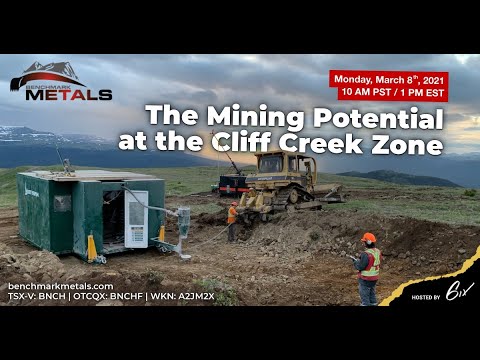
0:55 I'd like to thank Dasha at 6 Media for establishing the webinar at late notice. And for those of you who are new to the story, this opening slide here provides a great photo of the resource areas. This is a formerly producing mine from the late 1980s. It was a small producing mine that generated gold and silver from high grade narrow areas. But the difference in the story this time is it's a much larger mining potential. We believe this project has world-class potential And we think you'll see this potential in the news and in the results we provide through the presentation.
1:42 And certainly one of the rewards with former production is a road network across the property, which you can see some of our vehicles parked right next to the drill rigs, which helps decrease access costs, but also exploration costs. And of course, the typical disclaimer for a venture listed company, there are inherent risks, but we believe we're de-risking this project as we go forward. A quick snapshot of the management team and directors. I'm president and director and one of the original founders of the company. So is John Williamson, who is CEO and chairman. Both of us have well over 20 to 30 years experience in the mining sector.
2:31 We have taken new discoveries to production and production scenarios. So we are very technically inclined management team. There's a slew of other reputable colleagues and partners in the company who've had tremendous success in the resource sector. And then of course, joining me on this presentation is Malcolm Dorsey. Malcolm's a master's educated geologist. He spent considerable time at the project over the past year, year and 0.5. He's been helping build the drilling programs and Malcolm will speak later through this presentation.
3:14 Our project's located in north central British Columbia and we're calling this area the Golden Horseshoe. The horseshoe actually depicts the geological boundaries surrounding this deep basin in the center. Located near Benchmark's Lawyers Gold Silver Project is the Kamesh Gold Copper Mine. This is a world-class gold copper mine that's 45 kilometers southeast of Benchmarks Project. And directly to the western side of the Horseshoe or the basin, You can see other world-class resources and mines and that includes Freddiam's first track. Incidentally, the rocks, the age of the rocks given in gold and silver mineralization and just plain age of the rocks are very much the same as Benchmark's project.
4:05 And that's a good indicator that there is potential to build a mine at this site.
4:13 From a infrastructure standpoint, I mentioned that benchmark has a legacy here. There was former production from 1989. To 1992. We have direct road access from Prince George going straight north to psych. So there are several large centers within a drive to the project. We do pass the Kamez Gold Copper Mine on our way to the site. The Kamez Mine provides a power line tie-in to the British Columbia grid, which should reduce electrical costs, but also provides a nice corridor here to quickly get the mine into production when we're completed a feasibility study. We've also upgraded the roads and bridges.
5:01 The bridges and the roads are now amenable to heavy equipment. And there is an airstrip which we utilize on a somewhat regular basis. It's 13 kilometers from us, but during the 1980s and 90s, this sturdy airstrip was landing Hercules aircraft. So it's a sizable piece of infrastructure that we can utilize.
5:26 Corporate objectives. Last year we completed 87,000 meters of drilling, but we drilled in 2018 and 2019. We also have significant data from former production. So on the big milestones moving forward here in 2021, we anticipate our maiden bulk tonnage mineral resource to be published in late March. Perhaps it might stretch into early April, but it is weeks away. In addition to that, this year we will be drilling upwards of 100,000 metres to expand this new resource, but also move the project along the engineering and permitting path to a mining decision.
6:15 There's an awful lot of work planned through 2021, but the resource that's published in a matter of weeks will dovetail into a preliminary economic assessment, a PEA, and that will be published this summer. And we indeed believe that this PEA will show robust economics from the Gold and Silver resource that we're showing in a few weeks. In 2022, because of our cash position, we will be moving towards a feasibility study. So we will move very quickly from a PEA to a feasibility study with the cash that we have in hand in the treasury. And at that point, we're going to shovel in the ground type decision for money.
7:06 Our share structure is approximately 158 million shares outstanding. We have a cash position of just over $35 million. The key to this is we have options and warrants that are currently in the money between 30 and 40 cents. These warrants are starting to trickle in. There are investors exercising them, which means they've made money already on the story, which is very good. This could contribute another $6 million to the tax position. In addition to that, we have another 19 or close to 20 million warrants that are priced at $1.75. So Benchmark believes that as we move towards these big milestones over the coming months to 2 years, that there's an opportunity to move the market cap of this company and have all of those warrants exercised to bring additional money towards the treasury.
8:08 On our shareholder designation here, 20% of the stock is held by Eric Sprott. He's been a tremendous supporter of the company. Management and close associates own approximately 15% of the stock. In our large oversubscribed financing late 2020, we inserted some new institutional support and this support generally never invests pre-resource. So I think this signals the potential of the property, but also the past of the management and ability to succeed. This includes ASA Capital, VanEck Capital, and Franklin Templeton. We've got good support from some well-known resource-related banks.
8:58 This includes Sprott Capital, Clara Securities, and PI Financial.
9:05 And Now, right into the resource areas before I introduce Malcolm. This is the heart of the property. These are the 3 areas that will generate ounces in the coming weeks to come. You can see the depressed areas are pitch shells that benchmark design through the end of 2019. So these pitch shells do not include all of the drilling that was completed last year. The Cliff Creek resource area goes to approximately 300 metres depth and runs 1.2 kilometres in strike length, but it remains open at depth, remains open on strike. You can see the 2 neighbouring areas and resource zones, AGB to the far right of your screen and also Duke Surge to Phoenix.
9:55 Those areas will also provide additional ounces. In early 2020 last year, Ventura provided an exploration target of up to 1.9Moz Gold equivalent, grading 1.7g Gold equivalent for Cliff Creek. That total is for Cliff Creek only. And keep in mind, we believe we're confident that we have hit this target in the Cliff Creek zone, but perhaps surpassed it, given the deeper drilling showing the analyzation continues to 550 meters depth. And Malcolm will go into this. But this target doesn't include the Dukes Ridge zone and the AGB zone. So we expect a good, robust resource estimate coming from these 3 areas.
10:47 In addition to that, and Malcolm will get into it, there's tremendous new discovery potential across this big land package. We recently identified some big land targets to test drill for the 2021 program. And On the notice here of de-risking the project, we have completed metallurgy. We're showing Gold recovery of 98% and upwards of 97% on the Silver. This lends itself to using a conventional processing technology. This is likely to be gravity plus leaching and gravity or floatation. We are currently going through trade-off studies that would go into the PEA to identify which is the best method.
11:41 And without further ado, I will pass things off to Malcolm. Malcolm will run me through the potential of the Cliff Creek South area because that's where the recent news has been pushed out and published and without further ado, here you are. Welcome. Thank you. All right. Thanks, Jim. So on this side, what we're looking at is some longitudinal and cross sections of the Cliff Creek South Zone. So to give you an idea of where we're located, if you look up to the top left of the slide, you'll see a plan map of the Cliff Creek deposit and we're just down towards the south there. So on the bottom left you'll see a lawn section. Lawn sections are very good for showing the density of drilling.
12:27 So you can see that we've been increasing the density of drilling within the Cliff Creek South Zone. And then on the right hand side you can see a cross-section of the drilling that we've been doing. So one of the highlights that we've got here is in 20 CCDD 055. So this was a recent news release back on February 3rd. We released these results, and of course, very good results. We've had good results from surface down to depth, and this result is very good at 64 mirrors of 2.29 grands per tonne gold, 191.3 grands per tonne is very good at 64m of 2.29g per tonne gold, 191.3g per tonne silver, comes out to about 4.7g per tonne gold equivalent.
13:12 So this intercept is also very important. You can see that we're getting down towards the bottom of our 2019 model pit shells and of course we do have drilling that extends beyond those pit shells that we're awaiting a lot of assay results on. And also importantly if you look to the bottom left again at that longitudinal section, gives you an idea of the vertical depth. So this is about 350 meters below surface, which is about 100 meters vertical depth below our previously released hole 21, and that one was 221 meters of about 1 gram per ton gold equivalent. So very good results. We're seeing broad zones of high-grade bulk tonnage mineralization.
14:02 We've seen 3 different distinct types. We have that bulk tonnage, 1.01gptg equivalent across 221.53m. We're also getting high-grade bulk tonnage. That's this one that we released back on February 3rd. That's 4.68 gpm Gold equivalent across 64m.
14:25 And then we also have high grade. This is also going to provide some of our underground mining potential. So this is about 13.95 grams per tonne gold equivalent across 10.4 metres. So we're still open at depth, open along strikes, so still plenty more to check out and see as we continue drilling. If we go to this slide, if you look in the top left again at that plan view map, you can see that we're still in the Cliff Creek south zone, but we've actually stepped back about 100 meters to the south. This is one of our most well, this is our recent release that we released on March 5th.
15:11 This is looking at 20 cc DD 063. Within that, we're seeing broader zones of mineralisation. We're seeing more continuity of the mineralisation as we go to depth. We had 186m of 1.34g per tonne gold and 25.48g per tonne silver comes to about 1.66 grams per tonne gold equivalent. And again, if you look over to the bottom left, you'll see that longitudinal section, You'll see some of the more recent results outlined in red. So again, you'll see we're increasing density of drilling and we're getting very broad zones of mineralization that now extends down to about 400 m vertical depth. So we're seeing good mineralization right from surface down to 400 m vertical depth, and it seems to be increasing in extent, so it's broadening as well as greater continuity as we go to depth and to the south in the Cliff Creek zone.
16:20 As well as Jim mentioned, we'll also be checking out some additional targets during 2021, our exploration program.
16:30 So we've got 6 initial drill targets that we'll be checking out. That includes Marmot East, M-Grid, Giffords Edge, Lala and the Silver Pond zones. And all of these new high priority target areas have yielded significant gold and soil anomalies as well as high-grade rock samples. As you can see in the figure on the right-hand side, that figure is outlining some of those high-grade rock samples that we've got. Some of these you might be more familiar with that we have mentioned before, but Gifford's Edge and Lala is to the west of that. And there between our main resource areas and our new high priority Marmot Zone.
17:17 Marmot Zone, I'll be talking about a little bit as well. As you can see on the left-hand side there, we drilled it back in the previous season and we made a release back on January 13th. So as a pure exploration hole, we intersected 101 meters of core length of 0.82 grams per ton gold equivalent, so very promising as a new zone for drill targeting in our 2021 season. As well in this figure you can see just the sheer number of different areas that we've got that we can go and explore. The ones that you see in purple are the known gold occurrences. These ones we will continue to expand on in our 2021 season. The green circles that you see there, those are new soil anomalies that we've outlined. So again, untested soil anomalies, and it just goes to show the sheer number of areas that we've got for exploration to expand all along the plus 20 km northwest trending zone that we have.
18:24 So with all those new anomalies, we have an additional 14 plus targets that we will be doing geological work on to advance to a drill ready stage. And just to bring some attention back to the Marmot Zone, the Marmot Zone measures about 6 square kilometers and it has a strong resemblance to the Cliff Creek Resource Target, which is only located about 3 kilometers to the northwest. We did test it with 5 drill holes in last season. 4 of those 5 drill holes returned significant near gold surface and gold and silver mineralization at surface. We have that great intercept that included a high grade 2 meters core length of 4.52 grams per ton gold equivalent.
19:15 And we'll be coming back to continue to test this zone. You can see in the figure on the right, just the extent of the Marmot zone outlined in blue, as well as Marmot east to the right, to the east of the main Marmot zone. And within that footprint, we could actually fit all of our Cliff Creek, AGB and Phoenix, Dukes Ridge, Phoenix zones within just the Marmot footprint that we see here. So plenty of areas that we have to expand on and we're excited to see the results in 2021. So I'll be passing this back on to Jim at this point. Good, thanks, Ewan. A good summary here of the potential with new targets and then of course, the cliff-free zone, which is most definitely broadening and growing.
20:09 So really, a summary of the value proposition here in a few key points. This project is 100% owned by Benchmark Metals. It's a large land package. But the key milestones going ahead here is there's still drill results to come. This will be followed by our maiden bulk tonnage resource estimate from those 3 large zones. And then on the heels of the resource estimate, we'll be working towards a new preliminary economic assessment, and from there we should show the engineering and economic potential for the first time. The summer's drill plan is going to be upwards of 100,000 metres. That will be targeting expansion of the main zones in the centre, but also targeting new discovery areas that are waiting for the drill bit.
21:05 And along this path, because of our treasury, we're fully financed to complete a feasibility study in 2022. So all of the work we do this year and into 2022 will support an economic and engineering feasibility study and at that point we reach the mining decision. So there's a lot of value baked into benchmark at the moment simply because of the cash and the position where we are where we have advanced it very, very quickly. And so at this point I'd be happy to open up the table here to questions. And I'll turn the table over to Dasha at 6 Media. And, Dasha, please go ahead and form any questions. Great, thank you so much. Yeah, so we'll jump right into the live Q&A portion of this summit, so if you have any other questions, please submit them now. But we have a lot of questions already. So the first question we have here is, was AGB and Phoenix included in the exploration target of 1.9 million ounces?
22:06 Or are they in addition to the 1.9 million? So the 1.9 million ounce target was for Cliff Creek Zone only. There's still potential in ounces that will be delivered from the AGB and Dukes Ridge zone in this next resource estimate coming up. Great, thank you. Ken is asking, are these various zones and targets within truckable distance to a central mill or operation? So if we were to advance to a mining decision or results in the PEA, the 3 main zones, Cliff Creek, Dukes Ridge, and AGB, would be the source of all material towards the mill and the plant.
22:53 And you're likely to see a mine life of probably well over 10 years. So At that point, the mill and the plant and the CAPEX will be paid for from cash flow. So all these new targets lying outside of the main zone will be likely trucked to the mill, But the operation will be in a more favorable position because we would anticipate that the project would be fully paid for at that point. And so this just brings incremental allowances to move you perhaps to well beyond 20 years of mining. All right, thank you. Are you expecting to come out at 2 to 3 million ounce?
23:40 And what other companies that have this kind of grade and size trading at in terms of a market cap?
23:47 So, you know, we're confident that we're gonna get close or perhaps improve upon that exploration target just at Cliff Creek, but we're still performing geological modeling and we still await some drill results. So it's too early to give a guesstimate of the resource size, but that will be published very soon.
24:12 And I've forgotten the second part of the question. Oh, comparable companies. Right. So in one of the slides in the presentation, we actually show 2 Canadian companies that we believe we will approach the market cap to, And one of them is Marathon Gold and Skeena Resources. So we believe there's the same type of scope and scale in achievable market cap. Those are good counterparts for measurement. Great. Thank you. Ken is asking, what kind of strip ratio is expected in the Cliff Creek zone and how far the various zones or target are. Right, thanks Ken.
24:58 It's too early to discuss the strip ratio simply because we don't have the resource in hand. However, with what Malcolm went through on the south end of Cliff Creek, it is most definitely showing that we're filling and widening the zones with more tonnage, more gold and silver, which then reduces the strip ratio. So these long intercepts are providing potential for more ore type material, and this should have a big impact on the strip ratio. But to provide a number is a bit too early until we have the resource model in our hands. All right. George is asking, why don't you drill a single hole from the surface in the direction of the mineralization to the bottom to see how deep it goes?
25:51 We have done some of those drill holes, but given mineralization is close to surface, we get more information by cross-cutting these zones because then we can see the margins on either side. But there has been a number of holes that have been literally drilled straight down the throat, if you will. And we perhaps may look at doing some more drilling just to show continuity on that side as well during this next round of drilling in 2021. All right, thank you. Helmut is asking, when does Benchmark Metals expect to see results from M-Grind? Will M-Grid be a new zone or an extension of CC? Will M-Grid be part of MRE 2021?
26:43 I'd say that the limited data we show from M-Grid is that there is mineralization there, But until we do more work in that area, it's to be determined. I think it will be a focus of additional drilling in 2021. There could be results to come out from from M-Grid, but and certainly they help with the resource, but I think the low hanging fruit here in that Cliff Creek zone truly is the north end and the south end where it's just more robust. But M-Grid could provide a small amount of additional ounces. Great, thank you.
27:29 Helmut has another question. Is it conceivable that benchmark metals will also drill to a depth of 1000 meters in 2021, for example on Silver Pond? I would say without a doubt there will be deeper drilling, certainly in Cliff Creek on the north and south end, and most certainly probably in the other areas. But again, we need to see the new resource area to truly plan for next year's drilling, but there will be deeper drilling because the deeper drilling results are already providing good rewards. And I'd also have to say that perhaps Silver Pond will see some deeper drilling as a new discovery target.
28:16 Great, thank you. Martin is just asking, why do you publish news of the drill results on Friday evening after the close of trading? And he's saying since he's seen Benchmark do it a few times, Can you explain if you see any advantages to that timing? Yeah, well look, there's never a perfect time to put out news. Sometimes it's Friday, sometimes it's Monday, sometimes it's repeated over a weekend, but increasingly what we see is that new investors are taking time to analyze the results. And sometimes when you put out good results on a Friday, it allows a new investor to spend the weekend studying and deciding whether or not they want to put in an order on following Monday.
29:07 But I'd say in general, it is a very random events and we disclose the news materially when we can. And sometimes we just can't control the results as to timing. Yeah, absolutely. Helmet has another question. What can we expect from the RE, measured and indicated in all 3 areas, CC, AGB and DR plus FHX? Yeah, okay, thanks Helmet. From the main zones, the majority of drilling will be in a measured and indicated category. So those 3 neighboring zones being Cliff Creek, H-E-B and Dukes Bridge, we will see M plus I are measured and indicated as the majority.
29:57 And then perhaps a smaller amount of inferred ounces at depth. Those will be the 3 and only zones contained within the mineral resource estimate. All right. David is asking, could you offer comparable assets? You mentioned SKE, but they're a much higher grade. Yeah, I think Marathon Gold is another good example, but you have to keep in mind, benchmark, this is its first bulk tonnage resource estimate. So there is potential here to grow it a lot more, improve the grade more. We're still early stages. And so those other companies, be it Skeena or Marathon Gold have gotten to a feasibility level and have many more years ahead of us.
30:47 So we're, you know, virtually a brand new company that has advanced this very, very quickly. But we're already showing great results. And I think when this resource comes out in weeks to perhaps a month's time. The notice here is there's opportunities to grow it more because it's wide open. There's also new targets. But there's also potential to improve the grade, especially with blitz lying at depth below the pits. So we're not bound by anything. This is still wide open in all directions. Great, thank you. Ken is wondering, does the core have to be crushed and grinded to process, or is there a much more economical process?
31:34 Yeah, so there's always a crush and grind involved with the core. And one of the stages of engineering we're going through over the coming months is to decide what size of incremental crush is required. But certainly a portion of this rock is amenable to gravity. And essentially gravity liberates the heavy gold and silver content as you crush and grind. But as you get to a smaller grind size, then you need to go into the heap leaching or solution workings to liberate more of the gold and silver. But certainly with gold and silver recovery into the high 90s, this looks to be a very rewarding and standard flow sheet for metallurgy.
32:29 Great. Yeah, This might follow up into Ken's question. What is the recovery if metallurgy tests were done? So we had up to 98% gold recovery and up to 97% on the silver. And part of the proof in the pudding here is when they mined this 30 years ago, they were only mining the high-grade narrow areas. And 30-year-old technology was getting, I think, upwards of 94% on the gold and 80% on the silver. So we've shown through analysis last year that we can improve this significantly. Great, thank you. Kai, I was wondering if you could just address the First Nations. He says they're very active participating in this.
33:18 They're very active participating in the project development. How does this work? Sure, so we have signed agreements with First Nations, and we're already in discussions to improve the agreements that we have to a more advanced process as we work down the permitting line. There have been a number of First Nations used for employment during project activity. We've engaged First Nations to help with the baseline environmental studies that are ongoing. And we're trying to be more sophisticated and engage the First Nations as much as possible. So we're First Nations are no question.
34:06 The groups that are in our territory are very intelligent. They're very sophisticated. They're looking for employment. They're looking for career jobs when this gets into a mine, and we're happy to work with them as much as we can going forward. Great. The next question we have here is, what depth was the old pit shell? And following up, it says, this is 100 meters deeper. Is this still in mineralization? Yeah, so specifically at the Cliff Creek zone, the 2019 model pitch shells we utilized were about 300 meters depth. But what we're seeing right now is that mineralization continues to be on 550 meters depth.
34:56 So in the resource estimate, we anticipate that the resource will drop lower. And beyond that, we think there's potential to show high grade mining potential below the new pit shells. So everything has been pulled lower vertically and it still remains open. If you were to look at the Cliff Creek or AGP area rather, the pit shells that we looked at internally but didn't publish a target there, we initially, originally through last year, we're looking at about a 200 to 250 meters vertical depth. We have now extended that to beyond 275 meters depth. So this is another incident where mineralization remains open and continues.
35:51 And so this is all part of the big upside on this story. Everything remains open on the main resource zone. So the next round of drilling in 2021 should reward us more on a second and new resource estimate for next year. All right, thank you. Manuel is asking, he's saying trading volume is relatively low despite good drill results. What do you think the reason is for this? I think part of the lower volume that we're seeing is just a result of gold, the physical gold price pulling back a little bit. It's not a big concern because I think the world in general is very forward-looking in terms of what is supporting the gold price.
36:42 And I think, you know, be it government debt, not only government debt, but worldwide debt in general, and then inflation are 2 factors that are going to move the gold price back up. So I think this is just a short-term correction. And As the gold price moves up, we should see the benchmark share price move up as well. But you've also got to keep in mind, there's 2 big milestones, a resource estimate and a preliminary economic assessment. And I think truly the market cap will respond to those events. Yes, of course. Peter is also asking, what is the actual delay for essays coming out of the lab at the moment? So current delays have actually been not so much that we're in a long queue. It's that you're seeing some silver numbers that are exceeding and some gold numbers.
37:36 They're both exceeding detection limits. And so there's these thresholds that the lab set up for first round of drilling in order to ensure quality assurance and quality control. And when you get spiking of gold and silver over these detection limits, it's going to go back in line for a re-assay to analyze the high-grade nature of it. And sometimes we've seen 3 levels of detection exceeded. So yes, it's delayed results, but it's actually a very good problem to have. It's showing that there's some high grade material in these resources. Thank you. Our next question here is saying that the huge drill hole of 186 m is that inside the exploration target area or expanded outwards? And In other words, is it possible to be larger than the 1.9 million ounce target?
38:34 So maybe I'll pass this over to you and Malcolm, sorry, just to answer that because he covered a little bit of this in his topic. Yeah, so that was within the resource target, but what we're seeing with other drilling is that that's happening outside of the pit zone as well. And with the increased broadening and continuity of mineralization, we're expecting that to continue, especially as it appears that the resource is open in all directions, so open to depth and open along strikes, so we can continue to step out and test this mineralization. Perfect, thank you. Kai is saying Marmot East has all the same characteristics as the Marmot Zone and will both be drilled, tested in 2021.
39:24 He's asking when in 2021. I would say late spring or early summer, but it's more likely the first target to be drilled is just the Marmot zone, simply because we already have evidence from drilling. And so it's going to be a bit of a process, But I would anticipate expansion and extensional drilling at Marmot. And then once the snow clears a little bit more, we can understand where the drill collars will be placed at Marmot East. But I would anticipate early in the drill program, we will begin hitting the new targets. Perfect.
40:11 Peter is asking, during the last presentation, you mentioned that more institutional investors will likely buy in before the RE. Could you elaborate on the actual status there? Sure, look, you know, there's a number of funds, I can't name any of them, but a number of funds that are operating in North America and Europe and actually Australia that buy in the open market. And usually they buy when they see opportunities for market cap growth. And the reason they buy in the open market is because they're not held to a hold period when a private placement occurs. So there are other funds, small funds and large funds that are taking quick observation of benchmark.
41:03 I believe some of them probably have already purchased in the open market, but others are likely to wait until they see the resource published to show that truly this is a large scope and scale mining endeavor. Great, thank you. Last question here. Kenneth is asking what amount of gold is free gold without crushing? Ken, I'd have to get back to you on that. I believe it's in the neighborhood of 40% recovery from gravity, but if you send me an email, I'd be happy to get back to you. This was a number we published with Metallurgy Results last year, So I'd have to go back, but it's a smaller amount is recovered from gravity, but the majority is covered either through major flotation or heat bleaching.
42:03 Yeah, I spoke to you soon. There's a few more questions here. So Helmut is asking, what is the current situation with the data room? Has the interest of majors in the data room increased recently with the new results? We still have a data room available. There has been considerable interest from third parties as we continue to publish new results. However, It's a time and value exercise here. We've said it before, we will continue to build towards a mining decision because we strongly believe that brings very good value to the company and shareholders. But if a suitor came along with a good offer to shareholders, we would seriously consider this.
42:53 But I think it's going to take time. This isn't going to be, if there were an offer, it's not going to be the day after the resource. You know, There's going to be more investigation, more discussion, more looking at the resource model, perhaps site visits. But there's no question, there's a good number of third parties who are enjoying looking at the data and their eyes are getting wider as we produce these big glaring drill numbers. Great. How many rigs will you have working in 2021? How many did you have last year and any idea on the size of the program in 2021? So last year we had 5 drill rigs running through the entire season.
43:43 I would anticipate 5 drill rigs again this year and a minimum of 100,000 meters. Again, this could change depending on what we see with results. Great, thank you so much. Well, thank you, Jim and Malcolm, for taking us through the presentation and the Q&A. And thank you to everyone who submitted all these great questions. If you think of a question after the summit or you didn't get your question answered, we will be sending out a short survey, and the benchmark metals team will be happy to follow up with you directly. I've also uploaded the presentation under the handouts file here. So quickly before we're done, download the presentation if you'd like, as well as this summit is being recorded, so it will be available on six.com afterwards.
44:34 And you can also find more information on their website at www.benchmarkmedals.com. So I'll just pass it back to you, Jim, for the final word. Thank you, Dasha. Yeah, look, everyone's watching this story closely, anticipating a good resource estimate. We're very confident on the scope and scale and size of this resource. There's still drill results to come over the next few weeks and some big milestone events. So this is a good opportunity to get into this story and please contact us. You