Adrian Saikal
promoter and hold time director at Tarsons Products Limited
Replay available
Tarsons Products (NSE:TARSONS) Q1 2027 earnings call, held 2026-08-11. Watch the replay and read the transcript on 6ix.
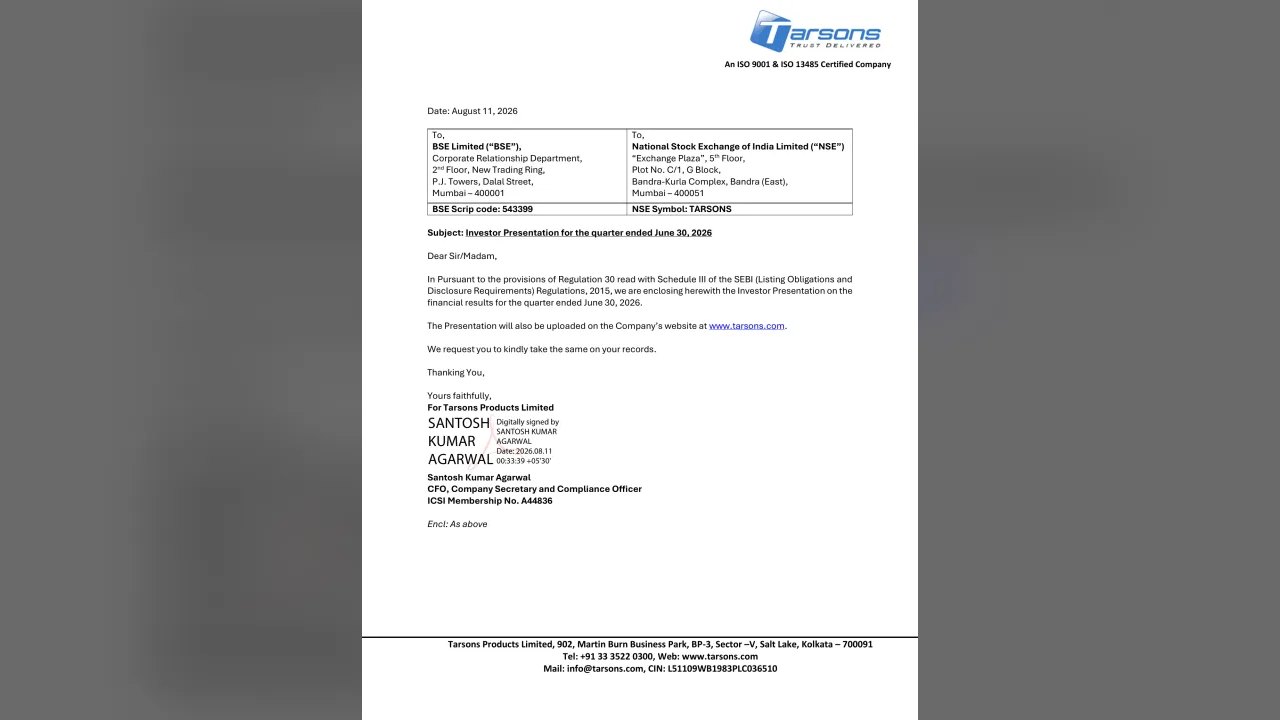
On 6ix: 6ix.com/event/tarsons-products-limited-tarsons-q1-2027-earnings-call
Automated transcript · Written by software from the replay's audio. It can mishear names and figures; the replay is the record.
0:01 Ladies and gentlemen, good day, and welcome to Tarsons Products Limited Q1 FY 'twenty seven Earnings Conference Call. Before we begin, I would like to point out that this conference call may contain forward looking statements about the company, which are based on beliefs, opinions and expectations of the company as on the date of this call. These statements are not the guarantees of future performance and involve risks and uncertainties that are difficult to predict. As a reminder, all participant lines will be in the listen only mode, and there will be an opportunity for you to ask questions after the presentation concludes. Please note that this conference is being recorded. I now hand the conference over to Mr.
0:47 Adrian Saikal, promoter and hold time director of Tarsons Products Limited. Thank you, and over to you, sir. Sir, you are not audible. I think your line is on mute. Am I audible? Yes, sir. You are audible now. Good afternoon, everybody, and a warm welcome to the Q1 FY 'twenty seven Earnings Call of Tarsons Products Limited. I'm joined today by along with Santosh Agarwal, our CFO and SGA, our Investor Relations partners. We have uploaded our results and investor presentation for the Q1 FY twenty seven on our website and the stock exchange.
1:37 I hope everybody had the opportunity to go through the same. Building on the momentum from the previous quarter, we delivered a healthy performance in Q1 FY 'twenty seven with consolidated revenue of INR 110 crore, growing by almost 21% Y o Y. Our stand alone revenue also grew by 21% Y o Y and came to INR 86 crores, marking our highest ever Q1 stand alone revenue. The performance reflects the resilience of our business model and our ability to deliver growth despite a challenging operating environment. Our domestic sales grew 17% Y o Y, supported by the strength of our extensive distribution network, deeper customer engagement and improving demand conditions.
2:28 We have seen a meaningful revival and improvement in the demand and momentum across end to end industries we serve with a notable uptick in customer inquiries during this quarter. Level of customer engagement during Q1 gives us confidence that the demand recovery is not merely transient, but has the potential to sustain and strengthen over the coming quarter. Importantly, this growth delivered in the quarter has been driven predominantly by our existing product portfolio with negligible contribution coming from our incremental capacities and newly introduced product categories. This is particularly encouraging from a forward looking perspective as it demonstrates the underlying strength of our core franchise while leaving significant headroom for growth as our expanded capacities and new products ramp up.
3:22 We believe this positions us well to capture the improving demand environment and deliver strong growth over the medium term. We have built the foundation for the next phase of growth through our investment in incremental capacities, enhanced manufacturing capabilities and expanded product portfolio. These investments are expected to contribute meaningfully over the coming years. Beyond the domestic market, our focus on expanding our international presence provides an additional avenue for growth. As our overseas footprint and capabilities scale, we see meaningful headroom to increase our overseas contribution and deliver sustainable profitable growth over the medium and long term.
4:11 Speaking of our overseas business, following the disruption witnessed in the previous quarters due to geopolitical tensions in West Asia and the uncertainties related to The U. S. Tariffs, our export business from India saw a healthy recovery, growing 29% in the first quarter. Customer inquiries and order pipelines have recovered with healthy momentum with increasing inquiry levels translating into healthy order conversions. While the operating environment remains dynamic, recovery is in customer activity and improving order visibility provide encouraging signs for the coming quarters. The growth in exports is also being supported by our ongoing participation in international trade fairs and exhibitions, which has further enhanced our visibility, enabled us to engage with new customers and markets.
5:06 The benefit of these initiatives are now increasingly translating into inquiries, customer additions and order wins. We are seeing encouraging opportunities in the white labeling segment and expect this to be a key growth driver in the export business going forward. As our international footprint expands and our brand gains greater traction, we believe exports represent a meaningful growth opportunity and remain well positioned to capitalize on improving market conditions. During the quarter, our German based subsidiary delivered a resilient performance with revenue growing approximately 6% year on year in constant currency terms. While the operating environment remains challenging, the business has demonstrated encouraging resilience.
5:54 We remain confident in its long term growth prospects supported by strong customer acceptance of the Nerve brand. We are confident of a considerable growth runway that can be unlocked through deeper integration and synergies between Nerve and Tarsons. Leveraging Nerve's established network and strong customer relationships to cross sell Tarsons manufactured products presents a meaningful opportunity for us. Thinking about our profitability, the margins moderated in Q1 FY 'twenty seven, primarily due to the sharp escalation in raw material prices over the recent months. Our key input costs have gone up anywhere in the range of 25% to 50%, putting pressure on gross margin.
6:41 EBITDA was further impacted by the operating costs associated with the recently commissioned facilities. All these facility ramp ups and revenue contribution scales progressively over coming years. We expect the operating leverage to support the margin expansion. To mitigate the impact of these higher input costs, we have implemented partial price increases during the quarter with full benefits expected to flow through with a one quarter lag. Also at the same time, we remain mindful of the competitive environment, and we'll continue to calibrate pricing as required in line with market conditions. Profit for quarter one remains impacted by higher depreciation and interest costs, followed by the commissioning of our new CapEx.
7:29 We expect the profit to remain relatively moderate in FY 'twenty seven as these costs are absorbed ahead of the full ramp up of the new facilities. Importantly, the underlying operating performance is expected to strengthen as new facilities scale up with improving capacity utilization and operating leverage supporting profitability going forward. This is reflected in the steady improvement in the cash profit, which has grown 18% year on year and stood at INR 25.6 crores on a consolidated basis. This increase in cash profit demonstrates the underlying cash generating strength and resilience of the business model. Around four years ago, Tarsons embarked on a large scale capacity expansion program with a clear strategic objective to significantly strengthen our manufacturing capabilities, expand our product portfolio and create a stronger platform for long term growth.
8:24 We are now in the final phase of this expansion journey with a substantial part of the planned CapEx already commissioned and operational. Over the past few quarters, we have progressively brought several new product categories online while adding capacities for existing products. Commissioning of the remaining facilities is progressing as planned with trial runs underway across select product lines. We expect these facilities to be fully commissioned during Q2 with revenue contribution beginning from second half. With a significant portion of the new capacity in our operation, our focus is shifting from capacity creation to utilization and commercialization.
9:11 These investments have substantially enhanced our manufacturing capabilities and product breadth, enabling us to address a wider range of customer requirements, deepen relationships with existing customers and participate in the fast growing segments of life science consumables market. As the production ramps up customer approvals and product adoption progress, we expect benefits of these investments to become increasingly visible from FY 'twenty eight onwards, supported by better fixed cost absorption and operating leverage. This expansion marks an important inflection point positioning Tarsons for sustainable revenue growth, greater market penetration and improved returns on invested capital. To summarize, I would like to say that the industry has experienced a challenging demand environment over the last few years, but we are now seeing signs of recovery.
10:03 Despite these challenges, Tarsons has consistently outperformed the industry and strengthened its competitive position. With the industry outlook turning more positive, we remain optimistic about a stronger growth trajectory moving forward. During this period, we undertook the largest ever CapEx program in the company, significantly expanding our capacities, capabilities and product portfolio, thereby creating a strong foundation for the next phase of growth. Going forward, as we deepen our presence across domestic and international markets, our ramp up utilization of our expanded capacities, we expect stronger revenue growth, improved operating leverage and a corresponding improvement in profitability. As all these factors unfold, remain highly optimistic about our company's growth trajectory over the medium term. With this, I'll hand over the call to Santosh. Thank you.
11:00 Thank you, and a very warm welcome to everyone on Q1 FY 'twenty seven earnings conference call. Let me take you through the financial highlights for the quarter. Revenue for Q1 FY 'twenty seven stood at 86.1 crore compared to INR 71.3 crore in Q1 FY 'twenty six, registering a growth of almost 21 on a year on year basis. Domestic business delivered a strong growth of 17%. Sport have rebounded strongly this quarter, growing by almost 29% on a Y o Y basis. Gross margin for the stand alone business in Q1 FY 'twenty seven stood at 67.1 percent, impacted by higher raw material costs arising from the spike in polymer prices.
11:52 EBITDA for Q1 FY 'twenty seven stood at 24.2 crore EBITDA margin was impacted by the lower gross margin and the higher commissioning and operational expenses related to the new facilities. We expect this cost to stabilize and margin to improve as utilization ramp up over the coming years. Profitability continues to be impacted by higher depreciation and interest expenses associated with the new CapEx. Cash profitability for the quarter stood at INR 25.2 crore, showing a healthy growth of 18% on a Y o Y basis. Speaking about the consolidated performance, consolidated revenue for Q1 FY twenty twenty seven stood at INR110.2 crores, registering a strong growth of 20.7% Y o Y basis.
12:41 Consolidated EBITDA in Q1 FY 'twenty seven stood at INR26 crores with the EBITDA margin at 23.6%. Cash profitability for Q1 FY 'twenty seven stood at INR25.6 crore, reflecting a growth of around 18% on a Y o Y basis. With this, we would like to open the floor for questions. Thank you very much. We will now begin the question and answer session. First question is from the line of Roshab Shah from Bugle Rock PMS. Please go ahead.
13:38 Yeah. Hi. Thanks for the opportunity. Sir, my question is on sports. During last few years, you have always, in our commentary, mentioned that we need to focus more on exports, and it will give us a significant growth. It's... I think market will give us more significant growth. It's still breaking. Yes, please go ahead. So my question was that in the last few years, we have always mentioned in our commentary that we need to focus more on exports, which will give us significant growth opportunities.
14:34 So what... Just wanted to know what would be our strategy to fight against these global peers since they have more stronger balance sheets and more number of SKUs as compared to Tarsons? So I think the segment the business segments are quite different. Most of the larger global peers in The U. S. And in Europe are branded players with established markets, established distribution networks and established customer bases. But as the world is moving more towards a better priced alternative with maintaining the same quality levels, I think the way our operations are positioned, we are a leading company being able to produce at very respectably high quality products at reasonable prices. We have a market which we can penetrate, which the global peers find it difficult or do not pay much attention to. And I think the bigger factor for us to look at this point in time is the global environment with the war, the conflicts, the rising escalation costs, tariff rates looming coming in and out every year. I think these are bigger problems than global competition. Global competition was always there pre COVID era as well and will continue to be there even today. And we are
16:04 well positioned to be able to find a spot in space for us in that market. Second question was how does each player differentiate itself in the market, like players like Tarsons, Aptos or Acumax? Can you give an idea a bit on the industry? How does one player differentiate itself? Is it only the product quality or the enterprise or something else also? Well, I think it's product qualities seems to be one of the most important points, followed closely by price. But I think the ability to deliver a large portfolio of products consistently to the customer over a considerable period of time is what differentiates various companies in the market.
16:56 Okay. And my last question is since we are looking to grow our business outside US and Europe, although we have majority of, revenue coming from there, but have we added any of marketing people in those countries where we need where we need to get validation from our customers like outside U. S. And Europe, have we taken steps to increase our business out there? We have taken steps. We do not have people directly positioned in those countries as of now. We have people working out of India looking after those territories, but we are in the process of even having more direct local presence as our revenues scale up and adding more distribution channels because most of the business which happens outside U. S. And Europe happens on a branded basis, not on an OEM basis.
17:57 Next question is from the line of Jastip Valia from Clockwind Capital. Sir, why has Panchala commercial commissioning has been delayed? Now in the beginning of FY 2026, you had guided for full commissioning at the commercial level by the start of FY 2027. Now it's gone and shifted to second half of FY twenty twenty seven. So what are the reasons which are driving this delay? It's just the sheer scale and size and the number of projects coming in at Barchala. So as I mentioned in my opening remarks that a large portion of the products have been commissioned, but there are still a few select lines which continue being commissioned in this quarter. So we are dependent on a lot of external factors, a lot of engineering teams from across the world, which are finalizing on the machines once they enter into our facilities. So there are a lot of variables involved in this.
19:06 Different suppliers come up with different kinds of challenges and different operational issues which have resolved, which is a very standard and normal part. It's just to show volume of the number of machines and the number of lines, which is leading to a delay of few months on the remaining lines to be commissioned. Got it, sir. And sir, what has been the contribution of Parsla to revenues in this quarter? So we don't have an exact number in line, but most of the revenue contributed from Parshala in quarter one are for existing products or capacity expansions, which have moved into Parshala. Okay. So first quarter, does it have contribution from cell culture products?
19:54 No, not from the cell culture consumables, but it has got contribution from the bioprocess containers and so on, which are Those media bottles and dealer were launched last year, right? Yes, yes, absolutely. And they are fully commercialized and selling in the market. Got it. And in the recent past, have you seen any reduction in competition from Chinese companies, given the fact that Chinese government has withdrawn significant amount of export incentives the current year? So see, in India, most of the competition from Chinese companies came in segments we could not ever compete in or which we did not have a market line for, which is a very, very low end segment.
20:52 And in the cell culture segment because that was dominated mainly by MNCs and some Chinese players had a small share. So what we do directly today as a business in India, we don't have much direct Chinese competition. We do face intense Chinese competition internationally from Chinese peers in different parts of the world, in Europe and U. S. And that intensity has not reduced. Got it, sir. Got it. And sir, what's the gross and net debt as of now? And interest expense and depreciation expense, have they peaked in this quarter and we'll see a reduction going forward? Or how what could be the trend? This is Santosh here. So I'm giving the answer for this.
21:39 The gross debt for the company is about to be crore and the net debt is about to be INR330 crores, INR340 crores something like that. And regarding your question on depreciation, this year our depreciation on a standalone basis is INR24.5 crore that includes a depreciation of INR14 crore from Panchala and INR4 crore from Vamta. And still we have INR160 crore of the capital working progress, which we think that will be capitalized and moved to main capital asset segment in the subsequent quarter, right. So we believe that in the full year, the position will be in the range of approximately crores to INR110 crores. That will be the peak year for longer duration. Got it, sir. And so what's the debt reduction target for this year?
22:29 Debt reduction target is about to be we are paying approximately INR 74 crores of loan repayment and some LCR also there, which gets converted into term loans. So effectively, we believe that INR 40 crores to 50 crores of debt should be reduced year on year basis. So sir, net debt will reduce by INR 40 crores to INR 50 crores by the end of this year? INR 40 crores we can assume. Got it, sir. And sir, what are the CapEx plans for this year? There is new CapEx plan as such. As we already said that some maintenance CapEx and some required CapEx will only be undertaken. Otherwise, there will not be any major CapEx. Got it, sir. So thanks a lot. That's all from my team. Thank you.
23:26 Next question is from the line of Aditya from Securities Investment Management. Go ahead. Hi, sir. Thanks for the opportunity. Sir, just wanted to understand how are the raw material prices trending currently? Have they come down from peak which we saw in March, April? And what kind of price hikes we have taken in both the domestic and export markets? So we want to take much of a price hike in the international markets. It's close to zero. And we are relying more on the depreciation of the currency in those markets because the rupee has significantly depreciated over the years. And most of the other global peers in The U. S. And Europe, which dominate these markets, have not taken a price increase.
24:18 And in India, we have taken a marginal price increase. All the price increase was larger, but if you take the entire business into equation where been a very marginal price increase, which has not been able to cover the entire extent of all the input costs going up. The input costs were at its peak maybe six weeks ago and then started dipping down with a peace agreement and other things in place. There was a sharp decline over the next ten days. But over the last two weeks, again, we have started seeing input costs move up sharply. So it's to be honest, it's a very volatile situation. And it's supposed to be tracked week on week basis. There is not much stability at this point of time in raw material prices.
25:10 Are we how should then one look at gross margins going forward? So is this the bottom end of the gross margins or you feel that the pressure on gross margins will continue going forward as well? Secondly, sir, reason why we are more aggressive in taking price hikes in domestic markets, seeing the demand conditions improving? The thing is, we have to as mentioned in one of my remarks, we have to calibrate pricing based on the competitive environment. What's happening is prices are moving up and prices are moving down. There are a lot of inventories which are there in the system. People could some companies that have older inventories could sell at lower pricing and so on. So a lot of international companies are also not wanting to increase prices very, very sharply.
26:00 So regarding the bottom of our gross margin level, it's difficult to say because today what's happening is most of the margin erosion what is happening is happening because of an external environment factor, right? It's nothing related to our internal operation metrics within the company. The pure reason for gross margin going down is higher input costs and higher purchase price of raw materials and inability to pass on the entire price increase to customers. So at this point in time, as we would like to scale up our revenues, we have to be very cautious about where the industry stands both domestically and internationally. Understood.
26:46 And sir, how do you see the domestic market going forward in terms of demand? So we are coming out of a low base. There there was a huge destocking, and there was some competitive pressure. But now going forward, how do you see the domestic market, you know, evolving for us both in terms of demand and competitive intensity? So we look at the domestic marketing multitude of ways. One is we have a very strong base, and we look to leverage strongly into this base and increase our market share and wallet share with customers for our existing products. We look to get very deep into the cell culture market over the next two to three years and hold a meaningful share in India in the cell culture space.
27:33 And you must have seen in the government budgets in February this year that the government is focusing very strongly on the biopharma with the biopharma Shakti scheme and so on and putting a lot of emphasis on biopharma. So what we do today, we cater a lot of our products to the pharmaceutical and the biopharmaceutical needs, and we would also look at a strong pivot into specialized biopharmaceutical products over the next two or three years to be able to gain a meaningful share in that market as well. And once we are done with all this, I think our benchtop equipment space, which accounts for a very low volume of our business, we would look to ramp that up as well, which is not a very, very large CapEx compared to plastics. But with our distribution network and our strength across the country, we should be able to leverage and gain a lot on the lab equipment and the benchtop space.
28:29 That's how we look to counter these four years, which I believe we would be able to have a very robust growth in the domestic market and be able to strengthen our market share further. Got it. Just one follow-up. So I believe the domestic market used to grow at around 8% to 9%. So are we back to that gross sales up? I believe we are almost there to the late single digits where the domestic market traditionally grew at pre COVID levels. Got it. Understood, sir. Sir, now coming to export Sorry to interrupt, Aditya. Maybe please request you to rejoin the queue for the follow-up questions. Thank you. Next question is from the line of Rahul Jain from Credence Wealth. Please go ahead.
29:21 Hello. Yes, thanks for the opportunity. So first question is with regard to the CapEx. So till date, how much CapEx has been completed? And further, what is the amount of CapEx which is to be done to complete our entire CapEx, the huge CapEx plans? So I will give you a perspective. Currently in our balance sheet, total capital at 109 is around INR24B and CWIP is around INR164B, right. So our major objective is to complete this whole pending CapEx. Apart from that, some maintenance CapEx will only fall in place. No, sir. Typically, so the amount of CapEx from the large CapEx, which is pending, is it further INR 150 crores, INR 160 crores that gets completed by the end of quarter two?
30:14 Not by quarter two, it will be completed within quarter two or quarter three. And this is not a new CapEx. This is advance related to and the CWIC related to the existing CapEx. Okay. And sir, with regards to once this CapEx is completed, say, by quarter three, and whatever we have done till date. So firstly, whatever we have done till date, what kind of sales is possible at peak utilization for the CapEx which gets completed by quarter three, including the one which is one till date? So on a fixed asset basis, we should be able to turn in at around 0.8x. So we are looking at somewhere around INR 400 crores of incremental revenue over and above what we have in our facilities existing through the entire four year CapEx plan.
31:13 Roughly about INR 800 crores to INR 5,900 crores is a peak sales possible. Is that fair? I would say more like INR750 crores what I discussed in our calls earlier, INR700 crores to INR800 crores, not INR900 crores, yes. Okay. And with regard to one previous participant asked the question about interest. So the interest run rate, which is roughly about INR25 crores for the year, including the CapEx, which is supposed to get completed in next two quarters, can we say this INR 25 crores is the peak interest cost on a yearly basis? Our current rate is about to be INR 24 crores per year, and we believe that same rate will continue in FY 'twenty seven also, but in FY 'twenty eight, it will go down.
32:03 It will go down. Sure. Last question, sir. In terms of this entire CapEx, so how do you see the ramp up in FY 'twenty seven, FY 'twenty eight and FY 'twenty nine? Look, I believe that the industry position looks much stronger than it looks the strongest ever in the last four to five years is what I believe. And if you see our numbers pre-twenty twenty one, which is pre COVID, we've grown at a sustainable level of 15% and above every year. So moving forward, I believe that our growth level should be at least that or more because now we have larger facilities, stronger company, much larger product line and a lot of new products to offer as well.
32:55 So can we look somewhere between Sorry to interrupt, Mr. Jain. Please request you to rejoin the queue, sir. Sure. Ladies and gentlemen, in order to ensure that the management is able to address questions from all the participants in the question queue, please limit yourself to two questions only. Should you have a follow-up question, please rejoin the queue. Next question is from the line of Jastip Walia from Clockwise Capital. Sir, thanks for taking my question. Sir, given that Tarsons is entering a new product segment this year and also the company aims to grow export significantly. So how have you beefed up your sales team, particularly at the senior level? Can you highlight some key hiring that you have done and their profile? So we've the key hiring, what we have done for sales in a senior level position, in an SMB position that was already communicated to the markets.
33:49 And he would be involved in a lot of revenue and strategy and growth for the company and a lot of teams are being built below him domestically as well as in certain key geographies internationally for now. The teams will be based out of India looking into international markets. But as we scale up further, we'd look at some local hiring in certain key geographies. Got it. Sir, except the hiring that you have disclosed to this candidate, any other senior level hire that you have done? No, Harvish, you would have disclosed it. You would have been an FMP. So we have a lot of mid to senior level hirings happening alongside, but all below the gentlemen.
34:35 So all reporting to the gentlemen. Got it, sir. Thanks a lot, sir. That's all from my side. Thank you. Next question is from the line of Kiran from Tavalry Capital. I have two questions, First question is, I mean, not a quarter question, but generally in FY 'twenty six, we did about INR $3.35 crore India sales and about INR 90 crore Germany in our business. So when you are talking of a 15% growth, 15 plus growth, I'm assuming this is more India growth and Germany will be around these levels, INR80 crores, INR90 INR100 crores levels. Is that a fair reading of the situation? See, what a fair reading of the situation would be that India we are more aligned at this point in time with our stand alone revenues, and we could expect strong growth moving forward year over year for all our revenues in India, either either export or domestic.
35:38 The sales in Germany, as we said earlier, it's more of a strategic buyout for us. And it would not be as consistent. There would be larger years where the growth would grow beyond those numbers, but it would not be more it would not be as consistent as the same levels of consistent growth year over year because as we launch more products and expand our base in Germany, we would see some strong significant growth coming from our consolidated revenues as well. Got it. Got it. That's the first question. Second question, is what should it take for us to grow beyond the 15% growth number? Is it the success of the cell culture line? Because there are many, many existing international players in cell culture line. It's a very intense market and a very highly motored market, and we are trying to enter that.
36:33 Is it fair to say that if we have to do a 20%, 25% growth, which is 15% growth in our existing products plus 5%, 7% growth in cell culture lines, that's the idea behind the if you have to reach the 20%, 25% growth? I think cell culture is a very sensitive line of products with a lot of established players. And hence, we are trying to find a strong space for us in that market. We have the product, we have the quality and we are now we'll try and leverage our network and our marketing and sales to be able to deliver that. And I believe that we more concerned about growth, which is sustainable.
37:21 We would like to grow very, very aggressively, but not over aggressively because sometimes growth which beyond a certain point sometimes is not very, very sustainable as well. So while 20%, 22% looks doable and very strong growth number, we will there will be a lot of factors involved with how successfully our new products can be launched for these numbers. Got it. Got it, sir. So we are saying 15% growth is what we can possibly achieve given the overall market rate growth and we obviously grow faster than the market. And then the delta beyond 15% depends a lot on the new products and the success of our new products. And on the external international environment because you need a huge support from the overseas market to be able to achieve those numbers.
38:18 It, sir. Got it. Sir, just on the 15% growth, are we considering a lot of white labeling and contract manufacturing to the export markets? That's part of the 15% growth is what you're saying? Yes, yes, yes, yes, absolutely. Got it. Got it. Thank you so much. Enjoy the rest of the year. Thank you. Thank you. Next question is from the line of Nishita from Sapphire Capital. Please go ahead. Am I audible? Yes. Yes. So just wanted to understand this 15% growth, can we achieve this in FY 'twenty seven? For now, it looks like we could with quarter one having exceeded 15% growth, and it looks like the demand is recovering well, and we are growing strongly.
39:11 And on the margin front, like because of the input cost, you mentioned that our margins have taken a hit. How do you see the margins behaving for the full year FY '7? What can we see the exit EBITDA margin in FY 'twenty seven? For now, it looks similar to what we have achieved in Q1. But if input costs because, see, it's a direct hit of about 4.5%, 500 basis points almost on the gross margin or the material margin. So again, we still have seven months approximately seven, seven point five months left for this entire financial year. So the external environment is very, very volatile. And for now, if you ask me, it looks similar to what we've done in Q1. But if these input costs change drastically positively or negatively in the seven months, it will make a big difference to our margins.
40:09 Okay. Okay. Understood. And from the new facility, the Pangsha facility and the Antar facility, the when can we expect the facilities to contribute to the revenue from FY 'twenty eight? Or can we expect some revenue to come in FY '7 like that? Revenues are coming even today. Q1 revenue also, we have revenue coming in from Panchala and Alta, but we expect that ramp up to keep continuing in these quarters over FY 'twenty seven and keep getting stronger in FY 'twenty eight as well. Okay. Okay. So what sort of revenue can we expect from these two facilities in FY 'twenty eight? What sort of growth can we expect from these two facilities? We would ideally expect Parshalla and Amdad to at least contribute to 20 to 25% of our stand alone revenues in FY 'twenty eight.
41:04 Okay. That is it for me. Thank you so much. Thank you. Next question is from the line of Bhavya Doshi from Chris. Please go ahead. Hi, Good morning. Yes. Please go ahead. Yeah. So just wanted to understand what kind of turnover we are expecting from the cell culture products for FY '28. And also if you can quantify the annual maintenance CapEx for this year and 2028 as well? So for now in this year, in the first four, four point five months, we've had very limited annual maintenance CapEx and moving forward.
41:50 The problem is we can't really budget at annual maintenance CapEx because that's always on existing lines, machine breakdown, some more repairs, more maintenance, adding newer molds for molds which have run its life and so on. But we don't expect to exceed that over more than INR 20 odd crores per year. Maybe in some tough years, it could be INR 25 crores, yes. Okay. And so the revenue that we might be expecting from the cell culture products for next year, 'twenty eight? So yes, so we could expect from our entire portfolio of new products approximately INR65 crores to INR70 crores in the next year is what we expect from our entire new portfolio that could include cell culture as well.
42:35 Got it. Got it. And so for this year, are we planning to take any price hike across our product portfolio, some percentage in order to tackle the RM cost? We have taken certain price hikes, but it's a small size of the total cost impact in the domestic market only. Perfect. Okay. Can you quantify like what percentage would be? We won't have it identically because we spread across only our entire revenue for the quarter is built across thousands of invoices to various customers. Understood. So it's not one for all kind of a thing. Understood. Understood. Yes. And sir, if you can just speak, throw some light on the cannibalization from glass to plastics in the industry, like, if in in domestic as well as an export market, like, you know, what percentage would be, like, know, from the product portfolio is moving from glass to our industry, our categories? Yeah. Unlike the human industries, I personally believe that the life science industry has got a clear market for both glass and plastics. And I don't believe that glass is overlapping into plastics usage and plastic is overlapping into glass usage.
43:57 There's clear demarcated end user industries and usage based on both kinds of material. Okay. Thank you. That's it from my side. Thank you. Next question is from the line of Nikhil Upadhyay from SIMPL. Please go ahead. Yeah. Hi. Good afternoon. I hope I'm audible. Hello? Yes. You are audible. Please go ahead. I have two questions on the export side. See, if I look at commentary in last quarter on exports, there were many challenges which we had seen and even for full of FY twenty six.
44:46 So this quarter, what growth which we have seen, is there some benefit of some shipments also or is it a normal phase which you are looking at even on a sequential basis? No, there's huge benefit of shipments as well because what happens is shipments are beyond our control. When we define the revenue for a quarter, we need to close shipments on a particular date before the quarter ends. And many of our shipments are dominated by our buyers and not in our control. So with the West Asia crisis, the availability of vessels and ships is also not in the best situation. So we could have a bad quarter for exports in the next quarter or the quarter after that or any of the quarters in the future and that could be nothing to our business performance in that quarter.
45:43 Okay. Got it. And second question was on Narbeh. You mentioned that your initial call you mentioned, now we would be looking at more integration of products between India and Narbeh. Can you just talk about what is the total size of market and what percentage of market Nerve was existingly like meeting the demand? And can based on our manufacturing facilities today we can like completely track the whole market segment. And is Navi only strong in Germany or do they have a good enough presence in whole of Europe?
46:28 So Navi is a very similar company to Tarsons. If you take Tarsons as 65% of business in India and 35% of business outside India, let us consider Germany as the domestic market and outside Germany as an international market, they would probably be 70% in Germany and 30% outside Germany. And that 30% would out of that 30%, 99%, 95% would be in EU. So they would do very little sales outside the European Union. So the majority business comes out of Germany. They have a very strong network of distributors and direct sales teams in Germany. And they're a very focused supplier on select niche products. If German market to German customers, so there lies tremendous growth opportunities for Nerve to expand their geographical presence outside Germany to similar levels to what there is in Germany as well as expand their entire product portfolio from Tarsons offering to products beyond what they have sold and also a lot of backward manufacturing for Tarsons.
47:41 Okay. And my question, in last one point five years, how is the sales team has never been increased? You're just breaking up. Sorry. Nikhil, your audio is breaking. You are not audible. Your your voice is still breaking. Hello? Is it audible now? Yes, please proceed. Yes. My question was in Nerve, how has the sales team increased in last month, one point five years? So there have not been a lot of increases in the sales team because Nerve works Nerve's business has also been very, very stable over the last two or three years. But of course, there have been a lot of upgrades in the sales team. They have changed a lot of people and brought in more experienced people from the industry, and they're looking at ways to strengthen the team. That strength is coming more from the quality of the people, not necessarily from the number of people.
48:43 Sure. Thanks. I'll come back, Indrik. Thank you. Ladies and gentlemen, in the interest of time, we will take the last question from the line of Aditya from Securities Investment Management. Please go ahead. Yes. Hi, sir. Thanks for the follow-up. So you mentioned that growth in exports is improving, but I wanted to understand more on the export side. So this quarter, we have seen strong growth. Some part of it would be majorly because of forex gain and some part would be because of bunching of our quarters. But on a longer term basis, on a nine month to twelve month basis, you see the environment in export market improving? Because last quarter, you mentioned that some of The US suppliers were at an advantageous position because they had lower raw material cost.
49:38 So how do you see the export markets, particularly in US going for us, particularly this year? It's challenging the environment and market is challenging specifically because of rumors of tariffs moving again on India as well as input costs drastically increasing in India, but we are finding ways of countering that by maintaining prices and using the advantage of the weaker rupee for better realization or to maintain the costs which are offset with the higher input costs, partial offsets. But we are as flexible and as aggressive as possible in international markets. Own Our endeavor at this point is to increase and build our base internationally.
50:28 And then at a more opportune time and the market is more stable, we could find ways on how we can operationally leverage ourselves improve our margins. But at this point in time, our entire focus is to be able to grow our base and market share in international markets. Understood. And sir, now with TARSH now coming to 10%, have you seen more inquiries and an increase in order book, particularly from U. S? Yes. The number of inquiries are there and the business looks very, very promising and strong. As long as the environment remains conducive to do business. At this point in time, logistics, transportation and input costs are the major hurdle, not so much the tariffs.
51:21 Got it. Got it. Understood. And now sir, in the domestic market of 1,200 to 1,400 crores, so how much of that demand is generated, you know, from government institutions? And secondly, if you could help us understand the impact of, you know, g g e m marketplace business. So have you seen our share in government business going down in the last five to seven years? Yes. I think our share in government business has gone down. The GM portal, although works well, and we do a lot of business through the GM portal, but that has significantly brought down business volumes in the international market. And in the domestic market, especially because of these research institutes where we had rate contracts in the past. A lot of these research institutes have abolished rate contracts and now they must move to a GM bid.
52:20 Every time they want to procure materials. So on the INR 1,300 crore market, I believe the government market would account for about 15%, at best 20% of that market. Understood. Got it. Got it. And any government grants or incentives which we are expected to receive for the CapEx we have incurred in Pansla and Amtra? No. No. We have not engaged with the government for any of our capacity expansion in facilities. Got it. Got it. And sir, just last one question. So we had launched a bioprocessed product that and roller bottles last year. So how has that flexibility been for these products? And are we happy with the scale up in these products?
53:08 And any learnings, you know, which we can take from towards scaling up of our self conscious products? No, I think it's a sensitive product line. While we've done well, we expect to do much better in the coming quarters and the coming years. The good part is that the product of Invade is a very robust product, highly reliable and very well accepted by customers. But to be able to get into customer SOPs and to be able be an alternate there's a process of being an alternate or the secondary supplier to the primary supplier who's been there for years or decades and then move up the ladder and increase the volumes. That is a time taking process. But the hard part of it to be able to build a world class product in the roller bottles and the bioprocess pharma containers, that's our manufacturing and R and D team have done a wonderful job there and we've been able to build a very, very successful product there.
54:12 But do you think a similar time to scale up would be required in cell culture products or do you think the scale up of cell culture can be minimized? See, cell culture is divided into r and d and research and the production and the biopharma side. So whenever anything which you're building for R and D and quality control and research, the scale up is faster and anything what you're building for production and bioproduction is slower. Got it. Got it. Sure, sir. Thanks for answering the questions. Thank you. Ladies and gentlemen, that was the last question for the day. I now hand the conference over to the management for the closing comments. Thank you, everybody, for joining us today. I hope we have been able to address all your questions.
55:02 We remain committed to keeping the investment community informed with regular updates on our developments. For any further information or queries regarding Tarsons, please feel free to reach out to us or SGA. Once again, thank you for your time and your support. Thank you very much, sir. On behalf of Tarsons Products Limited, that concludes this conference. Thank you all for joining us and you may now disconnect your lines.
Follow Tarsons Products Limited into a list and get an email when it puts out news.
promoter and hold time director at Tarsons Products Limited
CFO
at Bugle Rock PMS
at Clockwind Capital
at Credence Wealth
at Clockwise Capital
at Chris
at SIMPL