Andy Liu
CFO
Replay available
Synlait Milk (NZX:SML) Q4 2026 earnings call, held 2026-09-27. Watch the replay and read the transcript on 6ix.
On 6ix: 6ix.com/event/synlait-milk-limited-sm1-q4-2026-earnings-call
Automated transcript · Written by software from the replay's audio. It can mishear names and figures; the replay is the record.
0:01 Good day, everyone. My name is Ronnie, and I will be your conference operator today. At this time, I would like to welcome you to the Sinle FY26 results call. All lines have been placed on mute to prevent any background noise. After the speaker's remarks, there will be a question and answer session. If you would like to ask a question during this time, and if you have joined via the webinar, please use the raise hand icon, which can be found at the bottom of your webinar application. This time, I would like to turn the call over to George Adams, Sinle Chair.
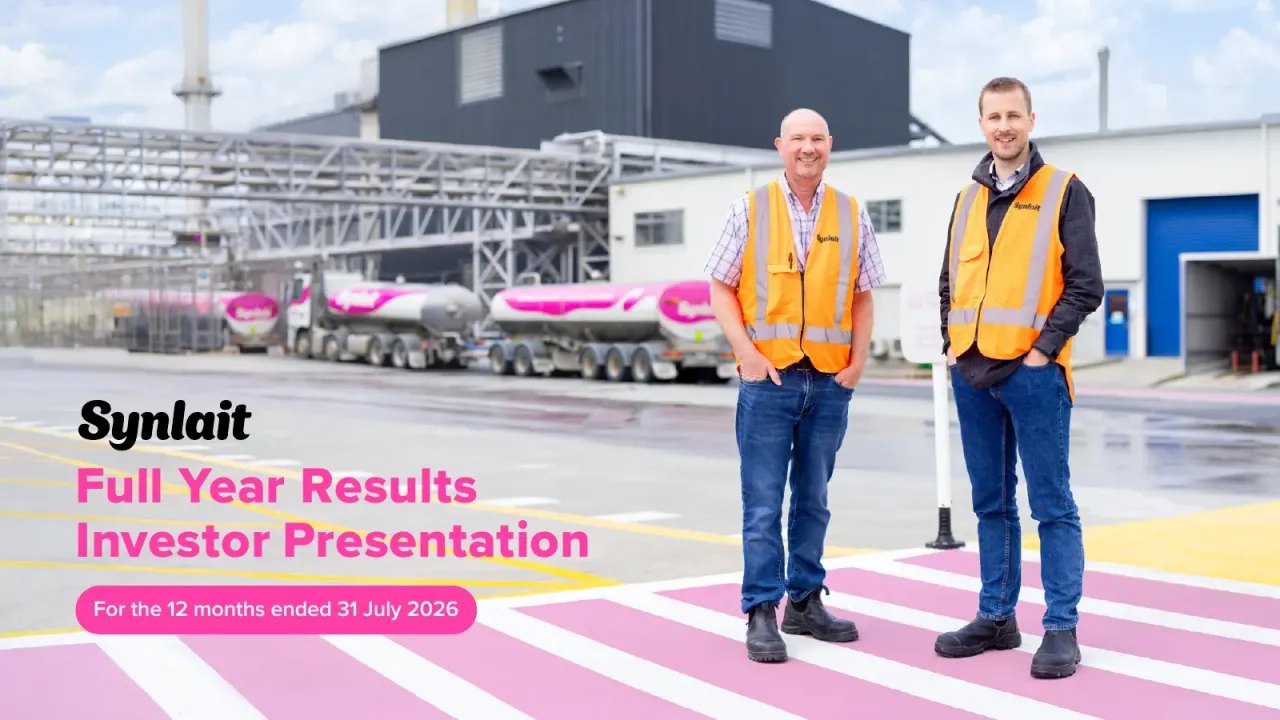
0:34 Thank you. Good morning, everyone. I'm George Adams, Chair of Synley, and it's my pleasure to welcome you to our FY26 Full Year Results Conference Call. Joining me on the call is our Acting CEO, Leon Fung, and our CFO, Andy Liu. They will take you through the results in detail shortly. First, I want to acknowledge that financially, this has been another difficult year for Synley, and I appreciate that for our shareholders, that is challenging news to hear. However, we have delivered a major operational recovery in the second half. And just like the repairs to the company's liquidity, milk supply and balance sheet over previous years, this is critical to our future. Simile is now stronger and more focused than before and well positioned to progress for recovery. That is real progress and I want to thank Simile's team for delivering that, including Hendrik and Ruben, who you can see on the front of our investor presentation and annual report. There have been many long hours worked on the board and I am grateful for that. I'll now hand you over to Leon and Andy and there will be Q&A after the presentation. Thank you.
1:44 Thank you, George. Good morning, everyone. Thank you for joining us for CINLE's full year 2026 results call. FY26 was a difficult year financially. It was also a year of real progress in our recovery. In the second half, operations stabilized, and this resulted in a strong improvement in financial performance. Today, Endian and I will cover the progress, the work still ahead, and how we will work to ensure Sinle's recovery continues. We will start by looking at our first half performance, as this is what has driven the overall result for FY26.
2:32 The half year result was impacted by three main issues. Manufacturing plan adjustments, lower ingredients returns, and deferred tax assets. The financial impact was significant. We posted a first half EBITDA loss of $34.7 million and an overall net loss after tax of $80.6 million. thinly responded with a clear recovery roadmap. It has three interconnected horizons. Stabilize the business by fixing the fundamentals. Simplify by focusing on Danfando.
3:17 And finally, scale, creating a strategy to drive future growth. I'm pleased to say we have made real progress on the first two horizons. Stabilize and simplify. This slide shows some of the work we have done. This is the deep work that has involved researching the fundamentals across four areas, operations and assets, quality, people, and revenue. In operations, we strengthened frontline leadership. We are investing in our assets, have improved production planning, and completed major projects to support long-term stability.
4:06 In quality, we strengthened protocols and processes to align with new regulatory expectations in the key markets, including China. We also introduced the new product checks and improvements and embedded a company-wide food safety culture. We developed our frontline and senior leaders, uplifted engagement, drove our new performance framework, and launched a new health, safety, and well-being strategy. We reset our revenue function with a strengthened business development team, broadened our infant formula customer base, progressed adult nutrition opportunities, a tightened pricing discipline, Together, these actions have built a strong foundation for recovery.
5:03 Our key achievement for the year has been operational recovery. Manufactured in stack, improved from 88% in FY25 to 93% in FY26. Production plan attainment rose year-on-year from nearly 92% to 95.5%. That is a huge achievement, thanks to our frontline teams. I'm pleased to say that manufactured in-step was 99% for August. We are focused on delivering that consistently to reach that level of operational excellence we are aiming for. You can see on slide five that operational improvement translated into a much stronger second half financial performance.
5:58 Reported EBITDA improved by $77.5 million. Underlying EBITDA improved by $38.1 million. Reported net profit after tax improved by $85.8 million. And underlying net profit after tax improved by $33 million. These results show the benefit of a more stable business. However, the full year result reflects the difficult first half. My final slide for you shows the overall results. The total group revenue for the year has increased to $1.93 billion. Reported group EBITDA was $8.1 million. Underlying group EBITDA was $46.3 million.
6:51 We have reported a net loss after tax of $75.4 million, with an underlying net loss after tax of $21.6 million. Net debt reduced by 14% to $213 million. Operating cash flow was negative, $183.3 million. This reflects weaker operating performance and higher working capital needs. The good news is for our farmers. Finlay is confirming its second highest milk price in our history at $10.07 per kilo of milk solids. This includes the incentives we pay our farmers above the base milk price.
7:38 I will now hand over to Andy.
7:42 Good morning, everyone. Thanks for joining us. I will begin with the main drivers of FY26 results. Followed with business unit performance, the North Island discontinued operations, cash flow, and net debt. Move to page eight. Let me start with the main drivers. Improved second half operations kept seamless recovery on track, although the four-year results still reflected significant first half impacts. The main point on the bridge is that that volume was not the issue. Consumer and food service growth contributed $2.3 million into bottom line, but that benefit was more than offset by price, mix, and cost.
8:28 Price and mix reduced impact by $7.3 million, reflecting higher portion of relatively lower margin products in advanced nutrition, and an unfavorable ingredients product mix, partly offset by stronger food service and butter price. Costs were the biggest challenge, reducing impact by 39.8 million. Operational disruption reduced fixed cost recovery and increased manufacturing, quality and milk transport costs. Milk premiums also increased the costs. These impacts moderated in the second half. Other margin and income were mainly affected by unrealized foreign exchange losses at year end. This was partly offset by Abbott's TSA income.
9:22 SG&A provided a $1.6 million benefit. This comes from closing Thomas North's office, leaning our leadership and commercial structure, and tighter spending controls. We achieved these savings despite inflation and oil-related cost pressures. At the same time, we continued to invest in our people, systems, and co-capabilities. Financing was a clear benefit. Despite negative operating cash flow, financing costs improved by $22.2 million. This reflected improved banking pricing, better base rates, debt reduction following the North Island sale, and more cost-effective CNH funding.
10:11 After adjusting for one of items, underlying impact was a $21.6 million loss in FY26. Go to page 9. I will show how these drivers came through across business units. The portfolio results were mixed. Consumer and food service delivered growth and stronger margins. while advanced nutrition and ingredients were affected by operation disruption, capacity constraints, and weaker stream returns. Advanced nutrition revenue was broadly flat, but gross profits declined 78%. The key issue was manufacturing efficiency with operational disruption, product plan changes, and increased costs from production catch-up.
11:03 Lower lactoferrin sales also reduced the contribution. Ingredients revenue declined 15%, with gross profits down 26%. Lower volumes and constrained product mix forced us to produce more whole milk powder and sold into lower-priced markets in the first half. The mix improved later in the year, especially through skim milk powder and AMF. Consumer revenue increased 32%, with gross profit at $51.7 million. This reflected growth across export and private label channels, good barter price achievement, improved manufacturing recovery, and inventory management.
11:51 Food service revenue increased 62%, with gross profit improving by $15.6 million to $11 million. the first four year of positive gross profit. This was driven by 43% volume growth, improved the pricing, lower fat costs, new China contracts, and expansion across Southeast Asia. Other revenue increased 32%, reflected practical milk sales in order to manage surplus milk volumes and manufacturing capacity constraints. Next page, page 10. This page separates the North Island discontinued operations from the continuing business.
12:38 The North Island sale is complete, making Thinly simpler and more efficient. The table shows the continuing business we are taking forward. The North Island results including the gain on sale. Without the gain and the related tax benefit, the North Island operations was still in loss making in FY26. Continuing operations generated $1.68 billion of revenue and underlying EBITDA of $46.3 million. This is the relevant baseline for assessing future performance. Now we have a clearer operating base, with our focus and investment centered on Don Sando and Dairy Works.
13:25 Page 11 It shows how operating performance translated into cash flow and net debt. Cash remains the biggest financial challenge in FY26. Operating cash flow was negative, reflecting weaker operating performance and significant working capital build, which was mainly affected by higher receivables and inventory. Again for that, the North Island sales generated roughly 296 million of cash proceeds and materially strengthened the balance sheet. After operating cash outflows, capital investment, interest and other movements, Netdex finished the year at 215 million.
14:13 In summary, the second half showed clear improvements in operating stability and financial performance. The next step is to translate that progress into stronger margins and cash generation, which continuing to reduce debt through disciplined execution and capital allocation. I will now hand back to Leon for the business update.
14:38 Thank you, Andy. I will now cover off the performance and the priorities of our business units. Advanced nutrition, ingredients, Food Service Consumer and Milk Supply Advanced Nutrition makes high-value products for early life and adult nutrition. In FY26, we secured purchase orders from a new Middle East Infant Nutrition customer for commercial supply commencing in 2027. This is a significant win for the team as we seek to onboard new customers. and we are confident this partnership will scale up quickly.
15:23 I'm pleased to report we have a pipeline of customers keen to work with Thinly. This means we are confident we will fill the capacity created by the A2 milk company moving its English label production. We have also commercialized Nutrabase, creating a platform for adult nutrition products and multiple private label opportunities in Southeast Asia. We also strengthened our dedicated business development function, a structured opportunity pipeline, and a project . These projects focus on specialty nutrition using high value ingredients, including lactoferrin. Looking ahead, our priorities are to grow the Middle East contract onboard new customers from Southeast Asia, expand higher-value consumer-ready solutions, commercialize specialty supplements, and reduce expos to any one customer or market.
16:30 Our ingredients portfolio includes milk powders, milk fats, specialty ingredients for global customers. During FY26, We focused strongly on value over volume. This includes tighter pricing decisions, customer profitability modeling, and stronger sales controls. We advanced diversification across Southeast Asia and the Middle East, simplified product specifications, and strengthened sales facing, hedging, and risk management. With manufacturing stability materially improved, our future focus is to extract greater value from available milk.
17:20 That means disciplined pricing, stronger product mix, greater use of our infant formula grade capability, customer-led technical solutions, and growth in higher value applications. Food service delivered its first materially profitable year, supported by 43% volume growth, improved pricing, and wider geographic reach. We expanded across Southeast Asia, strengthened our Shanghai presence, and launched Sinlei-branded UHT whipping cream in China. A new customer-owned brand partnership broadened our route to market, while changes to the sales and marketing team, strengthens distributor and end-user management.
18:18 We will now grow volume and market share while protecting returns. We will expand through our distributor network, build on our China launch, and use Sinley product quality, grass-fed certification, and New Zealand origin to stand out. Our consumer business delivered strong growth through Dairy Works and its portfolio of brands. More than 5,000 additional metric tons of cheese was shipped to Australia compared with FY25. Dairy Works brands delivered 11% volume growth and 17% value growth in the latest annual total.
19:04 Value added, graded, sliced, and snacking formats generated more than 55% of Dairy Works' growth. Innovation remained important. Dairy Works Protein, launched in June, contributed 50% of nature cheese snacking segment growth. Tobit Forest brand continued to grow strongly, and Costco sales increased 133% year-on-year. Our focus on product hedgehog is to improve plant efficiency, further growth in Australia and Southeast Asia, new product development, and supply chain optimization.
19:53 Strong farmer relationships remain fundamental to thinly success. We have almost 200 farmer suppliers. As mentioned earlier, were confirming the second highest milk price in Sinle's history today, $10.07 per kg of milk solid, including incentives for the 25 to 26 season. During FY26, we introduced a new customer-funded sustainability incentive of $0.02 per kg of milk solid. This is focused on reducing greenhouse gas emission and expect it to double in the future. We also delivered a new tool to provide real-time tanker arrival information and our biodiversity program have now distributed more than 385,000 native trees across Canterbury.
20:54 Our future focus is to grow customer sustainability partnership, improve the digital offer and continue our market-leading on-farm support. We'll look to the future now and explain how we will maintain the momentum we achieved in the second half. We are continuing to focus on our recovery roadmap. In operations, we have created a production plan to make the most of every drop of our farmer's we will retain our focus on stability, strengthening our assets, and deepen our talent pool.
21:39 In quality, we are recruiting the chief quality officer, continuing to reduce cost of quality and progressing asset investment to maintain access to the key markets and reduce regulatory risk. For our people, we will continue leadership development target critical capability, refresh onboarding, embed thinly safe mindsets, and critical control assurance. We are focused on diversifying our revenue streams while aligning the product portfolio with plant capability, milk supply, and returns. As mentioned earlier, we will also deliver the strategy to scale of our success. and share with you in 2027.
22:35 We remain clear about the risks ahead and have active plans in place to manage them. Operational excellence. We will keep our focus on our plans and maximize returns from our Don Sando assets. Leadership and strategy. We have a strong executive team at Dunsando and we will maintain that. We will finalize CEO and the Chief Quality Officer appointments and deliver a reset strategy in 2027. A2 volume shift. We have a new business pipeline, which means we are confident of backfilling this volume.
23:20 Contracted commitment from our new Middle East customer have the opportunity to scale up quickly. Revenue As well as addressing our concentrated revenue stream, we are focused on protecting margins and ensuring all commercial arrangements add value for Sinle. Refinancing We will continue working with our banking syndicate. After showing them, we can manage through challenging years like this one. Bryce Dairy's support is very helpful. along with their renewal of shareholder loan, which now matures in 2028. China market registration.
24:06 We have an experienced, cross-functional team working to renew the approvals required to continue manufacturing infant formula for China, and we are confident of success. We are also well equipped to deal with changing quality and regulatory requirements. managing stakeholder confidence, and continuing to show leadership in on-farm sustainability. Thin Lake is still in a recovery phase, and TY26 is a five-month transitional period that will be influenced by the timing of production, sales, working capital movements, and other seasonal factors.
24:53 Given the short and the non-comparable nature of this transitional period, Synlit is not providing guidance for the five months ending 31st of December, 2026. You only have to look across Synlit's financial performance over the past 11 years to see the company was most profitable before it expanded to North Island. Profitability peaked in FY19 with a net profit after tax of just over $82 million. The North Island assets traded a drag on Finlay's performance and now they're sold. The company is stronger, simpler, and well-positioned for the future.
25:44 The graph identified a period of underperformance and we are making sure we learn from the past. Our executive has taken a holistic view and identified issues that have caused Sinle to underperform, not just in FY26, but back to FY20. An oversupply of manufacturing capacity, the impact of COVID, and the subsequent decline in China's birth rate impacted every year until FY26. Operational stability issue impacted performance in FY25 and FY26.
26:29 We have worked to address these issues. The capacity issue is resolved following the sale of our North Island assets. Our new revenue strategy will ensure Finlay is no longer exposed to a single customer, market, or product again, which helps to protect us from future shocks. as we have achieved operational stability. Our goal is to return the company to earlier successes. We are confident we will do that given the pipeline of customers we are working with and the capacity and capability of Sinle's asset and its people.
27:15 The key message from me from today has made meaningful progress in stabilizing and simplifying the business. Second half performance improved substantially across EBITDA and net profit after tax measures. Operational recovery has been achieved and we are on track to deliver continuous operational excellence. The North Island sale simplified the business and strengthened our balance sheet. We have started addressing our next biggest challenge, diversifying revenue. This is an opportunity we are excited about. It will strengthen Sinle for the future.
28:02 And a reminder, we will deliver a full strategy to scale at our success in 2027. My final remark is to assure you all that Sinle is well placed to progress our recovery. Thank you. We will now move to our question and answer session. If you have joined via the webinar, please use the raised hand icon which can be found on the bottom of your webinar application. When you are called on, please unmute your line and ask your question. We kindly ask that you limit yourself to one question and one follow-up. We will now pause a moment to assemble the queue.
28:49 Your first question comes from Stephen Ridgewell with Craig's Investment Partners. Please unmute your audio and ask your question. Stephen, your line is open. You may ask your question. Stephen, we will return to you. We will move on to Nick Marr with Macri. Please unmute your audio and ask your question.
29:24 Hey, guys. Can you hear me? Yep. Yep, that's good. Just in terms of the kind of outlook, and I know you're not wanting to provide guidance in this half period, but do you think that the run rate on an underlying basis achieved in the second half is a sustainable basis for the business?
29:45 Thank you, Mark, for your question. Yes, we are confident to see we will continue the improvement in the second half and we will continuously making effort to maintain that success and which will enable us for scale up in the near future.
30:10 And in terms of the slide that you put on about the sort of free North Island earnings, are you saying that that kind of earnings figure is achievable in the future with just the North Island as it's set up today and sort of evolved customer and product mix? Or is it purely very illustrative?
30:30 The slides actually show some historical data when Sinle was very successful before the North Island asset established. But of course, it's not the only reason. There are other challenges alongside. We summarized that the birth rate declining in China also contribute to against our initial plan. But the key message here is that we have a very solid plan to move forward to get success again in the near future.
31:16 Yeah, if I could just add, clearly it's not indicative of a number in future. However, I would just add that it was also fairly clear that Pocono was a significant drag on the business and that drag has been eliminated. We are circling back now. Steven Ridgewell with Craig's Investors Partners. You may unmute your audio and ask your question.
31:49 Good morning. Can you hear me? We can, yeah. Perfect. Okay. Thanks, guys. Thank you for the update. First of all, on the milk supply, it poses a few difficulties at the top of the call if you already answered this that you know, but can you just give us an update on to what degree of success in this effort to retain its farmer supplies? Because we hear in various unit codes that some of them are still going to be competitive. So just any use of more detailed updates to provide on that would be appreciated. Thank you.
32:25 Yes, thank you, Steve. In terms of the milk supply, we have the right amount of milk for our plant, for our factories. That is the first thing I want to highlight. And I talked to our farmers, many of them, and I can see that our farm suppliers, they are very keen to see Sinlei to be successful again. And I really appreciate their support. I don't see that in the near future that we have challenges on the milk supply. All what we need to do is to deliver the performance to our stakeholders, to our shareholders, and to our farm suppliers, and we can continuously bring the value back to them.
33:20 Okay, so if you look at production volume in the year that's gone, it was down 60%, you know, should we be expecting volumes to stabilise in FY27 and FY28, or should we expect further decreases? I'm just trying to understand, you know, what the right level of supply is. You know, it sounds like you might possibly are expecting some of your pharma suppliers to go to other brands, but that's part of the plan, but just to help us understand maybe a few numbers would be helpful, I think.
33:49 Mm-hmm. We actually have a very good start of the season. We are expecting 3% to 6% more than budget. As I highlighted earlier, we have the right amount of milk for our plant, and we just want to get the right product mix in order to get the value of the available milk.
34:11 If I could just maybe also add to that, maybe Andy can give us some detail, but one of the reasons we had a decline in production last year was actually not the real shortage of milk, but we actually had to sell milk at peak because we were unable to process it due to the manufacturing challenges. So there's an artificial drop in the volume as opposed to us actually not having the milk supply.
34:35 Yeah I think George you just covered what I want to say but also just remind us that for these autologues for the new seasons volumes that we should also take into account that for the porcino side we don't have it then that which means we definitely for the advanced nutrition we have some kind of reductions which is we already expected early enough Okay that's helpful and maybe it's just on the same topic so you're currently playing a
35:06 at some point, if you're in the right supply, got the right amount of supply, one would presume that might come off a little bit. Or, you know, is it comfortable with the 18th per kg premium? Do you think over time that should come down? And the reason I'm asking it is, if I think of a medium-term profitability, certainly, obviously, for that to come down a bit to maybe where it was in the past would be helpful to profitability in some good ways.
35:42 We review our milk price strategy every year, like everyone does. But what I want to say is that Sinleys came from very deeply on the farming background. That is part of our DNA. We want to bring the value back to our farmers. Good examples are Lead with Pride, which is very well welcomed and supported by our farmers. So that brings the value. That is part of the reason we can pay more incentives on top of the found gate price.
36:28 We also have customer funded sustainability programs, which help as a part of our incentives, what we pay on behalf of the Farmgate milk price. We will continuously doing that. And we do have global customers who are very interested working with Sinle, working with our farm suppliers on that. So yes, we will maintain or looking at the more incentives to bring back more values to our farmers. But year on year, it will be some difference.
37:09 Okay. The second line of questioning was on the advanced nutritionals business. Is this a point of clarification on the statement you've made that you expect potentially this new Middle East customer and maybe some other customers to see you recover volumes that you're going to lose from A2 milk? internalised English label this year, which they've obviously stated publicly. You know, just wanted to clarify, when you say that you're going to recover the volumes, first of all, are you referring to the FY25 year where you, I think it was 40 MTs, where you're referring to FY26 was 45 MTs? What is baseline when you make that statement?
37:54 And then second part of the question is, you know, for this new release, in the next year. Some of the cash that's on would be helpful that your customers are thinking.
38:12 All right. Just to give you a little bit of clarity, the new Middle East customer we are working with is quite a big supplier player in the market. They are quite interested to work with us as a long-term partnership. The volume we are looking at is significant. And that's why we say that we have the confidence to backfill the gap that A2 Milk, they are moving away the English label from Don Sando. And also there are a list of customers we are working with, the team have been working on, and we are looking at onboarding more customers to Finlay. It's not only the infant formula, but also adult nutrition as well.
39:06 So similar strength is a nutritional product. Once we are very good at infant formula, it's easier for us to get into adult nutrition, the other nutritional products as well. And if we look at in a positive way, that's why we say that we're excited about opportunity. When A2 moved away some of this, volume, especially the English label products to their procurement factory. This creates opportunity for us to be diversified rather than just exposed on one customer, one product, one market.
39:54 Thank you. Just to give you an example, the volume we are looking at
40:17 is that representing 18% of our FY27 capacity. So, that is quite significant.
40:29 Yeah, maybe just to add in, just to add in Steven that, yeah, so regarding that rent up, we assume about three year, roughly three year time, we can backfill.
40:40 Yeah, because for any nutritional customer, it does take a little bit of time to ramp up the volume. So normally, it takes two to three years to get the peak volume they are expecting.
40:56 Okay, nice. Good news. I mean, just to be clear then, it's three years for it.
41:06 No, what I said that in 2027, we are expecting a big volume growth already.
41:18 If I can clarify, what Lyons mean is that for the next 12 months, it will be 18% backfill the loss volumes or capacity, and in three years time, we can fully backfill the capacity or the demand.
41:36 Okay, got it. Thank you. And then just this last one, I guess just in terms of the revised banking facility, which you announced in the end of July, just in the year before this new customer ramped up, right, and you've got a few guys still brewing wines on A2 volumes, and English volumes are coming off, and they're trying to label volumes down a bit at the moment. So I just wanted to ask, are you confident that the company will remain compliant with its banking covenants over the next, call it, 12 or 18 months? In particular, you've got a three-month fee to be able to access the looks of it. So are you comfortable, given the near-term impact on the structure of the demand for A2, that you can
42:31 Yeah, so regarding the ramp-up together with this A2 English Label, actually it's already, we already knew that early enough. So all of this is, we already take into account in our forecast and very openly share with the banks. So that's why that we said for seamless business, the second half is really good to show, see the improvement of the operations liabilities and the improvement, which really makes the financial numbers can be more reliable. and now that we have also a very close follow-up for all the bank covenants and as of today that we feel comfortable or confident we meet the complaint.
43:09 One last one. Given you've obviously got those detailed plans with the bank and you've shared that with them and they're comfortable and you're comfortable, did you give more consideration to providing guidance to the equity market? Because I guess if I sit back and look at your five-month period that you're about to go into now, You've had three months of actuals, roughly, and you've only got a three-month period to forecast. I mean, is it just this period you want to be giving guidance, or is it generally in a price that you want to give guidance to market for a reporting period to come forward?
43:44 We actually haven't given guidance for some time, and I think that was on the basis of us genuinely struggling to get our hands around operations I think we stopped doing guidance 18 months ago. So what we'd like to do is to review our position on guidance at the end of this year and we'll get back to the markets and obviously yourselves probably early February with our view on that. But at this stage, that remains our position.
44:17 Thank you very much for your answers. Thank you. Your next question will come from Marcus Turley with UBS. Please unmute your audio and ask your question.
44:31 Good morning. Can you hear me? Yep. Great. Just one point of clarification, Andy. You mentioned 80% of the capacity capacity. being filled with a new customer. Can you give us some perspective on what is the reduction in volumes from the A2 internalization for this year? What is the level of capacity you're looking to replace?
45:07 Yeah, I think from the A2's volume, it's more commercial sensitive, so I don't think I can answer that. But maybe proposal, you can find some other kind of export numbers to find it. So what I can say is that regarding that volume, yes, that we try to backfill the 18%. Sorry, I can't answer that.
45:28 Maybe a different style of question on it then. Are you expecting to do any material English label volumes for A2 in the next 12 months?
45:41 This is the question to ask A2, actually, because they want to prioritize their Pokemon factory. For English Label, we have the plan to not have their English Label production in Dansendo. But from time to time, they may still need our help. And in fact, we are still doing some English Label for them. Okay, good to know.
46:10 In the underlying result, as you highlighted, the advanced nutrition EBITDA was low and particularly low on a per ton basis. How much of that is, and you called out efficiencies and you called out costs, how much of it is structural? How much additional cost are you needing to carry now, particularly around testing and quality? that will mean that the gross profit per ton is lower than what we've seen in the past.
46:47 Let me answer this question at a higher level first, and then I get Andy to tell you a little bit more details. The high cost or lower margin in the last financial year is not representative. Advanced Nutrition is a profitable business. It's just that when we have the instability of the operation and some challenges, the cost is going up very quickly. And that also came to our food safety, product quality mindset. When we see some challenges, when we see the potential risks, we take a cautious approach. That costs us a lot, but I want to say that what you see now in the last financial year is not representative of this real picture, should be.
47:42 And we are confident. After resetting all the fundamentals, we'll be back to profitable business and nutritional business.
47:53 Yeah, so to build on that what Leon just mentioned, once that we have these operational stabilities and also they said we have a better control for the quality of everything, definitely as we expected, the margin will back to the more normal levels, which means previous, the more standard years, yes, normal years. Okay.
48:16 And so with additional costs like the incremental testing that you have to do to meet the Chinese regulations, that can be passed on to customers?
48:30 Any extra cost will be discussed with our customer, because as you all realize that there's a regulatory change and quality standard change, especially for the China market. in the last few years. So the testing cost, as example, does increase.
48:54 Okay. And then just finally, on getting working capital, you obviously have a bigger increase in working capital. Are you expecting any reduction or any of the issues that listed the working capital to be temporary? I'm talking about large magnitudes here.
49:15 Yes, Marcus is a very good question. Actually, you know, for me and my teams, from now on, the focus in the biggest one is cash generation. So definitely we expected the working capital should be improved from both inventory management and also receivable side.
49:31 Yes. Okay. Any magnitudes, Andy? Yes. Can you give us any... any targets in terms of reductions in working capital over the course of the next 12 or 24 months?
49:51 Not for the moment. I can just to check it and to see what else what I can provide you maybe afterwards.
49:58 Okay. And in the accounts just following on from that in the accounts there is noted some EBITDA minimum milestones that need to be met for the bank facilities. Are you able to give us any perspective on what they are.
50:16 No, sorry, I can't.
50:21 Okay, thank you very much. Thank you. We will return now to Nick Marr with Macquarie for your final questions. You may unmute your audio and ask your question.
50:35 just in terms of the Middle Eastern customer can you confirm whether that's a sort of bulk or base product versus a tin product and how we should think about the margin profile I guess initially and as it ramps up versus what volumes you're giving away or losing K2 yeah I can give you a high level picture of that it is in the bulk and the base powder
51:02 All right, so this customer has their own brand. They want to use New Zealand high-quality product, grass-fed product for their brands. So, yes, this is a very promising business for us for the near future.
51:23 Any sort of indication of relative margins of a sort of bulk product like that versus the tin product you're doing, Fraser?
51:31 We do have a good margin on that because it's a nutritional product, even though it's packed into 25 kg bags. But the details I cannot share because they're commercially sensitive.
51:44 Okay. And that's all. Thanks for sharing. Thank you. There are no more questions at this time. I'd now like to turn the call over to Leon Fung, Acting CEO.
51:56 Thank you. Thank you, everyone. This concludes today's call. and I really appreciate your time and questions. If you have any further questions, please contact Joe Scott, who is the head of corporate affairs and engagement. Thank you very much.
52:15 Thank you all. Thank you.
Follow Synlait Milk Ltd. into a list and get an email when it puts out news.
CFO
Analyst at UBS
Acting CEO
Chair of Synley
Analyst at Macquarie
Analyst at Craig's Investment Partners