Gonzalo Artiach
Analyst, Danske Bank
Replay available
Swedish Orphan Biovitrum (Stockholm:SOBI) reported Q3 2026 results on this call. Replay available.
On 6ix: 6ix.com/event/swedish-orphan-biovitrum-ab-sobist-q3-2026-earnings-call
Automated transcript · Written by software from the replay's audio. It can mishear names and figures; the replay is the record.
0:00 Ladies and gentlemen, welcome to the SOBE Q3 Results 2026 conference call and live webcast. I am Mathilde, the course call operator. I would like to remind you that all participants will be in listen-only mode and the conference is being recorded. The presentation will be followed by a Q&A session. You can register for questions at any time by pressing star and 1 on your telephone. For operator assistance, please press star and zero. The conference must not be recorded for publication or broadcast. At this time, it's my pleasure to hand over to Guido Oelkers, CEO. Please go ahead, sir.
0:44 Yeah, thank you. And hello, everyone. This is Guido Oelkers, CEO of Sobe. We are delighted to welcome you to the third quarter 2026 conference call for investors and analysts. Our presentation was posted to sovi.com earlier today and with this having said, let's go straight to slide number two. Forward-looking statement as per usual. and unless stated otherwise, we will be making comments and most relate to the third quarter at constant currency rate and a million Swedish Krona. Please turn to slide number three. Today, we plan to cover the key aspects of our Q3 reports.
1:32 I'm joined by Henrik Stenqvist, our CFO, Lydia Bartrand, head of R&D and chief medical officer, We plan to review the presentation first and then have Q&A until around 4 p.m. CET. For those on the phone, please join the queue. For questions, please by pressing star one. And please remember, you know, ask only one, maximum two questions. Let's turn to slide number four, you know, to the content. You know, the... We had very strong portfolio growth and that prompted us to increase guidance. So let me start with some key messages.
2:19 We have been raising the revenue outlook by improving now and improving obviously the probability to achieve our ambition for 2030. Q3 was all about improving the company along three vectors. Overall performance and launch performance, pipeline, and international diversification. Regarding performance, please keep three numbers in mind. Q3 revenues grew 16%, excluding the RSV effect, and we will come to this later, we grew 26%. Year-to-date performance is 23%, gross performance, and our adjusted EBITDA in the quarter was 45%.
3:05 The 16% includes the material impact of phasing of RSV royalties. Without RSV, we would have been able to grow 26%. This number reflects the performance of our commercial engine consisting of our three regions. Itowog continues exponential growth trajectory and Aspirelli showing a material uplift and has reached its full year 2026 patient target in nephrology patients by the end of Q3. Beyond the numbers, the quarter brought a series of important milestones that I would like to highlight. Regarding the pipeline, we should mention first the positive CHMP opinion for Tringosa in the treatment of severe hypertriglyceridemia and we expect to accelerate the launch by two months.
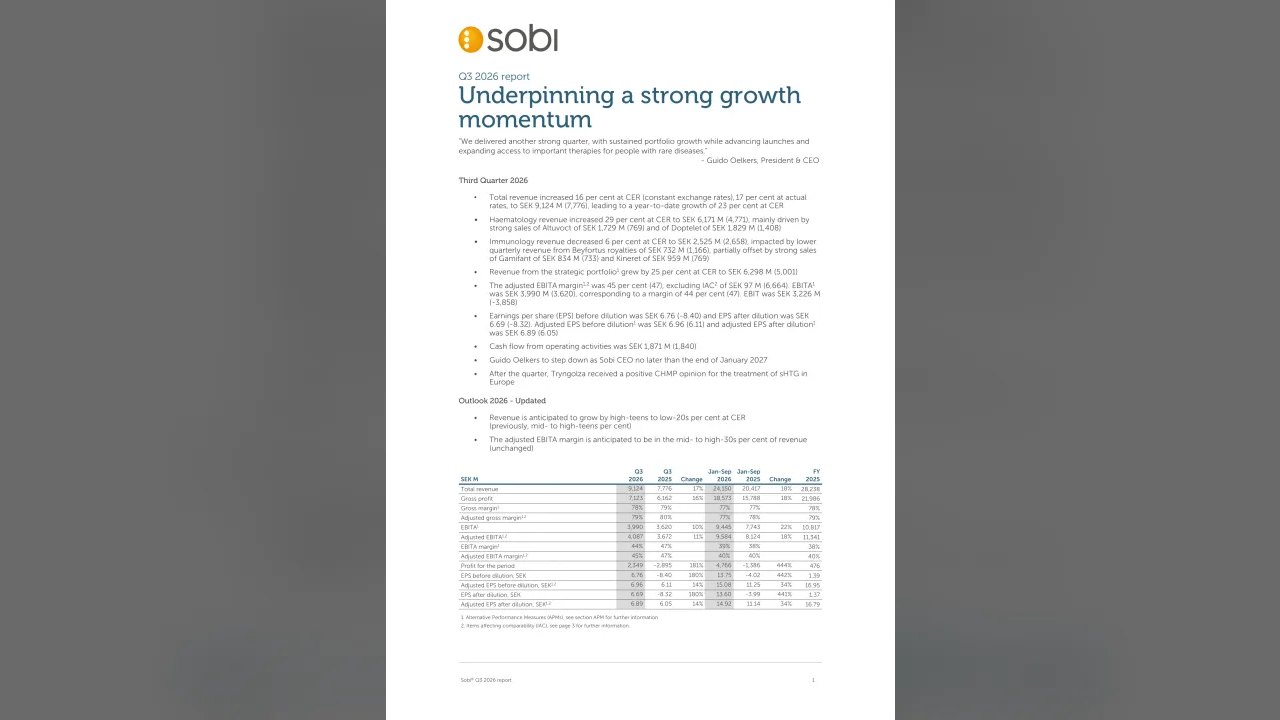
4:04 Second, in Japan, we received the approval for Gamifront in HLH mass and for Asper Valley in C3G ICMPGL. These approvals will unlock material opportunities in one of the largest rare disease markets. Third, We completed the transaction with Pin Pharma. This creates an exciting launch platform in a dynamically growing environment of Latin America. Concluding, we have made material progress across multiple dimensions and building further confidence to achieve our 2030 ambition. Let's turn to slide number five. Total net sales in the quarter were 9.1 billion, up from 7.8 billion a year ago.
4:54 And, you know, the growth was delivered, as you can see, across the portfolio, but also across all regions. The mix is also shifting into the right direction. Our strategic portfolio contributed 69% of sales. From a geographic perspective, growth was strong across all regions. Europe contributed 25%, North America 19%, and international markets grew by 58%. Taking together, this is a growth profile that is diversified, sustainable, and increasingly driven by high-value innovative medicines. Please turn to slide number six.
5:40 The slide also shows our timelines of launches and pipeline events. three uptides since last quarter. In gout, post-retinoid is progressing well. Filing remains on track for mid-2027. For NASP, after the FDA issued a complete responsible letter, we are in the midst of the FDA meetings and agree on the filing files. I will not preempt that discussion today or the discussion we also had end of last week and we will update you when we have more clarity. Gummy Fund. The preparation of the Phase 2b, Phase 3 Pivotal Trial for IDS is on the way and is now called Everest. Lydia will give a more comprehensive update on this pathbreaking development. Lacturimab.
6:34 The partnership is signed and with a potential US accelerated approval filing planned for 2027. Let's look at a few products in more detail and turn to slide number seven. Itovoct continues to perform extremely strongly and is establishing itself as a best-in-class product in the prophylaxis of Haemophilia A. Sales grew 125% at constant currency and our total Haemophilia A sales were 2.345 billion SEK. up 48%. We have now launched in 32 countries, including key European markets, and we are progressing through a structured three-wave launch strategy that we have outlined in previous meetings. The takeaway is that, you know, we still have significant room to grow in wave two, and wave three is really still ahead of us. So we are not at the end of this launch.
7:37 This performance reflects a strong clinical profile of Altevox and a very disciplined approach to execution of this fabulous launch. Asper Valley. Turning to Asper Valley, sales were 417 million SEC for the quarter, up 32%. We were very gratified that we have reached our 2026 target of 4 to 500 nephrology patients already by the end of Q3, one quarter ahead of the full year timeframe. I'm very proud of the team's execution. Reimbursement is available in several markets, including Germany, Spain, and Japan. Three further points. PNH performance remains stable.
8:24 We continue the international role of the infused device. We continue to demonstrate a strong clinical profile and as demonstrated at the ESPN conference where we presented additional 52-week adolescent data from the VALIANT and VALE studies. Let's turn to slide number nine. Bifortis obviously matters to the royalties we receive, and those royalties are an important catalyst for the strategic evolution of the company. The US RSV season, as every year, is now beginning, and the RSV activity is rising across many states. Although a competitor is now fully launched and on the market, this is not necessarily negative as it may help to boost the share of voice and improve immunization.
9:23 In order to provide more clarity on the situation, we performed a survey with, again, around 100 HCPs. The outcome is that 85% of the respondents said that the immunization rate is either stable or growing. 60% out of those 85 actually believe that it is increasing. There's a very high preference share amongst physicians, and they believe that over 90% will choose Bay Fortis. So 52% of the accounts are expecting to place additional orders, while 48 believe that they have sufficient stock. So what it means is that we cannot detect at least any issue with the product as such. If anything, there's a phasing primarily related to inventory levels.
10:21 But the season is obviously starting and we need to remain vigilant and seeing how it plays out. Let's turn to slide number 10. Briefly, you know, with regard to Dr. Lennon-Gammefeld. These two brands are continue growing at a very gratifying rate. The adopted it grew in Q3 at 29% to 1.8 billion. Growth was strongly and sustained across all three of our major regions. We are also continuing to expand our international launches over time and we expect these to significantly increase the ex-US contribution. For Gummy Fund, sales were 834 million, up 12%.
11:09 Strong patient demand continues to drive growth. International markets are supporting growth following the FDA label. And as mentioned earlier, the Yagami Fund is now approved in Japan for HLH and MAS. The EU filing is under review and providing additional further growth opportunity. And, you know, just to note, you know, the product has been growing for the year 28% year-to-date performance. Together, these two brands show the breadth of our portfolio. One is growing across regions and still expanding internationally, the other addressing a high need population and is moving into new geographies. Let's turn to slide number 11.
11:55 As a pillar of our strategic international expansion, let's say, is, you know, the progress now that we have made in Latin America and Japan. Let's start with Latin America. We have now been able to complete the transaction with Pin Pharma and assumed full ownership and using now this really dynamically growing region as a launch platform for our product. The transaction was completed on the 2nd of October and is 100% in line as previously outlined. In Japan, we are making great progress with three approvals in 2026. that expand our international reach with Kinneret, Asper Valley, and Gummy Fund, building on a successful launch performance with Doctylet in 2025.
12:47 On the development side, the Doctylet phase two, phase three study in a plastic anemia is enrolling and has had its first patient in September 2026. This study is focusing on Asia, where the incidence of this disease is significantly higher than other parts of the world. Taking together, this shows that we are building a next layer of growth, and we add new geographies through ownership and local presence, new indications throughout approvals, and new opportunities through clinical development. So we innate a partnership, as mentioned earlier, LactoMARC is an investigational antibody being studied in cutaneous T-cell lymphoma.
13:39 In cesarean syndrome, LactoMARC has already received strong regulatory support with prime designation from the EMA and a fast-track designation and breakthrough therapy designation from FDA. Phase II data are already available, and the partnership allows Innate to start a Phase III program and five for accelerated approval in the U.S. for its first indication, Cesare's syndrome. Sobe receives global commercial rights upon potential accelerated approval and we are eligible for full global development rights following positive phase three results. The potential indication expansion in mycosis fungoides could create a very meaningful product for Sobe.
14:28 In summary, This is an attractive addition to our portfolio of investigational programs in rare diseases, which has the potential to already start generating revenues in 2028. Let's go to guidance upgrade. And to bring, you know, and we had obviously very strong performance this year. This brings me to the outlook. This strong year-to-date performance with overall revenue growth of 23% across the portfolio prompted us to increase guidance. The revenue upgrade reflects the performance of a large portfolio of growth products such as Altawalk, Aspar Valley, Doctovit, Gamifund, Kineret and other strategic brands together with a strong growth trajectory across all three regions.
15:24 We have kept the adjusted EBITDA margin unchanged, mid to high 30s, and we want to invest into our launches and key studies. Henrik will discuss further this topic, and we will continue investing, as mentioned, into our future, because we believe that we owe it to the company and to patients to build the company up for scale. With this having said, I would like now to hand over to Lydia.
15:54 Thanks, Guido, and hello, everyone. I will start with the pipeline milestones on the next slide, please. We continue to make good progress during the third quarter. For Gamifan, we received PMDA approval in Japan for HLH macrophage activation syndrome in a still disease, which adds to our growing presence there. We also presented new HLH data at the Histiocytes Society meeting and made progress in our malignancy-associated HLH and sepsis programs, which I will detail later. The second approval in Japan was for Mpavelli-Aspavelli in C3G-ICMPGN. We also enrolled the first patient in our global phase four C3 study in these nephrology indications.
16:42 For Altubox, the Phase IV altitude study in hemophilia completed enrollment. FDA granted fast-track designation to Bonjo in Vexus syndrome, a serious autoinflammatory disease with high unmet medical needs. And we will see the top-line results of the Paxys Phase IIa study next year. For Doptelet, the first participant was enrolled in the Asia-Pacific aplastic anemia study. We are conducting this study in Japan, South Korea, and Taiwan, as the incidence of refractory aplastic anemia in Asia is three to four times higher than in Western populations. And finally, Tringolsa received positive CHMP opinion in severe hypertriglyceridemia earlier than expected.
17:29 And we also presented the interim 53-week data from the core and quartus studies at EAC, which I will cover in more details shortly. Turning to gamifan on the next slide, please. We are preparing two new phase three label enabling programs for gamifan. Both are in diseases driven by interferon gamma with gamifan blocks and neither disease has an approved targeted treatment today. Our biggest near term opportunity is in malignancy associated HLH. It's a form of secondary HLH where the disease is triggered by underlying cancer and not by a genetic defect or an autoimmune disease such as Stills.
18:14 Currently, around 1,500 patients in the U.S. develop it each year, and the number is growing. That's as many as primary HLH and HLH must combine, the two forms of HLH for which Gamifan is currently approved. Our pivotal phase three study, Staphire, will include around 80 patients with malignant HLH, and we will compare the results with around 160 matched patients in OPAL, our external control study. The primary endpoint is survival at day 60. In the SAFIRE study, we will also explore gamifan in other forms of secondary HLH and in hyperinflammatory complications of CAR T therapy.
19:00 We plan to recruit the first patient in Q127 with top-line data in 28, a potential FDA submission in 29. Real-world evidence from patients with HLH in the U.S. has shown significant improvement in 60-day overall survival for patients treated with gamifan. In the historical cohort without emapalumab, overall survival was 38% versus 75% overall survival in the emapalumab group, with patients being dosed by their CXCL9 levels. Moving into sepsis, gamifan targets a subgroup of patients whose disease is driven by interferon gamma. Today, these patients only receive supportive care. We're expanding our Phase 2b3 Everest study to sites outside Europe, with the first participant anticipated in mid-2027.
19:51 We will discuss the program with the FDA in the first quarter of next year. A Phase 2b analysis in 2028 will shape the Phase 3 part of the study. Together, these two studies could bring gamifan to many more patients with interferon gamma-driven diseases. Next slide, please. Tringolza received CHMP opinion for treatment of severe hyperglyceridemia, or SHCG, and we are looking forward to the EC approval later this year. Severe hyperglyceridemia is characterized by triglyceride levels above 880 milligram per deciliter. In September, we also presented interim one-year results from the core open-label extension study, confirming long-term efficacy and safety of olisarcin in SHTG.
20:44 In the graph, you see the design of the core and core two studies with three arms during the first year, followed by the two-year extension with only one open-label arm. In the extension study, all patients were receiving olisarcin 80 milligrams. Data shows profound and sustained TG reductions. After 53 weeks of open-label treatment, 90% of patients reached TG levels below 500 and 58% below 150, which is in the normal range. There was also a rapid response for patients switching from placebo to Olisarcin 80 mg, who quickly reached the same level of TG reduction as those treated with Olisarcin from the start of the study. The effect then held steady through the end of follow-up.
21:35 Regarding the Pathifact fraction, this interim data showed only a modest increase of less than 2% over two years of treatment. You can see from the figure that also patients in the 80 mg group who had an initial increase returned to these low levels afterwards, confirming the transitory nature of these observed effects. Olesarsen was generally well tolerated with no safety findings. Treatment compliance was 98% at a median of 10 months. Together with the positive CHMP opinion, this data strengthens our confidence in Tringulsa as an important new therapeutic option for people living with severe hypertriglyceridemia.
22:20 Next slide, please. Looking ahead for the next 15 months, we are planning for a steady stream of pipeline mice throughout all our therapeutic areas. In the fourth quarter of 2026, we expect two key events. The European regulatory decision for Tringolza in severe hypertriglyceridemia above 880, following the recent positive CHMP opinion. And in GALP, the reduced top-line data for poditinorad will be presented in the late-breaking abstract oral session at ACR on November 11th. Moving into 2027, we expect momentum to continue across the portfolio. Key anticipated milestones include Fort Pot Deteriorating Progressive Gout, data from Reduce 1 and Reduce 2, and the planned BLA submission to the FDA.
23:13 The planned FDA resubmission for MAF in Uncontrolled Gout, the European Regulatory Decision for Gamifan in HLH MAF in Stills Disease, and for Bonjo, the Pacifica Phase III readout in myelofibrosis and top-line data from the Paxys Phase II study in vexostimulant. The pipeline process we have sustained throughout 2026 shows how broad our portfolio has become and that we keep delivering innovation for people living with rare and debilitating diseases. With that, I would like to hand over to Henrik. Thank you.
23:49 Thank you, Lydia, and hello, everyone. And please turn to slide 20. And we will take a look at some key financial metrics for the quarter. So in Q3, our revenues of 9.1 billion correspond to revenue growth of 16% at constant currencies. And as we heard, if we exclude Payfortis royalties, growth was 26% at CER. Hematology increased by 29% at CER and our combined Haemophilia A portfolio increased by 48%. Altavox Strong Momentum continues as we roll out this product across major markets. Doptenet also increased by 29% at CER where we continue to see strong growth across all regions. After Valley increased by 32% at CER reflecting new nephrology patients.
24:43 In immunology we saw double digit growth in both Kinrit and Gamifant offset by lower royalties from the Fortis Gamifant growth was driven by new patients treated for MAS and Stills disease in the US and Kinrit continues to see strong growth across regions Royalties from Bay Fortress came in 39% below prior year. As Sanofi indicated, there may be different phasing this year between Q3 and Q4, and that competition and immunization rates remain uncertain for the season. As before, we have limited visibility as we only receive royalties. Specialty care increased by 23% at CR driven by new patients in Trinconza on FCS and patient growth in other specialty care medicines.
25:38 If we look at the table on the right and the adjusted growth margin of 79% in the quarter, the slight decrease compared to last year was mainly driven by lower share of Bay Fortis royalty revenue. The operating expenses excluding non-recurring items and amortization for the quarter increased by 24% at CER compared to Q3 2025. SG&A also excluding non-recurring items and amortization increased by 16% at CER driven by launch and pre-launch costs for Asper Valley in nephrology and Tringolsa. And these costs were partially upset by lower costs for Doctolet R&D expenses increased by 41% at CER, excluding non-recurring items, mainly due to the addition of Positune RED development programs.
26:35 And as a result, the adjusted EBITDA for the quarter amounted to 4.1 billion, equal to a margin of 45% compared to 47% for the same period last year. Operating cash flow for the quarter was 1.9 billion, which is in line with the same period last year. And net debt at the end of the quarter was just below 15 billion, a net debt to EBITDA ratio of 1.1 times. Please now turn to slide 21 and the financial outlook for the full year 2026. And as usual, this outlook is based on revenue growth at constant exchange rates, and adjusted EBITDA margin. For the full year 2026, we've raised the outlook for revenue. The outlook for the adjusted EBITDA margin is unchanged. We anticipate revenue to grow at high teens to low 20s percentage at CER, and previously mid to high teens percentage, and we anticipate EBITDA margin to be in the mid to high 30s percentage of revenue, which is unchanged.
27:48 For some additional context related to revenue, we saw 23% growth at CER year-to-date through the end of Q3. In Q4, we expect momentum to continue with large impact products, Altevox, Dobson & Gamifund, for example, and we expect to benefit from the addition of the pink pharma business. As I stated last quarter, and we saw in Q3, on a percentage basis, we're up against higher comps in H2, which will naturally bring down the revenue growth in Q4 compared to earlier in the year, even with strong performance. Bay Fortis remains difficult for us to forecast, and particularly for an individual quarter, and we expect to learn more from Sanofi in their Q3.
28:41 Related to adjusted EBITDA margin guidance, our margin year-to-date is 40%. In Q4, we will see increased investments in operating expenses. In SG&A, we expect an acceleration of the investment in Aspen Valley and Tringolsa. Aspa Valley will continue its standard launch in Europe and we will accelerate launch preparations for Tringolsa given the recent positive CHMP opinion for the treatment of SHCG in Europe. In R&D we will advance the Phase IIb study in IDS and finally as usual we continue to be diligent with cost containment in the rest of our business. And with this, I now hand over to Guido. Thank you.
29:34 Sorry, I was a little bit muted here. So let me close the prepared remarks, you know, by connecting this quarter where SOBE is heading. In February, at our capital market, we set out an ambition of 55 billion of revenues by 2030. So how are we doing in Q3 in 2026? And let me frame it according to four points. So revenue grows up. 23% year to date. This is clearly ahead of the needed CAGR of 15 to reach our ambition. Launches are progressing very well. Asper Valley showing an inflection in a number of markets. The approval of Asper Valley and Gummy Fund in Japan will further enhance our growth profile. Tringosa is making a good progress in a rather narrow FCS indication.
30:35 and as outlined earlier, we have obtained a positive CHMP opinion in Europe, giving us the opportunity to launch two months ahead of our expectations. Third pipeline, POTS Regenerate, and you know, I've got the outline from Lydia. POTS Regenerate is progressing well with filing on track for mid-2027. The government Everest program in IDS is advancing towards startup look forward to the first readout already in 2028. The innate partnership on Lakuta map further expands our pipeline in Hemong while thoughtfully managing our risk profile.
31:23 And then reach, you know, the completion, obviously, of Pin Pharma acquisition very much complements our global presence and creates a launch platform in a dynamically growing region. In summary, Q3 underpins our strong growth trajectory with a thoughtfully diversified business and a really exciting outlook. Material launches are ahead of us and we are proud about our de-risked pipeline project that addresses very much high areas, areas of high unmet medical need. On this note, I'd like to close the session and maybe open up for Q&A. And as earlier mentioned, please press star one, and if possible, keep it to one, maximum two questions.
32:15 Back to the operator. We will now begin the question and answer session. Anyone who wishes to ask a question may press star and one on their telephone. You will hear a tone to confirm that you have entered the queue. If you wish to remove yourself from the question queue, you may press star and 2. Questioners on the phone are requested to disable the loudspeaker mode and eventually turn off the volume from the webcast while asking a question. Anyone who has a question may press star and 1 at this time. The first question comes from the line of Kirsty Ross-Stewart from BNP Paribas.
32:56 Please go ahead. Hi, thank you for taking my questions, Kirsty Ross-Stewart from BNP Paribas. Maybe just one quick one on the margin first. So with 40% margin year-to-date and 4Q tending to be a kind of higher margin quarter, it's quite hard to see how the bottom end of your margin guidance range is realistic. So could you maybe just bless the assumption that you're tracking to the top end of that guidance range and clarify in a little bit more detail what it is that held you back from upgrading the margin at the quarter? And then, sorry, just a very quick second one on Asperveli. I understand that not all of the patients being treated right now are paying patients. So just wondering if you could clarify how long it tends to take to transition people off early access programs and when we can expect patients to kind of all be paying.
33:46 Super, thank you.
33:48 Yeah, maybe I'll start with the easy part of the question and then refer to Henrik. I mean, basically, with regard to Asperveli, You know, it depends, obviously, on approvals, reimbursement approvals, so there is not a general answer. I mean, we have two-thirds of those patients, roughly, you know, as we outlined our commercial. The one-third will blend in during the course of next year. and obviously we will further expand as you can imagine. So the product is actually on a nice trajectory now. I mean, it takes a while. These rare disease launchers, even though you prepare them well, you know, take a while until you get familiarity with the audience and then, you know, in this case, obviously, as we outlined, you know, earlier this year, it takes a while, you know, to get these patients through the vaccination programs. And, you know, and then in the German launch, which was the first launch, more important launch, it takes a while also to locate the patients because they are very, you know, they're diagnosed in the center, but the vast majority is actually treated by community-based physicians.
35:01 And this creates a little bit, you know, takes some time to, locates them and builds a referral network. So, you know, that's the reason why you see now more of an uptake and, you know, the belief that this will continue. With regard to margins, I mean, it's obvious that we are trending, you know, extremely well, but we have a significant investment program ahead of us into our launches and into our clinical trial as Outland. Henrik, you want to bring more color to it?
35:31 No, but that is, of course, the case, considering where we are, coming now very close to the launch in STG, and obviously the continued efforts around Asper Valley. We expect significant acceleration in Q4. So that is the reason, and on what prevented us from increasing the guidance, Well, Bay Fortis is an uncertainty, of course, for us in Q4. Our own business, we obviously understand very well and have a very good understanding of what we think about the quarter.
36:20 But, you know, it's fair to say that we are working towards the higher end. But, you know, by Fortis, we can influence. Maybe another question? Thank you. Yeah, thank you. The next question comes from the line of Christopher from SEB. Please go ahead.
36:42 Hi there. I hope you can hear me. Yes. Christopher from SEB. Thanks for taking my questions. I just want to start by thanking you, Guido, for showing us over the years how a biopharma growth story can successfully be built exclusively through M&A. It's not that many examples of success there. My question is on international. I'm afraid it does have a couple parts. It has been a big driver. It's set to be a big driver, and it's been really consistently underappreciated going back to before your 2020 guidance for 2025. Help us understand what's going to happen there. I mean, the moving parts I see are obviously the PINT acquisition that you've highlighted, but also the potential, perhaps you could talk about, of the Asahi partnerships.
37:30 and also Korea, how much can they contribute to 2030? And don't you need to start breaking out sales by region at the product level so the market can get a better grip on this to better price the shares? And then short term for Pint, do you expect stable revenue from their non-SOBI base from 2025 or growing or shrinking? Does it go into specialty care? Is there a significant seasonality in the portfolio? That sort of thing that can help us model it. Thank you.
37:59 Yeah, thank you. Yeah, no, I mean, you know, when you look at international portfolios, you look at these markets in more mature organizations, and granted, we started from a very humble beginning. I mean, you know, I remember the days where this part of our portfolios was more to the tune of $50 million. Obviously, it has come a long way. And But, you know, the percentage that you would typically get out of this international region is significantly higher than what we get today. I mean, it should clearly not, if you can afford a longer time horizon, I mean, forget about now 2030 because I think this is for my successor to tell you how he thinks about it. But, you know, if you take a, let's say you take a 10-year horizon, In a 10-year horizon, you would assume that this business is at least as large as our European business, if not larger, just by the dynamics and the market potential in this region. Japan is obviously a very important factor in this regard. There were rare disease companies where, for instance, one of the examples where Japan was the second largest market for them.
39:25 And I think that over time, the Japanese market will grow into an area where it's beyond our largest European market. You have to assume this just by the numbers and also for certain new products in favor of price conditions. So there's a strong dimension of growth. Then, you know, when you think about PIND, to be honest, we didn't buy it to administer it and sitting on the asset and like a hen on the egg and, you know, not doing anything with this business. This is a business that needs to, you know, once, you know, there will be some luggage as you always have to, as a very acquisition, but, you know, ultimately this is a business that will grow for us, you know, if you have a more longitudinal perspective, very strong double-digit growth. So it will be a very strong formidable growth pillar.
40:32 Latin America is obviously characterized, as many of us have seen, you know, over the weekend with the Brazilian election by a lot of, by more volatility. and you need to be able to afford this. But the good news is if you have a more, A, a more longitudinal perspective, and B, if you look at it as a portfolio, it seems that it will balance it off. So I'm very excited, for instance, by the opportunity for Tringolza in Mexico. I think it's a very material opportunity for the company, probably larger than some of the larger European markets for us. So I think this will be another pillar for us and then the diversification of this international division will give it strength and it's fair to say that the current geopolitical environment is not conducive always but there are always pockets that offset each other and luckily we are in an environment or in an industry you know, it's very hard to make trade-off decisions here with our product if you don't want to directly jeopardize health.
41:48 So, you know, in the pyramid of needs, you know, we're at least, you know, not at the bottom. So I think to what extent, you know, we will break out I think next year will be a very important growth year again for international for obvious reasons and I think then I guess the new management will have to make a decision in what way they should more break it out according to regions as some of the other global companies do. I mean at this stage Probably it's a bit premature, but I hope that the international business will grow into this size.
42:35 Thank you.
42:37 You're welcome. We now have a question from the line of Kapur Seas from Wainwright. Please go ahead. Hi, this is Yonzi sitting in for Mitchell Kapoor. Thanks for taking my question. My question concerns Tringulza. So with the positive CHMP opinion, how are you thinking about the initial reimbursed population for Tringulza? Would it be based on your, you know, based on your peer discussion so far, do you expect access to extend to patients being treated to prevent a first pancreatitis episode or to be, you know, concentrated initially in those with a prior one? Thank you.
43:18 Thank you. I mean, we expect to get a label reimbursed, an reimbursement in line with the label, which would be above 880, irregardless of an event of pancreatitis or not. The next question comes from the line. The next question comes from the line of Gonzalo Artiach from Danske Bank. Please go ahead.
43:48 Hello, thank you for taking my question. One on Tringolza to start. With the STG launch now expected in early 2027, most likely, how are preparations progressing and what level of interest are you seeing from physicians? How much work is still needed to identify eligible patients and establish referral pathways versus having a market that is already waiting for treatment? I'm just trying to understand what would be a reasonable approach to expect around the dynamics at launch. And a second question on Kineret. It had a particularly strong quarter, Q3, which you attribute to increased demand across regions. But could you give us some color on how much reflects underlying patient demand versus standard timing or inventory movements?
44:38 Is Q3 a reasonable base for quarterly sales going forward or should we expect some level of normalization? Thank you so much.
44:47 Yes, thank you. I mean, I'll start with Stringosa. I mean, Stringosa, the preparations are in full swing. You know, we make an extraordinary effort, which is reflected in our earning expectations for Q4. now to build a formidable team. I mean, we are already having the full team, for instance, in place in Germany, which really significantly increased our overall footprint. And we are now in preparation to do so across all the markets that are launching sooner or where we believe that we need to you know, perform a very strong prelaunch.
45:33 So, you know, this is, for us, we think it's one of the biggest opportunity the company has. With regard to the number of patients, you know, what we do, we have obviously performed various market research. We are in contact with these 700 lipid centers across Europe on a, you know, regular basis. I mean, in fact, probably by now in many cases, definitely on a weekly basis, if not daily at times. So we think that we understand this area. We're obviously quite happy that we were able to launch the FCS indications in many markets.
46:18 That gave us quite a bit of visibility here, and we have visibility already of eligible patients for the larger indication. grant, we need to get reimbursement approvals first, as you need to do in Europe. So there will be quite a few patients that will be put on treatment. There's quite a bit of pull for the product, but we also, as we have to do in nephrology, also here we give the team a little bit of time you know, to build these referral networks. But, you know, yes, this is probably, you know, a faster uptake launch than you, given that there's no vaccination that you would have had, maybe with Aspervel in C3G.
47:06 But it is, you know, still, you know, you need to, it's a new, you know, it's a new scale for the company. but we are ready and we believe, we walk the talk here. We believe we need to go for it. The other one with Kineret, we do not see any extraordinary inventory movements. So this is more the general interest in the product and an optimized commercial execution.
47:39 Thank you very much.
47:41 You're welcome. We now have a question from the line of Matthias Hegblom from Nordea. Please go ahead.
47:50 Yeah, thanks so much for taking my question. Firstly, for Guido, it's been a blast covering Sobe during your tenure, so best wishes for your future challenges. And then two questions for me, please. Firstly, on POS2-Tinerad, the first free trial was reported by the company roughly two months after it was finalized. For reduced one, it says on clintrialist.gov that the study has been completed in late August, which, following the same logic, would point to late October or early November. So, You're guiding for top line results first quarter 27. So help me understand why it takes longer to compile the results from a US only study. Any clarity there would be appreciated. And then secondly on GammaFant and IDS, I appreciate that call around plan meeting with FT in Q1 2017.
48:39 But why not earlier, given that you met with EMA already this spring? Was it because Sobit knew the agency would want to see certain data set into the long-term safety from the Phase 1b trial? Or was there anything else that you can help me understand the timing of this? Thanks so much.
48:57 Thank you, Matias, for the introduction. These are great questions for Lydia, so thanks for saving me today.
49:09 Thank you, Guido. Thanks, Matias. Maybe for IDS, as you know, we met with EMA and the Emergency Task Force, and we got very encouraging feedback. That was our first step. Before going to FDA, because, as you know, EMBRACE was Very, let's say, European and Greek focus. What we've done before going to FDA, and we have almost all the work done on the preparation, has been to have discussions with numerous KOLs from the U.S. because you know treatment patterns might differ from different countries and different centers. So we wanted really to inform all our documentation in order to have the discussion with FDA based not only on the initial feedback from EMA but also from KOLs from the US. So not driven by any safety data request of longer observation period or anything like that.
50:14 That's when it comes to ideas, so we will keep you updated on the next calls. For the TINRA, as I said, and I think we've both mentioned it, both Guido and myself, filing is expected next year, and the only reason why we have moved a few months the reviews, one, compared to previous communication is due to keeping the data blinded until all the scans are completing on the secondary endpoint. So we wanted to make sure that, yeah, there is no quality compromise on any end. And as long as we keep the submission date, we are confident that everything will go well. And we will be presenting some of the data on Reduce 2 that you've already mentioned as well at ACR in a couple of weeks, as I mentioned during the call. Thank you.
51:14 Thanks so much. Thank you. Thank you. The next question comes from the line of Georg Bjerke from ABG. Please go ahead.
51:26 Hi, this is Georg Bjerke from ABG. Congrats on a strong quarter. I have two questions, please. So firstly, I'm wondering if you would be able to provide a very rough split on how much of the Doppler growth came from the US versus ex-US. And secondly, if we keep increased investing in Q4, as you have mentioned several times, Out of the equation, how much of isolated optic savings in Q3 should be extrapolated? Thank you.
52:08 Yeah. I'll just start with Dr. Led. You know, the U.S. growth is, you know, in percentage term, is more or less in line, a little bit less than the average growth that we have shown, but more or less in line. The... The growth engine is international. That is far ahead here, and that will be becoming then the main growth driver for the future and where you have also longer patent life. And with regard to the operating expense structure, maybe, Henrik, you want to provide more color.
52:52 Yes, George, could you please repeat your question? I didn't quite follow it.
52:57 Okay, yeah, sure. So, of course, as you mentioned several times, you will invest heavily in Q4. So, if you just beat that out of the equation, I'm wondering how much of isolated optics savings that you were able to make in Q3. I mean, very rough size here that potentially should be extrapolated. So, just to understand different moving parts here going forward.
53:26 You mean how much of Q3 span that was delayed into Q4 and will go into Q4?
53:38 Yeah or also the Dopplet decrease cost you mentioned or other things that obviously there was a very big beat here versus expectations so of course just trying to understand here how much of that is just a simple delay from Q3 to Q4 and how much is other underlying actions that you have taken and then to that extent those should be extrapolated.
54:07 Q3 came in a little lower. Part of that is expenses that now will occur in Q4 instead. We now have a question from the line of Benjamin Jackson from Jefferies. Please go ahead.
54:32 Thank you for the question. Just a couple from me. The first, just following up on that operating expense question, I guess a different way to ask it would be if you knew that Tringolza was getting a recommendation two months earlier, In hindsight, would you have spent more in 3Q on the launch investments or do you think what you spent anyway was representative of whether it was two months earlier or what you expected before? Secondly then, just obviously a quick question on CEO search. What are the expectations in terms of profile? Is this internal or external? What can we anticipate in terms of timing? And then third, just a quick clarification, on the Bay Fortis slide, you report preference amongst physicians who actually express a product preference. So what proportion of physicians in your survey were actually agnostic to either of the two available antibodies? Thank you.
55:36 Yeah. I mean, let's start with Stringolza. I mean, You know, I think the hindsight, we were planning for success. And we have now, and it's a very large team that we, for instance, in the first launch country in Germany, we put up. Maybe we could have had a month or two earlier. We could have started earlier. But I think the timing, in terms of materiality for us, For Q3, maybe it would have been a little bit more, but it would have not moved materially. It's more now the consecutive expenses that come, also with external spend, because the team is not in place. It has been in place at the end of September and has been trained by the end of September, so they are in the field.
56:33 Yeah, you could have maybe started a month earlier, so it could have bumped up. But you know, for me, difficult to quantify now. Maybe Henry can later come back to this. With regard to the CEO search, I'm obviously not part of the search committee, but you know what I can tell you is that we, let's say that we have, let's say that they're working very extensively, they have a strong field of interested parties and there's an expectation, you know, expectation, not a guarantee. to have a name to report back before the end of year.
57:20 Yeah, but you know, this is, ultimately it needs two conceding parties and so it's always with the, but you know, that's what the teams are working towards too and in terms of profile, you know, definitely somebody who can run a business and has experience in this and has an affinity to, to further develop business and find new opportunities for the company. So somebody, and ideally, you know, somebody with an experience also in rare disease. With regard to B40s, you know, so relatively straightforward, there's a 90% preference rate. That means 10% were indifferent.
58:09 Thank you. You're welcome. The next question comes from the line of Victor Sandberg from Arctic Security. Please go ahead.
58:22 Thanks for taking my questions. I have two. Also on Doctolet, but maybe on a different angle. So the patent expiry is coming up next year. So can you give us your view on how you see that playing out? What is your split, for example, with non-US sales here that is exposed? and also wonder if there are any exclusivities that could protect you in any way, pediatric ITP, for example. I'll start with that one, thanks.
58:48 I know you want to give a comment on this.
58:58 Sorry, the split US, non-US for which product?
59:03 Doptylet.
59:05 For Doptylet. As we've said before, it's a majority of sales in the US, but where growth is clearly stronger outside of the US. And we will see where we stand as we lose exclusivity in July next year, because the US share is likely to become smaller over time. Okay, thanks.
59:34 I mean, so I think, you know, the doctor-led share outside is going to increase. The one already by the time the expiry is happening and, you know, and then you will have an effect obviously on the U.S. business. It's very straightforward, you know, and it will follow, you know, but, you know, the business is, you know, so you have at least more than half a year and then, you know, you will have erosion. You can model it according to the different erosion curves applicable in this context.
1:00:10 Okay, thanks. And just a quick one on Asperger's. Great to see progress is so quick on C3G. Maybe if you can provide some more color just on the uptake here. Physician feedback maybe on the preference here versus the oral alternative that you're seeing in this early launch phase. Thanks.
1:00:31 Thank you. I mean, You know, the product is very, very received. We have very strong also here preference share in these centers. Now, that's very helpful when you have a more concentrated audience where the market is really driven by these centers. as you know for instance in Spain where we also got now recently reimbursement and quite a few other markets like France which is not yet on the stream and in Germany though you know it's helpful there you have a very strong support in the center but you know but it needed some time and let's say to you know to connect obviously these reference center but if our Intel is correct you know you know our launch trajectory now, for instance, in Germany, looks very competitive, if not superior, to what an earlier launch in the same indication has achieved at the same point of time. So we are actually quite pleased with this. But it takes some time, and now you can see the inflection.
1:01:44 But the reception in the centers is good. You just need also to get the guys who are sitting on the patients right now, wanting to support us and then moving patients into the center that needs some orchestration and that's what's now happening on an increasing rate. But this is the overall preference for Pexetacroplan as evidenced by many surveys ahead of other alternative treatments in C3G. is very compelling. So are the data. The data speak for themselves and the community has accepted them.
1:02:33 Thank you very much.
1:02:35 You're welcome. We have a follow-up question from the line of Christopher Uder from SEB. Please go ahead.
1:02:45 Hi again. Thanks so much for taking my follow-ups. One on gamma fans and one on NAS, please. So malignant HLH, I guess they're both for Lydia. Malignant HLH, your earlier data in that indication was rather discouraging. What have you learned about how gamifant works in this population that gives you confidence that you can now succeed there? Does it bear on any other indications? And for NEST, the application, what can you tell us now that you've met with the FDA about the CMC deficiencies in the last application and what has FDA said about what you still need to do because the H227 submission is a long wait that implies rather a lot was not satisfactory, I guess.
1:03:30 And it's important for us to understand what you're doing to ensure the processes that led it through be thoroughly addressed. Thank you.
1:03:39 So, thank you. So, yes, you're right. And the study, previous study within malignant HLA, it was in a let's say very concentrated into a single center experience and with a very small number of patients. So now there is much more real-world evidence that it's really giving us the confidence on the effect of gamifan for this subtype of HLH driven by malignancy by cancer. And then on the NASP CRL, We are, as we've communicated before, in the middle of the interactions with FDA, and we are collecting the data that FDA requested in the CRL, mostly related to CMC.
1:04:35 There were also some non-probability issues that we will be discussing coming up very soon on hepatic impairment and on the PK profile, on the dosing, So those are ongoing conversations that we are moving ahead. And the only thing I can share is that we are following, that we are continuing having the conversations, the open conversation with FDA, and that we are following their advice in order to resubmit on time. So no more specific details, but clearly progress in the right direction.
1:05:14 Okay.
1:05:15 Thank you very much. Best of wishes, Guido.
1:05:19 Thank you so much. Guys, this has been a spectacular journey. By the time I leave, which will be in January next year, it has been nearly 10 years. I appreciate that you have spent time with us and with me. This has been a spectacular journey. I hope I made a difference for Suvi, but clearly Suvi made a huge difference for me, the way I think about life and clearly about patient orientation that we brought this to another level. I'd like to thank you for staying tuned with us. This is a fabulous company. As you can see, strong performance, great pipeline ahead and material pipeline.
1:06:07 that can shake, again, various segments in this market. And the whole thing is only possible because we have a fantastic team. So one person leaves, by the time I leave, we'll probably have 2,300, maybe 2,400 people. We seem to expand now a little bit more. So anyway, on this note, I wish you all the best, and we'll probably see each other is the one or the other format, but I will not be part of the next format, the next quarterly. Then you will get enthused by a new team, and I think it's time that you get exposed to new ideas and new perspective on SOBE. And for me, at least, I can say I hope I walk through the front door, and I'm not going to get carried out of the office, hopefully.
1:06:58 Anyway, on this note, I wish you all the best, and talk to you soon, guys. Ladies and gentlemen, the conference is now over. Thank you for choosing Coruscall and thank you for participating in the conference. You may now disconnect your lines. Goodbye.
Follow Swedish Orphan Biovitrum AB into a list and get an email when it puts out news.
Analyst, Danske Bank
Analyst, Jefferies
Analyst, BNP Paribas
Head of R&D and Chief Medical Officer, Sobi
Chief Executive Officer, Sobi
Analyst, Nordea
Analyst, SEB
Chief Financial Officer, Sobi
Analyst, Arctic Securities
Analyst, ABG