Transcript
Automated transcript · Written by software from the replay's audio. It can mishear names and figures; the replay is the record.
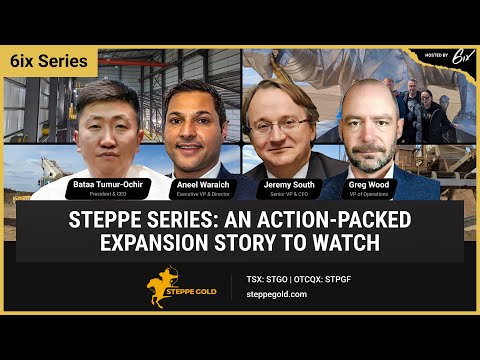
0:08 Hello everyone, welcome to Stepgold's live investment summit today hosted by 6. I'm pleased to introduce our speakers for today, Vata Tumar-Orchir, their President and CEO, Jeremy South, their Senior Vice President and CFO, as well as Anil Warich, their Executive Vice President and Director. As a reminder, if you have any questions, feel free to ask them using the Q&A tab found on the right-hand side of your screen at any time during today's presentation. And as always, this event is being recorded and will be available on six.com in the coming days. Without further ado, Anil, I'd like to hand things over to you to get us started. Well, thanks, Cam. And thank you, everyone, for joining our regular update on the STEP series here with 6. I'd like to thank my colleagues Jeremy and Bhatta for joining from Mongolia late in the evening here live and we look forward to your questions.
0:59 So as usual the normal disclaimers for any forward-looking statements on this presentation. For anyone new to the Step story, we are listed on the main board of the Toronto Stock Exchange. We actually listed in May 2018. We started the company as a private company in 2016 with the aspirations and ambitions of being Mongolia's premier precious metals company. So focused in and on Mongolia. In 2017, we acquired the 2 assets that we own today. The ATO being our flagship and cornerstone asset that we acquired from Sentara Gold for US$20M. And our second project is the Udham Hundi or UK project for short. That's a very large exploration license, 14,400 hectares in a new mining jurisdiction, a highly prospective Gold province. They were very excited to have started drilling for the first time ever this summer.
1:58 The ATO project, as I mentioned, required for US$20M, was previously owned by Sentara Gold. They had spent about US$30M on the project, drilled 67,000m, 28,000m of trenching, but most importantly got it fully permitted and licensed for the phase 1 that's currently in production, the oxide mine, but also for our phase 2 expansion. We bought a build-ready project, but took a phased approach, focusing on the oxide mine, which is from surface down to about 40m. It gets us established as a producer, a taxpayer, a royalty payer, an employer in-country, and use that cash flow to grow our business, which we have. So in May 2018, we listed the company as the only main board of mining IPO in 2018.
2:44 So raising 25 million Canadian in a very tough time back then. We were able to build our mine in the subsequent 14 months. Roll around to 2020 in another tough time with the global pandemic really just starting globally. In Mongolia, actually, the country was closed. You couldn't get in if you tried. We brought production online for the first time ever with our 1st Gold Core in April 2020, declaring commercial production in July 2020. So a Very quick build for about 25 million US. Our first ever a quarter of production was done locally with 100% local team. That's very important as we establish this company. We consider ourselves a local company, a Mongolian company listed on the TSX.
3:35 As you can see, Bhatta our CEO, who's full-time in Mongolia, is Mongolian, half our board are Mongolian, and most importantly 99% of our operating team in-country are Mongolian. And that allows you to, as in any jurisdiction, the more local you are, you get the support locally, provincially, and federally. And certainly in times of a pandemic where there are travel restrictions, you can still continue to operate. And that's very important for us. We were able to operate, bring production online for the first time ever in a very tough environment. That's a big win for us. In 2021, we actually put out our 1st resource update on this project, which I'll get into on another slide. But certainly we've added some significant value to the size of this asset without a lot of real exploration, more inform, extensional drilling and reassessing the data that Centerra had completed and coming up with a new take, which we've had wins on.
4:31 Later in 2021, we actually released a feasibility study on that phase 2 expansion I mentioned, that's based on that resource update early in the year. We've now added 10.5 years of mine life at double our current production profile. So again, a big win to have meaningful scale and production profile going into our phase 2, which we expect to come online in about 2 years time from now. So while producing from phase 1, we'll continue to build out the phase 2 operation, which is already under construction, which we'll highlight again in another slide. So in March of this year we actually restarted very successfully. We've been in production relatively stable since April this year with over 13,000 ounces produced in Q3 of this year. There is seasonality in production in Mongolia or anywhere when it's cold weather, but we will be producing all year round.
5:28 And just recently, which we'll also highlight, with that UK project I mentioned where we started drilling in July, we have about 3,000m of pending results. We announced a joint venture with a state-owned mining company, which we'll highlight. We have been fairly active while generating cash flow and getting bigger along the way. So as a reminder, in May 2018, we listed the company at US$2 a share when Gold was circa US$1,250. We hadn't built the mine, So there was nothing there on the Mongolian step. We had to build, we had build risk, CapEx risk, finance risk, and our final permit risk. Here we are today, having produced for, you know, produced almost 70,000 ounces successfully and profitably, and our share price is probably 0.5 from where we went public.
6:19 So again, it's an opportunity for investors, new and current investors to be able to average down in a producer that's expanding and still exploring. We have quite a lot of support from sophisticated investors globally. More importantly, our management team owns close to 20% of the company today. So, we're highly aligned with our investors. We do feel the pain in these choppy markets and we're here to ride the game over the long term and create that value as we have in the last few years and continue on that path alongside our supporters and investors. We've been public for almost 4.5 years and we haven't sold a share. So, we're certainly aligned with our investors and I think that's very important in any business to have the alignment with our investors. Out of Mongolia, we have some strong support as well from investors, owning close to 15% of the company.
7:09 We've had some very solid family office investors back us as a private company and public, longer term horizons supporting us. Fidelity International owns about 6% of our company and Ericspot owns about 11% of our company today. And now last but least, Elliott Management of New York and Triple Flag, who have been our supporters since 2017 as a private company, own about 4% of the company. So we have some sophisticated blue chip investors that have all come in at prices much higher than today. On the banking side, we have research coverage from Handman Partners of the UK, Stifel GMP out of North America and Haywood Securities also out of Canada. We do expect our research coverage to grow in the coming quarter. We conducted our first site visit in over 2.5 years in April of this year and we brought a few other banks.
8:00 So we do expect some additional coverage coming from some of the banks to bring more eyeballs on the story, because certainly we're one of the more exciting stories out there that offer that production, that cash flow, the expansion, yet all the sizzle of any Explorer Co. Out there on both of our properties. So over the next 2 years, we expect to produce about 90,000 ounces from the oxide mine, as I mentioned, while constructing the phase 2. The phase 2 should come online in about
8:30 Q4, 2024. So again, about 2 years from now, if we stay on track. I'll quickly highlight our board and management team. Very importantly, as I mentioned, we are a local team. Bok, our CEO, and Matthew Wood, our Executive Chairman, have worked together in Mongolia since about 2010. Matthew Wood, our Executive Chairman, is an exploration geologist and has had many wins globally, but more importantly in Mongolia. Matt and Vata built a company called Hudu Coal, raising $20M on the IPO in 2010. In 2011 that was sold for 500 million cash and again importantly upon that sale there was about 300 employees and only 3 were expats including Matt. So very similar approach of being local and creating a win there for our investors, all stakeholders and country.
9:25 I won't get too much into the management, but again, anyone has questions, please ask later on in the Q&A. So now we'll just talk about why Mongolia and I'll hand it over to Jeremy and Batla to highlight Mongolia. What do you like Batla?
9:47 Okay, thank you. Thank you Anil. So why Mongolia? Mongolia itself is a mining country, and over 90% of all our exports are mining commodities, and over 70% of all foreign direct investment into the country goes into the mining industry. So mining industry plays a vital role in the economy and especially Gold industry, where the central bank buys all the Gold and Silver and exports it in order to bring in foreign investment, foreign reserves into the country. So the Central Bank and the government of Mongolia is very supportive of export industries in Mongolia. And we are located, If you look at the map, we are pretty strategically close to the world's main buyer for all mining commodity products in China. So as for StepGold, our ATO project, we have the infrastructure and everything in place for the phase 1, where we sell gold and silver to the central bank and for the place too where we're planning to sell concentrates into China. So this is the big thing.
10:56 Just to add to that, Rio Tinto's Otooglo project, one of the landmark projects in Mongolia, has been around for a while, but it's certainly been in the news a lot of late. Rio's committed another $5 billion to take control of that project in partnership with the Mongolian government. It will be the 3rd or 4th largest copper producer in the world in 2 or 3 years once the underground is underway.
11:23 And that's really been a game changer, I think, for overseas investors as they look at Mongolia as a mining jurisdiction for a supermajor to commit what is probably $12 billion over the life of the project to this project is very important. Here In Mongolia, we see a lot of the Rio Tinto people. It really is a great advertisement for Mongolia as a mining country. And what it has also done is it's been able to really drive talent acquisition and talent training in Mongolia. So not only is Mongolia a great mining country, but it's now got a lot of homegrown talent and everything from engineering to banking, to HR, to geology. So I think, as Bata says, Mongolia is heavily reliant on mining and that project has really helped. There are many other projects in the country and it's still under-explored, but we certainly feel that we're committed to Mongolia. We like the politically stable nature these days and the mining expertise and the strong logistics is very positive. As we move into phase 2, which is a precious metal concentrate project, that the proximity to China really plays a
12:53 major role and really sort of positions us very well to really feed into the Belt and Road Initiative. President Xi in China recently underscored his commitment to Mongolia as a strong Belt Road partner. Back to you, Anil. Yeah, so the ATO project sits on 5,500 hectares located in Dornod Province. This is in the far northeast of the country, immediately south of Russia, with China to the east. We commenced mining in 2018. So While constructing the mine, we continued to start mining and build up an inventory and production commenced in 2020.
13:41 As I mentioned earlier, we have produced about 70,000oz to date, with an estimated 90,000oz remaining on a recovered basis. So when we bought the project, it was about 1.2Moz on a resource basis, inclusive of 210,000oz of reserves, which were oxide only. So on a recovered basis, those reserves on oxide was about 140,000oz. So we have exceeded the expectation of producing more ounces from the oxide mine. And this is without any additional drilling. So it is what it is today. Maybe down the road as we continue to drill out this property, there could be other satellite deposits that could feed into the oxide mine. We're not relying on that, but there's certainly
14:24 an opportunity in the future. But this is where we stand today. Today, as we mentioned, we had the resource update and reserve update come out last year. We now have converted that 1.2Moz on a resource basis to over 2.2Moz on a Gold equivalent basis, inclusive of 1.6Moz of reserves. Our reserves have gone up from 210,000oz, so almost 8-fold to 1.6Moz of reserves. That's the basis of our phase 2 expansion. It solidifies that we have enough ounces that are economical to expand into a 10.5-year mine life on phase 2 as a base case. We do believe that 10.5-years of mine life for phase 2 on the same property will continue to grow with the drilling that we've completed late last year and we continue to do so today.
15:12 There's a lot of opportunity to grow this mine to 15, 20 years and beyond.
15:19 Just a quick highlight of where we started and kind of where we're going on this project. So this is the 4 deposits you see here is the ATO phase 1 and phase 2. At the top of ATO 1, 2 and 4, right from surface down to about 40m is the oxide mine. So that's the phase 1 operation, the oxide mine. That will run again for about another 2-years or that remaining 90,000oz from today. Right underneath,
15:47 all deposits transition into the phase 2 ore, the fresh ore deposit. As you can see here, the maximum vertical depth so far is about 400m of drilling. The Feasibility study is based on ATO 1, 2 and 4, with only about 10% of the new Mung deposit on the far right here included. There's a lot of room for growth by just bringing the Mung deposit with another 100,000oz to 400,000oz into the fold, but add to the mine plan and You're going to have an open pit, probably close to the first 8 to 10 years, which will then decline underground at some point to the higher-grade chutes. As I mentioned earlier, we reviewed the data set that Sentara provided and had some very quick and easy wins on this project.
16:34 First, ATO4, where it looked like ATO1, like a breccia pipe, a carrot-like breccia pipe. It originally looked like that as well, ATO4, and we've actually proved that model wrong. We have doubled the size of ATO4 and it still remains open towards Mung and at depth. The Mung deposit was not in any resources or resource tables. We put our major resource of about 430,000oz on the Mung deposit, which will convert, we think, into MNI over the next year or so while building our Phase 2. So that's additional ounces that will add to the Phase 2 mine life and hopefully production profile as well. And we've now drilled for the first time ever under ATO1 and 2, which I'll get into another slide, which also shows that ATO1 and 2 also remain open at depth. There's new discoveries and extensions there as well. So this asset is something that we think that can grow to 3Moz to 5Moz over time. It's something that keeps giving.
17:32 We haven't had a lot of resources to focus on the growth side while building the phase 1 mine and keeping production online. Certainly a lot of opportunity for growth in the future as we step out of these properties, but also it's just at depth as well. All 4 deposits remain open at depth.
17:50 Again, this is a summary of the mineral reserve estimate I mentioned that came out last year that backs up the 1.6Moz of reserves on a Gold equivalent basis. And something to highlight here is the lead and Zinc that the grades that we used here of 0.46% and 0.78% of the Zinc and 0.46% of the lead, which I'll get into another slide. But this already shows that the base metal component of the 2 deposits, ATO1 and 2, are economical. And we are building a flotation plant for phase 2 that will process these base metals and produce base metal condens with precious metals content. And certainly the new drilling has shown that there's a lot more base metals and much higher grade. That shouldn't require any additional CapEx, which I'll get into.
18:36 With that, I'll hand over to Jeremy on the summary of this phase 2 feasibility study we put out last year. Thanks, Anil. So Last October, we released a study,
18:48 very strong results for robust economics, after tax NPV over 230 million, NPV, sorry, after tax IRR over 67%, a site-based AIC around 850, with inflation that we've seen probably closer to 900, but then with the grid power solution, we think that probably down closer to 800. So we still think we're working with about an $800 site AISC. Strong EBITDA. This table really incorporates the last 2 years of the oxide together with 10.5 of the fresh rock. We are in the process of finalising a reserve update on this project and we are looking to see some meaningful expansion of that reserve calculation.
19:43 So that will probably show up in a higher production profile, maybe not more years, but probably just a higher ton per annum result. So we'll sort of more on that soon. It's got a quick payback and I think the payback really owes itself to the cash flow that we generate out of the oxide. 150 million of CapEx is very much at the conservative end of conservative, we believe, but certainly in this environment,
20:12 while we were able to source most of our equipment from China, we've been conservative to make sure that the numbers really stack up. So, yeah, very robust project, but really just a baseline and we continue to improve on it and work on it and optimize it as we move forward. The grid power solution is important. We run off diesel generators, and being able to connect up to the grid will be a significant, not just saving on power costs, but a significant benefit for just reliability and ease of operation.
20:53 Back to you. Thanks, Jeremy. A couple of things to highlight here, you know, the CapEx of 150, when we put out the feasibility study a year ago, it was 128 million US, but it did not include that power solution that Jeremy mentioned. So our all-in costs will decrease with that power solution, but there is additional CapEx required. Hence, in this new world, we're using 150 million US as our CapEx number with that power upgrade, but now we have a lower cost structure because of that power upgrade. So it's certainly meaningful. The other thing I didn't mention at the beginning of this presentation, but goes back to the support we have within the country, 2 weeks after we released this feasibility study, we received a landmark US$60M debt package, sponsored by the Bank of Mongolia as part of the Gold II program. So again, it shows you we have a supportive government that is providing capital for us to grow, not changing the economics here.
21:47 That's very meaningful for us. It allowed us last year to continue to move phase 2 forward when we weren't in production during the winter. And in fact, we actually procured, which you'll see in another slide, the very large crusher, fixed crushing circuit, 1,000 ton per hour, which is now almost fully installed this month, imminently, that will be operational in the new year. So certainly a very supportive government. And the goal is over the next 0.25 to 2, I guess, probably by mid to late Q1, I think, Jeremy, our plan is to have all the capital on the debt side locked up. So that 60 million will probably come to about 110, maybe 120 million US of debt on the project that will allow us to fully fund the phase 2. And so our goal is to refinance that or expand that deficit that we received. But we certainly have enough capital to keep plugging away on phase 2 until we get all the capital lined up in the coming quarter. We don't need all the money today.
22:47 So we certainly have the luxury of a little bit more time. Now, as I mentioned earlier on the reserve table and in the other slide, the resource slide, we drilled out ATO1 and 2 and again confirmed our theory that all the deposits remain open, which we've shown in ATO4 as well with our initial doubling of the size. First drilling here in ATO1 and 2 have produced grades on the base metal side that are 10 to 20 times higher than in the Feasibility Study. So 21m at 10.5% Zinc. 55m at 4.5% Zinc, roughly. These are meaningful intercepts that we think will add to the mine life. So as I mentioned earlier, there's an opportunity to grow this 10 1.5-years.
23:32 We think by the time we bring it online in about 2-years, this will look a little bit different and more robust. And certainly, we believe without any additional capex. One thing that wasn't mentioned in the Feasibility Study, it wasn't included, was a CIP or CIL plant that would increase our recoveries and the amount of ounces we can produce. We think our goal is maybe in a few years, funded from our cash flow from Phase 2, we can just slot in a CIP or CIL plant that will increase our recoveries on the precious metal side. So again, a lot more optimization and growth opportunity on this baseline study that we're working off to construct and bring phase 2 online.
24:13 I'm going to run through the slides very quickly. This is the crusher construction that looks a lot different today, almost fully complete. We've actually put out a video on our website. You can see some of that crushed construction. So phase 2 is moving forward already.
24:29 With this, I'll just hand it over back to Jeremy and Bhatta on the summary of the ops for the last couple of quarters. Bhatta, why don't you speak to this slide quickly? Mr. Rao on the power and the crash. So the company has received all the approvals to be connected to the state grid system of 10 megawatts, which is going to decrease our costs approximately at least $100 per house. So All sustaining costs are going to be decreased a lot.
25:04 As for the new crushing unit, the new crushing unit is 90% complete. We're just waiting to be connected to the generators as for now. And later next year, we're going to start the construction, hopefully start the construction of the connection to the state grid system. And right now as in the inventory, the company has been building our inventory non-stop. Right now we have over 70,000 ounces after recovery at 70%. 40% is 40,000 ounces on the leach pad, 15 on the run pad, and 15,000 ounces as a blasted material. So this would generate the company about $150 million in revenue.
25:50 And most of the costs to mine and to crush is already covered. So for the last Q3, we've been steady continuing to crush the materials on the rampart and keep continuing our production.
26:13 So as I mentioned earlier, our second project is the Udumbundi or UK project. So this is in the southwest of the country in a new Gold District, very exciting region. And frankly, where we didn't have the time or resources to focus on the last few years, well, bringing the oxide mine online. So we did start drilling for the first time ever on our property. So in the Gold outline here, the Odom-Hundi project is a 14,400 hectare exploration license that has never been drilled. So we've done the groundwork, IP, magnetic, soil sampling and even trenching at surface. That yielded some very exciting results. 1.5g Gold, 450g Silver, 3% Copper. Very encouraging. What's also very exciting is the license is immediately added to the north and south, held by our peers, Ordine Resources. So Ordine's been in the country for quite a while, had some really good discoveries in drilling down here in this province, adjoining our license.
27:14 Today they're over 1Moz. And I believe by the end of the year, they're expecting close to 2Moz. So we're certainly in the right region. Now we get to finally focus on this license and drill. So we have 3,000m of drilling that we, as our initial program, we started in July. Based on these results, we will formulate a new program in the new year with results still pending. So going back to the exploration side, we have drilling ongoing at ATO. We know the ATO wanted 2 deposits with results pending. And we also have the UK drilling, made in UK drilling with results pending as well over the next couple of months. So very exciting to have that news flow. We do believe this district is a multi-million ounce potential,
28:00 certainly an opportunity to continue to grow and in a way could be our what I call a phase 3, our next production center. Still a few years away, but while we get phase 2 online and up and running we can continue to drill and grow this this region with the goal of bringing it online in a few years as their next potential miner too. Batak can comment now on our recent update we put out to the market on another exciting license, Self, of our project.
28:30 So we have announced that we have signed a cooperation agreement with the local government and plus on top of that there is a state-owned license called a project called Kurenza which is owned by a state-owned entity called Erdnassal. So we have made the proposal
28:48 to do the joint exploration and joint survey programs. And we have also signed an MOU regarding how to develop the region together. So right now we are planning to have a look at this Western Mongolia as a big multi-million,
29:08 all this potential, the high potential. So right now, we have both companies are planning to go to the joint exploration programs for the next year. So yes, so we expect, hopefully expect good results from the exploration programs next year.
29:28 Yeah. Okay, I'll Just jump in here and we can get into questions. Financials, as mentioned, we just finished our third quarter. We did pre-announce our goal production of $13,300. So around about 26,000 ounces here to date, hope to produce somewhere in the region of 8,000 to 10,000 Q4, which will bring us up to about 35,000 ounces. Have showed a strong ramp up through the year. We didn't really get going until April. So, you know, it's been a decent year production wise. We are getting up around 5,000 ounces per month in peak months, which is good.
30:15 One of the benefits of operating in Mongolia, we sell all our gold. We have a very simple sales cycle. We pull gold dore bars 1 day. We deliver them by armoured vehicle to assay lab. They're assayed and sold to the Bank of Mongolia the next day and we're paid about 30 minutes later. So very, very streamlined sales process. Not only that, but we get paid a 5% premium to our LME spot in the course of 2022. So we are seeing higher than market average achieved gold prices in 2022. Plan to report our Q3 results in November. Q2 showed percentages are around 50% and we expect that to continue into Q3.
31:09 That's 50% before debt service and before the stream.
31:14 So some meaningful cash flow generation, which is certainly giving us some flexibility on our ability to continue with mining, stacking, exploration and other activities. As mentioned, we are well advanced on discussions with international Mongolian lenders and traders for project finance options. And we're hoping to update the market on that and in the coming weeks, actually. So, you know, the debt markets are not helping us, but we certainly, we have a very strong, we have a strong story with, which is really an expansion story with cash flow and much of our infrastructure is already built. And as Barton mentioned, in the case of our phase 1 offsite operation, we have spent a lot of the money in actually getting the ore ready to leach. And that's going to show up in some strong cash margins over the next 2 years as we produce that 90,000 ounces of remaining ore.
32:22 So exciting times for Step Gold. Our balance sheet is improving and we're excited for the future.
32:35 Back to you, Neil. I think that's... Yeah, so it's, yeah, exactly. So I think with that, Cam, we can open up to the rest. Yeah, absolutely. Thanks, guys. As a reminder to everyone in the audience, if you'd like to ask a question, please do so using the Q&A tab found on the right-hand side of your screen. But gentlemen, let's get started. First question, with the hookup to the grid for power, does the existing diesel system remain available to provide backup in emergency situations? And to what extent has the existing diesel system been written down? Yeah, what do you got, Baja?
33:11 Yeah, so right now we're using about close to 4 megawatts of energy using the diesel engines. And we're planning to connect to the 10 megawatts and we're going to, we also are offering new gen sets. So we're going to have 2 options. So mainly we'll be using the state free system and that's going to keep the generators as a backup. Yeah, we'll have redundancy in the system. The gen sets, we don't own them all. We own most of them. And they have been depreciated using units of production. Nigel's also just wondering if you can reiterate what the current cash position is.
33:58 We have net debt of around $10 million. All right. Net debt, yeah. Next question, how long will the Mongolian bank continue to pay 5% premiums and do they do that for other companies? Yes, they started doing this starting from this year during the COVID period because central bank needs to buy the gold and silver in order to bring in foreign reserves to the country. So right now it's going to be continued till the end of this year, and we're not sure about whether it's going to extend the situation or extend the foreign reserves there. And it's available to all the companies, not just us, to everyone. Okay, great. Are there further risks and delays besides recent reagent supply issues that you foresee, especially with the onset of winter and ongoing geopolitical issues?
34:52 Yeah, I mean, last year we had a little difficult situation where we were unable to bring in reagents into the country from China. So This year we found 3 new routes and right now we're using the new routes. And so we're using all the available options and we keep continuing to talk into other new and suppliers and hopefully not to make the same mistakes like last year. So we are slowly building our inventory of reagents. All right. Certainly there is, yeah, I mean, the risk is real for everyone in terms of supply chain. So that's something we can't write off. We can only, all we can do is try to mitigate it by having these multiple sources, which we've done, and building up that storage and inventory on site so we can have a nice little buffer should we have delays, further delays from any of those channels.
35:46 Right, absolutely. With the current market landscape, how are you positioning gold's value proposition with all commodities taking a hit?
35:56 Yeah, listen, I think, you know, In a normal world, gold should be much higher given the risks that are going on in the world. Usually just a war is enough for gold to really move, not including all these other factors. But obviously, US dollar strength is opposition here to the gold price. It has obviously that strength has kept the gold price in USD, I would say down compared to where most people thought it would be. Saying that, if you convert the USD into any other currency in the world, gold is actually performing quite well. So it's actually performing as it should to offset that inflation and some of that risk. Now, it has been liquid like any other asset class. So there is obviously selling from other countries or individuals on Gold to create that liquidity.
36:48 Interest rates have gone up significantly in the last few months and it looks like they're still creeping up for a bit longer, inflation, so people need liquidity. So our take is that gold at this price is still fantastic. You can have a very solid margin. We don't need to rely on a higher gold price to operate and grow our business and still have a very profitable company and cash flow. But certainly the sentiment in the market requires a higher gold price for the equities to move. And maybe it happens this year, maybe it happens in the new year. We'll just have to continue plugging away and creating that value. And then as many know, equities have the torque and leverage. As the gold price moves up, you see multiples of that in the equities of gold equities. And so we'll just continue to create that value and wait for the world to wake up to gold.
37:40 No, fair enough. Another question, with the current economic uncertainties in an inflationary environment, There's been a lot of eyes on the unemployment numbers worldwide, and Stepgold has probably played a role in building Mongolia's talent pool and has a strong, fully Mongolian operational team. But are you worried that the global economic trends will have an impact on your own team? So, yeah, so we employ, we are one of the largest employers in the region, in the Eastern Mongolia, and right now we employ about more than 300 people on site, directly and indirectly. So I mean, last year we had the tough year with this COVID restrictions and lockdowns. So even though during those times, so we haven't, we kept all the positions live and we keep hiring more and more people with the development of the phase 2.
38:35 So we have a lot of demand that people are willing to work for the company and we believe we're going to continue to do this. Wonderful. Yeah, we're looking to double actually our workforce over the next couple of years, not reduce it. So certainly we're here to increase employment and local employment. And as I mentioned, because even with the depressed commodity prices, we're in a low cost environment. We can operate cheaply, cheaper than most people can around the world. Our off-takers or partners are either domestic, like the bank, with the central bank buying our current production and having China right next door. We have significant advantages over a lot of other countries that we have to export concentrates and you know a distance and Obviously that creates a lot of cost cost pressure.
39:24 So I think we have we're in a unique situation that we can weather any of these storms Yeah, and also I'd like to add this gold price is tied into the US dollar currency rate and whenever the US dollar keeps increasing worldwide, it's also increased in Mongolia. The Mongolian currency has been devalued about 20% And with this also devaluation, the costs are also coming down a lot. And we generate the revenue based on the U.S. Domestic rate. So even though we have an inflation in the country, but it's a match-up, yeah. Right, absolutely. Well, gentlemen, that looks like all the questions we received for today, so I wanna thank you for coming on, as well as everyone that is in the audience, especially those who have asked questions. But I wanna pass things back to you before we wrap up for the day for just some closing remarks. Okay.
40:18 Thank you. So, I would like to say, in general, the company has been growing with regard to the resources and reserves and operations, and the production is also increasing. So we expect the highest production at the lowest cost in the next 2 years, since we have an inventory of 70,000 ounces ready to be leached, and also an additional 20,000 ounces to mine and stack over the next 2 years. So We expect to produce over 90,000 ounces within the 2 years. This is the phase 1 for the company. As for the phase 2, the company has secured the initial financing for the phase 2, which will enable the company to start production of over 100,000 ounces per annum starting from the end of 2024.
41:06 So currently we are assessing several EPC companies and we are very close to fully commence the construction of phase 2. So while we are building phase 2 of the next 2 years, we will continue to produce gold and silver from the current oxide zones and we continue our exploration programs on our current ATO and autumn-hundred project. So thank you very much to our shareholders for being with us during this high and low period of the companies. Thanks. All right, well thank you Bata, thank you Jeremy, thank you Anil, and I hope you