Transcript
Automated transcript · Written by software from the replay's audio. It can mishear names and figures; the replay is the record.
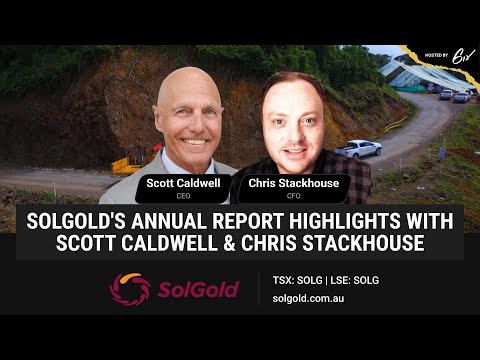
0:07 I'd like to formally welcome everyone to SolGold's live event hosted by 6. Please introduce today's CEO, Scott Caldwell and CFO, Chris Stackhouse. They'll take us through a brief presentation on their recently released annual filing, followed by a live Q&A session. As a reminder, you can submit your questions in the Q&A panel on the right-hand side of the screen at any point during the presentation. We'll try to get to everyone. We're targeting about a half hour for today's event, so please do enter your questions to make sure that we're able to get to them on time. As always, this event is being
0:40 recorded and will be available on SIX.com as well as YouTube to watch afterwards. But Without further ado, I'm going to hand it over to Scott and Chris to kick things off. Well, good morning, everyone. Thanks for joining us today. I think we kind of have a worldwide audience, as per the norm. But Chris and I are going to go over a short presentation and then try to answer any questions you might have. So next one. There are some forward looking statements in this presentation. And so we do have a cautionary language. Next slide, Chris. So the highlights of 2023. We ended in Chris will talk more about the financials, but we ended the year with a little over $32 million in cash.
1:30 And all the currencies in this are US dollars, by the way. And we continue to attract new investment, 30 million placement by Zhengxi Copper and a $50 million royalty purchased by Cisco. That was late last year in the fourth quarter, December last year. We had a major achievement, we successfully merged with Cornerstone Capital Resources. And so we now the main prize in that merger was we have 100% of the Caskabel project. And of course, we picked up some exciting exploration tenements with Cornerstone as well. And a couple of them have moved into our actually our top 10 of the 90-odd tenements that we have in the country. So we're really excited about those tenements as well. So we're working on one of those now.
2:19 So it was a successful merger. It did take a little longer than we thought, but we did close it in February. We went through restructuring and Chris will talk about the results of that, but we simplified the organization. Essentially, our Australian presence is strategic in nature. Our board is there. Most of our board is there. And we have one person in UK and we've moved as many functions down to Ecuador as we can. So we simplified the organization and reduced our workforce worldwide. We started a technical study and it'll be complete in the first quarter of next year. We call it a phase development approach to Cascabel. Exactly what it says is start out at a reduced rate, lower capital, shorter construction schedule from beginning construction and production, and then you expand over time using cash flow from the operation to expand.
3:21 You end up in the same place, you mine the same resource that's in the current PFS. It's just a different way to look at how to develop it. And we'll see how that turns out. Again, that should be completed in the first quarter, early in the first quarter of next year. Strategic review, that process is still ongoing. There's no timeline.
3:41 And why no timeline? We have a lot of assets, a lot of great assets, Cascadel being the prize, the crown jewel. But we do have 89 other tenements. And so when people are getting into the data room, they have a lot of information to look at, but there is a lot of interest, a lot of people in the data room. And so we continue to work through that process over the course of the year. I'm excited about the process. And again, what is it? It could be a joint venture on an outside exploration property. It could be the sale of an exploration property, an involvement in Caskadel. So it's really looking at our entire portfolio and seeing how we strategically extract value from that, maximizing a stakeholder value, our shareholders, the people in the communities we work in, our royalty holders, government of Ecuador, our employees. So it's maximizing not only shareholder value, obviously, and I'm a shareholder, so that's a key metric, but it's stakeholder value, all of our partners that we work with.
4:51 And with that, I'm going to hand it off to Chris. I believe Chris will take it from here and answer the hard questions. Well, thanks Scott. And thanks everyone for joining us today. I'm not gonna go through our entire set of financial statements, but I pulled together a few sort of choice key figures to run through with everyone today and try to draw some of the key conclusions, at least from management and the company's perspective. So Scott mentioned all the dollar amounts we're referencing today are in US dollars and we did end the year with cash of $32.5 million. You can see it's a little bit higher but effectively about the same cash balance as we ended the prior year with. And you can see we've capitalized, so a lot of work was done in advancing Cascabel and some of the various other assets in the SolGold portfolio.
5:42 You can see there was a significant increase in the non-current assets, which is effectively the capitalization of our various projects and moving them forward. The details of the balance sheet, obviously, you need to look through and go through the notes. Current payables has increased over the prior year. It's just general working provisions, payables, some of the restructuring costs that had been crude at June 30th are sitting in there as well. So you can see, I think it's note 19 of the statements where it breaks down that in a little bit more detail for the reader. The other piece that I'd like people to pull away from the balance sheet is the own share reserve. It says 25.4 million and why that's a little bit interesting, that's the shares that Cornerstone held in SolGold prior to the acquisition of Cornerstone.
6:33 So when when Soulgold acquired them, those shares were not cancelled and they sit in the old Cornerstone subsidiary. And we'll talk a little bit about those later on in the presentation, but they're worth pointing out. They had, I think, if they were mark to market, they'd be a little bit lower in value today, but as of June 30th, they had a value of 25, about 25 million US dollars.
6:58 So focusing on the balance sheet, why? Obviously it's not in a huge position of strength if you look at sort of the general advanced rate. Obviously we know that to put advanced cask bell is going to require a strong balance sheet. So a lot of the focus of the management team has been around protecting the balance sheet And so that's come through various ways. Protect the cash we do have and make it last as long as we have and use it in the most value creative ways. So we spoke about that and a lot of that's behind us now, the restructuring that Scott had mentioned previously. The investment attractiveness of Cascabel, so the works that we are doing with our current cash balance, we want to make sure that those dollars are focused on the maximum value creating, which is de-risking Cascabel, which we believe will increase the attractiveness to potential investors going forward.
7:53 We're also looking at this great exploration portfolio, what opportunities we can generate with that. So that's sitting on our balance sheet. We have great tracts of land, as an example, Port Veneer, great discovery there. We just needed additional resources to help move those projects forward. As I mentioned, the show gold shares acquired. We do have that block. Strategics have expressed interest in that block, but we're holding onto it for now because we just want to make sure that we do benefit, the current shareholders and the project going forward. So We'll use that when we believe it makes sense for the company.
8:40 So I spoke about restructuring. You can see here some sort of key metrics we pulled out. The average headcount in Ecuador, you can see through the course of 22, 23 and where we're at currently in the current quarter, you can see one of the fiscal 2024. So significant head reduction in our overall headcount in the operations, i.e. In Ecuador, significant reduction in our corporate headcount globally. So effectively the closure of our Brisbane headquarters, a significant reduction, we're down to effectively a single person in London. And then Scott and myself and a few other key people, which are effectively all majority of our work is based in Ecuador.
9:26 And Scott, that's where he's sitting today. Unfortunately, I couldn't be down there this week, getting these statements out for our shareholders. But I spend quite a bit of time down there as well. You can see the results of driving headcount down and refocusing our dollars. What does that mean to our burn? You can see those figures there. So our current quarter burn, it's around $2.6 million a month. That's down significantly from just earlier this year. And we do hope to keep moving that down through some additional cost reduction measures. We believe we can achieve in getting that closer to $2 million a month as an average burn. But in any case, we have effectively a fiscal 2024 full work plan that is fully funded.
10:12 So our current cash balance with our current work plan, we do believe can last to the end of fiscal 2024, i.e. June 30th and a little bit beyond.
10:25 So I'll kind of flip over from, I think I might have missed a slide, let me just go back here. We're going backwards now. We're going backwards now.
10:41 Nope. Strategic review. Sorry. There we go. Scott, maybe I'll pass it back to you and we can give a little more kind of color to the shareholders on the strategic review and where we're at with that right now. Thanks, Chris. Yeah, so I'll talk about the strategic review. And as I mentioned earlier, it is currently underway. And I said a lot of people are interested, as 1 would expect in this fantastic portfolio we have, of course, led with the Tier 1 asset, Cascabel. But the focus of the review is to maximize value for all of our stakeholders, which are shareholders, our employees, our partners, and of course the Ecuadorian government and the local communities we work in.
11:35 Ongoing, no timeline, a lot of interest in this portfolio. We believe that Ecuador is a great place to work. We've had a very good experience here historically and continue to have a great experience working with the communities and people. I live here in Quito. I've moved to Quito, so I walk to work every day. It's a wonderful city and I'm at Caskillville almost a weekly basis and wherever else I need to be. The discussions, the review is progressing well. Discussions ongoing with credible groups, highly credible groups, and they're in different stages of the reviews. As I mentioned earlier, it's a complex land package, a lot of opportunity.
12:21 And if you're going to look at the whole company, it's a lot of work to look at the outside tenements, all the data, and then site visits, et cetera. So it's a process that takes quite a while to do a proper due diligence. So, people are interested, they're looking, and it's just an ongoing process. Strategic interest engagement. Again, strategic would be people that we would want to partner with, that we think would work well in the country. They've got a strong balance sheet. They have a good technical, good management, good ESG programs.
13:01 And we know that they're perhaps in the country already, perhaps they're interested in moving into the country because of the great rocks here. You know, Ecuador has some of the best exploration potential, in particular for copper porphyries, but you have mines like Lundin's Fuerza del Norte, which is a phenomenally operated mine. That team is doing a great job and it was built and commissioned here successfully. You're all familiar with the story, but I can't say enough good things about this Fruta del Norte achievement and the operation there.
13:36 You know, Cascabel's significance. Cascabel is a tier 1 asset. It's one of the best I've ever seen. I've worked at Grassberg, I've worked at Coyawassee, I started my career in Porphyry Coppers in Arizona, low-grade open pit stuff. So I've been around some pretty good Porphyry Copper deposits, Grasberg and of course, Koyawase. And this Casco is right up there with them. It will be an underground mine, a block cave eventually. But it is a phenomenal mine. It produces a quality product. It produces a very, very clean concentrate with none of the bad actors such as arsenic, et cetera, zinc. And It's got a long mine life. If you just took the numbers, took the resource
14:25 and looked at a reasonable production rate, it's probably 80 years. I'm not saying that It's going to run that long, but it's a phenomenal asset and it produces a product that's highly desirable because it's so clean. A lot of the mines in the world, as they get deeper and older, their arsenic context, some of the things you don't like to see in content and concentrate is starting to creep up. So highly desirable product, which is a big thing if you're making concentrate, copper concentrate. It's a strategic asset. You know, I've talked to a lot of people about Caskabel. I first visited it in 2016. That's when I first invested in it in 16, 17. I still own stock. I own about 18.7M shares. So I'm a shareholder, a stakeholder.
15:17 It's a very, very high quality product, project. It's got some phenomenal grades in the high grade core. And that's the focus of kind of the phased approach is to start with the higher grade material and then as you expand, you would slowly mill lower grade material rather than extract the entire resource over time. The due diligence, again, I mentioned this, there's no fixed timeline on our process of the strategic review. And it's a lot of work to take a look at these assets and give them their just. And there's been a lot of work done on all of the assets. There's a lot of information to look at. And then of course, site visits are
16:04 another element. Not that it can't be done, it can be done, but our assets go from Columbia all the way down to Peru. So it's quite an extensive site visit if you wanted to look at all of the tenements. Caskabelle, of course, has the most interest. But it, you know, tier 1 asset. I'm really excited about the phased approach. And again, that will be completed at the end of the year, early next year, actually, first quarter of 24. We're excited about the opportunity there. We're excited about to continue to de-risk Caskabel, as Chris mentioned, through some low-cost initiatives in the field. We have option on a tail storage facility site. We'll do some geotechnical work with our existing staff, an option to purchase that land. We may or may not exercise it based on the technical work.
17:00 We have a number of tail sites. We're working on the right away for the concentrate pipeline to the coast, which is an old railway line, things like that to de-risk the project. We have received or will receive the early works permit, which would allow us to begin the long exploration drives or the declines that access the block cave mine. We hope to receive that in short order. We're working with the government on the exploitation contract and the amended Investment Protection Act, and that's proceeding well. So we're receiving approvals, agreements, permits,
17:41 and so to allow us to advance the project, but even low cost initiatives, We're not spending a lot of money on outside engineering for process plants, et cetera. We are doing the work on the amended or the phased approach, definitive, or the DF, or it's not a definitive feasibility study. It's a PFS. It's an amended PFS, so we're updating that. So we're obviously using outside experts for that. But with that, I'll leave that alone. And now I think we're probably moving to concluding. Yeah, well, I think, Scott, I think the key, you know, you kind of went through our look ahead for fiscal 2024. You've touched on most of these points. And I think the key point to tie it all back to our balance sheet is these are fully funded work programs that we have for the remainder of the year.
18:35 Yeah, I think you're right. And with that, why don't we open it up to questions, and we'll try to answer any questions we can. I appreciate it. Thanks so much, guys. So there are a number of questions that have come in. And just for the people who popped in a bit later during the event, you can submit questions in the chat panel in the bottom right corner of your screen. We'll get to as many as we can today. I noticed there's a number of questions that all kind of lumped together. People, it seems like long-term shareholders are asking about the share price performance and really just asking what kind of news or catalysts in the near medium term are likely to turn that around. Well, why don't I, and Chris, if you wanna add into that, again, I'm a long-term shareholder and I'm not pleased with the share price as well.
19:22 Obviously, a higher share price is better than what we've got right now. And I think if you look at short-term catalysts, and I'll just say in the next, let's just say 3 to 6 months, the strategic review is something that I really look forward to and I think that will be perceived very well by investors. And again, the goal of that study is to reduce the upfront capital, the initial capital cost. And if you recall the current capital cost in the estimate in the PFS is right around 2.7 billion. Is that correct, Chris? I think it is. So just under 3 billion US. So the goal of this is to dramatically reduce that cost. We don't have any numbers yet.
20:08 And when we have them and they're ready to go, we'll disclose them all. But it's so start out smaller. And I think people are going to like the economics and it's going to be a more manageable capital number. And that kind of fits into a lot of different aspects. But if we can get a good solid plan, we end up in the same spot and mine the same resource. Eventually over time, we expand to a big blockade mine. So I think that's a good catalyst. I think some of the permits that I talked about, the approvals of various agreements, we hope to have those in the final 3-months of the year. That'll be some news. And again, if there's some developments on the strategic front, in particular on the outside exploration, I think that we've got some very interesting things to talk about there.
20:58 No news, nothing finalised, but there's a lot of interest in the outside stuff.
21:04 Again, it's a complex due diligence when you start to look at that outside exploration and Caskville as well. So things I know are going to happen, there will be various agreements with the government, de-risking permits, things like that. And obviously that revised PFS. Chris, you got any ideas, thoughts? No, I think you nailed all the key ones. I think the only other element I'd add is, from an outside perspective, obviously Scott and I are very comfortable with Ecuador and geopolitical risks, but this year has been sort of cloudy with the election that's been ongoing. And after October 15th, we're going to have a clear
21:48 idea of which party is in power. With all of our views, but the 2 candidates that are running up at October 15th, both are pro-business, both are pro-mining. I think that'll just reduce another level of complexity to the story to allow people to analyze sort of the integrity of the aspect without analyzing the integrity of the country risk. Okay, no, I appreciate that. Matt asks about admin costs, really looking to know what goes into that and how many employees you guys currently have. Well, Chris, I'll turn that off to you and I can, if you want, but I know the number of employees. Yeah, I mean, so in the case of SolGold, I mean, a min cost would be almost everything that's sort of not capitalized, your corporate offices, and corporate offices outside of Ecuador but also in Ecuador, non sort of boots on the ground type expenses go into your overall GNA. It's your overhead to cover the business and keep the infrastructure alive.
22:57 I'll have to go back to the slide, but it was around 290 is our current headcount level. I think that was the question, Romeo? What comprises your admin costs and what the headcount is?
23:14 For more detail on the actual admin costs, I believe there's a further breakdown in note 3 of the financial statements if you want to kind of dig into a little bit more of the public disclosure there. Great, thanks. Rick asks if you can touch on currency risk, if at all, since Ecuador has USD? Yes, it's a bit of a unique case in that sort of the opposite of currency risk in our opinion. We don't have to deal with sort of an unstable local currency. Because Ecuador is dollarized and on the US dollar,
23:53 they don't have a printer machine like the rest of the other governments in the world to inflate their economies. They are dependent on foreign direct investment to bring new dollars into the country. They don't have a printer. So this is, you know, tie back the investment thesis. The government's ultra supportive because foreign direct investment is a way to bring new money into the country. And so the US dollar benefits that. And from an outside perspective, it's a more stable investment and helps with a little bit more long-term view on costs, operating costs and capital costs, because we don't have to add that third variable in of a local FX rate. I might add, when I was working at Koyawasi, when we were building Koyawasi, one of the interesting things was always to look at our Chilean peso costs. And of course, they have the UFA, which is just basically a link to the US dollar, but the inflation at times was one of our biggest concerns. You make an estimate on labor and the next day it was wrong. So at least here we have a US dollar base and that's very nice.
25:05 Right. Jack asks, when will all outstanding permits come in? So I can, I will attempt with that, all outstanding permits? We have a pro chair that we've modeled after successful permitting regimes in the country, Lundin Gold being 1. We've broken it into various modules, the first being the early works, which is early works last expiration declines. That's access to the deposit. That's critical path in the construction schedule. And we hope to receive that permit this year. But we've also got permits that address the tail storage facility, the concentrator. If you add all of that up, we hope to have all the permits by late 2025, but we're going to get them in series on critical path schedule number 1 is, of course, What I just spoke about is this development and expiration decline. Obviously, we'll explore when we get close to Cascabel, or excuse me, the Apollo deposit depth. We can't drill any deeper. Not that we need more tons, but there might be some good grade below us.
26:15 So 2025, the end of 2025, so a year and A02 years, that'd be 2 years. We should have all the permits, but we're gonna receive permits along the way, and then we get the ultimate EIS that will not slow down our current development schedule. Great. Thanks, Scott. There's a number of questions I'll kind of lump together here. There's people concerned about a lack of timeline on the strategic review. Can you comment on what that timeline might be or what the strategic review process looks like from here?
26:49 Again, as I mentioned, there is no specific deadline or timeline on the strategic review. And a lot of that has to do with the assets because we're allowing people to look at the expiration portfolio and a lot of, I say a lot of work's been done on a lot of this, of course, Kaskadell. And so there's just, it's a long process. Of course, you mix in the election with that, as Chris mentioned, that'll be another middle of October, October 15th. And we're comfortable with either candidate. We support whoever's elected, and we're looking forward to working with the new administration. But That's slowed people down inevitably because there is some, you know, what's going to happen with the election.
27:36 We're very comfortable with it. And if you look at who's working in the country, it's not just that we're comfortable with it. There's a lot of strategic companies, large mining companies that are active here or trying to get active here, as you may or may not know, the mining catastrophe is the ability or the legal way to acquire land for exploration from the government is closed. And so you have to work with people such as SolGold if you want to start an exploration effort here. And as I mentioned earlier, it's the right rocks, some of the best porphyry copper rocks in the world. And so you're going to have to work with somebody like SolGold. And like I said, there's people interested in it. But it's a lot of work to go through that vast amount of data before you make an investment. So it's just going to take a while. But there is no specific timeline.
28:34 Thank you. There are a couple of questions. People want to know your perspective on whether you believe the share price is being manipulated. I should hand that off to Chris, but I'll go ahead and try to answer that. I have no idea. I'm a shareholder. We have thin volumes. So obviously it would be easy to move the share price around. But I have no, I just would have to speculate. But part of the factor is we're a thinly traded stock and you buy or sell a handful of shares, meaning you don't have to invest millions and millions of dollars to move our share price up or down. So I have no idea, but I don't think it's being specifically manipulated.
29:20 You know, it's, we're in an interesting time. There's been a lack of news flow, admittedly. And hopefully that's going to start to improve here in the upcoming months. Hopefully, a strategic review can add a little interest. Don't know about that, but we do know that we're gonna be able to produce that study and we're excited about what that's gonna do for us in a lot of different ways. But I don't think it's being manipulated. But, you know, I don't know, Chris, I don't know if you have any thoughts, want to comment? Well, I guess my overarching thought is if I knew the answer to the question definitively, I would be a lot wealthier and in a different position than I am today. Yeah, I think the reality is the story has had a bit of a complicated history.
30:11 You know, I think we're in a bit of a show me period now. So We've given lots of, you know, the company, not necessarily Scott and I, but the company in general, the story over the last 5, 10 years is, it's had its challenges. I think with the current political turnover, the story is turning over, the direction has changed a little bit in the last 6 to 12 months with the cornerstone merger, significant management changes. I think people now need to kind of wait as the company starts to deliver on the new strategy, it will give people a reason to buy and it becomes de-risked. And this is why the work plans that we've laid out today, we believe are achieving those actions. It's using our dollars the best way we know how to give people a reason to buy the stock.
31:00 I appreciate that. I got one from David Edwards. He notes that SolGold is an explorer and asks, as an explorer, how is the current operation, which has described as strategic review, different to the normal business of an explorer with a big asset trying to find a buyer or partner? Well the strategic review, I wouldn't say it's different. It's just that we have such a vast portfolio, Caskerbilt being the tier 1 asset. And obviously, That's one of the reasons I invested, but it's such a vast portfolio that I've talked about with some very good exploration potential. So you have, I'll call it an asset that's moving down a development path. And so there's an aspect that's a little different from just true exploration.
31:51 And exploration in Ecuador is a process. It takes a while. Like any country, you've got to get permits and that sort of stuff. So it's a strategic review. We're looking at people that are interested in exploration and development. This is a question, a couple of people have a similar question. It's a question on strategy, really. They're curious why the company doesn't put a stop date on the strategic review to try and push interested parties into showing their hand. Yeah, you know, that's, you know, you could have a formal process with a stop date. We made the decision not to. And again, I go back to the quality of our assets and just the number of assets.
32:39 And we're allowing people to take their time to go through the data, conduct site visits if they desire. And so we've just made the decision with no stop date. And so we're allowing people to just take the time to review. It's pretty complex because of the quality and the number of assets, including Caskabel. Caskabel is a, a lot of work's been done on it and it's got a huge resource. So there's a lot of opportunity that people need to get their arms on. And we think that that's a way to make sure that we get the right value for any sort of strategic initiative that would maximize our return to shareholders and our stakeholders and the right partner who has the resources, technical, capital, financial resources, ESG, all of the things you need to execute a proper business plan in a responsible manner.
33:40 I appreciate that. Just for everyone in the room, we don't have time for too many more questions. Try to get to as many as we can, but really only gonna tackle probably a couple more. Please note, all of this chat has been recorded. And if we didn't get to your question, we'll make sure to reach out to you individually to get those questions answered. So just a couple more, 1 from Jack, I was curious if Saudi Arabia is exploring an arrangement with SolGold and if they're currently coordinating due diligence. I don't know if Saudi Arabia is looking at the information on a public basis. That's usually where everybody starts. But Saudi Arabia, we would love to be in conversations with anyone that has, you know, the resources to, to execute a proper business plan in Ecuador. And certainly Saudi Arabia does.
34:30 But anyway, they may be looking at us from far, but we'll see what happens. Great. So, to wrap up, that's a question I often like to ask to conclude these. But really, how's the company better positioned than it was a year ago? And I'll take that. I was in a better position. I think, 1, we've gotten our cash burned down to at least where we have enough cash to function and execute a business plan. And so we've had some difficult times to manage that. But we've got it back under control. And I think that's important to have an operating expense rate that we can manage within our means as we move forward and execute a plan. I think that's extremely important. The strategic review, I think that that is a direction for the company and what really enabled us to look at that and in a wholesome and fulsome basis, what was the acquisition of Cornerstone? And so we've consolidated Cornerstone and own 100% of Cascadel, and it's reduced the complexity of a transaction if anything happens or when it happens.
35:46 So we're encouraged by that, and we're very encouraged by looking at Cascabel a little bit differently in a phased approach with a lower capital cost and then ending up in the same place and lower development. That de-risks the project on a financial basis and, quite frankly, on an execution basis. It's easier, less complex to build a smaller mine to start than a large mine just is. So I think there's a lot of things going on that way. And we're excited about the future, and we're excited about working here. We're waiting for the elections. We're calm. We believe it's going to be a fair election. We're happy with either presidential candidate. We look forward to working with the new administrator. So consolidation, strategic review, de-risking Caskill through low cost initiatives and managing our expenditures so that we don't anticipate, we don't have to raise equity.
36:46 We've got those own shares that Chris talked about. There's a lot of interest in those. So if we needed more money, we could always sell those shares and have no intention of doing that today. Great. Thanks so much, Scott and Chris, for taking us through the presentation and for the Q&A session. I also want to thank everybody who joined us. It looks like we had a really international audience today and appreciate particularly everybody submitting questions. I know we didn't get a chance to get to everyone's precisely worded question, but Please know we did record it and we will make sure that somebody from the SolGold team reaches out to address any concerns that you have. But we really do appreciate you taking the time to participate in the interactive Q&A. It always makes these events really interactive and great. So I really will hand it back to Scott and Chris for a final word before we log off today.
37:36 Sure. I will first off, I would like to thank everyone for spending part of your day with us. As mentioned, any questions we didn't get to, we will reach out to you and try to answer your questions if we can, whether it be Chris or I or our investor relations group. But again, thank you for your time. Thank you for your patience. Thank you for your support. Remember, I'm a long-term shareholder with 18.7 million shares, so they're about long that I purchased myself. I really like the Kaskabel asset. I think it's truly a tier 1 asset. And in this outside exploration, I'm an engineer, not a geologist, but I've been around a lot of exploration programs and a lot of pore-free copper deposits.
38:23 And we've got another one down in Port Veneer. And I know there's another one out there. We just have to find the right partner to help us advance it. So looking forward to what the upcoming months and years do for us. And again, thank you for your patience. Thank you