Sumair Gumman
full time director at Shivalik
Replay available
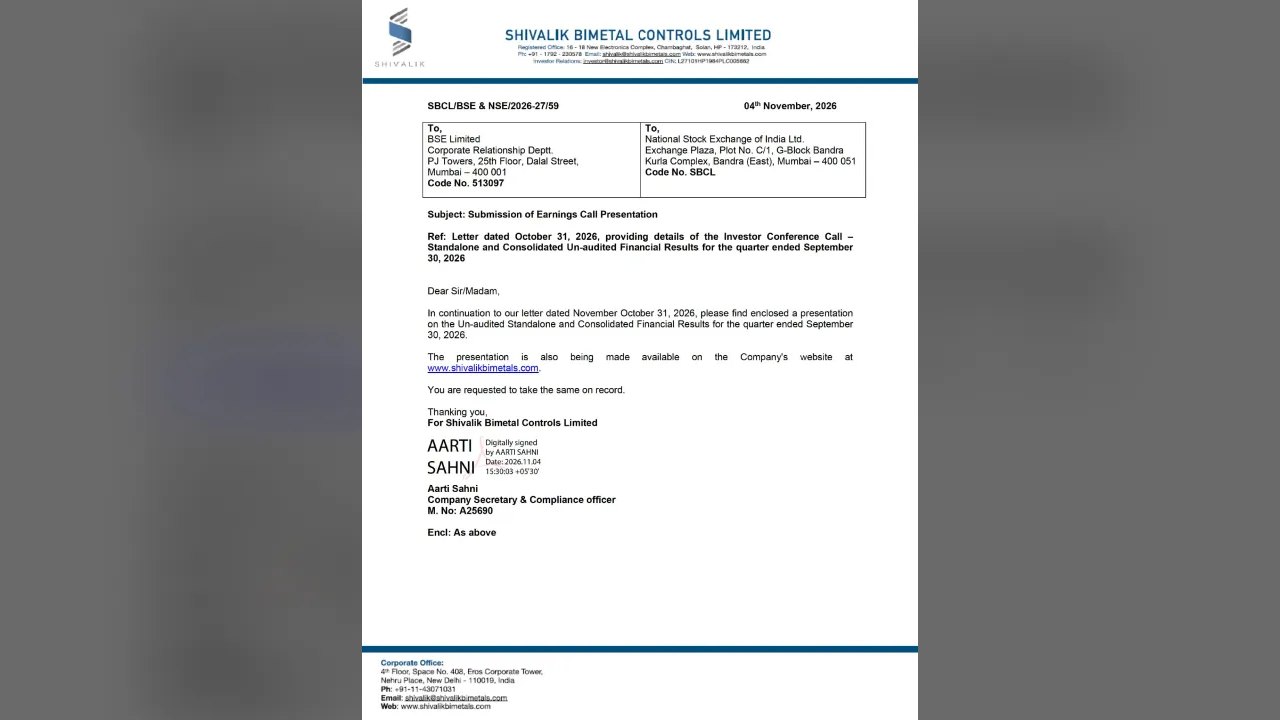
Shivalik Bimetal Controls (NSE:SBCL) Q2 2027 earnings call, held 2026-11-04. Watch the replay and read the transcript on 6ix.
On 6ix: 6ix.com/event/shivalik-bimetal-controls-limited-sbcl-q2-2027-earnings-call
Automated transcript · Written by software from the replay's audio. It can mishear names and figures; the replay is the record.
0:00 So ladies and gentlemen, good afternoon, everybody. Warm welcome to Shivalik Bimetal Controls Limited's q two and h one f y twenty seven earnings webinar produced by LOV. So I'm Shankini. I'm the director of investor relations at Dickinson, and I'll be moderating our call today. So joining us from the Shivalik management team are mister Sumair Gumman. He's the full time director, and mister Kabir Gumman, managing director. Note to all our participants, please note that this conference is being recorded and that some statements in this call may be forward looking based on current expectations and subject to risks that could cause results to differ materially. You can all download Shivalik's investor presentation and press release for h one FY twenty seven from the company website or the MSC.
0:49 Great. So I'll now hand the conference over to Mr. Kavir Ghuman, MD of Shivalik, to begin with opening remarks. Get started. You, Shakini. Good afternoon, everyone, and thank you for joining us. At at Shivalik, we believe enduring growth comes from making our expertise increasingly valuable to our customers. That principle guides our progression from specialized materials and components towards integrated solutions that deepen our role in the customer programs. Our first half performance of FY twenty seven strengthens the foundation of this journey. Consolidated revenue grew by approximately 39%, while EBITDA increased 48% and profit rose profit after tax rose 40%.
1:37 These results give us confidence in our ability to grow while strengthening profitability. India provides an expanding domestic base, complemented by long standing international customer relationships. And across these markets, our opportunity lies in applying our materials and process knowledge to a broader range of customer needs and applications. As we extend and expand our capabilities, we will commit capital and resources where customer demand supports growth and the economics offer attractive returns. Our ambition is to earn a deeper role in our customers' business and translate that position into sustained value for our shareholders. Thanks, Shakini. Thanks, Kabir.
2:25 So we'll be getting into the Q and A session now. So just a note to all our participants, to ask a question, you'll have to raise your hand. Quick reminder on how to raise your hand. If you're on desktop or laptop, look for the reactions button at the bottom of your Zoom window. Click on it, then select raise hand from the options. Your name should appear on the queue. If you're on mobile or tablet, tap on the more dot dot dot button at the bottom right of your screen, then select raise hand from the menu. Great. So we'll get started with the first question. We'll take the first question from the line of Bhavya Nahar. Hi, Bhavya. You can go ahead and unmute yourself and ask your questions. Hi. Hi, Kavir. I just have one question.
3:12 Could you help us understand how much of the inventory buildup is driven by planned business growth or anticipated demand versus stocking up due to pricing expectations or, you know, jobs... Geopolitical uncertainty? Hi, Javier. So see, the inventory buildup is actually... There are multiple reasons for that. So one is, as we've been discussing in past calls, and you must have also taken note of that, that there's active conversion in two different programs where, you know, initially, we were talking about just direct strip supplies where we've gone into assemblies or finished components. And in those cases, the, you know, the supply chain cycles have slightly shifted, which are still stabilizing, where certain programs require multiple validation cycles and, you know, there's quick reaction in terms of design changes. So there there has been a little bit of an impact when it comes to that. Then there's also the other business verticals, you know, specifically in terms of the busbar assemblies and PCBA activity that's going on, which also, you know, demands a slightly higher inventory. But we are working... And I think, Sumay can also shed some light on this. We're working on certain programs to actively reduce this cycle as well. Basically, Bhagir, this is more of a temporary phenomenon because of the excessive development work that's going on. So it's usually, you know, when a lot of developments are going on, like we were saying, a lot of, you know, inventory gets built up, but it's...
4:43 As that business converts more and more into a regular business, then the development converts into regular business, we'll see that easing off. Other than that, we are already actively pursuing two, three programs to work on reducing inventory cycles, which which, you know, obviously have a phase wise implementation. So we understand that that's anyway an issue even if this temporary buildup was not there. It's an issue that we need to address and try to rationalize it as much as possible. Got it. Thank you so much. Thanks, Shivalik. We'll take the next question from the line of Dhaval Shah. Hi, Dhaval. You can go ahead and unmute yourself and ask your question. Yeah. Hi. Hi, Sumair. Hi, Kabir.
5:31 Very good set of numbers. Am I audible? Yes. Thanks. Thanks,. Yes. Yes. Yes. Okay. So, my first question is that, as I understand, your business takes time to, you know, get approved by the customer and once it's approved, the stickiness of the business is high. So, basis that, is it safe to assume that, you know, the current run rate is what, is is something which is at least, you know, we can foresee this, this quarter's revenue to sustain for the, you know, becomes a base and then you grow from here. And and and the second question is with respect to the, you know, to the end market segment, how...
6:26 What has led to this so much growth? Even quarter on quarter, we've grown very well. Understand BuzzBar SMDs, I think, should be the big growth driver. And along that, your American customer is coming back, and you are forward integrating their most scope of work. So if you can just elaborate more, how is the demand scenario you're looking at? What sort of outlook would you like to, share with investors? Yeah. These are the two questions. Yeah. So some part of your second question, I think, was answered by the... What you said initially. See, the development takes time, but once the business starts, it's usually there to stay because a lot of time and investment, both from customer as well as our end, has gone into that development. So so it's very rare that something... Some business will start and, you know, disappear in a shorter period of time or for some reason, you know, go away.
7:20 So so, of course, it's it's sustainable. In fact, usually, when business starts, it starts in a slightly staggered way. So in a way, you know, one can see... Once business starts, it can not only see it as sustainable and possibly see it as a, you know, a few, you know, longer period of of of growth as well. Okay. So So there could be an acceleration of earnings. I mean, meaning, the business grows once you start, as you said, staggered manner. Yes. So what we are seeing now, you know, a lot of the growth, the main driver behind this growth, and to answer that question, we'll answer this part also. The the main driver this time has actually not been the PCBAs, the the PCBA assemblies or the the CCS that we are working on. Some part of it has been there, but it is still a a a very minor number because those are still, you know, things that we have... We we started doing maybe one or two... One month or so of the last quarter, we had more increased quantities. But as we go along now, that's turning in the current quarter and the coming quarters is converting into much larger volume.
8:28 But in this quarter, that is under discussion. It it it only had a very small role to pay... Play more... Much more than the previous quarter we had before that, but still small relative. So then where is this... Where is it... Where does the growth come from? A lot of the... You know, if you've been following last about seven or eight quarters, we've been talking about multiple developments happening with customers. And those are not for assemblies. Those are for our core principle, core components that we make. A lot of those developments have materialized into regular business. They were at sampling stages or pilot lot stages, and now they are are regular businesses. And then one or two of our larger customers, you know, their designs have have changed, and those have started materializing now into business. So what... What's interesting to see is that not only those are those changes adding to the top line, but they are adding very positively to the bottom line because we were expecting that to happen because a vast majority of those developments were a higher value add. So what we what we what we look forward to now is is at least a few more quarters of, you know, such value added kind of growth, which is exactly the kind of growth that we like as a company because we feel that, you know, of course, with the higher value added, there is a reason behind why something is higher value added or why a customer pays a higher value add because it's usually typically a difficult product to make, which also means threat of competition is is is less.
9:57 So having said that, of course, we know that in the foreseeable future, very soon, we'll have a larger percentage of our total revenue coming from the assembly business, which we acknowledge and know that as a percentage margin might be lower, but the scale is much, much bigger. So it may kind of makes up for it. So this is the direction that you're going in. But again, to answer the first part of your question, the main driver behind this growth is coming from the core product at at this point and not the forward integration. Got it. So in terms of... So we already almost run rating at 30% plus kind of revenue growth for the current year. So then for the next year, a similar sort of growth, how do you see your, you know, your conversation If we simply if we simply look at it from a customer point of view and a potential point of view, we feel that that, you know, doing those kind of growth numbers is possible.
11:01 But, of course, there's a lot of ifs and buts, like, you know, like, we were talking earlier just you mentioned a little while ago that, you know, it takes time. Development takes time. So sometimes it's very difficult to say that a new set of developments happening with a bunch of customers, whether it will materialize as expected or maybe it will take a longer... Slightly longer time. So that's why we sometimes have these ups and downs. However, the the scope the scope is there, the market, the opportunity exists. If we handle it correctly and if we do everything right, then definitely this is a sustain... Sustainable growth possibility, not just for a few quarters, but for a few years. Okay. And lastly, would you like to, share any updates on the new developments, new products, which you mentioned in the last con call with respect to widening that... Our TAM, getting into new products.
12:00 Yes. So so as of now, again, we we are still... You know, we are in in a deeper stage of of analyzing this. What I can shed more light is that most of these products that we are analyzing or working on or, let's say, you know, even to some extent technically invested in are related to special materials that go into some some some sort of electronic application or the other. So broadly speaking, we are we are very interested in in expanding into certain types of special materials, metals that go into electronic applications. So if you see most electronic applications use some kind of specialized metals, and that may involve some sort of specialized joining or may not involve, but it could be a specialized or a very special thickness or a dimension of a material, which is very hard for... Typically for for somebody to make. So those are the the the things that we are working on. And, you know, at this stage, again, it is it is probably not the right time for us to publicly disclose it. Once we have finalized and decided to go ahead with it, and we feel that it's the right time to make this information public, we will certainly be talking about it. But there is is quite a lot of depth. We've we've gone down quite deep into this this development, and something will be happening in this area very, very soon.
13:26 Okay. Thank you. Thank you, ma'am. I'll back... I'll be back in the queue. Thanks, Shivalik. We'll take the next question from the line of Dhruv Jain. Dhruv, you can go ahead and mute your line and ask your questions. Hi, Dhruv. You can go ahead. Looks like Dhruv's caught up for the moment. We'll move on to the next participant. Our next participant asking a question will be from the line of Vivek Ganguly. Hi, Vivek. You can go ahead and mute yourself and go ahead with your questions.
14:13 Thank you, Sanfilippi. My question has been partly answered. What I wanted to understand is assembly, Buspar and p... PCBA. As in when they become substantial more of the revenue proportion in terms of proportion, will they be shown separately, or will must be part of your either your contact and PCB part of your, know, some other segment of the existing three? No. It's... It will be... See, basically, it's a forward integration of the resistor business, but we foresee that it has a a massive scaling possibility. So so it will be shown as a as a separate vertical within the the the core business.
15:02 Okay. Yeah. It's not a it's not a a stand alone subsidiary or or it's part of the the the parent organization. Right. So you until... So right now, you're on show... You know, you're on divide your revenue into three buckets. So this will be the fourth bucket. This would be the fourth bucket. Now one one of our... Of course, one of our verticals happens to be a subsidiary because, you know, it's a separate entity because it was a joint venture at one point, and then it happens to be a subsidiary. But other than that, you know, we now treat it as a hunt... Like a... Another product vertical within the the same. It's just legally a separate entity. Right. That's all from my end. Thank you. Thanks, Shivalik. Our next participant asking a question is from the line of Mahek Talati.
15:50 Hi, Mahek. You can go ahead and ask your questions. Yeah. Hi, sir.. Yes. Yeah. Sir, thank you so much for the opportunity, and congratulations on a great set of numbers. Sir, as I can see, there has been a significant decline in the shunt volume by close to 16%, but our overall top line has grown by close to 36% from the shunt business. So two questions. Number one, what is the reason behind a significant drop in the volume? Number one. And number two was how much of this value growth is due to commodity pricing, and how much is due to forward integration plus components? Right. So it's a very it's a very valid question, and it's... You know, it can...
16:39 That that is... When you look at just the the the output volume of shunt, it can be a little bit confusing. So so what is happening is that shunts... A lot of the shunt business is converting from... A lot of the volume, came from from wide and thicker strip materials, which was being purchased by some of our customers as raw material to further make resistors. That has gone down drastically, and we are making more of more and more every quarter of the of the final resistor. So as a result, we are shipping out lesser material as a... In kilograms, but with a much higher number of processes added to it, and as a result, value add and as a result, you know, improved bottom line added to it.
17:25 So even though our volume may be going down because that was going as thicker and wider material as as I said. So so so this... You know, looking at absolutely the the output in KGs is a little bit misleading. This is actually a very ideal situation for us to be in, wherein the the... We are sending less of material and more of value add, shipping out more of value add. And that is also reflecting in our increase or improving profitability. Okay. So it's more or less related to forward integration rather than accommodating pricing. Should that be a correct understanding? No. So that's a separate matter. So this this... The output going down is is what is what... That that part is what I gave an answer to right now.
18:15 But the... Your... To answer your other question, which you're talking about, you know, material... The the the metal prices or the impact of commodity prices. So, see, first of all, our our pricing works in such a way that that we... In most cases, or a vast majority of materials are sort of a pass through. So so any increase or decrease does... Has very minimal impact on on our bottom line. That is why even if commodity prices go up drastically, and and it has in the case of, let's say, copper, even silver, but copper has been a bigger impact. If you see that even then, you know, even though those numbers have gone up, our profitability has still remained in the similar ballpark. So even if materials go down, similarly, it will have very minimal impact on the bottom line.
19:05 And as far as revenue is concerned, yes, some part of the growth, even in the last call I had mentioned, some part of the growth is contributed by material value going up. Good thing is, like I said, it's not affecting the bottom line. But if you were to segregate it, you know, it's very difficult to put a standard number to it because there are many different commodities involved. But if we were to segregate it and say that, let's say, if you're talking of, you know, this this quarter compared to last quarter or this half year compared to last year's half year, if all material values were... All commodity values for the both could be considered to be the same, they would be... Would still be at a 25%, 26% pure growth level if you just look at it simply from the amount of components that we shipped. So there is growth, but, of course, if you add factor in the materials, then then growth looks like a little bit lot... A higher number.
20:04 Think also That's true. I'll just also add here, and I think this will probably answer any future questions also that that, you know, this this also puts us in a in a far more favorable position in the supply chain because generally speaking, specifically from an automotive application standpoint, the likelihood of a potential replacement at a component level mid cycle during a program is very, very low as compared to the likelihood of changing the input material, which we were doing in the previous models, for example, where input strip material is going, which has been converted by somebody else into a finished part. Switching that part of the supply chain is easier for customers rather than switching the end component because that at that level, if a component has to be changed on a board level at an automotive application, then that has to go through complete validation cycles. And that's to be a very strong reason for somebody to go down that route. So if you secure a business at a finished part or an assembly level, that's, you know, essentially virtually locked in for the life of that program.
21:07 Understood. Thank you for the detailed question... Detailed answer. And second question was related to the CCS business. So we have already started supplying to one customer. And I guess in the previous example, you mentioned that you are in talks with further two, three customers. So are... Where are we in the qualification stage? Can we... Given the volume increase in the EV two wheelers, do we expect a quick turnaround and you can start supplying to them in, like, let's say, q four or q one also? So here, at least two other programs, two or three other programs are actually in advanced stages now where initial prototyping is already done. There are some that are undergoing testing. You have to understand that this is also a slightly new supply chain within India because before this, a lot of this material was being imported from China directly. So very little design work or R and D work was happening at the OEM levels and at the supply chain level. So so, you know, these these cycles of validation, fine tuning, they take a little longer than they will maybe in a year's time. Obviously, these things will rapidly improve.
22:19 So having said that, at least two or three other programs are now at advanced stages along with the one that is running in mass production. And, of course, talks are going on with with other players as as well. Okay. Okay. Thank you. Thank you so much. Is from the line of. Hi,. You can go ahead and unmute your line and ask your questions. Hi. Good evening, sir. Thank you for the opportunity, and congratulations on the good set of numbers. I just have two question. Firstly, earlier, you had indicated that you were evaluating a few inorganic growth opportunities. However, with the recent dividend announcement, should we assume any change in capital allocation priorities, or how should we look at this opportunities going forward?
23:11 No. So since this this... The dividend announcement is not... It does not have a major impact on our on our availability of funds. So that is why we we planned it like that. And we still have, you know, there's enough availability of of free reserve or free cash sitting with the business that... See, none of our projects that we are looking at require an immediate capital allocation. So we are not looking at, let's say, immediate acquisition kind of an opportunity or something like that where we need a large amount of funds at the same time. It's usually... It comes at a... In a in a more staggered way. So we step start step by step. So there's enough time to plan for funding. That is why we felt that at this point of time, it would be better to... It it is okay for us to propose this dividends.
24:04 Okay. Okay. So... And secondly, given the growing the opportunity globally, how should we look at the opportunity for SBCL in India compared to international markets? And, like, over next two to three years, how do you expect the domestic versus export contribution to evolve? Domestic, you know, like, going back to one... The the answer Kabir was just giving before this, a lot of new developments in India are taking place, which we had actually not anticipated that will happen quickly because the whole ecosystem has advanced faster or is advancing faster than we had anticipated. So we feel that what was earlier a more export oriented opportunity, which is still there, which we still have a lot of projects. We'll be working on a lot of developments with various existing customers as well as new customers.
24:53 But other than that, a lot of potential now lies with the developments that are happening for the domestic market. So so as we go along, we will see that there is going to be a lot of growth coming in this high value add sector of our business or a high value add, areas of our business, like these transistor component, for the India for the Indian market. Because earlier, a lot of the the complete packs or complete battery packs or complete assemblies of, we say, BMSs, etcetera, were being imported. And now they are, you know, slowly being assembled here, then the component supply chain is being formed here. So we see we see a great opportunities now not just for export, but for domestic as well. Okay, sir. Thank you. Thanks, Sanjali.
25:44 Our next participant asking a question is from Dhruv Jain. Hi, Dhruv. You can go ahead and ask your questions. Hi. Hi. Hi, Sameer. Hi, Kamil. Hi, Shivalik. Thanks for the opportunity. So my first question is a little bit on this quarter. So what we have seen is that the U. Shine volumes revenue has actually declined. And if we look at, say, one of your larger customers book to bill, it seems like they've their order books are rising. So if you could just clarify that and if it's just a 0.25 thing and if things will normalize in the next quarter. So that's the first question. And related to that, if you can also talk a little bit about you know, the Europe business actually doing pretty well for you on the Shant side.
26:36 Can you just repeat the first question again? You said that the volume... Are you asking about the volume? No, sir. I... No, Sameer. I was actually talking about The US shunt revenue declining. Right. Yeah. So I just want to understand, you know, why that has happened. Because if you look at, say, say, someone like a Vishay's order book, at least in the Yeah. Yeah. Yeah. Got got it. So so what's happening basically is a lot of the the conversion of our existing customers in The US that we have done recently, A lot of that is under an arrangement wherein we are supplying directly no longer to The US, and a lot of this development happened due to the tariff issue that happened last year. So that that accelerated this development.
27:22 A lot of those, those resistors are used outside The US. So a lot of that... Those shipments no longer go through The US. So what you'll see as a decline is partly... Part of that decline is coming coming from there. Now there is a... There is certain developments that have taken place with our existing customers in The US, which which has started in... Materializing into business more towards, you know, the last two or three months. So some part... Only some part of that business came into the previous quarter or or the quarter or two, basically. So that is why it is showing as a decline, but then some of it has been compensated in other regions, but going to a US customer, but going directly to a different region. Got it. So, basically, it will be classified in, say, India or Europe going forward?
28:12 Mostly mostly Asia, actually. If you see the... A lot of that, conversion or a lot of that diversion has actually happened to Asia. So it'll show up in the Asia, geographic side. Got it. And, sir, the second question, you know, on the bimetal side, so we've seen a very sharp, uptick in the India bimetal number. Right? So, just want to understand what really changed, because we've seen a sluggish sort of a time... You know, sluggish sort of numbers in that vertical for some times. So, I think a lot of what what at least what we get to know from from our customers is is more driven for for for retail demand or for... By retail demand or by, let's say, real estate or or new constructions or new infrastructure, projects, a lot of that demand. I think there had been a time in between where a lot of over inventorization had also because, you know, the market in India was kind of flat for the demand for these products. So I think a lot of inventory had had accumulated, and that sort of carried on for a few quarters. And now that that demand is again beginning to pick up to sort of meet the actual demand.
29:26 And what we are being... Or at least, you know, coming from looking at the switchgear background and, of course, thermostatic biomaterial is affected only by one portion of the switchgear market. So what... At least what information, we have from our customers as well as whatever research we do, that the the outlook generally in India now for the next two or three quarters for, for for medium and low voltage figure is looking good. Okay. Okay. That's fair. And just, you know, one question. If you can just give some guidance with respect to both busbar and overall numbers for Shivalik for, say, FY 'twenty seven, FY 'twenty eight, how are you looking at margins and top line both in the current context of the plans that you have?
30:15 In '27, '28, we expect that, the kind of developments that we have in the in the assembly business. Right? Let's start with that assembly business. There's a there's a, again, which parts translate into business or materialize into business that is, you know, dependent on many, many factors. But the the opportunities that are out there, which we can, go and grab and those, when we look at that, we can anywhere between a 100 to 200 crores, somewhere in between that number can be looked at for... From just that assembly business. Now when when we look at that kind of a business, that business also, you know, expected comes with a expected lower EBITDA margin of maybe 15%, 16% as opposed to maybe 26, 27% those lines. So we expect that if, say, on the higher side, even INR 200 crores comes with that low margin and looking at that number as well as what growth anticipation we have or outlook that we have from our customers for shunts and all the other the legacy product lines and the expected growth in contacts, which is also a 15%, 16% EBITDA margin business, we we can possibly see that if if we can, maybe, you know, maintain a similar this 30%, 40%, 30%, 35, 40% kind of a growth number, if assuming that, you know, a lot of these things fall into place, we can expect that in that year, maybe our total profitability cost... Profit goes up, but,
31:45 you know, our margin comes down maybe from a... Maybe by towards maybe one or one and a half to two and a half percent, some... Somewhere in that range because of the addition of revenue coming in from these 15, 16% EBITDA margins... Margin businesses. So that is the the kind of profile we see that we could be going in that direction, but that also means that there could be a good, sustainable revenue growth. So we could be somewhere in in, maintaining a balance in between the two. Got it. So, basically, you know, just to conclude, I think 30, 35% top line growth over the next two years is sustainable. Margins could dip, but that's a function of mix, basically. Right. And that... Yes. And if that... Of course, that dip comes from the the... Some of the newer products being added in the...
32:32 In... As far as the the stand alone product verticals, the legacy product verticals are concerned, there, in fact, we don't see any reason why margins should dip. In fact, either margins should only as a result of, further improvement in volumes, should further continue to improve, which could further, as a percentage, compensate for some of the lower margin business in the foreseeable future. Got it. Thanks a lot, Sumir. Thanks a lot, Kabir, and best wishes for Diwali to you and the team. Thank you, and same to you. Thank you. Thanks, Dhruv. We'll take the next question from the line of Nausha Chaudhary. Hi, Nausha. You can go ahead and unmute yourself and proceed with your question.
33:18 Yes. Hi. Thank you for the opportunity, and congrats to the team on a good set of number. First, the... From a leadership perspective, what are the gaps currently we see in the organization? And what are the critical hires we are evaluating now to take it to the next league of growth? So thanks,. Basically, of course, you know, other than the the key positions that we recently had had become, we can't be a bit... You know, those are already in line and, to begin with, our... In the leadership role, need the new CFO should be, with us and, you know, all finalized, should be with us and, by the end of December.
34:15 So that is one area. Other than that, we are actively, at this point of time, pursuing a a a position... A good candidate for a position of a COO. We may call it... Call him, or something else, but we... The the primary function would be that of a COO. And, part of the reason, you know, where we... What we've foreseen a lot of Shivalik's future growth story, other than streamlining all our existing businesses, is these... Are these new verticals that we will be going into and working on. And when... With Kabir's availability becoming more and more important for those projects, it is very, very important that we have a very efficient and a very... Somebody... A a person in that position who who can who can take over that role from from Kabir. And that is, you know, that is the ethos that we are following in a lot of other areas in the company as well, that we have a leadership team complete that takes care of all of the operational matters and wherein my role and Kabir's role in this business can be then more and more related to the the the strategic decisions regarding expanding into other product verticals because the real the real key to future actual future growth of the business lies there.
35:35 So so that that... In those areas, we are looking at hiring. We're looking at... We are actively searching for some key people ahead of r and d who we are... You know, we've already got some new people in r and d, but we are looking also for a... You know, depending on what projects we go for, another senior position in in r and d as well. And, so the the... We are also looking at a a very senior marketing, and salesperson or as marketing as well as a salesperson, specifically with an experience in electronics. So since we are a company that is turning more from metal work specialized components more towards metal components for electronics, you know, that that changes that profile a little bit because that ecosystem is different. So these are the, you know, few leadership roles that we are looking at at this point.
36:34 Sure, Sameer. And last Your line your line isn't very clear. Hi,. Your line isn't very clear. Yeah. We'll we'll come back to you,. We'll proceed with the next participant while, it's on a better line. We'll go ahead with the next question from the line of Prateek Shivalik.
37:22 Hi, Prateek. You can go ahead and mute yourself and ask your questions. Hi. Can you guys hear me? Yes, Prateek. Go ahead. Yeah. Hi. Again, congratulations on a great set of numbers, both Sameer and Kabir. My question in general is more about... I think, Sameer, you mentioned that, yes, you know, you are seeing much faster growth in the end market mix. Right? Could you share more light on that? Because we are in multiple different market. Right? We are in two wheeler, EV, four wheeler, switch gears, industrials, smart meters. How do you see these end markets evolving in the future? And what would be your, I would say, more focused area? Then the second related one, of course, is more around this, you know, the data center opportunities and also in the energy storage opportunities.
38:14 Are we evaluating something for these in the business verticals as well? I think we've... So... Yeah. I think this... The second part of the question regarding the data centers and the battery BES applications. So both in both cases, for the data centers, you see data centers also require multiple switchgear applications. They also require battery management systems. So in both cases, indirectly, we are seeing demand increase in... At the component level for for those parts. But more interestingly, the on the BESS, we are seeing some applications, which brings me back to my earlier conversation where we were working on some of the other CCS and busbar applications where there are some that are directly related to the BESS packs.
39:12 So there is work going on in that front as well. It's very early stages, like, as was the case with the two wheeler EVs. This is a... We, know, India in general is undergoing a shift where reliance on China for for complete battery packs is is, you know, exponentially decreasing. So that'll only fuel the the growth rate or at least the the speed or development in India. Got it. And on this EV, I think on the deck, we mentioned that, you know, that for the EV for EV versus ICE. Right? Either in... You know, it is growing... It is, like, two x per shunt value and three times the ICE TAM, right, for the EV segment. So how many shunts per vehicle and how are we increasing content per vehicle for EVs?
40:01 So you see, it depends. If you talk about shunts per vehicle, it'll... It significantly changes depending on the the category or the class of the vehicle that we're talking about. So lower end EVs or, you know, modernized engines also now could could see somewhere between 30 to, let's say, 50, 55 shunts depending on the OEM, depending on their design and feature list. Whereas something at the higher end of the spectrum, you know, top end vehicles that you see on the road from the top two, three brands, their their marquee levels will probably have over, you know, 200,250 shunts per vehicle. But obviously, these are not all large shunts, but these are much smaller SMBs, but shunts nevertheless. So it it varies from case to case.
40:47 Now with our conversion, which we spoke about in the beginning of the call, conversion into finished parts, a lot of this is also going into end OEM automotive applications. So so as we push forward to manufacture more parts, have a stable quality, have a good track record in the, you know, in in the market, Obviously, our our sales and marketing team are pushing harder to get bigger market share of the final pipe as as... So to speak. And you can also understand that it it it was quite a challenge, which is why it took this long also for this conversion is because for a new player to come in and replace, let's say, a a German or an American supplier who's been supplying the finish lines for the automotive applications for years, it was, you know, definitely something that took took a while and a lot of fine tuning in the process and quality controls to to get that level of accuracy.
41:44 Got it. Got it. And one last question just on the blended margins moving forward. What sort of blended margins do we expect, let's say, for the 05/27 and moving into a 05/28? So, you know, if we... Let's say... I mean, let's... For a second, go even beyond that. Let's say not let's say, a three year horizon, where we see, you know, the direction where the company is going, it could be a possibility that we could be, you know, eventually in a fifty fifty situation in our total revenue between sort of a 26, 27% EBITDA kind of business and the other being a 15, 16%. So which means a blended margin of somewhere in between that is is what we feel that eventually at, you know, maybe three times of of, let's say, what revenue we could foresee this year, maybe three times of that revenue, we could be in a situation where we are at a, let's say, 20, 21% EBITDA margin level or maybe 22. I don't I don't know, depending on factors. But somewhere in the middle of this 15, 16 category because we see the the business eventually going into that, and then we we would plan to, you know, treat these two or three different segments in a in a different way.
43:07 Of course, when we do choose to go go with the product vertical with a with a lower than what we use... Low margin than what we are used to or what we normally go for, usually, it could have bring in some added advantage which strengthens the core business of ours and is related to it in somehow... In some way or is strategically important to it. So, yeah, to simply answer your question, it's... We expect that, at three to four times the revenue of today, we could be in a... You know, somewhere between the 15, 16%, 25, 26% number. Got it. Got it. Thank you. Thank you, Sumeet, and thanks, Pradeep, and all the best to you guys. Thank you. Thank you. Thanks, Prateek. We'll take the next question from the line of Nirali Govani. Hi, Nirali. You can go ahead and Yeah. Hi. Yourself and proceed with your questions.
43:57 Yeah. Hi. Hi, Nirali. Go Hi. Hi. Thank you for the opportunity. Congratulations on a great set of result. Maybe a little repetitive, but a little bit on the growth side. So, Shivalik, when you say that, you know, next year, Busbar itself is supposed to deliver 200 crores of revenue. And this year, if we replicate h one and h two, we are around somewhere around $7.50 crores of revenue. So this 25, 30% growth will be driven only by bus bars. So then your outlook on how will Shenz perform or Bimetal perform, largely from the perspective that the strips to component shift will largely be done in this year. So what is your outlook on that side? So, Matt, I think you're on mute.
44:47 Yeah. Sorry. I think there was... There may be a little bit of confusion in what you may have understood. If we are looking at this year or, let's say, if you're looking at next year of... You know? And what I had mentioned was that that there isn't... These opportunities of these assembly businesses of that revenue are are there. They are available, whether we are able to get a lot of that business or we are not. That is separate. So we... So it's not exactly like that we will definitely be getting that business. We we... The opportunity exists. We are creating the the ecosystem to have that onboard. So if all goes well, yes, that is a possibility. Probably even more than that is a possibility. And then at that time, including that year, we also continue... Would continue to probably see in our existing product verticals a decent amount of growth. So when we look at the end... Towards the end of 2028 or towards the end of financial year 2728, we would be in a situation where even at a 200 or a $2.50 crore value of of of the PCB business, it will still probably not be more than maybe, you know, 15%...
45:53 15% to 18% of total revenue. So so so that margin business should not overall because the other the other... If the other businesses are not expected to grow or we we were not foreseeing growth in there, then then, yes, your understanding would probably be correct. But that is not the case since there are a lot of developments that we've been talking of, since this call started related to a lot of the existing products. See, I think, and I have mentioned this before, and I think for everybody's benefit, I would like to to mention it again. We do not foresee or we do not look at any of our PCBA assemblies... PCBA business or PCBA assembly businesses or as, becoming a core product of us. This is a product that we are making assemblies of, a, for what the customer requires, b, because it is a...
46:43 It has to be sold like that. So if we... If our cladded components or if our EV related components must go in that form, they have to go as an assembly. So so so it is basically an extension of our product and not not... Cannot simply be looked at as something we would be doing otherwise. It is a very, very important extension of what we already do in the shunt resistor business. Now the moment you look at it like that, your, you know, understanding of that product will be slightly slightly different. So we also... But as we're getting... As as we are getting deeper into it, we realize that there's a massive scale up scale up opportunity. And I think it's it's probably a great thing for Shivalik because that is the kind... Exactly the kind of scale up that a business like ours needs. You see, our business is such that years of development may bring a very highly profitable 20 crore business to our top line.
47:31 And and it's a cause of celebration for us. But when you look at it from... As an outside investor, you may not even notice it because, you know, 20 crores added to the top line with a decent margin may not show up to... In a stand alone way in the numbers. So so it it... Having a mix of those as well as this kind of scaling opportunity, these are very, very important things. But primary reason will always be it is that it is an extension of our existing core product. No. Very clear. And secondly, on the CapEx, what kind of CapEx are we planning for this year, and where do we plan to, you know, work on that? Like, which areas are we planning to expand?
48:19 I think we will shed some light on the the the the CapEx. Yeah. So you see that the core focus moving forward will be a, in capacity enhancement on downstream processes because as we've discussed in the past also, you know, the core... If you talk about the core product categories when it comes to the actual diffusion or the or the merging of the metals for either of the business verticals, that principal processes have sufficient capacity. But as in when required, depending on the demand from the market or the order book, there is enhancement that has to happen on the downstream processes, which is a fairly quick cycle to announce. So there will be some CapEx expenditure on expanding capacities on downstream processes at parts level, assembly level.
49:08 The other area where we are even the last two quarters and going forward also, we are going to be heavily working on is the automation for end of line calibration testing. As we go further into, you know, integrated assemblies, the complexity and the criticality of these tests and calibration systems also goes up. So there's going to be some CapEx involved there, which is ongoing. Then, of course, for the PCB and PCBA type of parts, we are also planning certain expansions and CapEx expenditure there as well. Perfect. And lastly, on the bus, so currently, we are working for a two wheeler, and, you know, you said that you are in talks with other customers also. And you said that there is an opportunity for four wheelers also.
50:01 So any any thoughts there? Are we getting nearer or any of the talks are with four wheeler OEMs or, like, on that side or anything on that part? No. Early early stages at this point. There is a faster traction and a faster growth or activity that we're seeing on the two wheeler side. We... You know, you must be following the news where I think last month or last last month, almost 40% of two wheelers sold were electric or 30, 35% were electric. So that... Those kind of numbers are, you know, it's nowhere close when you when you talk about the four wheeler market. So there is, you know, it's directly proportional to that activity that we are seeing in terms of registration of new vehicles versus the activity that we are seeing in the supply chain from two wheelers versus four wheelers. So there are talks going on, but the the acceleration rate for adoption is faster on the two wheeler side.
50:57 Perfect. Yeah. That's it. Thank you so much for answering my question. Thanks, Nirali. Our next question will be from the line of Ajay Surya. Hi, Ajay. You can go ahead and ask your questions. Thanks for the opportunity, and congratulations on the performance, sir. Sir, my question is, like, I've divided... First question, sir, I want to understand on the electrical contact. So, sir, like, we expanded capacity maybe a couple of quarters back. So just wanted to understand, like, sir, like, what would be the current capacity utilization in our contact business and, like, when when do we expect this to maybe run at full capacity?
51:44 Because also, sir, like, again, I'm sure, like, you explained past, again, silver prices are corrected even this quarter. But our business, both in terms of revenue and margins are held up. I'm sure, like, it is also because volumes are growing or maybe some kind of pass through. But if you can maybe give some more color on the volume growth, which we should expect in this business. And should we expect maybe this quarter's margin as some kind of some sustainable benchmark going forward for our electrical contacts business? So I... I'll I'll start with the... Your... The second part of your question first because that's connected to the first part. So, you know, what we have been doing generally as a as a... You know, our decisions a few years ago, we wanted to move away more and more from high silver consumption components because we decided at one point that we don't want to get into the silver manufacturing business because that is not our specialization.
52:46 Dealing with bullion comes with its own set of complications, and it's not our core business. Our core business is is a good quality of joining between com... Complicated materials and making very complicated components for which toolings are difficult to make and tool designs are difficult to make. So why go away from that core competency? And we also saw that there was a void in the market. Now as a result, we focused making... On making the components and not go go down the route of silver. That is why you'll see over the years, impact of silver prices has been minimal on us. Solely sometimes in case of revenue, it can show especially when the the jumps are too high, but it doesn't affect our margins as deeply. There is a slight impact when there'll be too much of a rise in silver. For example, in one quarter last year, for example, silver went from 1.5 lakhs to 3.5 lakhs. When that kind of a jump comes, and we all know that that is a very rare situation, then it can have a slight impact because some part of our pricing is is connected to silver, but it is a very minor part. So so it is it is going to have an impact. Similarly, when it goes down also, the impact is going to be very minimal. Silver will have to go crash to 25% of its value for it to start showing up in our margin.
54:00 And even then, it will only have an impact to a limited extent because co... Vast majority of our profitability comes from the the the the manufacturing process, which remains the same in either case. So, of course, overall revenue may look different. Now coming to the... Today today, when we speak of silver versus, let's say, the same corresponding quarter last year, you know, there is a... Maybe silver is still double the value of of them. And if if 64 or 65% of every of all materials that are being used, there is going to be some impact. So if you see that our our contacts business has grown nearly, you know, more than, I think, a 100% or so, out of which 40 to 50% is only because of materials, and the other balance is actually because of customer related...
54:49 Customer develop... Growth in customer development as well as actual product increase. So we are in a very favorable situation that if... That alongside the silver thing, we have all... Alongside the silver jump over the last one year, we have also really substantially grown in business. If we had not done that, then... And our entire top line growth was only coming because of SILVA, then it would have been a cause of worry. And now as you as you correctly pointed out that, you know, we we started our our shifting to the new facility two quarters ago. And by July this year or June end or early July this year, our... That facility was fully functional. The impact of that added capacity is is now showing up in some of our numbers because a lot of a lot of our existing customers wanted to give us increased wallet shares, and they... Wallet share. And so so as a result, you know, we are seeing an further increase in in growth.
55:47 So we we anticipate until we reach a certain point with our customers or as well as new development, we anticipate this kind of a growth trajectory to continue. And, frankly, for us as a company, since we are not into silver manufacturing, for us, silver prices going up or down is not a major concern. And, of course, learning from specifically from what has happened last... In the last one year, we have ensured that it doesn't have an impact on us or has minimal impact on us. Coming Got it. Go ahead. Coming to the point related to the capacities Yeah. So so within the contract business, we have four or five different, you know, product types or for for... And they are very similar to thermostatic biomaterial manufacturing, wherein there is a core process and then there's some eight or nine, you know, down the line or before the preparatory processes.
56:36 So so it's very difficult to say what the capacity is, but we... You typically calculate our total capacity on the core process because those are the ones that are difficult or costly to to add in a in a short notice. Down the line processing and finishing can be added in a shorter notice. So they can always be increased or decreased. So as far as core processes are concerned, we are... You know, for one of our product types, which is nearly 50% of total revenue, that business is currently running at a 50, 60%... 50 to 60% capacity after adding this revenue. So let's say we take 50% of the overall revenue that we expect this year from contact business and say that, you know, that is running at half. So it can... It has the potential of doubling. So half of that revenue that we're expecting has a potential of doubling without any added CapEx.
57:24 And and similarly, in the other other areas we are running in in in one of our processes, we are running at maybe around a 30% capacity. And and if you take out a mix sort of... You know, there's no point going into these details. But if you take out a mix, I think we would... We... It would be safe to say that we are running at about... Already at about 50 to six... 55, 60%. We had originally at this CapEx set up this plant at approximately a $303,150 crore revenue potential, but that was calculated at half the silver value. So let's say at this silver value, that would numb... Number would translate to about 400 crores. We possibly expect that we should be crossing about 45... Probably about fifth... Somewhere between 50 to 60% of that number this year alone.
58:10 So by the end of this year, we should be probably be at around, you know, 55% capacity utilization to answer your question. So that... Thanks for the detailed explanation. That very well explains this part. Sir, one question on... So just one question on our stand alone business. So, sir, was there any contribution from our... Maybe the PCB or CCS business, which was included in the stand alone business, if you can clarify? Very minimal. Okay. I did... It was it was not not more than... I think if you look at the stand alone business, it was probably not more than six or seven, but not even that, but maybe somewhere around... I I maybe So, yeah.
58:57 Let's say, to 7%, somewhere in that number. My question was more on, like... So if I look at the stand alone margins, particularly, like, it has grown, like, now to more close to 30%. And I believe, like, from past calls, we can make out, like, it has been because of the shift of shunts from maybe, strip to assembly. But, sir, can you give maybe any percentage, like, what portion of our shunt volumes today would be, like, in strip form versus assemblies form? And, like, where it could reach in maybe a couple of years going forward? Like, because that will help us explain the growth maybe which we expect in channels. And, like, can we also shift this model of maybe maybe selling only strip to maybe set or assembly, which can be repeated across all our customer ways.
59:53 It has happened actually with most of the most... The the larger portion of the customer base. You see, there was only a very limited, not in terms of volume, but there was only a limited set of customers with whom we had that kind of an arrangement, which more or less is all is all gone now. You know, part of the reason to give you some history, part of the reason behind why that was the case is because we were experts at making that strip, not specifically all sorts of the complicated components. So specifically, the high value added components is something that has been more of a recent technical addition. When I say recent means 2019 or 2020 onwards, we started building the capability of me being able to make such complicated components which come with these kind of margins.
1:00:38 So so, of course, you know, that may seem like a long time to everybody. But, again, you know, where it takes two or three years to develop a customer, the... This five or six year period in that... From that perspective is not much. So so this is a more recent thing for us. That is why, originally, a lot of the resistor business started as strip. So as we have developed the capability of making these these kind of smaller component, most of our new developments are already in that form. And and a vast majority of our old existing business is already converted. So so so what... To to... Well, I still agree with what you are saying that what what you are suggesting that this this ideology can be applied in in some other ways as well. We we have to always look at what we can do, whether it's in thermostatic biomaterial or whether it's in shunt. What we can do to go one step forward to get a higher value from the same product? And we are actively working on that as well because, you know, we we we we are as a company, we have changed our point of view about how we look at, you know, revenue or profitability and what what these numbers mean.
1:01:45 This is from a few years ago when we we we we focus more on the product. Our focus on the product still remains the same, but we have also started looking at our strategy related to these things. If we can add better value by going forward and as well as, you know, get more business as a result, then why not? Thanks, Sumair, and thanks, Ajay, for your questions. We'll be happy to take up your follow ups on a... At a different time. We'll take the last question. Just looking at the time, we'll take the last question from participant Harsh Mulchandani. Hi, Harsh. You can go ahead and ask your questions. Yes. Am I audible? Hello? Yes. Yes. Thank you for the opportunity.
1:02:31 Wanted to understand that we lost some revenues in US with respect to Shant's business in the PPT. So do... Wanted to just understand, are we losing market share or, you know, there is some dynamics with respect to particular market, and we can again, you know, re... Those volumes going forward with respect to Sun's business in Americas. So so, Harsh, a lot of this... Actually, this is is coming from, you see, a vast... A major couple of customers of ours who we... With whom we have now, you know, an arrangement of... Instead of supplying what we were earlier just before this talking with Ajay regarding... You know, we've converted some strip business with some major...
1:03:17 Some business account into components. Now a lot of those components, and in some cases, 70, 80% of those components are used outside The United States. So so what has happened as a result is... And we we, as part of an arrangement with the with the... With with those customers, we are supplying directly now to their end users of those parts. So so so what's showing up as as The US numbers going down are... Is actually going to a US customer, but directly to its final user outside The US. In most cases, that is actually Asia. That is why you'll see that Asian quantities have also increased disproportionately. So a lot of The US business is actually now showing up as Asia. Okay. Got it. Thank you. And just one more question on the CapEx side. So, you know, there's a 1,300 crore number mentioned with respect to capacity.
1:04:09 So, you know, if we continue to grow at this rate, maybe, you know, we could be closer to those numbers. And you mentioned that we are doing additional CapEx. So just wanted to understand if you could just help me understand where do we see the capacities in the coming couple of years and... Between the utilization which we are targeting. So some some areas have grown faster than others. So there, we have already done a little bit more CapEx on capacity enhancement as Kabir mentioned in in one of the earlier questions. So so capacity enhancement, you see our products work in such a way. It's not not not not that something that happens in a typical manufacturing business where you have x amount of capacity and x amount of revenue, you know, core... Connected to each other.
1:04:55 Our business works in a slightly different way. So some some components may increase in in in in volume. And as a result, you know, some process may need to be added, whereas the core process may not need to be added. So it's it's not as simple a calculation, but we understand that, you know, we need to come out with some some average number. So so some capacity enhancement is already done. So it would be safe to say that that 1,300 crore number would probably be a little bit different, not it'll be on higher side than that. And and we also keep in mind whichever product vertical or whichever area we are already reaching a sort of a tightness in capacity, we already have plans to increase that. Having said that, most of the cap... Capacity enhancement that requires a heavy Capex or a heavy CapEx CapEx is basically...
1:05:44 That is where we have enough room available. So so the the the capacity enhancement where... Which we can do in a short period of time at a low cost is where some enhancement may be required. So we are, you know, in a very safe place to ensure that before we reach any over... Or or utilization of capacity, we are in in the right place to... Or right position to enhance it at the right time. Got it. Thank you so much. Thanks, Harsh, and thanks, Kabir and Sumair. I can see there's a couple more participants with their hands raised. So please do feel free to reach out to the IR team. We'll make sure you get concrete answers from the management.
1:06:31 We'd also like to let you know we are setting up some meetings in Mumbai soon. So please do reach out to us and, you know, we can take your consideration. So we'll conclude this call for this afternoon. I'll hand over back to Sumair for closing remarks. Thanks. Thanks, Sangini. Thank you for your time and thoughtful questions. We entered the second half with a stronger earnings base and a clear set of priorities. As we mentioned in our discussions, our focus is on sustaining core profitability, improving cash conversion and progressing new programs through customer adoption. We remain confident in the opportunities ahead and will pursue them with discipline and execution and capital allocation.
1:07:20 Thank you for your continued trust in Shivalik. Thanks, Sumer. Thanks, Kavi. Thank you, everyone. And thanks to everybody for spending the afternoon with us. Looking forward to the next step of chapter growth for Shivalik. Cheers, everybody. Thank you. Bye bye. Can disconnect now. Thanks. Bye bye. Thank you.
Follow Shivalik Bimetal Controls Ltd into a list and get an email when it puts out news.
full time director at Shivalik
managing director at Shivalik