Petra Müller
Head of Investor Relations, Sartorius
Replay available
Sartorius (Xetra:SRT) Q1 2026 earnings call, held 2026-04-23. Watch the replay and read the transcript on 6ix.
On 6ix: 6ix.com/event/sartorius-ag-0niq-q1-2026-earnings-call
Automated transcript · Written by software from the replay's audio. It can mishear names and figures; the replay is the record.
0:02 Ladies and gentlemen, welcome to the Sartorius and Sartorius Stellium Biotech Conference Call and Live Webcast on Q1 twenty twenty six. I'm Moritz, your Chorus Call operator. Would like to remind you that all participants will be in a listen only mode and the conference is being recorded. A replay will be available shortly after the call. The presentation will be followed by a question and answer session.
0:32 The conference must not be recorded for publication or broadcast. I would now like to turn the conference over to Petra Muller, Head of Investor Relations of Sartorius. Please go ahead. Thank you. Hello, and a warm welcome also from my side. I'm joined today by our CEO, Michele Kostner by Florianz Funk, our CFO by Reni Farber, Head of the Bioprocessing Division and CEO of Sartorius Stellen Biotech and by Alexander Gassermeij, Head of our LPS division. As always, we will start with prepared remarks followed by the Q and A session. As the call is scheduled to one hour, please limit your questions to one so that as many participants as possible can take part. Please note that management's comments during this call will include forward looking statements that involve risks and uncertainties.
1:17 For a discussion of risk factors, I encourage you to review the safe harbor statement contained in today's press release and the presentation. And with that, I'm pleased hand over to Michael Krauss,
1:27 CEO of Sartorius. Michael, please go ahead. Thank you, Petra, and a very warm welcome from my side as well. We are happy with the start of 2026, which is again sort of a transition year. Before turning to the key messages for the quarter, I would like to briefly reflect on the strategic context following our Capital Markets Day a few weeks ago. At the CMD, we provide an update on our strategy and outlined our new midterm financial targets. Since then, the focus has been and is very clearly shifting to execution. The real work begins by consistently translating strategy into tangible results selections, And the work has already started in line with the evolving needs of our customers and the broader biopharma and life science market.
2:18 Our shared vision remains unchanged to simplify progress in biopharma and life science research, enabling better health for more people. With that context in mind, let me now turn to the key messages we would like to share with you today. We are off to a good start in 2026 and are very pleased with our performance in the first quarter of the year. Sales developed well with a continued strong recurring business in both divisions. At the same time, underlying EBITDA developed positively year on year and profitability remained resilient. This once again underlines the strength and resilience of our business model as well as the benefits of our disciplined operational execution.
3:04 In bioprocess solutions, sales increased by around 8%, reflecting robust underlying demand. Consumables momentum remained strong while equipment was soft as expected but is anticipated to improve in Q2. Lab products and services showed around 5% sales growth continuing the positive momentum that started in the second half of twenty twenty five already. This development was driven primarily by lab consumables and our bioanalytical portfolio, also including the Mabtec acquisition. While instruments, IBAL remains cautious overall, we continue to expect at least stable development in 2026. Cash flow development was strong year on year.
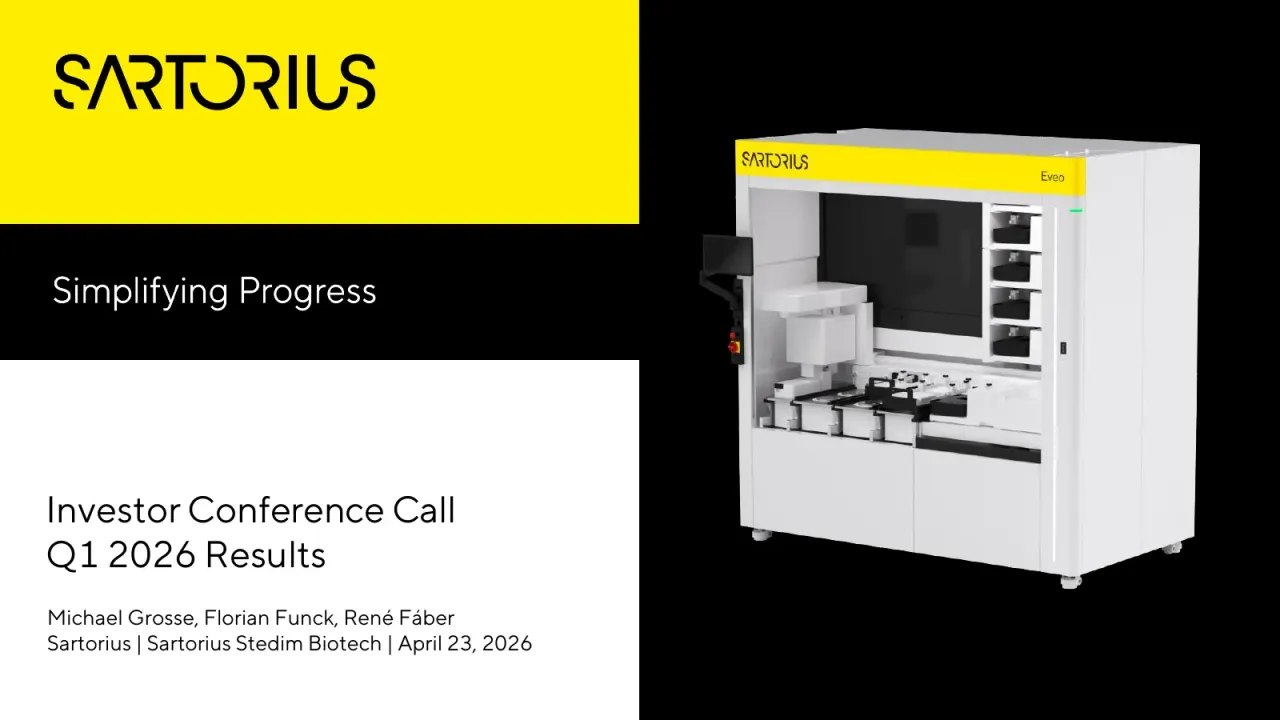
3:49 At the same time, we continue to make progress on deleveraging, underlining our clear commitment to financial discipline and a strong balance sheet. In light of our solid start into the year, we confirm our full year 2026 guidance for the group and we expect sales revenue growth in constant currencies of around 5% to 9% and an underlying EBITDA margin slightly above 30%. Let me now briefly highlight a few innovations launched in Q1 that demonstrate the strong customer demand for Sartorius solutions across the biologics value chain. Starting with cell therapy manufacturing. With Eeveo, our new cell therapy manufacturing platform, we are addressing one of the key bottlenecks in autologous cell and gene therapy, scalable and reliable manufacturing of highly personalized therapies.
4:45 Eveo enables fully automated multi peril production, allowing customers to run up to eight patient batches in peril and achieve up to four times higher yields compared to conventional approaches. By automating critical process steps and reducing manual handoffs, We view also shortens manufacturing cycle times, helping customers move faster from vein to vein and ultimately accelerate time to patient. At the same time, we view it helps to reduce footprint, capital intensity, and over manufacturing complexity, supporting both centralized and decentralized production models. Turning to cell line development. We introduced two complementary innovations aimed at significantly improving speed and efficiency early in the biologics development.
5:37 The latest generation of our Cell Selector platform, Cell Selector CLD for cell line development, enables significantly faster and more reliable cell line developments by combining automated imaging, monofinality verification, and gentle clone isolation in one single system. This reduces manual efforts and uncertainty early in the development, shortens timelines from months to weeks, and strengthens regulatory readiness through integrated documentation and traceability. In parallel, our genetically engineered CHO host cell line allows for faster clone development and up to three times higher productivity, supporting robust and scalable manufacturing as biologics pipelines continue to grow in complexity.
6:26 These innovations once again highlight how Sartorius systematically removes bottlenecks across the biologics value chain from early development to manufacturing by helping customers shorten timelines, increase yields, and improve overall process efficiency and cost structures. Well, with that, I now hand over to Florian to walk you through our q one financials in more detail. Thank you, Michael, and a warm welcome from my side as well. I'm happy to take you through our numbers that reflect a continuation of consistently strong performance from the year 2025 into 2026. Let me begin with top line performance at group level. In the first quarter of twenty twenty six, sales revenue increased by 7.5% in constant currencies and 1.8% reported, reaching $899,000,000.
7:22 Looking now at our divisions in more detail. In bioprocess solutions, sales increased by 8.1% in constant currencies and 2.4% reported, reaching $735,000,000. Growth was driven by the high margin recurring consumables business. Equipment performed in line with expectations with a softer Q1 due to delivery schedules of customers and revenue recognition more loaded towards Q2. We anticipate stronger Q2 equipment sales and expect DPS equipment to deliver at least prior year levels in H1 in constant currencies, supporting a healthy first half performance. In lead products and services, sales increased by 4.9% in constant currencies, reaching 164,000,000.
8:15 MEDHEC contributed 2.8 percentage points to LPS growth in constant currencies, And based on reported figures, LPS posted a slight sales decline of minus 0.6%, which is purely FX related. Growth was driven by a robust contribution from our recurring business, supported by positive momentum in our bioanalytics portfolio. Let me also quickly elaborate on our regional performance. Overall, the first quarter showed healthy growth momentum across all regions, supported by continued strength in consumables. Starting with EMEA, sales increased by 8.0% in constant currencies in the first quarter.
9:01 In The Americas, sales grew by 6% in constant currencies, and the growth was solid, particularly considering the stronger comparison base from last year. Asia Pacific delivered the strongest regional performance with sales growth of 8.9% in constant currencies, with China contributing nicely to the region's BPS growth. Let me now turn to profitability, which deserves a bit more explanation given the offsetting dynamics in the first quarter. The group's underlying EBITDA increased slightly by 1.6% to $267,000,000 in the period from January to March compared to prior year. Positive volume effects and economies of scale were upsized by mix effects within DPS consumables and tariff impacts, as well as continued investments in future growth initiatives, especially in LPS.
10:03 Against this backdrop, the corresponding EBITDA margin remained resilient at 29.7, almost fully absorbing negative tariff effects of around 40 basis points. Similar developments as on group level were also recognized at divisional level. In bioprocess solutions, the underlying EBITDA margin developed positively. Margin expansion was driven by increased volumes and operating leverage overcompensating tariffs and some mix effects within consumables. As a result, underlying EBITDA increased to $233,000,000 and the margin improved by 30 basis points to 31.8% in the quarter. In lab products and services, as already flagged in early February, we are executing a multi investment program to scale future growth areas.
10:57 This is already well reflected in our margin development over the past couple of quarters and is fully in line with our full year 2026 expectations. Consequently, the underlying EBITDA margin was 20.7%, unchanged compared to the level in Q4 twenty twenty five, and also, of course, negatively impacted by tariffs. Now let us look at performance below underlying EBITDA, where both net profit and free cash flow developed well in the first quarter. The development of underlying net profit is mainly driven by the same effects we discussed at the underlying EBITDA level. On top of that, it is also mirroring higher depreciation caused by our CapEx programs over the past few years, as we highlighted at our Capital Markets Day a few weeks ago.
11:54 While depreciation effects are recognized immediately with go live of a building, as usual, the corresponding volume revenue contributions materialize progressively as the additional capacity utilization is ramped up. Furthermore, we saw financing costs slightly increasing as cheap financing from early pandemic times ran out in H2 twenty five. Reported net profit increased by 16% year over year to $56,000,000 thanks to lower extraordinary items that were last year mainly driven by our S4HANA changeover, and we talked about this also at Q1 conference call twenty five. As you know, these extraordinaries are excluded from our underlying profit KPIs.
12:46 Turning to cash related items. Operating cash flow increased strongly to 189,000,000 up almost 36% year on year. This improvement was driven by $20,000,000 higher reported EBITDA and lower tax payments versus high prior year base compensating for the growth related increase in working capital. Looking at working capital, I would like to emphasize that the working capital dynamics can mainly be explained by higher accounts receivable at quarter end, reflecting strong sales activity towards the end of the quarter. Customers received shipments and were invoiced late in the quarter, but due to timing effects and the Easter holiday season, many of these invoices have not yet converted into cash by quarter end and therefore sitting in AR.
13:38 Based on the higher operating cash flow and relatively constant CapEx spending, also free cash flow increased significantly to $113,000,000 The CapEx ratio of 8.6% was at prior year level, reflecting continued disciplined investment in support of future growth, but we continue to expect full year CapEx of around 12.5% of sales for the full year period.
14:06 To conclude our discussion of the first quarter financials, let me briefly turn to our balance sheet related key figures. We maintained a solid equity ratio of 39.4% at the end of the first quarter. The slight change compared to year end reflects the dividends already offset from equity after the AGMs of Sartorius AG and Sartorius AG in March 2026. Net debt decreased slightly to $3,727,000,000 reflecting continued deleveraging despite ongoing investment activity. At the same time, we continued to actively manage our gross debt profile. This makes the reduction in net debt particularly notable as it was achieved despite the dividend payout to Sartorius AG shareholders for fiscal year twenty twenty five on March 31, underscoring our continued focus on disciplined deleveraging.
15:03 As a result, the leverage ratio defined as net debt to underlying EBITDA improved slightly to 3.53 times, down from 3.55 times at year end twenty twenty five. And this confirms that we are progressing as planned on our deleveraging path. Taken together, these developments underline our continued commitment to financial discipline and to maintaining a strong investment grade credit profile. And with that, I would like to hand back over to Michael. Thank you, Florian. Based on the solid performance in the first three months of the year and the overall market development, we are confirming our full year 2026 guidance and continue to view 2026 as a transition year, covered our midterm ambitions as outlined at our Capital Markets Day in March. For Sartorius Group, we expect sales revenue growth in constant currencies of around 5% to 9%.
16:02 For bioprocess solutions, we anticipate growth within a range of approximately 6% to 10%, primarily driven by recurring business, while the equipment business is expected to remain at least stable. In net products and services, we expect sales growth of around 2% to 6%, reflecting continued strength in the recurring business and the stabilizing instruments environment. At group level, sales growth includes around one percentage point contribution from the Mattek acquisition and The US tariff related surcharges, while LPS revenue growth includes approximately 1.5 percentage points from Mattek. Turning to profitability, we expect the underlying EBITDA margins to be slightly above 30% for the group. For bioprocessing solutions, the margin should be slightly above 32%, while in lab products and services, we expect the margin to be slightly below 21%.
17:02 The CapEx ratio is expected to remain around prior year levels as we continue to invest selectively and with discipline in our global research and manufacturing footprint. We also expect net debt to underlying EBITDA to decrease to slightly above three times by year end, reflecting our continued focus on deleveraging, as Florian said before. Given the recent volatility in FX rates, we would also like to share some additional color on the expected foreign exchange impact for the second quarter. We currently anticipate a headwind in the region of minus 2.5 percentage points in Q2, respectively minus four percentage points for H1 cumulated, while we continue to expect FX effects for the full year to be around minus two percentage points.
17:57 We remain mindful of an increasingly complex external environment. Current geopolitical tensions, particularly in The Middle East, are driving increased uncertainty, especially the longer the situation persists. However, we feel comfortable with our guidance as defined in early February and reiterated today. We expect the second half of the year to be stronger than the first half in axial commumbus. Our confidence is based on the positive underlying development of the biopharma market, a strong order book, and our ability to navigate the continued volatility and uncertainty caused by the geopolitical and macroeconomic tensions. Looking ahead, Sartorius has a clear vision and strategy, and we are firmly committed to executing it with discipline, consistency, and a long term perspective to deliver sustainable value creation.
18:51 With that, I would now like to hand over to Rene, who will walk you through the financials of Sartorius Stedim Biotech in more detail. Rene? Thank you very much, Michael. Also from my side, welcome and thank you for joining our Q1 results call today. Sartorius Steadim Biotech delivered a strong start to 2026 supported by our high margin consumables business as well as continued operating leverage. In the first quarter of twenty twenty six, sales revenue increased by 7.9% in constant currencies, $762,000,000 Growth in reported currencies amounted to 2.3%.
19:30 Our recurring consumables business was fueled by strong underlying demand. Equipment, as Florian mentioned before, performed in line with our expectations with a softer Q1 due to the delivery schedules of customers and revenue recognition more geared towards Q2. We anticipate stronger Q2 equipment sales, which should deliver at least prior year levels in H1 supporting in healthy first half performance. Looking at profitability, we observed similar developments to those at Sartorius AG as Florian elaborated earlier on. While earnings continued to improve in the first quarter, the underlying EBITDA margin remained largely flat.
20:15 Positive volume effects and economies of scale were offset by a less favorable product mix within the consumables portfolio and tariff impact. Additionally, it has to be noted that there was a technical margin drag of 25 basis points due to an increase of the Sartorius brand name free charge from Sartorius AG to SSB. As a result, underlying EBITDA increased to $233,000,000 and the margin remained Brazilian at 30.7% for the quarter.
20:50 Looking at the regional performance, all regions contributed to positive business development in the first quarter supported by continued strength in consumables. Starting with EMEA, sales increased by 9.1% in constant currencies. In America, sales grew by 5.6% in constant currency reflecting a tougher prior year comparison but remaining positive overall. Asia Pacific delivered the strongest regional performance with sales growth of 9.4% in constant currencies with China contributing nicely to the region's growth. Looking now at net profit and cash flow, profitability and cash generation developed solidly over the year.
21:38 Starting with earnings before EBITDA, all metrics improved slightly. Underlying net profit increased slightly disproportionately to underlying EBITDA mirroring higher depreciation caused by our CapEx program over the past few years. Reported net profit improved by 3% to $88,000,000 thanks to lower extraordinary items which are excluded from the underlying profitability measures and were therefore supportive. Turning to cash related items now. Operating cash flow increased strongly to $193,000,000 up more than 61% year on year driven by higher EBITDA and lower taxes, compensating for the gross related increase in working
22:25 capital. As a result, cash flow rose significantly to 124,000,000 supported by the strong operating cash flow and stable CapEx at the prior year levels. Accordingly, the CapEx ratio increased slightly to 9.1%, reflecting continued disciplined investment in support of future growth, but we continue to expect full year CapEx of around 13% of sales for the full year period. A quick look at our balance sheet metrics. At the end of the first quarter, we continued to show a very strong equity ratio of 50.6%, reflecting our solid capital structure. Compared with year end, the slight decrease mainly reflects the dividend, which was offset from equity following the AGM end of March.
23:17 Net debt decreased slightly and the ratio of net debt to underlying EBITDA progressed as planned. The net debt to underlying EBITDA ratio improved further to 2.28 times, down from 2.38 times at year end, confirming that we remain well on track on our deleveraging path. Overall, these developments underline a strong balance sheet position of Sartorius Stellium Biotech and provide a solid foundation to support future growth while maintaining financial flexibility. Before we move into Q and A, let me quickly elaborate on our confirmed outlook for full year 2026. Based on the solid performance in the first three months and the overall market development, we are confirming our full year 2026 guidance.
24:11 We expect to stay on our profitable growth path and for 2026 sales revenue growth in the range of 6% to 10% in constant currencies, including one percentage points contribution from U. S. Tariff surcharges.
24:27 Growth will be mainly driven by recurring business, but again, against higher comps while the equipment business should remain at least stable. Based on our order book, we continue to expect a stronger second half compared to the first half at Sartorius AG. This reflects the expected gradual normalization and improvement in the equipment business throughout the year. The underlying EBITDA margin should increase to slightly above 31. Our CapEx ratio is expected to stay around previous year level of around 13%, reflecting our ongoing investments into research and resilient production footprint. Our commitment to deleveraging remains unchanged. We anticipate the leverage ratio, the net debt underlying EBITDA to decrease to slightly above two times at year end.
25:22 Given the volatility we have seen in the currency exchange rate over the past few months, let me also share some FX assumptions for the Sartorius Stellium Biotech Group. We currently anticipate a headwind of approximately minus 2.5 percentage points in the second quarter while we continue to expect FX effects for the full year to be around minus two percentage points.
25:48 Michael highlighted earlier for Sartorius AG and without repeating this in detail, the same considerations also apply to Sartorius Stead in biotech. We feel comfortable with our guidance as defined in early February and reiterated today. Our confidence is based on positive underlying development of the biopharma market, our strong order book, our ability to navigate the continued volatility and uncertainty driven by geopolitical and macroeconomic tensions. With this, I will hand over to the operator to begin the Q and A session. Anyone who wishes to ask a question may press star and one on their telephone. You will hear a tone to confirm that you have entered the queue. If you wish to remove yourself from the question queue, you may press star and 2. Questioners on the phone are requested to disable the loudspeaker mode and eventually turn up the volume from the webcast while asking a question.
26:47 In the interest of time, please limit yourself
26:49 to one question. Anyone with a question may press star and 1 at this time. And the first question comes from Zane Ibrahim from JPMorgan. Please go ahead. Hello. Zane Ebrahim, JPMorgan. Thanks for taking the question. I'll stick to one. And my question is on the demand activity you're seeing at the moment in equipment. Can you comment on what the latest is from customers based on related conversations with them? Thanks very much. Yeah. Thank you for that question. So yeah, let me first reiterate what we have just explained how the equipment is developing. So for Q1 we have seen a bit softer
27:35 development in sales, more or less as expected. And you know, we see the revenue recognition being moved or was moved more towards the Q2. So what we anticipate to see for the H1 is, first of all, Q2 equipment sales. And H1 to be then at least at the level of the prior year. So overall, I would say equipment develops as we have expected.
28:07 You know, the positive start in the year coming from a quite strong, relatively strong H2. We have seen already in H2 last year. Q3, Q4 particularly were quite positive quarters in equipment and we're benefiting from that in the beginning of the year as well. So overall, we are confirming our view on the equipment moving forward.
28:41 As I said, H1 positive at least at the prior year level and same for the full year. Overall, H2, as we can say today, we would expect based on the discussions we have with customers and the funnel we see which is positively developing as well, for H2, we expect to be stronger than H1 from today's perspective. Thanks a lot. Then the next question comes from Doug Schapnikkel from Wolfe Research. Please go ahead. Thank you for taking the question. It sounds like you expect bioprocessing equipment growth in Q2, which I think is what you were clarifying in the last question.
29:32 But I just want to make sure that's right.
29:35 And I want to also confirm that based on trends and backlog that you're expecting bio equipment growth to continue into the second half. And then I guess the last part to this question would be, are there any areas that you would call out that are notably driving recovery in equipment? And conversely, are there areas that you're still awaiting some recovery? Thank you. Yes. So, absolutely. Thanks for the question. Confirming, yes, we're expecting Q2 growth in equipment sales, as mentioned. And also, I think second part of your question was H2 above H1. That's our current view indeed.
30:21 Know, on the where is this happening? How is overall equipment developing, looking at different parts of the portfolio or regions. Honestly, I think it's quite all over the place. We don't see really special pocket of growth or still muted development. Definitely we have seen good traction on bioreactors. Now, as you remember, talked about the consumption of bags and consumables, which we see going with the equipment that is still well on track and continues nicely growing.
31:08 And here and there, we see already new installations happening. I mentioned bioreactors, but it's going also downstream with very successful initial placement of our new innovative bionic platform going supporting process intensification as well. Some larger projects in area of peptides, in chromatography. So it's kind of across the board. Then the next question comes from Zubu Nambi from Guggenheim Securities. Please go ahead. Hey, guys. Good morning. At the Capital Markets Day a few weeks ago, you mentioned that biotech has been improving.
31:55 The capital markets environment remains strong for biotech. Are you seeing any change in behavior, and is that a potential source of upside relative to your full year target if trends continue?
32:09 Yeah, I may start. I'll just briefly, yeah. So, I think if we've indicated there at the Capital Markets Day, I think we've already started. We need to see signs of, you know, I mean, the funding environment has improved progressively in the second half of the year. Towards year end, we already could see, you know, some more activities and interest and lead generations as well from the biotech side. I think overall, it remains as well. I mean, if we look now as well at the LPS portfolio, remains probably still on a more rather stable and lower levels. At the same time now, as we said, I think as we expect overall order situation opportunity generation for the second half of the year to be a great foundation, again, given the lead times for these orders that will be generated, you know, as well from that part of the business.
33:02 Again, I think you need to be mindful that early realization of those sales will be rather the very tail end of 2026 and rather create now the potential bench for revenue realization in 2027.
33:17 Thank you. And the next question comes from Charles Pittman King from Barclays. Please go ahead. Hi, Thanks very much for taking my questions. Can I just and I apologize if I missed this clarification, but just coming back to your 2H being greater than 1H on both an equipment specific and a broader BPS dynamic? Can you just confirm that what you're expecting when you say absolute is actually a continued growth in the organic line? Or is this primarily reflecting the removal of the FX headwind? Like, that what gives you the confidence of absolute being greater in 2H than 1H? Just trying to get an idea that the equipment sales are, in fact, expected to improve over the course of this year. Thank you.
34:04 Yeah, Charles. First, let me talk to the question regarding FX. All that we are talking here, which is sales related, is FX corrected. So it's in constant currencies. And what we have been saying is that we are expecting
34:24 a higher H2 versus H1 in absolute million euro currency adjusted. And just in terms of the organic growth rate on equipment in the second half, Sales versus orders? No. We have said that we are expecting H1 sales currency adjusted to be at least on the level of prior year. And still, also, for the full year, we've said that we're expecting full year equipment sales
35:05 to be at least on prior year level. Perfect. Thank you. Welcome. And the next question comes from Charlie Hayward from Bank of America. Please go ahead. Thanks. Charlie Hayward, Bank of America. Question on DPS consumables actually and the contribution to the guide. So I think Renea, the full year, suggested low teens consumables growth is a reasonable expectation for a normal year. And then you haven't called out many specific headwinds to the consumables side other than acknowledging 25% is a tougher comp. And then obviously tariffs is actually a slight tailwind to that. So is it fair to think of all those factors that consumables growth in the roughly low teens range for this year would be a sensible answer?
35:53 Well, let me tackle that, Charlie, and Rinne, maybe to comment on that. First of all, please bear in mind, have said that the year '26 is a transition year. So please do not apply the kind of normal growth rate that we've given in the midterm guidance also as the kind of anchor point for the year '26. Additionally, on top of that, I think what we also said clearly is that we are expecting clear base case effects because of the very high comps. So that growth rate that we've seen in the year '25, where it was in the teenage area, is not one by one to be expected to continue. It will be still a healthy and strong growth. That is our expectation.
36:50 But I think it would be wrong now to nail us down on a double digit consumables growth for the full year. Thank you. And the next question would come from Charles Weston from RBC Europe. Please go ahead. Thanks for taking the question. In terms of China, you both you and Rene both spoke quite constructively at the Capital Markets Day, saying that there's more activity and recovery from China companies looking to expand globally. I think that one of your U. S. Peers reported double digit growth in China bioprocessing in Q1 and said it was in recovery mode. So can you just perhaps give us any further color about what you're seeing from that market in Q1 and in Q2 so far, please?
37:48 Yeah. I can get started. I mean, as outlined, I think overall, we are encouraged to see that there is a growth contribution from China after, you know, two rather difficult and reasonably weak years overall. I think I still would like to make the comment upfront that the tendency that we see and a bit the muted demand when it gets to the equipment and instruments business, that remains there. And hence, with a bigger impact that we have in that business typically for the lab, products and services division, it is indeed the fact that here the contribution is lower and it remains rather soft on that side. However, I would say it's great to see the Q1 development there on the VPS and consumer business side, where we basically see an overall group level performance of around close to 30% on that basis. So, I mean, on this perspective, we take a look at the growth contribution overall from China is positive on the consumable side as we mentioned.
38:57 Thank you. And the next question comes from Oliver Metzger from ODDO BHF. Please go ahead. Yes. Good afternoon. Thanks a lot for taking my question. It's about the full year guidance. So Q1 experienced still some headwinds and also had from the Q1 last year, let's say, a higher comparable base for the consumable side. So momentum from the consumables over the next quarters should not meaningfully deteriorate just from the space effect or remain similar. As you said, equipment demand is seen to improve and also we observe now a gradual improvement or recovery of LPS.
39:44 So would you describe Q1 as a trough with regards to growth rates for the current year, if not any unforeseen headwinds pop up? I would not do that. It a solid start into the year. It is very much in the midpoint of our guidance. And I think we have, especially when issuing the guidance, have also communicated about the drivers of the guidance, what might lead to the lower end, what might especially lead to the high end. And you know that we said that the lower end would be more the kind of not so much expected scenario, and the higher end would require quite healthy dynamics also in the equipment area to take place, whereas the midpoint would see an equipment business rather on prior year level.
40:55 I think we have seen now in Q1 a healthy start in the consumables business. We are going to see, at least this is the current point of view, that H1 from the equipment side would be at least on prior year level. And with that, I feel very comfortable with the overall guidance. And to frame Q1 as a trough, I would be cautious. Okay, thank you. The next question comes from Odysseus Manesiotis from BNP Paribas. Please go ahead. Hi, thanks for taking my questions. I also had a question on phasing throughout the year.
41:44 Is it fair to assume Q2 could be the strongest growth quarter given the easier comps here? I mean, I remember you had some fluid management related U. S. Customs delays that made Q2 twenty twenty five a bit weaker. Could you confirm whether that's a sensible way to think about it? Thank you, Alicia. So if you look at absolute numbers, you've seen that the year or that Q2 in the year 'twenty five was somehow standing out. It was above Q1 in absolute terms, and it was above Q3. It's true that the tariffs were ramping up with the implementation of the tariffs.
42:37 Middle of April Q2 took some time. And of course, the tariff effects are more pronounced in H2 twenty five and not so much in Q2. Nevertheless, I would say that Q2 is a not too low comp if we look forward into Q2. As I said, it was higher in absolute terms than Q1 and Q3. Then the next question comes from Thibault Bouzerin from Morgan Stanley. Please go ahead. Thank you. I just want to come back on the Commerce and Equipment and I guess the sustainability that you expect from this. So I guess, first of all, to what extent your conviction of improvement in Q2 is coming from the order books versus just expectations and discussions?
43:40 And sort of what lead time do you have on the order booking equipment, giving you that confidence? And then related to that, are you confident this is the beginning of a recovery cycle that we've been waiting for some time? Or could we still be in the kind of the fluctuations where we could see equipment order and equipment sales being a bit more volatile for the next few quarters? Yes. Thank you. And let me quickly start on the visibility on equipment for Q2. You know, making the statement requires support by order book, and this is exactly what we're seeing. So we are feeling quite confident looking at the order book. Of course, there might always be, you know, late adjustments from the customers indicating they want to have certain orders in June, and then maybe, I don't know, what happened at their site requesting something in July. But the general volume is clearly in the order book already for Q2.
44:52 Yeah, absolutely right, Florian. What I would add to that is that, you know, I'm not sure it's like a, you know, as we expect at least flat full year sales equipment, would rather call it still a transition year. We, however, are quite positive with the outlook, you know, that orders in the year, full year on equipment will be above the h one, above the h one last year and also for the full year above 2025. So, yeah, as I mentioned before, funnel is there.
45:38 The discussions we have with customers indicate positive development, but it's still a positive transition year regarding that. Thank you. And the next question comes from James Maintenpas from Jefferies. Please go ahead. Yes, hi. Thanks for taking my questions. I just got a question on underlying profitability just to understand the construct because if margins are basically flat year over year, the other operating income seems to have had a 2.5 percentage benefit because I guess Q1 last year was minus 12 and that's moved to plus 10%.
46:23 I And was just wondering if you can help us understand what's contributing to that level and if that's sustainable. And so if the MAX actually has had such a big benefit and a swing, it looks as if the underlying margins have gone from over 31% to sort of less than 29 which the largest driver seems to be at the gross margin level, which is down to 2.7%, I think it is. So the second part of the question then is, you've clearly talked about mix, but can you also help us understand the inventory write downs, which happened last year and when that's exposed to start to improve over the coming years? And if that math sort of makes sense, what's happening in the underlying profitability? Thank you. Yeah. Thank you, James, for your question.
47:08 Let me start with that. So yes, of course, wealth deposits when we're looking at gross margin. The one really big driver in gross margin is FX. And as you know, we have a rolling forward hedging strategy on FX. But the positive hedging effect on FX on that margin rolling in other income. So there is a kind of mismatch if you're looking at that, and therefore, it is in the consequence clear that you observe a healthy other income margin and the pressure on gross margin.
48:00 Now regarding inventory. What we have been talking was more a kind of general statement to give you a feeling for possible support for further margin increase rather than giving you a concrete number that you can bring on a timeline. And please accept my apologies for not going deeper on this for your modeling. Thank you. So just so I understand, what you're saying is the swing is just due to that sort of mismatch in FX. So should we really be considering gross margins, looking at what your gross profit is with an adjustment for what we see in the other operating? Is that correct? So if you've seen this big swing, is that the sort of the level of anticipation we should have for this year? Because I also we sort of noticed that in the same number in Q4. Is it the type of thing which should then roll off in the second half of the year? The reason I'm asking is because it's sort of material to the overall margin overall. So it would just help us sort of build a complete corporate picture.
49:08 Yes. James, we are guiding on underlying EBITDA margin, not on gross profit margin. Therefore, we've taken appropriate measures to secure that level of profitability. There is that FX swing. And there is another point that we also communicated in this call here that is around the mix effect that, of course, also had a certain slight drag besides tariffs on the gross profit margin. So please always bear in mind, Q1 last year was free of any tariffs, Liberation Day tariffs. And please also bear in mind that we have that kind of mix effect within DPS consumables.
49:58 That's great. Thanks for taking the follow-up. Thank you. The next question comes from Naresh Swan from Intron Health. Please go ahead. Hi there. Thanks for taking my question. Couple of bigger picture ones, please. We calculate the underlying demand for mammalian, biologics is low double digit, obviously, which you returned to last quarter. If we and I heard your comment just now that we should caution that we may not see that this year. If the underlying demand is low double digits, can you help us understand the delta between your sales growth? Is this a share issue? Is it yields? What's happening? Why are you not growing at the rate of demand?
50:46 And then and secondly, as yields continue to improve, this is a more of a question around equipment. As as yields continue to improve, are you seeing customers increasingly shifting to smaller batch bioreactors over the last few compared to the last few years, and therefore, could could it be that you in equipment that you share can improve? Thank you. Yeah. Yeah. Thanks for that question. So I agree with what you said on the demand. However, this is something you need to consider over longer periods of time. So, you know, looking at a year, there might be fluctuations.
51:33 But overall, this is what we see and expect. So when we talk about market fundamentals and growth, we see that and expect that the biologic demand will grow and continue to grow. Low double digit is fair assumption. At the same time, improvements happen. That has also impact, as you indicated, on what consumables equipment are used. And yes, we have seen, but it's now for more than a decade that this yield or efficiency improvements leads to more and more smaller volume processes, more and more single use of adoption.
52:23 And if you listen to our Capital Markets Day, this is also the expectation we have. And what we do and drive as an innovation industry is further improvement of this efficiency so that even more, especially commercial drugs, will be manufactured in that smaller, more flexible, single use equipment and facilities. Which, of course, will positively impact and drive our market position and the growth of the business. I just have to follow-up. Should we then assume on the basis of that that your equipment sales should hold up pretty well, but consumables will grow slower than than underlying demand over the kind of short to medium term?
53:15 No. Okay. Thank you. And the next question comes from Falko Friedrichs from Deutsche Bank. Please go ahead. Thank you. I have one question, please. Is it fair to assume that the group adjusted EBITDA margin in Q2 is likely still below the full year guidance range, just like it was in Q1, given the incremental tariff headwind and more equipment in the mix? Could be. Depends also on the other components of mix, Balco. Okay, fair enough. Thank you. Then the next question comes from Theodore Rowe Beadle from Goldman Sachs. Please go ahead.
54:10 Hi. Thanks for taking my question. Can you talk to how you're managing the current geopolitical risks and energy price increases? And what are the key mitigating strategies that you have in place? Thank you. Yeah. Thank you very much. So when we are talking about the Iran crisis and energy crisis, first of all, it has to be noted that Sartorius is not to be considered as a kind of energy intensive company. If we purely talk about electricity, it is a very low single digit percentage of cost of goods sold. And in recent years, we have also invested in expanding renewable energy capacity at our sites worldwide to become more independent, of course, over time from fossil based energy.
55:02 We are not using short term hedging instruments, but what we are using are rolling contracts, longer term rolling contracts. So even if we see on the spot market hikes in gas or electricity, this should not have any larger impact on our P and L in 'twenty '6 and in 'twenty seven. On the other hand side, there might be indirect or second round effects from rising energy and or gas prices on costs, for example, higher freight costs or oil based components in raw materials, so plastic, for example. And this is, of course, somewhat more relevant, and we are watching the supply and the sourcing situation very carefully. We have a task force on top of that.
55:58 This might lead already in the year 'twenty six to an increase of our cost base. And on the other hand side, most of our supply contracts are longer term. And even if we have higher price levels, they will also be mitigated by internal moving average prices based on inventory in place. And furthermore, currently, we have no significant component shortages that have been identified by the task force that I was mentioning. And of course, even if there were some cost effects, and if I had to put a risk number, it would be, I don't know, around about $10,000,000 for the year 'twenty six, we would then act and implement countermeasures, including price increases or freight surcharges.
56:59 And this is all currently evaluated. And, of course, if the conflict is prolonged and we're seeing persistently higher oil prices, that, of course, could have an impact on cost in 2027, but this is now too early to tell. But I can tell you that we have overall the instruments in place to fare our way also in an inflammatory environment. And the next question comes from Charles Weston from RBC Europe. Please go ahead. Hello. Thanks for taking the follow-up. I just had one, please, on the, comps. I know the question has been asked before, but, you've about there being tougher comps, in 2026 on the consumables side.
57:52 But I thought that 2025 was effectively described as a more normal situation in absolute revenue terms. So if there was additional sort of restocking by customers in '25, making the tough the comps tougher, Perhaps you could, just discuss that. But but if not and it was more normal, then why would 2026 consumable growth be lower because of tough comps? Thank you. I'm not sure I really got the question because what we've seen in prior year in consumables was a growth in consumables that was definitely above average market in a still transitioning year.
58:51 And based on that, I would simply assume that or simply say it is not fair to assume that these high kind of growth rates will persist in the year 'twenty six and that we will see base effects. When I was talking about comps, it was based on the question regarding Q2, where I just said that Q2 stood out in absolute volume against Q1 and Q3. Okay. Thank you. And the next question comes from Delfinale Louet from Bernstein. Please go ahead. Yes, hello. Good morning, everybody. Just to be back into the mix effect and specifically at BPS, Rene, can you clarify a bit more the impact in between the volume and the price, if any, or in between the consumable, all the service versus the rest of the line when it comes to the equipment?
59:52 Can we have a bit more granularity here, please, for us to clearly understand? Yes, thank you very much for the question. So yes, we've seen that in the quarter. We see it as more as a quarter effect, nothing to be continued and move forward. It's really a short term makeshift to a certain, you know, part of part of the portfolio, so nothing structural. Okay. And there's nothing on the price? Nothing specific? Just regular price increase? No. No. No. That that has nothing to do with the price as far as yeah. The Yeah. No.
1:00:41 Ladies and gentlemen, this was the last question. I would now like to turn the conference back over to Petra Muller, Head of Investor Relations for any closing remarks. Thank you, operator. This concludes today's call. Please reach out to the Investor Relations team or in case of any open questions. We thank you for joining today's call. Wish you a pleasant rest of the day and see you next time. Operator, you may now disconnect. Thank you. Ladies and gentlemen, the conference has now concluded, and you may disconnect. Thank you for joining, and have a pleasant day. Goodbye.
Follow Sartorius AG into a list and get an email when it puts out news.
Head of Investor Relations, Sartorius
Chief Executive Officer
Chief Financial Officer
Head of Bioprocessing Division & CEO, Sartorius Stedim Biotech