Replay available
SAI Life Sciences (NSE:SAILIFE) Q2 2027 Earnings Call
SAI Life Sciences (NSE:SAILIFE) Q2 2027 earnings call, held 2026-11-06. Watch the replay and read the transcript on 6ix.
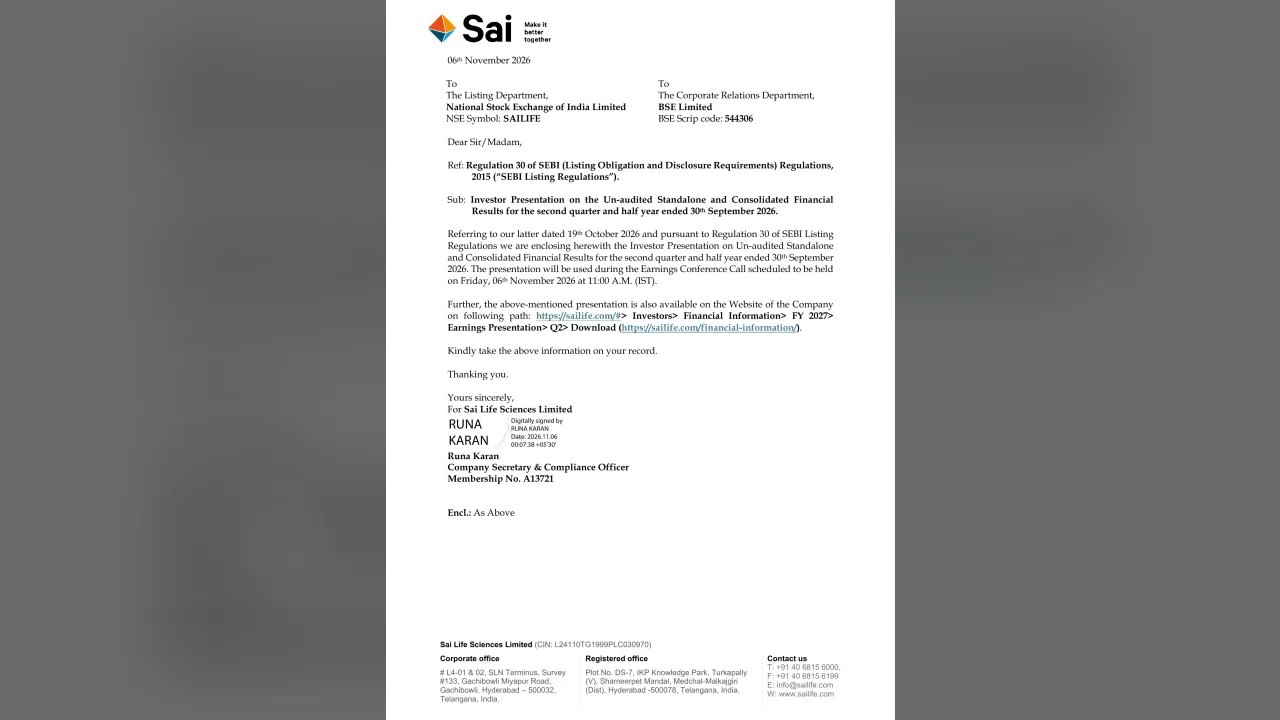
- Company
- SAI Life Sciences Ltd. (NSE:SAILIFE)
- Period
- Q2 2027 earnings call
- Date
- Fri, Nov 6, 2026, 4:36 AM ET
- Replay
- Watch the replay on this page · 56 min
On 6ix: 6ix.com/event/sai-life-sciences-limited-sailife-q2-2027-earnings-call
Replay
Transcript
Automated transcript · Written by software from the replay's audio. It can mishear names and figures; the replay is the record.
0:00 Ladies and gentlemen, good day, and welcome to Sai Life Sciences Limited Q2 FY 'twenty seven Earnings Conference Call. As a reminder, all participant lines will be in the listen only mode, and there will be an opportunity for you to ask question after the presentation concludes. Please note that this conference is being recorded. I now hand the conference over to Mr. Devakar Pingle from Thank you, and over to you, Mr. Pingle. Thank you, Sai. Good morning to all the participants on this call. Before we proceed on the call, let me remind you that the discussion may contain forward looking statements that may involve known and unknown risks, uncertainties and other factors.
0:50 It must be viewed in conjunction with our business risks that could cause future results, performance or achievements to differ significantly from what is expressed or implied by such forward looking statements. Please note that we've made the results and the team are available on the company's website. In case anyone here has not received the same, you can write to the Investor Relations team, and we'll be happy to send this in over to you. To take us through the results and answer your questions today, we have the top management of Sai Life Sciences Limited, represented by Krishna Panamuri Managing Director and Chief Executive Officer and Mr. Ishiwachitu, Full Term Director and Chief Financial Officer. We will start the call with a brief overview of the quarter run past and then conduct the Q and A session. With that said, I'll now hand over the call to Krishna Konamuri. Over to you, Krishna.
1:38 Good morning, everyone, and thank you for joining us for our Q2 FY twenty twenty seven earnings call. As we concluded another successful quarter for the company, our priorities at Sai remain unchanged to deepen our relationships with global pharmaceutical companies, expand the range and complexity of services we offer and build the capacity and capabilities required to support customers over the long term. We are making progress on each of these fronts. We are seeing continued interest from large pharma, increased traction from our integrated outsourcing model and steady progress on our capacity expansion program. Let me begin with a brief overview of the broader operating environment. Tailments supporting supply chain diversification continue. We remain focused on converting these opportunities into sustainable business growth.
2:27 Recent developments in The U. S. And China add another dimension to this. The U. S, the proposed rules under the COINS Act seek to introduce additional restriction on certain U. S. Investments involving Chinese biotechnology companies. Separately, China's Ministry of Commerce and Ministry of Science and Technology have proposed additional controls on the export of selected technologies, including the biomedicine space. While these are evolving regulatory developments and their eventual impact remains to be seen, they reinforce importance of geographic diversification and need for pharmaceutical companies to build resilient, alternate supply chain partnerships. We believe Sai is well positioned to benefit from this trend, particularly given our established, flexible global innovators, our integrated capabilities, our track record of supporting customer across discovery, development and manufacturing.
3:16 The advantage increases lives with CIDMOS that have scientific depth, infrastructure and customer relationships to take on larger, more strategic engagements. The ongoing situation in The Middle East is also having some impact on the cost of certain chemical and solvents. While this has created some cost pressure, our proactive supply chain management has ensured continued material availability. We are working closely with customers to recover the incremental costs where applicable. On the business front, we continue to see good traction in outsourcing opportunities from the large pharmaceutical companies. An important milestone this quarter has been the consolidation of our position as an integrated CRM of choice to large pharma customers. In the last investor call, we had announced our first end to end integrated collaboration with a top tier market pharma company.
4:01 We have since commenced operations with this customer. Building on this success this quarter, we have converted another large pharma relationship into similar strategic engagement. We're also working on extending this model to other large pharmaceutical companies. Discussions are progressing with a few large pharma customers as we see encouraging potential to deepen these relationships over time. Our focus remains on building long term partnerships where we can progressively expand the scope of work from individual projects to integrate engagements, spanning discovery and development, eventually to manufacturing. We believe that such integrated partnerships will help us build a robust, consistent effort to long term pipeline and revenues. With that, I will hand this over to Shiva to take you through operating performance and progress of our capacity expansion and CapEx program. Thank you, Krishna, and good morning, everyone. Let me take you through our operating performance for the quarter, followed by an update on our capacity expansion and CapEx program.
4:52 For Q2 fiscal 'twenty seven, our revenues grew by 23% year on year, with the CDMO business growing by 20% and the CRO business growing by 28%. For the first half of fiscal 'twenty seven, overall revenue growth stands at 17% year on year. The CRO and the CDMO businesses contributed to 3862% of the half year lease revenue, respectively. EBITDA for the quarter was 28% of the revenue and was in line with the year on year margin trajectory. For the first half, EBITDA margin stood at 28%. As we had indicated in our earlier calls, we expect the second half of fiscal 'twenty seven to be stronger than the first half. Let me now give you some highlights on our operating performance. Let me start with the CRO discovery business.
5:39 During the quarter, we successfully started integrated discovery programs with two large pharma customers, building on the efforts I had outlined during our last investor call. These programs are currently small, but are a validation of our belief in this model, which has the potential of becoming a significant lever for future growth. We also witnessed an uptick in inquiries from biotech customer that points to a revival in the biotech sector. Many of these inquiries are for integrated engagements in new modalities, specifically peptides. In CMC, our late phase and commercial pipeline continues to remain strong. Over the quarter, we added one molecule to our late phase pipeline, while one molecule moved from late phase to commercial. On the cost front, we have seen a modest increase in raw material costs, particularly certain solvents and chemicals, arising from the ongoing Middle East situation. As Krishna mentioned, our supply chain teams have been proactive in ensuring material availability and continuity of operations.
6:41 We are also working with customers to recover these incremental costs. We expect the impact to be managed through these recovery mechanisms over time. Coming to our CapEx program. We have incurred expenditure of approximately INR $6.21 crores during the first six months of fiscal 'twenty seven, of which INR $3.58 crores was incurred in Q2. We remain on track with our overall CapEx plan of INR 1,100 crores to INR 1,300 crores for fiscal 'twenty seven. Let me touch upon the progress across some of our key projects. The expanded small molecule capacity at Bidir or around two twenty kL is now ready. We are currently completing the final quality trial to the site ahead of commencing commercial batches. This is an important addition to our manufacturing capacity and is expected to be revenue accretive in the current year.
7:31 On the second phase of capacity expansion, we have undertaken some prioritization of projects to align with some of our customer priorities. As a result, the commissioning of the additional capacity of two twenty five kl is now expected to be available by early Q3 of fiscal 'twenty eight compared with our earlier time lines. Importantly, we do not expect this change in time lines to affect our ability to meet our revenue commitments in fiscal 'twenty eight. We will continue to align the pace of capacity addition with customer demand and the requirements for our development commercial pipeline. We also commenced a design work on our new manufacturing site in Telangana. The planning and design process is progressing, and we currently expect to break ground in Q4 of fiscal twenty twenty seven. This will be an important addition to our longer term manufacturing infrastructure and growth plans.
8:20 Overall, our CapEx program is progressing well. While we have recalibrated the time line for certain capacity addition based on our project prioritization and customer needs, our broader investment plan remain intact. Our approach continues to be science led and aligned with customer demand with a focus on building the capabilities and the capacity required to support Sai's next phase of growth. To conclude, we remain focused on balancing growth investments with execution discipline, ensuring that new capacities are commissioned with the required quality standards and are aligned with the opportunities in our pipeline. We remain confident of achieving our stated long term growth and EBITDA projections. With this, we would be happy to take your questions. Thank you.
9:06 We will now begin the question and answer session. Session. The first question comes from the line of Amit Alge from JM. Please go ahead. Yes. Thank you for taking my questions and congrats to the Sai Life team on good set of members. First question I have on the CRO business. CRO business is growing very strongly for last eight quarters now, totally against the trend.
9:52 Is it possible to break down this growth? Like how much is led by the capacity increase, the number you can give in the scientist addition, which you have done over the last six months? Or anything which you can give color on, like in which areas this growth is coming from? Is it chemistry led, discovery or biology? Or any customer which we have added recently, which is driving this growth? If you can break down this growth, it will be helpful for us to get clarity on the CRO business. I think I'll take the question, Krishna, please repeat. So our overall growth has been led by, I think, two factors which is reiterated. One is the ability to do integrated discovery, which has kind of helped us build mine an existing customer more for revenue. That's the first strategy. The second one is our growth in the large pharma, as we alluded to earlier in our other calls.
10:53 We had a very minimal pharma presence a few years ago and today are as of 'twenty six, and we had a CRO split for Pharma at 40%. And that these two important factors have led to our growth on the CRO side. Without giving you, we've not broken down the numbers by the CRO CDMO business in terms of headcount. But if you look at, we have given you a number headcount at the end of March and at the end of June and at the end of September, we are around 4,400 people. So there is people related growth that has happened that you can probably take out from our investor presentation. Objective for us is to kind of make sure that we can get to all of the niche technologies and make sure that we can present and mine existing customers.
11:42 That has been the strategy, and that's kind of helped us grow. You covered everything. Yes. So you expect this growth to growth moment to maintain? And is there any future outlook on the scientific addition, let's say, next one, one and a half year? I mean, at this point, we're really not giving any guidance on that. We are playing it by what we are seeing in the market. As of I think, look, we are pivoting a large format, EMEA is alive and well. What pace that will take is obviously adding. We also see biotech coming back small in way. I think there is I think we continue to see our demand going forward. What it is, it all depends on cycles.
12:33 Sure, sure. That's clear. And we are talking about two big customers for in... Integrated programs. Is it possible to explain bit more in detail in what sense these programs are integrated and how big these programs could become in terms of revenue potential? Thank you so much. So, I think what we are saying is an integrated service offering and we're not saying it's an integrated program offering. So what we are saying is that with these customers today, we provide them service across the entire drug discovery life cycle, starting from discovery going up till commercial manufacturing. And the ability from a Sai perspective is one of the few companies that offer an end to end service either at the medical chemistry, early process, clinical scale up, commercial manufacturing, and that's a spread that we provide to a customer.
13:32 What we are seeing is that customers who probably use one or two services with Sai earlier today are coming out from these piecemeal service picks that they were doing to a more strategic engagement where they are saying we will work with you across the drug discovery lifecycle. That's really what we're seeing. I think the important thing here is look at it the fact that we are the only company which has significant scale in all three dimensions, discovery, drug and commercial. I think given the fact that have these relationships, it's easier for them to consider us as key partners given the scale we have and almost ten plus years back to where we have most of these companies. The next question comes from the line of Sidharth Degandi from CWC.
14:19 Please go ahead. Thank you for the opportunity. Congratulations to the SAILIFE team on a very great performance. Few clarifications. You've mentioned 34 active MC molecules, which is the same as the previous quarter's presentation. But you mentioned about one more commercial molecule getting added. So is there a churn out? And similarly, if one had to look at the update on one more coming to late stage, right, the net addition from quarter one to quarter three from 11 to 14. So if you could just help us understand that better. The second one was you'd mentioned about a very fast ramp up last quarter in the CRO capacity that was set up, which is already at 85%, 90%.
15:12 And therefore, on the planned CapEx, would you would you end up having a recalibration of adding more CRO capacity given that some of the CDMO capacity you spoke of is is now coming in q three next year? That's question two. Question three, your large pharma clients continue to be 19, right? So I'm assuming the new two programs are with existing pharma clients. While these are small today, what would that mean in terms of customer concentration, say, in a couple of years? Yes, those were my three questions, and wish you all a happy to call it. Thank you, Sudhak. I think let me take the last question first, which was on the pharma program. I think I want to clarify a couple of things.
16:03 One is the two integrated programs that Krishna mentioned in SP is from the nineteen out of twenty five. The program that I talked, which was which I said was small was an integrated discovery program in the discovery space alone. What we mentioned, if you go back to our last investor call, we said one of our key factors for success with the biotechs was the ability to do integrated programs in discovery space, which meant doing chemistry along with GMPK and raw biology. And we said we are now we want to get into want to get into the pharma space with that and we have made certain investments in terms of automation for that.
16:52 And we have mentioned that we would want to get into at least one or two large pharma and there is an effort going This is what we mentioned during the last investor call. And that is what we are saying. So that is small. So the integrated outsourcing work that Krishna talked about is existing customer. We are not that is a customer where we offer everything to that customer starting from the discovery and commercial manufacturing. The integrated discovery is just a portion out of that, That's the first question. The second point, I think in the last investor deck, we had a number. There was a typo in the number, and it was showing up showing as 34, but we confirmed in the call that it was 33 and then we confirmed that there was a churn in one of the molecule, which is becoming less active, which is why we said it became 33. So the 33 became 34 in this quarter based on a product moving from the late phase to commercial.
18:04 The last what is the other question? Customer concentration. So customer concentration, I guess, this will have to play out at this point in time. Our I think we announced at the end of last year, our the largest customer was around 12%. I would believe over the next two, three years that some of these things in terms of relationships and strategic focus from the customer and changes from a Sai perspective. Some of the top 10 customers would itself reject it and then would come back in a different order is how we feel believe in fees. While and we remain cognizant of concentration and how we should manage it, and we are actively working to make sure that we are not focused on one. We've already onboarded two, and we are saying we will onboard more.
18:54 The other point with respect to concentration within a customer is very different being concentrated on a specific product. So if I have one product and that constitutes the entire revenue with the customer and God forbid for whatever reason that product did not pan out well for the customer, that has a complete impact on our numbers. But if I'm doing an integrated business and even if I'm doing a very large number with that customer, I am probably doing five, six six different services, five, seven clinical molecules, two, three commercial molecules. So the concentration per product or per service then comes down at a smaller. So the concentration with one customer is slightly different from concentration on that specific product.
19:40 I hope I answered all your questions. Yes. Sai, thank you so much. Just one thing I had also checked on, you've spoken about 85% utilization on the new CRO block in the previous quarter. Does that mean that there will be certain recalibration of our CapEx plans to add more CRO capacity given how that business has been growing? We are already adding at this point in time. Okay. Great. Thank you very much. I'll get back. You. You. A reminder to all the participants that you may press staff and one to ask a question.
20:28 The next question comes from the line of Amit Yadav from KJMC Capital Market Services Limited. Please go ahead. Thank you for the opportunity. Great set of numbers. Congratulations to the team. My first question is on AI's impact on the discovery cycle. So, basically, we can see that... How do you think the AI adoption will change the discovery to development cycle for CRDMOs? Particularly, if I'm talking about is... What I'm talking about is compounds in... Compound synthesize the laboratory experiments and etcetera. For example, could this mean shorter discovery cycles and reduce billable hours for higher projects, which will give a faster progression?
21:13 My second question is on capacity expansion and return on investment. Basically, we did a six twenty one crores investment in h one FY twenty seven. The full year CapEx is planned for 1,100 to 1,300 crores, if I'm not wrong. And the q two utilization was at 67%. How much do you think the upcoming capacity is backed by customer commitments? And what will be the utilization ramp up and the time to time to breakeven, which we can expect? My last question is on integrated partnerships. Basically, as we know that with the first end to end collaboration, which is expected to actually become fully functional in q three, and there is another large pharma relationship converted into a similar engagement.
22:00 How do you think these partnerships will give a future revenue visibility, and what will the wallet share for these partnerships will be for these partnership will be? And lastly, what do you think the growth will be for the next two years with these supported by the committed business? Many questions. I probably will not be able to even remember on Python, everything that you had asked me. You may have to... Like, can we limit it to two questions so that Yes, sir. Just make sure that everybody else can have it done. I can talk with the AI question, which is Yeah. Very broad. I think AI impact on discovery services will be will not be as significant because end of the day, I think no matter what the design is, you have to continue to make the molecules and test the molecules.
22:51 Everybody I have talked to from a pharma standpoint has told us that the outcome of this will probably be doing more molecules rather than reducing budgets, depending on success. Still, if the proof is not yet out in terms of effectiveness and discovery, But nobody so far has seen a downward shift in our external sourcing budgets. That's very clear. So I don't see an impact from that from the CDMO sector. And if anything, you have more and more to connect that helps development side. So I see AI as a net positive for India and also because given the fact that the better quality tools are available for us for cost optimization, process development, that could affect aptly makes more competitive. I'll answer the question.
23:40 On the question on capacity utilization that you had asked, I think the CDMO business from a plant capacity, we consider a plant to be fully utilized if we reach around 70%, 75% capacity utilization. We look at our ROIs and look at our investments based on which we take decisions and customer or potential based on which we take decisions on capacity expansion. And these are taken twenty four to thirty six months in advance because that's clearly how much time you will need, one to plan and second to execute some of these pharmaceutical plans. As everything and we've mentioned this last time, we do not believe and we do not have a complete commitment on any plant. This business is a service business unless you put up capacity and unless you're available and be ready, our customers will move out their products from a clinical phase to some other supplier in commercial.
24:42 What you will get to hear is potentials and possibilities. What you expect to hear is molecules that are currently with you that has the potential to continue to remain with you. And then you take your own estimates and projections to make a capacity available. And that's the only way we will be able to do this. Okay. So lastly, just just a quick follow-up, actually. So about the end to end collaboration that will be functional in q three, and there is a similar large pharma deal, is happening right now. What do you think will be the revenue visibility and the wallet share for the same? We don't give we don't give any guidance in this account. We've never done and never would. Arun, thank you so much. The broadest source that I will leave you with is that integrated CRDMOs like Aushi or a PharmRon have had a significantly longer trend of consistent growth, and they've all built their businesses working around some of these strategic relationships. And I believe you probably have more knowledge than me with respect to these companies.
25:48 So do you think in the next two years, there could be a we can expect a growth in this portion of the segment? Obviously, yes, there'll be growth, yes. I think we should call it next person. Thank you so much. Thank you. The next question comes from the line of Sachil Kapoor from Antifrillage Thinking. Please go ahead. Yes. Thank you and congratulations on the quarter. Krishna, Siva, looking back at the IPO, how did you think about the pricing back then? I mean, getting the highest price the market would pay or leaving room for new shareholders to do well?
26:36 And does that thinking carry into how you guide that guidance? And what price any future capital raise may be at? Thank you. Our objective was to always make money from an investor perspective. We've done that with respect to the private equity investor, and we were very clear when we came to the market. That was our objective. With respect to future raises, it's kind of too early to comment. Our fundamental thesis will generally remain the same. That's helpful, Siva. And secondly is for SAILIFE real motives customer relationships, over 90% of revenues come from returning customers.
27:26 But then people leave on both sides. Right? So about a fifth of your staff turnover each year and client champions also move on. When people move, what keeps the work at Sai and how do you measure whether that getting stronger? Thank you. Just to be honest, I think the relationships grow at very senior level. I don't think they really build at the ground level. I don't think any our turnover at the senior level and mid level is extremely low. I don't think that's a reasonable for us. The next question comes from the line of Ronnie Raik from Arid Group Family Office.
28:19 First of all, congratulations on a good set of numbers. My first question is like what are your CapEx plans, not just from FY 'twenty seven perspective, but for next three to four years going forward? Because there's in the CDMO, we have witnessed that, first of all, you build capabilities and then probably the orders comes. So can you guide on can you provide a guidance on that part? On the CapEx front, I think we haven't provided a three to four year guidance. I think when we are ready with some numbers, we will come back to investors and provide this. But I think suffice to say, just based on opportunities we see, we should see a strong CapEx cycle for the next couple of years. That's what we've indicated, I think, earlier in the last year in the last quarter Q and A, and I think that guidance remains.
29:18 Okay. And how are you planning to fund this CapEx? Because as you see, like, your cash reserves are close to 100 crores and internal accrual, like, I mean, you have, like, 200 to 500 crores you are generating internally. So, like, what how are you planning to fund this CapEx? I think we have a fairly comfortable leverage at this time. We will use that leverage to our benefit. And the only commitment, given that I don't have all of the numbers in front of me and I've not completed this exercise, I will not be able to provide you that complete guidance on how I will do. The only commitment I we have given to the market is we will not stop the business of CapEx. And if we need to come back to the market or take that, we will do both of it.
30:10 The next question comes from the line of Karan Gupta from ACMII. Yeah. Hi. On the CDMO front, just wanted to know how many molecules that we have with stage three. Can you please be a little louder, please? I'm unable to hear you clearly. Yeah. On the CDM of it, how many molecules we have... All the programs we have in the stage three? As you said, 155 programs in the pipeline, but how many is the stage three? So we've given this data in the investor deck with respect to the late phase, we stated that we have 14 programs in late phase. And then we have 34 programs that are commercial.
31:14 34 programs with commercial speech. Hello? Yes. Okay. Okay. Thank you. The next question comes from the line of Sidharth Nagandhi from CWC. Please go ahead. Hi. Thank you for the follow on opportunity. Just to understand, we added one molecule last quarter and one other this quarter to list of commercial molecules.
32:09 But in molecules that we've taken from discovery to market, that continues to remain at five. So I'm assuming these were lateral entries. Just wanted to understand whether we are the second supplier or the primary supplier in both cases. And if so, if you could give us some understanding of what that people in terms of wallet share. We don't discuss molecule level details, Sai. All that I can tell you is that our business is today not based on taking a molecule from discovery to commercial, which is a span of twelve to fourteen years. Our business is to kind of see if we can integrate within the CRO side, integrate within the CACDMO side and follow the molecule. And there will always be tactical opportunities where you can come as a second supplier if you have relationships with existing customers.
33:03 Very useful. Thank you. And one more question on which which I missed last time was similarly, the phase three and registration... The pre registration has moved from eleven to fourteen, but you spoke of one addition to the the late stage. So if you could clarify that. 14 was also in June, and one moved out and then the one came in. So the number remained. Okay. Sorry. Because the number in the Q1 presentation seems to be at eleven maybe. Yes. We actually told you in the call.
33:49 No, no, sorry. I just had one second. So the number that you see in the presentation was as of 03/31/2026. We had mentioned in the call that we added few molecules and that's why we said 14. And since it was getting us on a quarterly basis, we decided to update the investor presentation to have that number. The participants were disconnected. A reminder to all the participants, please restrict yourself to two questions. The next question comes from the line of Rahul Jivani from IFL Capital. Go ahead. Thanks for taking my question. Sir, can you talk about some of the new modalities in terms of the progress which you would have seen during the quarter? So we were supposed to commission the peptide development lab and then we were supposed to begin construction on a new peptide facility as well. So some color in terms of how the progress has been across the new modalities?
34:59 Sure. So, Rahul, on the first peptide development lab has been commissioned. So that is as what we discussed in the last call has been commissioned. The additional peptide development labs that we are talking is in the process of construction and that we believe will come in the next few months. We had in the last call mentioned about constructing a new plant, peptide plant in Telangana. And if you what we had what we've mentioned in the speech that earlier we had provided as a prelude to the question was that the design is work is happening in terms of the overall site in the block as we speak.
35:50 We expect to break ground in January, February. So we've given a Q4 time line to actually break ground once the master plan is done. Sure, sir. And with respect to ADCs and bioconjugation as well, so we were pursuing projects within those segments as well? Yes. So all of them are fairly active, the peptides and the ADC sites are fairly active on the discovery site. We are working to figure out the next steps in terms of taking we're also building our development labs. So the Classics Containment Labs for cross development will come on board very soon. The discovery ones are already up. The CMC ones are almost coming online this year. And then we are figuring out the next step with respect to taking larger steps on ADC side.
36:49 Sure, sir. And regarding this two twenty five scale capacity, which was supposed to get commissioned by the end of this year, which has slightly moved into next year, what has led to the delay in commissioning of this incremental capacity? So there was some other capacity or capability that was needed for a couple of the large pharma. So we prioritized that over this because we were going to build this in any way in March. And then we looked at our pipeline, we still had given that the two twenty five ks already came very recently. So we've moved it by a couple of months so that some of the other capability could come faster. Sure, sir. So now this will get commissioned in first quarter of FY 'twenty eight.
37:37 We said it will come in the third quarter of FY 'twenty eight. So said it's going to be end of Q1 I'm sorry, end of Q4, which is Q1 of FY 'twenty eight, now Q1 is moving to Q3. Sure, sir. And sir, last question from my end with your permission. So you have guided to the fact that second half would be stronger as compared to first half. Now if we see typically, our revenue split between first half, second half has been forty-sixty generally. So do you expect a similar trend to play out this year as well? Without getting into the number, I would say that visibility is good, and we expect to have a stronger quarter.
38:27 Anything more, I'm going to actually guide you to a number in hedge too, which I would like to avoid, Rahul. Sure, sir, sure, sir. Thank you. Thank you for answering my questions. Thank you. Thank you. The next question comes from the line of from Antifragile Thinking. Please go ahead. Yeah. Hi. Thank you for the opportunity again. Krishna, just a quick clarification on the relationship thing you mentioned because something very similar happened with another company in India when previous management was there. The relationship was too concentrated in one individual at the customer side, and when that individual moved, the the relationship moved with that person. So is it much more broad based? It may still be at the senior level, but it may...
39:19 Is it is it, you know, two, three people in the... On the customer side and know what size up to? Let me add one thing. In today's age, given the fact of the depth and breadth of relationship you have, no pharma company is going to pick up and leave for a single individual, no matter who it is. Unfortunately, will love to say I am the person, but no, it's just unfortunately, companies are betting on the entire team and the talent and everything together. I don't think anybody today, large pharmaceutical companies, they bet on a company, they've never been on an individual. That's the default motor. That's helpful, Krishna. That's all I wanted to clarify. Thank you. Thank you.
40:07 The next question comes from the line of Dhaval Khut from Jefferies. Please go ahead. Hi, thanks for taking my question. Krishna, you mentioned about two strategic relationship with one of them being sort of getting functional in third quarter. So you have any approximate timeline when you think the other relationship will also start to become functional? Hard to get. Hard to get. And where is the revenue sort of to begin with? Is it going to be largely to start within the development side?
40:53 Or you think it can be in any of the vertical, which the customer wants to sort of start with based on how it has panned out? A A couple of comments, right? Number one is, contract negotiation always moves slow. Nothing moves fast. So for us to go come and predict where it is, it's so they never give you time lines on anything maturing. And again, look, it may or may not mature as well, where are conversations, they might not mature. And generally relations, as we mentioned, we see relationships going from either we start the manufacturing partner and becoming a development partner and discovery partner or going to discovery, development and commercial. But then as you grow more and more services, the line item is depending on that specific need.
41:44 Sometimes they might have more development, sometimes more manufacturing. So it's not linear. It all depends on assembly sales as a company who's relevant across areas, but the pace of growth in each area will not be similar. It's just that you're more entrenched in the company than you have been more than anything else. It's just that the handoffs become much easier between discovery and development and development and commercial manufacturing. But the rate of growth of which is very hard to predict and even rate of growth of how big this can be also depends on how we perform, right? So there's no guarantees of anything. It's just that it's we're just validating the direction of travel which we guided to. This is our aspiration, and we're seeing early signs of those sticking at this point, if you can.
42:35 Right. And then initial comments mentioned that you are in talks with a few other customers. So just what's your sense in terms of the number of companies that are willing to build such a relationship with Indian CDMO companies just based on your assessment? Because what happens is when the projects are coming in, when numbers are coming in, you know, people believe in this geopolitical diversification. When it doesn't, probably there's a lot of skepticism on it. But this strategic partnership definitely shows some kind of intention by the pharma companies to sort of come to India and make strategic partners. So what do you think is, is the universe out there, is it is it, you know, three to four select companies? You think there are five, seven companies who are sort of trying to evaluate such kind of partnership, irrespective of how many we end up converting it, but what do you think is the universe Let out there take a dial back. I don't think anybody is saying right now we want to be fully integrated with one company or so forth. That's not what they're saying. Almost every company at some level is now saying we need a China independent or China broader supply chain. That's the clear conversation.
44:07 And what we're seeing is, I would say, almost every company in the world is looking at some level of engagement strategically in India, right? The strategy could be integrated, strategy could be manufacturing, strategy could be just discovery, but they're going beyond. So we always consistently said in the past, India was more of a tactical supplier where they will come for some projects. But now almost every large pharma is thinking about how do you become strategic with a few maybe one or two companies in India, I'm already saying one or two companies in India, right? And strategic does not just mean that integrate end to end, right? So that's our business model. Some could be just a strategic manufacturing partner, some could be strategic discovery partner. So I think I just don't want to say there's one model here. The universe is broad. I think there are almost everybody is looking.
45:01 And there are so many good companies in India who all have strategic relationships. The flavor is different and our flavor is different. Helpful. Hope that answers your question. You're right. Answer is still the reality situation. Sure. Sorry for interrupting, Mr. Kur. Can you please rejoin the queue for more questions? Okay. Thank you. The next question comes from the line of from Kotak Institutional Equities. Please go ahead. Hi. Thank you for the opportunity and congrats on a good performance. First question, Krishna, out of the various factors that are helping drive overall growth for the company, be it CRO or CDMO, and you spoke about different factors, supply chain diversification, there's also the biotech funding, integrated offering, scale, newer modalities. So out of these four, five factors, what would be your broad pecking order in order of importance, which is which is driving that growth?
46:05 I think, Ankur, how this operates generally, right? You will generally start with companies with what is the core modality. You might just start with small molecules, but as they get comfortable, you'll be entering on the edges of the business, right? You will be starting maybe, let's say, the 80 seats, right? Usually, conversationally based on linkers and payloads, then you start doing the conjugation. We have a discovery side. Obviously, we do everything conjugation, peptide, all XTCs. So the development side will be slowly starting getting into more high potency areas. In peptide, it will be started going with development, maybe fragments. So I think what you will see, you will see a gradual migration to newer modalities. You won't see a current speech of saying, okay, we're going to jump immediately in newer modalities. So I think you will slowly start seeing this over the next two, three years as customers get comfortable with the delivery and relation companies, you will see more and more new modalities come into play. So I think you will see the modality growth in next two, three years, but it's not going to be a sudden shift overnight to newer modalities.
47:09 It will be a gradual shift, but the net net reality is, I think, India will be a player in most of the modalities because they have small molecule backbones and companies are actively working with partners who are willing to grow with them and invest along with their needs. Okay. And specifically, Krishna, was trying to understand, given that we still have 50% or the revenues coming in from the biotech within CRO, how important has been biotech funding in driving growth in discovery over the last ten, fifteen months or so? I think for us, the last ten, fifteen months, I think the growth in pharma has been a big factor in terms of driving our overall growth. But I think if I have to take a longer term view, we need both the biotech and the pharma to kind of tango, that's when the overall business growth will be better because we still have a significant and a meaningful share of revenue from biotechs on the CRO side. And the biotech company will come back, right? Yes, right now, there's a cycle of kind of selling late stage assets.
48:23 So once that is done, the new company formation is going to start. So I think biotech will continue to be a healthy pipeline for growth. It's just that it's in the middle of mid phase cycle. Also, I think the number of IPOs, all of these kind of JVs, we see the confidence or the early investors, the confidence that there is an exit, right? The number of acquisitions that have happened this year, the number of IPOs, all of these gives them confidence. That's really what we are hearing from the market. And as I told you, we're seeing some early green shoots in that area. Got it. And yes, just one final question. While you're yet to freeze the exact plans at the new greenfield facility, broadly, what's the range of capacity that this site can support?
49:12 Listen, the site is the land parcel is bigger than our current site in Beadah. So it can be even a capacity higher than what we have here. But we will have multi modality there. So it's very difficult to put one number. But as we kind of get there, we'll give you a little more background on this one. Thank you. The next question comes from the line of Gaurav Bhamma from GM Financials. Please go ahead. Congratulations on the great set of numbers. I just had a bookkeeping question. I think you mentioned before too, but Nandeep has confirmed again. The two twenty five kl capacity that's commissioning is now expected by early Q3 FY 'twenty eight or Q1 FY 'twenty eight?
50:11 Q3 FY 'twenty eight. Understood. And did we commission any other additional capacity this particular quarter? So we have said that if you look at our last presentation, we said we are adding two production blocks of two twenty five kl each. One is ready, which is what I stated in my presentation. The second 25 ks is what will move from the Q4 of FY 'twenty seven to Q3 of FY 'twenty eight. Understood. Thank you, sir. That's all from my end. Thank you. The next question comes from the line of Ronny Nai from Arid Group Family Office. Please go ahead.
50:59 Hi, sir. Thank you for giving me a chance to answer the question. One question is like, can you just provide a glimpse on how this new modality is oligonucleotide lipids and peptides beyond GLP-one will be the meaningful driver for growth going forward? And how many projects do we have on this or just a ballpark range of that? We don't individually I think two points. One, we don't have manufacturing capacities at this point in time. Most of it is in discovery scale or early process development scale at time. And in any case, we don't talk about individual number of projects, Sai. Okay. But, sir, how will the innovator work with the one who is just in a CRO space and not in the manufacturing space in this So this is why we are adding our manufacturing capacity. At this point in time, today, don't have a manufacturing capacity.
52:06 But an innovator can still need R and D work before he gets to manufacturing. I'll return the question. Basically, is going on in all this space you mentioned, the technology manufacturing technology is changing dramatically. So the plans of the future won't be the plans you have today. What you're seeing is using GLP-one capacity based on technology, which is now sustainable long run. So the manufacturing sector, both peptides, polyunucleotide, everything is changing. So we are ensuring that we have the technology part ready and we are evolving with the direction of our technology where plants will be current with the latest technology going forward to support most of the micro-sixty peptides and other solution based peptides. So I think it's one is the current operating, one is the long term sustainable opportunity. We are focused on the sustainable opportunity.
52:56 Okay. Thank you so much. Best of luck for your next quarter. Thank you. You. The next question comes from the line of Nishant Gwal, who is an individual investor. Please go ahead. So first, I'm quite happy with the quality of execution and revenue growth. So how I was looking at it, what are the key bottlenecks preventing Fine Life to grow at even higher pace? So is it a capacity, talent, customer acquisition? So more importantly, what are the concrete steps being taken to remove these constraints and unlock next phase of growth? I think the constraint I wouldn't call it a constraint. I think pharma relationships in a service business take a long time.
53:50 And there are no shortcuts to doing that. Our belief is that we need to follow a path that kind of builds the business long term as opposed to a short term big bang approach. That's really what we've done so far. Do we have challenges in business? Every challenge is a challenge. Everything is a challenge, but there are enough things that we are doing across to make sure that these things are part of are negotiated as we kind of run business on a daily basis. But I think primarily service businesses take time and pharma takes its own time to kind of increase and grow business. I'll also say one thing. One thing is the most important thing in any relationship in CDMO is to maintain the quality of service.
54:35 I think there's you should not be rushing just to add revenue. You have to be ensuring that the customers' satisfaction remains high throughout. I think that's the primary goal of any CDMO, I think. So we always have a balance of growth with respect to it will deliver effectively and maintain the relationship. Okay. Perfect. Thank you. Thank you. Thank you. Ladies and gentlemen, that was the last question for today. We have reached the end of question and answer session. I now hand the conference over to management for closing comments. Thanks, everyone, for taking time to attend the call. I think just to conclude, we remain confident of where we are as a company, and we believe that our longer term goals and safety positions continue to remain valid.
55:30 We remain focused on balancing our investments with execution, and we will ensure that capacities are commissioned with the required order of these standards. With this, we conclude the call for today. Thank you. Thank you. On behalf of Sai Life Sciences, that concludes this conference. Thank you for joining us, and you may now disconnect your lines.
Follow SAI Life Sciences Ltd. into a list and get an email when it puts out news.
Latest news releases
- NSE:SAILIFE — Sai Life Sciences Limited has informed the Exchange regarding a press release dated November 05, 2026, titled "Press Release on Financial Results ". · Thu, Nov 5, 2026
- NSE:SAILIFE — Sai Life Sciences Ltd. Press Release Aug 06 2026 · Thu, Aug 6, 2026