Transcript
Automated transcript · Written by software from the replay's audio. It can mishear names and figures; the replay is the record.
0:00 Hello everyone and thank you for joining us for this live inaugural presentation. Today we're joined by Jed Richardson, President and CEO of Safi Silver. Since this is a news story for many in our audience, Jed will start with a presentation to introduce the company and we'll follow that with a live Q&A so you can submit your questions at any time using the chat feature at the bottom of your screen and as always this event is being recorded and the replay will be available shortly after we conclude. With that Jed welcome the floor is yours.
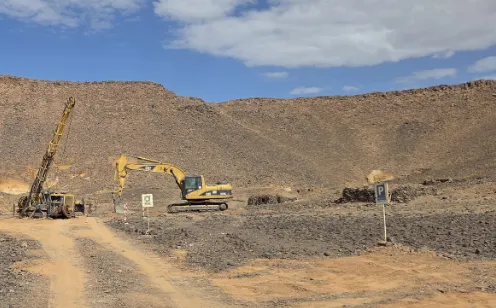
0:32 Hi good to meet you all for the first time here. I want to tell you about Safi Silver. We are a, not a new company, but a new phase of a story exploring in Morocco. Here the cover slide here you can see an image of an area we call Antenna Hill. This is part of our Adena project and as you look in you'll see this valley just filled with all these old workings. This is the heart of what we'll be exploring. And we are really just starting that exploration now. And We're doing so in a pretty special position as a company.
1:22 We'll get into that here. Safi is focused in Morocco. We've got 2 projects there, the Adana project and the Silver Hill project. We also have a Copper-Silver project, also early stage exploration in Namibia. We call it Kalahari. It's on the Kalahari Copper Belt. We were formerly a copper producer in Namibia. We sold our operation there, the combat mine, in December of last year. And the proceeds from that sale are now what's funding the company in this new phase.
2:11 So why we really love Morocco is for a few reasons. Morocco is a country I personally have been visiting and looking at projects for almost 15 years now. Right when we started off, we got exploration projects in Morocco. We already had some success at our Silver Hill project, which I'll get into. And then we were able to get the Adena project. But Morocco is exciting for a number of reasons. It's a really mining friendly jurisdiction. It's already the largest Silver producer in Africa and really one of the few areas around the world where you can find silver dominant projects.
3:09 When you're investing in silver companies, you get really familiar with Idaho, Mexico and Peru. But there are a few other areas around the world. And one of the ones that I think has not seen enough attention is Morocco. You already have one of the world's largest silver mines there, Imiter, which has been mined by Manizhem for years. And then just awesome discovery, Boumediene and Nzugunder by Aya.
3:45 And we're hoping to follow in their footsteps with what we've got at our projects, Silver Hill and Adenna. So here we are, if we can see my cursor, our flagship project, which is really grassroots, but a brand new project. Dana here is in the southern part of the country. We are right across a valley from what was actually one of Morocco's largest gold mines, the Aqa mine. We've got an area where there's a lot of historic workings, like you could see in that initial cover slide.
4:33 And we are now following up on that work, put together 112 square kilometer land package and has started our exploration. Our other project, we call it Silver Hill. It's about 14 kilometers away from Aya's Boumediene project. It is a Copper-Silver-Cobalt discovery.
4:59 We've already got some drilling into it and it's showing a lot of potential to grow. I'll get into that as it goes through the presentation. But I think what really sets Safi apart is our history. We were formerly Trigon Mining. We operated the combat mine and we put that mine into production. We were not profitable in that operation and then made the decision to sell it. We sold it for what would be a US$24M base payment with an expansion catalyst that would bring in an additional $13M at today's Copper prices.
5:55 And then a Royalty that will contribute quarterly once that mine returns back to production. It was a challenging asset. And if there's questions from the audience, I'll happily talk about it at the end. I don't want to go into a whole story on it, but
6:22 we were really been set up nicely by that sale. We receive $3M every quarter. So far we've received 2 and are due to receive the third installment.
6:39 If the mine goes through an expansion, depending on the Copper price at that time, it will contribute US$3.5M, US$8M or US$13M in new capital. Currently Copper is around US$6.70. We're comfortably in the $13M production payment zone. But beyond that, we actually have an additional trigger where even if there is no expansion of the mine, if Copper goes above $6.80 or $15,000 per tonne and holds it for 30 days, then that triggers the expansion payment as well of $13M.
7:30 And like I said, we're at right now at about $6.70 a pound of Copper. So that is becoming closer to being a reality. Beyond that, the new owners of the mine will be paying us a quarterly dividend on 1% of their Copper production. And again, at today's Copper price, that would be about US$400,000 every quarter. Pretty unique position to be in as an exploration company and a company with a market cap of around $20 million Canadian dollars. We've got a pipeline of capital of over $30 million on the come in US dollars.
8:36 So here are our Adana project. This is a couple aerial photos looking at the at the area. You can see this map with our claims. The main focus is this Antenna Hill area. This morning, sorry, last night, we put out some results way down here in the Southwest, where we're already starting to show some mineralization. There's workings throughout this region and it's been largely Silver, Silver-lead mineralization and some Zinc. Notably in our results this morning we also started to get interesting hits of antimony.
9:22 We are expecting this to be a big Silver polymetallic system. And if we're lucky, it could be something similar to Boumediene. So what we, the ridge that we're seeing down the center is the squeezing of, the tectonic squeezing from either side and pushing up that ridge. And in that action, we've created cracks in the different layers. And those cracks have filled with vein mineralization.
10:12 The main area that we see at Antenna Hill, we see these veins every 2.5m. In the Southwest, where our results came out yesterday, we see very thin veins, but enough to be interesting. We started off with drilling in that area and have already had some positive hits, showing that the mineral system is not discrete. Just to put this in scale, from here to here is over 40km. This is an absolutely massive system.
11:01 We can see veins like that in these claims as well. There's some claims in this area held by a local government agency that we're in discussion with. And we really see this as a massive district that has the potential to be tied together into one big silver polymetallic project. Notably, right across the valley from us is one of Morocco's largest gold mines, Aqqa. It's a gold-copper deposit. It would be lithologically, it sits deeper than or older than where we are at
11:57 Adana. And for that reason, we have some belief that the fluids that we're looking at will have passed through both lithologies and could potentially have some Gold. Even the assays we reported yesterday, the assays we reported yesterday, we have not yet done fire assays to look and see if there's gold as well in that mineralization. So this is a geology map of the area. Antenna Hill, where we will start to see some results in the next few weeks, is up here. That's what we call our primary target.
12:52 The Southwest is where we got results just last night.
12:57 It's definitely a secondary target, but already interesting. But our belief is that consolidated, this is one big project. So here is that southwest area. We've reported just 1 hole so far. Altogether, we'll have 7 drill holes in this area. And we are drilling really just the nose of this ridge. And in this area, we could see some old workings. And we just, we set up the drills to intersect the areas under the areas where we've seen workings to get an idea of what might have been there historically.
13:50 Our belief is that mining or artisanal type mining has happened in this area over the past 600 years. So some of these workings are incredibly old and we wanted to get an idea of what they were actually coming after.
14:08 And we're starting to see that with an intercept of over 600g per tonne Silver in our results just yesterday. But even on its own, this little ridge is sizable, 2.6 kilometers in strike length, 800 meters wide. If we are, if our thesis is correct though, that we've got some, we've got the pressures that's come from either side, but there's a lower heat source that's driven these fluids, then it will not, there's potential that it's not just the anticlines, just not just the ridgebacks that are mineralized, that there's potential for mineralization on the walls and in the valleys
15:08 around this area. And that would be somewhat similar to what's driven the system in Boumediene. Meanwhile at Antenna Hill, this is where workings have been most intense. You can see this is over 800m, again about 400m to 600m in width and veins throughout. Everywhere you look here you can see veins. You can see the yellow of the sulfur staining, little gossens that have formed.
15:50 And again, we've been able to even talk to some old timers that have gone into work in this area. And they see, they talk about massive silver galena veins, a meter and a half in width, 2.5 to 5 meters apart. This has potential to be a really rich system. Our hope or plan is actually to look under this area at some of the different lithologies, kind of tipping back to this slide here. We can see there's great, There's been great vein formation in the upper layers. But if the belief is that the fluid flow came from deeper, we should be able to find more of it in some of the layers as we go down, and maybe even more intense mineralization, intense and tabular mineralization.
16:48 So that's the ultimate target when we talk about Adena. Some of the grab samples that we've had in here, our T3 was 564g per tonne Silver with 25% Lead and 5% Zinc. T1,317g per tonne Silver, 23% Zinc. Some really, really rich material.
17:19 Old tax records talk about material coming out of here in excess of a kilogram per ton of Silver. Again, Here's some of the mapping that we've done of the veins in this area, marking over over over 45 40 44 veins. And that's that just in the Antenna Hill area, but with potential for that to continue along the full ridge. Again, really, really not a small system. We've got a big target here. Some images from the work.
18:11 Drills just starting up at Antenna Hill here. The drills in the Southwest. We've now got 2 rigs working and we should start seeing results regularly from our project. Our second project is more advanced. It's the Silver Hill project. We initially started working on this in 2021. We had some great results and really management time, attention and capital got consumed by the mine in Namibia.
18:53 And we've kind of had to sit. Well, now that we've got the mine behind us and cash coming in from the sale, we're re-initiating work general in Morocco, but also here at Silver Hill. Just to kind of put it in context, you could see Silver Hill here on this ridge in the foreground, And then this area behind us here is Boumediene.
19:26 But a great neighborhood to be in with already some great results. You've got Boumediene there, probably the flagship behind Aya's over US$5Bn of capitalisation. And you have Imitare here, historically one of the world's largest Silver dominant mines. And still produces about 8Moz of Silver annually. A quick summation of the results we've already got at Silver Hill. Our discovery hole S1, it was a 14m interval of 74g per tonne Silver with 1.1% Copper.
20:16 We followed that up at S13, which is not far off from there. And that had 8m at 121g Silver with 1.8% Copper.
20:30 Our best result, interestingly, was a trench that we put here. It's about 2km away from the discovery hole. There we got 13m, 2.7% Copper, 34.5g of Silver, and then a little bit of cobalt came with that. And that here, I'll show you what that looks like in some cross sections. So there's a cross section around S, well, around S13. And You can see the high hits of both Copper and Silver.
21:10 There's a change between a sandstone and a schist here. At the contact, you get the highest grade mineralization, but you do get it throughout the sandstone, and it leaks into the schist. It's interesting when you get over to our trench, that's 100% in schist
21:35 host rock, but the kind of the epithermal veins, they permeate that schist area as well. So we are planning a drill program that will test in and around these holes and build out from this discovery area. And we'll get that mobilized towards the end of this year. A second area is this cross section here and this is on the ridge here. So our first discovery area is the cross section I showed you there. Our secondary is here that we're going to be testing in and around this ridge in our upcoming work.
22:33 And then also, this is the trench area. We did the trench. We got that fantastic result. Very Copper-rich, 2.7% Copper with an ounce or 34.5g
22:49 of Silver. And then we did do a drill hole under there and that interestingly got a pretty solid result of 30m of 0.7%
23:09 Copper. There wasn't a whole lot of Silver in that one, but we did see some Silver in there as well. Now we'll go back and test in and around that with a drill program looking to build out that area.
23:32 Where we are and being in Morocco, what we've already seen in our work, this is ultimately going to be a silver base metal story. And a silver something that's pretty meaningful to me. I started off as a silver analyst with Cormark and Sprott Securities many years ago, was part of initiating coverage on being one of the first analysts to initiate coverage on a number of what we would consider Silver majors now.
24:26 And for that reason and for others, I've always felt Silver was a pretty
24:32 special metal. It often can lag Gold, but usually outperforms it when it goes into demand. Over the last 30 plus years, silver was both precious and industrial, in that it was a rare precious metal associated with it being a storehouse of value, but it historically was also consumed for photography. That obviously changed with digital cameras, but that story as being part industrial metal is back because of Silver's use in photovoltaics.
25:21 And that's creating a brand new demand for Silver that is only going to grow with fuel prices up around the world and likely not coming down anytime in the near future. So I think it's a really timely time to be investing in Silver and a really special time to be investing in in SAFI. So here we are, I'll give a quick background. I'm a mining engineer, spent some time as a research analyst which I mentioned, been involved in operating in Africa for more than a decade.
26:09 Also some experience in Brazil in both managing and operating companies. Our chief exploration officer, Andy Rumpel, a structural geologist, which is exactly the type of skills you need to make sense of what we're working on in Morocco. And he's got experience on a number of discoveries in and around the Canadian market, but cut his teeth with Anglo-American. Our VP Corp Dev, a seasoned banker, was corporate development for Kinross historically.
26:55 I met him early in my career. He's at Dundee, but is well known around the street. Tom Panoulias on our board of directors, a good set of skills, great skills in country.
27:10 Notably, we have Larissa Sprott, who is head president of Sprott Money and notably a daughter of of famed mining investor Eric Sprott. So yeah, tiny market capitalization, 20 million market cap, tons of cash coming in, another 47 million in total minus the 6 that's already come in.
27:46 And yeah, and a great set of projects in Morocco. Perfect. Thank you, Jed. Thanks for the thorough overview. Interesting story for sure. Just a reminder there, we are taking questions. There have been already a few submitted here, so let's get into it. But first, with the steady inflow of funds from the Horizon quarterly payments, it's clear that exploration drilling has been a top priority. But as the copper price approaches the trigger, how is SAFI planning to deal with this additional potential cash injection. And I'll just add to that, cause there was a question in the chat. Maybe it's worth clarifying this agreement cause someone asked in the chat, isn't the current horizon payment overdue?
28:31 Yes, it is. It is overdue, but there's, this is something that, like we've been in conversation with them. There was a, where the payment should, We should hit the accounts tomorrow.
28:50 There were some changes in bank details that we needed to organise this week. It's not something we're worried about. They've been making the payments regularly so far. They're continuing to invest in the mine and they're well capitalized to make the installments. The installments. Now the trigger is, it does put us in an interesting situation where we would have beyond our budgeted capital. It would really depend if the share price continues to stay
29:45 depressed. We might use that capital to return it to shareholders in some way. We've talked to shareholders about buybacks. But then also, if we're through this program and we are seeing fantastic results and a good share response, then we probably use that capital to accelerate the work that we're doing. Definitely. Luxurious to be in though.
30:21 Yeah, yeah, for sure. Now you described a Tizinal workings along a 40 kilometer trend at Adania with satellite imagery picking up 44 veins Southwest of Atenna hill. So what would you need to see from the first 12 hole program to be confident you're looking at a true district scale silver system rather than a series of smaller, higher high grade vein targets?
30:46 So in this program, in my opinion, it's already a foregone conclusion. This is district scale. Now Is it a district where we, you know, like a Coeur d'Alene district where you are mining the individual veins or are you mining something large and tabular, like, let's keep it in the same geology, like some of the deposits that you end up finding on the Montana side of that area. That I actually don't think we will determine in this drilling.
31:34 What we're going to do in this drilling is we're going to be looking at the upper levels of the geology. There should be enough there to be a big deposit on its own. But what actually excites me is what will lie beneath that. So we're looking for the lateral extension of the system. In fact, that's what is exciting about our release yesterday, is that we are well away from what looks like the core of the system, but we can still see mineralization
32:30 out in these extremities. What we drill is by no means a discovery hole, but it is an indication of what we should be targeting in our next phase. So this work here, we'll get a nice sampling of what's happening in that upper layer. And then we'll, it'll, you know, seemingly backwards, we'll do our drilling and then we'll do geophysics to start looking for the targets beneath the upper mineralization. Great, thank you for that. There's an individual asking 3 separate questions, so I'll break them down one by one.
33:15 The L OAD 2025 paper describes vertical veining striking North, Northeast, South, Southwest, and West, Northwest, East, Southeast. Your holes were drilled at azimuth 210 degrees and 170 degrees, roughly parallel to the North North East set. The question is, could the holes have missed or under sampled those veins and will the Atena Hill holes be oriented differently? So, I'll start with the end. So yes, the antenna hill holes will be oriented differently. But our, like the, I think I can actually show it here.
34:05 I'm gonna switch, how do I do this? So yeah, so you can see some of the historic workings. And we've used the historic workings to guide that first drilling. But the orientation that you're talking about is actually orientations on this part of the system.
34:52 There is a slight turning that happens here. So we think our orientation is correct. It could be different. It could be different, but it is, again, not the ultimate target. I'll go back to this slide here. If what we see in the southwest is a mini version of this, what we see on the main adena, the orientation of the veins is more consistent with the brittleness of the layer and where those cracks formed.
35:46 Could that change as we change into different lithologies? Almost certainly. So that's where geophysics is going to become important, is to give us
35:56 some idea on targeting and orientation as we go deeper, now that we already know that mineralization did indeed permeate all the way into the upper layers. Great, I hope that helps. Did that answer your question? I understand, Yeah, that's great. I feel like I missed the third question, but I might have got. No, I there's actually there's 2 more questions, but you're going I'm going to put a pen in yours for now just to give other people a chance to have their questions addressed, because there is quite a few and we great are limited on time. One question from Doug, please explain further the 8 million royalty figure. 8 million, okay.
36:44 I'll stick to the presentation because I think it explains it best. Sure. Okay. So, what Doug's referring to in the 8 million Royalty is this year. So at $650M to $680M, we will over 5 years receive about $8M in royalties from the Combat Mine. Now, what we negotiated in the sale was not a in perpetuity royalty. What we negotiated was a royalty for what works out to 20 0.25.
37:42 From the time that mine restarts, Each quarter we'll have an option to take 1% of the Copper net smelter return. We estimate that will be around US$400,000 per quarter. If they have a bad 0.25 as far as production or the Copper price is
38:18 lower, we actually have an option to reject 0.25 and have that quarter credit into the future. So we can take a total of 20 0.25 and we can reject, I think, a total of 4. But it provides a nice little supplement income for us going into the future. The kind of more captivating part of this situation right now is these production payments. Would have to have doubled the mine production from where we left the production, which does look like that is their plan to start off at a higher level of production.
39:15 However, even if they're not able to hit those numbers, the $6.80 mark and holding that for just 30 days would, or actually holding that price, having an average price of in excess
39:33 of US$6.80 a pound Copper would trigger that payment. Beyond the base payment, there's still
39:51 quite a bit more cash to be contributed from the combat sale. We'll stick on this slide as Kevin is actually looking for more clarification. You just mentioned the average copper price exceeding or around $6.80. Does that alone trigger the US $8 million payment or must Combat also be operating or achieve a mill expansion production milestone? And exactly what has to occur before the additional $5 million becomes $5 million. So, yeah, it triggers. But what we did leave allowance for is that the actual payment doesn't come due until they started production. So the trigger lasts. If the trigger happens this week or next month, then they now owe $13 million.
40:49 And that would sit on Safi's balance sheet as a payable that we are now owed. But we will not start charging interest on that until they start production. We have given them a little bit of grace. This was meant as a bonus to Safi and its shareholders for the asset that we've given up, but It was structured in a way that it wouldn't
41:37 put the operation into a whole bunch of stress before it even started production. Ian is wondering, do you have an idea when Combat will be back in production? Right now, the current plan is that they will start the mine in December. But realistically, it's going to be in January. If the $13M bonus comes in, why not buy back 10% of the shares around these levels? What are your thoughts if you do get the bonus?
42:16 Yeah, no, that's top of mind. I think even when we mentioned it earlier, I suggested the same thing, that we would do that. Doug's wondering, are you actively seeking out more land packages near Adania or and Silver Hill? Absolutely. Yes, for both. Like Silver Hill particularly is constrained. I can go to the slide. Let's see if we can see it here. Not so much here. Yeah. So Silver Hill is in here, and we've got the mineralization really at the base of this hill and going around the ridge.
43:09 We've walked this ground along these ridges here and we continue to see mineralization to see mineralization of definitely Copper, Silver, in some areas it's richer in Cobalt.
43:33 In Morocco, there's a situation that's considered a black permit. And that is an area where the initial claim holder, their claim has now lapsed, but the permit hasn't been brought back
43:55 for a new claimant. And that's the situation that we've got in and around Silver Hills. We've been working with the local authorities in that area, it's called Catataf, on getting this ground and bringing it into the Silver Hill project. Because we're positive that there can be, that this deposit is bigger than what we just have on our claim area. We're in priority for that ground and we're steadily working on it. Just recently, it's not something we publicized,
44:41 but I brought in a specialist in Morocco to help us with our land claims. His background is with Kadataf, with the Ministry of Mines and with Onim. And he's already helped us a lot in moving forward on getting these extra pieces. There's a lot more to discover here. Thank you. Moving on, Simeon's wondering, wasn't Mr. Mulcahedem on the board too? Is he still involved? Potentially an investor?
45:23 He is a shareholder and has been supportive in that way. But no, he left our board in June. But on his departure, he exercised all of his options out of the money to make sure he stayed a strong shareholder. Oh great. Going back to Juergen here, what surface or historic grade support Antenna Hill as the primary target? How many holes, to what depth, and when do you expect first assays? So surface, the only surface results we have are these grab samples, right? So that 0.5 kilogram Silver, 25% Lead.
46:22 Now the holes that we have planned, we have 5 holes planned right now, mainly just crossing the structures. As we have success there, we will
46:35 continue the program, but yeah, it's just get an idea, test the system and then we'll report those. We just got the rigs going. We had to sort of rebuild a road to get back up on Antenna Hill. I think you can actually even, in this image you might even be able to see where the road was washed out. But we completed that this summer and got rigs up there in September and they started turning a week and A02 weeks ago. So We're making some slow progress. I think the hole right now is down about 70-80m.
47:25 As the holes come out of the ground, we'll be sending them into the lab. Our labs in Marrakech have been pretty good on their turnaround. So we should start seeing antenna hill results probably mid November. Great. We'll wrap up here Jed with the final question. Thank you for the presentation and for being open with all these questions. I expect we'll be doing quite a few of these in the future. So if we haven't got to your question, don't worry, we will pass along all these questions to the management team. There is also a request meeting button when we close off here today. So if you would like to meet with Jed or the team, just submit that request meeting button and I'll be sure to pass that information along to the SAFI team. But I'm going to combine 2 people's questions here to conclude because it just wraps a nice bow on it. But if similar to Boma Dean, IR Gold has a market cap of $5 billion. Put in your shares at $100 per share. Thoughts.
48:20 But the real question I want to ask is the one from Doug here. The market response to date does not seem to recognize Saffley's potential. What do you attribute the market apathy to?
48:30 Contribute to the market apathy to?
48:35 Well, we've been quiet. We haven't had a whole lot to say up until just now. Closing the transaction, getting the program started. Like even, you know, as your prior questions talked about in getting extra ground, In a lot of ways, we've had to be a little strategic around our releases so that we can lock up the potential that we see. That changes now, right? As we, now that we're in, now that we've got the drills turning, now that we've got news to share, we can start correcting that. I think it's like, as myself and the board were making the decision what to do and how to move the company forward, looking at the potential in the products we had and looking at the success of an Aya in Morocco, like that's something we see for ourselves.
49:54 And now we're in position to start realizing it. Great, Jed, thank you so much for taking the time out of your day and sharing the Safi Sober story. Until next time. Thank you. Bye, everyone.