Baden Gowrie-Smith
MD and CFO at REFUELS N.V
Replay available
First Half 2026 Results hosted by Refuels (Oslo:REFL) on Investor Meet Company, held 2025-12-02.
On 6ix: 6ix.com/event/refuels-nv-refl-first-half-2026-results
Automated transcript · Written by software from the replay's audio. It can mishear names and figures; the replay is the record.
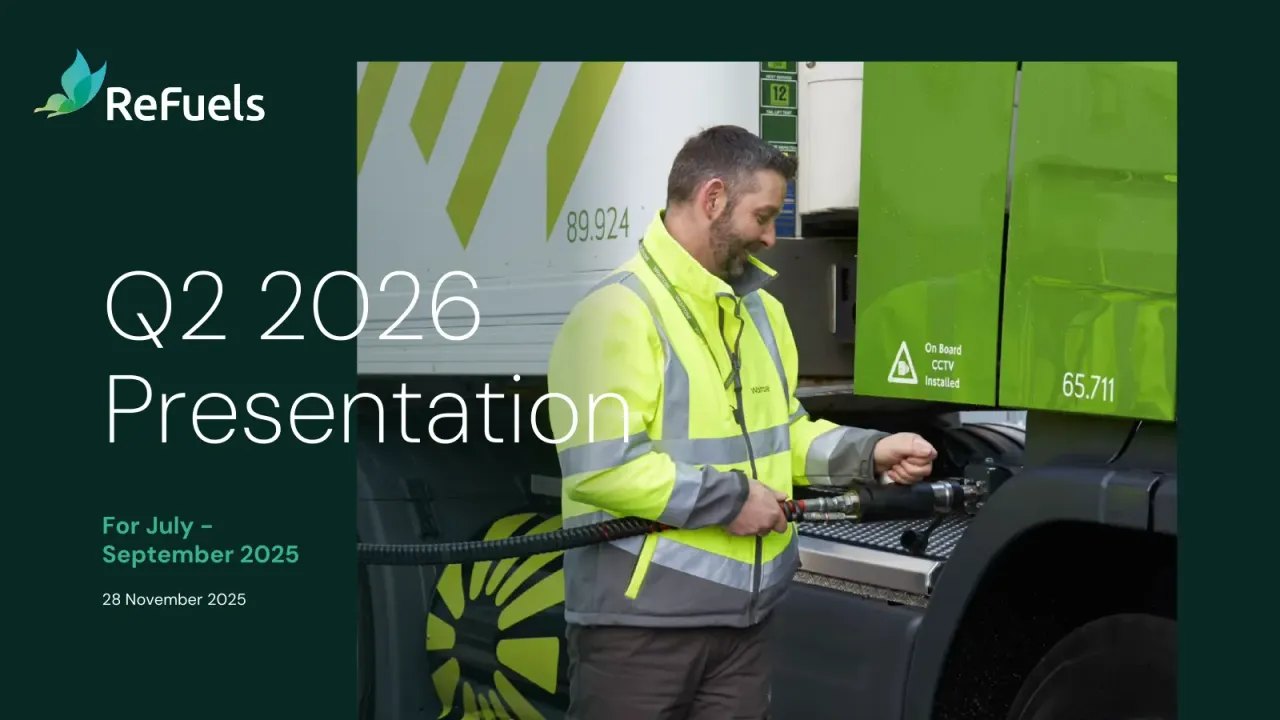
0:00 Good morning, and welcome to the REFUELS Q2 twenty twenty six Investor Presentation. Throughout this recorded presentation, investors will be in listen only mode. Questions are encouraged, and they can be submitted at any time using the Q and A tab situated on the right hand corner of your screen. Simply type in your questions and press set. The company may not be in a position to answer every question it receives during the meeting itself. However, the company can review your questions submitted today and publish responses where it is appropriate to do so. Before we begin, I would like to submit the following poll. I And would now like to hand you over to the management team of REFUELS, Philip Baden. Good morning. Good morning. Thank you. And, yeah, welcome to everyone watching this, whether you're doing it live or on catch up. As mentioned, we're gonna take you through, sorry, our q '2 results for the July to September period.
0:52 And then please do take the opportunity if you do have any questions to put them in the chat box. And as always, you can also get hold of us, after this call or at any point in time. We've got our email addresses out there. So, yeah, without further ado, let's crack on. So what is it we do? Just a couple of highlights. We own or REFUELS owns 40% of CONG fuels, which again has, 16 large grid connected stations, in The UK. Dispense is 100% renewable and sustainable by methane into trucks, or as we call it, bio CNG, which offers greenhouse gas emissions in the range of 85 to 90% compared to regular diesel.
1:44 For calendar year 2024, we supplied more than 50 of all biomethane that goes into trucks, whether that is supplied through bio CNG, which is what we do, or through bio LNG. And by putting biomethane into trucks, we can also generate, renewable transport fuel certificates, RTFCs, which Vaden will touch a bit upon later on with regards to earnings. As of, currently, we've got about well, currently, it's about 2,150, trucks, using our our network. What's important to understand there is this is no longer, a niche application where we've got a couple of large customers that do this. We've got, more than a 165, unique customers that use our network, pretty much every day.
2:34 There are benefits to our customers here, not only greenhouse gas emissions, but also, saving cost. And over the last five plus years, we have helped our customers save more than 50,000,000 pounds of fuel cost. And finally, for the last year, or this is a calendar year 2024, we have helped our customers reduce their greenhouse gas emissions from typically long haul transport by more than 220,000 tons of greenhouse gas emissions. We always have a slide showing one of our stations just to give you a bit of a visual image as to what it is we actually do. We changed it this time around. Today, it's it's Warrington. That's the M 62 Motorway you see there, the one that goes between Manchester and Liverpool.
3:22 Why are we showing Warrington? Well, we built it in or we opened it in late twenty nineteen. It currently refuels north of 500 trucks a day, dispenses more than 700,000 kilograms into trucks during a month, is cash flow positive, and as such, you know, it's a good metric for what a typical station can do. We often talk about how many kilograms we can put through a station, you know, the fact that it provides positive IRR, etcetera. I think one one aspect we haven't been speaking that much about previously is the fact that when we come into an area, we buy some land, and we develop that land. We often also provide a direct uplift to the value, of that land. Warrington is a good example.
4:07 We bought it for x back in 2019, and today, the land value is is estimated at four x of what we bought it for. So it's not only the ongoing operations of that of that site, but it's also banking some land value for the future. If we then look at the highlights for this quarter, we had 16% growth year on year with regards to volume. Now most companies would be happy with 16%. We're not really happy with that. We feel we can do better and we should do better in the future, but still, it's not a bad number. Why do we feel we can do better in the future? Because we're now starting finally to see, six by twos arrive. Not massive numbers yet, but given the visibility we have, given what we're hearing from customers, we do expect that to ramp up, quite quickly, next year.
5:00 We have got, raised funding, £25,000,000 that we announced six weeks ago, whenever it was, to build another three stations. The first one of those, Magor, has gone into build. If you look at that EBITDA, we are up a 190%, quarter on quarter, and we are pleased to have announced that we are raising our guidance for for this financial year from 8 to 10,000,000 up to 10 to 12,000,000. And finally, we often have questions. You know, are we looking to to to list somewhere else or or or change our listing venue, yes, that is something we're considering, whether that is through an uplisting, in Norway or through also a dual listing or another exchange, which is something that we'll get back to in 2026.
5:50 If we then just take a a quick look at the operational review, the left hand side here, I think is is is a a good illustration of what we can achieve, once you really get going. As of today, we are about 10% of the so called four by two market, where there's about 21,500 registered four by twos in The UK. Today, about 10% of those, are CNG trucks. If you then go back to when we founded the company, of course, the graph here only shows back to 2020. If you go back to when we founded the company in 2014, the number was zero. So I think it's a it's a good illustration of, the type of adoption we can see. On the right hand side, we've split the dispense volume into two. The lighter green is from our bridge connector stations, and the darker green is from our mobile refueling stations, which are an important, you know, have an important role, in making sure that we can get volume, into fleets that don't happen to have a distribution center nearby, one of our stations.
6:58 That is a solution we came back we came up with in, in 2020, and it is something that we're looking, or we expect to grow quite quickly going forward. If you are a fleet in The UK and you're adopting BioCNG, there are two key metrics you look at. First metric is you are looking at the economics. As our customers say, yes, they might be large PLCs. They might have very strong balance sheets, but at the end of the day, they can't really afford to go green and lose money. That's just not an option for them. So what are they benchmarking us against? Well, your your your day to day benchmark might be comparing bio CNG to running a regular diesel truck on on on regular diesel.
7:44 Then the other benchmark is against HVO. And we've seen positive price spreads there develop over the last, let's say, six months. We're now at 25 to 30% cost savings compared to regular diesel, and now we're north of 40% cost savings compared to HVO. And particularly, HVO has really that that spread has really blown out in favor of of BioCNG in the last six months. So what is it that's driving HVO prices up? For those of you who've seen these presentations before, you know, we spent a lot of time talking about, how sustainable aviation fuel largely uses the same feedstock, as HVO, and now we're starting to see the effect of sustainable aviation fuel mandates gradually starting to tighten that market. And as a result, sustainable aviation fuel prices are going up, and it's dragging HVO along with it.
8:41 Couple of, exciting customer announcements in the last two, three months, Tesco, and Coop. And now we have eight out of the 10 largest supermarket chains in The UK are now customers of ours and are now running CNG trucks, and all of those have plans to continue to order CNG trucks into the future. Next year, we'll see a lot more other customers come come on here as well, and the six by two offering here is an important one because as I say, you know, here you see two examples of so called four by two trucks, which is a much smaller market than the six by two market, and as such, as the six by two really starts to get into customer hands, we will see, our customer base also, rapidly, expand.
9:31 And here is one of the six by twos. This is an M and S, photo. So as of today, we've got about a 136 by twos, in operation, so it's a very, very small part of our customer pace and even smaller part of the overall fleet of six by twos on the road in The UK. There are about a 144,006 by twos in operation in The UK today, so a 130 of those being CNG is negligible. However, if we look at the interest in the six by two, if we look at the interest in demoing it or trialing it, it is something we've never seen before. We've basically given up, trying to stay on top of the demo list and the trial list, but the interest, as I say, is extremely encouraging, and we are expecting a six by two the number of six by twos on on the on the road to start to expand rapidly.
10:27 We announced probably about six weeks ago, eight weeks ago, that we've done our first meaningful fixed price by CNG, by methane contract with one of our customers. Why is this important? Well, from the customer perspective, it gives it gives certainty. Majority of our customers are not risk takers. They see fuel. They see trucks as a necessity, not something they're there to speculate on price movement. So as such, that gives them longer term visibility, and, of course, their finance department can then plan according to budgets, etcetera. From our perspective, it also gives us visibility. We get visibility on volume, etcetera, etcetera. This contract is for now, it stretches out eighteen to twenty four months.
11:17 And we're and we're very excited about it because, one, the first one we've done at this scale, and two, now that we've got the first one done, we're excited about rolling this out to other customers. I mentioned the £25,000,000 that we announced about six weeks ago. So that £25,000,000 is currently being deployed into building, more stations. First one has gone into build, already, and then there will be two, two after that. We have an ambition here, to basically essentially double our refueling capacity from currently north of 11,000 trucks up to basically 20,000 trucks by the end of twenty twenty eight through a mix of new grid connected stations and additional mobile refueling stations.
12:12 So here you see that the first, new or the the last, sorry, the last new station we we we opened was Livingston back in May. We've currently got Magor in South Wales in construction, got Swindon going into construction pretty soon. And then the third station that we'll be building under the £25,000,000 facility, we will announce that in q one, which one that will be and where it will be located. Sometimes we, you know, get questions. So how hard is it to develop the type of in in infrastructure you're doing? And the answer is not so hard, but also very hard. Why is that? Well, first of all, there's a lot of, clearly, design and r and d that's gone into the actual how the how the stations are designed, operated.
13:07 There's a lot of stuff that goes on underneath the hood here. But if you look at just the process that leads up to something that we call shovel ready, which is when you can put digs on-site as you see here, a lot of people just think that is a short process. It's not. It could take many, many, many years, unfortunately, from negotiating with landowners, agreeing with landowners, doing your surveys, getting, submitting a planning application, finally getting the council to provide, planning approval, then discharging conditions, and then being ready to go on-site. So this is a really, you know, drawn out process. From we identify location where we would like to have a station until we get to shovel ready. Best case, we're probably looking two to three years, but we've got sites that have taken us a lot longer.
13:58 Now so it's not just if you look at competitive advantage we've got, it's not just about how we actually build this the stations, how to design them, how we operate them. There is also a competitive advantage here in the fact we have our own land team, who who have made sure that we have a a pipeline of future sites we can develop, which has been ongoing for many, many years. I mentioned RTC prices previously. If you look at historically, the average price has basically been 26p. We're now trading just model. The the certificates are trading marginally above that. What is it that's supportive, of the certificate price? Couple of things. First of all, the biodiesel market is, is in a better position and more balanced than it was previously.
14:50 And finally, we have now starting to see the impact of sustainable aviation fuel and the fact that feedstocks used to produce sustainable aviation fuel are also dragging up the price of of biodiesel. And finally, this is a hot topic within the EU currently, but we're also starting to see the effect of of EU member states now now starting to adopt red three. Red meaning renewable energy directive number three. And with that, I will hand it over to Pin. Alright. So look. I just might describe what you're seeing here. First of all, these are the results of CNG fuels the and the metrics of CNG fuels, the operating business, which REFUELS has the 40% share in.
15:40 We show this because, of course, it's the best proxy for considering the value of of REFUELS itself and the performance of the underlying business. If you want to see REFUELS stand alone accounts, they are available at the end of the report well as in full at the end of the report as well as a more comprehensive view of the CNG fuels figures as well. So, obviously, very pleased to to say we've increased our guidance to 20% for this financial year. It's, you know, it's easy to say. We sort of could sink say it's easy to say we're seeing continued favorable market conditions where it's actually the reality that these we are sort of bang in line with historical market conditions that we've seen on average across many years of of of this business operating with, you know, with the exception of of of a period depressed prices about a year and a half, two years ago now.
16:35 So these are so so with with that, the the underlying growth of the business has continued to to provide to to to boost earnings, and the improved visibility we now have on EBITDA generation from a combination of both the station network and the biomethane r t biomethane slash RTFS RTFC business enables us to to to have the comfort in in raising our guidance as we have done. Why is that? Well, the station business itself is obviously has has predictable earnings on the given given the captive captive fleets that come through us and the and the visibility we have on the orders of new vehicles showing up. And the biomethane biomethane and RTFs side of the business, we have we've had the ability to forward sell a lot of our RTFCs for the year and forward purchase biomethane.
17:30 So for the periods of 2025 and a lot of 2026, we have high confidence in the earnings that can come from that side of the business too. Gross profit margin on the on the RTFCs sold in the quarter was 29.7%. You'll notice there's a difference in the in the way it has to be accounted for in our formal accounts at 22%, and, of course, this will balance over time. But our our financial year is a difference to our to to the calendar calendar obligation year, and it just depends on the timings of when our TFCs arrive. But for the purpose of the business and the understanding of performance based on how we've shown it historically, the gross profit margin has been 29.7%. It's very healthy and in line roughly with our historic historic average around 30% gross profit margin on these RTFCs.
18:18 We've had a 20% increase in revenue over the year. You'll note Philip mentioned a 16% increase in volume, corresponding to a 20% increase in revenue. However, our EBITDA has more than quadrupled for the first half of this year versus the first half of last year. So you can really start to see that operating leverage we have. As we continue to boost revenue, we have we're having an outsized impact on our earnings at the same time. And so, yeah, continued this continued growth in volumes is translating to excellent bottom line growth. So I just wanted to mention here a couple of a couple of items you see. First of all, there's a growth that we have. We are continuing to grow the station profitability in the business in this quarter.
19:05 Last quarter, we had roughly an even split in the gross profit between the CNG station business and the biomethane business. We were slightly undersourced in the biomethane business last quarter, which has been larger which is being caught up in this in this quarter. And so in this quarter, we had a two thirds, one third split between r t f the RTFC biz biomethane part of the business and the station part of the business. And EBITDA contributions between the two were £3,500,000 from the biomethane side of the business versus negative 650,000 on the station side. However, that station that negative performance on the station, negative earnings on the station side is improving, and and it is it is approaching approaching zero. You have will have seen previously that we showed the earnings of the stations as being very positive, which is absolutely correct. However, of course, now that we've brought the entire business together, we now have the full overhead of the CNG fuels business, including all of our development activities and transport activities.
20:05 And when you combine those two parts to that that entire side of the of the business, it's currently negative earnings. However, with a with a we with a with a a modest amount of the deliveries that are already confirmed for delivery over the next year, we will we see the the the station part of the business on on an on its entire basis breaking even in the first half of twenty twenty seven along with with the continued performance of the of the biomethane side. And what's really great about those those two revenue streams is they are they are fund intrinsically linked by linked to improve with improving volume. However, they are two separate streams two separate revenue streams from the way from what they're derived from. And so with those two streams being positive, it's really gonna help underpin the earnings earnings growth of the business and and and and help you and and derisk derisk the the business as well. I've decided to also mention the overheads and and efficiencies across the business, which we've been really focused on on on our cost on our cost base over the last year as we continue to grow volume through and utilize the resources we have already deployed and CapEx we've already deployed into the business.
21:17 And we have now that we have brought them together, we can see the overheads of the entire station side together. And what we see is from the first half last year, we had a 26p per kilo overhead across the entire across the entire station business, and that is reduced to 21 and a half percent 21.5p per kilo in the first half of this year. So about a 20% decrease in overhead per kilo, and we anticipate that'll continue as we maintain cost cost control, but continue to drive drive new volume through volumes through the through the station network. Here, you can see a picture of the new financial the the balance sheet of the, of the CNG fuels business. It was a a very strong part of the narrative and consideration we had in the transaction. We completed with foresight to bring the stations back into the CNG fuels business and bring the RTFS shareholding under the CNG fuels business as well. So everything was in one place. So what we have now is dual revenue streams coming in from the stations and the RTFCs and a strong balance sheet with a £105,000,000 of PPE, which which is essentially the station assets.
22:26 So able to able to support and continue to generate those earnings. We've got £25,000,000 credit facility we took out with the Forsyte Group in the last quarter. That's gonna go into three new CNG stations, which will again further boost our asset base up to a 130,000,000, and a £25,000,000 credit facility means we'll just be about 20% levered. So very conservative leverage and room for that for that to be increased over time as we continue to recognize it, as we continue to roll out additional CNG stations. And then a healthy cash balance of £12,500,000 within the group also to underwrite our working capital requirements. Thank you. Thanks, Baden. So I will summarize briefly, and then we will go into q and a. And I can see there are a a couple of questions come through already, so, please don't stop sending them through. It was like like questions.
23:22 So just to summarize slightly, you know, Baden's already mentioned we're starting to see how our operational leverage, works, in in a in a very positive way. We've had an outsized growth of EBITA versus our, our increase, in volume. We're also driving currently operational efficiencies, through the business. And at the end of the day, this is all down to basically scale effects. You know, we've we've done a lot of the heavy lifting with regards to building a a nice strong platform if you want. And going forward now, we will be able to actually harvest from a lot of the seeds that we've been planting over the last ten, eleven years. So when we did the transaction with Foresight back in April, we gave a bit of an illustration to our shareholders what might the picture look like in in 2030 just to give a bit of a crystal ball gazing exercise?
24:22 If you assume that we have 8,000 trucks on the road in 2030, something we feel or that goes through our network in 2030, something we feel is is is conservative, then we'll be looking at a quarterly EBITDA of roughly $2,525,000,000 pounds there or thereabouts, an annualized EBITDA of a £100,000,000. As of today, we're on track for that target. Yes. We've still got many years to go. I think this is just a good illustration to to to say that, you know, if we if we achieve the 8,000 trucks in 2030, then, you know, the the the the numbers that we can deliver on will be a long way up from where we are today. And we often get the question, how realistic is it with 8,000 trucks in 2030? Well, just to give you a bit of a reference point, we had zero trucks going through our network in 2014 because that's when we founded the company. In 2019, September 2019, we had 250.
25:17 In March 2021, we had a thousand. And in March 2022, we had 2,000, and now we're at this point in time next year, we expect to be at 3,000. So the adoption here is accelerating, and as such, we're feeling quite good about this slide and what it could or or what we could achieve in the next four or five years. So just to summarize where we've come from on this quarter before we go into the q and a, we've got continued to deliver good volume growth. We expect that volume growth to either stay at its level or move up from there as six by twos really start to hit the road in the coming, quarters. We have raised the EBITDA guidance. As Baden said, we have much better visibility, on that now.
26:06 So that's clearly a a nice message. And finally, we've got the £25,000,000, facility, which puts in a position to now build another three stations, and then we will be looking at the listing venue in 2026, whether that means uplist in Norway and or a dual listing. And with that, we will go into questions. Let's see what we've got here. Alright. I'll start with one about six by twos. What is the plan output by OEMs of CNG six by twos? So well, first of all, they don't tell us exactly what the numbers they wanna produce next year and the year after. What we can say, however, is that we haven't been told that they have any realistic constraints as to how many six by twos they can deliver.
27:00 We have been told that if there is demand in the thousands, they will produce them in the thousands. There is minimum amount of tooling changes we need to make in the factory, and as such, they will react to demand. Probably more importantly, what are we seeing in general on lead time of vehicles? For those of you who've been following the the car manufacturing truck manufacturing industry for the last three, four, five years, you'll probably recall that during COVID, there was component shortages, which then meant that if you wanted a new car or a truck, you'd have to wait a year. Prior to COVID, the lead time for a typical gas truck was about six months, there or thereabouts, depending on the spec you wanted, then that blew out to nine to twelve months typically, maybe even a bit longer.
27:46 What we're seeing now is very positive for us. If you want to order a CNG truck today, your lead time if ignore Christmas, of course, factory shut down, your lead time is currently four to five months. So we're actually now on the shorter end of the lead time we've historically seen. But to get back to the six by two question, no. We aren't aware of any constraints from the manufacturers. On the contrary, we are hearing customers of ours now starting to talk about orders into the hundreds over the coming years. So that's that one. Then we've got one here on this one for you, Baden. Can you talk about a potential uplisting or dual listing in twenty twenty twenty six? Would an uplisting alter your access to capital, cost of capital, or strategic flexibility for European expansion?
28:41 Yeah. Sure. So, look, it's this is we had flagged an uplisting, you know, in in 2023 when we when we first list on the Euronix growth with the intention of, obviously, moving to a main list to increase liquidity and, yeah, and access to capital for for the business. We know we had challenging challenging market conditions for the first year and a half or so, you know, taking us through till well, it's first year year and a bit or so of of being listed, and so that wasn't a priority for us. Now that we've completed the the restructuring with foresight, cleaned up the capital structure, and managed to bring in some, yeah, some some debt in order to continue our growth, we think this is probably the time to go and have a look at addressing the equity equity side of the capital stack.
29:31 You know, what what does it do for us? Yes. So number one, of course, it it will improve should improve the liquidity of the share. So we have a well functioning well functioning stock that's able to fully reflect the valuation of the underlying business as opposed to the complexity of trading it. And so that, of course, that is something be something welcomed by existing shareholders, but also by incoming shareholders is having access to be able to get hold of the stock in the right amounts that that they would like to do so. The other thing, of course, is access to capital and the flexibility that brings. And so the question, of course, then is how much we we would go and and and look to have in listing, which is, you know, which is a matter of discussion and where the optimal place for investors to be able to come and access the stock is. But we are conscious that it is currently more difficult to access than it would be on a main on a main list. And so that is something, again, we are looking to address, increase visibility, increase access, and increase liquidity, and increase the flexibility of the of the business itself in order to to raise capital for anything it needs.
30:32 Thanks, Ben. And now we have a related question, which we'll just dive straight into given they're on the topic. How can we trade the REFUEL shares now ahead of an uplisting? Yeah. Take that one? I'll take that one as well. Absolutely. Yeah. So, look, your next growth is a nonregulated market, and and therefore, is harder to access from certain jurisdictions, Joe, and and and certain trading platforms simply don't have it. However, we do I think I think on LinkedIn, we have a we have a page, and we'll add it to future presentations on some of the play some of the places you can. This is not a sponsored ad, of course, for for where you can go and trade nor nor advice on trading the shares. However, the Saxo Saxo platform is available from most countries.
31:20 The the Jiro platform is available again for most countries, and then there are a number of of Nordic platforms as well. There's Advanza, Nordnet. I believe it's also tradable if you have accounts with with Arctic, Pareto securities, etcetera. So there are ways to trade it. Setting up some of those accounts don't doesn't take a long time, but that is how we have found access for investors. That was so that's how investors have found access, from from countries all around the world. Thanks, Maiden. Then we've got one on biomethane procurement that I'll take. How are the biomethane procurement contract structured, and what is your exposure to feedstock price volatility or regulatory changes? So first of all, I won't go into the details as to exactly how our contracts are structured. There's a bit of secret sauce internally, which I think we will keep keep secret for now. What I can say is we have a mix of short term, medium term, and long term contracts with also a wide range of of pricing structures for a number of reasons because certain producers have a preference for that. We have a preference for, of course, to have a bit of portfolio exposure.
32:33 You know, are we exposed to the thing, you know, things like feedstock prices in general? No. Are we exposed to regular changes? I mean, sure. The business will always be exposed to regulatory changes to some extent. But in general, I'd say we have a mix of contracts. Maybe more importantly, what we currently see in the market, you know, we're not finding it challenging to source biomethane at the market at this point in time. There is a lot of investment currently going into new biomethane production capacity. We are aware of about €30,000,000,000 going into upstream investments over the next increasing biomethane production over the next four to five years, probably other investments out there that we're not aware of.
33:24 There is a bit of a megatrend currently going on across Europe with regards to upstream, investment, happening, which means that there's a wave, and it started to happen already, but there's a wave of future supply coming. As such, we're quite comfortable with the with the sourcing position at the moment. And, yeah, it's it's not something that we're we're really worried about. But, of course, it's something to keep our eyes on because, you know, markets are always cyclical, and they have an ability to change. But all in all, we're seeing a quite healthy, sourcing position in the biomethane market, currently. What else have we got here? Here's one for you, Baden, with regards to owning or leasing land. If you lease, aren't the lease liabilities on your balance sheet too low?
34:14 No. So we we we have a strong preference for owning land. We do own the majority of our sites. We do not we don't lease them. I think, believe, currently on our balance sheet, we have about 6.7 or so million pounds worth of lease of of noncurrent lease liabilities, which would which relate to the lands that we have leased. But, no, we have a strong preference for owning owning land where possible. It provides us additional flexibility in what we wanna do with it now and future. And, of course, as Philip showed earlier in the in in the presentation, a number of our sites now have doubled, tripled, quadrupled in value since we bought them. So we also have a valuable land portfolio as well, which which helps us underpin the value of of the asset base of the business. Thanks, Leyden.
35:01 Here's one that I'll take. Not many six by twos have been delivered yet. Is this an indication of poor uptake? The answer is no. Absolutely not. As we've showed in the presentation, we've got about a 130 on the road. We our customers have gone 30 on the road moment to go through our network. What's important for, people viewing this to understand is that the six by twos in the current configuration, have really only been on the market for the last twelve to eighteen months. Majority of our customers will want to trial trucks before they buy them, want to demo them before they go ahead and buy them. There's been a limited amount of demo trucks available in The UK, both from Iveco and from Scania, and that has meant that a lot of customers have had to wait, sit on their hands, and not being able to order.
35:55 That situation is changing. There is now a considerable amount or volume of demo trucks, in operation as we speak, and that is resulting in orders, being placed, that we are aware of almost weekly, and then I'm sure there are orders being placed that we're not aware of. So as of such, as such, it's a function of time. It's not a function of lack of interest. It's just the fact that there are certain hoops that need to jump through. As such, we're really excited by 2026 because that would be the full kind of first calendar year or financial year that we can actually see orders being placed and being delivered. So, no, we're not we're not worried about that. And there's another one on six by twos. We'll just do that one as well. Is the uptake of six by twos affected by the weak overall truck registrations in The UK or the weak overall truck market in The UK?
36:49 Good question. It gives us an opportunity to talk a bit about the overall truck market. Yes. It it it is true that the logistics sector in UK and across Europe, by the way, and the truck market in UK and across Europe is in a downturn at the moment. There was a lot of expansion during the COVID years that you know, these markets are cyclical. We are we are seeing a downturn at the moment, I think, to the first half of this year. New registrations of trucks, this isn't for CG trucks, just in general, was down, I think, by 15% in The UK and similar numbers in The EU. Does that affect necessarily six by two interest, CNG six by two interest? Not really. For the following reason. As of today, there are about 165,000 articulated trucks in The UK, four by twos and six by twos, about 44,000.
37:41 Six by twos, 22,000, four by twos, so 165,000 there or thereabouts. As of today, there's 2,100 and a bit that are CNG. So we've only, you know, so far, penetrated a very small part of the market. So if the overall market I think they're about fifteen fifteen thousand 12 to 15,006 by twos sold every year. If that market has a bad year, one or two bad years, let's be honest, it's not really affecting our growth. Yeah. It might shave one or two percentage points off our growth, but we've got so much left of the market to grow into. So as such, that's not an issue for us. What it, of course, does indicate is that we do have a quite weak economy in The UK at the moment, but as I say, we are largely insulated from those effects because we have such a large market to grow into.
38:40 And then we've got one more on trucks. How long is on average the demo period? For instance, when M and S will make full commitment to six by two trucks. Well, clearly, we can't speak for six by two. No. So M and S, they'll make their own decisions. On the demo period, it varies. Some will go down the so called seed vehicle route where they might order one truck without demoing it and take delivery of that and then run that for six to twelve months, and then they'll decide if they wanna order another 10 or 50 or a 100. But if they don't do that, then they will run a demo vehicle, and we're getting, our own demo vehicles in the new year of the new updated models. A typical demo period is in the range of two to four weeks.
39:27 So, you know, therefore, when we have an we have a list of plus minus 100 fleets that are interested, it takes a lot of time to churn through that, and that's why getting a large number of demo trucks on the road has been important, and that's what we're now starting to see with an increased number of demo vehicles on the road. And then I think we have time for one final one. It's for you, Baden. What do you mean by operational efficiencies? Please, can you elaborate? Absolutely. The so we we run a UK wide network. It's a twenty four seven network. Availability at our stations is absolutely critical, and we have an unblemished record since, you know, 2020 now of having availability at all of our stations twenty four hours a day, which means a customer can shop to one of the stations and they can get CNG. So we're very proud of that, and that's very important. But with that came a very substantial investment into the resources, into both human capital and resources CapEx, the way we build our stations, the way we, way we operate them, and with, and and a lot of excess capacity in in doing that in order to make sure that what was running was always gonna be running.
40:39 Now what we're trying to do is make sure that we focus on on those resources deployed so we're able to use them in the most efficient ways. We're able to grow into those resources without without compromising the operational efficiency of the business, but trying to hold that cost line as steady as possible. And, actually, I was only looking at this yesterday for for as part of a discussion. And over the last this half compared to last half, our operational cost base of the business is actually slightly down on the same period last year. So what we've got is about sort of five to 10% saving on operating costs over the last year where we haven't been haven't been excessively overinvesting in in in excess in new excess capacity versus a 16% growth, of course, on the underlying volume. And what that means, of course, that's why you see about twenty twenty or so percent boost in our or or or cuts more to the point in the cost per kilo of, in the cost per kilo of our operating overheads. And we anticipate that'll continue. Now we make healthy margins both, on at the CNG stations, and the additional cost to us of adding a truck or a 100 trucks is essentially negligible.
41:43 So we can we will continue to see, opera we'll continue to hopefully see, the the healthy margins, low operating costs, and yet, as I say, and and continued efficiencies. But without the with without compromising, of course, the availability of of of the station network. That's great. Baden, Philip, if I may just jump back in there as you have addressed all the questions from today. And, of course, the company can view all questions submitted today, and we'll publish those responses on the investment company platform. But Philip, before we direct investors for their feedback, which I know is particularly important to the company, could I please just ask you for a few closing comments? Yes. Thank you, and thank you once again for showing interest in the company whether you're watching this live or on catch up.
42:29 We've got some yeah. A good quarter behind us, but there's a lot more to come, and we're very excited about the growth we've got going ahead. Also, on the q and a section, we always like getting in good questions, but, you know, we can't answer all of well, we have answered all of them today. But if we haven't and if and if you don't feel comfortable putting questions up there, please don't feel that you can't get in touch with us. You'll find our contact details on various announcements. And finally, yeah, see you back at the end of February when we have our third quarter results. And thank you once again. Fantastic, Philip Baden. Thank you once again for updating investors today. Could I please ask investors not to close this session as you'll now be automatically redirected to provide your feedback in order that the Board can better understand your views and expectations.
43:22 This will only take a few moments to complete, and I'm sure will be greatly valued by the company. On behalf of the management team of REFUELS, we would like to thank you for attending today's presentation, and good morning to you all.
Follow Refuels N.V. into a list and get an email when it puts out news.
MD and CFO at REFUELS N.V
CEO at REFUELS N.V