Transcript
Automated transcript · Written by software from the replay's audio. It can mishear names and figures; the replay is the record.
0:04 Good morning, good afternoon, good evening, depending on where in the world you're signing in from. I did see a number of time zones on the list today, so thank you very much for taking an hour to join us. I got today on CEO Simon Ridgeway and VP Exploration Scott Kastman, both of Rackle Metals. Gentlemen, how are you today? Very good. Very good. Thanks, Robiel. Awesome. So here's how today's going to work for the folks in the room. We're going to start by doing this housekeeping we're going through right now. I'll hand it over to these 2 gentlemen to run through a presentation. Shortly following that, I'm going to ask some questions that I've got for them, but then we will jump to questions from the live audience. So this is an interactive event today. That chat button on the bottom right of your screen, you can use to ask questions at any time during today's event. I'll try to get to as many as we can at the end of today's webinar. If for whatever reason I don't get to yours, either I miss it, which is unlikely, or we just run out of time, which is possible. I'll make sure that the Racklet team gets it so that they're able to get back to you as soon as possible. They'll get the whole transcript, so feel free to ask any question that you'd like.
1:00 The other thing that I'll say is that this event is being recorded and will be available live on both SIX.com but also on 6 Inc.'s YouTube page probably by end of day Eastern time. So it will pop right in your inbox and you're able to share it at that point. But enough out of me. I'm eager to get to the protein of today's event. So I will pass it off to Scott and Simon to run through a presentation. Okay, thank you, Romeo. Thanks, everyone, for tuning in. So expanding the boundaries of the Tombstone Gold Belt. I will explain that, how we're going to go about that in a second. Next slide, Scott. Usual
1:34 forward-looking statements. I'm sure you've all read that several times. So here we have the Timberstone Gold Belt. It actually starts in Alaska, but this is the belt as it goes through the Yukon into the NWT. What the belt is, for those that don't know, it's a series of intrusive bodies, usually Cretaceous or all Cretaceous, that can host very significant gold deposits. I used to live in Dawson City back in the early 90s and prospected in the Tombstone Belt then. Since then, actually my first public company was called Tombstone. And I took that to Latin America shortly after listing for reasons of just marketability. But since that time, there's been some 17 million ounces found in the Tombstone Mountains just outside of Dawson City.
2:26 But what was understood at that time was that the western part of the belt was gold-rich and the intrusives in the eastern part of the belt were tungsten rich and gold poor. So when I saw Snowline's discovery in 2022, it really contradicted that belief. I jumped and looked at the maps, looked at the staking and saw that all the ground to the east of Snowline in those intrusives was mostly open. My research showed me that they really hadn't been looked at for gold. We staked a bunch of ground in the intrusive bodies, mostly close to the canal roads, so road accessible. And we've been working on that belt since then, 2023, 24, we began working on those intrusive bodies. Next slide, Scott, please.
3:17 So this is the gray is Snowline's land position. The yellow is the ground that we picked up in Rattler. And worked initially on the Astro and the projects that are right on the border, northwest territory, Yukon border, and then began working south. And then in July of last year, some ground came open down where the grad and the auger symbols are. So we went in and staked the grad and the auger based upon the geochemistry
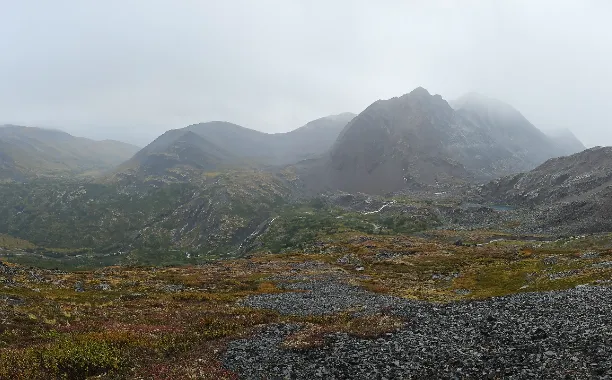
3:50 coming from those intrusives. So we got the results of the first work from that back in August of last year. And I'll hand over to Scott now to talk about that, the results we got. Yeah, thanks Simon. So this is a picture of the Greninick intrusion that is the core, the center of the Grad property. And As Simon mentioned, our reason for going into the region was quite anomalous government sampling. The land had been tied up in land use planning with the Sahtou Dene First Nation and Northwest territories and federal government. So they did a lot of work in assessing the mineral potential of the region prior to deciding which areas to make parks, which areas to leave open for development, and which areas to have as category A or B First Nations land. And This area just became open in July of last year, as Simon mentioned, and our crews were on the ground immediately.
4:53 This is what they walked into. You can see a spectacular cliff. We'll give you some other views of it that show some of the impressive veining, alteration and mineralization. But the bite showing was our key discovery that we made there and it is shown here at the base of this cliff. This slide here shows the relation of Grad to Ogre property and some of the regional geochemical sampling that the government did. There's a lot of numbers on there, but what highlighted to us was 1, there was good Gold values in the stream sediments, but there was also a couple of other key elements that are critical for the type of deposit that Snowline hosts and the other ones that Simon mentioned.
5:41 Those elements are bismuth, tungsten, arsenic and tellurium. This area was quite highlighted for those values. So that's what brought us in and that's what led to our discovery of the bite zone on the grad property.
6:01 So some of the first things we did was some talus fine sampling, which is like soil sampling, but at these elevations there isn't a lot of soil development. So we grabbed the fines that are in the talus, and those circles that you see on this image are where we grab talus find samples. And while our crews were out sampling, 2 of the first rock samples that they collected are shown here, 92.4 grams per ton gold from the base of the cliff and a 15.9 grammer. That was from the fellow who was doing the Talas fine sampling. So when we got the results back from that, we knew we were on to something quite spectacular and it was a very nice surprise.
6:47 The other thing about the Talus Fine Sampling is that over that 550m width of sampling at the base of that cliff, the average concentration of Gold in those samples was 1.06g.
7:01 And within that is that narrow interval of higher grade mineralization, 180 meters, that averaged 3.68. So, that's quite spectacular for talus fine sampling. And what it told us is that across the breadth of this cliff face there is gold in rocks shedding off there. So it gives us some indication of the potential size that we might find there. We followed up that work with, this is another close-up shot of the same cliff face, you can see the 92 gram sample there and the 15 gram sample, and we followed that up with more rock sampling, continued to get multi-gram gold samples from chip samples and grab samples. Most of our chip sampling was over 2m.
7:52 We put a little short trench in there where we could reach at the base of the cliff. It was a 40m trench, 38m of which ran 1.8g per tonne Gold. So by now, as I mentioned, we started working in this area in early July and after each round of sampling results came back, we would go back and do more work. So by the time we got the trench in there, we were running out of the field season and weren't able to follow up on that and that would be part of our plan for this coming year. And I'll hand it over to Simon to talk in detail about some of what we were seeing on the that cliff. If you go back to that last slide just for a second, Scott and Guthwal, pointing out that the samples on the other side, at the back end of the talus, which have been on the other side of the creek, we're also getting gold in the intrusive there that's running, you know, up to 2 grams and with good business and good telluride numbers. So under all that tellus is the intrusive and that'll be the target that we'll be drilling sometime well hopefully by mid-June but it may be as late as July. Okay go back to that and if you look at the intrusive we've been asked many times you know how many what's the vein density per meter well it's pretty hard to tell because the whole intrusive is shattered, as you see in this picture, and the next one, if you can flick to that, Scott. I mean, the intrusive is just cut with these, quote, storm lean, quote, business veins, and how many veins per meter, though they're carrying the gold, it's really hard to tell. It's almost shattered like a schistos work. So, you know, we're getting the
9:23 background on some of the 1 to 2 meter chips here. We're getting, you know, 1
9:27 to 2 grams and then within that sometimes you'll get a 5 gram or a 10 gram in the veins that are cutting it. So we've had a lot of multi-gram, 2 meter chips across the base of this cliff. Let's see if we can see that in the drilling. What we did after we got all those results is we did photogrammetry, and we can take a look at that in the next, if Scott jumps to the next slide, we can then, so that's the same cliff face we looked at before, the white line is the intrusive sediment contact. You could click onto the video, Scott, We can then spin up to the top. And that should start there. There we go. So we see the same veining, the same alteration. We presume that the oxides we're seeing up here, they're that same bismuth telluride oxidizing. We don't know yet because we have no samples from the cliff top yet.
10:21 By the time we got all the samples in, it was a bit late to be flying up top there. We see the same alteration on this western face, and again on the north face. We're seeing the intensity of the veining, the same alteration, that same shattered intrusive body and all we've sampled from this side so far is the float has rolled down and that again is running good gold numbers with bismuth and telluride. Presuming then it's the same system, this is a very strong alteration package right through the mountain. And that's about from the creek bottom where we saw the intrusive. It's about 400 meters vertical and about 450 meters horizontal. So
11:02 we have a sizable target here. How are we going to go about it? Initially, we've got a mountaineering geologist that's going to be working from the ridgetop, sampling the veins on the south, north and west face here. And if they confirm that there's gold in those veins as it is further down we'll be preparing drill pads all along the ridgetop and drilling through that whole cliff. Initially we'll start at the base drilling through the talus where we're getting very strong gold numbers and very strong serosite alteration and very strong bismuth telluride numbers.
11:39 So we plan about 4,000 meters of drilling, testing both the base, the initial 2,000 at the base of the cliff. And then if we get the numbers we're expecting from the top, we'll be preparing drill pads on the ridge top. We've been asked many times, both Scott and myself, about how do you mine a mountain top? Well, it's actually quite a lot easier than putting a big hole in the valley bottom.
12:02 You know, with these gravities working with us, We would have no strip ratio if we could confirm that this whole mountaintop that's poking up through the sediments is carrying good gold with any kind of consistency, which it seems to be from the sampling we've done to date. Next, Scott, what have we got? I'll leave it up to you now. Yeah, the other thing that is impressive is the size of the anomalous area that we're seeing so far. So as I mentioned, the Talus fine sampling returned 1.06g over 550m. Simon mentioned the cliff is 400m vertically above the valley bottom where we did all our sampling. And as you saw in that 3D image, there's quite a density of veining and iron oxide staining all the way up that cliff face. So our supposition is that that mineralization continues from the valley bottom to the top. And then as we went to the north, we did very little work on the north end there, but we did get 1 sample of the slide material that ran 2.8g per tonne Gold, continued to have the same geochemistry as what we were seeing at Bight, high bismuth, high tellurium, high tungsten.
13:18 Indications are that that mineralization goes the full extent across the intrusion
13:24 and that northern part of the property is 1.3km from the Bight zone. There's lots of room for size potential there. The full dimensions of the intrusion are 2 kilometers in an east-west direction and 1.7
13:40 kilometers north-south at the broadest extent. So there's lots of room in there to test stuff. This is an example of the produced intrusion-related gold system model that was put together by Craig Hart in the early 2000s.
13:58 The place you want to be in this model is right at the top of the intrusion, so the carapace zone. It's the part of the intrusion that would have the greatest density of fracturing, all of the mineralizing solutions would tend to want to concentrate at the top, and in all of the deposits that have been discovered along the Tombstone Gold Belt. That's where the sweet spot has been for discovery for gold. So we feel that we've got a lot of the elements that we need to make a significant discovery by drilling it this year. And this map here kind of shows what kind of access we have. At the bottom of the map, you'll see Nahanni Range Road. That's a road that's open generally year-round and it accesses the past producing Canton Tungsten mine, which you see right at the bottom of the map there.
14:51 From there, there is an access road that is seasonal at this point, but it goes from the Nahanni Range Road up to the Howard's Pass Project. And it's a lead-zinc deposit that is owned by a Chinese mining company, Selwyn Chihong. It's not in production yet. It's not permitted yet, but they were on the verge of developing it in the mid-2015 or so, and they put it on hold because of a drop in lead-zinc prices. But they have good infrastructure there. The road is actually in great shape and we'll be renting our camp for this coming season from them. They've got a camp, a 50-person camp that's available for us to use and from there, so that's road accessible from there it's a 40 kilometers, 35-40 kilometer flight to the grad property. So All of our work will be helicopter supported for this season.
15:38 As Simon mentioned, we're looking at in total about 4,000 m of drilling. We'll do mapping, prospecting, lots of sampling, trenching, and we're doing a sizable regional program because one of the things that we found with this occurrence sticking right out of the ground is this region of the Northwest Territories and into the Yukon is highly underexplored and there are great opportunities sticking out of the ground there. I did a lot of research when I saw Solar Alliance Discovery and looked at all the work that had been done all through the belt in the NWT and really very few samples have been taken for gold or any work at all inside the intrusive bodies. So that's what we always said is in our marketing, you know, getting boots on the ground inside those intrusives, you can come up with a grad discovery.
16:31 Let's hope we, you know, we see the consistency in the drilling that we've seen in the sampling today. But there is, we will put 90% of our effort this year into the grad property, but we will have a team doing regional work on some of the ground that we're presently staking right now, just in increasing the land position. Yeah, and historically there have been waves of exploration in the region related to discoveries that have been made. So in the 60s, Howard's Pass was discovered and then there was a big wave of lead sink exploration. But back in the day when you were analyzing your samples, it was expensive and multi-element analysis were not developed yet. So the analytical technique just focused on the element of interest. Same with Canton, it was discovered also in the 60s and actively explored up until the 80s. And then this region kind of went quiet for a long period of time. And there really hasn't been a lot of focus for Gold exploration here. And we're finding that the opportunity is tremendous.
17:36 Yeah, exactly. So let's look at the structure a little bit. So we got 123 million shares out presently. We got 5.5 million cash. There was a lot of warrants that are presently being exercised. They're 20 cents. We're trading today at 30, 31 cents. So I think of those 45 million warrants that are out there, I think 25 or 26 million of them are 20 cent warrants that expire on June the 7th. So I think that will, it will increase the issued capital, but it will also increase the bank account. So you know, we are, we're well financed for this year's program and there should be some liquidity if there's any interest from people listening to get a position. I think we'll see some trading, some liquidity over the next month while those warrants get exercised.
18:34 Next slide. The team. So, Scott, I've been, you know, as I mentioned earlier, worked in the tombstone mountains early on. Since then, I've been in Latin America. I've got a I've had a very lucky career, made a number of discoveries. And I'm very happy to be back in the full circle, back into the Tombstone Mountains again. And Scott joined me as soon as I did the staking. After the 2022, 2023, I contacted Scott with his experience in the Yukon, and he joined the team. And Doug Murray and Armand, very energetic young geologists that have actually made the discovery on the ground property. So we're happy to still have those guys working with us.
19:18 And the team that have been with me for a long time, Sally Whittle over 20 years working with the Gold Group, same with Kevin, a long period of time working with me. So we've got a well-established team and a good board of directors, which we could touch on. Tom Garrigan with B2Go for many years, Tim Beale. So it's mostly made up of geologists and 1 accountant to keep us in well budgeted. So a good board of directors, which we will need to increase if we have the success that we're hoping to win the drilling this year. So that's Rackler Metals. I think it's a very exciting target. Let's get the drills turning.
20:05 Awesome. Scott, Simon, thank you so much. I appreciate going through that presentation. Like I said, I got a couple of questions for you. There are some great questions in the chat, but I'll run through the ones that I got for you first, if you don't mind. First one I want to run through is Simon, the ByteZone shows to my eyes just very impressive gold grades up to 92.4 grams per ton. I'm curious how this compares to typical gold grades in other reduced intrusion related gold systems and what you think that means for Rackle's future potential. Well, all these systems are high-grade pods. I think there's a lot of visible gold in with all the systems that have been discovered to date. So I think more importantly for the potential of the grad property is the intensity of the veining. More than the odd grab of 92 grams, obviously it's good to see, but the channel sample of Bonpointe over that 38 meters where we climbed up the cliff and got that continual channel sampling. But more importantly, the intensity of the veining and the shattering of the intrusive, I think, is a great indication that we're onto something here that may be quite special.
21:12 Awesome. I appreciate that. Scott, I'm going to throw you on. With your really extensive experience at the Yukon Geological Survey, what similarities do you see between Racklow's property and Snowline's valley deposit that define that 7.3 million ounce resource?
21:30 Yeah, so when I was with the survey, my role there was the head of minerals geology. So in that role, you go out and liaise with the mineral explorers, the mining companies, and you get the opportunity to tour a lot of property. So that gave me the opportunity to actually tour Snowline's valley discovery shortly after it was made. As well, I've been to the Eagle Mine that Victoria Gold used to operate, Brewery Creek just outside of Dawson, Sitka Gold's RC property and Banyan Gold's Ormac project. So I've seen a lot of these systems and I'm quite familiar with the mineralization style. And there are a number of features that are characteristic of a reduced intrusion-related Gold system.
22:20 As we've been exploring the belt in Western Northwest Territories, Eastern Yukon, we've been very much focused on looking for Cretaceous intrusions that have that alteration, veining and mineralization. And we see those in spades at Grad. The other properties that we had early on in our presentation are all centered around Cretaceous intrusions. And we've had seen various elements that you would expect in a reduced intrusion in all of them. But what we see at GRAD is an order of magnitude better. And some of those features that you look at, 1 is the cretaceous intrusion, 2 is the geophysical signature that all of these deposits have. So because they're reduced, they don't have a lot of magnetite in the intrusion.
23:11 So magnetically,
23:14 the core of the intrusion is low, but as it comes in, it alters the sediments around it and creates a lot of the mineral pyrrhotite, which creates a magnetic high on the outside. So you get a donut shaped geophysical signature, magnetic geophysical signature. We see that at Grad. The other factor that's crucial is the structural preparation. That will give you the density of sheeted veining in these deposits. As Simon mentioned, that intrusion at Gred is very highly fractured. While we haven't counted the density of sheeted veins, we do see an abundance of them there. The alteration is a key factor. The intrusion coming into the sediments alters all the sedimentary rocks and then the alteration along in the veins. So we have good sericite silica alteration as well as the quartz veins. The mineral association, bismuth, tellurium, tungsten, arsenic associated with the Gold.
24:06 Our numbers at Grad are significantly better than any of the other properties that we looked at, so that makes it very exciting. And then the other factor is a metal zonation where the gold with the tungsten and tellurium and bismuth is generally at the core. Out from that you see arsenic antimony, out from that you see lead zinc. And that metal zonation is really well pronounced at Grad and the bite zone, much better than anywhere else that we've seen.
24:36 So that's why we're particularly excited to get in there and drill this target this year. Awesome, I appreciate that. I've got one question before I get to the rest of mine. 1 from the chat that's on topic for what I'm about to ask. Wesley asks, how long is exploration drill season and how many meters this year?
24:52 Typically, you can start in June. It depends on the elevation that you're working at. As you can see from that mountaintop, we're quite high up. I think it's 7,200 feet. And it's right along the spine of the Rocky Mountains at the Yukon-NWT border. So it does get a lot of snow. We need to wait for that snow to clear and eliminate the avalanche danger. We're thinking that mid-June to late September will be our season this year. You can work outside of those areas, but you have to be prepared for bad weather and to deal with snow and that kind of stuff. But for this year, the first phase of drilling that we will do, that'll be about the window that we're working at. Awesome. And which- I think it's a dozen meters or a little bit more if we start to see the consistency
25:39 in the drilling that we're hoping for, right? That makes sense. Which I always love asking, Gioza, What specific targets are you most excited about testing? Which ones are keeping you up at night with excitement? Oh, it's gotta be bite.
25:52 Yeah, the numbers that we showed on those images, there's no question. There's a lot, like, as we mentioned, we barely scratched the surface last year. It was a new discovery in July and we quickly ran out of season. So there's a lot more to look at. But what we're seeing at BITE is,
26:10 in my history, you rarely come across something as exciting as that. But also the rich top, I mean the intensity, the prominent pictures we have. Neither one of us has been, nobody's been on top yet. We should point out first of all, no one's taken this properly before. It's never been looked at before. There's never been a claim on the intrusive. I don't think anyone's ever walked up that creek before. And from the photogrammetry we did, the intensity of the alteration on the ridge top, obviously I'd like to get some, we're keen to get some sampling up there. It looks as intense as the bite zone itself, and that's 450 meters vertically away. So that is obviously a very exciting second target. But initially, as you know, drilling through that talus, where we've picked up a lot of very high-grade samples is the key zone. Yeah, Great.
27:02 I actually want to talk about being an early mover, being the kind of first in the region, because I know based on your presentation that the region is only open for that industrial development
27:10 July of last year. So what does that mean for investors?
27:15 How does that give Racka competitive advantage? Well, we are busy staking at the moment. I mean, basically, as I've said, nobody's looked at these intrusives in the belt in the Northwest Territories for gold. The project we have is in a Mayo suite intrusive so the belt is sort of broken out, I'm not sure why I'm not a geo but they're broken out into the tombstone suite, the Mayo suite and the tungsten suite intrusive bodies. They're all granitic intrusives and they're all cretaceous but there's a, I guess there's a chemical difference. What we have at Grad is a male sweet intrusive. Most of the other intrusives in the NWT are tungsten sweet intrusives. Can the tungsten sweet intrusive host all deposits too? It's not been shown yet, but we've had some pretty interesting drill holes on, you know, further up north when we had the grad property and the HIT property.
28:10 So we didn't make any great discovery there, but they certainly, we did have systems that were gold rich. So we think, based upon the geochemistry that the government's done over the years, we've picked up a number of other properties and we're presently consolidating our land position in the area of the Grad property. Great. I want to talk really quickly about capital structure because I know in your presentation it says insider ownership is at 49% and I know that's not all management but I know it certainly includes management. So I would like to see that because it shows conviction and the potential etc. I'm curious what aspects of this project convinced your team, really, and yourself to make such a significant personal investment? Oh, the results of Byte. I mean, obviously, I had a good position before, but the results of Byte and the appearance of the alteration of the intrusive is what we've been looking for for 3 years, right?
29:05 Walking on these intrusive bodies where we believe nobody's tried before or certainly no prospectors have walked up in the intrusive itself. You know, they walk up the creeks where the anomalies are looking for lead, zinc or tungsten, they get to the intrusive turnaround and go back down again. So just walking up into that intrusive and seeing that alteration, I mean, our interest got increased significantly. And as far as the other, you know, large shareholders, people that have large positions in Snowline or a few people that have large positions in Snowline contacted me after the grant discovery and wanted to take a big position in Rackland. So you know, they become insiders by the nature of their holdings, not by their involvement with management.
29:51 Right, makes sense. I do want to talk about the bite zone, and I know we've been over this a bit already, but as part of a larger intrusive system, I'm curious, and I guess I'll throw it to Scott first on this one. How extensive do you believe the system could be beyond what's currently visible at surface? Well, we're fortunate that it is exposed well on that cliff face. So we've been able to measure the extent in plan on surface. And as I mentioned, it's about 2 by 1.7 kilometers. And the other thing is we do get a bit of the third dimension looking up that cliff face we can see you know almost 400 meters vertically from the top of the hill down to where we were sampling at bite we haven't as Simon mentioned we haven't sampled up higher on that cliff face, but that's one of the things we plan to do this year with some professional climbing geologists.
30:41 It's not something that I want to do, so I'll leave that to the professionals there. But there's no indication that it stops at that valley floor. The veins that we see are nearly vertically dipping. And they're based on our observations through the photogrammetry and helicopter flights and so on. They are very through going and they should continue down. If you consider Snowline's valley deposit measures approximately 400x400x400m and what we're seeing there, what we understand about the geology is there's easily room to fit something like that into the alteration and mineralization zone that we see at Bight and further North. Whether there is the concentration of Gold, That remains to be seen, but the sampling we've done on surface definitely points to the fact that there is gold in the system. How much and how extensive, we'll start by testing that with drilling this year.
31:42 Great. Simon, I don't know if you had anything additional to add there. Sorry. All good. Just curious if you had anything to add. Right at the cliff bottom there where it goes under the old talus, obviously there's some samples of the base of that that I've taken myself and walked along that intrusive sediment contact and the intrusive there is equally as vain as it is on the cliff face. So it's going to go down further. How far? We'll find out. I mean, the initial holes we're going to be putting in at the valley bottom are going to be 150 to 200, I would say, Scott, at the most, drilling through the talus into the cliff face and away from it, just confirming that the – Is the contact between the intrusive and the sediments vertical or is it shallow?
32:34 We don't know that yet. So it could move further to the, you know, under the sediments. We'll be testing that as well. So we'll probably put in 2,000 meters down there in, you know, 10 holes, I would guess, in the valley bottom. And while we're doing that, we'll get all the samples and get the results of the ridgetop sampling and then plan the program from up there also. Great. There's one question from the chat. Graham asks, I know we already covered this, but I think this is one of those questions. So it's great to reiterate whenever possible. But Graham asks if this year's exploration is fully funded. Yes. Perfect. What milestones you hope to achieve with this year's campaign and the capital allocated to exploration? To show the continuity of the gold minimization.
33:22 It's okay getting these 92 grams and 15 grams and these 2 meter channel samples that are running good gold numbers, but We need to show that you can put 150 meters of drill core in and get an average of, you know, 1 to 3 grams in those 1 to 200 meter drilling. I mean, you know, obviously, we want the program this year is to show the continuity of the gold mineralization within that intensely shattered intrusive body. Makes sense to me. I know your team has a really impressive track record of global discoveries. I'm curious how you're applying that experience to the grad property? Well, at the moment, I have not to apply it because we just made the discovery. But I think, you know, from always when you make a gold discovery, it's knowing what is the best move for the shareholders.
34:14 What Is it better to join venture at some point? Is it when is the right time to sell it? When is the right time to try to monetize the discovery? Or are you better, you know, you've also got to consider all the stakeholders, right? It's not just about the shareholders, it's the stakeholders also. So constantly monitor your skill set and what the project needs to advance it. And have you got that skill set in-house? Do you need to bring other people in? Do you need help? Scott, your opinion on that? Yeah, focusing on the exploration side of things. Having experience in the Yukon myself and some of our crew, just learning how to go about exploring and targeting things in the most efficient manner possible. When you're dealing with helicopters and remote locations like this, there are ways to waste money and ways to be more efficient with your money. So that's kind of what I focus in on. Be prepared when we go into the exploration season, because it is relatively short up here, that we can get the biggest bang for our buck and target things appropriately.
35:23 Yeah, and the drilling is going to be, my guess is, we're probably going to be north of $700-$800 a metre. So we don't want to be wasting meters, right? Yeah. Makes sense. It's a lot of money. Sure. One thing, I know you kind of went over it, but I am curious to see any kind of elaboration you've got. I know you highlight the potential for district consolidation as one of the catalysts coming up. Could you say a little more about the strategic acquisition opportunities you're seeing on the belt and how they might complement your existing portfolio to create additional value? Scott? Yeah, as you could see on the earlier slide there, we had a number of properties in the belt. We started by staking a few and then optioned 3.
36:12 The 3 that we optioned are what we call the Astro Plutonic Complex. That was the focus of our activity for the first couple of years. And then as we got familiar with this part of the Tombstone Gold Belt, we realized that there are tremendous opportunities out there that aren't staked. So along with our focus on Grad and the drill program there, we're going to be doing the regional program that I mentioned. And Simon mentioned we're staking some claims right now. So, the nice thing about that is you get 100% ownership on there. So that I think is maybe a slight change in the way we are going to operate rather than looking to option, although we won't turn down a good opportunity.
37:00 We probably right now have the best expertise in this portion of the belt. So we're continuing to look at things. But I think right now, making our own discoveries really excites us. Awesome. One question from the chat, Bluefin asks, and this he asked right at the beginning of the hour, not a priority, but how likely is it that the host rocks also hold gold mineralization? Yeah, so that's a curious thing about the model. There are other gold occurrences in the region that are orogenic style gold veins. They typically are all in the sedimentary rocks, but gold hosted in the intrusive, I am not aware of any of the intrusions hosting a different style, other than reduced intrusion related gold system, in this part of the country.
38:00 There are scarns that are gold bearing, tungsten bearing and or copper bearing. So there's that style that could be there and the orogenic veins in the sedimentary rocks. We'll keep our eyes open of course for something like that, We don't want to have our blinders on too much. Right. We have seen them some, though. I mean, we are getting disseminated bismuth mineralization within the intrusive without veining. I mean, you know, the initial samples that I took there and at valley bottom, they were not cut with veining, but they were in 10 grams and 3,000 bismuth. There was dissemination within the intrusive, which is unusual, and maybe it was just proctomol too. As you saw from the pictures, the amount of veining in there, but the sample I took, there was certainly not a cause for any neutrusive when it came back with those numbers. So there is some dissemination into the horse rock itself from some of the samples we've taken to date at BITE.
39:02 Yeah, yeah, that's true. Great. One question that came over email. I'm going to try to get the, it's lengthy, but I'll try to get to the gist of it in 2 parts. He asks, presumably you will drill not only below, but into the South Face, which should give you a good idea of what's under the ridge for 400 or so meters. Is that fair? Yes. Yeah, perfect. Then a second follow-up question. Scott, this is just for drilling horizontal. We did look at that, but it doesn't seem to be that practical, Scott, would you say? Or is it? Yeah, we need a bit more of a setup. So how do we tackle if we do wanna drill that cliff face? Do we set up drill pads higher on the cliff face and drill conventionally down holes or use an underground style of machine set up at the base of the cliff and drill up. It's possible, but it requires a bit more of an expense in building your pads and getting an underground type rig set up there. That could be something we would look at in the future.
40:04 But at this point, we're looking at downholes. Probably nothing right on the cliff face, unless we're really excited by what we're seeing from the ones at the bottom of the cliff face. There's lots of room in that talusy area, like horizontally it's about 200m between the bite and the contact with the sedimentary rock, so there's lots of room for drilling and hopefully defining a target. Great. And I think the intrusive is very shattered. So it's to set up, you know, to put drill pads on the face going up the hill is a bit delicate. It's quite shattered with the veining. From what we've seen to date, you know, even walking along the base of it, I got a little nervous because lots of huge boulders are just sort of sitting up, not attached, right? They're just balanced on top of each other. So, yeah.
40:59 It's not impossible. It's not something that hasn't been done before. The Yiskit River region of northern BC, there's lots of drill setups on cliff edges and stuff. So it can be done, it just takes time and expense to do that. So we're trying not to go there right away this year until we know that it's really worthwhile to put that effort and expense into it. Makes sense. Another question from the same person. They want to know if you could estimate how much the system has been eroded away, noting that the South Face is the highest point. Yeah, I haven't put much of an effort into that, but you probably could estimate it. I think we're very close to the top based on the intensity of the fracturing that we're seeing so that carapace zone as it gets in contact with the sedimentary rocks when it comes in, cools quickly and becomes very brittle and fractures quite a bit. So certainly we are right in that carapace zone.
42:01 I don't know if it would be a couple hundred meters or what, but it's probably somewhere around there to what would have been the top of the intrusion. Great. I got one. Go for it, Simon. Oh, it's okay. I got one last question I'm going to ask each of you separately, and then we can jet for the day unless another question pops into the chat. But I'd love to know what you're most excited about for 2025. What has you most jazzed for the year ahead? I'll start with whoever's got an answer tip of their tongue. During the bite zone, I think we both came up with the same answer. I mean, you know, the consistency of the veining, seeing the first 3 or 4 coholes come in, that's going to be very exciting. Yeah, I've got a, same thing, a number of priorities. We're bringing a small excavator in there to do some trenching. We've got plans to do more extensive sampling along the base of the cliff with our geos and get some good coverage across there on what is exposed.
43:01 And can't wait to get that first drill hole in. We're planning it right at the bottom of the cliff, just off the edge of where that trench was put in. And I can't wait to see what comes out of that hole. So yeah, unfortunately, mother nature is gonna make us wait a little bit longer, but look for results towards the end of July on that. Awesome. Well, Scott, Simon, thank you so much for not just going through your presentation, but accepting a bunch of questions, both from me and from the audience. And thanks to everybody who's in the room. Really appreciate your time today. If you think of the perfect question to ask right after the webinar, which I sometimes do, feel free to email it in. I'll make sure that the Rackle team gets it, or you can always reach out to them directly through their website. But Simon and Scott, thank you