Transcript
Automated transcript · Written by software from the replay's audio. It can mishear names and figures; the replay is the record.
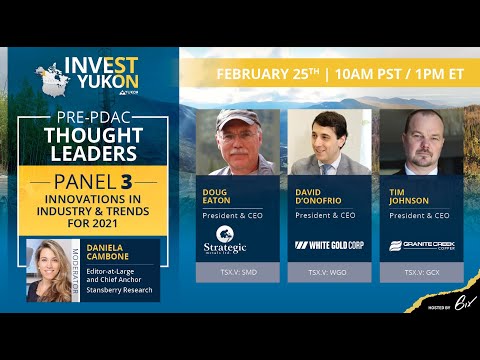
0:09 Hi, my name is Daniela Kambone. I'm the editor at large and chief anchor over at Stansberry Research. I've been covering commodities and mining for over a decade now. So I'm honoured and thrilled to be joined by these thought leaders in our industry as part of this pre-PDAC panel series. Today, we will be talking about innovations in industry and trends for 2021 that everyone should be eyeing and being on the outlook for. So I'm going to be introducing this all-star panel now. Today we have David D'Onofrio. He is the president and CEO over at White Gold. We have Doug Eaton, who is the President and CEO of Strategic Metals.
0:54 And finally, we have Tim Johnson, President and CEO of Granite Creek Copper. Gentlemen, welcome to the panel. Thank you for taking part. Thank you. Pleased to be here. So before we kick things off here and really get into the mood of it all, why don't we just take a second to present each of you. David, a few simple lines, tell us what you do. Great. White Gold Corp is an exploration company focused in Canada's Yukon. We have a very, very large district-scale land package, which is about 1 million acres. Part of that package is grassroots exploration and our projects span right through to defined resources that are just under 1.8 million ounces now.
1:43 I'm also part of the Power 1 Capital Group or a boutique merchant bank based in Toronto and we've been investing and financing exploration development in the commodity sector for almost 20 years now. Thank you David. Doug? Yeah, Strategic Metals, like David's company, is focused on Yukon. We're primarily a project generator. We've got about 130 active properties at the present time. A number of those are optioned out. But in addition to that, I've very, I spent most of my career with a consulting group, Archer Catherine Associates that's based in Yukon as well. I've been doing that for about 50 years. So very broad background. I've been lucky enough in the last few months to be part of a panel that's working on a
2:32 mineral development strategy for Yukon. It's an independent panel that was supported by all of the settled First Nations and Yukon governments. So it's been a great opportunity to learn a lot about how Yukoners view mining and where they like it. Love the Yukon, I've been there a few times. Tim, finally, Tim Johnson. Thank you. Likewise, we are a Yukon focused company. Granite Creek Copper is fairly new. We launched the company January, 2019. And within 24 months, we've gone from an early stage exploration play to a resource company by acquisition of our neighbor Copper North. So we now control the CarMax and the CarMax North deposit and exploration property. 177 square kilometers of really highly prospective ground within the Minto Copper Belt.
3:23 Fantastic. Well, thank you for all that. So I thought it would be nice to start with what we see as the key drivers for commodities in 2021 and what extent are they common to and are they divergent between base and purchased metals? David, do you want to start?
3:45 Absolutely, yeah you know that's a very interesting question And I think there's a lot to be said about commodities in this day and age. There's a number of drivers, I think, that are going to be pervasive across resources, metals, but particularly all commodity types for a number of reasons. And I think it really positions companies like ours and especially countries like Canada
4:12 in a very interesting and opportunistic setting as it relates to this. Commodities is a very cyclical industry. We've seen some great times, we've seen some down times. And I think right now we are emerging
4:27 into what looks to be a very strong bull cycle for commodities. And those aren't just my sentiments. You've probably seen in the press, even the large US investment banks calling for a super cycle here. And what's going to drive that? I think there's a lot of things. There's global investment as part of the world recovery efforts from COVID-19 pandemics. That means a lot of infrastructure spend, which is obviously very supportive for the base metal industries. I think Federal monetary policies across the world are at unique and unparalleled time positions and that's going to have impacts on precious metals in addition to their industrial uses.
5:14 And we are now just, I think, in the very early stages in this new call it green metal decarbonization focus which is being a huge driver for some of the metals that are key in
5:28 that sector. So those are a couple of things I don't want to steal all the thought. We have a couple of really smart guys here. So maybe they want to chime in as well. No, absolutely. I actually just finished an interview with Robert Friedland, who said it's not even a super cycle. He sees it as a revolutionary cycle and almost like the revenge of the miners, how much metal will be needed to meet the green new deal. So echoing what you were saying, David, Doug, how do you see it? There's no question that, David, it is the first time in my career since the late 1970s that there's been a conjunction that's been favorable for every type of metal, not just gold or base metals at some point in the cycle, where every single metal seems to be topical at the present time. People forget that if you're gonna have a green economy, the greenest of all metals is copper.
6:20 You need fundamentally have to have copper to electrify things. And there's a whole suite of elements that
6:27 really we've never looked at as an industry before that are becoming really critical, partly because of wider use, but also the geopolitical considerations and concerns about the supply out of China, specifically Russia to some degree. So the industry is really set up for a good several-year run, and I'm glad I'm still part of it. Yeah, just on the note about copper, look, it's at an 8 year high as we're speaking right now. Is the buzz gonna be focused away from gold and silver now? That's all we talk about to now copper and lithium, cobalt?
7:06 I don't personally think so. I think that David was right. There's been so much money printed effectively or so much debasement of currencies that precious metals are still going to have their day. Fantastic. Jim, talk to us about how you see this blending of precious and base metals and trends you see for commodities this year. Yeah, I mean, I can echo the other 2 gentlemen's sentiments in a lot of ways.
7:36 Like Doug's comment about the printing of money, I think as we look to all commodities, anything that you can physically get your hands on and keep is going to be a store of value whether it's precious or base or anything along those lines. And as we do transition to the electric economy and we get off fossil fuels, it's only good for copper and other base metals. And really, I think we are on the precipice of something really amazing in our industry. And I think we're gonna see the geologists that went and became school teachers come back screaming to the industry because
8:12 it's gonna be back on. And it's gonna be a very interesting time, the next probably 10 plus years to be where we are and moving things forward. Wow, I feel the excitement coming back to the space. It's so nice, especially since I'm sure we've all been in it for a very long time. So nice to see the energy. I will just add one thing that people need to be cognizant of in this type of a sector With the cyclicality when times are slow prices are lower My income especially large are not investing in new exploration And that has a significant impact on bringing new production on stream. So, you know, these metals we all know of gold, copper, aluminum that are going to be core to this green
9:02 revolution. It's not like you can flip a switch and increase the production. You need to have discoveries, you need to bring that on. That takes time, that takes capital. So companies like ours, that sort of have a leg up, or countries like Canada with an established mining system. You know, that's part of the reason why I think we're positioned so well to take advantage of this. It really is very difficult.
9:26 And not only do we have these, you know, elements that everyone knows and everyone's to some degree been working on, although it is, I think, a fairly broadly agreed upon consensus that there's been a drastic underinvestment in commodities over the last 10 years. But stuff like now, uranium, you know, lithium, graphite, molybdenum, iron ore, you know, we're just starting to see these prices increase. And I think it's, you know, it's not until the world kind of realizes what this supply crunch could look like that we're really going to see a major revaluation in some of these commodities. And that's when I think things are going to get particularly interesting as tends to be the case. Really?
10:04 Yeah, no, that's a great, great point, David. And I think there's one little quote that I wish was taught in elementary school, on that, if it's not growing, it's mined. And it's something that's very dear to our industry, but a lot of people don't realize that. And just not to diverge too much, but I was speaking with another CEO who was telling me that with COVID and we're doing this conference now virtually, it's going to hurt mergers and acquisitions. We're already seeing it. And just to your point, David, about, you know, lack of new exploration and discoveries, the fact that CEOs can't meet face to face, how much is that impacting, you know, M&A activity and new projects coming on board? I think it certainly had an impact.
10:52 Like I mentioned, I'm with Power 1, so we're very involved with a number of different entities and we've been fortunate enough to build a track record where we look to work with early stage companies, help them evolve and eventually be sold to larger companies and go into production. And initially a year ago, last March, April, it was totally shut down, right?
11:13 Making it very difficult. It started to, It's still more challenging, but I have seen headway being made. Fortunately, a lot of stuff you can do virtual, but I don't think anyone's technical team would be comfortable making any type of a transaction without getting boots on the ground. So certainly there have been hindrances. Although with that said, there have been acquisitions that have been done in this environment. And I think we're starting to see a little bit more and more of that. And I do believe, again, you know, another positive
11:45 perspective for our industry is, you know, M&A is a big part of why people want to be invested in the resource pipeline and we're just starting to see that happen now and I think we're very much in the early days of that and I think it has to happen. Tim said it, you got to mine the stuff that's not grown and guys like us go find it and then the big guys have to buy it to replace their pipeline because without that, you know, there's no other way to, you know, for them to do that. That's critical for them.
12:15 Millennials now, you know, I do so much coverage of the crypto space as well now, and a lot of it is, you know, how much fuel is Bitcoin taking from gold, especially? What do you think needs to happen to attract the millennials and by millennials I mean 38 and younger into modern news and mining?
12:41 I think there's 2 things that have to happen. I think that The industry needs to do a more effective job of explaining how fundamental we are to an economy, but to the economy in general, to get it through to the millennials
12:59 that we aren't a sunset industry, that we aren't totally damaging to the environment, that we're working very hard to find more effective ways to operate that are less damaging. We need the social license to be really well established. And I think that that's gonna be important. The millennials are much more aware of sort of global impacts than some of their...
16:08 earlier generations were.
16:10 And I think that David hit the nail on the head. I think that You need to see the merger and acquisitions picking up. You need to see some really big money being made in our sector. And like most people, if people are making money, people will gravitate to that industry. Well said, David, any... Yeah, I totally agree with that. And this whole focus on ESG, I think people need to be more cognizant of it as an industry, not only to attract the investor's interest, but it's generally a good thing, right? So this is a very positive evolution for our sector, long overdue.
16:53 You know, the advent of this green revolution is a great way to sort of fast track that part of the evolution. So I think that's going to be a big positive. Millennials are very aware of that, as Doug mentioned. So I think that'll really sort of help. And technology, right? Like, you know, technology will make that easier, right? You know, maybe It's not in their interest to buy silver dollars and tuck them under their pillows, as maybe our parents or grandparents did. So how do you sort of evolve that? Well, the stuff that they're into, the Bitcoin, the blockchain, you know, there's now tokenization of these physical assets That makes it a lot more accessible to this younger generation, which may not have the capital available to go buy, you know, some of these hard assets Also, you know some of these new technologies and evolutions We're seeing like with Robin Hood
17:43 and fractional shares and said I just make it more accessible to the broader public, which we see happening. I think that's also a very
17:54 positive evolution for the sector. Tim, any thoughts on how to attract more millennials to the sector? Yeah, I think in some ways it's almost self-propagating as the industry grows and as you get more people aware of what's happening, we will start to attract millennials. Even, you know, right down to sort of grassroots boots on the ground as you get millennials working in the field as geologists or geology students That's where a lot of the interest in our industry comes from it comes from people
18:26 You know who are in it and they talk to their friends and their family and it spreads out from there So I think in some regards that's going to happen. And you know I think some of these fads, you know maybe crypto wasn't a fad, but some of these things that peak and then come you know when they come off then the money naturally looks to what the next thing is And we need to be ready as an industry to be able to provide those opportunities when they come.
18:53 Danielle, sorry, if I could just make 1 further comment. Absolutely. And that's that, you know, the industry is someone alluded to earlier, it's very cyclical, it's like a pendulum and always swings too far. One of the things that people tend to forget about the mining industry is that the total dollar footprint of our industry is very small compared to other sectors. And a tiny swing in interest
19:18 where, you know, a few percentage points of the money that's out there comes to our industry, it's gonna be a tsunami. It's gonna be a terse visit. We thought it right in 2 days, albeit short-lived. We saw it with the silver squeeze. He's the point, right? It's just, we're very, very, very leveraged to move. That's right. And again, maybe to Doug's earlier point, expand on it. Mining is fundamentally critical for the, you know, green, greenification of our world going forward. We're just, we need more copper, we need more lithium, we need more graphite, we need more uranium, we need more molybdenum. And the only way that to happen is through investment and support of mining, exploration, development and extraction.
20:06 Yeah, I definitely feel there's some sort of shift happening right now. So let's talk about AI, artificial intelligence. That might be a way also to peak in millennials interest, but is that something that your company is presently using or down the pipeline you might wanna look at?
20:28 Yeah, we have started to look to integrate that. It's funny, you know, White Gold, with our sort of land package being as big as it is, and you know, Sean Ryan, our founder, having worked the Dawson District, which is the site of the historic Klondike Gold Rush from over 100 years ago, for so long, he's actually amassed what is probably the largest soil sampling database in the world. And that's kind of been his
20:53 secret sauce by identifying the big discoveries in our district. And he actually views himself as much as a data scientist as he is a prospector, because it's not necessarily there's the old crop where we are. So it's not like you find a little piece of gold in an outcrop and extrapolate that find you know your bodies you have to look for these other trade indicator elements and it's by you know collecting the data interpreting it reinterpreting and resampling it that sort of led to these previous discoveries. So that's been a huge focus of his and his team always.
21:27 And once you've amassed this much data, like any other data-intent industry, these new technologies will be very helpful. So we've certainly started to incorporate that into our analysis. I think it takes a little bit of time. You see other companies in this industry using it and I'm a big supporter. I think it's going to really
21:47 help out a lot. Doug, anything you've done at the Strategic Metals with AI or something maybe the company's looking at? Yeah, I don't want to get into an argument with David about who's got the largest database, but I think we probably have a larger database than Tron does, but absolutely. We're constantly reviewing the data. We're increasingly using computers to do it. As you get into some of the more esoteric green metals, some of the strategic metals that people need for the green economy that people haven't traditionally looked for, you often have whole new suites of Pathfinder elements that you can utilize to
22:33 target new acquisitions. And so absolutely, it's critical to anyone who wants to be competitive, they'd be constantly reviewing their databases and finding more effective ways to do it. Finally Tim, AI for you? Well I think the term that David used, data scientist, is very telling. In fact that term exists,
22:56 especially in our industry and I know you're now getting geologists who specialize in data management, data review. And I think it's here to stay. And using AI to parse that data and to dive down through some of these huge databases. And we're able to make correlations that, somebody sitting in front of a desktop trying to figure it out just can't do. And to be able to have that sort of computing power to be able to make a correlation between a soil sample and a geophysics anomaly and a structural anomaly and to be able to put it all together that, yeah, it's something that we're definitely looking in. We're a member of a group of companies, 3 companies in the group. 2 of the companies already have retained an AI specialist to review their large databases.
23:45 And I think we'll probably be joining that group shortly as well. So, yeah, absolutely. I guess I'll throw this one to anyone who might want to answer this one. How broadly can innovation be applied to exploration and mining? I'm thinking it's not an easy thing to accomplish per se.
24:07 Does anyone want to talk to that? Yeah, I'd love to. You know, it's as broad as people's imagination can make it. I'll give you some examples. We talked a little bit about how artificial intelligence can be used for targeting and project acquisition. Sean, you know, David's partner has been very innovative in the way he's tackled some of the exploration techniques, he's modified equipment to make it more portable and come up with ways to explore that previously we couldn't. Miners are constantly reviewing
24:45 their technology to make it safer and more effective. My company Strategic has made quite a push looking at reclamation. We're trying to find ways of dealing with tailings that people haven't traditionally looked at. I think we're having some success with it. In fact, we founded another company, TerraCO2, that's focusing largely on that. And even down to the regulators, with some of the new technologies that are available, they have more effective ways of monitoring activities and cumulative impact of operations. So honestly, it's a very broad brush. And I think that there's so many different people working on so many different ways. I'm really excited about the changes that are happening in the industry.
25:34 Very cool.
25:35 I don't know if any of you can share, you know, an innovative practice or technique that your company has done or planning to put in place. Any real life examples?
25:51 Yeah, I'm happy to try. I think Doug is exactly right. The opportunity for the integration of new technology, innovation and mining is limitless. We're in an era where the advancement of technological evolution is unprecedented and all of that can be applied to I think every industry. And so why wouldn't mining necessarily lead itself to that as well? And it only will sort of bring
26:20 endless benefits in terms of access, discovery, safety, environmental sensitivities, etc. Some of those examples that Doug had given. I think for us, you know, we have an approach which has been coined drones to drills. Our first class now is using drone technology. This is something that didn't exist even 4 or 5 years ago in terms of the reliability and accessibility. That provides access. It's cheaper. You're maybe taking planes and helicopters out of the air using these drones to do some of this preliminary expectation. So that's a huge, I think, especially in more greenfield type frontiers. And it really, it helps in really all aspects of exploration which are cost, human capital,
27:11 time, et cetera. That's one particular example I can share of many that were integrated within Whitepool. Just on a side note, because I would think that all these techniques, innovations are great, but they sound very expensive to me. So how does that impact the company? You have to grow, you have to evolve, you gotta get into AI, you gotta get to the forefront.
27:38 How does that impact budgets at the end of the day or your reallocation of budgets?
27:45 Yeah, I can speak to that a little bit. I think, well, a couple of things. 1, when you're at the expirations phase, your most expensive expiration tool is the drill bit, right? So anything that you can do to have more success at the end of the drill bit is going to save you money so that your holes have a higher chance of hitting. And some of the technology we're seeing, like the drones that David mentioned, and that is building up your data set to be able to have that success at drill bit. So it's actually cost saving. So you may be spending more money on a drone, you may be spending more on the surveys, by the end of the day you hope to have a better outcome. The other thing I think that should be mentioned is that Technology has to fit with your program and has to fit within what your objective is. I think it's very easy to use technology as almost a crutch to
28:41 maybe remove some people from the piece, but I think a company's got well-designed programs and that you're bringing the technology as an ad and you're not replacing something else and you're still relying on the boots on the ground and the knowledge of your personnel as well as technology and you're not replacing that. It has to be a synergy, it has to work together.
29:08 Yeah, another thing, Danielle, that I think is very important is that in order for technology to be effective, you don't have to be the innovator. Being the innovator may give you a slight advantage for a short period of time, but as the kinks get worked out of the technology, it becomes widely accepted, And that's where its real power comes to play when everybody is able to utilize it. Good example is color TVs. If you bought the first color TV, it cost you tens of thousands of dollars. Within a few years, you could buy a better TV. That's what you should do. Should make going with both feet. That's so you can't innovate, but you got to know when to adopt the technology. That's such a good point.
29:54 I remember when CD players came out, begging my parents, and they were crazy, crazy price. And then, well, now you can't even find a CD player.
30:02 All really good thoughts, gentlemen. As we're about to wrap here and open up questions to the audience, are there any final thoughts you'd like to share?
30:15 Anyone? Well, I just have one. I mentioned briefly that Strategic was working on a technology that comes back to social license. One of the things that we've been playing around with was a way to dispose of sulfide tailings
30:32 in a manner that basically put the project to bed forever. They wouldn't have to have continual water monitoring and maintenance of tailings dams and whatnot. I don't know if it'll work. I'm optimistic that we're on the right track, but it's the type of thing that can be a game changer for the industry. And it didn't cost much money to get to where we're at. We made an investment of about 1 million dollars, raised another 500,000 privately, And the company that's now working on it has registries $10 million US from very wealthy investors, very well-educated investors. And they're working on a technology now that basically can deal with sulfide tailings, but it also has the capability of displacing Portland cement
31:21 as a dominant cement, producing cement with 60% less CO2 generation and the kind of stability that you need to encapsulate sulfide. So it all came out of a crazy idea that we threw at a student who fine-tuned it and the company is in the process of commercializing the process. So It can move very quickly, 3 years and there you are.
31:50 Good. David or Tim, any final thoughts before we wrap here? Yeah, I think, you know, just sort of like you touched on throughout our conversation here, I really do feel that we're at a fundamental inflection point in the commodities industry, particularly the metals. I've personally never seen so many influencing, positively influencing factors that are kind of culminating all at the same time. It seems somewhat of a perfect storm here. Absolutely. It's very exciting for us. And I forgot to mention before, we're talking about attracting millennials and AI.
32:26 Does anyone have any thoughts on blockchain and mining and the use of blockchain to help mine? I feel like we're talking a lot about this. Has anyone had any experience yet with that?
32:38 Or things that could be an integral part of mining? Yeah, I think anywhere where you have conflict minerals, I think blockchain probably has a place to be able to attract from mine source to end user.
32:58 I think that's kind of out of the jurisdictions that we're talking about here, But that's probably the most likely place I think you'll see it applied in things coming out of the Congo and stuff like that. Yeah, that's what I was going to mention for sure. I think we're going to see an evolution there. And then also what I touched on earlier, just the tokenization of assets and allowing for accessibility of investment,
33:23 gold and whatever other commodities is something I think we've started to see, maybe not in broad adoption yet, but I think that will come. And even here to the point where producers can start to pay dividends, you know, as you know, a gold dividend, but you know, won't be a fleck of gold, it'll be through a tokenized piece of gold for people to put in their wallets on the blockchain. I think if you can invest in a gold company and get a dividend in gold, well that makes it that much more appealing. So there's gonna be, I think, a lot of interesting new adoptions of the blockchain in this industry like every other industry. Really good thoughts from you, David, Doug, Tim, albeit virtual. I hope we could do this next year in person.
34:09 I learned a lot. I thoroughly enjoyed the discussion and I thank all of you. Thank you. Thanks, Dana. Thank you. Great. Thanks for having Danel. Thank you. Thank you, everyone. ♪ ♪ ♪ ♪ Those of you joining us, thank you so much. We already have some Q&A rolling in and I know we don't have much time and hopefully we'll get to go through all of them. I'm going to start with 1 that's really for I guess all 3 of you here. Why are we not seeing more mines in the Yukon go from exploration into development?
35:00 Anyone want to start with answering this one? Well, I think first of all, there is a delay between expiration and development pretty much everywhere. There are certainly or have been permitting issues. It's not unusual across Canada to see delays. Yukon has to streamline the system. We've heard as the panel that I sit on, we've heard that from many, many people. And certainly, I think you'll see in the next 3 or 4 years, some very serious efforts by government to find ways to permit more quickly and with clear pathways to development.
35:49 That's a good point, Doug. If I could just maybe add on to that. Canada's newest gold mine is in the Yukon, so mines are getting developed. It's a matter of obviously having the resources there discovered and then brought into the next level. And this is a point that is being very openly discussed with the government at all different levels and they are motivated to continue the progress of this industry in the Yukon. They fully appreciate the opportunity for them as a territory. I think, you know, from our side, we see a significant investment and commitment to helping that work together. So, always room for improvement like everything else, but, you know, we do see mines there, we see other mines being terminated, so things are happening, but to be continuing to improve, very positive, all the prices are going up.
36:41 Tim, did you want to add something to that? Sure, I can add, I think what people need to sort of remember is that there's a lot of timing issues, you know, it's where the market's at. I mean, you can develop a resource and if you're on the wrong side of where the cyclical nature of the market is, develop resources as the market's going down, it can add another 10 years to the development timeline for that project, right? And just because the market's up now, that doesn't necessarily mean that the projects are ready to go, you can't turn a switch and turn them on. So there are lots of issues and, you know, from permitting to availability of financing to all sorts of things. I wouldn't say that the Yukon is any worse jurisdiction than anywhere else that I've worked or know about.
37:29 Thank you. I guess Just staying along the same train of thought, there was another question coming in from Robert Lawrence. This one's for David specifically. It says, does White Gold have any projects that will become a producing asset in the near future when I'm a shareholder? Okay, great. Well, we certainly have some of the most advanced assets in the U.S. Contract in the gold side. Our flagship gold side on our deposit is approximately 1 million and a half ounces and we have the QB deposit about 10 kilometers away, which is another 250,000 ounces. So that's the type of asset that, you know, what we call brownfield, we discovered over 10 years ago, it's been 100 million plus invested into it. We have a very solid defined resource.
38:15 Most of it is in the indicated and that's ready now at the next level to move towards production. And this type of a market, as you can imagine, there's a lot of interest in assets like that. There's not a lot of those around in the world. As Tim mentioned, there's been probably a deficit of investment and aspiration globally in the last 10 years. So assets like ours are kind of at the top of the heap of getting attention to bring into production. And as we all know, you know, the majors need to continually refill their pipeline and materials. So that's why I think assets like that are going to be in high demand and getting a lot of attention. And as the M&A cycle here picks up with this commodities market, we're going to see more and more of these types of assets get brought to the next level. So it's something we're very, you know, spending a lot of time on, evaluating the options. We're very optimistic, you know, the next steps for that set in particular.
39:09 And not to stay on you, David, cause I have other questions for Tim and Doug, but again, it's kind of like in the same category of questions. I wanna know, is there a mill nearby your project or would you have to build one? There's not right now. But part of it, and this kind of gets back to the first question, The foundations are being put in place to help all this be advanced. That's an important part of the process. Another important part is access. The Yukon government along with the Canadian federal government is committed to this resource gateway program, which is a $360 million investment within our district and in other districts across the Yukon to build or upgrade existing roads to provide access to these types of projects. There's ours, we want to have the coffee deposit which they acquired through their Gold Corp acquisition formerly Camenac, That would be another operation which is very advanced, and we're looking at the next level as well.
40:07 Okay, thank you. We also have a question for Doug. How is your project with Terra CO2 Technologies progressing as this is possibly a very innovative project involving construction and tailings remediation? I have to say it's progressing very well. I'm no longer directly involved in the company and unfortunately I'm bound up a little bit by conflict of interest concerns. Don't certainly want to give away part of the business plan, but I can say that they are moving rapidly toward commercialization. As I said, they've just received a huge infusion of capital from some extremely well-heeled investors.
40:57 In fact, one of the investors has done interviews recently on CBC and elsewhere where he actually alluded to the technology. This is a fellow who's very, very well known. Again, I can't, I'm not allowed to say who and which groups have invested, but We're ecstatic with the progress that they've made. We still own over 20% of the company and have warrants that allow us to get a larger interest. So I think that the, you know, stay tuned. I think you'll see more happening in the near future, but again, I'm not at liberty to announce it. Okay. And if anyone else has more questions please keep sending them but for now I have one for Tim. Is there a plan for the oxide that might involve Minto Mine or any other potential with them as far as trucking to the port?
41:50 Good question. So pretty specific question. It's very, very specific question, but I think so I can, I kind of can echo the sentiment that we're, that we're presenting to other shareholders and potential investors? And that is that we're taking a holistic approach to the mental copper belt itself. We are considering what the best avenue of processing both the oxide and the sulfide would be but in our near-term plans are to grow the resources both in the oxide and sulfide. And our sort of long-term goal is to attract a major copper producer to the belt. So that would be, you know, getting to a total contained metal to the point that we'd be able to attract a bigger copper player.
42:36 That's our near and longer term goal. I know I'm kind of ducking the question a little bit. We have no direct talks with Minto, although, you know, there is, there would be possibilities there that There's probably some good synergies. Nice. Okay, here's a more general question, courtesy of Vladimir. When talking about the role of the mining industry in the green revolution. Isn't it appropriate to also talk about its use of diesel as the main, if not the only, source of energy and the need and opportunities to move away from it? I don't think there's any question that in Yukon territory that there will be a very strong push away from diesel.
43:24 At the very least it will be toward LNG, which is still hydrocarbon based, obviously, but it's much more efficient than diesel. I think that you'll see a major push by mines to incorporate as much solar and wind power as they can into their organizations, but they do need baseload. I believe that you will see a strong push to get some form of connection to the larger source. One of the possibilities is to extend the Dease Lake line up, connect with the Yukon grid and give us access to the site C power in BC, which is renewable and screened, and it would solve the baseload needs for lines of the Yukon for the foreseeable future.
44:23 Tim or David, any thoughts on this? It's a very good question because... Yeah, and that's, you know, Doug's sort of bang on. The only thing I would sort of add to that, in an evolving newer frontier, it's actually a great opportunity for us to start to embrace the new technologies, right? You're working from a blank slate and that keeps all your options open. These technologies are now more readily available and starting to be deployed throughout the world. We have the benefit of seeing how they work. We see mines now going fully electric, etc. With their fleets. So a lot of different alternatives to be considered. And as an industry, you know, it's a focus for us. It's always been, you know, part of our fabric to evaluate these different opportunities, environmental sensitivity, ESG, that's sort of topical the last couple of years, but something that's been core to our operations, you know, since the very beginning for over a decade now through Sean Ryan's earlier works and you see that there's crazy sort of things that are out there that seem crazy today but maybe in 10 years they won't. You know, even like these mini nuclear reactors.
45:28 There's some huge projects in the Yukon that may not look to be economical based on current technology, but if you pop something like that in there, it could be a major. So a lot of different opportunities, and I think you'll see places like the Yukon be early adopters, so it's a great opportunity. Right. Do you think that the industry has done a good job of showing the public that it's making strides in trying to become more environmentally friendly or do you think there's still a lot of work to be done? Personally, I think there's a lot of work to be done. I think that as an industry, we're reluctant to blow our own horn and point out where we are making really strong and very positive steps environmentally.
46:15 It's got to be better advertised because I can tell people honestly that the will is there to do it. And I think that some of the legacy projects in Yukon have left a bad taste in the general public's mouth. And I think the industry is going to have to work very hard to show that that type of project will never happen again. Tim, did you want to add anything? Yeah, no, I can echo that. I think We are, you know, Doug is right. We are, I don't know if medicine's the type word, but to promote ourselves to the general public, we seem to focus on promoting directly to, you know, the banks and the investors, but there is a need for the general public to understand what we're doing and the integration of our industry into the greening of the economy.
47:12 And without that, I think we really need to build up that social license. Just on, sorry. No, I'll just say that's a great point. People unfortunately think mining with a brush is bad. Without mining, none of these evolutions are possible. We're trying to talk about solar, we're trying to talk about wind. Well, you need silver, you need copper, you need gold, you need all these things. So it's just a matter of figuring out a way to do it responsibly. I know the industry is committed to. It's obviously a challenge for everyone, but I think we're going to get there. And it's just making that readily apparent. What's our game plan? Communicate to the broader public so they can understand that money is not bad. Yeah. We just had a lot more questions roll in here. So if you don't mind, I'll move on to the next, but kind of a tie-in, you know, we talk environmental issues and also issues with dealing with the local population. And this one comes from Duane.
48:07 He says, how would you each describe your relations with and possibly investments in local indigenous communities? Well, I can answer that quickly from our side. Our group has been quite proactive about engaging with First Nations early and often, which I think is very important. And we're very open to working with First Nation either individually as companies or through their development corporations. We're constantly looking for opportunities for to get the First Nation groups involved in our projects. And I think that that's very common across industry. I don't think that very many companies anymore are close to the idea of First Nation participation in a very active.
49:03 No, I can echo that sentiment. You know, we're open to whatever sort of form of partnership was gonna work for all parties. We're a fairly new entrant to the Yukon and we're still getting our feet under us to you know in the engagement and outreach. COVID kind of hampered things a little bit and made it a little bit more difficult to have the important face to face meetings that you need to build those relationships, but we're committed to building those relationships in any way that we can. Here's a pretty general question. What is being produced now in the volume of gold, silver and copper mines? Which companies are the major producers?
49:50 I mean, I presume he's putting it, the context is Yukon. And in that context, the major gold producers is obviously Victoria with their Eagle. The major silver producer, Alexco, has just gone back into production. And the most significant copper producer, as it has been for many years, is Minto. There's a lot of other projects that are, I would say, at advanced levels, but those at the present time are the major producers. Any numbers in terms of volume of gold, silver, and copper mined in the Yukon? I think you'd have to go to each one of those companies individual mine sites. I don't know about you gentlemen, I don't think I have those numbers at my fingertips.
50:39 Yeah, well, I can tell you that for gold, that there are about 200 ounces, 200,000 ounces per year at Victoria, but there's also production from Placer and there's also smaller scale productions from Meadow. There is some gold and others, but I agree that it's best to look it up by company. I was just going to add in there, but let's not forget, you know, the Yukon, these new modern mines are coming online here, but it has a long, long history of plaster-type mining, which has produced very significant amounts of ore. In the Dawson District, where we are, White Gold, that's produced over 20 million ounces, literally from the gravels in the creeks over the last hundred years. And that also sort of touches on maybe the first question about permitting. You know, the Yukon's a little bit of a, has territories within territories and certain territories like ours, for example, have this mining as part of the fabric and part of the history and you know that sort of maybe helps with sort of the embrace of the First Nations communities and we're obviously sort of feel it's you know imperative to have everyone sort of work together. I'll stay with the other guy who mentioned himself but it's certainly you know beneficial when you sort of have this backdrop and this part of the culture integrated within the communities for so long, as many parts of the Yukon have.
52:03 Okay, so with the time we have left, I have 2 specific questions. One is for Doug. Could you please comment on Mount Hinton, the progress, known drill holes, etc.? Yeah, okay, Our Mount Hinton project is directly adjacent to Alexco's Hill deposits. We drilled their maiden program last year, looking at 3 areas, but really most specifically 2, Got some very positive results from both of them. We expect to drill in there again this year, probably with a diamond drill and a reverse circ drill. It's a camp scale target, we'll be working on it for many, many years.
52:51 It's a very nice new discovery and I think we're very happy with it. Okay, thank you, Doug. And I have another question for David. Does WGO have a plan for any marketing to get the word out? What appears to be a very undervalued stock? The short answer is absolutely and you know we're taking the opportunity for forums such as this to get in front of more people. I agree it's sadly under value here considering we have almost 2 million ounces over 2 grams and the type of deposit in terms of the size and scale profile that's really not very many of them around globally, particularly in a tier 1 jurisdiction like Canada. So it is top of agenda, we are doing as much as we can, and we'll continue to do more, take advantage of virtual sessions, which has made accessibility of the markets a lot more realistic, and we'll see a lot more of us coming, and especially, you know, hopefully as we enter into our active season but maybe a little bit seasonality you know we'll see a little bit more excitement in terms of following.
54:01 Well I know I'm very excited to get back to the Yukon and see all these projects live as I'm sure all 3 of you are and many of our audience members as well. I want to thank Tim, Doug, and David and all of you for joining us here today for this fantastic discussion. That's all the time we have left today. Thank you