Transcript
Automated transcript · Written by software from the replay's audio. It can mishear names and figures; the replay is the record.
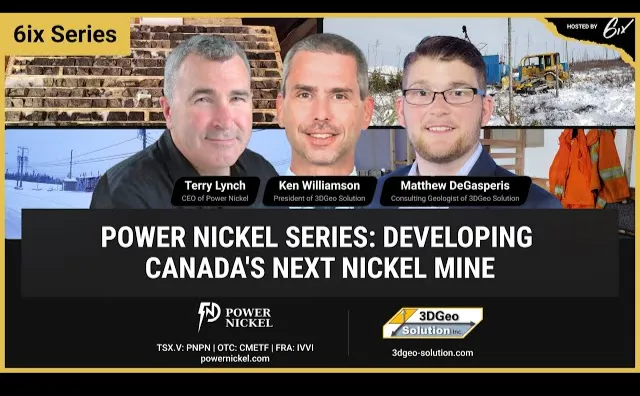
0:07 Hello everyone, and welcome to the first episode of Power Nichols' new monthly series hosted by 6. I'm pleased to introduce our speakers for today, Power Nichols CEO, President and Director, Terry Lynch. And today we're also joined by the President of 3D GeoSolution, Ken Williamson, as well as their Consulting Geologist, Matthew DeGasparis. Terry, Ken and Matt are gonna walk us through a company presentation and then we'll be taking questions live. I'd like to remind the audience that you can ask your questions using the Q&A tab found on the right hand side of the screen at any time during today's presentation. And as a note, because today's presentation
0:39 is the first of their new monthly series, with your registration and attendance of today's event, you'll automatically be notified for next month's episode. As always, this event is being recorded and is going to be available on six.com afterwards. Without further ado, Terry, I'd like to hand things over to you to get us started. Thanks, Ken. Thanks for having us here and looking forward to updating our shareholders and interested possible investors into Power Nickel and the exciting things that are going on in our company today. I'm very pleased to have Ken and Matthew on the podcast with us today. Ken and Matthew have been guiding Power Nickel ever since we acquired the deposit, you know, almost 2 years ago now. And when we had acquired the NIST deposit from Critical Elements, who was our partner, they had a lot of domain expertise working in this particular area.
1:34 And, you know, critical elements suggest strongly that we consider hiring them. And we talked at a meeting of the minds and I'm super glad we did because we basically had Ken and Matthew and their team at 3DGEO model the deposit from a 3D perspective for the first time. And then, you know, we'll sort of, you know, what we'll, we learned from that was sort of guided us on our exploration program, which has been very successful. So what I'll do today, our objective I would say today is just to give you a brief update of what's going on and then dive really into sort of a transparent discussion on the deposit and you know our theories on the deposit and what we've learned and what we're continuing to learn and and we'll go from there. The you know Ken and Matthew are also our 43-101 authors so you know they're not here to give stock recommendations.
2:39 Clearly, that's if anybody's job would be mine, you know, but today we're really just gonna be focusing on more of the deposit because, you know, I believe in mining, If you have a great deposit that can eventually become a mine you'll eventually have a great stock. And so what's most important for us as you know you know managers of a mining public company is to find a great deposit and to prove it up. And so that's what we're in the process of doing. And what today's conversation will be about is just exactly how that process occurs to help educate our shareholders and our interested parties as to, you know, what steps we're taking to de-risk and expand the deposit and to help you understand our approach and hopefully, you know, you'll like what we're doing. So I'm gonna, you know, without further ado, just go through a little bit of a slide deck, you know, very quickly, just to sort of position us as to where we're at in the world.
3:42 And, you know, sort of a little bit of a, I call it positioning piece. And then we'll get right into some questions that I'll ask, you know, Ken and Matthew to guide us somewhat on the mining side of things. And then ultimately, as this conversation goes and the audience listens and you have questions in your own mind, please, in the right hand side, there's a chat box there. You can enter questions and then at the right time, we'll take a break from our conversation and start to answer some of those questions. So the whole idea is to be a bit interactive here and to give you a chance to sort of you know talk to the people that are really guiding us and hopefully into discovery what we we believe will be Canada's next nickel mine.
4:29 So without further ado I'm going to don my glasses because sometimes this stuff gets a little bit detailed and Terry's old eyes can't see it. So I'm gonna skip past that. So where are we at? So basically we're at just South of James Bay in Quebec. And that's a really great area, geologically speaking. A lot of mineral activity up there. It's very charged. There's a number of Lithium mines being developed in the area. We're literally about 5, I guess maybe, 7 to 10 kilometers from the Namaska deposit and mine. Critical Elements, who we acquired NISQ from, is building the Rose Lithium deposit. That's probably, I don't know, 50 clicks away and Galaxy's building 1 as well. So it's a charged area. And what's good is, as these mines are being developed, it shows that it's possible to get permitting. And why is that? Well, a number of good reasons.
5:30 1, Quebec is probably the most pro-mining jurisdiction in the planet or one of them. It's certainly in northern Quebec, the Quebec government's done an amazing job of engaging with the indigenous First Nations communities and doing a good job of, you know, making them participants in the process so that we've got really great community support. The Cree, which is our local native partner and where our project is, is the very pro mining friendly. And that's really important in mining to have community support as it relates to getting permits and ultimately to build these things because there's no point in discovering a mine if you can't build it. And there are spots in the world where that's possible and it's too hard to find it if you can't build it. So we're blessed to be in Quebec and in an area where that's possible. The other thing that's important to note is that, you know, we're literally across the road from a major hydro Quebec substation.
6:29 Why is that important? Well, A, there's a road to our project and in many places in mining you you have to take Helicopters and you know, it's it's super off-road vehicles And it's the more you have to do that the more expensive it is to explore and develop so the good news for us is we can drive off the road to our project and we can drill it. Our drillers can actually go back and actually stay at a local resort overnight. So it's one of the, you know, in my years of mining, one of the best sites I've ever been working on in terms of logistics. So that's really gonna be important as we go forward in terms of developing the mine, exploring the mine in a cost-effective way. The fact that we're across the road from the Hydro-Queque substation, it's also important because, you know, ESG is a big part of the world today.
7:19 And that nickel, the very fact that nickel is hot right now is in large part because of ESG and the electrification and the greening of the power grid. And people wanting to drive electrical vehicles and not fossil fuel vehicles. So obviously having a hydro Quebec substation right across the road means it'll be very possible to make this nickel mine one of the greenest in history if not the best. So and quite cost effective because Quebec hydroelectric power is amongst the best in the world and the most cost effective. So those are all subtle, significant positives, I would say, to the location. And I think it's sometimes we forget these things, we don't really emphasize them a lot, but if you were to pick a spot to make a discovery and make a mine, I would think here would be as good as it gets.
8:09 So now what do we got? So the guys actually, Ken and Matthew, were the authors of this, And this was the first initial resource. So you can see it's generally about 4 million tons if you add them together, all the various indicated and inferred. And generally speaking, it's about 1.25% on average, nickel EQ. And we think there's, and we took a very conservative base case using $8 nickel. And there's PEAs that have been done since we've been published ours that have used 960 nickels. So obviously 43-101 wise, we could have done that and that would have boosted this thing to 5 million tons. But we kept it at 8. And the reason why we did that is
9:04 the company we'd like you to think we're gonna be like when we grow up here is Talon Metals. And maybe we'll switch to this next slide since that has them there. So this is a comparison of what I would say is our peers. Nickel sulfide deposits of 1% EQ or better. And the point I would make here is we're right now the cheapest, i.e. We're the least expensive. And Talameles is the most expensive. So we're getting a little over 10 cents a pound of nickel discovered in the ground. Talameles is getting more than a buck 20 and these numbers are dated. I think they're up significantly since then. The point is, generally speaking, we're cheaper than any of the other deposits. And I would argue that we certainly feel like we're, of them all, we're very bullish on our abilities to get to be commercial. What that slide shows is that Tala Metals is the only deposit at the moment that the market thinks is going to get commercialized.
10:08 And as a result, they're getting rewarded with a fairly high price, north of a dollar a pound for nickel discovered in the ground. So as the as the as the, you know, investing world becomes confident, this mine will become commercial. We're going to trend towards that number. That's just going to happen. And because there's no reason why it wouldn't happen. We're in a we're in an easier jurisdiction to build than telemetals. We're a shallower deposit. So there's no other, you know, owies out there that would come and bite you and say, oh, well, there's something we don't know. No, everything we know is even better really here than there.
10:46 The one thing is there, you know, the market is waiting to decide, yes, this is gonna get commercial and should get rewarded with it with a bigger price critical discovery. When that happens obviously that will have an amazing impact on our stock and we believe that's going to happen soon. And that's why we're communicating the story such as we are now and why we're drilling again. So the deposit itself, this is what it looks like from an isometric view. And I guess what's naturally drawn to your eye is this white section in here. And you say, well, why is that? And generally speaking, it's just because we didn't drill there. So we'll be drilling there in this round as part of our infill drilling programs. And this is just a view of the inferred and indicated side of things. Again, just showing the gaps that can be infilled. So we will, you know, is it likely there is ore between these spots?
11:43 Highly likely. Nothing is for sure in this mining industry. There can always be some faults in here. We don't know, but highly likely that that'll get in this round. We'll be able to tap that out and add that to our deposit. And that's fairly low risk drilling for us. The more exciting part of where we're going, I'll just skip that for a second, is we see this inverted V here, and generally this red dot here, that was our best intersection, sort of 2.5%
12:15 plus nickel EQ, And we're stepping out from that in a number of different ways just to see where it goes. And this is when we're gonna start to chat with the guys in a second about the deposit and why we're doing certain things because I'm not a geologist. My mission is to make sure the company's adequately funded and we hire the best people to grow this deposit and find it and that's what I've done. And the guys that we're actually looking to guide us are the guys we got on the call right now. We're gonna talk to them. In fact, we're gonna step back to this one slide because I'd like them to position, I'd never drilled nickel before. Nickel is a new mineral for me as a investor and as a mining promoter.
13:04 And I've always been sort of in the copper or gold. So with nickel, it's a little bit of a different, there's sort of sulfides and laterites and there's class 1 nickel and other nickel. So there's some interesting things. One of the things I learned, and you know, we'll start maybe the conversation with Ken and Matthew now, is that when you have a nickel sulfide deposit, historically speaking, around the world there's many of these and the particular type of deposit that we believe we have here is called an ultramafic deposit. And examples of that would be Lynn Lake in Manitoba, which is around 22 million tons and Voisey's Bay, which is obviously Newfoundland and Labrador that is plus 50 million tons. Those are ultramarine deposits. So we feel that this is what this is.
13:54 And so the this, you know, these particular areas, this is where we're drilling right now in NISC, Maine. And you can see, we've seen some similar geophysical anomalies here. And what we know historically in the world is that when you make these discoveries, the ones that, obviously the ones that are in production, not a single one that's been in production that's just 1 deposit. There's always multiple deposits. So we're obviously we're exploring NISC main and we'll get into that in some detail. But it's highly likely there is other spots. So guys, I'm gonna come to you now with a sort of a, you know, give us a little, you know, I'm giving the people a bit of a perspective of what I understand on nickel sulfide deposits and why there's multiple things, but maybe let's turn it over to you and you can guide us a bit more on these types of things. Ken, maybe you can start with you. Yeah, I'll go ahead.
14:46 First of all, by mentioning that your description of the the situation is pretty much what it is theory on in the field In the sense that the the NIST deposit itself is a sulfide related nickel deposit
15:02 Some questions were asked way at the start of the project. Was it the Nuxite-style deposit, which is completely different? But no, we're in the Abitibi here, our Archean Age rocks. Very typically what we could get in such environments are ultramafic flows that will typically, you know, be extruded from a volcano or something like that and you end up with massive lava flows on the ground and the nature of the thing just makes it such that heavy minerals or heavy metals, nickel and chromium and things of that nature
15:48 will have a tendency, just it's not the right terms I guess, but will have a tendency to sink at the bottom of them flows and will concentrate themselves that way. So that's the natural process of creating such a nickel-rich lens, I guess, within such a lava flow. And we think that the ingredients are all there at NISK to concentrate Nickel in such a way that it could become economics. And the study we've done recently with that 43-101 reporting and mineral resource estimates is confirming somehow that there is a deposit there. We can now say it's a deposit post MRE.
16:42 And it is a deposit of, I would say for now, due to the very little amount of drilling so far that there has been done in the deposit itself, it's a fairly significant-sized deposit as well, in the sense that the location of it closer to surface is a game changer in the resource itself. As you did mention, Terry,
17:10 it's a combination of really good factors here, but the presence of that mineralization closer to surface allows us to split the deposit type in terms of mining into an underground operation versus open pitting it. An open pit scenario is a lot cheaper. And so it makes it really good. And because of that, what we look at now is we know we have a deposit, we know we are going through that lava flow, so to speak. Now the idea is to find out where are those better concentrated lenses of nickel in there. And as you did indicate, there are from geophysical work and geology work done in the past, indications that it is not the only lens that we have to deal with. So NISQ-Main is what we've worked on so far and defined the resource on.
18:14 But definitely from the image we see on screen, there are those little hot color blobs that we see are good spots that we will follow up on. And with the hope of discovering something very similar to NISQ main in those other areas. Very, very well said. So without further ado, Matthew, we're gonna put you to work here too. This is sort of a interesting slide to me when we were first discussing, you know, how does this deposit work? You know, where where where are we going to find the prize and why? You know, and and so this is sort of the current thinking.
19:00 And the the purple
19:02 circles you see here are actual drill targets that we're drilling on in this campaign as we go forward. And the way, and these other lighter grade ones are permitted areas for us to do more drilling because the neat thing about nickel that I love is that you pretty much know when you're drilling if you're in the sweet stuff. And we've got the XRF machine on site and the rock that we're looking for is very distinctive. So you get a sense of it. So but as we're drilling in here, it will identify possibly other drill targets for us to follow up on with more immediacy than others.
19:49 And that's sort of why we laid this all out. But Matthew, why don't you walk us through what we're thinking of here and what we've discovered and when you guys were modeling it, how you came to this theory of this is the NIST main. Yeah. So basically, the NIST main block model is presented here in the base case mining scenario. And then overlaying in red show high grade trends, which are based off of variography. And it's interesting to note that those trends line up with how the mining methods, the DSO shapes were modeled with the engineering firm. So it lines up quite well, which validated our variography work.
20:40 And then, so the plan for the drill program was to do a combination of infill drilling
20:48 and then step out as well to identify potentially the west target and then further on the wildcat targets that were previously shown in magnetics. So the blue dots there represent the current drill program. And currently we are on, I believe the third hole and we are working on the infill gap there in the central portion. The idea behind starting there was to give the team on the ground a better sense of the rocks before stepping out further. And then we will continue to the west side. So targeting at depth near the central High grade hit that what we had hit in December 2021 Down at the depth down at depth there.
21:43 Yeah to the left So the goal will be to continue toward that way. And then hit a couple of those step out targets in the West zone target. And the idea behind there was to step out from known high grade intercepts, 50 to 100 meters. And then, so we currently have 5,700 meters permitted or planned for this program, but in total we have over 30,000 meters permitted, which gives us the option to modify on the fly as we go, and then also to drill more if we're capable of financially.
22:32 If I may just compliment on that Matthew, thank you very much for the good description. I just wanted to add here that if we recall one of the slides from before showing the categories, where Terry was describing that V shape which is empty in the middle. What we need to realize here is it's empty in terms of a resource. I mean we had to declassify those blocks as being some sort of a mineral inventory from now on, because the drilling density was not high enough and sufficient enough to categorize that portion of the resource as a resource. But that doesn't mean that the mineralization isn't there. I mean, we have drill holes confirming that there is Nickel actually in that gap area in the central part of the NISK main deposit. It's just a matter of drilling that more to be able to reclassify
23:37 them portions of the resource to hopefully an inferred at least or up to an indicated resource category. Thing is, we have to realize here that it's a little different than a Gold deposit where you'd have tiny veinlets that you chase and then continuity is a big thing in Gold deposit. Here, due to the nature of that deposit, we were discussing about major lava flows or a sill of a major importance with accumulation of Nickel in specific spots within that lava flow. Well, continuity is a lot, lot greater naturally here in Nickel style deposit than what it would be for Gold.
24:26 So that to me is an essential component that we need to understand in the sense that, you know, drilling here should show lots of continuity unless we are hitting structures and unless the deposit gets cut by something that is external to the deposit itself.
24:52 We believe that this will happen on both sides of the NISQ main with a couple of structures that seem to have major impacts on the location now of that same prolific unit. But with the indications that we have from magmaps and other geological information that we've gathered from the past drilling and that we are gathering in the current drilling phase too. That's the other component I'm going to touch base on in 2 seconds. But we are positioning ourselves to better understand and better define where to drill next, after, on outside or past them faults. So what Mathieu described as being NISQ West's gap in the NISQ West extension area, are areas like that where we have indications that the lens is now there as compared to where it was with the the main lens.
25:56 Historical holes have shown little sniffs I guess of nickel in there so that's why we've we are targeting this. The wild-card targets to the east will be the same thing.
26:11 Good sniffs that we have, so it's really good education guess that we're taking by setting up a drill up there. And what we also need to realize is the more we'll drill, the more educated guesses like that can be made, because the more information we get, the better we'll know where to drill next. So, essentially what we're doing here, I think, with Thierry, in collaboration with Thierry and Power Nickel, is to be using the study we've done for the mineral resource estimate, trying to learn the most that we can out of that and then reapply that science in the field, in a real-life situation where we can actually guide
26:58 the drilling operator and Terry as far as from that resource work and with new data that we're throwing in there, we can update that thing live pretty much and deciding the day after where to drill next. And that's basically that end-to-end
27:20 relationship that is happening right now. Yeah. So, sorry, it's a little bit outside of the topic there. No, no, no. I think that's all good information for the audience to get. And it's good. It's always good even for myself to listen to it again. I sort of in my mind's eye sort of when I talk to people and I describe the deposit, I say well it's like a river and the river winds and it bends And sometimes it can come almost back on itself and there's shallow parts of it and there's deep parts of it and there's narrow parts of it and there's wide parts of it. So it's very much like this, lava flow was effectively a river back in the day, I guess. And so it can, and that's why when I asked last, when this program was put together and I look on the screen, I see, this is the red spot is that's what we want.
28:15 We want a lot more red spots on this this chart is that would make us all happy And so, you know, it's interesting work like we're you see how these 3 holes, you know are basically surrounding it But because we're you know, we think it's going this way, but we don't really know, you know And and that's that's the that's the reality of mining is that you know this sink we think it could be meandering down this way, but it could come straight down too. So that's why we have to sort of drill it.
28:43 And you know what, Terry, sorry I'm cutting you, but what you're saying is so true, but it's true both ways. It could go one way, it could go the other way, or it could go both ways too. We need to cover all options now in terms of where to drill next, internal to that ore body that we've defined, but also outside. That's another thing. And inside it, there are a few things that we need to achieve. We are focusing right now at following up that super nice intercept that we have in the bottom left of the defined lands with a few holes there. That should allow us to expand.
29:28 Now, that being said, in the core portion of it, there are some holes there. Some people may ask, well, why are you guys drilling there? It seemed to be already drilled. Well, those holes are meant to confirm and are meant to infill. So if it's too weak or relatively weak in terms of category, that it's borderline to be an inferred versus indicated or not even a resource, well we've decided
29:57 to poke holes there to answer those questions and not have that question anymore. And overall I guess the program is designed to, once we're done, and now I'm speaking as the resource geo completely independent, once we're done I'm hoping that we would have gathered different data enough, different style of data enough, based on our own recommendations, which should happen. But at that point, to be able to have a revamped dataset that will be a lot easier to play with and handle than the data set that we had initially which was somewhat incomplete and that's why we're drilling now and that you've drilled last year to complement that drilling pattern.
30:48 So personally I think we're on the perfect way to make things happening here, at least in terms of resource. What the output will be, I don't know. But Will that resource work be well done based on educated guesses and voluntarily drilling areas where the knowledge is weaker, such that we can
31:13 de-risk that project? That is essentially what Matthew and I are aiming for, de-risking this, because we've demonstrated it's there. So let's de-risk it and let's grow this if we can, you know, so is the overall strategy I would say. So this is another slide, another way to look at it is in this just sort of touching, gives Ken a bit more, you probably can see it a bit better with this slide, the purple holes and this is the area he was talking about, drilling in there, the infill drilling here, just to sort of categorize this particular deposit. In addition to obviously exploring this and exploring this area over here, which are probably going to be more promising from a growth perspective. But you got to do all these things in order to make these things come to work. Because, you know, at the end of the day, this is 1 pod, we hope, and obviously,
32:10 it's the only pod we've got right now. But in all likelihood, you know, there is going to be another pod over here to the left or to the right, or possibly, you know, a kilometer away. We don't know, you know, this is the nature of these
32:26 nickel sulfate deposits is they generally congregate in a reasonable geographic area. And in what you, you know, that typically there are 3 or 4 pods. And it's like, I remember having the conversation with Ken and you were saying, well, historically, that this is what happens in these types of deposits. You'll have, you know, multiple pods. And then, you know, what are the odds that NISQ main was the best one? Well, I mean, the math of it, if you find 4 pods, or that we find one, well, the odds that this is the best is 1 in 4, you know, because that's, you'll know when you get them all open and identified. But I mean, it's what's good, you know, as a mine promoter, somebody who's trying to basically prove to the market that this will become a commercial mine and as a result, enable us to get the resources we need to actually, you know, show that in a more proven way, you know, scientifically through advancing the 43-101 process, you know, and updating the mineral resource estimates and ultimately doing PEAs and PFSs and
33:31 et cetera, is you gotta, obviously you have to have raised significant capital to do that. Well, you have to de-risk it. You have to show the market that it's worthy. And this is the work that will get us there. And, you know, we think, you know, with, you know, obviously there's a very good likelihood after this round that we'll be able to have a nice resource estimate and that'll put a smile on her face. We can't ask Ken and Matthew to give us that number because they're not Nostradamus. You know, they can't predict that and they would lose their license if they did. So that's not their gig. But I mean, obviously you can, you know, just as reason, you know, people, we can look at this graph and can sort of see there's a lot of potential to add more area underneath this graph, you know, that's going to get, you know, coloured in because the drilling will have confirmed that resource is there and then they can include it in a resource estimate. And as we step out from the red spot here and hopefully find more red spots around here, then obviously that can be added too. So we don't know if that'll happen, that might be the only one. But the gods are,
34:47 we're hoping we'll be more generous and that this will be a bit of a red area. And so I personally think that the 1.25% we're at now is sort of not where we're gonna end up. I think we'll end up at a higher grade as we go forward.
35:05 As we just step back there, Ken touched on it a bit, was the nature of how we see developing this thing is initially an open pit at the top and then there'd be a couple of declines. So the declines might be these areas here to be determined by the drilling course. But to the extent that we could do that, That would be a very economic way to go at this mine. That's the way we've been thinking about it, both the engineering firm and ourselves. Engineering firm, by the way, was in a big explode. They did terrific work for us in no time.
35:50 So I just wanted to thank them for that live. Yeah, so it's split in 2. Typically what we'd do with that in real life would be to excavate the top portion first, and then from the bottom of that pit ramp down, and for cheaper, get that underground resource out of the ground. Now the thing is for me, and we've discussed about that, you and I, before, but if we were able to discover parallel lenses near surface, good or bad, I mean, they could be tiny or big, bigger would be better, but say just tiny few lenses that could contribute somehow to the economics in the in-pit portion, that could be also a game changer in terms of economics for the project. So what we've not talked about in great detail, I guess, but that geologists here working on the project are keeping in the back of our head is that we're drilling.
37:04 The main targets are obviously the main sulfide lens that we're trying to reach there, but obviously anything else that we see from surface down to there is of importance. So you alluded to XRF that is on site right now. Things like that. Well I'm not gonna go in great great detail but let's just say that GeoVector, the consulting company that is taking care of the drilling for you and for us, is there in the field trying to gather as much data as we can right now, which is totally what they should be doing. I'm totally, totally happy with that. In the sense that, you know, the nature of the deposit, the more data we'll gather, maybe it will become possible at one point to identify where we are in the stratigraphy of the deposit by drilling using XRF and characteristics of them units and whatever else.
38:09 And that would make our life, you know, targeting things and defining where to drill next and things a lot, lot easier. So at this stage, I guess the resource component is super important to keep in mind. Yes, we've done a mineral resource estimate especially for that. But also what we need to realize is that in parallel to all of that economic related work, There is a lot of good geological work that people will never hear of, probably, because only geos will get interested by that. But at the end of the day, all of that information is somewhat digested by us and incorporated into the resource estimate that we've done. So we've done that initially and we'll continue to do that and with the more and more precise and you know I would say deep information that we gather from the deposit with more technology being involved.
39:09 And we're thinking maybe enhancing the surface, the surface mapping by flying a LIDAR or geophysical stuff, or we're defining this right now. But all of this is aiming at 1 thing, is de-risking the mineral resource system. That we'll end up doing in a few months from now, like the update. We want to gather as much as we can, such that we can take the lens itself, but surrounding this with geology information to help us out, either at discovering a new one or help us out doing real good work when it comes times to actually deal with the NISQ lens itself. What I mean by this is, thinking in the future, we're right now gathering information about rock density, hardness, things like that, that could help out should the project become a real mine at one point.
40:12 You are wishing for that. I cannot say that I wish for that, but let's say we all need that to happen. Well, things are going to have to get prepared in advance. A lot of engineering is going to get done in there and things like that. So even if we are at the resource stage, I think it's important for the audience to understand that Terry and I and Matthew are looking at this with a few years, a couple of years in advance and we're planning now what should be done in 2 years from now, should it be successful and positive here. We just don't want to miss that dream. So all of this is going to be tackled at the same time, I would say. So not only the resource and drilling, but the whole thing is as a whole. You know, what's interesting and why we're having this conversation in a transparent way, we're obviously trying to educate our audience as to the deposit and how it looks now, how we're seeing it, how we're exploring it, you know, to help them understand, you know, how these things are done, you know, and it's like, you know, you mentioned, and it's important, GeoVectors are drilling contractor, and drilling contractor doesn't just drill, they're actually as a geologist on site, a very capable, Eric Herbert doing a great job out there.
41:43 And their job is obviously to target the drill holes on the coordinates that are provided by Matthew and Ken based upon their modeling. But what's interesting, working through the process, it's an iterative process because I know Eric saw some ultramafic rocks on surface that he communicated to Ken and the team saying hey guys you know we've got you know these these rocks on surface here maybe we should angle the hole a little bit this way to intersect that that ultramagnetic on surface so that we can still get to your target but let's let's let's check this ultramagnetic out that's on surface. You know, just picking up into Ken's point of, obviously to the extent that we could, you know, find some more lenses on surface that are higher grade or add to the deposit or whatever, it would certainly improve the economics. And those are the things, those are the little things that make a big difference in making economics work on these projects and adding resources and it's all part of the, you know, the science of developing and exploring a mine And it's interesting to see it in real time and be part of it.
42:50 I mean, unfortunately, a lot of the, I've been looking for gold and copper, which is a different beast than this. And it's much more difficult, I find. This is like an interesting, maybe I just, you know, obviously we're lucky here. We've got a, we had a, you know, a historic deposit of work where we believed it was actually true and it turns out it was. But it's been interesting to work with it because, you know, you're actually able to sort of chase down these leads in real time. And the neat part about people want to maybe, I didn't know what an XRF was until I actually saw 1 at PDAG. And basically an XRF is just, think of it as an x-ray gun for minerals really that it does a Like a like like a beam of light over a particular section of a rock and based on that can give you You know the mineral ology of that rock for that beam Okay, And that it doesn't mean that the whole thing is like that. It just means that one beam has these particular characteristics.
43:54 And it's just it does help you in this case, you know, with the nickel sulfide to know, hey, are we still in the charged portion of this body? And if we are, then great, we can keep on going because generally the stuff will continue to flow. But that's what we mean when we say XRF. And these are the tools that the site geologists can use to get early data and feedback to Matthew and Ken who can then sort of say, okay, well, that's a check mark there. And that may help them in their modeling as to interpretations as to what does that mean to them and to us, you know, in terms of advancing forward in the least risky way for it.
44:41 You know, I mean, always when we're spending money, as we do in mining, chasing these things is we're trying to do things with the least amount of risk. It's incredibly risky business. Most of the time, you're coming up with goose eggs because Mother Earth doesn't give it up very easily. She's very difficult, but that's her nature. But she does share her clues, and she does give you the scientists. And what I found is that work, because obviously, I'm not a scientist. I've worked with a lot of geophysicists and geologists over the years. And I found that the good ones are scientists, but they're also artists. They have a somewhat of a feel somehow. I don't know, it's one of those things you can't teach. It's like years of reading and research, whatever, have given these people a sixth sense, if you would, of where the rocks are flowing, where the good ones are. And luckily, I believe Ken and Matthew actually had that, and we're blessed as a company to be able to have retained these guys and have them giving us advice, because they're guiding us in a great path here where you know the last round we hit 7 of 8 holes where we hit our target which is man you know I've had entire drill programs where if we were got one out of the 20 holes we were you know because at least you got something but no if you get 7 of 8 I mean that's that's ridiculous now obviously we were that part of the drilling was not aggressive. We were basically stepping out
46:13 from no one's box. But anyway, It was very, very impressive. And that's what it takes to find these things, is to try and follow up on these, get the data, use the science as best you can. And inevitably, we're gonna drill some, what I call them dry holes, but they're basically just holes that don't contain any nickel, you know, or what we're targeting, but it will still be helpful because it'll say, that's not where to go. You know what I mean? And so we'll know, okay, that's part of the education program. And Hopefully, you know, you know, in the early parts, because we're, you know, as a public company, super low market cap, we want to want to have more hits than than empties. But, you know, so that we can get our stock price up so we can do this more effectively. But generally speaking, you know, all data is good data. You know, It'll help us get towards the promised land.
47:06 And that's what you get the really great scientists like Ken and Matthew, and they can take that data and really help to guide the thing. And it's really impressive to see it in real time. Guys, it's been an interesting part for me because I'm, again, my first nickel deposit to be proving up and it's been a revelation to see how it's approached and how you interact with the geologists that are on the rig and at surface, and how iterative the whole thing is. It's exciting to see it. I can't agree more with that, Terry. Absolutely. The cool thing too is, you alluded to it, but it is a closed circle right now in terms of procedure.
47:55 From the drill rig to us, to you. And it becomes a full circle in the sense that people on the rig right now will inform us every day what they've seen, what they've logged, like the quick daily log and things like that. The nature of the beast here allows us, both Matthew and I, to pick that information and refresh the system like off the bat. You know when you're in massive sulfides intercept, so you can easily measure it's going to be from there to there, and although we can't guess what the grade of nickel or nickel equivalent is going to be within that given interval, for both Matthew and I, it remains possible to retweak the 3D model that we have in our hands right now without having the real values from the lab, it's been identified what the interval is. So nothing prevents us to be proactive, refresh the model as we drill it and, you know, if need be, tweak out those targets a bit. Then we're in contact with the guys in the field directly and they can make those changes.
49:10 The example you said with the Ultramafic unit being seen on surface, we were colouring just off it. We would not have seen it in the drill core without them guys in the field guiding us with that. It's a process that goes both ways. What they see in the field, we use it. What we see in the computer, we tell them. So we all are on the same page. Yes, it's very symbiotic. Listen, guys, I think we've done a good job of educating our investors and listeners. And I know there's some questions out there. So Cam, do you maybe, cause I think we're on here for an hour and about 10 minutes left or so. So maybe it might be a good time to, If there's some questions from the audience, let's get them answered before we're done here. Sounds like a good plan there, Terry. As a reminder to everyone in the audience, if you do have any questions, please ask them in the Q&A tab on the right-hand side of your screen. But first question up, Are you able to drill through the winter?
50:18 Yes, yep, we're able to drill through the winter. The only time you can't really drill here is in break up in the springtime, which is sort of, it depends year to year, but I would say mid-May to mid-June or something in that range? Is that what your view is, Ken? Absolutely in the hunting season. 2 weeks break, we are careful about our geologists there. We don't want them to get hurt. Frank wants to know if there are potentially different mineralogy and products with copper etc. Present. Have you started any metallurgy? And there was some historical metallurgy done, you know, very early on, very preliminary stuff.
51:10 Did you want to comment on that? Well, As far as we can tell right now, it is a multi-element deposit. You guys have seen on the slides nickel equivalent. It means that there is nickel, but there are also other elements that are worth a certain value in the market. We're talking, what are we talking? I have a great memory of Matthew. Palladium and platinum. Copper and cobalt. And copper and some gold, a tiny bit of it, and things like that. So it will depend. It's too early yet, I think, to discuss metallurgy in great, great detail. What we can say is it is a multiple elements deposit and likely depending where we are in that deposit the recipe won't necessarily be the same in terms of those elements that makes it as ore.
52:09 So the potential mill or eventual mill will have to deal with that depending what's thrown at it, the different recipes and things like that. But there are byproducts other than Nickel that contribute to the economics of the project. Yes. Great. Andrew wants to know, Terry, what cash resource are you going to need before you have an economic and commercial deposit? Is more inferred resource needed and further drilling? Yeah, I mean, basically, I would say the market would say as you get north of 10 million tons, you know, of, you know, north of 1%, you know, 1 and a quarter, whatever, then the market would start to perceive you as it being a commercial deposit then. I mean, still, market perception and reality are often different things, But generally speaking, I would say that would be the case.
53:05 I mean, ultimately, you know, the defined way you prove up a deposit is you go from mineral resource estimates to PEAs and then pre-feasibility studies and then feasibility studies. And each step of the way, you're de-risking the deposit in some fashion, whether it's through density of drilling or metallurgy or environmental permit risk or et cetera, till finally you get to getting permits. You know, each step you de-risk it, But the market often perceives risks in different ways. And generally speaking, I would say for us, as we get north of 10Mt, 8Mt to 10Mt, the market will start to say, okay, this is going to be commercial, highly likely to get commercial. And that would move the risk, you know, the value you get for nickel in the ground up.
53:56 No, absolutely. I think Ken needs to go at this point here. We do have a couple more questions though. Andrew has a follow-up, and this is in reference to sort of thinking about the Lassonde curve, but if you were the next Canadian nickel mine, when is that going to start? You know what? If you were to absolutely crush the ball out of the park, it could be 4 years, but realistically 7 years, you know, and quite often these things take 10 years. So, I mean, there's a fairly large spectrum there. I mean, you know, so, I mean, the good, what we got going for us is great jurisdiction, shallow deposit, relatively, you know, a great infrastructure. We can get to it off the road. The world needs more nickel. So, you know, the as long as we dot our I's and cross our T's, I don't think raising the capital to bring this thing to production is going to be a problem. We've got lots of interested Nickel consumers and Nickel producers, you know, wanting to, you know, engage with us right now. So this thing will go very quickly relative to most mines. Right.
55:01 Another question. Do you see positive feedback from your ESG programs? It's early days for us. Honestly, you know, I know when I'm talking to investors that they're moved by ESG, that they like that they're investing in an electric vehicle sector or the critical mineral sector or the better metal sector. So I know investors tend to like that. So, you know, that's all I could say on that at the moment. Yeah. No, fair enough. Terry, how deep is the NISQ deposit? Starts at about, I think, 80 to 100 meters, or we start picking up grade. And at this point, I think we've gone down to about, in the last round, maybe 250,275, and this round we'll probably get down to 400 meters.
56:00 And we're open at depth right now, so we don't know how deep it goes. Can you go anything further on that? It's about that. I guess the resource has been defined down until up to, what, 450 meters? Yeah, it's around 400, yeah. As far as we're concerned, mineralization outcrops, so we do see it on surface. So that's why there is an open pit there. And as you're mentioning, wide open at depth, no constraint or constraints vertically speaking, but a couple of faults to deal with laterally speaking. Absolutely. Another follow-up question to that is, what grade is NISQ and do we think that we can maintain or enhance this?
56:54 As Terry mentioned, nickel equivalent about 1.25-ish in percent in average. The picture we see on screen right now shows different colors in yellow, orange and red. You can see that the yellow color represents 0.5 to 1.2 nickel equivalent in percent but the vast majority of the The lens itself is more in the orangey color Which is more around that average grade that we see at 1.2% to 1.4% nickel equivalent. What's inside that white area, We would have not done engineering and then would not be 43-101.
57:51 So, take this with a grain of salt, we'd then be talking about a mineral inventory, not the mineral resource. But initially, the mineral resource was a mineral inventory and that white gap in the middle would then be filled with the same kind of grade mineralization. So is grade continuity there? I would say yes, grade continuity is there amongst all of the historical drill holes that we've dealt with or looked at. The new drilling confirmed continuity of grade, past historical grade, So there are no reason to believe that this would not continue at this point.
58:37 So drilling will confirm, but we have high hopes that grade's going to be there with thickness being preserved as well. So we'll see. Fair enough. Thanks, Ken. And for that matter, Terry, Matt, thank you both. Ken, thank you for coming on today. That's all the time we have, unfortunately. So before we wrap up, though, Terry, I want to pass things back to you just to close us out. Yeah, well, listen, you know, again, Ken and Matthew, thanks for coming on and helping us to explain the deposit and our approach to our investors and interested parties. Thanks so much for your work. You guys are doing great work and keep it up. We're cheering you on. In addition to paying you, we're cheering you on because that's your success is our success.
59:23 So we're feeling good about things at Power Nickel. We think we're doing the right things to move this deposit forward. And we know if we move the deposit forward, the company will move forward in tandem with it and we're expecting to have a really fantastic next couple of years. So if you're not into power nickel stock yet please check it out you might find it to be a great Christmas gift for you and it'll be a gift that keeps on giving I think. So I'll leave you with that thought and look forward to seeing you in a month's time and hopefully we'll have some update for you