Automated transcript · Written by software from the replay's audio. It can mishear names and figures; the replay is the record.
16:38 And I'll show you in a sec that 50m to the east were another fence of holes where we intercepted the same kind of gorgeous looking stuff with, remember, hole 44, 47, and so on and so on. So the zone is there, definitely, And we're very, very happy about it. So I'll just skip pictures, stop touching my mouse for now, and just switch screen. I'll present to you where are those holes live in the 3D setup. So here's my LeapFrog screen that you should see now.
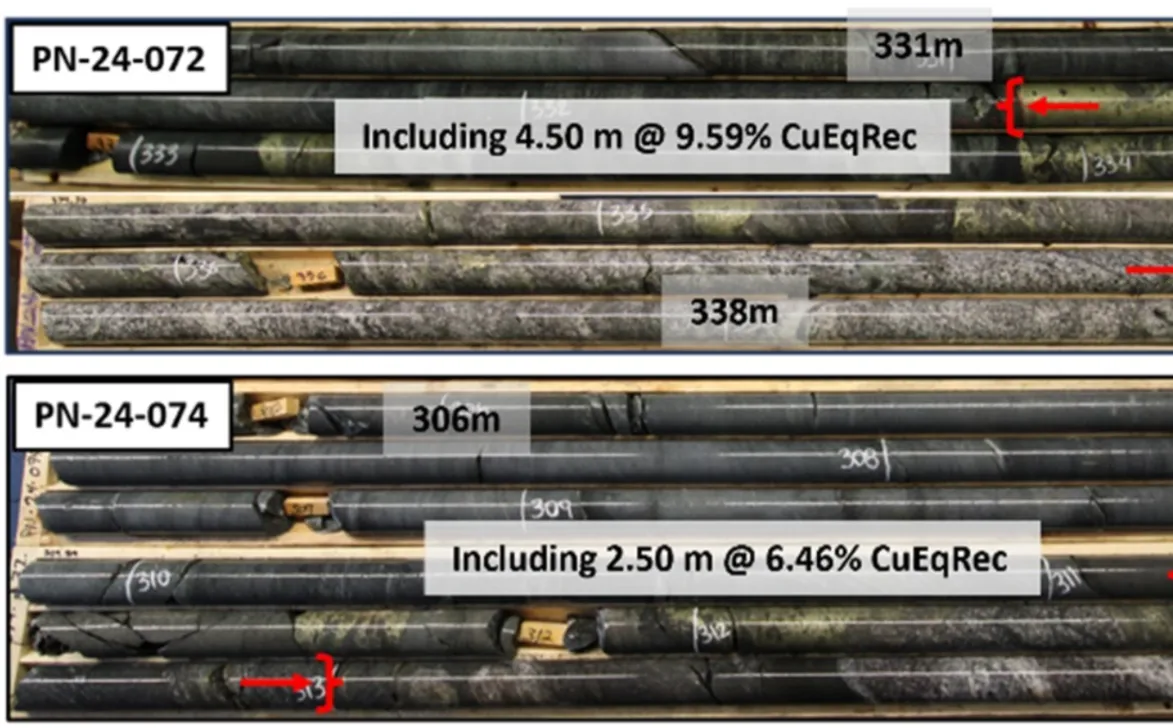
17:24 Yep. Okay, so I'm gonna zoom in on these. Those are the whole 69 in here, 70, 71, and the recently, the release from this morning just below here. So all on the same section, I've managed to do this that way. What do we see on screen? Well it's grade, the larger envelope here is the Copper equivalent that we're calculating for the press release purpose. And inside that blob, that yellow blob, what we have there, I'll just turn it off, what we have there remaining is the palladium content of the rock, or the sampling that we've done. So what I want to put emphasis on here is the fact that the the massive sulfide that we've just seen on the core picture is represented by those thick bands yellow and blue and orange bands that we have here and if you want to refer to the grade that would be the first colored thing there. So orange would be 5% copper equivalent and above, yellow is 2% etc.
18:44 It doesn't look that great but remind you this is the large composite like from where we start seeing massive sulfides to where we end seeing massive sulfides. But it doesn't mean that the rest in here, that the Angan wall or bit of foot wall ain't mineralized. It's just not part of the composites that we are releasing as the zone. But there is remaining mineralization a tiny bit in the footwall and a good chunk of it in the angle on the left side of the screen. So what's really interesting too in terms of geology here is the fact that the massive sulfide lens stays where it is. I mean, no big surprise there.
19:38 Very close association with the ultramafic contact that we have. That's the magenta or purple unit sitting at the bottom here. And as you can see, all of the massive sulfide hits are intimately tied to where the, that contacts located in space. So bracket here, we just define a correlation between geometry of the lens and geometry of the ultramafic contact. That we can model, that we can predict its geometry, that ultramafic unit, well, therefore, we can also predict where sulfides should be. Well, where is that contact, essentially.
20:28 So coupled that with the Dano-Lien technique, then you have a very successful recipe to discover where the next mineralized zone could be. You know, because what I'm saying here is it's a twofold effort, where me on my side with the help of GeoVector we're trying to unravel what the geometry of the rocks are, what is the architecture of the geology there, but at the same time, once we do that and drilling and using the downhole EM survey, downhole EM survey will give us geophysical plates like areas in space where to drill, that's excellent.
21:21 The 3D modeling should give us more precision on the geometry of that particular spot in space, per se, and therefore drilling it better, as simple as that. So, Back to the grade and things... Lots of massive sulphides and lots of PGE. We've put lots of emphasis on the fact that it's a polymetallic system for all of the good reasons that makes polymetallic very, very interesting. We're very happy about all of these, but that's not what I'm going to talk about. What I'm going to be talking about is a little bit more detail today about the distribution of the grade within those composites. And I'm going to try to convince you guys that those large composites aren't, you know, just an assay at the beginning, an assay at the end, and we kind of fudged it all up. No, no, no, it's continuous stuff. Well, the pictures clearly show that, but in case you want to have a demonstration with data, here we go.
22:41 So again, what I was mentioning earlier, those thick bars are the composites you will see in the table. So that's the large composite. If you read old 70 reported, I believe was 39.6 meter at blah blah blah, whichever grade, that's the that yellow bar that you would be looking at. If you look inside the table, we'll have includings and including this, including that. Those would be related to those thinner, I guess, little bars that you have inside. So for example, we probably have reported that wide distance, including a shorter interval, including a shorter interval, and within this, probably a tiny, tiny, relatively speaking, 2 meters wide spectacular interval type thing.
23:41 So it's all imbricated 1 into each other, but realistically the scale we have to look at this is about that scale now where we see the the sulfide band being tens of meters wide. So not the 2 meters super rich, it's 10 times larger than that. So copper equivalent, I'll just get rid of that and focus on the assay. It's the first time I'm presenting a bunch of elements side by side. I'm not gonna take lots of time doing that but still.
24:26 So let's start with copper. That's the reporting grade anyway. So we can easily see on that section here where copper is distributed. So, for the most part, at the bottom of the interval or the intercept, right adjacent or very close by to that ultramafic contact. And then we have disseminated sulfides and stringers and things like that. That would be that upper envelope that we're also including inside the zone. I'll tell you why in a sec. Well, it's PGE rich that guy. So, but still with a little bit of copper, which allows us to say that the zone envelope is that thick.
25:15 Now, talking about thickness, look at the attack angle, well that one ain't that good, but these guys, that guy, this guy, almost perpendicular to the contact. So, what you see in core is almost through thickness. So, there's no say, oh, it's down all length, it's probably half of that. No, no, no, no, it's down all length and it's probably 90% of that. So what you see is kind of what you get and we are doing that by purpose almost. You can see a bunch of colored dots here on top. Those are color location or possible color location. We're playing with this to making sure that attack angle will remain the best as possible with a few exceptions I have to alright so that being said true thickness almost what we see very good grade in copper what about the rest here in a BTB we're very intrigued with gold well here is gold on that section not very very impressive, but what if I click on this guy here and tell you that it's 16.2 grams per tonne?
26:31 That would make goosebumps in some of my friends that I know working in Gold mines right now. They barely get that kind of grade for Gold. So, mind you, if I was to just uncut the section, those are the gold hits that we had in a polymetallic system and all those gold things like 5 grams and above, 10 grams and above, it's not very rare at NISP, but it shouldn't be that rich. But that's the polymetallic nature of the thing. That's really cool. So now, what else? We can have a look at, perhaps, we've looked at gold, we've looked at copper, what about silver?
27:23 Well silver is a good indicator for us because silver seems to be kicking anywhere there is sulfides and or pgs So it could be palladium related or gold or whatever. There's gonna be that silvery kinda mineralized halo surrounding and wrapping the whole thing. That's cool, I'm using that for a guide, I guess, for modeling purposes. And now, what about Nickel? Well, NISQ main was a Nickel type system, where we believe it's part of the same system as Lion, a much bigger system, so there is some Nickel kicking around as well.
28:09 Now the grade is, I have to say and have to admit, almost better than what we had at NISQ. And NISQ main was a Nickel Lance proper with very, very interesting grade. Without Lion, we would have made a big story out of NISQ itself. But now that we've discovered Lion, it seems that, ah, forget NISQ, it's not interesting no more. No, no, no, no, it is very, very interesting. NISQ was something in itself, and now we're repeating nickel grade at Lion, and even better grades of Nickel at Lion. But I guess we're all blindsided by the high level content of the PGE.
28:57 So I'll start with Platinum in here. So you can see that, and again, the sulfide lens is at the bottom here, about that thickness, but you can see PGEs are bleeding way, way bigger envelope, I guess, than the sulfide lens themselves. And that's what Steve Beresford was alluding to as well. You know, in polymetallic system like that, we'll have a zonation of those minerals, starting from a nickel-rich core towards the PGE more volatile elements in the periphery of this. Well, mind you, that's likely a local example of the same behavior, where we have the massive sulfide lens at the bottom here, close to the contact of the ultramafic, and those more volatile, call it that way, PG elements, you know, a little bit further away, but still interconnected within the same system. And now, the last but not the least, Palladium in here, which shows spectacular grade. I mean, I've colored it here with 2 grams and above being magenta, but definitely my color scale now ain't working anymore because we will have a look at palladium values like 20 grams per ton, 30 grams
30:30 per ton, 45 grams per ton, it's just nuts. So I'll have to change that and readapt it for a more ounce per ton kinda color scale here, which makes me happy. Anyways, so that's that for that section, and I'll just put back the regular stuff. So, we've done this. You can have a look at pictures side by side, I guess. What I usually do, I have 2 screens in my setup here, but what I usually do is I would for instance that here is all 71 so all 71 is this guy here is it yep so That's this guy here. So what I usually would do is, side by side, having a look at those grade and trying to identify where it is, and then all of a sudden you enter that bottom portion, that's what you see here.
31:42 So there's no ambiguity. You know, grade is grade, but the visual ain't lying. So whatever you see at the bottom is going to be looking as this so that's what when we when we put out those pictures when we don't have the Assays as we've done 16 times. We're now 16 for 16 in terms of pitchers to good assay results. And Ken has given you a clear explanation of why that's so, because you can clearly see these are visual did ringers. Oh absolutely, absolutely. It's a no-brainer, it's a total no-brainer on that one. So and you can correlate actually, if I won't do the exercise, but it's really cool. I have pictures where the samples are being marked up.
32:34 You can actually look at the numbers, look at the visual. And right now I'm just playing with this. I'm kind of, as I was doing it, when working at the mine, trying to guesstimate what the grade's gonna be based on the visual. And that's really cool being able to do that because we can actually use the live data, no wait for the assay results, using live data directly at the drill to plan the next drill hole. So it makes our lives so easy. I mean it's the best of both worlds to me. It can't be better than this, in the sense that we drill, we find really cool stuff that makes Thierry happy, and me too, and all shareholders too, I hope.
33:30 But me on top of that, you look at the visual and you kind of know off the bat very easily okay, was it a good hit or no good hit and Deciding what to do with the drill after it's just a charm. It's it's Very very cool. Anyway, enough about my loving of the project. Listen, I think that, again, we want it just to come on and give you some perspective of what we're seeing at the drill bit and as we do it and the press releases and how they've gone. So I think we've done a great job. Ken, thanks for doing that. I think it was great. I'm always watching Dunkster. Thanks for stopping me, Terry. I just was in my frick. I would have gone there, talked to you for the rest of the day. Well, that's why we love you, because you love the rocks, man. And we love the rocks, too. So You're a rock star.
34:32 So I'm going to come back and maybe throw it out to the audience, see if there's some questions there. And if there's any questions, we could maybe answer those. Because we've got a limited, we've got to basically, we've got about another 9 minutes here before we have to decode for another event here. Right, just for people that came in didn't realize that Terry's in Zurich right now for the 2024 Precious Meadows Summit. Happy to moderate some questions. I'll fire them rapid fire at you here. As we go West, should we expect to find this additional 10 meter zone of high PGMs to exist? You know what, I mean, Again, what we can say is we've been doing the downhole EMs.
35:21 It's been very positive of what we'll find in the West. And we expect that we're gonna be happy with our results. That's about all we can say at the moment. CP focusing or asking rather, do you have ground EM for depth? We did ground EM. The challenge with ground EM at NISQ is there's a lot of hydro lines up there. So it really complicates factoring that noise out. We're doing some sophisticated noise reduction on that. So I would say it's being helpful, But would have been far more helpful if we didn't have the power lines. But, you know, it's sort of a blessing and curse. We got power for when you actually build stuff. But it is a bit of a challenge on the exploration side.
36:10 So thank you, Terry. Mike was wondering why are you going 250 meters to the east? Why are we doing that? I don't see it doing that. So you're not going east 250m? Yeah, at some point we expect to drill east, but Certainly right now we're focused on the West. Okay. Yes, part of the overall plan. That and deeper. Right now, based on Steve's Beresford recommendation for the down-hole EM and things like that, what we've found is it's a lot more advantageous for now to remain like short holes closer to surface.
36:58 The plunge of the ore, not ore, The plunge of the mineralization going westward, we thought it was going east before, but now it's clearly going west. What we decided to do is to punch a bunch of holes on the west side, down O'Lea'em, that define better targets while we're attacking the zone in better detail, I guess, 50-meter gridding approach at the same time in that same direction. Okay. Michael is just following up saying that in the press release it said East. But I'll have to take a read after. Constantine is wondering, hey guys, how's it going with the current program of the winter and when can you share the first results at its earliest?
37:50 Yeah, so generally, I think we've been giving guidance that by the we're hoping by the end of November or early December, we expect to get the first First holes of the winter program out. So I think that's Probably a good target. So I've been saying every 3 or 4 weeks get assays out So so that's a you know, we dropped today. So Give us 4 weeks and we'll have some more news And another individual is wondering if there's a timeline for drilling the other Wildcat in brackets Lion 2 question mark or Austin line You know what I think what we're doing focusing on right now is this westward extension, we'll definitely get to the other spot over there sometime in the fall-winter season, but as long as you can step out 150 meters and bang successful holes, you're going to keep on pushing that envelope because that contextually, again, very, you know, you know, sort of back of the envelope type math.
38:58 If you stepped out 150 meters from hole 70 and you hit another hole 70 like 32 meters of 7% that's like putting 350 million in mineralized metal in the ground you know in the in the ground so and you did it for a cost of a $50,000 hole that's how powerful that move is so obviously if you can spend 50 thousands and produce that much value in the ground, you do that until you can't do it anymore. So that's clearly what we're focused on. Excellent. Now, I know you're on a tight schedule here, Terry, so I'm going to finish the Q&A with combining these last 2 questions, as it's a nice way to end it. Considering the awesome assays, why isn't PowerNickel at $3?
39:45 And then another individual, Oran, is asking, you recently mentioned that the company is for sale at the right price of 2 billion, that puts share valuation at $10. Is that still the plan, or do you intend to develop the mine and produce? Yeah, you know, the context is always important in these answers. You know, somebody asked me, is the project for sale? And I just gave an example saying, hey, look, if somebody offered us 400 million for the project, I'd say no. If somebody offered you $2 billion for the project today, I'd say we'd have to consider that because obviously you're taking a lot of risk off the table and it's all about risk reward in any investment competition. So that's the answer to that question. The $3 thing, we disagree with you.
40:32 I mean, I would say the number 1 reason why our stock has not moved is we're being aggressively shorted. I mean, we filed a complaint with Ciro a year ago. We've actually got a pile more new data, new evidence that we'll expect to deal with in the next week to 10 days, further evidencing the malfeasance that's being allowed to happen to Power Nickel and many other juniors in our market, unfortunately. And there's just no question that that's, in my mind, the sole reason why our stock's not much higher. That being said, you know, we're up triple, quadruple where we were this time last year, so it's not been an unhappy sort of season. It's just that, yeah, the reality is, given the success of what we've delivered to date, value in the ground and this sort of thing, 1 would think we'd be worth a lot more. And we will get there.
41:24 You know, eventually we're going to crush these, you know, we call them get shorty. It's time to get shorty. So we're focused on that. But I think the spin out's gonna help there. I think there's gonna be some other things that are coming down the pike that'll be helpful. And again, at the end of the day, this drill bed is not stopping. And eventually, if you have a great resource, a world-class resource, which is what we're building here, you're gonna get a world-class valuation. So I think it's, if you're a shareholder now, fantastic. If you're not a shareholder, I mean, there's absolutely hands down, this is one of the great speculative plays in Canadian mining and in the world mining scene.
42:09 And you know, we're hearing that from many, many people. So it'd be a great time to take a look. And we think you'll be very happy with where we get you. Gentlemen, thank you for taking the time out of your day. I know you have places to be, but we do appreciate it. And thank you everyone that submitted the questions here. The replay will be available today. So keep an eye out for that, But thank you everyone for your time. Cheers guys.