Replay available
Pondy Oxides & Chemicals (NSE:POCL) Q1 2027 Earnings Call
Pondy Oxides & Chemicals (NSE:POCL) Q1 2027 earnings call, held 2026-08-05. Watch the replay and read the transcript on 6ix.
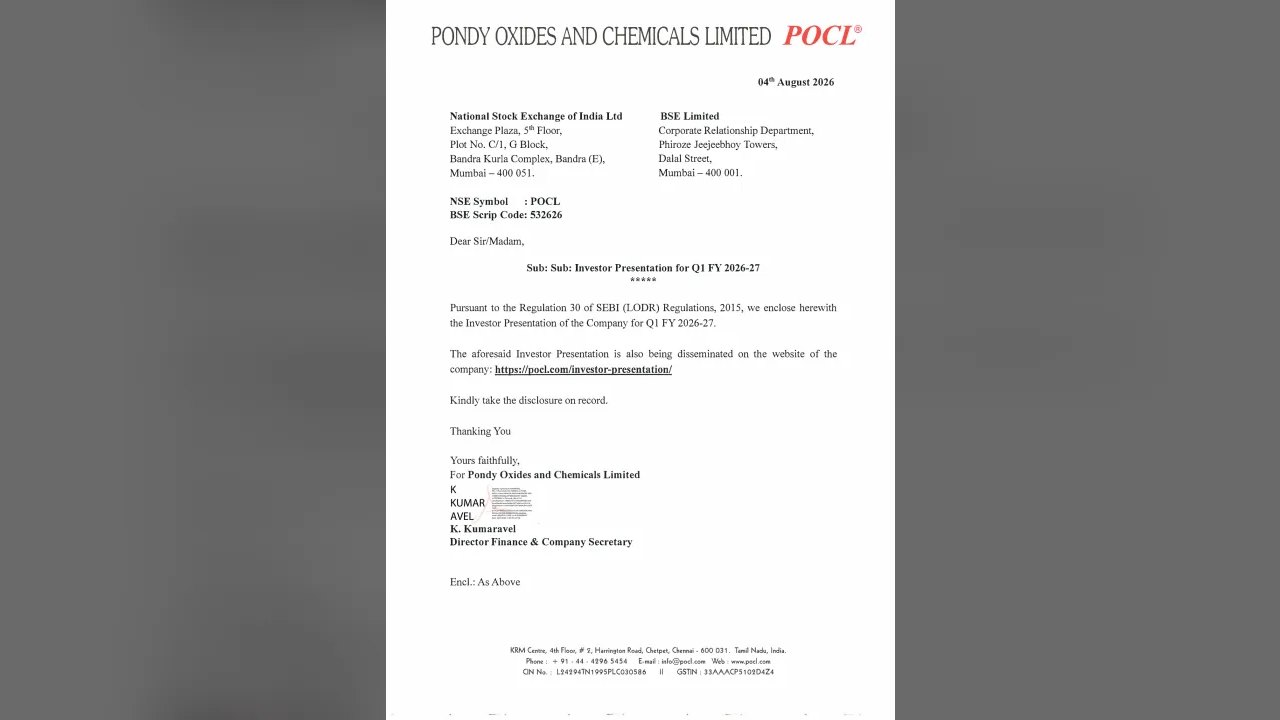
- Company
- Pondy Oxides & Chemicals Ltd. (NSE:POCL)
- Period
- Q1 2027 earnings call
- Date
- Wed, Aug 5, 2026, 9:57 AM ET
- Replay
- Watch the replay on this page · 57 min
On 6ix: 6ix.com/event/pondy-oxides-and-chemicals-limited-pocl-q1-2027-earnings-call
Replay
Transcript
Automated transcript · Written by software from the replay's audio. It can mishear names and figures; the replay is the record.
0:00 Ladies and gentlemen, good day, and welcome to the Pondy Oxides and Chemical Limited q one f y twenty seven earnings conference call hosted by GoEngle Advisors. As a reminder, all participant lines will be in a listen only mode, and there will be an opportunity for you to ask questions after the presentation concludes. Should you need assistance during the conference call, please signal operator by pressing 00 on your touch tone phone. Please note that this call is being recorded. I now hand the conference over to miss from Go India Advisors. Thank you, over to you, ma'am. Thank you,. Good afternoon, and welcome to Pondy Oxides and Chemicals Limited earnings call to discuss q one FY twenty seven financial performance. Today, we are joined by mister Ashish Bansal, chairman and managing director, mister K Kumarawil, director finance and company secretary, mister Aras executive director, mister Vijay Balakrishnan, chief financial officer, and Mr.
0:57 Gupta, associate vice president operations. We must remind you that the discussion on today's call may include certain forward looking statements and must be therefore viewed in conjunction with the risks that the company faces. May I now request mister Ashish Vansal to take us through the company's business outlook and financial highlights, subsequent to which which we will open the floor for q and a. Thank you, and over to you, sir. Thank you, Shana. Good afternoon, everyone, and thank you for joining us for POCL's Q1 FY 'twenty seven earnings call. I hope you had the opportunity to go through our financial disclosures available on the exchanges. I'll walk you through the key strategic updates, operational progress and financial performance followed by a Q and A session. We have started FY twenty twenty seven on a strong footing with Q1 FY twenty twenty seven revenue, EBITDA and PAT growing at 56%, 3032% year on year respectively.
1:50 I'm pleased to share that our copper vertical continued its strong momentum in Q1 FY twenty twenty seven, achieving the highest ever quarterly production and sales with both volumes increasing by more than three times on a year on year basis. These results reflect the strength of our integrated business model, our focus on value added products and our commitment to delivering sustainable and profitable growth. Before turning to the financial performance, I would like to highlight the key strategic initiatives that have supported our strong start to the year and are strengthening the foundation of POCL's long term growth and value creation. Our copper expansion project continues to make increasing progress. We are establishing a 36,000 metric tonne per annum copper cathode facility at our Telwar Kandige plant in Tamil Nadu a total investment of approximately INR 200 crores, fully funded through our internal accruals. We have already incurred around INR 25 crores towards the project and execution remains on schedule with major equipment orders finalized and key construction activities underway.
2:50 The first phase of 18,000 metric tons per annum is on track for commissioning by December 2026, with trial runs expected in Q4 FY twenty twenty seven, while Phase II is targeted for commissioning by Q3 FY 'twenty eight. This project marks a key milestone in strengthening our nonferrous portfolio and expanding our value added copper vertical. The facility will leverage integrated pyro refining and electro refining technologies to produce LME grade copper cathodes, further enhancing our vertical integration capabilities. Upon commissioning, the project is expected to improve our product mix, enhance margins and drive profitability through value added copper products. It will also create operational synergies, support import substitution, increase the use of recycled copper and further reinforce our commitment to sustainability and long term value creation.
3:39 The incremental 6,000 metric tons per annum copper recycling capacity commissioned in Q4 FY twenty twenty six has ramped up well and is expected to achieve capacity utilization of approximately 75% through FY twenty twenty seven. These investments will strengthen our copper vertical, enhance value addition and support our long term growth strategy. Chrysler has upgraded POCL's outlook to A positive from A stable while reaffirming its credit rating, recognizing its strong balance sheet and sustained financial performance. Building on these strategic developments and operational financial performance in Q1 FY twenty twenty seven reflected the resilience of our business and disciplined execution across the organization. While net production and sales volumes moderated during the quarter, There was a conscious strategic decision to prioritize value added products amid supply chain disruption and production constraints that enabled us to achieve our highest ever net EBITDA per ton of INR 21,595.
4:40 Copper production and sales volumes increased by more than 3x year on year in Q1 FY 'twenty seven, supported by the ongoing ramp up of the additional capacity. The segment delivered strong profitability with copper EBITDA per tonne rising 66% year on year to INR 48,488. Copper is expected to contribute approximately 45 of our overall revenue in FY twenty twenty seven as capacity ramp up progresses. Coming to financial performance. For Q1 FY twenty twenty seven. Revenue growth remained robust during Q1 FY twenty twenty seven with revenue increasing to INR $9.31 crores, registering 56% year on year growth. The overall sales mix between domestic and export markets stood at 5545%, respectively. And between the lead and copper verticals, export mix stood at 5525%, respectively.
5:31 Within the lead vertical, value added products accounted for 85 of the segment revenue, reinforcing our strategic focus on increasing the share of higher margin products. EBITDA and PAT increased by 3032% on a year on year basis to INR56 crores and INR36 crores, respectively. In Q1 FY twenty twenty seven, EBITDA and PAT margins remained strong at 63.9% in Q1 FY twenty twenty seven. On a consolidated basis, the same momentum continued with revenue, EBITDA and PAT increasing by 55%, 3343% year on year, respectively, driven by higher volumes, improved product mix and enhanced operational efficiencies. As we move forward, we remain confident in our long term growth journey. Our target 2030 roadmap is focused on delivering over 15% volume growth, 20% plus CNGR and revenue and profitability, EBITDA margins above 8%, ROCE exceeding 20% and deriving over 60% of our revenue from value added products.
6:32 The ramp up of expanded lead capacity, long term copper capacity additions, increasing contribution from value added products, forward integration initiatives and our continued focus on operational excellence and sustainability position us well to deliver profitable growth, enhance shareholder returns and create long term value for all our stakeholders. Thank you for your continued trust and support. I would now like to open the floor for questions over to you. Thank you very much. We will now begin the question and answer session. Anyone who wishes to ask a question may press 1 on their touch tone telephone. If you wish to remove yourself from the question queue, you may press 2. Participants are requested to use handsets while asking questions. Ladies and gentlemen, we'll wait for a moment while the question queue is handled.
7:26 The first question is from the line of from three sixty one Capital. Please proceed. Hi, sir. Thank you for taking up the question. Sir, you've guided in last quarter for around 1.25 lakh tonnes to 1.3 lakh tonnes of lead volume sales for FY twenty seven. So based on current quarter run rate, do you expect another maybe one lakh tonnes sales for next three quarters? Or do you see any revision of this? Good afternoon, Dheeraj. This is as you're aware, whole supply chain issues were getting I mean, through the quarter, they were a little constrained and that is the main reason.
8:14 And we hope to achieve and catch up to the volumes, but we'll have to see how the whole supply chain pans out over the next one or two months. And we are confident at least we will be able to close-up to the numbers that we had committed over the last quarter. Okay. And since you're importing majority of copper scrap, but copper has seen very good growth while there will be problem in lead industry. Could you explain briefly on why is this only being facing in lead recycling while not in copper? I mean, it more of the regional placement. So of course, we are also importing copper, but the copper material coming across from a few other locations as well and copper just started. So when you look at the volume growth, you look at multiple growth, wherein they're already being at very high volumes, you see that differential not showing as much.
9:16 I mean, it is more of a location advantage little bit and little bit to do with the supply chain from the kind of countries that the copper scrap was imported from. Okay. Got it. And do you see any difficulties or challenges being relaxed as of now? Or do we see this increasing going forward? And as of now, the status quo, and I'm not too sure, but I don't think it looks like it should increase more. But as of now, it's a little early to comment on the same. Okay. And last question, What is our capacity utilization for our new 72,000 tonne TKD of lead? And what is the one for 6,000 tonnes of new copper plant that you commenced last quarter?
10:07 On the new capacity, because here we mainly do more of our pure lead product. So the capacity utilization is below 50%. And as you're aware, we had concentrated more this quarter having lower volumes to keep up the margins more on the value added part. So almost 85% of our production has been from the value added production. Hence the new facility, the capacity utilization has been little low versus the other value rate has been a little higher. In terms of copper, almost 75% of the capacity is being utilized on the additional capacity added. So just a follow-up, 75% that you're seeing is on the new capacity that commenced in copper? Yes. Including the old and the new, 75% overall, this thing.
10:57 Okay. Overall. Okay. Thank you, sir. Thank you. Thank you. Before we take the next question, we would like to remind participants that you may press star and one to ask a question. The next question is from the line of from Spark Capital. Please proceed. Yeah. First of all, thank you for the opportunity. Sir, my first question was just a follow-up on previous participants on the lead utilization. I understand that the lead utilization is low of the difficulty in getting the scrap as well as in sales actually.
11:42 But I wanted to understand, is there a softness in the demand as well? Because we are not exposed to Middle East. We are more exporting to the European countries. So is there a demand slowdown as well as in the Western part as well as what we are seeing in the Middle Eastern region? Basically, first of all, exports are not to the European countries. They are predominantly more to Southeast Asia and the likes. And in terms of what you call demand softening, there's no demand softening, but there has been supply chain delays because of which the whole issues have been volumes have been lower and all of those.
12:34 Okay. So is there when do you see the demand on track at least in H2 or will the softness in demand continue in FY 2027 or late? Like I said, there is no softness in demand. The gap there is a gap in supply because of delay in shipments and the supply chain disruptions. But overall, the demand is intact. Okay. Fine, sir. My second question was related to our cost pressure, sir. The other expenses were up 16% Y o Y and 44% sequentially. So is this only because of this increase in the freight forwarding costs and the increase in the logistics cost?
13:22 Or is there something else also in this one? Logistics is a very I mean, it's a small part of increase, which is a part of it definitely is, but that does not contribute to the major part. The major part is contributed by the fuel prices and couple of additives prices that have shot up in the last three months. The next question is from the line of Norman. You will proceed, sir. Yeah. Thank you so much for the opportunity. So firstly, I wanted to understand that the current quarter you have attained the highest ever realization and EBITDA per turn on the lead side.
14:13 So what you will be guiding for the lead EBITDA per turn and the realization going forward? It's a onetime only. This quarter, is Vijay. So this time our value added mix was about 85%. So as we said in the past, whenever we do more of value added EBITDA range will be around 19,000 to 21,000. So since predominant portion of this lead volume comprises of value added, we achieved this volume. But moving forward, when the volumes increase, we'll be able to retain the sustained EBITDA level of about INR 18,000 to INR 20,000 per metric ton. That is a sustainable level of EBITDA that will be maintained. What you've done? '17 to 18, you will be sustaining a That that that is the number what we have guided. 18 to 20,000 rupees per metric ton EBITDA levels. That is a sustainable level, which we can, you know, attain moving forward.
15:12 Okay. Got it. Secondly, on the copper side plant, how is the CapEx going on and what would be the outlook like it will be starting your 18,000 tonne metric tonne, was expected to start in the September, right? So how is the CapEx going on on that side? Correct me if I'm wrong. Your question is what is the CapEx that's already been done on the copper part? And if as you are thinking it's September month, will it start in September? Is my question right, Am I understanding? Yes, yes. Yes, yes. So currently, machine all orders are in place and they're almost ready for inspection. We have spent approximately 25 crores out of this thing and the further part of spending will happen in this quarter.
16:04 Our commitment on starting the trial production was December 2026 and not September 2026. September 2026, the machine installations will start around September end and will take about October, November for the machine installations and the trial productions to happen in December, and which is on track. Okay. Got it. And lastly, if you can give the... What volume you are expecting on the both the lead side and the aluminum lead and the copper in... On the '27 and '28? We'll revert with those volume guidance in... Shortly in the future. Yes. Always. Okay. Yeah. Thank you so much.
16:50 You. Thank you. Before we proceed for the next question, we would like to remind participants that you may press star and 1 to ask a question. Participants who wish to ask a question may please press star and 1 at this time. The next question is from the line of Kush from GOG CMS. Please proceed. Yeah. Hi. Thanks for the opportunity. I just wanted to understand how much of the sourcing is coming from the Middle Eastern trade groups because it is not just due to the whole industry that has highlighted to the supply chain issues. That would be helpful. So our Middle Eastern procurement is well below 5%, but the issue more than the Middle Eastern procurement is the supply chain in terms of the shipping route that is through the and all of those which are getting delayed.
17:42 So that is the main issue and because of which the whole delay is happening. Sure. And if these delays process because of the x y z reasons, how do we try... Trying to mitigate it? We are looking at alternative sourcing as we have, and we have already started working on it from our Southeast Asia and other South American and other region suppliers, and we are trying to push for more supplies from these regions. Okay. But then that would be at the similar pricing that you are buying right now, or it could be at the higher end? Technically, it should be at the similar pricing, but it all depends again on the inward freight costs and all of those. So we'll have to see as the retail starts being offered. Got it. Got it, sir. And in terms of the plastics and aluminum division, where are we in terms of what is the ramp up, etcetera, over there?
18:38 So plastic division for this quarter, it has turned profitable. We have achieved about 15 lakhs in terms of profit, net profit. So we did about 800 tonnes approximately, and we are preparing for doing value additions in the quarters to come. With respect to aluminum, we are doing a small quantum about 200 metric tons. You know, that is what is the production right now in terms of both these verticals. Got it, sir. And one last question for the full year, what should be the expected valuation value added mix for leads? Because this quarter was extremely high at 85. Sure as things improve, it would come down. So what would be the sustainable mix of value added for LEN?
19:24 Yeah. Annually, we are looking at around 65% to 70% of the value added mix. Last year was at about 63, and we... This year, we are expecting and targeting around 65 to 70. Sure. And in Q1 FY twenty six, how much it will be? 85%. No. No. Last year, sir. So last year. Last year? Last year was about 55% approximately. Oh, okay. Okay. So it's a huge... Got it. Got it. Thank you so much. Thank you. Thank you. Thank you. Before we take the next question, we would like to remind participants that you press star at one to ask a question. To ask a question, please press star and 1 now. The next question is from the line of from Global Considine Resource. Please proceed.
20:16 Sir, thank you for the opportunity. My... Most of the questions have already been answered. So one last question is now on the CapEx side. The guidance that you have already, it was at least $1.75 per 4,527, which we have already disclosed in the investor presentation. So out of this INR175 crores, can you please break down that how that is the growth CapEx and the maintaining CapEx out of this? The current INR 25 crores is for the fresh CapEx that has already been spent. Out of approximately INR 175 crores, the maintenance CapEx will be in the range of $20.25 crores and balance from $1.40 to $1.50 crores will be for the copper new plant addition. Okay, sir.
21:04 Okay, sir. Thank you, sir. That's all I said, and best of luck for the future. Thank you. Before we take the next question, we would like to remind participants that you may press star and 1 to ask a question. The next question is from the line of Aditya from RIA Asset. Please proceed. Hi. Am I audible, sir? Yes. Thank you. Thank you for the opportunity, sir. I just wanted to understand on corporate, like, as we are ramping up our corporate capacities. From sourcing point of view, I mean, how should we think about copper scrap security? I mean, we are seeing that global supply is tightening, especially on the copper side as well. And more and more countries are looking to keep more of scrap within their boundaries.
21:55 So are we seeing any kind of sourcing problems, especially on the copper side going forward? And what is our take on that? So currently, most of our copper sourcing is on imports and little more diversified different countries than where we are doing predominantly. But we are also looking at copper from domestic sourcing, which would contribute about 25% to 30% going forward. And a lot of which we have also started looking at it currently. I mean, it has to be I mean, the sourcing model for scrap going forward will have to be extremely dynamic in terms of being able to quickly switch over to domestic and versus import. So it has to be a dynamic function of the whole process.
22:51 And as it goes as we go forward, we'll have to keep making it stronger. Got it. Very helpful. Just on the life side, we understand that it was it's not a demand issue right now, but majorly a sourcing issue like we are facing supply chain issues because of this Middle East crisis. But if this crisis persist, say, for the next one, two or three months, how are we planning to to, I mean, source our scrap on the lead part? Because, again, our lead imports are quite high. Yeah. Is when we say sourcing, it is more of the shipping delays and all of it which is happening.
23:37 And already we have started looking into other regions like the Southeast Asian region and little more on the domestic part of it. And going forward, I mean, those the specific shipping routes routes will have to be avoided. So because of it, there could be the selling time would be a little longer and maybe a little impact on the pricing in terms of raw material overall. But I mean, it has it will find its balance in the due course. I mean, it's not going to be perennial. Got it. Just one small follow-up on that. I mean, does that gain to working capital? So whenever there's a war, post war, the scrap generation is also at multifold due to all the calamities that's happened during the war.
24:28 Thank you, sir. Just a follow-up a quick follow-up on that. I mean, with Raj being elongated, does that stretch our working capital also? I mean, do we see that kind of working capital being stressed at least for the next one or two quarters? No. Our working capital is not stressed if you look at our current numbers. Our payment cycle is when the material arrives closer to the port, that's about a week before the arrival of the material. So that still stays in place. So that does not really has not impacted our working capital side. Thank you, sir. That's very helpful. Thank you. Thank you. Before we take the next question, we would like to remind participants that you have press star and one to ask a question. The next question is from the line of from.
25:17 Please proceed. Yeah. Hi. Thanks for taking my question, and congratulations on great numbers in the top environment. My first question is on the copper EBITDA per ton. If I recall rightly, I think last quarter, you had guided for 35,000 to $40,000 on a normalized basis before the value addition kicks in. This quarter, again, we have surpassed last quarter EBITDA per tonne in copper. So what kind of guidance would you like to provide before value addition for the copper EBITDA per tonne for the full year? Thank you, Sunil. You're exactly right. We had guided at 35,000 to 40,000.
26:04 But with our increased capacity right now from 6,000, the additional 6,000, we are able to get little more efficiencies back into our operations and translate that into the I mean, into the sales pricing. And also because of good amount of volumes, are able to compress a little bit on our working capital cycle in terms of overall cost on that basis, there was a we were able to bring down by a couple of basis points. And in addition to that, currently in this quarter, we also had a little run up due to the demand situation in terms of availability. So we are able to get little more premium on the selling side on copper. But nevertheless, looking at going forward margins on this, I mean, we should be able to do in excess of 40,000, which mainly is driven through the efficiency that we have gotten through our increased capacities and some machine additions and all of those. So we can safely guide above 40,000 would be for the part which was earlier 35,000 to 40,000.
27:18 And sir, on volumes also, think we had guided 12,000 tonnes per copper. Again, per quarter, we have done about 4,000. We are already at 75% utilization. So can we expect some more ramp up in this or should we expect that like 4,000, 4,500 should be the run rate in the new capacity can kick in? So we will have our new capacity kicking in the last quarter. So definitely in the last quarter, we will have the capacity benefit of the new capacity coming in as well. Till then, we will be pushing hard on the existing capacity, whatever we have and see what maximum we can do. Understood. And sir, lastly, just a question on copper. So right now, when we say copper cathodes right now, what... In what stage do we do the scrap processing? Do we just do the ingots or do we do the anodes also as of now?
28:17 Just wanted to understand that. Is anode is a part of the new project that's coming up. So from the scrap processing to anode, anode to cathode will be a part of the new process that comes. Currently, we are doing the basic pre processing in terms of shelling, chopping, sorting and a small amount of melting as well into some remelted, I mean, kind of ingot or fillet, but majority is pre milled condition, pre milled. So when we target Q3 FY 'twenty seven, 18,000 tonnes, that will be still cathode and not still anode. Is the understanding correct? The installed capacity, what we are establishing for 18,000 tonnes will be till the end product cathode.
29:04 Understood. And sir, lastly, any plans that you have formalized on forward integration from copper gator into busbars, wire rods or any value added products that you're looking at as of now? We are on the way of finalizing, but right now we don't have a confirmed product which we will be announcing. So closer to as we get to our final production stages on the cathode, we will come out and announce further plans of forward integration. Sure. And lastly, any update on lithium ion or we are still at pilot stage is there? Sir, Mr. Vaidy will speak a little more on the lithium ion. Yes. Hi. We are still the industry is still evolving.
29:53 We are still contemplating and working with some strategic technical partners. These are predominantly in India, only the LFP chemistry is available and wherein the recovery extraction is about 1.5% to 2% and rest, they are in self I mean, phosphate is not of much demand and much value. So we are just monitoring the entire the feedstock arrival and the other challenges like the evolving technology and other stuffs. So once we kind of convince ourselves in terms of what to and how to go about it, and we will surely let all of you know about it. Yeah. Thank you so much, and best of luck for future. Thank you. Thank you.
30:41 To ask a question, please press star and 1 now. The next question is from the line of Gupta from Swan Investment. Please Yeah. Thank you for the question. Yeah. I hope I am audible. Yes. You are. Yeah. Sir, I wanted to firstly understand, like, in this quarter, our lead value added mix was 85%, and that has been the historical high, I believe. So was this due to the supply constraints or is did our customers... Was it because of our customer demand? So basically, when we had some supply constraints, so we did discuss with our customers where we spoke to them and interested because they are customers who take the value added products are specifically dependent on specific suppliers for value added products.
31:37 So we requested them if they could take the basic pure lead and other products from elsewhere and change the value added products from us. So and we were able to convert those into, you know, broader. So if you see basically our value added products have been sold as they were in terms of volume, but since the pure lead volume did come down, so the percentage is at 85%. Understood, sir. Just a follow-up on that, like assuming the similar situation continuing in quarter as well. Do our customers have the bandwidth to accept more value added mix, value added products in late segment? I mean, I don't get the question. You mean, when do they accept more in the sense?
32:28 So, like, in this quarter, we did 85% of value added, which helped us achieve an EBITDA of 21,000 or 500 something. So do we have... Do our customers have the do our customers have the requirement of additional value added products in this quarter as well? Or... Because I believe that yearly, there is a certain demand that has to be met for value added, and post that, we can supply only alloys to them. Yes, sir. So I just wanted to understand, like, how can we immediately we can shift our value added mix that helps us attain higher EBITDA per ton. As in your answer, you said that this was a onetime event that because of supply chain issues, you requested our customers to get... To take higher value added products.
33:18 No. No. No. Again, I'll again explain the same thing to you. We did not request our customers to take a volume of added products. We requested our customers to take the basic product from any other supplier because that's more easy to procure, wherein value added products are supplier specific. So when our volumes of the pure lead drop, in totality, if you see the percentage, it was 85%. Understood. Understood. So we concentrated to see that we don't drop the volume of the value added products from where it is and rather drop the volume of the lower profitability products and continue with whatever best we can do in the amount of raw material that was available at that point in time.
34:05 Understood, sir. And just just one last question. In the last con call, there... I guess there was some receivables around $110.15 crores that we had to receive in April. So what's the status on that? And That was that was received that was received then it was saying that it was received on April 5 itself. During the con call, it doesn't result in negative cash flow was due to there's a vessel delay, which moved just supposed to be around the last week of this year and moved to April one, two. Hence, we received that payment on April 5, and that's what showed the cash flow to be negative, but that was received on April 5. Understood. So so how... What's our... At the end of the quarter, what is our working capital cycle? Currently, we are at forty six days. Rest of fifty three days a year.
34:52 Right. Understood, sir. Thank you so much. And then positive cash flow as well. Yeah. Yeah. Thank you, sir. Thank you so much. Okay. Thank you. The next question is from the line of Dave from iThought PMS. Please proceed. Yeah. Thank you for the opportunity, sir. So I understand that by end of this financial year, we'll be having 12,000 metric tons of copper recycling, 36,000 metric tons of copper cathode. So how much of this we will use captive recycled copper for the copper cathode and the balance amount where we'll be sourcing our copper premelt from? Because I wanted to understand in different scenarios what could be our margins and what could be the EBITDA per ton, like when we are doing copper cathode from own pre melt and when we are doing copper cathode by sourcing it from out there.
35:46 So by the end of this financial year, we will have installed capacity of 18,000 metric tons of cathode. And by Q3 of next financial year, we'll have the balance 18,000 on stream. We will be using almost close to 70%, 80% of our in house recycled material. Or basically, idea of using in house would be the lower grade will be used for our production and the higher grade will be solar agitars because on the high grade of scrap, as much value addition will not make sense. So that kind of a processing cost and everything, so that will be sold as well. Apart from that, we are tied up for sourcing of various other kinds of copper scrap that will be used for this cement. The blend what we had guided was a blended margin profile on this should be in the range of around $60,000 $65,000 As of now, we still hold the same unless until we start. And of course, as we start and we go through couple of months, efficiencies will definitely kick in. So we are sure that we will be able to increase the number on that, but a bare minimum of 60,000 to 65,000 per ton will be achieved on this the third part.
37:04 Got it, sir. Got it. So, sir, since we have, like, higher copper cathode facility, are we also, like, planning to increase our copper recycling facility for the backward integration? Yeah. We we most probably will, but we will look at it at that point in time based on the raw material mix that we wish to push in from our production. Got it. Got it. Sir, next question was on the lead side. So given the disruption that we have seen in the current quarter on the lead, but still our sourcing mix was like 97% for international. Any specific reason that why we didn't go for more domestic sourcing despite the disruption in the international channels? Yes. The domestic pricing because the domestic market understanding that there is a delay, the price delta was so high that if I if we had gone in for more domestic sourcing, our overall profitability in terms of per kg EBITDA would have drastically dropped.
38:05 So it did not really make too much sense to push him to go for domestic sourcing and wipe out the profitability as well. Okay. Got it, sir. Thank you so much. All the best for next quarter. Thank you. Thank you. Ladies and gentlemen, in order to ensure that the management is able to address questions from all participants in the conference, please limit your questions to two per participant. And in order to ensure that the management is able to address questions from all participants in the conference, Please limit your questions to two participants. The next question is from the line of Dasher from Crown Capital. Please proceed.
38:52 Hello. Thank you. Good evening for taking my question. Firstly, congratulations on a, you know, good set of performance in a very challenging environment, sir. So just wanted to know a lot of my questions have been already answered. So just on the lead side, sir, like, are we still seeing that, you know, big supply chain issue right now happening? Will it hamper our q two as well? Because the war doesn't seem to be getting over anytime soon. And even if it does, the shipping lines might not, you know, come to full force right now. So what would be your, you know, outlook and view on the current q two happening? And as well as, like, if, you know, we have to hit our, you know, guidance of nearly one, you know, 01/01/2020...
39:37 One lakh 20,000. So then we should... We would have to do sizably in, you know, h two. So do we have enough capacity for that, sir? See, in terms of capacity, yes, we have the capacity to do that. And in terms of will it continue for q two, I would love to be optimistic that it should not continue for q two. The first month has been a little better than the first... The last three months. But hoping that things would be better, but I mean, we have to only wait and watch how things pan out on the supply disruption side as of now. I mean, I will not... We might not be able to give you extremely concrete answer. Maybe another month down the line, we might have more concrete answer.
40:22 But at this moment, we stay as optimistic that it should end. Oh, okay. Okay. Fair fair enough, sir. And I just wanted to know, like, in FY '28, when our full... You know, the new cathode capacity comes in, so what kind of volume are we expecting from copper in FY '28? Our rough range will also do so. I I I didn't get your question. Will you expecting a So in copper, like, FY '28, like, from the 18,000, like, what would be the capacity utilization ramp up that we can see, sir? In FY '28, I mean, we are confident we'll be able to utilize over 80, 90% of the capacity of 36,000 metric tons. Okay. Of 36,000, we will be able to do... Yeah. Okay.
41:09 Yeah. That's it from my side. So thank you so much, sir. Thank you. Thank you. The next question is from the line of, an investor. Please proceed. Hello? Hello? Yes, please. You're audible. Yes. Audible? Yes, sir. Thank you for good set of results. So I have made a question. Will be much higher. Right?
42:03 Percentage sir, EBITDA margin, sir. Correct. EBITDA margin percentage. Percentage. Would you... So you'll be happier if it is 9%, but it's still, for example, 50 crores versus if it is 70 crores, but it is only 8%. So you're saying you'd be happier with nine percent and 50 crores. I'm just trying to understand. K. Thank you, So absolutely, the absolute quantum numbers, it will be much higher because per ton utilization on copper margins will be at cathode level be in the range of about 65,000 versus lead being at 20,000, 21,000.
42:59 So accordingly, mean, if you look at percentage, it might... It will be slightly lower, but in terms of absolute quantum, it will be much higher. We will be able to have a blended 8% by 2030 is what we have given the target, but we are confident we'll achieve much before that. Okay. Thank you so much. That's it. Thank you. Thank you. The next question is from the line of from Elko Content Solutions. Please proceed. Thank you so much, and great set of numbers in this environment where your peers couldn't perform.
43:49 I just had a question. Now once your entire copper capacity comes on stream next year, we should be able to do around 28 odd thousand tons. This is gonna be a mix of cathode, which is gonna do 60,000 plus and your base copper recycling. So how should we look at the EBITDA per ton in FY twenty eight for this 28 odd thousand tons blended EBITDA per ton? In in FY twenty eight, we will have the complete capacity of 36,000 metric tons of cathode by itself. So we should be able to do in excess of 30,000 tons of cathode by itself. And most of our recycling material that we generate, almost about 70% to 80% will be internally consumed into the cathode plant and only 20% of which would be sold to the outside market. As of now, in the initial feasibility stage, are guiding on the cathode side approximately 60,000, 65,000 per metric ton on the cathode and recycling in excess of 40,000.
44:58 And what do you mean the recycling volumes? As of now, we are adding a volume of 12,000 tons. So definitely, that will be fully utilized. So even in FY '28, we can assume 12,000 of copper recycling and around 30,000 of copper. Yeah. I mean, technically, the 12,000 should be higher by FY '28. But as of now, till we don't install the capacity, I would not commit that the 12,000 would be higher. But copper cathode capacity will be 36,000. And we are saying that comfortably, we'll be selling, I mean, producing and selling over 30,000. So I'm only still taking a delta of 20% and speaking that will be at 30,000 tons and above. Understood. So sorry. I'm slightly confused. So today, copper recycling capacity is 12,000. Correct? And is...
45:46 You don't have yet. You're gonna commission it in December. And in FY '28, when you're you do 30,000 volumes, what will be your volumes of your base business, which is 12,000 today? The capacity is not the volume, if you can hear me. So so like I said, as of now, it's 12,000 unless we add more capacity, which we most likely might add. So until I add, I will not be able to commit, but we will definitely look into the kind of raw material available. And according to that, we will have our processing lines come into place. Understood. And have you still... Have you decided on Sorry to interrupt, mister. Maybe request you to join the question. Okay. No worries. Thank you so much, sir. Okay. The next question is from the line of, an investor.
46:54 Yes. So the copper recycling that we have is 12,000. And by the end of complete expansion, we will have a cathode capacity of 36,000 tonnes. Now 60,000 to 65,000 per tonne EBITDA that we are talking about, will it be on 36,000 tonne capacity or will it be on 36,000 tonne of cathode plus 12,000 of recycling adding up to 48,000 tonnes. So it will be on 48,000 tonnes or it will be on 36,000 tonnes. I think sometime back very precisely the same thing I explained, but nevertheless, I'll explain this once more.
47:44 So basically, as I explained earlier to another gentleman who asked me the similar question was that the blended margin guidance on the cathode will be approximately 60,000 to 65,000, but definitely that should go up once efficiencies come in. And whatever we sell the recycled product directly without processing into the cathode plant will be in the range it will be above 40,000 per tonne. And 80% of our recycled material, which is approximately somewhere around 8,000 or 9,000 tonnes, we will be utilizing into our cathode plant. And the balance about 25,000 or 22,000 whatever we consume will be from other scrap that we will be importing. So when you think of blended of these two, it will be in the range of $6,065,000 and what is sold out, sir, there'll be an additional of 40,000 plus.
48:38 Okay. The next question is from the line of an investor. Mister, your line has been unmuted. Sir, we are not able to hear you. Am I audible right now? Yes, sir. If you could speak a little louder would be better. It's not too awkward. Okay. So I just want want to ask a couple of questions. Firstly, our EBITDA for the late business has been the highest. That's been reported.
49:25 And 45% of our lead business is the domestic market. Sir, has the implementation of EPR credits and back... Battery based management tools contributed in any way to improving margins of customer preference? What has there been negligible impact in it? No. But in the investor presentation, they mentioned this quarter, majority is imports. So costing of EPR credit on domestic purchase is very minimal for this quarter. Probably in the second quarter, we look on credit if the domestic procurement improves, then we can have the benefit of EPR in the second quarter. And sir, if that happens, what kind of an that would have on the margins? Margin that will be compensated through the prices.
50:16 So basically, when you buy the domestic raw material, people start factoring in the EPR pricing and all of that. And the raw material prices automatically get somewhere readjusted a little bit based on those factors. So the margin in just basic idea of EPR, it just makes it more viable for you to procure domestically and process and that's how it helps. Maybe there could be a few basis points here and there better margins, but it all depends on demand supply in terms of availability of material, the pricing and all of those. Currently, the domestic market pricing is higher even after looking into all the EPR benefits and everything and hence we did not really push for domestic procurement. And this quarter seems like little bit the prices are better. So we have already started looking into the domestic procurement.
51:03 Secondly, we had some ETR credits available for us, which we did not monetize. Have we monetized it? Or are we looking to monetize? Yeah. We have not yet monetized that. Still have it in our credit. This will be a different site. It's a new site where the copper capital plant is being installed. This is in Tamil Nadu. The current copper recycling plant is in Andhra Pradesh. That's it, Pondy. Thank you for answering the question. Thank you. Thank you. The next question is from the line of Amit from Anvil.
51:48 Please proceed. Hi. Am I audible? Yes, please. Hello. Yes. So my question was like for the current copper products, I wanted to know our end user industry and post the copper cathode coming on stream. So will the end user industry be the same? Or or will it differ? Like, currently, for layered, it is predominantly autos. So I just wanted to understand for the copper product. So currently, we supply to a lot of wire rod makers, basically, the secondary wire rod makers, and a few other household wire manufacturers. And the higher grade of copper scrap, we supply to a few of the busbar and other product manufacturers.
52:39 Once we have a cathode, the cathode can be supplied to the industries which require the highest purity and highest form could be, your industrial cables to your high end electrical applications to foils to your requirements for your PCB boards and all of those kind of users where extreme pure critical, it's good purity is extremely critical. So... Okay. Yeah. I'm sorry I'm sorry for repeating the question if it looks like, but I have a doubt, like, for the 36,000 tonnes, our 12,000 tonnes of scrap recycling will also be used. So the volume in FY '28 will be, like, it will be 36 plus 12 or 36 is inclusive of the 12,000 tons?
53:29 Ashish already explained, and, again, I'm repeating you. For this 36,000 ton out of 12,000 tons, they are planning to use 8,000 tons for the captive consumption. Balance 4,000 tons you see added to the 36,000 tons. So, not nearly, sales realization for 40,000 tons per annum, not 48,000 metric. So basically that blend could change little bit plus or minus depending on how much of internal recycle material is going be used for the cathode as extreme high purity scrap might not be required to re purify and manufacture the cathode. So those could be sold off at a good value and price. So the lower grades will be priced internally, the higher grades could be sold off externally. Okay. Okay. Thank you. Thank you.
54:19 Thank you. The next question is from the line of Nagpur Gupta. You may proceed with your question. Hello. Good evening, everyone. So I have basically made a question. Like, what is the production output for the month of May to July? If you can quantify for each particular month, it will be great. May to July or April to June? April to June or April to July, if you want to give July numbers also. Numbers. We have we have given the quarterly numbers. I I don't think it'll be possible right away. Maybe we can get back to you with each monthly exact numbers. Actually, I want to get a point whether there is an upward trend of production or it is just stable around...
55:10 The numbers are stable as if they are in the April month. So can you just help me out with this? The numbers are up in a better or not? So as as the, what you call, the supply issues, I mean, shipping issues increased a little bit towards the month of May. And for in the initial part of June, the production numbers were a little low in May and June. And April month, the numbers were good and consistent on the higher side. So on average, the net side, the overall quarter, the number on terms of net was a little lower. Okay. So another question I want to ask is, one of your competitor, market leader, has a bit of 10% degrowth in lead volume.
56:00 But when we see our our is about 25%. So what is the rationale that why we have big on at a much faster pace as compared to the competitor? I won't be able to specifically comment on the competitor, but regarding our reasons, we have already given you the reasons in terms of why the volumes are lower. Okay, sir. Okay, sir. Thank you so much. Thank you. Thank you. That was the last question for today. I would now like to hand the conference over to the management for the closing comments. Over to you. Thank you, everyone, for joining us today and for your continued interest in POCL.
56:46 I would like to thank our Board of Directors for their guidance, our employees for our dedication, our customers for their continued trust, and our investors for the unwavering confidence in the company. If you have any further questions, please feel free to reach out to our Investor Relations team at Go India Advisors, and we appreciate your participation and continued support. Thank you, and have a great day. Thank you. Thank you. On behalf of Go India Advisors, that concludes this conference. Thank you for joining us, and you may now disconnect your line.
Follow Pondy Oxides & Chemicals Ltd. into a list and get an email when it puts out news.
Latest news releases
- NSE:POCL — Press Release May 26 2026 · Tue, May 26, 2026
- NSE:POCL — Press Release Jan 28 2026 · Wed, Jan 28, 2026