Jonathan Arnold
Vice President of Investor Relations
Replay available
Pacific Gas & Electric (NYSE:PCG) Q2 2026 earnings call, held 2026-07-23. Watch the replay and read the transcript on 6ix.
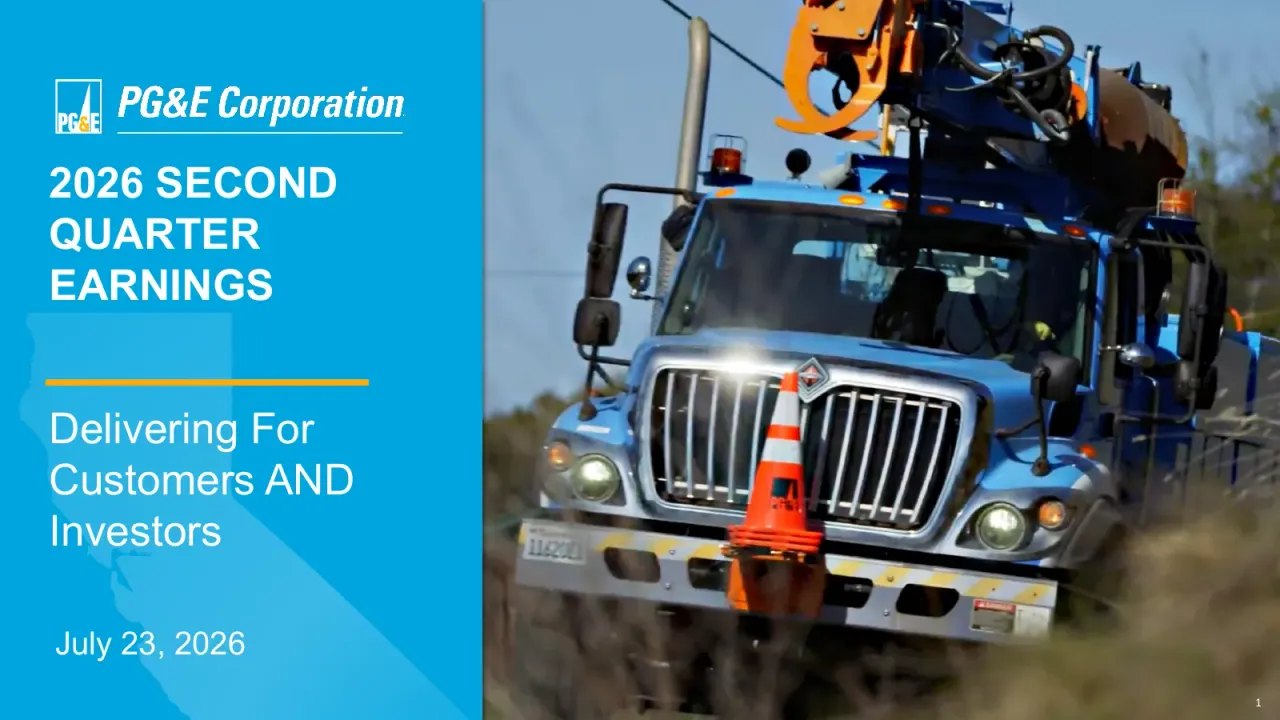
On 6ix: 6ix.com/event/pgande-corporation-0qr3-q2-2026-earnings-call
Automated transcript · Written by software from the replay's audio. It can mishear names and figures; the replay is the record.
0:00 Ladies and gentlemen, thank you for standing by. My name is Krista, and I will be your conference operator today. At this time, I would like to welcome everyone to the PG and E Corporation Second Quarter twenty twenty six Earnings Release. All lines have been placed on mute to prevent any background noise. After the speakers' remarks, there will be a question and answer session.
0:32 Thank you. I would now like to turn the conference over to Jonathan Arnold, Vice President of Investor Relations. Jonathan, please go ahead. Good morning, everyone, and thank you for joining us for PG and E's second quarter twenty twenty six earnings call. With us today are Patti Poffee, Chief Executive Officer and Carolyn Burke, Executive Vice President and Chief Financial Officer. We also have other members of the leadership team here with us in our Oakland headquarters. First, I should remind you that today's discussion will include forward looking statements about our outlook for future financial results and other matters.
1:09 These statements are based on management's current expectations, assumptions and estimates. Some of the important factors which could cause our actual results to differ materially are described on the second page of today's earnings presentation. Today's discussion will also contain non GAAP financial measures. The slides provide important information regarding these measures, including reconciliations between non GAAP and GAAP. They can be found online at investor.pgecorp.com along with other relevant information. We also encourage you to review our quarterly report on Form 10 Q for the quarter ended 06/30/2026. And with that, it's my pleasure to hand the call over to our CEO, Patty Poppy. Thank you, Jonathan, and good morning, everyone.
1:55 Our core earnings per share are $0.40 for the second quarter and $0.83 for the first half of twenty twenty six. These results reflect consistent disciplined execution enhanced by our lean operating system and the durability of our simple affordable model. Halfway through 2026, we're well on our way to extending our run of double digit earnings growth for a fifth year, which supports my confidence in reaffirming our financial plan today, including our full year core EPS guidance of $1.64 to $1.66 which at the midpoint is up 10% over 2025 our 9% plus annual EPS growth from 2027 through 2030 our $73,000,000,000 capital plan through 2030, which does not require additional equity financing and our target of reaching a 20% dividend payout by 2028 versus an implied 12% in 2026.
2:57 At the same time, we remain intensely focused on customer affordability for Californians we serve every day. We're committed to achieving our path to flat, targeting 0% to 3% annual customer bill growth. A key enabler is electric load growth, and one of the most exciting opportunities in front of us is large load demand coming from our data center pipeline. As you'll see in a few minutes, we've updated our pipeline this quarter, holding in new projects from our 2026 cluster study. We continue to see our current plan as the best plan for our customers and for California. As we like to say, performance is power, and I'm proud of the improvements we're delivering for our customers across multiple dimensions.
3:42 We've extended our safety performance on serious injuries and fatalities and have had zero public safety incidents from asset failures. On affordability, our residential bundled electric rates are down 23% since January 2024 for our most vulnerable customers. On wildfire safety, we are in our fourth year of no major fires linked to PG and E equipment and no structures destroyed. On reliability, our performance has improved 23% year to date versus the same period last year, driven by fewer outages along with faster restoration time. And as I'll discuss shortly, we're continuing to see significant load growth opportunities associated with data centers looking to locate in our service area, which includes Silicon Valley, home to the world's technology sector.
4:32 Turning to Slide four. We know that California wildfire liability reform is top of mind for investors as it is for us. While important work remains, we're encouraged that California's leading policymakers have made it clear they recognize the need for a durable solution. This is a critical moment for California. And as the CEA emphasized clearly in their April report, the cost of inaction is too high to ignore. We couldn't agree more. A constructive outcome would accelerate our path to investment grade and lower financing costs for customers. Conversely, inaction would slow that progress and ultimately make the system more expensive to finance. That's why getting this right and getting it done this year matters so much for the long term affordability of the California energy system for the customers we serve and for our investors.
5:28 Our five year plan assumes that California will follow through on the commitment made in SB two fifty four to strengthen the wildfire liability framework. For us, this means a durable and financeable framework that provides greater predictability and one that supports access to low cost utility capital, thereby protecting customer affordability.
5:52 While our preferred path is to continue executing the plan we've laid out, We have a responsibility to investors and customers alike to ensure capital is allocated appropriately under whatever framework ultimately emerges. If the framework remains unresolved or insufficient, then we would need to reevaluate our capital allocation priorities and long term investment plans. Our objectives would remain unchanged, safely serve our customers, preserve affordability and attract the low cost capital necessary for any regulated utility to deliver the expectations of policymakers, regulators, customers, and of course, fulfill the expectations of those of you who have entrusted your capital to us.
6:40 Turning to Slide five, our continuous monitoring capabilities are a key driver of wildfire safety, reliability and affordability. We are on track for a fourth consecutive year with zero structures destroyed. More broadly, our mitigation investments and disciplined execution continue to reduce risk and strengthen safety outcomes. Continuous monitoring is also delivering tangible operational benefits for the Californians and communities we serve. In fact, I was just at our command center on Monday. It is amazing. Since January 2025, our team has helped avoid nearly 20,000,000 outage minutes, 28 ignitions in high fire risk areas, and over 5,000 emergency response hours while saving more than $11,000,000 through lower cost repairs.
7:31 We are in pursuit of the first completely predictive electric grid. No more waiting to see what breaks. Continuous monitoring is enabling our next level of extraordinary operational performance at PG and E. On Slide six, we're showing once again our simple affordable model, which continues to give us line of sight to our path to flat, keeping annual customer bill growth at 0% to 3%. We're delivering results through disciplined execution across each of the levers in the model. We've built a strong track record of exceeding our annual O and M cost reduction targets and that focus continues. For example, we've saved more than $40,000,000 already this year through targeted sourcing and procurement initiatives and we aren't stopping there.
8:21 At the same time, we're laying the groundwork for future load growth by advancing our data center pipeline and enabling new business connections. We're also continuing to pursue efficient financing, building on progress we've made toward restoring investment grade credit, which will lower the cost for our customers of financing the needed long term investments we're making on their behalf. We're working every day to bring this model to life for Californians, delivering better service to our customers at a lower cost and demonstrating that affordability is enabled by investing in the right infrastructure. Looking forward, we remain confident in our ability to deliver affordable service for customers alongside consistent high quality results. Turning to our data center pipeline on Slide seven. We shared last quarter that we had over 10 gigawatts of additional pre application interest coming out of our 2026 cluster study, illustrating the strength and breadth of demand across our service area.
9:20 This quarter, that demand is coming into focus with new projects moving into our pipeline, which now stands at over 12 gigawatts. As we continue to build our pipeline, we're focusing not on size but on quality. To that end, with today's update, we've refined how we categorize our projects, raising the threshold for inclusion in both the preliminary and final engineering stages. Assigned work performance agreement and the associated financial commitment, typically around 10% of overall project costs are now prerequisites to be included in final engineering. We've also restated our March numbers so they are shown on a comparable basis. At the same time, we remain very focused on pricing this load correctly, attractive to data center customers but still rate reducing for our other customers.
10:13 We support efforts to achieve this on a national level and believe that FERC's recent order to show cause is a positive step. We're collaborating with external stakeholders, including CAISO, to respond by next month's deadline. On the state level, we continue to engage with stakeholders and the CPUC on both Rule 30 and the Commission's advanced rate design rulemaking.
10:36 Our focus across all venues is simple create clear, transparent and durable frameworks for new large load customers while improving affordability for the customers we already serve. Done right, these efforts can help build a high confidence pipeline that lowers electric bills, drives economic growth and keeps California at the forefront of technology and innovation. With that, I'll hand it over to Carolyn. Thank you, Patty, and good morning, everyone. Here on slide eight, we're showing our earnings block for the first six months of twenty twenty six. Our core EPS of $0.83 is $0.19 higher than midpoint last year. As a reminder, prior year results through the first half were impacted by dilution from our December 2024 equity financing, as well as the CPUC cost of capital phase two decision from October 2024.
11:35 The core drivers of this year's earnings growth are coming in as expected, with customer capital investment contributing 9¢ year over year and O and M savings and redeployment contributing a net $03
11:50 While some of the remaining growth reflects timing related items that we expect to reverse over the remainder of the year, this quarter's performance reflects consistent underlying execution you've come to expect from our team and positions us well for the year. As we look forward, we remain confident in delivering our 2026 core EPS guidance of $1.64 to $1.66 We continue to see opportunities across the business
12:21 to drive efficiency and manage costs, supported by the same disciplined execution and operational vigor you heard Patty discuss earlier. On slide nine, there is no change to our five year $73,000,000,000 capital plan through 2030. We continue to see at least $5,000,000,000 of customer beneficial investment opportunities that fit outside the plan. These opportunities, largely for capital, have the potential to improve the plan by facilitating incremental rate reducing load, which is consistent with our current preference, namely making our plan better in terms of affordability or longer in terms of duration rather than making it bigger.
13:08 Moving to slide 10. Our five year financing plan remains unchanged from our prior call, and that includes reaffirming that our equity needs are fully satisfied through 2030. Additionally, our current dividend payout ratio enables us to grow earnings in line with rate base without the need for additional equity financing.
13:32 This is allowing us to avoid as much as $10,000,000,000 of financing over the planning period versus if we had a typical utility payout ratio. Our combination of a disciplined capital allocation program, a focus on affordability, and a self funded growth profile positions PG and E to deliver premium results for both our customers and our investors well into the future. In June, we completed a $2,200,000,000 utility bond issuance, bringing our total utility debt financing to $4,400,000,000 for the year and covering the annual financing needs that we previously shared with you.
14:18 As we look ahead, our financing priorities remain unchanged. We continue to focus on achieving investment grade ratings, sustaining FFO to debt in the mid teens and targeting a dividend payout ratio of 20% by 2028 and holding on that level through 2030.
14:38 We believe our plan is the right plan for California and for our customers. That said, our plan is premised on achieving a constructive legislative outcome. On slide 11, we continue to make progress toward investment grade credit ratings. As shown, following our first quarter call, S and P upgraded our rating, bringing us to just one notch below investment grade.
15:05 Importantly, S and P cited the progress we've made reducing wildfire risk through our mitigation efforts and operational execution. They noted that the improvements we've made in the last seven years like PSPS, EPSS, system hardening, vegetation management, and the continuous monitoring that Patty talked about, all are meaningfully reducing the likelihood of utility caused wildfires. That recognition reinforces an important point that safety and financial performance go hand in hand, benefiting both customers and investors over the long term. Additionally, our underlying credit metrics continue to be at levels consistent with investment grade ratings.
15:51 Achieving investment grade remains a critical milestone because it enables more efficient access to capital, which in turn translates directly into lower borrowing costs and lower bills for our customers.
16:06 Both S and P and Moody's also continue to highlight the importance of a durable legislative solution to wildfire liability as key catalyst for additional upgrades. On slide 12, we remain on track to deliver 2% to 4% annual reductions in non fuel O and M. As our history shows, reducing costs while improving safety, reliability, and customer outcomes has become a repeatable capability at PG and E.
16:36 Over the last several years, we've consistently exceeded our cost reduction targets, and we continue to see opportunities across the business by taking a systematic approach to eliminating waste, improving productivity, and finding ways to better serve our customers. While no single initiative drives the outcome, literally thousands of improvements, large and small, all across the company give us confidence in our ability to continue delivering both operational excellence and customer affordability. On slide 13, we're showing major regulatory and legislative milestones. In our 2027 GRC, we're making steady progress with hearings and opening briefs taking place this quarter.
17:26 We also filed for interim rate recovery effective January 2027, which, if approved, would help smooth customer rates.
17:35 This request is consistent with our broader approach of pursuing every available lever to support affordability for our customers while making the investments needed to operate the system safely and reliably. On Kincaid and Dixie, we continue to expect a proposed decision in November. As a reminder, this is the first wildfire recovery case where a utility had a valid safety certificate and a corresponding presumption of prudency.
18:06 I'll close here on slide 14 by reiterating that our simple affordable model is working. Our focus on affordability keeps customers at the center of our decision making. Our capital plan is designed to deliver the right customer outcomes while offering premium growth and avoiding the need for equity.
18:27 With that, I'll hand it back to Patty. Thank you, Carolyn. As you've heard this morning, we're continuing to deliver on our simple affordable model. We're driving disciplined execution today while further advancing customer affordability, building on the five rate reductions we've already implemented in the past two years. That performance is showing up in our business. We've maintained a strong safety culture, improved reliability, and improved customer satisfaction across a wide spectrum of experiences, all while reducing rates.
19:03 While we deliver continued execution and operational performance, we're encouraged to see the state continuing to do their part by working toward a constructive solution on SB two fifty four Phase two. I'm confident that we have the right team with the right plan at the right time to deliver for the millions of Californians we serve. With the right wildfire liability framework, we can fully realize the benefits of that plan for our customers and for our investors. With that, operator, please open the lines for questions. Thank you. We will now begin the question and answer session.
20:01 And your first question comes from Shar Pourreza with Wells Fargo. Please go ahead. Hey, guys. Good morning. Good Good morning, Good morning. Just, Patty, on legislation, I mean, you've been clear if you don't get what is needed from a legislative process, you'll rethink capital allocation priorities. I mean, that's the key message today that you've repeated. I guess, what are you looking for from legislation as we're approaching the tail end of this process? Like, what's a fair outcome for you? And then how quickly can you pivot capital should the outcome not be adequate at the end of August? Thanks.
20:36 Yeah, it's a great question, Shar. Obviously, of mind. We've been pretty clear that we need a durable, financeable, predictable, and affordable legislative framework for how to deal with wildfire liability. So obviously,
20:56 that's a pro affordability message at a time where that's top topic in Sacramento. We We think it needs to be affordable for customers, and we think attracting low cost capital from the equity and debt markets is an essential ingredient to affordability for customers. So whatever the final proposal is and legislative action is, it needs to make it attractive to the capital markets and affordable for customers. Now pivoting on the capital plan, you know, I think
21:28 there's one thing for people to really understand. Look, there's no case for no action. In other words, if the legislature does not act or if they act and don't actually solve the problem, then we're going to have to take action. And we've been very clear about that. And we'll look at, obviously, reallocating our capital plan. And as I've said, and I continue, this is not the right time for me to go into detail about what that looks like on this call. I have no intention of racking and stacking what we would do with that capital and how we would reallocate it. But I want you to know that there will be action in the event of inaction on part of the legislature. Got it. Perfect. And I think you would hear from us shortly after the legislative session Appreciate about that, Pat. Appreciate that, Patty. And then just on Dixie and Kincaid cost recovery, I mean, the ALJ just set a settlement conference for July 31 and evidential hearings are set for August 17 to the twentieth. I guess anything to read into
22:29 this? Can you settle? What could a settlement look like? Thanks, guys. Yeah, hi, Char, it's Carolyn. The settlement conference date has been part of the schedule that's just really standard in almost every case. As we've shared previously, we're always open to settlement. But at this point in time, like we're just very focused that we presented a very strong case.
22:54 And the next steps in the hearings as you just talked about, the hearings are in August, briefs are in September and then we still expect a PD in November. Got it, fantastic guys. Thank you so much. See you soon. Thanks, Shar. Your next question comes from the line of Steve Fleishman with Wolfe Research. Please go ahead.
23:15 Good morning, Steve. Hi, good morning. Good morning. So I think you made a pretty good case of how things are going well across the spectrum of kind of shareholders, customer rates coming down, improvement in operation performance and the like. Do you feel like the policymakers are like
23:40 seeing this and understanding that these improvements are here and that they're subject to big changes. I mean, I don't know what plan B would be, but, you know, some of these things could have to be changed if they don't do anything. Well, you know, Steve, we've worked hard to make the case that our simple affordable model works. I think the proof is definitely been realized, but perceptions lag actual performance. And so when we say performance is power, we know that it takes time for people to believe and see the consistency of that performance. So I can appreciate that my legislature still gets pressure from customers that they want more from PG and E. And they have higher expectations of us. And we believe that we can live up to those expectations best with our current plan. We think our capital plan and our simple affordable model absolutely is the right plan. We love our plans.
24:39 And so we hope that they are noticing. We're certainly making a
24:43 case. I was with a legislator to be left unnamed, but I said, are you aware that we have reduced our rates five times? And he said, I am aware. I have gotten the message. So I do think our communications have been breaking through the fog. All that to say, I think wildfire legislation is a complex subject. And I don't envy the amount of work that our legislature has on their table. And but they've given good signals that they obviously think that they need
25:15 to find a path that works for customers. Look, the case for an action is clear. The CEA study shared that wildfire related charges now account for approximately $20 to $40 per month, as much as 14 percent to 19% of monthly bills. That's a legitimate cost of inaction.
25:33 And so I do believe that's why, we're seeing discussions happening and we're very supportive and working close and resolute that a good outcome is absolutely possible. But we're prepared in the event that it doesn't occur.
25:54 Okay. And I guess two other questions. First, just on the what you know, there are a number of different things that were mentioned in the CA report and obviously, we know what some of the utility and cost of capital, you know, capital access issues are that need to be resolved. But how about, you know, some of the other issues were mentioned on things like tort reforms and insurance reforms, things like that. Just any sense on progress in some of those kind of other areas? And then the last question is just on maybe you could give us any takeaways from the investor letters that you sent in to the commission the other night?
26:38 Yeah, great question. First of all, I think the tort reform and the insurance reforms, all of it is still on the table. There's Nothing's off the table yet. I believe that there's certainly conversations. I think what's important to us to be clear is what is an accessible outcome for utility customers and utility investors, which when the governor did his executive order specifically pointed to financial health of the utilities. So investment grade at the utilities
27:09 is very important for customers, is very important for California and particularly in this growth era that we're entering, we need to have access to the state needs us to have low cost access to low cost capital. So I would say nothing's off the table, but we've been really clear about the fix for attracting capital doesn't necessarily require the whole of society approach. There's very specific things that make it more durable, predictable and affordable for investors. And so
27:40 we're not losing sight of that. As it relates to the investor letters, I really appreciated our investors speaking clearly directly to us about what they see. And we felt it was important that the CPUC hear from them as well. I think the CPUC has been interested in hearing from the capital markets to understand what is the necessary steps to attract capital here in California. And so those letters were a means of us being able to share what investors are saying directly to us with the CPUC.
28:19 Great, thank you. Yeah, thanks, Steve. Your next question comes from the line of Nicholas Campanella with Barclays. Please go ahead. Hey, good morning. Thanks for taking the time. Good morning. Just on the comments on reevaluating the plan, just, understanding you have this GRC that's been filed, how does it intertwine with that? And would you have to kind of if you were to go to a plan B, would you kind of come and materially update that? Are you too far along in that process? And would we expect that to kind of get pushed to the right? Can you kind of comment on that?
28:53 Yeah, Nick, that's a great question. As we look at the GRC in our filing and any kind of shift to the capital plan, obviously, we'd have to integrate that. We don't know that it would require any kind of additional filing or filing modifications. But certainly, we would make sure that the capital that we're looking at still enables us to meet our first order obligations and our obligation to serve safety and reliability are key
29:27 obligations and compliance obligations we would certainly fulfill. So that's the balance that we would have to seek. But we don't think it necessarily would require any kind of change in our GRC filing, and we certainly wouldn't want it to affect GRC timing. And I'll just remind you, Nick, two things. One, we always plan conservatively. So our filing does not necessarily represent what's in our plan because of our assumptions there. And then two, just remember our FERC represents $20,000,000,000 of our $73,000,000,000 plan. It's not all CPUC capital.
30:06 That's great. And then in that spirit on the $73,000,000,000 you have the big portion that's FERC. Is there just anything that you could offer on how much of the $73,000,000,000 is really on reliability and resilience versus, say, things that are more kind of growth oriented to facilitate economic development for the state or otherwise programs that could be looked at? Thank you. Yeah, if you look in the appendix, a chart. There's about $16,000,000,000 related to resiliency, which is our system hardening. And then there's another $23,000,000,000 related to capacity and new business.
30:39 You. Your next question comes from the line of Carly Davenport with Goldman Sachs. Please go ahead. Hey, Good good morning. Thanks for taking my questions. Just two on the data center pipeline updates that you guys provided. First is how do you think about the potential of this cluster study load to move through the pipeline versus prior studies? I guess just kind of trying to get at the characterization of the quality of the projects and these applications.
31:08 Yeah, Carly. We it's a great question. We learn every day further about which of these projects are the highest quality. And I think there's a couple of factors that will drive the quality. I don't think we can predict today which of them will flow all the way through. We know they won't all, but our number one criteria is they must be rate reducing. And so therefore, we have to price it right. It's actually quite simple. I know there's a lot of conversation about all of these matters. But the bottom line is you get the pricing right, then that can convert into the 1% per gigawatt of new load, a 1% rate reduction. So or more. But so we assess all of them first and that's why the cluster study process is powerful. It allows us to provide them adequate pricing visibility.
31:58 Then we've added in the final engineering this WPA, which allows for more significant capital
32:09 upfront. It's about 10% fee that they pay. And so we have more and more confidence as the projects flow through this pipeline. And so when you see them in final engineering, have higher probability, obviously, than pre engineering. What we know right now and what we've been clear about is we expect about 1.8 gigawatts to be online by 2030 of this pipeline. Now some of these earlier projects have faster speed to power or have direct connect, for example, to our 500 KB in the Central Valley, things like that. That may enable us to increase that number by 2,030. But right now our real important planning assumption is about a 1.8 gigawatt addition of load by '2 30.
32:56 Great. That's super helpful. And then just a follow-up. As you think about the interconnection process, do you see any potential changes coming from Kaiser's response to the FERC show cause order relative to what has been ongoing with the Rule 30 process? Yeah, it could be. It could be. I think our process has improved a lot here in California in the last several years. And so that is becoming less of a deterrent, would say. It's not necessarily it doesn't slow us down so much. But I would say that we're looking forward to continue to collaborate with CAISO on and see what they file back to FERC. If there are improvements, that would be helpful.
33:41 We can't help but think that AI can help us do more simultaneous engineering faster. And so I am hopeful that we could have some improvement to that interconnection process just in the engineering portion. That's just the portion that we own. So we're looking forward to continuing to collaborate on that. Anything that we can do to reduce cost and improve speed in order to get that load growth that rate reducing load growth online faster feels great to us. So we're very much dialed in on that objective. Great. Thank you. Appreciate the time. Your next question comes from the line of Richard Sunderland with Truist Securities. Please go ahead. Good morning, Rich. Good morning. Hey, good morning.
34:26 Thanks for the time today. I'll stick to the data center topic and just watching some of these newer disclosures. It looks like the number of projects for preliminary versus final engineering in the pipeline implies a much larger average size out of the latest cluster studies. Can you speak a little bit more to the type of projects you're seeing now, if this is changing or if this is more reflective of where projects fit in the pipeline overall? Yeah, you know, we've started to get some interest on some of the larger projects. Until now, we've had a lot of, you know, as I affectionately called them, Goldilocks projects, lots of smaller expansion of existing facilities, facilities that are concentrated in the Bay Area and so constrained in geography and size and scope.
35:13 And as the cluster study processes become more visible and as people realize that we have more capacity in California than they thought and that we've been adding capacity and we have transmission capacity, we've had more applications for these larger projects in the mix. But we continue to be at the 1.5 gigawatt or smaller size of projects. And the bulk of them, however, are the sub gigawatt projects. Got it. That's helpful context there. And then we touched on a few of these themes over the course of the Q and A, but circling back to, I guess, the rate case and your comments on perception, lagging performance.
36:02 I'm curious how you're seeing the rate case process itself play out in this light. Any thoughts on sort of the, you know, where you stand to date, and particularly in light of the rate reductions versus affordability attention overall, how that's factoring into the GRC? Yeah, I think the GRC was well received. Look, it's the lowest general rate case we filed in over a decade. If fully implemented with our full ask, rates would be flat from 25 to twenty twenty seven. That's a marked departure from this last decade of significant increases. And then combined with our implementation of the simple affordable model, it's enabling a much more well, as you know, we're pursuing our path to flat, which is the 0% to 3% annual increase. So obviously below inflation.
36:56 So I would say the case was well received. We're in the process as we speak. And we've got upcoming dates. We've got reply briefs will be due tomorrow. And we've got a proposed decision expected in March '27 and a final decision in May '27. As you know, we've implied for interim rate relief so that we could have a better customer experience, smooth those rates out because the implementation really should start in January versus mid year of next year. We'd like to prevent the customers from having that price spike they experienced in the implementation of our last GRC. So we're hopeful that the interim rate recovery will be considered and implemented.
37:47 Appreciate all the color. Thanks for the time. Yep, thanks Rich. Your next question comes from the line of David Arcaro with Morgan Stanley. Please go ahead. Good morning, David. Hey, thank you. Good morning. Let's see. As you as you iterate on O and M cost reduction efforts, was wondering, how do you see the sustainability of the two to 4% savings and any potential areas of upside that you see emerging there? Yeah. Hi, David. It's Carolyn. I love this question. As I've said before, when I think about the numbers that we've put out there in terms of guidance, the O and M savings of 2% to 4% is one that does not keep me up at night.
38:33 We still have plenty of room for savings. If you look at our capital to expense ratio, we are we hit 1.0 last year, which was an improvement. And then we're really proud of that and we looked and we're looking to improve it further. But our peers are at two, you know, well over two. So we have some room for improvement and our O and M continues to be an area of high focus. The places where we see real potential are in particular strategic sourcing. We're really beginning to see some savings there but there's still plenty of room to do in terms of how we source our significant materials and external services.
39:19 And then two is AI. We've really only just really started to scratch the surface of being able to implement some AI solutions to the way we do work. This is that we're excited about. Got it. Yeah, absolutely. Okay, great. Thanks for that. I was also wondering if you could touch on just the current fire season, how it's shaping up so far in your service territory, what it looks like maybe through the rest of the year from where you sit today? Yeah, we would say that this year's conditions are and actual ignitions and acreages have been similar to last year. But as we look at it, you know, we just we don't think about it that way. We think about it as being ready every day. We don't prepare, we are prepared.
40:12 We are prepared three sixty five days a year regardless of the conditions. And as I shared, our continuous monitoring has like it just has continued to improve our visibility to our system and all of the potential faults and failures. You know, that continuous monitoring already this year we've had ten seventy six good catches of potential outages. 13 of those could have been potential ignitions. We just see technology and innovation every single day from our wildfire team and our continuous monitoring center. I was just there this week. So excited about what it foretells both on a wildfire prevention, ignition prevention, seeing the way it works is these sensors tell us when something is going to fail before it fails. That prevents the ignition. In fact, while I was standing in the continuous monitoring center, there was a fault alert that a pole was leaning.
41:13 Now, come on, guys. We used to walk past the pole once a year. Now we have daily continuous monitoring of our poles with these sensors. It's so I cannot overstate the safety enhancements and reliability and cost because now we can plan to address that pole on planned work, bundle it with other work, and lower the cost to resolve that issue before there ever is an issue. So I can't overstate the value of that. And so I guess to your point, the fire conditions are what the fire conditions are, we're ready. Excellent. Thanks so much for the color. Appreciate it. Thanks, David. Your next question comes from the line of Anthony Crowdell with Mizuho. Please go ahead. Good morning, team. Hi, Anthony. How are doing, Jonathan? I thought we were going to say congrats for the big win, but it didn't work out as well.
42:07 Sorry. Too soon, Anthony. Too soon. Too soon. Just two cleanup questions. And I know you're not looking to talk about Plan B, why that may exist, but just on Slide 24, I think a follow-up from Nick's question. You do identify the buckets of your future capital plan. Would you be willing to tell us maybe what bucket of spending would be most at risk on a Plan B? I think the only thing we're willing to say about that is we have to evaluate all of it. But we're never going to sacrifice safety or compliance or obligation to serve. And so obviously our customers' well-being is number one. But then number two, recognition of the capital that has come from the equity markets.
42:54 It's your capital and we need to think about how best to treat that. Great. And then one follow-up to David's question. Carolyn, you talked about where the company is on a capital to expense ratio, where maybe the target of getting to two times or three times. I'm just wondering if you want highlight maybe or talk about the timing that you think may require to get to that level. Yeah, in our capital plan, if you look at our five year plan, we get to 1.7 by 2030. That's I'd hope to beat that, to be honest. And the teams, you know, we're using our lean playbook. As I mentioned on our call, we have thousands of improvements coming from employees, from our coworkers that are working every day on behalf of our customers to become more efficient. And they're exceeding our expectations every year. So right now it's 1.7 by 2030, but I'm hoping that we exceed that.
43:57 Great. Thanks so much for taking the questions. Your next question comes from the line of Greg Orrill with UBS. Please go ahead. Good morning, Greg. Yeah, hi, good morning. Thank you. Regarding the rate case and the request for interim rates, what is your case there? And how does that affect the financial plan, whether you get it or not? Yeah, it doesn't affect the financial plan. It just affects the customer's experience. And so the way given our rate making construct here in California, whenever we get the final decision, we get to allocate those earnings that year.
44:50 So no earnings impact. But what it does impact is customers would be paying both for the rate increase plus that which hadn't been collected yet. And so you can have a pancaking effect. And that happened in our last GRC and it was very notable for customers. And so in this affordability environment, we would prefer to see that rate collection spread throughout the year. And so we've made a proposal at 55%, 75%, and 85% of the total revenue as requested. And we're hopeful that the commission will see the value in doing an interim rate recovery. And then what happens is if they if we over collected, then we would do a return.
45:36 But again, the total revenues are captured in the calendar year as for our regulatory accounting standards. Appreciate it. Thanks. Your next question comes from the line of Ryan Levine with Citi. Please go ahead. Morning, Hi, Ryan. Hi. A couple of follow ups. Are you seeing any unlocks in any of the new AI models in reducing wildfire risk? And should we expect a meaningful update in the data center outlook as Rule 30 outcomes becomes determined? Yes, so a couple of things. On the Rule 30, we were allowed to have interim implementation of that rule.
46:22 So that I would say is reflected in our current pipeline. It'll be great when we can have certainty about that. And I do think the FERC order to show cause may cause us to spend some time making sure that whatever we implement meets the needs of both of those. And, Ryan, sorry, what was your first question? Surround the Oh, AI new for wildfire. Yeah. I would say we definitely are using AI for wildfire and have been. The new models per se, we're always continually improving our technology adoption. Our biggest utilization of AI is certainly in meteorology, in predicting our fire conditions and the fire situations. We use machine learning with our smart meters, which has been a big enhancement as of late. We take signals from our meters that previously were unutilized, and we can now triangulate those with some of the sensor technology as well as just the smart meters themselves and go ahead and see faults on the service lines to homes, which is a whole new advancement. So that's been a very important adoption of AI for wildfire.
47:41 Yeah, in addition to that, like we have over six fifty high definition cameras out in our service territory. And that's allowed us to be eighteen minutes faster in response versus our traditional methods. Yeah, those cameras send automatic notifications to our wildfire responders across the state. And we can oftentimes fires well, in the past they required somebody noticing and having the wherewithal to pick up the phone and call someone. Now these cameras automatically notify first responders. So as Carolyn mentioned, eighteen minute faster response can be the matter of a catastrophic fire to a very containable fire.
48:28 Thank you. Yes, thanks Ryan. And ladies and gentlemen, that does conclude our question and answer session. I will now turn the conference back over to Patty Poppy for closing comments. Thank you, Krista. Well, thank you everyone for calling in today. You know, we remain encouraged by the progress on SB two fifty four Phase two and the continued focus on a durable solution for California. In the meantime, our team is focused on delivering safe, affordable and reliable service every day. This is the team for the time and we have a plan to serve. Thank you for joining us and please stay safe out there. Ladies and gentlemen, this does conclude today's conference call. Thank you for your participation and you may now disconnect.
Follow Pacific Gas & Electric Co. into a list and get an email when it puts out news.
Vice President of Investor Relations
Chief Executive Officer
Executive Vice President and Chief Financial Officer
at Wells Fargo
at Wolfe Research
at Barclays
at Goldman Sachs
at Truist Securities
at Morgan Stanley
at Mizuho
at UBS
at Citi