Mike Buck
CEO at PETRO MATAD LIMITED
Replay available
Annual General Meeting hosted by Petro Matad (LSE:MATD) on Investor Meet Company, held 2026-05-28.
On 6ix: 6ix.com/event/petro-matad-limited-matd-annual-general-meeting
Automated transcript · Written by software from the replay's audio. It can mishear names and figures; the replay is the record.
0:00 Ladies and gentlemen, welcome to the PETROMATAD LIMITED Annual General Meeting. My name is Lily, I'll be the operator on the investment company platform this morning. For those listening on the platform, you may submit questions for the company to answer at the end of the meeting. I'll now hand you over to CEO, Mike Buck. Thank you, and good day, ladies and gentlemen, from wherever you're joining. My name is Mike Buck, Chief Executive Officer of PETRO MATAD LIMITED. And in accordance with the articles of association of the company, I've been nominated by the Board to preside as Chairperson of the meeting.
0:32 I'd like to start by welcoming everyone to this Annual General Meeting of the company, which comprises an actual meeting here in Ulaanbaatar and online access to shareholders and other attendees via the Investor Meet company platform. May I start by asking everyone here in the room to ensure their mobile phone and other electronic devices are switched off? All those in attendance in Ulaanbaatar have been briefed on emergency evacuation procedures prior to the start of the meeting. There are no fire drills planned for today. So if the fire alarm does go off, please evacuate the building as quickly as possible. It's just after 4PM local time under article 53 of the associate of the articles of association of the company. Company's meeting is two members. The company's now open.
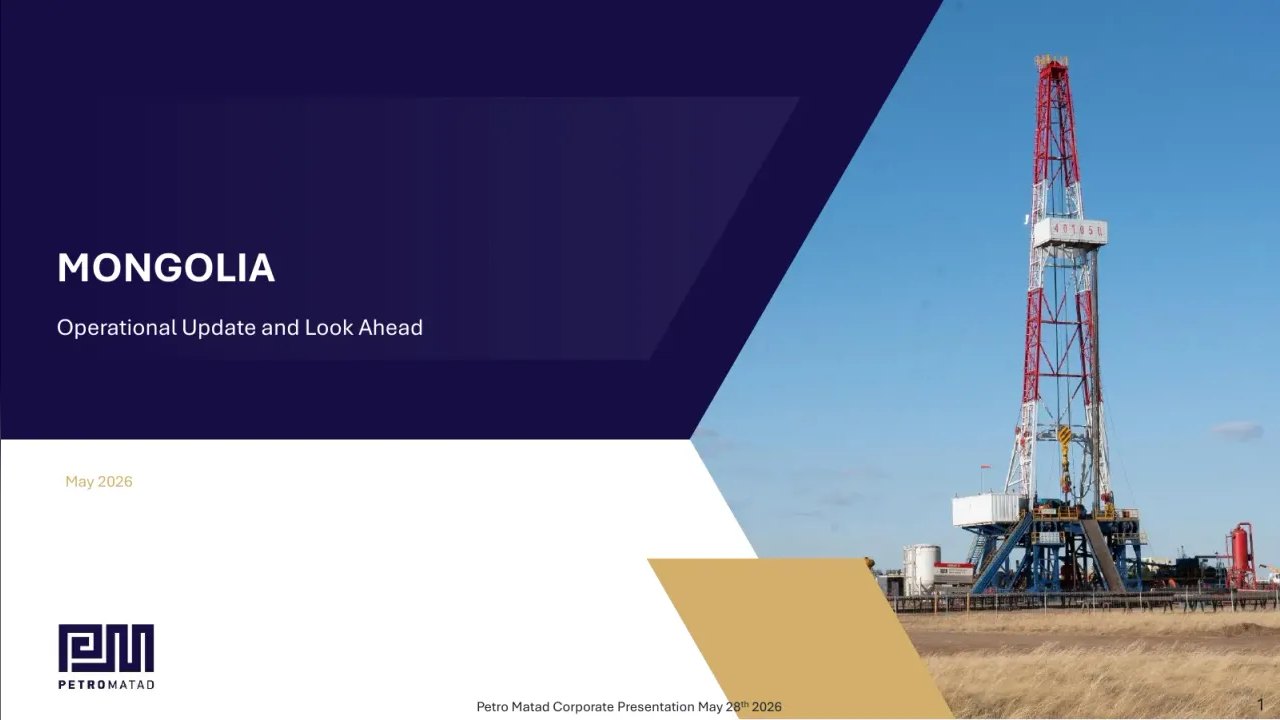
1:21 The take this opportunity to provide a brief summary of the company's company's activities during 2025 and to update you on the status of activities and our plans for 2026. To do this, we will use the latest corporate presentation, which will shortly be available on our website. It is on screen here in the meeting room and accessible to those online via the Investor Meet company platform. So oh, good. The button did work. Right. Well, I will just run everybody through the introductory slides.
2:07 I'll do the second 20. And turn Jerry for the operations section on production performance on our forward plans in Block 20 and our forward plans in Block seven. We've continue to see the of of
2:35 on the status of the past. Mongolian the oil industry, I'll start with the progress box on the right here. Those of you familiar with PETRO MATAD and familiar with Mongolia will know that PETRO MATAD has been watching progress of the Mongol refinery for some time. The government of Mongolia has decided to build a domestic oil refinery and this is forecast now for completion in February 2028. There is a pipeline being built from very close to PETRO MATAD's discoveries and to the main producing area of Mongolia in the East, and that pipeline will very likely be finished before the refinery itself is finished. This is an important project for Mongolia. It is costing a lot of money on a soft loan from the Indian government.
3:24 But it has become apparent to everybody over the years that with Mongolian crude production falling, there won't be enough as things currently stand for domestic production to fill the domestic refinery. If you look at the box in the middle on this slide, the current production in Mongolia is less than 10,000 barrels a day and the current demand for refined products is rocketing upwards and is now 75,000 barrels of product per day or or even in excess of that. And the chart at the bottom shows you production over time from Mongolia and it's been declining since 2015. The majority of this comes from the fields immediately to the north of our own Block 20.
4:10 And the horizontal red line there is the capacity of the Mongol refinery. It needs 30,000 barrels a day to fill it. And at the moment, as you can see, there's probably less than a third of that currently available and it is in decline. Obviously, PETRO MATAD wants to be available and very willing to fill that gap when the refinery comes on stream. And at the same time, the government is trying to incentivize and improve the environment for oil exploration and production in Mongolia. And I'll say a little bit more about that in a moment. They've also recently signed an MOU with the Kazakh government to bring in crude. And of course, if you're familiar with your geography, you'll know that whilst Kazakhstan is close, it's not actually adjacent.
4:59 And there's 20 kilometers of China or Russia to get through and of course a very long distance to bring oil. So the ideal situation for the government would be greater exploration, more discoveries in country and therefore more production. And to that end, the current government has been doing a pretty good job to incentivize companies to come. Local meetings, as you may know, we've had local problems over the years. Those have now significantly died down because central government and local government are working together more closely. And I think the government as a whole realizes the importance of finding some more oil to help Mongolia achieve energy independence.
5:46 We recently had our block seven annual meeting in the local area and the photograph in the box on the left shows the attendees there. As you can see, there were a lot of them. There's a it's a very big block. So a lot of local government comes along, other stakeholders, and of course, members of our team. So the Mongolian government is doing what it can to get the the oil industry moving a bit faster here in Mongolia and we're pleased to see that. They are also in the process of updating the petroleum law. Probably the results of that won't be available until next year, But I'm pleased to say that they are very seriously taking into account the comments of those of us that are already active here.
6:31 So we have had quite a lot of input to what should be in the law. We haven't seen finally what's likely to be in the law. But at least to the government is is listening closely to what its operators are saying. So with that, although the computer seems not to respond now, the past. We the
7:05 very very I'm Technical and Subservice Manager, overseeing a small team of Mongodian geoscientists and production engineers based in our Ulaanbaatar office and indeed in our operations base in Block 20. On the slide now presenting you three boxes on Heron and Gazelle and production operations, and I'll briefly talk through those. So 2025 activity was as busy in fact as the previous year and comprised of production continuing production operations at Heron and the completion of the electrification project there. An acid wash and installation of the beam pump at Heron 2 and reentry, testing and completion of the Gazelle well into a production well.
7:53 So starting with Heron, basically production operations continue throughout the year without incident with oil rates as per forecast and the continuing low water cut values for the sales oil, which is encouraging. The well is in steady decline as formation pressures will naturally reduce and this is typical for the wells in the basin, but to alleviate that water injection is planned. The electrification project comprised installation of a one kilometer 10 kV line from the nearest Block 19 connection, and that was completed in December last year. Although we've had a few power outages, the supply has been pretty good and it's a very good project to complete, not only because it actually saving us a lot of money on diesel, but also clearly it reduces our emissions, which is a very positive thing.
8:42 In total, the uptime for production at Huron is over 99%. So that's excellent and reflects the quality of the work done and indeed an in place plan maintenance schedule make sure that the beam pump and generators are always working efficiently. Moving on to Gazelle. Following the completion of the successful raise last year, that enabled us then to move on and complete the various service contracts that we had negotiated, finalize them, issue mobilization notes and get on with the basically doing the work for the year. And we started with test operations at in October at Gazelle where we perforated quite a thin eight meter zone across two reservoir units. And when we put them on test, they actually surprisingly delivered over 400 barrels a day, which is actually pretty good for the reservoir of similar type of very light oil as we see at Terren.
9:38 That result justify completing the well and installation of production facilities. And that was achieved not much later than October 31, so pretty quickly. And we were able to and that was a great success for our operational team again in the field. The well flowed naturally for a short time and then the beam pump was acquired soon after. And we found that the produced fluid had a higher water content than we have seen at Heron up to about 30%. And that took a little time to stabilize by optimizing producing hours and indeed managing the beam pump and casing back pressure. But again, overall production is above expectation as I'll actually highlight later.
10:25 As a consequence of controlling the water, the uptime at Gazelle is a little bit lower than inherent, but it's necessary. Moving on to the production operations slide. The team in the field continued to perform very efficiently and now operating two wells. But more importantly, there is an emphasis in the field of safety and minimizing our environmental footprint. Again, same team is managing the two wells now. As noted above, the electrification project was completed for Heron. This has lettermark decrease in diesel use, given that Heron two production tents were required to be heated over the winter months. Obviously, I said, this has reduced our emissions significantly, but also impacted positively on our operating costs and by the reduction of 15% there because of reduced diesel use.
11:17 The cable that we use for the installation of electrical line has sufficient capacity in it, then we can join other wells to it later in if we need to. So that is an option for Gazelle down the road. As you know the crude that we're producing is relatively waxy and there is an issue that then could be wax precipitation down hole and we are doing regular dynametric tests on the pump and echo meter readings down the well to gauge the fluid level in the well and monitor production performance really to find out whether the well and the equipment is performing efficiently or struggling and that could suggest something downhole is causing a problem. However, that is not the case And so we will not be doing any hot oil wash immediately nor indeed any sand screen or anything like that. So we haven't seen any sand production at all. So we just continue careful maintenance and monitoring the well going forward.
12:19 Next slide. If I can get the machine to move on. Don't press it too many times. No. Sorry. Apologies. Yeah. You've been nice.
12:44 It's not working for me, Frank. IMC, are you able to move the slides for us? Absolutely. What slide would you like to be on there, Mike, please? The one we've got now, which is slide nine, I think. Yes. We are we are showing slide nine production slide. Is that the one you wanted, Jerry? Sorry about that. So this slide, you can see the production for Heron since its initial start up back in 2024. You can see on the graph hopefully that we had initial high rates because the well flowed very high rates by itself. But then we had to put the beam pump on as that declined and you can see can see that we've got a fairly gentle decline of the oil rate, which is expected as the reservoir pressures decrease. But on the whole the well is performing pretty well and is one of the better wells as far as we're aware in the basin.
13:55 On the green line there is the cumulative sales oil which you can see is rising nicely to the left to the right beg your pardon. By the end of twenty twenty five we had produced over 71,000 barrels of fluid and offloaded at the TA1 facility just to the north of us by three forty three loads and got a total of 67,000 barrels processed and stored into the tanks in TA1 and then offloaded and exported for sales. Rate at the end of the year was about 127 barrels at Herringbone. Now if I try and move on to Gazelle, similar slide here.
14:42 And again, you can see, although it's much shorter production life here clearly since we started in November 2025, again, a high initial rate as the well flowed initially on natural flow, and then we put the beam pump on action. As I said, we did have water in this well more than we've seen at Heron. And to mitigate that and try and reduce any early water breakthrough, we optimized production time in December and onwards by adjusting the pumping hours and that effectively stabilized the water rate and then the actual rate has come now to about 20% and it's holding. So that's a positive result. At the end of twenty twenty five, 9,000 barrels of fluid because I have been produced offloaded at Tier one facility about 7,000 barrels of sales oil with a daily average of about 120 barrels from that well.
15:38 And then end of April this year, you can see the numbers on the screen are what we've shown right now. So again, they've increased and the well is again performing pretty well. Just a little bit of focus now on Gazelle. Again, on left hand side of that slide, you can see the same production curve, but on the brown line there is actually our forecast. So indeed the well is performing above our initial forecast which is very encouraging and indeed it's good to note that the well actually has the activity to re enter, do the test and complete the well was actually paid back in February. So we're moving forward to take a profit in that well. On the right hand side of the slide is a revised structural map of the Giselle Trap and you can see that the well is pretty near the closure of the limit of closure of that field, which implies it's quite near the water in reservoir. And that could be why we're seeing a bit more water in this well near the Heron, which is fairly in the middle of closure. And indeed that's why we've been careful not to draw up that water and actually kill the well so that's why we've been reducing pumping hours in that well.
16:53 As you can see also from the map in the box that says Upjip area, there's a consigual area obviously to the south of the Hecht Gesell Well that is the upside of the trap and obviously there's drilling opportunities there later on. And importantly on the little picture below is the log analysis of the Gazelle Well you can see the two producing sands at the top of that little section but more importantly the thicker sand sea beneath which is a very thick sand for the base about 45 meters and a well towards the south of the structure because the elevation of the structure is higher and above the water contact that we see in Gazelle, we will bring that hopefully if that sand extends to the south that well into the oil Lake and obviously if that is the case we will not only get a lot of production from that sand given its same quality but obviously that would help the reserves significantly of our Gazelle field.
18:01 And clearly if we do get new seismic then obviously that will firm up the southern part of the field and enhance the structural interpretation of Heron and help with optimization of our drilling locations.
18:29 So the next slide is really our plans for this year. Clearly we continue to maximize our production rates and clearly monitor and keep the maintenance on the equipment as high spec as we can to make sure that the uptime is as high as it can possibly be. We do have a plan to move our accommodation for our field operators nearer to where we are inherent to and try and get them established in the TA1 facilities based safe down on the travel time but we're working on finalizing that. And also there is always a continuing process of training and building capacity of our local operations team who are all Mongodians and get them higher trained and take on more responsibility of the work there.
19:23 At Heron two, we have seen over the winter months the well has been shut in as increase in the fluid level in the well but at a low rate as we saw indeed during our pump out activity last year. We are reviewing the technical and commercial details maybe to deploy radial drilling. Those of you who don't know, that's a technique that you drill quite small multiple laterals and we're talking about an initial so hole maybe up to several meters out away from the wellbore that has the effect of enhancing the delivery of the section around the well and that increased flow rates. And where that's used that has actually been and where it works it's mainly used for tight reservoirs as we see inherent and where that's done it can improve the rates significantly.
20:16 We're looking at doing that and there are contractors who have been doing that in Block 19 so we talk to those to see about their availability and the costing of that. And lastly on the right hand side, seismic acquisition. We have had a very exciting offer from an experienced seismic contractor to acquire a three d across the whole of the block of this summer. Obviously, new three d will not only enhance our structural interpretation of the whole block and especially across Heron and Gazelle fields. It will obviously optimize future well locations. We might even be able to get some reservoir direct characterization from modern data and that will significantly help obviously with well placement and also hopefully unlock some new field drilling opportunities which we can add reserves with success and obviously add production too.
21:12 Moving on, so technology, a little bit more about that radial drilling. So I've sort of said that already, can read the slide. And the seismic acquisition that gives you a little idea of the shape of the area, about 150 square kilometers or so. And we would expect to get a fast track volume of that fairly shortly in the third quarter that would help with any well planning we might be able to do this year. Next slide is the four plan for Block seven. We are continuing to work on Block seven doing a regional work and integrate as much data as we can. Clearly the excitement about Block seven is the extension of proven plays and adjacent bases in China into the block where there's not only Mesozoic, I. The proven plays that we have in Mongolia, but also older Palazzoic plays that are successful both for oil and gas in the adjacent bases in China and we're hoping that those extend into Block seven.
22:13 We've got several people who are quite interested in the block on the Chinese side and we're talking to those about possible future farm ins and we are planning later in the year to do a land gravity survey just to infill the existing data and that will help us better define the basins for planning for two d seismic later on in the following years. So I think that's what we really want to say in Block seven. Moving on, turning over back to Mike to talk about renewables. Yes, thanks Gerry. I just got two slides on renewables. And the first one is just summarizing what the state policy for Mongolia is on the renewable energy sector.
22:59 And you can see it here on the slide basically by decade. This has been the state policy for some time, but the government that's now in office has really been aggressively pursuing this and particularly actually in the last few months. But over the last few years, this has been pushed because Mongolia is very, very keen to realize the massive potential it has for both solar and wind inside its territory and the massive market that exists outside of Mongolia, obviously, particularly in China. So we're very, very pleased to see the government actually moving as quickly as they are on renewables because it sits very, very well with what we're doing with Sunstep, our renewable energy venture.
23:53 This slide summarizes what we're up to in 2026. As those of you who've been following us, you'll know that Sunstep has made quite a big impact since it was formed in 2023. We've got four projects that are currently under development, and we had chosen the 200 megawatt hybrid project in Toug province as the one most likely to reach a value crystallization event, I. E, get it ready to build as the one to focus on in 2026. Here, we have a project for wind, solar, and batteries adjacent to a new build thermal power plant. And our partner in this venture is the owner of that power plant, and they are very, very keen to move this forward quickly.
24:40 We have completed the feasibility study. It is with the Ministry of Energy for approval. Unfortunately, due to government upheaval earlier in the year, that approval has been a little bit slowed down. But now the Ministry of Energy is really moving quickly, has a new minister in place and that is where this aggressive approach is is is stemming from. So we'll be happy to see that one moving along pretty quickly. Meanwhile, other sizable projects have become available. We have bid with a shortlisted consortium for a 90 megawatt solar and battery project for Ulaanbaatar City, and that evaluation by the city is is going on. We hope to hear something on that soon. We've also expressed interest for a 100 megawatt wind and battery storage project that is being marketed for the government by IFC.
25:32 And so those submissions have been have been sent in. And we also have, what I would say, is pole position on a fast track opportunity that the government is pushing for a 100 megawatts of solar and particularly urgently battery. Why they need that is last winter, Ulaanbaatar suffered from quite a lot of brownouts because the aging thermal power plants in in the city were were were not producing reliably. So more battery storage available for such events is what the government really wants. This 100 megawatt project, they are pushing to have the batteries working during this coming winter. And they have said they will do all that is necessary to basically approve those projects as quickly as as required to achieve that goal.
26:23 There has recently been announced another five projects for auction. Those are between twenty and fifty megawatts. And we're looking at the what is required to be able to compete in those and to bring them on stream if that's a realistic a realistic goal. And so as I say, what we're looking to do is focus on the projects that we can rapidly bring to a value crystallization event. Our intention at the moment is to follow the traditional developer route that is to get these projects ready to build which can be done at relatively low cost and then to find an investor or potentially a co investor to attract a development premium to get some carried interest, but as far as possible to stay involved.
27:10 We'll do that until such time as Sunstep is able to fund its own way through to through construction and and into revenue generation. But it's exciting times for our for our renewable project at the moment. So we're hoping to make some significant progress during the year. So I think that's it for the pre AGM presentation anyway. And we will have time for questions on our activities at the end of the formal business of the meeting. But I would like to live up to give a little bit more detail on two important matters right now namely the 2026 oil sales agreement for Block 20 and secondly our farm out aspirations. So as attendees at the meeting may be aware, our block 20 oil production reaches market through a cooperation with PETRO China Mongolia.
28:02 They are the operator of the neighboring block 19 production license. In 2025, we are no negotiated an agreement with PETRO China under which we deliver our production to their facilities. They process, store, and export our oil along with their with their own to refineries in China. Under the agreement, we pay at cost for the use of the facilities and for the trucking operation, and we pay a reasonable per barrel tariff by way of management fee for the extra effort and responsibility that PETRO China takes on. And we enjoy the same selling price as PETRO China of Daiching minus $1 a barrel. Daiching trades at a similar price to Brent. And we would very likely not be able to achieve such a selling price on our own directly if due to the relatively low volume of the of our current daily production.
28:53 So we're very, very happy with the arrangement. And since production starts up in October 2024, I would say that operationally, this cooperation has worked extremely well, and we value and appreciate our relationship with PETRO China Mongolia. Contractually though, things have been a bit more complicated to say the least. Last year, it took until late April to get the oil sales agreement approved by PETRO China as it was the first of its kind in Mongolia. Then we suffered because they were worried about tax exposure and so they withheld 30% of our revenue. After much discussion, we were able to secure full payment of 2025 revenue and we also began work on the 2026 agreement which we thought would be a lot easier given that it was the second of its kind in Mongolia.
29:40 Surprisingly, the 2026 agreement has taken even longer to approve than last year. We were able in the process to get comfort from the Mongolian tax authorities and all the parties involved agreed some changes to the contract wording. Local approvals were then secured from PETRO China, but their approval process stalled in their head office over concerns about adding specific mention of Block 20 crude to their sales contract with their buyer. That was obviously an internal issue for them, but they tell us they have now resolved it and that final approval of the contract is imminent. Whilst this long delay has been frustrating with the rising price of oil through the year so far, there will be a commercial benefit for PETRO MATAD by selling for a price that is higher than if we'd sold month by month through the year to date.
30:33 In parallel, and in case that approval dragged on forever, with a potentially saleable volume of oil now in storage having accumulated in the tanks in Block 19 of 35,000 barrels, we were able to engage with Chinese oil traders in case PETRO China's issues were not resolved and we needed an independent market, a route to market. So we were encouraged by the positive response from traders and that has given us comfort that we do actually have an actionable plan B if needed. But with the approval of the oil sales agreement now expected, the tried and trusted route to market via PETRO China's infrastructure remains our strong preference. We hope to be able to announce the final approval of the oil sales agreement for 2026 shortly.
31:23 And so that summarizes where we are on the oil sales agreement. It was covered in our RNS today and there's more detail has now been provided. On our strategy for the Mongolian farm out of our Mongolian portfolio, what we want to do there is to bring capital into the venture from Afarmane to accelerate field development, production, revenue and exploration activities. The rise in the oil price over the last few months has actually seen a marked increase in the interest to partner with us and we are in conversation now with several companies at the present time whereas in the past we have struggled to get people to come and look. But right now with the global upheaval in the oil seal oil scene generally, we've got a lot of interest particularly from China.
32:17 The former front runner in our farm out process has undertaken some seismic reprocessing of existing data, and we are still awaiting their feedback. But Jerry's talked you through our work plans for 2026 and the potential to shoot new new three d seismic on very favorable commercial terms. That's an attractive proposition and we think can be value additive for our portfolio and some potential partners have responded positively to this initiative already and we hope this will help our farm out efforts and allow us to resume our drilling activities expeditiously. So I think that concludes the update that we wanted to give. But as will be explained shortly, during the formal meeting, there will be the opportunity for those in attendance here to ask questions about the proposed resolutions.
33:08 And then at the end of the formal meeting, we'll hold a q and a session on operational and any other matters raised. So I will now move to the formal business of the annual general meeting. We have apologies from our directors, Dienkma, Bish, Shinozaya and Tim Bushel, who unfortunately could not be here with us today. Brief biographies and details of areas of expertise of each director are provided on the company's website. We have in attendance our department managers. Before commencing with the formal business of the meeting, I will briefly explain the procedures we will follow. The notice convening the meeting sets out six resolutions which will be proposed. Before the first resolution is proposed, there will be an opportunity for those who are in attendance in Ulaanbaatar to ask questions about any of the resolutions.
33:56 The company has given shareholders the opportunity to submit any questions they may have about the company's business prior to the meeting via email and via the Investor Meet company platform. Those who are accessing online today can also submit questions via the platform. I will answer these questions on any other matters resulting relating to the company's business after the final resolution has been considered. If you do have a question, please state your name and the capacity in which you are speaking, that is whether you're a shareholder, proxy or representing a corporate shareholder. I will either answer the questions myself or refer them to our management team as appropriate. I will call for a vote on a show of hands on each of the resolutions. Should any resolution not be passed on a show of hands, I intend to, in accordance with the articles of association of the company, demand a poll to be taken ten minutes after the conclusion of the meeting in respect of any such resolution.
34:50 If a resolution is passed on a show of hands, I will announce the results of the proxy votes after voting on each resolution. Results of any poll vote will poll vote will be announced by the company following the conclusion of the poll. I would now like to commence the formal business of the meeting as set out in the notice of annual general meeting dated 04/30/2026. This notice includes six resolutions to be proposed at the meeting. With your consent, I propose to take the notice convening the meeting as read. Copies of the director's current service agreements and letters of appointment and copy of the proposed new memorandum and articles of association of the company with a copy of the existing memorandum and articles of association marked to show changes being proposed are available for inspection at the back of this room.
35:39 I would now like to invite questions from those in attendance in Ulaanbaatar on any of the resolutions to be put before the meeting today. Any questions on any other matters relating to company's business shall be answered after the final resolution has been considered. This will ensure that we proceed with the formal business of the meeting in a timely and orderly fashion. Are there any questions from the rule?
36:05 As there are no questions, we will move to the agenda and the resolutions contained in the notice. Resolution number one, receive and adopt the annual report and accounts. The December the director's report for the audit accounts of the company for the year ended 12/31/2024 together with the auditors report on those accounts have been in your hands for the statutory period. With your permission, I will take them as read. I propose that the directors report and the audited accounts of the company for the year ended 12/31/2024 be duly received and adopted. Will all those in favor of the resolution please raise their hand. Will all those against the resolution please raise their hand.
36:53 I declare the resolution carried by the required majority. In relation to resolution one, the company received in total 378,154,158 proxy votes in favor, 1,238,432 proxy votes against, and 580,621 votes were withheld of the resolution. Resolution number two, appointment of the auditor and power of directors to fix the auditor's remuneration. The next business is the appointment of the company's auditor, Hall Chadwick, WA audit PTYLTD, to hold office until further notice and authorizing the directors to fix the auditors' remuneration.
37:40 I now put resolution two to the meeting. Will all those in favor of the resolution please raise their hand? Will all those against the resolution please raise their hand? I declare the resolution carried by the required majority. In relation to resolution two, the company received in total 375,608,887 proxy votes in favor, 4,066,703 proxy votes against, and 297,621 votes were withheld of the resolution. Resolution number three, reelection of Mike Buck. In accordance with the articles of association, I am retiring purse pursuant to article 89 of the articles of association and offering myself a reelection.
38:31 I now ask mister Jerry Smart to take the chair for the purposes of setting out this resolution to the meeting. The next business is the reelection of mister Mike Buck, who is our chief executive officer, retiring pursuant to article 89 of the Articles Association and offering himself for reelection. I now propose that mister Mike Buck, who retires pursuant to Articles Association being eligible, offering himself reelection, be appointed be reappointed as director of the company. Would all those in favor of the resolution please raise their hands. I declare the resolution carried by the required majority.
39:18 In relation to the resolution in relation to Resolution three, the company received in total 360,965,536 proxy votes in favor 16,217,068 proxy votes against and 2,790,607 votes were withheld of the resolution. I now hand the meeting back to Mr. Mike Buck to continue. Thank you, Gerry. Resolution number four, power of directors to allot shares. The next item on the agenda is Resolution four, the directors' authority to allot ordinary shares in the company up to an aggregate nominal amount of $8,048,605.71.
40:05 The full text of this resolution is detailed in the notice. By way of explanation, this resolution if passed authorizes directors to allot shares up to the aggregate nominal value specified in the resolution and will be subject to the preemption provisions in the articles as amended by resolution five if passed. As of today's date, there are 1,858,800,396 ordinary shares in issue. I now put resolution four to the meeting. Will all those in favor of the resolution please raise their hand? Will all those against the resolution please raise their hand? I declare the resolution carried by the required majority.
40:51 In relation to resolution four, the company received in total 363,519,973 proxy votes in favor, 15,819,103 proxy votes against, and 634,135 votes were withheld of the resolution. Resolution five, special resolution amendments to articles of association, disapplication of preemption rights. The next resolution, is to be proposed as a special resolution, would amend the company's articles of association to renew the authority to disapply preemption rights on the issuing of ordinary shares representing approximately 33% of the total issued ordinary share capital of the company and an additional follow on offer to the company's retail shareholders of no more than 10% of the total issued ordinary share capital of the company.
41:47 The full text of this resolution is detailed in the notice. A special resolution requires 75% majority of those voting to vote in favor of the resolution in order for it to be passed. I now put resolution five to the meeting. Will all those in favor of the resolution please raise their hand? Will all those against the resolution please raise their hand? I declare the resolution carried by the required majority. In relation to resolution five, the company received in total 369,404,883 proxy votes in favor, 5,242,817 proxy votes against, and 5,325,511 votes were withheld of the resolution.
42:38 Resolution number six, special resolution, authority to make market purchases. The final resolution, which is to be proposed as a special resolution, would empower the directors pursuant to article fourteen one b three of the articles of association until the conclusion of the next annual general meeting of the company to exercise all of the powers of the company to repurchase ordinary shares in the open market with an aggregate nominal value of not more than 15% of the aggregate nominal value of the share capital of the company in issue as of the date of the notice of this meeting. Special resolution requires a 75% majority of those voting to vote in favor of the resolution in order for it to be passed.
43:23 I now put resolution six to the meeting. Will all those in favor of the resolution please raise their hand? Will all those against the resolution please raise their hand? I declare the resolution carried by the required majority. In relation to resolution six, the company received in total 376,703,864 proxy votes in favor, 2,965,673 proxy votes against, and 303,674 votes were withheld of the resolution. Ladies and gentlemen, that brings us to the end of today's formal proceedings. I shall now open up our Q and A session, and we will open that session to those in attendance in Ulaanbaatar before questions that have been submitted in advance and then questions submitted online will be read out and hopefully answered. I will now open up to Q and A to any questions to those in attendance in Ulaanbaatar.
44:29 Okay. Well, we've got no questions in the room. So I will now start by reading out questions submitted in advance of the meeting either directly to us by email or through the IMC, the Investor Meet company platform. We'll try and get through as many of these as we can. Those we don't answer today will respond on the IMC platform over the next the next week. I'll out with two sections that are loosely oil sales agreement and then farm out, then I'll hand over to Jerry for operations, then I'll come back for the rest. So we did receive lots of questions about the oil sales agreement, but generally they were wanting an update on status. And I think those have now been answered in the RNS and the presentation and my comments following it.
45:20 On the farm out, we've had a number of questions. Please may we have some specific reasons why the farm out deal hasn't been concluded and not the usual hiding behind it confidentiality excuses, we're entitled to some material feedback beyond the absolute minimum we always receive. And say an answer to that, the only way we can control the pace of someone else making a firm offer is to put deadlines on the counterparties, which we do. If they choose to ignore those deadlines, we can either extend or we can give up. We've chosen to extend up until now and through 2025. Although we did generally have three parties involved, it was not always the same three, but one was common to all. It's kind of a little bit there a buyer's market.
46:06 They control the pace. Now with a lot more interest than previously, we would hope that our efforts to come to a rapid conclusion will have more impact. Next question, surely the management can see that a less than optimal farm out deal effectively resulting in a dilution of Block 20 interest would be a better outcome than any significant placing effectively diluting the whole company and not just limited to block 20. Yes, management is aware of that. We don't want to suboptimal farm out deal, but a farm out deal would be a nice thing to have. So we will be negotiating with those parties that are serious and ready to come in. Next question, wouldn't it have been expedient to have parallel discussions with all three interested farming parties rather than be at the mercy of a single entity as we have a limited 2026 operational window.
47:00 As I said, the initial three became kind of one constant and two new. It transpired that there were varying degrees of seriousness and readiness. And of course, PETRO MATAD pursued all potential parties in parallel. We would very much like to generate some competitive tension. Next question, when can we realistically expect the 2026 oil sales agreement to be signed? And is this holding up the farm out conclusion? Well, I've addressed the the oil sales agreement, but no, that has not been holding up the the farm out agreement. But obviously, we're in a much better negotiating position when the revenue is rolling in. So we're very keen to establish that for 2026 as we had for 2025. If there is no farm out deal by today's date, may we have an honest update linking in the firm proposal already received and not any hiding. Oh, a little bit similar to that previous one. Yeah. No deal has yet been consummated with the counterparty that made a proposal back in late twenty twenty five.
48:02 We hosted their due diligence visit. We answered all of their follow-up cash questions, made lots of presentations. They said that they wanted to reprocess seismic data, which they are now doing and before seeking to close the deal. The delay has been a little bit frustrating, have to say, But they have been, you know, they're reasonable people. They have been putting in a lot of effort, so I can't criticize them at all there. But with the upheaval in the global oil scene, interest being expressed in our portfolio is now rather pleasingly gone up. And as I say, if we can generate some competitive tension, then we hopefully will get a better deal and we hope to be able to speed up the process of getting there. Is the farm out conclusion linked to the Gobi Bear well testing results? And if so, would any negative test result outcome still result in a farmhouse for heron?
48:57 Actually, that hasn't come up in any discussions we've had. Potential farm and ease to date have tended to focus on the producing fields rather than evaluating the exploration upside. Although we certainly always encourage them to do so. The plan for a new three d will be seen as a positive addition because not only does that cover Heron and Gazelle in their entirety, it also covers Gobi Bear and all the rest of the prospects and leads on the block. So that's the questions on farm out. Gerry over to you on operations. Thank you, Mike. First question is, what is the estimated overspend on Heron two operations and will it be economical to continue with the well? The actual total cost of Heron drilling it, stimulating it, completing it, the acid job we did and installing the beam pump and doing all the swabbing activity was actually just over about $3,000,000 and actually less than the original AFE for the well.
49:58 We have negotiated for future work up the well rental of pump and other equipment at about $3,500 a month. So it's pretty cheap to continue that pumping effort there if we have the weather window to do so, etcetera. And we are looking at radial drilling as I alluded to before, which might be a stimulation technique to deploy at the well, but we are waiting for costs on that. But yes, overall, we think there's a reasonable chance the commercial production given the costs and then we will explore that if and when we can and it's obviously worthwhile to try. Next question is why haven't we progressed Gobi operations at the same time as Heron two?
50:44 I think that refers to the Gobi Bear well and test there. Well, you've seen, 2025 was too busy with Gazelle completion operations and productions actually to do a further activity later in the year. But for 2026, the testing company is not very active unfortunately, so they have less presence in the country but we are trying to pin them down for timing and costings. The next question is how confident are you of Gobi Bear being a commercial well given that hydrocarbons have already been identified. It's actually quite hard to say the log indications we had at the time are encouraging but not conclusive. We did have shows in the well, but not as strong as we would like And geochemistry have shown there is some migrated oil in the well but at low volume. So it is bit of a teaser, but we are still looking to go back to that well later on.
51:46 Next question is, what would be the cost timeframes to implement and potentially increase flow upside of any prospective production enhancement techniques such as radial drilling? As said a couple of times now, we are waiting from costings for the contractors for radial drillings. There are experienced contractors available in China, so we could potentially mobilize quickly if a small job in Mongolia were to incentivize them and or we can combine this with other work that we can do. Regarding the aspiration for those work, well, clearly, it's depending on the type of technology we deploy and the contract. But the contractors sort of showcase presentations and documentation, so it should say that actually rates of up to 1000% increase can be achieved, but obviously that's their best case scenario. But I would expect several folds over of increase in production if the technology works.
52:45 Next question, what do the company expect re the Gazelle optimization flow rate? It's been back significantly from initial flow rates. Well, as the chart in the presentation show the initial flow rates were pretty good, if not excellent, but we have water breakthrough, which came quickly given I think the location of the well quite close to the old water contact. Now we are pumping and we are pumping at full capacity as we can by keeping the water cut increase minimal and controlling it. Obviously, don't want to draw too much water in and actually water out the well. Our production management has resulted in stabilization of the water cut to around 20%, as I mentioned before, much lower than we thought we would be able to achieve when we initially got the well on stream.
53:33 The field team monitors pressures, production and fluid levels in the well constantly to make sure we are maximizing the oil rate and reducing water. Next question is, what is the timeframe for Block 24 field development? What can we expect as far as net revenues at stage and with the operational ore refinery cutting out costs related to trucking via PETRO China? With the farm out providing a funding injection, we would like to accelerate so that when the refinery is actually online, we can be a significant supplier clearly. Revenues will depend on number of wells and success rate we achieve, but fiscal terms are excellent. For example, at a $70 barrel oil price, we, PETRO MATAD, net over $40 a barrel after costs and government take are taken out.
54:24 At higher prices of $100 a barrel, netback increased to 62 barrels, clearly quite a positive revenue generating fiscal regime. Clearly piping crude and so the chuckling is operationally and environmentally much more preferred and should be substantially cheaper which will improve the net back up just alluded to. However the government has yet to advise us on tariffing but we would told them we would expect it to be significantly lower than the trucking cost clearly. Next one, this is now questions about Block seven. First question, how much interest has there been in Block seven farm out negotiations? How advanced are they and what is the realistic time frame for conclusion?
55:10 It's been a little bit of a slow start, but I think now with what's going on in the world, interest has increased and we've got two counterparties have expressed particular interest in Block 7. We think those are people who are operationally adjacent to us. If we can generate some competition we will be in a better position to push to close the deal hopefully this year but we can only do our best on that one. When are further seismic evaluation expected for Block 7? As I said earlier 2026 sees us completing in house technical work and seismic would follow in 2027 and drilling thereafter That is the plan. Next question, what are the current thoughts on the potential side of Block 7 reserves accepting limitation without requisite testing?
56:00 This is a huge block with not a lot of actual data on it thus far, though the existing seismic data that was acquired by the previous operator does have leads mapped in those data that range in size in terms of recoverable reserves from 40 to an upside case of about 200,000,000 barrels. There is one larger structure in lead, if you like, in the block as well, which could be that upside size or indeed larger. But clearly, we would need more seismic data to evaluate that fully. But good potential in the block we see so far, there's no reason why that shouldn't be duplicated in the Southern Basin where we think there's more prospectivity or greater prospectivity there adjacent to the Chinese basins. Next question is, what is the group's projected exploration expenditure of 2026 and 2027 to meet the balls on the Block seven PSC commitments?
56:53 And how is it planned to provide this for this outlay? How would you plan to provide for this outlay? The committed expenditure for Block seven for 2026 is low and just a few $100,000. We have the option to enter the next phase in 2027 or indeed drop the block without further penalty. We obviously want to continue and hence our pharma efforts. 2027 was the extensive size of our acquisition and Block seven IDD funded or in whole or part by a Pharmony. That concludes the questions from the technical side. Okay. I'll carry on with those pre received questions. Loosely, this heading is financials. What is our current cash reserve? Cash on hand at the moment is a little over $3,000,000 and that's without the receipt of any 2026 production revenue so far. So let's say comfortable.
57:48 Has PETRO MATAD looked at purchasing their own drilling rig? If yes, what would be the costs? Rigs are expensive to run and maintain. If you don't have full time work for them yourselves, then you spend your time looking for work from third parties. And that's extremely labor intensive. This is why most oil companies outsource drilling to specialized rig owning contractors. PETRO MATAD does not have the financial nor personnel capability to become a reoperator. Next one, what's a realistic time frame for some form of maiden dividend initiation based on the planned strategy development of the company. Our dividends even envisaged in the strategy moving forward. Well, if we land a good farm in deal that allows us to get to a level of production revenue that covers the ongoing activities, we would consider dividends because we know they're becoming more popular even from even from small caps.
58:46 But that's not likely to occur in our case particularly rapidly. If our renewables project generates sizable development premia then we would consider that for dividending on an ad hoc basis. Next question, have there been any buyout approaches however tenuous? No. Can we please next question, can we please not have another hugely discounted cash raise? I've been an investor for decades, never seen the kind of discounted fundraiser PETRO MATAD routinely undertakes, especially given the quantifiable asset base the company possesses. I'd only expect such huge discounts on complete gambles dealing in untested assets or tech. I respect respectively suggest the company's brokers advisers are not acting in the company's best interest.
59:37 Well, discounts are painful for all shareholders and for the and for the company. When cash has been needed, the PETRO MATAD board has been faced with the decision to raise at the discount demanded by investors or not raise at all. To be active requires funding. Many of our peers raise money just to keep the lights on. We do not. We raise money for a specific work program which we then execute. We have confidence that our brokers and advisers do their best. They've been very supportive. They have given up their own commissions to others in order to try and fill the book on occasions. But all that said all that said of course, yes, discounted cash raises still hurt everybody, and we recognize that. There's a couple of questions here that are quite detailed, so we'll we'll answer those online in the next in the next seven days.
1:00:29 Next one, would the directors consider actually purchasing stock on the open market as opposed to benefiting from hugely discounted placings to procure shares? Many of us can't take advantage of open offer situation and we've built up our holdings on the open market. Management aren't really aligned with shareholders if they can't do the same. Most of our directors have quite significant holdings already built up over many years and actually have not participated in in the raises since I joined the company. Part of my own shareholding for has been built up from raises, but not to exploit a discount. I would happily have bought at the price on the day or even a premium. My participation is to show my belief and commitment in what the company is doing at a time when it is often important as it helps to encourage investors to participate.
1:01:23 Next question. Are you able to advise the current amount of the audited cost pool for Block 20? Is there a capped maximum and then that can be recovered from each barrel of oil sold? And are recoveries applied prior to or after payment of government share of revenue as per the PSC? Okay. So the block 20 cost pool as audited and approved by the government at the moment is round about $65,000,000. Recovery of sunk cost is capped at 40% of annual revenue after royalty is deducted. That caps a bit miserly by world standards and we've told the government they should increase it at least for future contracts. Unrecovered costs rollover into the following year. So the remainder of the annual revenue is divided between government and contractor.
1:02:10 Mongolian fiscal terms are very good by world standards, although please don't tell the government I said so. And as a result, whilst we're in full cost recovery, we get seven about 70% of all revenue generated. In some jurisdictions that I've worked, it's less than 10% goes to the production sharing contractor. So whilst in revenue and whilst in cost recovery, we do well. As there is regular widespread commentary and speculation that the group will need to raise additional capital to meet any further drilling on Block 20 during 2026, are you able to allay shareholder concerns that further shares will be needed to be issued to meet the cost of any planned drilling or can you confirm that expected oil revenue perhaps together with a call in the past mentioned PETROVIS soft loan facility if still available or alternatively local Mongolian bank project finance against the security of the group's proven oil reserves will be sufficient to meet any 2026 drilling costs.
1:03:16 Obviously, that question is raised frequently. We want to be an active company to generate news flow and to generate value for our shareholders. Having production and so a revenue stream means that the company can now run without needing to tap shareholders just to stay afloat. Whilst we have aspirations and an expectation of being able to secure a farm out to fund the next phase of drilling until we are successful, we are focusing on lower cost but value additive activities that we can afford with ongoing production revenue. The increase in the oil price may offer us some flexibility to increase our spend too if it lasts. The PETROVIS loan is relatively small. Debt funding from the banks would be would also be small if available at all as proven reserves as they're currently defined in block 20 are still small and our production history is not long and our well stock is two wells.
1:04:16 This is not to the banks risk averse liking at present. So if available at all, debt funding from the banks would be very expensive. At the next question, at the last investor meet company q and a, the company said it will look into P and R drive to make institutions aware of the PETRO MATAD investment, summarizing how's that going. So our plans for meetings were made, but they were put on hold pending PETRO China approving the 2026 oil sales agreement that in our view should obviously have been done a very straightforward process. A lot of effort has been put into getting that approved. And obviously, the the company's story is a lot better received and a lot more fun to develop and to present when the the revenue is flowing.
1:05:11 So yes, we are we we are still planning to do that and we hope that that will be soon. Do the group's joint brokers, Shore Capital and Zeus, hold any assessment opinions as to risk net asset value breakdown for Heron, the development upside, Sunstep, and for Block seven? Do either of these brokers have any market research papers that can be availed by shareholders? So yes, their assessments are available on their own websites and via the research tree platform. I have also seen a few of those numbers in in recent months published by others that are widely available and they don't look too far out of whack with what the analyst community calculates.
1:05:57 The risk value on the Heron base case has been quoted at around about a $150,000,000. And I have recently seen Sunstep value quoted as maybe round about 50. That's unrisked. I've not seen anything specific on block seven so far other than a $6 per barrel unrisked valuation for exploration prospects. But I direct you to those websites to see if you can access through through those. Okay. That's it on financials. On renewables, will the 200 megawatt hybrid project or other select projects be flipped? Actually, I think I've answered that one. Currently, because these will be quite capital intensive to construct, We are plan a is to be a traditional developer to bring in an investor or co investors that can carry us and pay us a development premium once we get them ready to build. So that's kind of the plan.
1:06:59 Would only change when we can find funding mechanisms to bring in a substantial amount of money that doesn't have to come off PETRO MATAD's balance sheet. May we have some information on partners involved or interested in the renewable portfolio? Are the Arab investment funds interested? What about Chinese investors? I just say here that the Chinese are very active. Arab investors have expressed interest and we are in close communication with them. We've got a very long question here about Sunstep's business model. We'll answer what we can of that online. Our next section relates to London Southeast chat board fake news and abuse.
1:07:45 This was brought up last time we did an IMC presentation. It's been brought up again. The the question says, I've started to report any false and meaning misleading statements from the LSE message board to the FCA. I'd appreciate if you could contact LSE and determine what action they are taking against those who make false and misleading statements against PETRO MATAD. Obviously, we're very aware of the misinformation that spread by some posters on the bulletin boards. Many of our shareholders, including some of you in attendance today, have reported this to us, and we appreciate you doing so. We do take this very seriously, and we have, for some time now, been working with our advisers and also directly with LSE on this issue.
1:08:31 That said, LSE has told us that they can only go so far in their investigations, and they have also told us they're restricted in what follow-up they can actually provide to us. We do know that a couple of accounts that we flagged as abusive are still active, and we are raising the matter again with LSE. We appreciate that some of you have taken into your own hands to report a number of accounts that are abusive and or spreading fake news. As a company, we are supportive and interested in the healthy debate and discussion on these platforms. But unfortunately, fake news is increasingly prevalent and some action needs to be taken and abuse just needs to be stopped. So yeah, we're taking it seriously and we're doing what we can. A little bit disappointed by how much that seems to be at the moment, but it doesn't mean we're giving up.
1:09:20 On communications, as a shareholder, am concerned that the company is undertaking a number of significant changes, but shareholders are receiving little or no clear communication about the rationale, progress, expected benefits, risk and likely impact of these changes. There haven't been any significant changes without our AIM reporting requirements being triggered and PETRO MATAD works very closely with its nominated adviser to make sure we meet all regulatory requirements. I will admit there have been some long silences particularly recently, but that is because important matters have moved a lot slower than we wanted to and updating people when there's nothing substantive to say is a is a waste of our time and a waste of yours.
1:10:08 But I do appreciate that the silences tend to fill with speculation that we're changing things, we're or we're failing to report things, we're not, or we are disrespecting shareholders, that is definitely not our intention. The board is committed to us meeting AIM reporting regulations as an absolute minimum and updating shareholders with all meaningful matters as soon and as much as is practical practicable. Okay. And then finally, on the pre received questions, got two more in the miscellaneous section. Does Zula, the CEO of Sunstep post as wild wise owl on the London Southeast discussion forum? Well, the last time we were asked if it was me, it's not me and it's not Zula.
1:10:56 The next question is, I guess related, would the company consider naming one of the future Wells Wise Owl in acknowledgment of PETRO MATAD's loyal shareholders? So we will check Wise Owl's posting history and then we'll give we'll give consideration. Okay. That gets through most of the questions that we received in advance and very a big thank you to everybody that submitted those. Those that we haven't got to as I said will answer online. Now we've received some during the presentation. Let me see. As it clearly takes more than six months to agree the oil sales agreement to get paid, what steps are being taken to agree the 2027 oil sales agreement to give the best chance of payments continue uninterrupted into 2027.
1:11:44 Good one, questioner. Last April, when it finally looked like PETRO China was going to approve the 2025 agreement, I said, can we please add 2026 to it so we don't have to go through this nightmare again before the end of 2025? They said no. They can only do it year to year. Now we've had an even longer wait for 2026. I think that the contract we've now got, everybody, certainly everybody within PETRO MATAD, I mean and I mean everybody. Hopefully, a lot of people within PETRO China, probably not everybody, but a lot of people within PETRO China, the relevant people now see that it's actually a good agreement, and it deals with their big issue, which tends to be how will the tax be treated.
1:12:30 So I'm hoping 2027 will be easy like 2026 was supposed to be. But, yes, question to you, had exactly the same thought that I did. When is the SRE venture expected to start generating some revenue? We are targeting this year certainly with our hybrid project although the delay in approval of the feasibility study is annoying. But the government aggressively pursuing projects that they want online by the end of the year or at least during the winter. That gives us a chance if they really do show up and give the approvals as quickly as they will need to, that does actually give us the chance to get to ready to build and then to bring in some revenue. Will the payment for the 2026 oil currently in storage be received by MATD in one lump sum or over several months?
1:13:26 It should be in one lump sum. That's what PETRO China has told us and that's certainly what our invoice says. What's the timeframe for Block 7 farm out? You mentioned uptick in interest. We've got a decision date in early twenty twenty seven, January 2027 actually, whether we enter phase two. As Jerry mentioned, we can we could drop the block at that point if we wanted to without any further costs or penalty, but we don't want to. We really like the block. The commitment for the second phase which is I think a phase of three years is also not that high. It's a few million dollars for seismic off the top of my head. But we'd very much like to have a farm in E signed up before January 2027 so that we're making a commitment to more spend using either having them in whole or in part finance the venture.
1:14:23 Under what circumstances will a fundraise be required this year? Haven't really thought about it at all. That spiel I just gave about how we are living within our means at the moment, enjoying an uptick in revenue from high oil price or shortly going to allows us to be a little bit more relaxed than we have in the past. So yes, there hasn't been any discussion about that at all. Can we have a realistic timeline for the GobiWell test? Only in your opinion of course, what do you think the likelihood, how confident are you of the well-being commercial? That was kind of specifically the question that Jerry managed to unspecifically answer.
1:15:09 It is a teaser. I'm an optimist. I tend to gravitate towards the positive indications and slightly ignore the negative. You might think that that would make me say it's a better than 50% chance, but I'm not going to say that now. On the timing, we've been chasing the radial drilling contract for a little while. At first, we were worried about what depth they had previously worked at, but the radial drilling contractor for Heron can do down to the depth we want. And for Gobi Bear, we're just looking for a standard test. The fact that the test contractor is currently out of the country because he's not working for PETRO China at the moment means he's being a bit slow to give us any any feedback. So timing on Gobi Bear, I'm not really sure.
1:15:56 If we do do the three d seismic which we'll have to decide within the next few weeks I think then probably best not to have a well test operation going on on the southern part of the block. Production operations will obviously continue, but we want to keep it quiet whilst the seismic is in operation. So maybe we try and do it after the seismic is finished. Any more on here, Tif? That one. When you say radial drilling can increase flow rate significantly, what sort of figure are we looking at? I think Jerry just quoted that they do say a thousand percent, which I think means 10 times. Right? Anyway, yeah, that that that's what they say. We're trying to get a little bit of case history work from wells that apparently were done to the north to give us a better idea.
1:16:43 But Heron two needs some help at the moment and continuing with the pump out although relatively cheap is not really telling us very much at the moment. So radial drilling might help and we hope we get a decent cost for it. Doing one well, of course, all the mobilization, demobilization will go on to one job. If we could convince somebody else, namely PETRO China to do some similar work, we would try, but they're not particularly active at the moment. How long would the new three d take to obtain and be usable for well planning? Would it be available for drilling in 2026? If it's shot in July, August, then final product would be available by the end of the year.
1:17:32 But I think workable product would be available by potentially the end of August. And I'm saying that because I very much like and I'm very much pitching to the farm in East or would be farm in East I talked to that we could very quickly be drilling using their money. So I would like to follow-up the three d with some drilling activity in 2026. If it could only be one well, if the winter was rushing on, I'd make it Gazelle two, but I don't wanna get ahead of myself. I'm not promising. But, yeah, that's what I have to say on that one. Does the company believe current cash resources plus expected oil sales are sufficient without further fundraisers? Well, for the short term, I would say yes. For the time until we find a farm in E, I would say yes.
1:18:22 As Jerry has shown you and we don't hide the fact that in this basin until you get pressure support in the reservoir, production tends to decline. We're seeing gentle decline in both our wells, but it's nothing to worry about for 2026 or 2027 unless something was to go horribly wrong. But in our forecast, that's not the case. So with this and a good a good oil price, then we're a little bit relaxed about the cash position at the moment, but we've never been a cash rich company. It's always nice to have more. But as I say, I'd like to have more from a farm in E. Back to renewables. On the 200 megawatt project, at what stage can the project be considered to be ready to build so that it can be monetized? Usually, once you've got the power purchase agreement signed, that is a trigger for lending banks to get involved and then equity investors tend to like to see that too.
1:19:22 And then finally, the license to construct is a good trigger. We were hopeful when we submitted our feasibility study on the December 24 that we've been negotiating the PPA right now. But the good news is that Mongolia has actually come up with kind of a model PPA that they have shared with us. So we think the negotiation app will be reasonably quick once we do get the approval of the feasibility study. So we were aiming for 2026, maybe the 200 megawatt project might slip to 2027 to be ready to build. But that might be because a number of other projects have come in ahead of it and we're involved in at least one of those and we may be involved in more. Can you let us know what happened to the 24 megawatt green hydrogen project at the copper mine? Yeah, we are we've been pushing that hard.
1:20:16 The operator of that mine is Oyu Tolgoi. Obviously, they're part owned by Rio Tinto. Rio Tinto, they're very enthusiastic for the green hydrogen project and for a renewable pilot project, but they've got obviously, they've got a lot of other stuff going on and it's hard to get attention. So it's moving at the pace that they set which not is not the pace that we wanted. We still have it. We're still in discussion with them. We still have the Japanese government grant in place and the Japanese government has been nice enough to extend that once and they said it was extended again. So we haven't given up. It's just not moving at the speed we wanted it to. You mentioned the former county front runner. Is there another front runner now? Well, that guy is the most advanced in his in his efforts because he's been looking at the data for quite some time.
1:21:13 But there's a a lot of enthusiasm in the air at the moment. So, you wouldn't call him not the front runner to his face, but I have told him I'd like him to speed up. What would be the net profit of the oil at $100 a barrel? I don't know, Jerry, if you quoted the figure. Right? See, it is the net back after all operating cost, after government share, after royalty, etcetera, is about $62 a barrel net to PETRO MATAD. So that's a nice thing to have. We budgeted on $60 a barrel. So you can imagine what it does for the budget. How much cash oh, we've answered that one. What is the cost of the three d to be carried out on Herrinfield?
1:21:59 And is this dependent on PETRO China paying us? Well, actually the one of the attractions of the three d proposal we received is shoot now pay later. So the expenditure in 2026 is is relatively small, a few $100,000. And then the rest is to be paid in 2027 after more revenue has come in. So we're, yeah, we're we're we're quite happy with that. It's as I said, we do have cash in the bank. It's actually more dependent right now on being sure we like the configuration and being sure that we could get the the permits in time. We think we can because we have a pretty good relationship now with our local government, and they've been very, very helpful on all other matters. But we certainly don't want to mobilize the crew and have to pay standby because there's a permit missing. So that's what we're working on at the moment.
1:22:51 Last question, why don't you shoot Block seven seismic whilst the contractor is in country doing Block 20? The contractor has made this offer to us because he's about to take his crew in the late third quarter back to China because suddenly there's a lot of seismic work being commissioned in China. And I guess we can all imagine why in terms of upset to their supply of oil. So he's only available for the one job. If we had a farm in E, then I would probably try and incentivize them to pay some other contractor to work in Block 7 as quickly as possible. But that's why we're not using the same contractor for it. Oh, it wasn't the last question.
1:23:37 Did you get a revised Gazelle resource estimate? Did you give one, Jerry? With the new mapping just finished, we're working on it. Okay. We're still working it up. The the new mapping has been done not because the data has changed in any way, but at least now we can tie the seismic to where actually the pay came in and then that gives us a slightly different map to work off. And as Jerry showed, it's quite close to the old water contact, so the the water cut's not a surprise. I'm glad it stabilized, but there is quite a lot of up dip potential if only the three d went a bit further. So we're working on that too. Okay. So I think that's it. If there are any other questions that have been unanswered or not filtered out, as I said, we will we will get to that.
1:24:26 So if I can find the right page on my script here, as there are now no further questions to be answered this session, I will close the q and a. I thank you all for your attendance today, and I declare the meeting closed. I'll pass over to the operator to end the call. That's great. Thank you to the board of PETRO MATAD. This concludes today's meeting. Thank you for joining, and you'll now be redirected for feedback.
Follow Petro Matad Limited into a list and get an email when it puts out news.
CEO at PETRO MATAD LIMITED