Doron Kempel
Founder and Chief Executive Officer
Replay available
Our Bond (NASDAQ:OBAI) reported Q3 2026 results on this call. Replay available.
On 6ix: 6ix.com/event/our-bond-inc-obai-q3-2026-earnings-call
Automated transcript · Written by software from the replay's audio. It can mishear names and figures; the replay is the record.
0:00 Good morning, everyone, and welcome. Thank you for taking the time to join us today. We are still having some attendees join us, so we're going to allow another minute or two for them before we begin. Thank you for your patience and welcome to Our Bond's 2026 Third Quarter Business
1:44 Update Webinar. We appreciate your continued interest in the company and are pleased to have you with us today. Our host today is Doron Kempel, Founder and Chief Executive Officer of Our Bond. During today's presentation, Doron will provide a quarterly business update highlighting recent commercial momentum, customer developments, progress across key markets and its strategic business outlook. With that, I'm pleased to turn the webinar over to Doron. Doron, please go ahead.
2:15 Thank you, Ali. Hi, everyone. Thank you very much for your continued interest and for joining us today. As we typically do, we'll introduce you to a short disclaimer. Let you take a minute or less. to gaze at it. Now let's cover the objectives of this session is to review Q3 financial results and to provide a business update and perspective. In terms of agenda, we'll cover the Q3 business update. We'll talk about financial results and we'll summarize. And as I typically do before I go to the Q3 business update, I provide all of you some context so you remember what the company is about and what it is that we're doing uniquely. And I might say successfully on the business side.
3:06 And that'll give you the right context against which to interpret everything that we say. I know how busy you are. So I typically start without context. and then we'll open it to questions from you that we'll try to answer and we'll release everybody by the bottom of the hour, which is in about 27 minutes. Let's start with a Bond business update and we'll talk about the differentiated platform that we've established and the very positive traction that we see in the marketplace. And as I typically do, I go over the fundamentals. We're addressing a very large total available market. The product and service work as designed. In fact, the platform is about eight years old right now. It's very robust.
3:52 It has significant high time and it delivers on everything that we expected to deliver. Of course, we continue to develop new code, but in general, the platform works as intended and is massively scalable. We have proven an ability to sell to the largest corporations in the world, literally. We'll go over the list. We have one of the three, you might say one of the two, if I said one of the one, you'll know who that is, companies in the world adopting the platform. and now, which is a new phenomenon that we've been working on for a while, we have cities adopting the services for their residents, paying for the residents and for their employees. This is just starting. I think that it's a very promising development that we talked about.
4:38 The economics of the business are very positive, high margin and low customer acquisition costs. Now, if you look at the balance sheet or the financial have established a platform. Now that the platform is established and has reached scale, if we go to another customer and we win that customer, if that customer has 20,000 employees, 50,000 employees, That is not going to increase our operating expenses almost at all. Now, if that customer has a million end users, then it means that we need to recruit people in order to address that customer's end users, but we factor the number of people who we need to hire on top of the existing platform when we say that the margin is high. So we've reached a point, and we'll talk about that later, and I addressed that in one of our were in order to address more customers, the incremental investment that is required in order to address that particular customer is factored into what we believe is a very high margin business. We've reached that point. That was point number four and the checkmark that's associated with this. We have not encountered any competition that does what we do that we'll talk about momentarily. In other words, preventive personal security, none that can deliver any of the essentials that we deliver.
6:09 Sometimes I present to customers and I tell them at the end of the meeting, you're thinking about everything that we've presented. You are nodding to everything that we said. Yet in your mind, you said, but I've seen some app before. Yes, like saying that you've seen another human before. That doesn't mean that we're all Michael Jordans. So you've seen other apps. None of them do what we do. So just think about it. Yes, you've seen other apps. That doesn't mean that they're like us. iTunes is not Bond. So the moat is significant. You know that it has taken us more than $100 million to just to build and harden this particular platform. So if anybody wants to get into the game, the specific game that we play in is gonna take a significant investment upfront. Growth, major investments that were made in early 2006 until now.
6:59 As I've been saying up until the time that we went public, we didn't have money to invest in sales and marketing. We've made significant investments. Some of them are non-recurring. Some of them are recurring. And that has now given rise to a significant pipeline, a significant funnel that I believe we're going to be delivering upon from now or from the beginning of this year into 2027. Most of the pipeline emerged just recently. Cash to Fund Growth. We, I think, have consistently proven that we have access to cash. We have excellent investors. You've just seen $15 million of their capital, at our request, move from the liability side of the equation to the asset side of the equation. And one of them invested $250,000 in a pipe at $2.75. We have excellent investors. They are deep into the company.
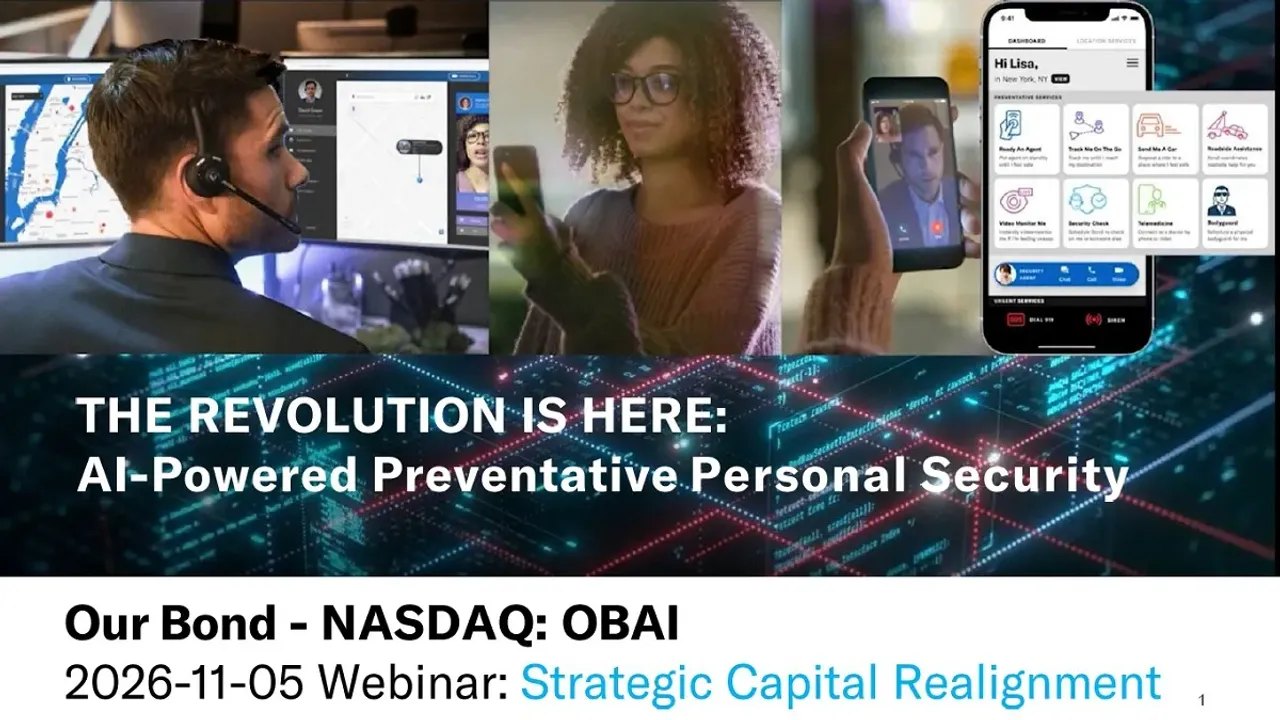
7:55 They continue to support us. and that fuels my belief that has now been proven that we do not have problems getting cash to fuel our growth. With that, let's talk about the security gap that Bond addresses uniquely. One problem, which is one side of two sides of the coin, are all the situations, billions of situations annually, where people feel unsafe but it's too early for them to dial 911 in the United States, 999 in the UK or other locations around the world. One of those situations, one of those three categories of situations that when we walk alone at night in the United States, 45% of women, 35% of men say they feel unsafe walking alone at night. When they do, like Lisa in the photo, she feels unsafe, she has a peace of mind problem that has no solution.
8:49 If she dials 9-1-1 or 999-INDIOCARE-17 in France, she's going to be told, Lisa, you're not an emergency, you've got to drop off. But this is a real problem that people face that has no solution. We call that the too early to dial 9-1-1, problem number one. Problem number two are the situations that typically are the other side of the same coin, where now it's too late to dial 911. We felt uncomfortable. Now we're facing an assailant. When we do, the distance between us and the assailant, either the person who's walking towards us in the parking garage or someone we open the door to, or somebody who's driving the car that we're in, or somebody whom we've just met for a date, or somebody we've just met for a business transaction. In all those situations, again, somebody who suddenly becomes an assailant is too close to give us enough time to complete a nine-on-one call. And just to express that, Saint Lisa is now in the parking garage when she notices a stranger. He's typically two cars away.
9:51 That's 30 feet. Closing time for running men, two seconds. Nobody completes 911 calls in these situations. Nobody has panic buttons in their hands. Most normal people are not adept at clicking anything under pressure. All of this paradigm doesn't work. The idea of calling 911 when you're under duress facing an assailant does not work. Therefore, sadly, I report to you something that I've reported in the past, that according to the Bureau of Justice, 500,000 women in the United States, it's 0.3% of all women over the age of 18, are severely sexually assaulted every year. There's no solution. And by the way, none of these attacks occur in front of cameras or witnesses.
10:37 I'm now hinting to the Bond solution. So this is problem number two, too late to dial 911. How do we address it with a new paradigm? Which means that we now invite people to use mainly the services that you see in the green bracket. These are the preventative security services. We tell all of our members, that's what we call our end users, don't wait until it's too late. You're walking to your car, you feel uncomfortable, you're accepting a delivery at home, you're going to a meeting. In all these situations, As you can see on my screen, basically you have Bond available to you. Just click a button, we're going to look after you. The best button for you to click is the Video Monitor Me button, which I'll now demonstrate.
11:22 You click the Video Monitor Me button, and then in five seconds, a Bond security agent, a human, from our command centers in the US, in Mexico, in Brazil, in Canada, France, UK, Israel, South Africa, depending on where you are, you're going to get a security agent on the phone. We've just delivered a personal security companion who's now going to walk Lisa to wherever she wants to be walked or be with our mothers when they live alone, receive a delivery from somebody, or they're in some cab. Any situations, we're by your side. It's highly unlikely that anybody who wants to harm anyone would want to be on camera with our agent, and this is now proven. But at this point in time, I'm just saying we're addressing problem number one. We're walking Lisa to her car. Nobody does that, not at scale, not with privacy preserved. You can have your parents or your boyfriend, girlfriend be with you, but that's not scalable. And it's like me saying, I can take care of the dental problems of my kids myself. Yes, I can, but that would be a bad idea.
12:23 You want professionals looking after you and the people that you care about, including your employees. I'm reminding you things that we know. And that also offers deterrence. In most cases, when Lisa is walking or Doron is walking with a bond agent on video, nobody will approach me who has bad intentions because they don't want to be on video. But if we have to, in over 400 cases up until now, we actively deterred. We asked Lisa to stop. to gently turn her phone screen towards the approaching stranger, and we speak with them very politely, and we've had 100% success, which I do not promise anyone. Remember, safety belts and airbags also do not deliver 100%, but we expect that in 99% this will help.
13:09 Up until now, we're operating at 100%. So we deter, and this addresses the two problems. So with that, we are transforming personal security on behalf of individuals, whether they're employees, whether they're residents of cities, whether they're students of universities. We're delivering for the first time something that is effective. It can deter. By the way, we can detect that there's a problem in case where you just asked us to look after you and we're not on video, and then we call the cavalry. When typically nobody knows that you're being attacked or you're suffering epileptic seizure, we look at you, we find that we are metaphorically the smoke detector that people now have on their phones. Smoke detector in the sense that we detect a problem.
13:54 So it's effective, it's affordable, massively scalable, and privacy-preserving. Why is bond difficult to replicate? Very high barriers to entry in terms of capital, in terms of building this great technological platform that we've developed, requires a lot of engineers, proven track record and market validation. If you're one of the large corporations or cities that we sell to, do you want to deal with some startup or do you want to deal with us given who our customers are and given that we've handled more than 1.25 million security service requests and over 10,000 emergencies and life-saving situations? and Scalability and Competitive Advantage. We've established this infrastructure that now when we deal with very large customers, they ask certain requests of us. I'll give you a quick example that is very relevant.
14:42 15 minutes. A lot of our customers, thank you, Ali, a lot of our customers are retailers. There's a new law in New York State whereby if you're a large retailer, you have a lot of stores above a certain number, I think it's 500 employees, You need to make sure that each and every one of your employees stepping into the store has the ability within seconds to activate some level of security that is not 911. In other words, if I'm a retail employee, I'm in the store, I feel threatened by something, I need to be able to push some button and get someone to look over the situation. That somebody could be the store manager. Bond, Inc., Joseph Desalvo, Mike Hollick, Rob Quimby, Doron Kempel, Amit Hod that is available to all of your employees in the store.
15:43 All they need is to have access to a device, a phone, and we're by their side. We will evaluate or resolve the situation, and we can be basically the conduit to 911. So these opportunities arise all the time, and when they do, we have the foundation to address them that others do not. Business model B2B is now proven. Business to Govern to Consumer is starting. I think it has great potential. Most of our dealings or our sales effort have been in Israel, and in France for a variety of reasons. And now we're starting to pitch that in the United States. This has great potential because cities have access to more people than corporations.
16:28 And then at some point in time, we believe that large corporations will start buying and gifting or buying and reselling Bond to their members. I'm talking about large corporations that have a lot of consumers. And then at some point in time, when the market is more familiar with what Bond does, We will start selling directly to consumers. We typically talk about who our customers are. Just take a look at this list. Quite significant. We have great validation, including Ernst & Young that has run a study suggesting that if your corporations, you give bond to your employees, you save about $200 You know where we are. We're about to cross the chasm and we're reaching the inflection point. And on the right side of the slide, I typically talk about what that means.
17:14 I'm giving you just the snippets of that. Recent business momentum, we've announced a citywide agreement funding bond for approximately 270,000 residents. We talked about success in the real estate domain. We talked about the great showing that we had at the most important security conference in the world in Atlanta in September and the demand and the pipeline that that generated. We talked about a recent deal with a Standard & Poor's 500 financial technology company. and recently this week, the launch of a new growth engine, which is our ability to not just offer executive protection to executives. There are a lot of fine companies that do that, but then it typically leaves the families exposed and the executives themselves don't want bodyguards 24-7,365.
18:07 We address this gap. We're now double clicking on that. And to that end, We brought another executive into the company who was a former US Secret Service and private sector executives in that particular domain. And we expect that to open new doors to bring our AI preventive personal security to those people, to the families of executives, and from there out throughout the organizations. And we're seeing very strong municipal adoption. We're seeing 60% adoption within the cities and among city workers when they're presented and offered bonds. So very similar stats to what we see in corporations. We should not take that for granted. This is great. Industry average is about 5% adoption.
18:52 Third quarter financial results. Let's go left to right from the top. 41% subscription revenue growth. Subscription is the AI cloud. Remember, we have revenues that are in the physical domain and we have the revenues that are based on the platform that I've discussed. That platform, which is our future, which is the real revolution, has grown 41% year over year and 40% Q3 over Q2. If you care about where we're headed, this is a great indication of where we're headed. Moving to the right, $2.5 million quarterly revenue, 3.1 million quarterly bookings. You can see this is 19% growth, both of them sequentially and year-over-year respectively.
19:39 And we've grown deferred revenues to 1.2 million, more than 2x since year-end. Moving below the line, we're at $10 million annual revenue run rate. 4.7 net loss, which is slightly lower than 4.8 in Q2. And most importantly, balance sheet strengthened post-quarter debt conversion and up to $10 million pipe that has been established. But most importantly, we moved about $15 million from the liability side to the asset side of the balance sheet. And we'll talk about the implications of that. This is another way to think about the recent capital realignment. I won't get into all those data points, but you can see how before the realignment, column number two, where it says before we had about 7.8% senior secure debt, about 800,000 other debt, about 839 annual cash interest expenses and so forth.
20:42 And look at the column to the right. All of that has cleaned up. And according to the people who advised the company, this is now going to allow us to bring long-term capital investors into the company, something that we've been missing since we went public. In terms of addressing the compliance on NASDAQ, one of the ways of doing that is getting to $2.5 million of positive shareholder equity. In September 30th, on the left, we had minus $17 million. After the capital realignment, in my estimation, we're about $3 million away from getting to this $2.5 million target. that means that we've moved about 15 or so million dollars to the right side and we're taking other steps. I don't want to communicate all of them in order to get us to 2.5 million and I think that we're about 3 million dollars away give or take.
21:45 2027 cost reduction. We recently announced that given I expect us to reduce our operating expenses in 2027 by about $6 million, increase our overall revenues by 50%, And as you know, all of that is going to contribute greatly to the valuation of the company and is going to be a result of significant investments that we've been making over the course of time and in 2026 in terms of sales and marketing. Summary. We're very well positioned, proven platform and large market, commercial validation, Q3 growth momentum that is indicative of where we're headed.
22:34 Strong Financial Foundation, and Scalable Growth Opportunity. I'll stop here and take some questions. Ali, please go. Thank you, Doron. We'll move into the Q&A portion of today's webinar. First, we will take a live question from Jack Hedera from Maxim Group. Jack, please go ahead with your questions.
23:00 Jack, I think you're on mute, sir. Ali, if we can hear Jack, I'm assuming that there are other questions that have come in electronically. Ask Jack if he can hear us to type his questions and give me another question in the meantime so we don't hold people up. Sure. So we will go with, can you follow up on the rollout in Jerusalem? How does this translate to SAS revenue?
23:33 So all of that is only SAS revenue. So all of that deal just has to do with humans. In the case of Jerusalem, they held the pilot. The pilot included residents and city workers. The mayor decided, let's start with the city workers because of risks that they faced, about 10,000 of them. They bought licenses for the city workers. We've started rolling that out. Adoption rate is about 80-85% in Jerusalem city workers. That is great. I expect, but can't promise, that this will now translate at some point in time also to the residents. All of that, 100%, is the AI SaaS business. In other words, this is not physical security. It's the platform that is going to transform the world. Next. Thank you. What is implied in the 2027 growth guidance?
24:20 By the way, on that point, the city of 270,000 people is also that platform. So everything that we've been communicating regarding cities, in fact, all of the communication points of the last few weeks are all relevant to the AI-powered preventive personal security platform. Go ahead, Ali. Yes. What is implied in the 2027 growth guidance? What is going to get you to the 50% growth? Is it mostly SaaS? Is it new customers or just existing coming online? Any additional color would be helpful.
24:56 90% of it is going to be SaaS. So basically where most of the effort is, is on SaaS. And when we described recently that we've hired somebody in order to deepen our reach into EP, executive protection, all of that is mainly in order to offer our SaaS, our AI preventive personal security, to large corporations through their executives, through their families, and then out to the rest of the employees. So I expect that 90% of the growth is going to be growth in the most important high margin AI preventive personal security, which I know the bankers call SaaS. I'll call it AI SaaS. In terms of the sources of revenue, I expect that about 50% of that will come from existing customers as they expand. and another 50% is going to come from new customers that we have line of sight to, that we're in dialogue with, but they're still early in the sales cycle. In other words, that's going to happen at some point in time.
25:57 Having said all of that, we all understand that we're still young and we're addressing a relatively small number of targets. We're not a company like Dell that addresses thousands of customers right now. Any one of those customers can surprise us. And one of them, for example, has the magnitude in terms of the sheer number of employees they have to enter into a deal that is higher than $10 million that I'm not forecasting because it's so large. But we all need to understand that in this phase of our evolution, The opportunity for very large deals, if they occur, can completely outstrip everything that I've talked about thus far. Is there a dimension of the question that I did not address, Ali? No, I think you covered that, and we have three minutes left.
26:43 Our next question is, bookings were strong. How much of those are expected to be SaaS revenue versus security services, and are any expected to be recognized at revenue in Q4?
26:56 All the deals that we've announced recently, all of them are in the AI SaaS side. And if we close them, let's assume just to ease my math, that the value of one of these deals says $1.2 million, just to make it easy for me to calculate. That means that every month we will recognize one over 12, which is $100,000 every quarter, including in Q4. Great, thank you. Our next question, with the planned cost reductions and expected revenue growth, when do you believe bond can reach positive cash flow?
27:36 So there are a lot of ways to address that, but in the time that we have left, the way to think about it is once we reach $20 million ARR, annual recurring revenue, we're going to be cash flow positive, $20 million. Now, notice that there's a difference between ARR and revenue. And remember that in the main business of the company, which is the AI cloud SaaS business, we typically get paid when the deal closes. So while revenue is being recognized month by month, a year out, We book the deal, which becomes part of our annual revenue, recurring revenue within the time that we close the deal. So typically we close the deal within 30, 45, 60 days, we get the cash and it counts against annual recurring revenues.
28:28 In other words, when we close the deal, that is a leading indicator because we just said, hey, annual contract value is now increased by whatever is the size of the deal. But the revenue recognition lags that on average by about a year, right? If we just got $1.2 million into our ARR, it's going to take us the full year to recognize all of that revenue. So when I say that I anticipate a 50% growth in revenue next year, that understates what it requires in terms of ARR. So again, very importantly, ARR is what I look at in order to see how much cash is coming through the door. Revenue is a lagging indicator in that particular regard.
29:15 And the business that we're in, remember, relatively small number of deals in pursuit, not thousands, tens at this point in time. And any one of them could have a significant impact on everything that we just talked about, revenues and ARR. And none of them have been lost. There isn't a major deal that I can think of that we've lost. They're just deals that are delayed. We're waiting for them to make decisions. They have other priorities. And when those deals occur, they're very meaningful. Well, thank you, Doron. Unfortunately, that's all the time we have for questions today. If we weren't able to address your questions or if you have any additional questions, please feel free to reach out to our investor relations team at investorrelationsatarbon.com.
30:02 Doron, I'll turn it back to you for any final remarks.
30:05 Thank you, everybody. Have a wonderful weekend.
Follow Our Bond, Inc. into a list and get an email when it puts out news.
Founder and Chief Executive Officer