Craig Foster
CEO at ONDO INSURTECH PLC
Replay available
Investor Presentation hosted by Ondo Insur Tech (LSE:ONDO) on Investor Meet Company, held 2024-05-20.
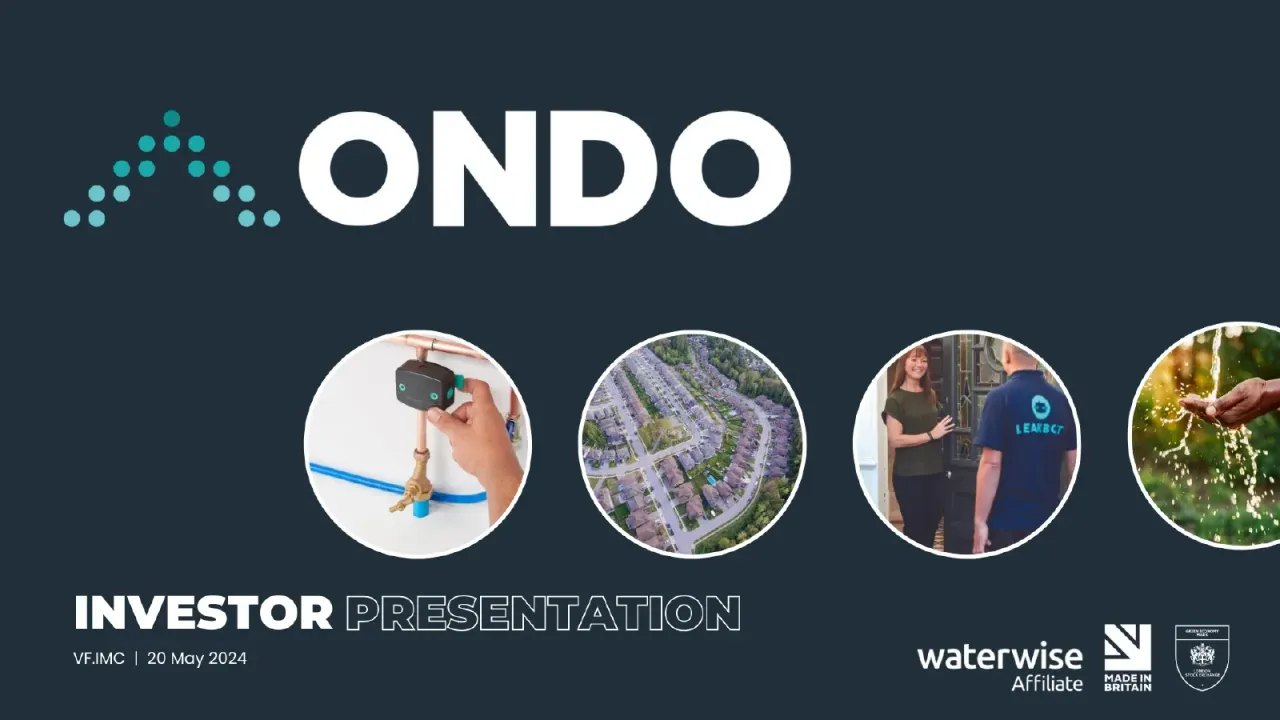
On 6ix: 6ix.com/event/ondo-insurtech-plc-ondo-investor-presentation
Automated transcript · Written by software from the replay's audio. It can mishear names and figures; the replay is the record.
0:01 Good morning, and welcome to the ONDO INSURTECH PLC investor presentation. Throughout this recorded presentation, investors will be in listen only mode. Questions are encouraged and can be submitted at any time by the Q and A tab situated in the right corner of your screen. Just simply type in your questions and press send. The company may not be in a position to answer every question it receives during the meeting itself. However, the company can review all the questions submitted today and publish responses where it is appropriate to do so. Before we begin, I'd like to submit the following poll. I'd now like to hand you over to Craig Foster, CEO. Good morning to you, sir.
0:29 Good morning, everyone. Thank you, So my name is Craig Foster. I'm the chief executive of of ONDO INSURTECH. Thank you for joining today's investor presentation. We can already see we've got really great attendance to the to the call today. So today, we'd like to update you regarding our recent progress and our immediate plans, especially with regards to North America given some of the recent breakthroughs that we've made and also in the context of the recent institutional placing and the the open offer that we've made to existing shareholders. Thank you for submitting, your your questionnaires. We'll endeavor to answer some of these as we go through the formal part of the presentation, but there'll also be, a q and a at the end. Before I take us through the presentation, by way of introduction, I'm joined today by our CFO, Kevin Withington. If you've joined our previous, results calls, you will remember Kevin from from those calls.
1:28 I'm also pleased to say that we're joined today by our chairman, Mark Wood. Now Mark hasn't been on one of our previous results calls, but Mark has joined us on our recent institutional roadshow over the past couple of weeks. Mark was also keen to join today.
1:44 So we'll start by, as as many of you will have not heard from Mark directly, I'll hand over to Mark just to make a brief introduction. Thank you, Craig, very much, and good morning, everyone. And I'd just endorse Craig's comments. Thank you for the many questions that we've received, which we'll work through at the end of this presentation. I'm Mark Wood. I've I've been involved with ONDO from the period when we organized the management buyout from home serve and then and then our subsequent listing through the the RTB. So the
2:26 presentation today, as Craig has described, follows our recent institutional fundraising exercise. And I was keen just to introduce myself. I'm a chartered accountant. My background is in financial services predominantly insurance and most importantly in this context in property and casualty insurance. I was the chief executive of AXA in The UK in the nineties and built up the AXA operation to the form that it's in today. And then subsequently joined Prudential in 2001 running The UK and Europe
3:03 businesses of Prudential. And then in 2005, I raised £500,000,000 worth of private equity money to create a new insurance company, Pattonoster, which specialized in buying out the obligations of defined benefit pension schemes, occupational final salary pension schemes. That was integrated into Goldman Sachs, similar operation in 2010. And since then, I've been working in private equity, most notably perhaps buying out the RAC breakdown service from Aviva in 2011 and founding PensionBee, which is now a listed company PensionBee PLC, which we founded in 2016 and floated in 2021.
3:52 So very briefly, that's my background. Let me hand back to Greg.
3:58 Thank thanks for that, Mark. So we'll go through the formal, investor presentation. This is the same exactly the same presentation that we've used in the recent institutional, roadshow. Now many of you, on this call are likely to be existing shareholders. So some of this, you will be familiar with, but nevertheless, we'll recap the the kind of broad introduction to the business before we talk about the specific, plans with regards to North America. So our mission, as you may well know, is to protect homes, reduce waste, and help the planet given that there's an environmental angle to to what we do. Our vision remains to become, the world leader in claim prevention technology specifically for home insurance. So the quick overview, is we're a proven INSURTECH business with a solution specifically designed to prevent household leaks.
4:49 We have a proprietary technology, a product called LeakBot that involves a unique sensor technology that we invented and we've patented all around the world, that can detect small leaks, in properties, and we combine that with an engineering plumbing solution that can then find and fix the root cause of the of the problem. Now why do we do this? We do this because this is a huge problem for the insurance industry. It's the the main cause of claims on home insurance, typically 20 to 30% of the claims paid out. And to give you an idea of the materiality for that, if you add together The UK and The USA, that's £16,000,000,000 worth of claims paid out, every year to put properties back how they were before as a result of damage caused by leaks that you can't see in the ceiling or in the wall.
5:39 It's also, a problem for the planet. Water scarcity is an increasingly global concern around the world as a result of climate change, as a result of population growth. The UK, despite the fact that it rains all the time here, is not immune from this, and it's increasingly a problem here, especially in the South Of England. Household leaks are are a big part of that problem, surprisingly. And we'll go on I'll go on to talk about why why that is and how we can help in a moment. So we have a solution that's already been adopted by large insurance companies around the world. We've got 16 insurance partners in The UK, Scandinavia, Sweden, and more recently in The United States. This is in every one of those instances provided for free to the homeowner as part of the insurance policy and paid for by the insurance company to us mostly on a recurring basis to provide those services.
6:36 And, also, more recently, we've been experimenting with, partnering with water utilities as well who are using this as a way to drive down those household leaks. So the the business is growing. The number of registered customers has grown, and, we have a defensible proposition here with 29 patents on this core proposition, around the world. So here's a quick snapshot of some of the partners that we work with, some names that you will be familiar with if you're a UK investor, insurers such as Admiral and Hisscox and Direct Line. Names probably less familiar, some big insurers in Scandinavia such as TopDenmark and the Lanser Schaffringar in Sweden, and more recently, some US partners. So Mutual of VenomClore and Selective and and, obviously, most significantly, nationwide who are one of the largest insurance companies in the in The United States.
7:39 And we'll go on some more in a second to talk about the recent breakthroughs as we've launched four states in quick succession and proven that we can deploy this in The United States as we have done in Europe. So this presentation will be available for for for for all of you after the call. So I'm not gonna step through our exact potted history here. But as Mark already explained, this business was, spun out of HomeSURVE, a a company with a big, expertise in, services such as plumbing. And I set up an innovation lab for the HomeSURTECH PLC group back in 2014. And as part of that work, we invented this new way of detecting household leaks, which created this opportunity in 2022 through reverse takeover transaction to float the company on on the market as a separate entity.
8:33 And since then, we've made a lot of progress. We've signed multiple partners. The business has grown significantly. And more recently, we've made this breakthrough in in The US.
8:46 So to recap the problem, I've already explained how this is a huge problem for in insurers. There's 1,600,000 claims in The United States and The UK, every year, And the typical claim in The US is about $11,000. So, it's important to remember this is not the the kind of big escape of water that you might imagine. It's not the ceiling falling in and, the person moving out of the property for for a year. Those claims happen, but they're really, they're really rare. The typical claim for a home insurer is a leak that's, a pipe into the back of a toilet or, a pipe somewhere hidden behind tiles or, under a kitchen sink, and it starts dripping slowly over time, and it goes unnoticed until it's caused a bit of damage to that property. And with a bit of redecoration and reinstatement quite quickly, that can be easily 10 or 11,000, dollars.
9:38 And it is exactly those types of leaks that we, detect. I already mentioned that it's also a big problem for the environment. The thing that we detect is the leaking toilets. If you see water running down the back of a toilet, that's typically 10% of toilets have that issue. And when they leak, they leak on average about 215, liters per day, and that adds up to a huge amount of water. By some estimates, there's an NGO in The UK Waterwise that, estimates that if you could fix all of those toilets in The UK, it would provide enough running water to provide the needs of Sheffield, Leeds, and Manchester combined. And, again, these are exactly the leaks that we can pick up and and and fix. So the LeakBot system is a unique technology.
10:25 It's a self install low cost sensor. We send it in the post for free to the homeowner. They clip this to the pipe. We typically get over 80% installation rate. And then if we detect a leak, it connects to an app, and, we alert the customer to the problem, and then we connect them to a trained technician who can come to the house and find and fix the root cause of the problem. I've explained I'm not won't won't go into this in huge amount of detail. I explained it on on other calls in the past. But to to anyone unfamiliar, the reason why this is a unique proprietary technology is we invented a new way of detecting leaks based on temperature fluctuations. So the device detects the temperature of the incoming water and compares this to the ambient temperature where the device is located.
11:12 And by measuring the delta between the two readings, we can detect leaks down to about three milliliters per minute. So a small drip and it doesn't matter where in the the house that leak is, the device can pick it up. And the the relevance of this is it's the only known noninvasive way of detecting a leak without physically cutting the pipes. So it's particularly relevant to this, home insurance context. So that is the the value proposition in a nutshell. We prevent insurance claims. It also, prevents, unnecessary wastage of water, which is good for the environment. And homeowners love the system because it protects their household bills and it protects their property. There's some, recent customer testimonials here. You can read these yourself. They're all publicly available online.
12:03 So you can see from our Trustpilot score and App Store, score that, the user experience, the in home service and the technology is is really great. So here's a case study from Sweden before we go on to talk about The US specifically. We, we launched a pilot in one particular region, in Sweden. And as as per the model, the devices were offered for free to, to Lancashire customers. In that one test region, we penetrated 40% of the customer base and also delivered a 50% increase in new sales during that test region. So we since signed a rollout five year rollout contract so we can expand that offering across the the Lancet Africa's 2,000,000 customers.
12:52 One thing that that that Lancet Africa wanted to do is, they're a multiproduct financial services company, with savings products, banking products, other insurance verticals. What they realized as part of this deployment that 40% of their customers in this one particular region had their app on their phone as a result of their activity, albeit it was our app. So one thing that they've done is they've developed a new app to drive customer engagement across sales, and they've incorporated our APIs into the app. So their customers use their app to install the the device, and they just launched that publicly over the last couple of weeks. The new news is how we've managed to replicate those types of results in The United States.
13:46 So our value proposition when we pitch it to US insurers always goes down very well. US insurers have a bigger claims cost on a per property basis than in Europe. People pay much more for their homeowners insurance in The United States. They typically pay $1,100 a year for a policy compared to 2 to £300 in The UK. And, so the claims, as a proportion, adds up to a much bigger number on a per property basis. Now US carriers have tested competitive solutions where it involves physically cutting the pipe, and those solutions work, but they're usually $500, and they require a professional installation. So it's really hard to find a scalable business case. So the feedback, we we would get from US partners is this sounds great. It sounds like the solution we've been looking for. However, can we believe that you can replicate the same kind of results in The United States as what you have done in Europe? Will you get the same customer satisfaction?
14:49 Will you be able to deliver the actual fix the same types of claims, as you can in The UK and in Scandinavia? So in the last, six months or so, we've launched into Washington, New Jersey, Washington, New York, New Jersey, and Ohio with Pure Insurance, Selective, Mutual of Leaning Claw, and nationwide. And you can see some of the results on on the slide here. There's some customer testimonials, direct verbatim quotes from some of the customers, very similar to, what we get in The UK. We had a net promoter score on the deployment of plus 80 and a 100% satisfaction with the engineer visits.
15:34 There's a quote here from Mutual of Eden Clore where they said in the first six months when they were paying our $5 per month fees, they delivered a saving of over $150,000 in claims. Nationwide, interestingly, are, obviously, a much scale bigger partner than, the other three that I mentioned. So they're a Fortune 100 insurance company.
15:59 They're the eighth biggest insurer in The United States in home insurance. Got about three and a half million, homeowners insurance customers, across The United States. And what they're doing in this area is really interesting. They've invested significant time and effort building a a smart home platform. And what that's designed to do is integrate with products like ours and ingest data on the API so they can enact real time discounts, on the customer's premium in response to the customer installing this type of technology. They've had that program, certified, signed off by the regulators in in 34 states already, and, they've been looking for the right solution in leak detection, which is why we've signed the the, perpetual master services agreement to start deploying LeapBots.
16:49 So the first order has gone really well as their VP of personal lines, products is on the quote here. They see big potential for this across their customer base in The United States, and the first deployment has gone ahead of their expectations. And, it's really the question that we've been asked by Nationwide specifically about where next and which states we're going to expand into. And are we, as a small UK company, going to be able to, execute, in line with their ambitions? And that's really the reason why we've been talking to institutions. We're talking to you today as we're funding to make sure we can support that growth and have the right infrastructure in place in The United States. So for anyone less familiar with the business, it's worth just recapping our economic operating model.
17:41 So as I've already explained, the proposition encompasses an actual physical device that we manufacture and we send out to customers and entails the the software that we use, to support the system, the APIs and the dashboards that we present back to the insurers and also the consumer facing apps. And it also involves an in home repair service. In The UK where we started and in Denmark, we had a range of different pricing models where we priced independently for the device, for the software, and in some cases, a separate fee for the repairs.
18:18 It's worth pointing out that we've evolved the thinking over time, and we think we've found the the the right pricing model that is optimized both for the insurance partner and for us. And that's the the model that was launched recently in The United States where we charge a flat recurring fee that encompasses all of those services. And in The US, it's around $5 per month, and that's been really consistent across the the deals that we've done.
18:43 And, the reason why this model works very well is it provides clarity to the insurer as to exactly what this deployment is gonna cost on a per household basis. But it's really good for us because it drives long, long term ongoing recurring revenue, which is ultimately the best thing for for you and for us as as shareholders to drive the the ultimate valuation of the business. Also, the other thing that we figured out is to the problem with that type of model is that can be a big working capital strain to build a recurring revenue business due to the the, the, lack of an immediate cash generation, at the point when you ship a unit. What we've done to counteract that problem is, we've been successful in The US so far of, asking customers to preorder whatever the first order volume is to pay immediately for the first twelve months of fees upfront, and then we can draw down against that as we, as we deploy the units. And so far, that seems to have worked.
19:46 So existing shareholders would be familiar. These are our last interim results. You can see that the customer base is growing. We've been successful in shifting our revenue towards the recurring revenues, and we've also seen significant growth in the number of households that we can address through the partnerships that we've recently signed. The most significant of which being Lanza Schaffengo in Sweden and also nationwide in in The United States. So we're funding for growth, and the vectors of growth are, continuing to grow our core insurance business in The UK and in Scandinavia, specifically The US expansion that, that I've already mentioned. So building on that breakthrough to penetrate both the new deals with customers like Nationwide and also sign more insurers, and open new states all around that consistent model.
20:42 And third is continuing to experiment through the water company channel. Can we also start to open up, that as a new new route to market starting in The UK? The chart on the right just gives you an idea for the the size of the customer base as it was back in September 2022. We had about 50,000 deployed units. And the insurers that we'd signed were mostly high net worth insurers in The UK and smaller insurers. And they had a total number of insured properties of about half a million. If you fast forward a year, because we'd signed
21:23 because we'd signed, Lance Schaffringar, that suddenly expanded to two and a 500,000. So, demonstrating the size of the opportunity in front of us. Since then, we've signed Nationwide, which has brought that number closer to 5,000,000. And if we also add on the immediate pipeline that we've got in The US, and by that, I mean late stage deals where we're at contracting stage, we've, provisionally agreed volumes and timings. It brings that addressable household base up to close to 8,000,000. So it gives you a sense for the immediate opportunity that we've got, right in front of us.
22:01 So the one thing worth just explaining in a bit more detail is with regards to the use of proceeds and how we're gonna expand the operation in The United States. So to give you a sense for the baseline of where we are today, we're operational in four states. Our main employee is Jim Strickland, who some of you will be familiar with from, from from other news interviews. So he's a he's our US general manager. He's a sales guy by profession. He's worked in the property and casualty industry selling technology products into these, insurance companies in The US for the last thirty years. And that's what we want him primarily focused on, and he's the one that's, done these these initial deals in The United States. Now that said, he's doing an awful lot of other things, at the moment as well.
22:50 So he's doing a lot of account management, managing the day to day deployments of some of these trials, in a in a partner facing role.
22:59 He's also the only person who can do on the ground oversight of some of the operation where we've currently got a couple of customer support people, and four engineers on the network who are doing the repairs. The way that we would like to expand this is is firstly hiring a US, customer success lead to sit, sit beside Jim. And that person we want is to manage all the existing partners in in The US and manage new ones as we bring them on board and to really farm those accounts and drive the recurring revenue room repeat orders from those customers,
23:35 and making sure we're delivering on the on the return on investment for for the insurer, which will really free Jim up a 100% to focus on new business development and drive our growth in The United States. We also want to put in place a US field service engineer and operational manager. We're kinda doing all of that from The UK at the moment, which is quite inefficient, sending people back and forth across the Atlantic. And then we'll build out the customer support and the repair services as we go on a state by state basis. So the idea is not that we'll go across The US in one go with a small amount of, leak bots everywhere, but with our partners. And in nationwide, we're already talking about the shortlist of which states they want to go into next, And we'll expand on a state by state basis.
24:30 So we recently complete completed a successful institutional placing where we raised £3,000,000. The placing price is at 14p, so small discount to the, previous close. We've also opened up an open offer to all of you as existing shareholders at the same price on a one for 10 basis.
24:52 It's worth bearing in mind that, directors and senior management between us have invested a further £100,000 as part of this, as part of this fundraise, and that's in in addition to the already significant investments that we made at the time of the RTO. So the company's growth plans, are now fully funded in The US, and in Europe. And, it's worth mentioning that we've had support from three new institutions as part of that placing in addition to follow on support from two of our two existing, institutional shareholders.
25:26 So the timeline is the open offer closes on the May 30. We've got a general meeting on the June 3, and then the settlement date is the June 5. And as we've covered, the use of proceeds is all about establishing that US administration and support facility to support those growth plans in The US, to fund The US rollout with sales, customer support, and engineers on a state by state basis, and then provide more general working capital for both US and for Europe. So in summary, why invest now? Well, we've recently signed Nationwide. It's a fortune 100 insurance company. They're the the eighth largest home insurer in The United States, and it's very hard for a company, especially of our size, to make it through that procurement process and become a supplier on a national basis in The US.
26:20 Part of, what we needed to do to even make it through that process was to prove to Nationwide that we could achieve the ISO 27,001, certification, which we formally announced just this morning that we've received that certification.
26:36 Even in the launch state of Ohio, nationwide, we've got a 180,000 customers to give you a sense for the scale, of these guys, but they've got over over 3,000,000 customers across The United States. So we've got immediate market opportunity with the partners that we've already signed, up to 5,000,000 and immediate pipeline opportunities with deals at a close stage in The US that allows several million more.
27:01 We've got a successful recurring revenue model that's proven. We know how to do it. And all The US contracts are on that, $5 per month recurring revenue basis. And the major r and d on that core product is all complete. So we're really in the stage of just growing and commercializing that at this point. And this fundraiser is to really accelerate the growth on all of those fronts.
27:24 So that is the the end of the the formal, presentation. Thank you for all the pre submitted questions. I think, Alessandro over to you. We will move now into the q and a. Yeah. Perfect. Craig, thank you very much for your presentation. Just for the company to take a few minutes for you the questions that have been submitted today, I'd like to remind the recording of this presentation along with a copy of the slides and the published q and a can be accessed via your investor dashboard. As you mentioned, we did receive a number of pre submitted questions. Craig, And, if I could just hand over to you just to maybe start with those, that'd be great, and then I'll pick up from you at the end.
27:59 Okay. Thank you very much. So, yeah, we've got quite a few questions to get through. So, I mean, we'll do this fairly informally. So maybe I'll start, at some of these, and then Kevin, Mark, if you if there's other perspectives you'd like to add, then, just feel free to, to chip in.
28:18 So one question we had is, can the company share, some of the forecasts of the broker research?
28:24 Some of this is only for institutions. Can we know the target price, sales forecast, and some, some key metrics?
28:34 So our house broker, Dowgate Capital, published a few different research notes. The last one was on the twenty sixth of, February. So this research is available on the Dowgate website for investors. So if you register to receive that research, I will, if this works, in the just to direct you to exactly where that is, I've put a link in the in the chat that will take you to where that research, where that research is available. Another question we had is, Ting is being deployed, extensively with State Farm. Can you comment on the status with the top 10 insurance companies?
29:19 Who who have you approached, and, and and what's the status? So, obviously, Nationwide are a top 10, insurer. Jim has been working hard, and and I've been helping, getting into and starting conversations with some of the top 10, insurers. So I can't disclose specific details, but already a couple of them are live and active leads that we are progressing through that through that sales process. And certainly, our the the the really, the the the restriction is management bandwidth, honestly, about how many deals can we actually, execute and land. The reason why we wanna hire the customer success manager is it frees Jim up a 100% to focus on new business development. And we have a preidentified candidate actually that is also has, numerous links across the top 10 based on her previous role. So more news to come, about that in in due course.
30:19 But, the quick answer is there's a couple already in that top 10 that are live and active leads that, that we're pursuing. So a few more questions on The US specifically. Can you give details on how the smart home initiative is is expanding with with Nationwide? So Nationwide have obviously, stated that they believe, the smart home technologies is gonna play a really key role in the future of their homeowners', business. And this smart home platform that they've developed is really, quite unique. We've not seen any other insurers in Europe or in The United States build do that type of technical integration. So the initial, order in the first launch, they've shipped the devices having, even though they haven't finished that technical integration on on LeadBot, which they're just finishing off now.
31:15 But, they've already, like I mentioned, signed, had regulatory approval for this smart home program across 34 states. And I think what I really like about it is the fact that they, there's a real incentive for the customer because you will see a monthly discount on your premium, from having installed the the technology. Now the key thing is what technology are they gonna offer, and what will really deliver a claim saving. So they found one thing, a a product called Ting, that prevents some electrical fires. So you plug it into the mains, and it will detect electrical arcs and then, connect you to a trained electrician if there's a risk of a house fire. So this is something, although house fires are much less frequent than WaterLeague claims, obviously, when they happen, they're much higher value.
32:07 And, Ting seems to have had some, success in being able to prove that return on investment with US carriers. So I think Nationwide have deployed about 50,000 of them already. I I think State Farm have deployed almost half a million, across The United States. And, so Nationwide are looking for products like that that that, they believe really has a claims mitigation benefit. And frankly, they've tried other things on WaterLeak as have many US insurers and found that there's just no real business case. There are the point sensors that don't deliver a claim saving, or they're these plumbing systems that are really expensive. So Nationwide, the way they talk to us, they don't talk to us like this is a pilot. They've already nearly completed, all of the technical integration.
32:54 The nature of the contract we've got, with them, we don't need any other contract to roll this out, with them as we go state by state. We can just enact, subsequent orders, attached to that contract as as we go. So we're already we've we will exhaust that first order pretty soon. We're already talking to them about what states they wanna go into, next. And that's about as much as I can say about Nationwide at the moment, but obviously more more news to come. Another question on Nationwide. Are the addressable households attributed to Nationwide just those on their smart home program? So no. They're not actually. So although the smart home program is really interesting initiative, I think even for Leaguebot, the the ambition is broader than that. So they clearly, as a business, want to make as bigger difference on claim savings as they can through this type of technology. And it's worth bearing in mind in The US, this is in the context of, rising claims costs because of inflation across the board. So this is increasingly putting pressure on insurer margins all across The US.
34:03 So, yeah. I mean, watch this space, and let's see what happens. I think we're one thing that we're picking up is, US insurers starting to think a bit more radical, compared to, insurers over here in Europe and thinking about starting to make, these types of technologies mandatory for new customers. So make it an actual mandatory policy requirement, as part of the as part of the insurance. I guess much like a a car telematics, black box would be on a car telematics policy in in, in The UK, for example. So, yeah, we see the applicable addressable market as being all of nationwide's, customers across The US. And then another US question on this on a similar topic. The US pipeline, seems to add another four and a half million users. This implies we may not have larger companies than nationwide in the pipeline. Can you comment generally on approaches to top 10 insurers? So I've probably covered that already. So in, in the numbers we used there, I think, we included one pipeline, prospects because that conversation was a a much further stage.
35:12 And, but like I say, there are others in the mix that weren't included in in those, numbers as well. I think, Craig, it may also just be worth highlighting that, since the nationwide announcement, Jim's job really has been about fielding inbound calls as well as making approaches. And I think that, you know, that's really the big thing that's changed with Nationwide. We've attracted the attention of Nationwide's peers who are calling up and wanting to know more. Yeah. And I think that's that's exactly right, Mark. And I think that is a a common phenomenon in in b to b sales, with technology products where, you know, companies tend to look very carefully what their peer group are doing. And Nationwide is such a big name and well respected that, the fact that they've partnered with us and backed us so publicly, and they've been, you know, very, very, keen to to back us in that way, I think has sent a a really good message, across the across the industry. And and and there's nothing exclusive about this as well. I think Nationwide are, you know, quite happy for other insurers to deploy the technology, and they see that as a as a as a good thing generally. So there there is in no way like a a kind of exclusivity around what we're doing.
36:36 A couple of questions about manufacturing. So what is the current manufacturing capacity, and are there any plans in the pipeline to to increase this? So the part the capacity we've got in The UK is up to about 240,000 devices a year if if we push it. So that's, enough to meet our near near term needs. We're we've, the the manufacturer that we use are part of a much broader group, and they've got facilities around the world. So we have already got a plan in place with them to open a second facility in, North America, as and when we should need it. So it's a relatively easy thing for us to replicate, and, you know, we could just replicate exactly the the way that we manufacture it with the the same kind of test rigs and everything in a in a second location and run the two things in parallel.
37:29 Related question, is it likely that the cost base for US manufacturing would be lower than the current cost given economies of scale or larger potential supply pool? And so, yeah, I think it is likely. Labor costs are obviously gonna be cheaper in Mexico than they are in our UK factory, I would imagine. And also at those just at those volumes, there probably will be further economies of scale. How much and what what is that worth exactly on a per unit basis? I don't I don't know, don't know at the moment. So there was two questions related to the same thing. Is there any update on the Australian trial? Could you provide a progress update on a collaboration, with Firemark, Collective and, IAG to test the all weather outdoor version in Australia.
38:20 So, so to recap, if if anyone doesn't remember that, we we, there was an announcement last year about us partnering with, the largest insurance company in Australia, IAG. Well, their their innovation, the innovation part of that business called Firemark Collective. And the background to this is, IAG approached us and said, great news. We've selected Leakbot to be our solution for home insurance prevent water leaks in Australia and New Zealand, to which, our response was not so fast because we don't think our products will work in Australia and New Zealand. And the reason we thought that was, because everywhere we've deployed the product today, the rising water main comes underground and then up into the property, and the device is located near to the stop tap where where that enters the the property. Given that most of the people on the call are probably UK investors, investors, you'll you'll know know where where that is in your house, you know, under a sink or in a basement something.
39:20 In Australia, in most of the parts of Australia where it doesn't ever freeze, the rising main comes out of the garden and into the side of the property. So and then it branches into the cavity wall, there's no access from inside the property. Now our device hasn't been weather sealed. It wasn't the algorithm wasn't designed for that extreme kind of fluctuations in temperature. So IAG's response was, we said, look. We'll let you know if and when we have a solution for that use case. Their response was, well, what if we fully fund that as a project and you develop something and we'll fund the r and d costs? So that's what we've been working on. We haven't put any formal update, but, you know, I can basically set this you know, say enough to say it's going well. So we think we figured out how to do it.
40:13 We tested early prototypes with really good results, and, we think we've cracked that, that modification to the product to solve that use case, to the point where we also think there's some unique, IP that we can protect. And, we're just, now scaling the project. As part of that, IG project, we're now scaling that testing into more and more homes across, Australia. So I enjoyed this question. There are so many companies on the main market that create hype to generate cash flow for themselves. What makes you stand out, to the crowd? Are you a genuine business? So I think, I thought this is I'll add to the style of that question. So, yes, we certainly are a genuine, business. And, Mark, you might like to add to this one as well. I mean, my answer would be, why are we a genuine business? We're a genuine business because we're addressing a real high value pro problem to for a huge industry that's fairly consistent around the world, and it's a growing problem because of that cost price inflation.
41:21 And we have a proprietary solution to that problem, something that's defensible. There's an IP moat, around it. And we've got a proven go to market model. We've got proven traction with big insurers, and, now it's a momentum game. And I think it's proven evidence that it's a genuine business. We as a management team and directors have invested a significant amount of money, mostly at the original, RTO, but also as a follow on in this round. So you can see that we absolutely believe in the potential of the business and believe that this is a a genuine business. Mark, you like to add anything to that one? Yeah. It may just be worth mentioning why, you know, why I chose to get involved and why I invested. As Craig says, I mean, this application is a benefit to every insurance company in the world that insures escape water, and escape of water is a major category.
42:15 As Craig has described, the major category of claim within household liability. And and in my mind, this you know, the unit cost of fitting this device is comparable, actually a lot less than a good quality lock on the front door, and and no insurer in the world would insure a house without a lock on the front door. And so I think we'll we'll get to the point and we're beginning to see the the first signs of this in The US with nationwide and that the interest of that stimulated. I think we'll get to the point where this becomes an essential for insurers and there will be insurance policies that only pay out if you have a leak bot installed. So I think ONDO INSURTECH enormous potential in the given this parallel between this piece of technology that identifies a leak early enough to mitigate the claims cost and the approach that the insurers take to, for example, an appropriate burglar alarm or indeed a lock on the front door.
43:19 Thank you, Mark. Let's see what else we got. There's a couple of questions about water companies. So, what progress has been made with regards to a dual billing strategy for insurance and water clients? Can you comment on the results from Portsmouth Water? They've indicated LeapBot has a temporary role until water meters are rolled out. Can you comment, on Leakbot versus smart meters? So, I mean, water companies all have various different plans to deploy smart meters, you know, from now or through through 2030 and beyond. And they're all publishing different plans on how they the kind of rough idea of how they plan to approach this.
44:08 So smart meters are obviously primarily designed to make billing easier so they can read the the water consumption from from a distance. But they can also detect leaks, especially larger leaks. They don't have the same degree of sensitivity as, as a leak bot, but they can detect large flows of water. What they can't tell you is, where that is because of where the smart meter is. It could be that it's the underground supply pipe on in the garden that's leaking. They don't know that it's a leak actually in the house. And smart meter certainly can't detect a leak as small as what drives the the insurance use case. I think what the question is referring to is Portsmouth. We did a small pilot with Portsmouth, and they've then, published their what's called a AMP plan, to the regulator, like a business plan for the for the next five years through to 2030.
45:00 And what they've said in there is they want to use LeapBot wherever, a smart meter is not appropriate for the property. So, I mean, we're still finding our way with insurers. We're still trying to figure out if there's a role for us to play. We certainly had a huge amount of interest from from the water industry. And I think what the Portsmouth plan is referring to is there are certain properties where a smart meter is not appropriate. It's not commercially viable to fit one or for a whole host of reasons. It's not, not suitable for a smart meter. And what they wanna use is a LeadBot to kind of fill in those, those gaps. And that is one kind of relevant use that, that LeadBot can can play, with the with the water companies. So, I mean, we're still experimenting. We've done a deployment recently with Southwest Water, and they were using it for a different region, just hitting a really water stress particular area, with a quick deployment of LeapBots to try and immediately drive, us to go in the home and fix some leaks and to drive a water saving.
46:03 So, I mean, we're still figuring that out and experimenting with the with the model and, and also experimenting with ways that both the insurer could contribute to the cost, in addition to the to the water company. And we've got a lot of interest from the, from the insurers, on that. So yeah. So it's, we'll continue to update, as we learn more about the model and how it can play out. Craig, I think it might just be worth commenting on the the the the purpose of the smart meter in the in the context of of water conservation with LeakBot because I, you know, I guess just listening to your your characterization of the very successful pilot with Boardsmouth, people might conclude that actually smart meters will make make Leapbot redundant. Of course, the key element of our IP, the patent the worldwide patented IP is that it detects very, very small flows.
47:02 Mhmm. And it's this concept of interrupting the process of of a small leak somewhere causing damage out of all proportion, whereas a smart meter meter is designed really to detect abnormal use such as a, you know, a garden irrigation system with a leak in it that's spewing out water. Mhmm. Yes. Other water waste, really. Yeah. So they although superficially, you know, the Paul Smith comment might suggest that one day, LeapPop will be redundant. They're actually very different applications and different technology. Yeah. Yeah. No. You explained that very well, Mark. Another one here. Leakbot has a high impact from, initial deployment. Are the contracts with companies for a fixed set of years?
47:56 If not, is there an incentive for them to only use LeapBot for an initial impact? So the question is, is right in terms of the LeapBot does have an immediate impact because we immediately find some preexisting leaks and can fix them. However, the benefits do accrue over time. So it's not that we fix the leaks straight away and then there aren't any subsequent leaks. Although the the incidence of leaks drops from year two, then we still carry on detecting leaks. So, the the insurers are always motivated to carry on, keeping the systems detected and carrying with the service so long as that that, remains a customer. So is there a minimum contract on a particular device? Yes. It varies by account. So we have a range of, different minimum terms, from a year, sometimes up to two or three years.
48:49 But, the the key thing is, you know, if that's still a insurance company customer, they, they will wanna keep that connected because of the the ongoing claim saving. So there's been lots of questions coming in as we've been, as we've been talking. So, despite all the positive news, the share price has dropped 30% this calendar year. What are your views on this disconnect? Well, I'll I'll I'll put that to to to Kevin and Mark as well. I mean, it's it's very difficult to to know as always. The I mean, I think it's been largely down to, the the fact that we, we're gonna need to raise money was kind of anticipated a bit by, the market, especially given the recent contract wins in in The United States.
49:41 And I think that expectation has maybe, driven some of the share price decline. It has gone it is a disconnect because it has gone, you know, it doesn't represent the progress that we've, the progress that we've made and the progress we to make. So, certainly, our hope is that, we'll we'll we'll we'll bounce back strongly from from this point now we've, now we've sorted the funding. Mark, anything that you would add to that? Well, just I mean, reading the EFT as recently as this morning, you know, the the the the big story there is Jupiter's chief executive commenting that that people are beginning to realize that the The UK UK listed stocks are for sale at a discount. And, you know, the the the rise in the footsie, I think, is expected to lead to a broader rise in in investor recognition of the value of cash flows. I mean, anybody that looks at our business on a on a discounted cash flow basis, you know, the traditional way of of valuing a company that has recurring income would have to say that the, you know, the pace of which we're building in an endowment, building in this sort of annuity concept of fees being payable for deployed devices and Craig's earlier comments about insurers in the second year and third year and fourth year of a contract being particularly motivated to promote LeadBot because of the higher retention rates they
51:11 get on policies suggests that this this annuity is a, you know, is a pretty valuable component of our business model. So you would you would have thought standing back and looking at recent news, looking at the discounted cash flow concept that the the shares are very significantly oversold. And the reason for that would be people shorting their positions in anticipation of of the of the capital raise, as Craig has said. Do you have a look at the link to the investor research because that that in particular looks at the at the model and what the embedded value of the current contracts is as those contracts develop over the coming years. Yeah. Very good. Thank you, Mark.
51:58 We're running out of time, I don't think we're gonna be able to answer all of these. So I'm just gonna pick the ones I think are definitely important to to cover. So somebody has asked, what does it mean when you say a 10 for one basis for existing shareholders? So I think the the what that means is for every share every 10 shares that you own today, you have the opportunity to buy another one, at the offer price of 14 p as part of the open offer. It's also worth mentioning that I think there's the opportunity to subscribe to buy more because, obviously, some people won't take up the the offer. For example, the the management team, have taken part in the placing, so, our open offer rights won't be used, and some of those will be sold back if anyone wants to buy anymore.
52:47 Although I am taking up all of my rights under the offer. Just Yeah. I'm doing the placing. Yeah. Yeah. You're right. Placing. Yep. Let's have a look. So this, this is, obviously a pertinent question. There have been a number of shareholder dilutive activities including warrants. Can we expect this practice to have reached an end? With this lasted with this lasted fundraise, will you reach positive cash flow generation to support growth, and or, access, debt financing? So, yes, we've raised sufficient funds to to meet our stated growth plans and and, provide sufficient working capital, certainly for the next twelve months as it lays out in the in the prospectus.
53:38 With regards to reaching breakeven, so we, as a company, haven't put out, a specific forecast in this, but it I can point you to the Dow Gator analyst forecast, which shows us, breaking even in the second half of, f y twenty five. With regards to warrants, I mean, we used, warrants in the past at the part time of the original RTO, and some warrants were in existence, back when the, the listed entity was Spinnaker Acquisitions. So now I think we've with Dowgate as the broker, I don't think there is any intention to issue warrants. And especially now as we're we're moving, we've also added institutions onto our shareholder register.
54:25 I'm learning some of this, recently, but I know that they they're not particular fans of warrants. So I think the short answer is I'd I'd we're not anticipating we'll do any anything any more of that in the in the future. We haven't issued new ones, have we, either? So the the position with the warranties as a as it as it was at the last set of financial statements in March March twenty three less the exercises. And the average warrant price is very close to what was in those financial statements of about $22.22.5 pence. So, yeah, so there there have been no new warrants issued in the last three to six months. I should have And, course, it's worth and, of course, Kevin, it's worth pointing out that as the share price rises and the warrants are in the money, it's a further thought source of, funding for the company.
55:19 Yes. Yeah. And we and we have had and when we when we publish our full year results, you will see that that we have had a warrant exercises during the period, which are obviously announced as part of the, voting rights periodically so investors can see what's gone through. Okay. Last few minutes. So oh, the quick if you submitted a question and we haven't answered it, we'll we'll, publish answers to all of these, afterwards and and and consider everything that's been submitted. Would the board would the board point to as the most significant current or future inflection point that may not be appreciated by the market?
56:05 Maybe you would you like to take that? Not to put you on the spot, Mark. What would you say to that? Well, I think we've touched on one or two potential inflection points here. The Australian funded research, of course, is also applicable even though it snowed last year in Texas. It, you know, it is relevant in terms of deploying the kit in climates where the water supply is not within the home, not not underground and then into the building, but underground, the overground and into the building. So that's that opens up a target market beyond the capability of the current technology. We've commented on the inbound inquiries that we've had in The US prompted by the announcement of Nationwide.
56:59 A couple of years ago, we saw the Chief Executive of TopDenmark comment on the 2% benefit that TopDenmark had derived from deploying the LeapBot devices against their claims ratio, which is really astonishing. You know, to have a single initiative that reduces your claims ratio by 2% is really quite extraordinary. As we roll out with Langerhafen in Sweden and as we see the rollout in The US, my expectation would be that we would be we would be getting further endorsements of the financial impact on the claims reserve of deploying LeapBot. And of course, you get into a virtual circle at that point because other, you know, you then get into an analyst presentation with, I don't know, Royal Sun Alliance or Aviva in The UK or State Farm in or Allstate in The US and the analysts say, well, you know, we see Nationwide are getting a 2% benefit on their claims ratio.
57:58 What are you doing that's comparable, you know, and so it and so it gathers some momentum. So those those would be three things that I just just draw out from the conversation we've had here regarding inflection points. Yeah. Very good. The other thing I would add is sometimes there's a I there's a comment from from shareholders where they say, oh, unless there's, you know, like, a million unit order from State Farm, you know, that's the only thing, you know, that I would see as being like a significant kind of inflection point. And, the thing I would add to that is having spoke to, our friends at Ting who are up to half a million devices, I asked them and I said, you know, how how did that go with State Farm? Did you just one day get half a million order? And they said, no. Absolutely. It wasn't like that. We had a master services agreement, and then we slowly expanded a state at a time, an order at a time, and their orders were for 2,000 units to start with, then five, then 10, and then 50,000, and then, subsequent orders of of that kind of magnitude.
59:02 Maybe it's 25,000. I can't remember. And, so it was over time. So the, what I will, endeavor to do is to keep updating, as much as our partners will let us put things into the public domain about the steady progress that we're making, as we add new partners and as we expand with the existing partners, as we launch into new states, as we, deploy more and more devices, so investors can sense, you know, month to month how how is that expansion, going. Because I think that's how those contracts will evolve over time rather than there suddenly being, a million unit order in one one go, which, by the way, would cause us all kinds of a headache anyway if we had to manufacture a million over overnight.
59:54 That is a problem that we would solve there, wouldn't it? Yeah. Oh, absolutely. Yeah. Absolutely. So, Alessandro, I think I think we're on the hour. So any questions that we we haven't answered, we will we'll consider carefully and see if anything we've missed, we can publish responses to. Perfect. Thank you very much for answering all those questions from investors. As Craig has just mentioned, the company can review all all the questions submitted today, and we can publish those written responses on the investor meet company platform. But just before redirecting investors to provide you with their feedback, which know is particularly important to the company, Craig, I was just wondering if I could ask you for a few closing comments. Yeah. I think my closing comment would be, to thank everyone for their their support. I absolutely recognize the frustration of some shareholders as the as the share price has has gone into that decline as one of the, the questions, referred to. And, obviously, myself and Mark and and all the board feel that too is we're all significant, shareholders.
1:00:54 But it does, go totally contrary to how things feel on the inside, right now. The recent gains that we've made in The United States, the confidence that we've got that this solution works in that US market, is, is really exciting because we know that we just need to keep doing that, and that momentum will grow. And the confidence in this as an industry standard solution in The US will will continue to grow. And, and we're looking forward to to executing on on the the back of this fundraiser. Thank you for your continued support. Thank you indeed. Perfect, Craig, Kevin, Mark. Thank you for updating us today. Could I please ask investors not to close the session as you now be automatically redirected to provide your feedback and all the management team can better understand your views and expectations.
1:01:41 This will only take a few moments to complete, but I'm sure you'll be greatly valued by the company. On behalf of the management team for ONDO INSURTECH PLC, we'd like to thank you for attending today's presentation, and good afternoon to you all.
Follow Ondo Insur Tech PLC into a list and get an email when it puts out news.
CEO at ONDO INSURTECH PLC
CFO at ONDO INSURTECH PLC
EXECUTIVE CHAIRMAN at ONDO INSURTECH PLC