Transcript
Automated transcript · Written by software from the replay's audio. It can mishear names and figures; the replay is the record.
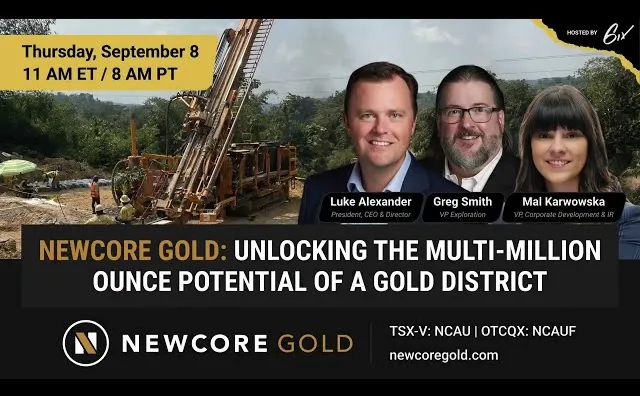
0:08 Hi everyone thanks for joining us today so for those of you who don't already know me my name is Mal Karbowska and I'm the VP of corporate development and IR for New Core Gold. I'm joined today by New Core Gold's President and CEO Luke Alexander as well as our VP of exploration Greg Smith. We've had a very busy 2 years and this morning we actually did just announce the start of further drilling following up on the success we had with our 90,000 metre drill program at Enshi. Which delivered really strong results and highlighted the resource growth potential of the project. We look forward to taking this opportunity today to dive into more detail on those results from the last 2 years of drilling at Enshi, as well as discussing the UCorps' key achievements over the past 2 years, and then of course what's ahead.
0:54 Before we get started, I do want to highlight that we will be making some forward-looking statements today. I encourage you all to visit our website where you can find the full cautionary language. And lastly, please don't forget to submit your questions. After the presentation, we will be answering those live, so please do make sure to submit those using the questions tab. So with that, over to you, Luke. Thanks Mel. Hi everyone. Hope everyone had a nice summer and September is off to a good start. Hopefully we see a little more sun in the markets this fall. New Core Gold, we're advancing the Enchi project in Ghana. It's an advanced stage district scale exploration project backed by a management team with a proven track record, and who are truly aligned with shareholders through our 24% interest in the business.
1:42 We are also very well supported by deep-pocketed, mining-focused
1:46 institutional investors, currently about 40% owned by institutional investors, as well as strong support from the capital markets and 5 tier 1 investment banks who cover us from a research perspective. So I'd encourage anyone to go and have a look at that research. But at the end of the day, the thing that really drives a company forward is having a great asset. Our ENSHI project, as I mentioned, is a district scale exploration project, which is fundamentally underpinned by a very robust PEA that we put out in 2021, which outlined an after-tax NPV of $212 million, IRR of 42% after-tax and just over a two-year payback.
3:04 We're currently trading at about $15 per ounce in the ground, which again, I would argue is a very attractive level for investors to be looking at at Nucor. In terms of the project, we did drill 90,000 meters over the last couple of years. It was the largest ever drill program on our ENCHI project. We will be getting a resource update in Q4 of this year, which we'll talk about. And as Mal highlighted, we're excited to have announced that we've kicked off a phase 2 drill program to build on the success that we had with that initial drilling at our Enchi project. Ghana, it's a tier 1 jurisdiction to be operating in. You've got 2 prolific gold belts that run through the country. You've got the Ashanti belt as well as the Sefwi-Bibiani belt.
3:53 We're on the Sefwi-Bibiani belt, 200 million ounces historically discovered in Ghana. Great Neighbors a long trend from us. You've got Asante who owned the Toronto mine as well as the Bibiani mine. Those are 5 and a half and 6 and a half million ounce historical endowments on those projects. And then you've got one of Newmont's 2 producing mines in country, the Ahafo mine, which they're currently spending an additional $800 million on, and that sits at a historical endowment of 15.5 million ounces. So, really large deposits along trend from us, and we've just started to scratch the surface from an exploration perspective on our ENCHY project.
4:39 In terms of the 90,000 meter drill program, which we just completed, I'd encourage you to go back and have a look. We put out a press release in August which kind of outlined everything we accomplished with that drill program. But when we kicked it off, we ultimately took a multi-pronged approach and wanted to accomplish 4 things with that drill program. We wanted to expand the existing resource area at all of our known deposits so we stepped out along strike at all of those existing deposits and have extended the mineralized footprint which Greg will talk about. We wanted to go back to previously drill tested areas and look to make additional discoveries at those areas and start to move them into the resource category which we were able to accomplish.
5:30 We also wanted to make some new discoveries, which again, Greg will talk to us about in a bit more detail. And we're very excited to have made 3 new discoveries this
5:38 year, which all sit right around the key infrastructure that's proposed on our project. And then lastly, one of the things that we wanted to test for the first time ever was the high grade at depth. For the first time we started to drill below 125 meters as part of this 90,000 meter program and we've had some very good success from that perspective. With that, I'll hand it over to Greg and he'll talk to us and give us some examples about that expansion that we've done at our existing resource areas, starting here with a map of our project. Over to you, Greg. All right. Thanks, Luke. And yeah, this is the Enchi Gold Project. It's adjacent to the town of Enchi, which is about 18,000 people. So all of the services that you need, We have our houses there that where our crew stays. We've got a warehouse and core facility here next to the main paved road. This is a paved road and power lines that cut right through the project.
6:44 So great infrastructure, great access. In terms of the resources, we've got the Boin zone here and Sayoum. Between those 2, they make up about 90% of the resource in the smaller Niam and Kwashi Krum areas. So all totaled 1.4 million ounces of in-pit mineral resources and again we'll look at the resource in a little bit more detail in a later slide. We'll first talk about the Boeing deposit, so A little over half a million ounces currently in the Boeing deposit, 505,000 ounces. If we look at, when we look at these images, we've got 3 main components here.
7:29 These are pit-constrained resources, so the gray areas that you see there are the pits that constrain these tons and ounces. The blocks are the block model, so the blue is up to half a gram. The yellow up to 1 gram per ton and the red greater than 1 gram so indeed and this will be a bit of a theme again we see some higher grade portions and some shoots going to depth and we'll look at this both here at Boyne and at some of our other deposits and then the black traces with the yellow is highlight the where we've got the mineralization within the the drill core. So this is this is again focusing in on on the recent drilling that we've done so you rotate this around again you can see the pits that constrain the 2021 resource here in gray. You can see we've done quite a bit of drilling, both to the north and in particular to the south, where we've expanded this by 1.5 kilometers.
8:28 You can see some really good results coming, both expanding the existing sort of known area within the pit, but in particular, this almost 1 kilometer step out where we've generated some really good results there. You can see here at Boyne, and it's probably the best example that we have of all of our resource areas. These are structurally controlled deposits, so they tend to form relatively straight lines in terms of the controls to the gold mineralization. And clearly, this is open to the north and to the south. And we have some drilling planned in the upcoming program to continue to follow this zone
9:06 to the south. As part of the 90,000 meters, we also did some drilling sort of on the edges, if you will, of the existing resource. So these are sort of just below and just adjacent to the existing pits had some some very positive results 2 grams over 12 meters 1.7 over 16 you know 1.7 over 18 and indeed some nice high grade results within this zone as well this is the highest grade result we had on the property 95 grams over over 2 meters so we'll look at this area in a cross-section this contains again some of the higher grade results that we have now this pit is is this is based on the on the 2021 resource so so obviously we'll be looking at expanding that as we do the updated resource estimate.
9:57 And again, this section sort of highlights both the narrower high-grade results, but as well we've got some holes where we've got you know 40 meters plus 12 meters plus over a hundred meters of mineralization all in the same hole and obviously that gives us the ability to really have some significant mineralization within these pits. We started drilling some deeper holes and again we'll look at this some of the other zones this is a diamond hole that we've actually just recently released a nice zone here 1.28 grams per ton over 74 meters with some nice higher grades within that as well you know over 2 grams up to almost 10 grams for 4.1 grams per ton so we see some some nice grade occurring in some of these deeper holes but in terms of of Boyne what we're really focused on is again, expanding this along strike. And as I mentioned, as part of our announced just today, drilling program, we'll continue to expand this to the south. And as part of the resource update, we'll be including all of this drilling that was completed as part of the 90,000 meter program.
11:13 Thanks, Greg. So the second thing that we obviously wanted to accomplish with this program was starting to drill some of the high grade at depth for the first time ever. Prior to this 90,000 meter drill program, which we just completed, the deepest hole ever drilled here at our Enchi project was only down to 125 meters which for those of you who follow the mining sector closely will recognize that that is quite a shallow hole and really that was deliberate because we were focused on the oxide and transitional material which lends itself to a heap leach project which is a much lower capex way of producing gold. So the bulk of the 1.4 million ounce resource that we've put out to date is within that oxide transitional category but we are also excited to start to explore deeper and test some of the sulfide material as well. What we're looking at here is a is a long section of our Enchi project we're then looking at the Toronto mine. What we've done is we've superimposed
12:21 the depth of the oxide transitional zone which again 85% of our current resource sits above that. Those pits that Greg was just showing you the average vertical depth of all the pits on our project is only down to 63 meters and as you can see by looking at Toronto again where these deposits typically really grow in size and increase in grade is as you start to get deeper to put that in perspective Toronto's currently mining down at 800 meters below surface. They've drilled down to 1.2 to 1.3 kilometers. We for the first time, as I mentioned, have started to drill below 125 meters down to about 300 meters, 350 meters, and we started to have some very good success with the results from that.
13:15 I'll show you some of those results at our NIAM deposit where we've been able to put the most deep holes into and had the best results. Looking here at a cross-section at our NIAM deposit, as you can see, some very nice higher grade oxide material near surface 2 grams over 35 meters within that almost 5 grams over 8 meters and as we started to drill deeper here
13:44 at at NIAM in this hole number 45 as we got down to about 175 meters below surface, we've hit 5.4 grams over 9 meters. Sitting 500 meters to the south of that, within this hole number 48 here, as we got down to about similar levels, 175,200 meters below surface, we hit 7.4
14:07 over almost 8 meters and that's within 4 and a half over 13 meters. So these are the kind of higher grades that we're looking for to show that underground potential over time. When we now pull it back and look from a long view perspective, you can see some of those grades, 5.8 over 7 meters, 5.6 over 8, 5.4 over 9, almost 5 grams over 8 meters. So with this density of drilling, we now have the confidence to start talking about how we think we've hit one of these high grade shoots plunging at depth. Sitting 500 meters to the south, as I mentioned, here's that hole number 48, 7.4 over 8, but within this same area, 3.2 over 9, 3 and a half over 9, 6 grams or 6.25 over 6 meters. So again, we can now start talking about how we think we've hit a second one of these high grade plunging zones at depth. Big question for us is what potentially sits in the middle here. As you can see, there aren't any holes drilled here and I'll get Greg to talk about it, but as part of this phase 2 program that we've just kicked off, we are gonna focus on some drilling in this area to follow up on all of this high grade success we've had. I'd also encourage you to look at our press release this morning. We've included a long section in there which illustrates
15:39 how we think these areas are plunging at depth. So maybe Greg you want to touch on what we've got planned from a exploration perspective as part of this phase 2 program to build on all the high grade success we've had here at NIAM. Sure, thanks Luke. So yeah, Luke's been sort of drawing our interpretation of these high grade chutes. Obviously, we don't have any drilling here deeper down so we can sort of. Draw these plunging in a couple of different directions as he mentioned we haven't done any drilling here in the middle so it might not actually be 2 shoots it might actually be 1 large higher grade area and as part of the current program we'll be putting some holes in this area. We'll also be putting some holes deeper down in terms of the interpretation of what we now believe to be the plunge on these chutes and as well we've got sort of a third area here just to the north and again we can see that we've got some nice high grades near surface and that's a theme, these high grades are near surface and they continue at depth so there's a good indication that as well we've got some potential to follow a third chute at depth here so the current program will include both this internal area here to test to see if these actually join up some slightly deeper holes and again keep in mind that when we talk about deeper holes as Luke mentioned we're you know 175 to maybe 250 meters vertically so we're still drilling
17:12 industry-wide you know relatively short holes to find this higher grade material and as well again start to test some of these other chutes that we see in the near surface environment with some higher grades and test to follow those to depth. So really even here just at NIAAM we've got 3 targets for higher grade material continuation of the chutes. It's also significant that in terms of the previous drilling, every
17:41 one of these holes hit higher grade material. So it's not like we cherry picked certain holes within this area. This is the results from all of the deeper holes here and every one of them had some nice higher grade results. So we're quite encouraged about that and looking forward to following up with that with the additional drilling that was announced this morning.
18:05 So Greg, I think you're gonna talk to us now about some of the new discoveries. One of the things we're, the third thing we wanted to accomplish with this program is ultimately make some new discoveries on our project. On our 216 square kilometer land package we've got 3 structures that run through it, through 3 shears. Total strike length of those is about 100 kilometers. We've identified about 25 targets across our overall property. Only 4 of them currently feed our 1.4 million ounce resource. And we ultimately wanted to make some new discoveries as part of this program, and very excited to have announced 3 of those this year, which Greg will walk us through now.
18:50 All right, yeah, thanks Luke. So yeah, this is again, part of the multi-pronged approach, the resource areas expanding on previously drilled zones, and in this case, 3 particular areas where Tokosea, SIUM South, and SIUM Extension Parallel Structure where we hadn't had any previous drilling. And again, we've been able to announce some really positive results from all of those areas. To locate us within the project, we'll actually be looking at the SIUM area, so we'll touch on that briefly as well. We've talked about Boyne, we've talked about NIAM. SIUM is actually our largest deposit in terms of the existing resource and some of these really positive results have been in and around that. So it's quite exciting that we're seeing these new areas develop in and around, and when I talk around, these are kilometer scale zones, so they're anywhere from 1 to 4 kilometers away from the CM deposit but it's significant that all of this is happening in and around our largest resource area which is currently about half of our resource at 725,000 ounces. So it's really encouraging. We're seeing some sort of critical mass in terms of the results that we're seeing there. And it's good to that again, these new areas that we're testing are all sort of around what is our largest deposit so when we look at it here
20:21 these are the resource areas that make up SIUM. This is SIUM South a parallel structure to the to the main SIUM structure. This is the the Tokosea area here to the north, so this is again between Sioum South, Tokosea, and then this area here which is the parallel structure, again another structure likely connected potentially to our Tokosea area, which is actually made up of a number of sub-parallel structures, but all of this happening within the broader Sioum area and again sort of a good critical mass, you know, underpinned if you will by some of the real high light results that we've had here at CUM and that includes you know some really wide widths here 70 to over a hundred meters near surface mineralization within the pit that's how it's been able to to grow as large as as it is We've also got some really good grades here at the SIEM extension in terms of near surface almost 2 grams over 25 meters, gram and a half over 14, 1.7 over 13 and 1 area that we tested just towards the end of the drill program last year. So this is the the parallel structure out here at the seam extension. So we have a nice golden soil anomaly associated with this but we had another one here that had never been drilled tested before but it has some positive trenching results out there.
21:49 And then in terms of the very first pass drilling that we completed, really again some positive results coming from the drill holes out there, included some really nice higher grade results. And again this was relatively new surface within the first 5 6 meters of surface 20 almost 27 grams over 1 meter but as well some nice wider zones as well 0.7 over 20 so just now starting to develop this this parallel structure and again given its proximity to the existing resource areas that's quite quite encouraging. Interestingly we've actually got some internal zones as well so if you look at this cross section here through that area that we were just looking at. You've got the existing resource which is highlighted here by hole 160 sitting here. Again we've looked at some of the really positive grades that exist there. We've got the holes that were announced here in particular the Highlight Hole 151.
22:46 We've actually got some mineralization here internal to the 2 zones as well and we'll be putting some drill holes in here as part of the upcoming program. So again, lots of potential for multiple sub-parallel zones here. In terms of the results for Sium South, again, sits here about 4 kilometers away from the Sium resource and Tokosea, where again, we actually did 82 holes here at Tokosea. We started with a plan to do fewer, but with the positive results and quick turnaround times that we had, we were able to get back there, do some more drilling.
23:24 And again, you can see some of the highlight holes here giving us widths of anywhere from 10 to up to 30 meters wide, good grades within the oxides, and then some higher grade material, higher sort of core structures in there as well. So we're quite excited about Tocosea, certainly the fastest growing of the new areas outside of our resource. And again, as part of this upcoming program, we'll be doing some more drilling
23:52 in the Tokose area. So again this is a good indication and similar to most of our zones where you've got a principal structure here in the footwall. You've got some additional structures in the hanging wall, including quite a ways away here. That's a couple of hundred meters away. And then again, the good grades over wide widths that we see in terms of the mineralization, within this case, within whole Tocosea 045.
24:27 Thanks. Thanks, Greg. We can see that there's lots of questions coming in, which is great. So we'll do our best to get through the rest of the presentation and get to your questions. So in terms of the exploration program, as we discussed, it was a multi-pronged exploration approach. We've expanded resource at all of our main resource areas, our mineralized footprint at our main resource areas, which we think will grow the resource, made a number of high-grade discoveries at depth. And for the first time, we think we will start to be able to potentially wrap a small resource, underground resource around some of that. Gone back to previously drill tested areas, had good success. And as Greg just highlighted, we were also able to make a number of new discoveries, which critically sit right around our key infrastructure.
25:18 So these aren't stranded discoveries that we've made that sit 40 or 50 kilometers away. They all sit within the key infrastructure that we've got proposed
25:27 on our project. You can see the breakdown here of the meters of the 90,000 meters drilled about 20,000 of it we were able to include in our 1.4 million ounce resource update that leaves us with an additional 72,000 meters that will go into future resources and economic studies. Of that 72,000
25:52 metres we've highlighted here, about 40,000 of that we see as true resource expansion drilling. The rest of it is new discoveries that we've made, high-grade discoveries at depth. Those obviously grow the overall potential for size and scale of the project, but they won't
26:15 necessarily fit into the next resource update, which is anticipated for Q4 of this year. If you look at our 1.4 million ounce resource, all of the historical drilling, including that 20,000 meters that I just highlighted, equals about 110,000 meters. When we look at that 40,000 meters of resource expansion drilling that I just talked about and we compare that to 110,000m, you're looking at about 40%. The reason we think we will grow our resource to roughly 2 million ounces with this next update is back of the envelope when you look at 40% growth over a 1.4 million ounce resource today, that gets you to about 2 million ounces so that's a back of the envelope calculation just to give you a bit of a sense of where we think we're going to go from a resource perspective.
27:11 In terms of grade we do sit at 0.62 grams per ton which is something we like to highlight. Again, these are heap leachable ounces. They sit within the oxide and transitional category, about 85% within oxide and transitional zones. And if you look at oxide
27:30 projects or heap leachable projects globally, you're typically looking at more like 0.3 to 0.5 grams per ton. So one of the key things that helps drive the economics for our project is obviously that we've got nice higher grade oxides. That ultimately ended up driving a 0.2 gram per ton cutoff, which
27:53 drives that 1.4 million ounces. But if you want to start to price in a different gold environment, and let's say take it to 0.5 grams per ton for the cutoff, you're still looking at over a million ounces at roughly 1g per tonne. So lots of flexibility within that resource that we've got as well. I've touched on this, we've delivered on everything we wanted, expanded existing resource areas, high-grade discoveries, gone back to previously drilled tested areas and then made some new discoveries as well. So we're extremely pleased with all of the success that we've had with the initial 90,000 meters.
28:31 I'll now talk to you a little bit about valuation and where we sit today. Again, in terms of the team and the support that we've got from a capital markets perspective, Management and Insiders, we own 24% of Nucor. The team has a proven track record of making shareholders
28:55 money with a number of successes in the past. We're also very strongly backed by institutional investors. Currently 40% owned, we've grown that from 0 over the last 2 years. Franklin Templeton is our largest investor, followed by Ruffer, Merck, SSI and Earth Resources. These are all precious metals, mining focused investors who recognize the district scale opportunity that we've got at our Enchi project. We're also very well supported by the capital markets. If you get research from any of these brokers, I would encourage you
29:32 to read it. They all have very favorable views of Nucor. And then a very good capital structure. We did raise $5 million, which closed in July of this year. That was a straight equity deal, no warrants, so we still have no warrants on our balance sheet, and we are very well positioned with 6 and a half million dollars of cash. One of the things that we're seeing in the market now, given how difficult it has been for exploration companies, is that a lot of companies out there are running out of money. One of the things that I really like is that, you know, we've announced this morning that we're gonna be kicking off a phase 2 drill program. So we're gonna continue to add value to the project in a down market. That's something we've been doing over the last year in a down market is we've been adding fundamental value to the project, which ultimately when it comes time for the market to start re-rating, and I would view us as one of the first to move out of the gates from that perspective.
30:36 What we're looking at here is a few of the things that we've accomplished over the last 2 years. And for investors who are looking at Nucor for the first time, you're buying Nucor at prices we haven't seen in 2 years. Since
30:53 we relaunched the company 2 years ago, we've drilled 90,000 meters. We've put out a 1.4 million ounce resource. We've put out a PEA with very robust economics. We've increased our institutional ownership from 0 to 40%. We've added 5 invested banks from a research perspective and we've, you know, we've traded right back down to where we were before all that work started. We've seen that across the board. I mean, you want to take the biggest company in the world, Newmont, they're down over 50% from their highs of this year. So needless to
31:28 say, we've been caught up in the overall sell-off, but I think fundamentally there's a lot of value that we've added to the project which will ultimately re-rate the stock over time. I've touched on the PEA a couple of times. If you're interested, I'd encourage you to go to our website, we've got a full 30-page PEA presentation on there which outlines the economics, but there is a fundamental underpinning of value for Nucor that you don't get with pure exploration companies. At a 1650 gold price,
32:02 our PEA has an after tax NPV of 212 million, after tax IRR of 42% and just over a 2 year payback. Nice leverage to the gold price if you want to increase that to an 1850 gold price, you're now looking at a $300 million NPV and a after-tax IRR of 54%. So looking at our share price today and market cap of about $32 million Canadian, about $20 million US. You're all of a sudden buying Nucor today about 0.1 times NPV, which again, in my biased view is a very attractive level. I've just touched on All of these things in terms of capital markets support, institutional ownership, management, alignment.
32:50 We've also raised $34.5 million over the last 2 years, which we've invested in the project. I talked about the PEA economics as well as obviously Greg and I have gone through in some detail the results that we've had from our 90,000 meters. One of the other things that we've started to talk with a number of investors about as well as the capital markets is the flexibility that our ENSCI project has. One of the things that I've noticed over the last 2 or 3 months is the number of CapEx blowouts that we've seen in the industry. These large projects that have
33:32 doubled in capex and tripled in capex. One of the great things with our ENCHI project is that because it's a heap-leap project with very good infrastructure, it is the kind of project that we could bring into production. We could bring 25 to 50,000 ounces of production in for relatively low CapEx. We've seen that type of production come in with a number of companies of our size around the world. So that creates a lot of flexibility for us at Nucor. The other opportunity would be maybe to sell Nucor to a mid-cap producer who looks at our PEA, sees 100,000 ounces of production that they can bring in for 97 million capex, very good capital, intense project with the opportunity to scale that up to 150 to 200 thousand ounces.
34:26 That's something that could be very attractive to a small cap or mid cap producer. The other opportunity is obviously we've got a huge district scale exploration project which we've been unlocking the value and our view is still fundamentally that we can grow this to 3 to 5 million ounces and once you get to that kind of size and scale, you're all of a sudden attractive to any mid-cap or major gold producer out there. So one of the things we're going to start talking about more, and I think on this webinar we're talking about for the first time, is the amount of flexibility that our ENGIE project gives our shareholders. Our view is still that by continuing to aggressively explore, grow the resource to 2 million and 3 million ounces is where we'll create value, but as we're moving along that exploration
35:22 timeline we also have the opportunity to evaluate this project from a production perspective as well as an opportunity to look at it with other groups out there. With that in terms of upcoming catalysts, I'll finish it off here. As we highlighted, we announced our 5,000 meter drill program this morning to build on all the success that we've had with the initial 90,000 metres. We are in the process of running 3 additional column tests. We expect to get those results back in the next month and we'll get those out to the market.
36:00 We are also planning a updated resource in Q4 of this year. I think I laid out back of the envelope why we think we'll get to 2 million ounces with that update. And then, as we kick off this 5,000 meter drill program, you can expect
36:18 additional drill results to come out towards the end of Q4 of this year and and then into into 2023. So with that maybe I'll hand it back over to Mal but just before I do just reiterate the point that we do put out lots of very good content on social media, so I would encourage you to follow us and look us up on any of these different platforms and
36:44 feel free to get in touch anytime. We're always keen to engage with perspective and existing shareholders. Over to you Mal. Thanks Luke and Greg for a great presentation. So I'll kick things off with a question for both of you. I think it would be really interesting to see the answer from Greg who You've been working on the project for over 10 years, and then Luke, from your experience over the last 2 years. So the question is, what was your exploration strategies from grassroots stage to this current stage?
37:11 And Greg, why don't you kick things off? Sure, yeah. Well, first and foremost, we're in the right neighborhood. You know, Luke talked to that introductory slide of all of the additional deposits that exist within the Sefui-Bibiani belt. Ghana is Africa's largest producer, the sixth largest gold producing country in the world. They've been producing gold for thousands of years. This area was known as the Gold Coast. So first and foremost, and all of that, of course, comes out of the geology. So that is all part and parcel of these structurally controlled, greenstone-hosted gold deposits, which are some of the most prolific in the world. They have some of the largest deposits in the world. The Obawasi deposit, which is here in the center of the image, is over 60, 70 million ounces. And again, there's a number of other deposits within southwest
38:11 Ghana here that are tens of millions of ounces. So first and foremost, the strategy is to be in the right neighborhood, specifically the Enchi project, again building off the fact that these are known to be structurally controlled deposits, so we've got a lot of historic data, as you've mentioned, I've been working on it for 10 years. Dan Wilson, our country manager, has been there for almost 20. So it certainly takes a lot of work to get to the stage we're at. We're able to drill all of these zones because
38:43 the other work has been done already. So there's been extensive soil coverage. The whole project's been covered, tens of thousands of samples. The airborne geophysics has been flown. There's ground geophysics. Again, we've done trenching programs, which we continue to do on these kilometer scale anomalies. So the strategy is, as we've sort of laid out with the drilling program, the exploration strategy was similar. It's look at the whole project,
39:11 prioritize the largest and best anomalies that we have and move those beyond the geochemical, geophysical stage into the trenching stage, move the better trenching results into the drilling stage and then ultimately expanding our resources. So it's really been that multi-pronged approach using all of the tools that we have in the toolbox. Certainly given the, you know, the real strong structural control here, the geophysics has been key to highlighting, as Luke mentioned, those 3 structures that go right through the project from north to south. You know, our resources sit along those. And then the gold and soil anomalies have given us kilometer scale anomalies to follow up on. And as we see in Boyne, we've been doing that now. We obviously started at some of the stronger portions of the anomaly there now, but these, you know, kilometer step outs that we're doing are now sort of well outside of the bullseye portion of those anomalies, if you will, but we're still having great success finding additional gold mineralization.
40:18 I don't think much I can add to that Mal, Greg did a great summary. Obviously continuing to expand existing resource, those oxide ounces near surface are extremely valuable ounces That was highlighted in the PEA that we put out. We will continue to grow the overall size of the oxide transitional zones, and that will just show a larger, more robust project in the future. But we're also conscious that high-grade and underground mining is also something that's of interest to the market as well as potential corporate buyers. So that's something that we will also continue to advance at the same time. So it really is exactly what we had set out 2 years ago which is a multi-pronged exploration approach to build value with all of those different you know those different things.
41:15 Great so next question what gold price was used in the previous pit resources study? So, yeah, that was 1650. And Luke highlighted that in terms of that's what was used in the PEA as well. So certainly in today's gold price environment, we're still looking good. And it works really well at higher gold prices. Luke highlighted what the economics looked like at 1850. But you can actually go in the other direction as well. And in terms of the resource, as Luke mentioned, the economics of the inputs had us using a 0.2 cutoff, which gives us the 0.62 average grade. But if you actually look at a half gram cutoff, we've still got more than a million ounces within the pits. And these are still pit-constrained resources. So you look at a higher cutoff, which is sort of reflective of, say, a lower gold price or higher inputs or both input costs. And you're still over a million ounces at almost a gram per ton. So really robust deposits, really robust resource.
42:28 And again, big benefits, obviously, upside potential if we're into a better gold price environment but really protected from the current one and again even lots of strength if we see even some further weakness in the gold price. And again that helps that these are all really near surface deposits as well. We don't have to move a lot of material to get this gold out of the ground. The stripping ratio is less than 2 to 1. And so again, it works under varying different gold price environments. And shifting to that underground potential, so where do the grades suggest future underground development potential? Greg, did you want to answer that one? Sure, and we talked about it on a couple of slides here. I think ultimately you will see some underground potential in all of these areas.
43:19 You know, we didn't talk a lot about the deeper holes at Sioum and at Boyne simply because we've, there's some pretty wide spacings there, so we don't have any clusters quite yet where we're seeing those deposits. Where we did talk was Niam, And again, we've got those dozen holes, which are seemingly highlighting 2 chutes that are going to depth. And every one of those dozen holes has that sort of 3 to 5 to 9 gram material. So that's the most advanced target we have in terms of something that's defined some potentially underground mineable grades and widths. It's important to highlight the widths as well, as we're not talking 5 grams over half a meter here. These are zones that are 5 to 10 meters wide at these grams per ton. So that again makes them potentially mineable. And it's important to highlight that when we talk about this deeper mineralization, it's 175 to 275 meters vertically below surface. So we're still able to test these zones, expand these zones by drilling holes that are, you know, 250 or 300 meters long. We don't have to drill kilometer long holes or kilometer and a half long holes to go and test these. So yeah, this is the area here.
44:37 Again, we're talking about 2 chutes now. I think potentially there's a third one a little bit farther to the north. And again, as I stressed when I was talking to this earlier, it's really important to know that we haven't cherry-picked those results down below. Those are results for all of the deeper holes that we've drilled it. And again, we're getting good consistent grades and mideable widths out of those results. And maybe I just add, you know, from an underground perspective, I mean, if you look again at Toronto to the north of us and you look at their recent quarters, I mean, they're currently mining underground about a gram and a half to 2 grams per ton. I mean, I'd obviously caveat that with the fact that they've got all of the infrastructure built and at that point you can mine those kind of grades, but I would expect in terms of the type of cutoff that we would use for an underground resource, it would be around 2 grams per tonne. But the opportunity is with these big greenstone hosted deposits, once you're underground like you, like, like Toronto is, obviously, you know, these mine lights typically tend to extend well into the future because you can start to mine at those kind of grades.
45:52 Great, so on the theme of that underground deeper mineralization, what metallurgical test work has been completed on the sulfide mineralization? Greg did you want to comment on that? Sure because that's going to be a short answer. Yeah so we just drilled those deeper holes last year. We're in the process now of selecting certain of those that will we've been again focused on the oxide metallurgy up until this point, oxide and transition, as Luke mentioned, we've just completed some tests there. So there hasn't been a lot. Basically, no metallurgy on that deeper material because we just drilled those holes. We will be doing that. So once we put a pin in these latest results and get the final reports and everything summarized there, well then within the next phase and as part of the current exploration and advancement work that we're doing, we'll start to do some metallurgy on these deeper zones.
46:47 Yeah, and one of the key things I just add there is obviously 85% of our current resource sits within the oxide and transitional zone so that's why that's been the key focus for us from a MET perspective. I'd encourage anyone who's keen to look at the Met in more detail. We put out a very detailed press release July of 2021, which goes through the Met work and column tests that we've done to date. And you can expect another one of those out within the next couple of months which again is focused on the oxide transitional material but that's the material that's really driving the economics of the PEA which is why we focused on it. But as Greg highlighted now that we're starting to you know drill more of the sulfide material it's another phase of of network that we've got planned in the next 6 to 12 months is to start to do some column tests on that sulfide material and probably do some bottle roll tests as well. So it's, yeah, just to understand the reason we haven't done as much work on that is because it hasn't been as relevant to date.
48:00 I would say, Mal, I'll just jump in back in for a second. What we can speak to is the mineralogy. Obviously, we've got the drill core. We've logged that. Our geologists have looked at it. When we talk about sulfide material, there isn't actually a lot of sulfides in it. It's only 1% to 2% pyrite that's associated with this mineralization. It's just below the level of oxidation. So when you look at the mineralogy, when you look at the fact that this is free gold associated with quartz veins, based on everything that is the historic results, based on our neighbors, based, again, on mines around the world that are mining this type of material. There's certainly nothing that we see in the geology or the mineralogy that would, you know, give us any pause that there's going to be any metallurgical issues with this deeper material.
48:53 Thanks Greg, I think that's a very important point and one thing that I think our team does really well too is continuously looking at all the work that needs to be done to de-risk the project going forward. So it's not just the drilling. There's a lot of technical work that happens and metallurgical test work is an important aspect of de-risking the project going forward. So good to see the new drill program kicking off, but will any of the 5,000 meter program make the cutoff of the resource updates? Either of you want to answer that? Unlikely any of it will. I mean, we're in the process of starting to kick off the work to get that resource update completed. Given we're just starting the additional phase 2 of drilling at this point, unlikely we'll be able to get any of it into the updated resource.
49:47 Thanks, Luke. And one additional question for you as well. You've spoken of an updated PEA after the resource update. Is that confirmed? If so, when approximately can we expect that? What we'll do is once we get the resource update completed, we'll obviously look at that resource and we'll do some work internally to kind of look at what the project would look like based on, you know, call it 2 million ounces in terms of size, scale, and we'll make a decision on the back of that as to whether it makes sense to, you know, put out an updated economic study or whether, you know, we wait for additional drill results to come in to have another leg up in terms of the overall resource and then do an economic study on the back of that. So we'll evaluate that on the back of the resource in Q4 of this year.
50:45 Perfect. So on the theme of the 5,000 metre drill program that we announced this morning, we've highlighted the follow-up drilling that's planned for NIAAM. What other priorities do we have with that drill program? Greg? Well, I have lots of priorities, but yeah, in terms of these meters, obviously we have to be focused on where we think we can make the most immediate impacts. I did highlight that southern end of the Boyne deposit. So again, in terms of the near surface targets, that's where we had the most success, if you will, in terms of that 1 kilometre and a half step out there. We really found some nice mineralization in the last couple of sections and others north of it, but in particular on the last couple of sections there. So real immediate target there. Tokasea is another one where, again, This first 80-plus holes that we put in there were very positive. So in terms of the near-surface targets, they would be the 2 primary areas. And then again, in terms of the diamond drilling, the deeper holes, as we've discussed, we've got several targets at NIAM.
52:00 And as well, at Boyne, we've got some individual or areas where we've got 2 or 3 deeper holes where we've got some good high grades, mineable grades and widths underground and we'll be following up on that as well. But NIAM will certainly be the main focus in terms of the deeper holes just again following up on the consistency of the results that we've seen there to date. Thanks and I think it's important to reinforce you know in Ghana we've seen great turnaround time with drill results which is really helpful in terms of following up on positive results that we received. So there's always that ability to pivot, which I think is great for Greg as he, as the drill program evolves. So other than drilling, what concurrent exploration work do you have going on at ENGIE?
52:47 Yeah, so we've, there's a number of other initiatives going on. We've talked about the metallurgical work and essentially we've been doing metallurgy since day 1, bottle rolls, column tests. These last set of tests that we're just finishing now were actually done on diamond drill core material, so within the oxides, but specifically drilled some holes to get larger, coarser samples. So they went into the columns, they were larger, they were coarser, more in line with the size fraction that is being proposed in the PEA. We're talking to a couple of different groups now about again the next phase of metallurgy which will happen as part of the current program and that may include actual sort of bench scale testings on even larger samples.
53:37 We've got a baseline study that we're completing now so again this is something that's essentially been ongoing. We've done a lot of this work previously but obviously you have to continuously update all of the environmental and social studies that are would be and are required if you want to move the project forward. And then I've mentioned this trenching program. So we've actually had some real good success, again, looking at new areas, areas that have never been drilled and never been trenched, kilometer scale gold and soil anomalies associated with these geophysically defined structures. And over the last number of months, we've had crews active going in and basically generating some real high quality drill targets through these trenching programs. So again a multi-pronged approach.
54:29 Great, So 1 last technical question before we pivot to some more corporate level questions. So Greg, is there lots of faulting that might mess up your geo-interpretation or are the drilling results fairly predictable so far? Yeah, it's a gold system so yes there's lots of things that mess up our interpretations, but that's par for the course. I think, again, a good example is the Boyne deposit. If people can envision, When I put that up on the screen and drew those great big straight lines, that's a 4 kilometer stretch of a structure there that's essentially continuously gold mineralized. Now within that on an individual hold basis or an individual cross-sectional basis, yeah, there's going to be some jogs and there's going to be, you know, there's not a lot of straight lines, obviously, there never is within deposits. Deposits are made by having complex geology.
55:27 Suyum is another good example of that, where, you know, the structures take a jog there. That's one of the reasons why the gold has fallen out there. We've got an intrusive body there that the structure goes through. That changes its orientation and how you connect the dots, if you will. So yes, there's definitely some complexity. But by and large, given that these are structurally controlled deposits that sort of simplifies things a little bit in that you're you know the dominant orientation the dominant control to the gold mineralization is fairly well behaved. Thanks Greg. So Luke you stated the management owns 24% of the shares How much of that was acquired with hard dollars? All of it was acquired with hard dollars.
56:14 So I mean, when I joined the company, I wrote a large check into a financing that we did early on and then I've participated in all the financings since along with the bulk of our management team and a number of members of our board. So, you know, our largest board members who hold stock, they've been investing alongside companies for a number of years. So when we talk about shareholder alignment, I think that's important because I think you're probably driving at the question of did we issue ourselves a whole pile of stock at half a cent a share and then come and ask you to put money in at 30, 60 and 80 cents. No, we wrote checks alongside investors all the way through.
57:00 Yep, I participated in every financing since I joined. I think it's a very important aspect of our company. Just on that point, I mean, I last invested at 30 cents a share. So if you're buying the stock today, you're buying it at about 20% discount to where I last invested. So continue to see the huge fundamental value and inevitably anytime we get caught in this type of a liquidity sell-off, all companies are gonna get hit by that. But I see the fundamental value and that's ultimately what you know over time comes through and gets reflected in share prices. Yeah, absolutely. What is the current burn rate? Burn rate from a corporate perspective is about a million and a half Canadian.
57:54 So we run the business extremely lean. Again, as 24% owners of the business, our view is that where we're going to create the value is by getting as many meters into the ground as possible and doing as much work on the project as possible. So from a corporate burn perspective, a million and a half Canadian, so Very low burn. And that would be per year, correct? Yeah, yeah, per year. Why is the stock price continuing to go down when we've defined a 1.4 million ounce deposit, which was released, obviously, last year and all the work that we've done? I mean, the last year has been an extremely challenging year for the gold sector as a whole. I mean, I can't think of any companies that are up. I think I used the example earlier on this webinar. I mean, even if you look at, you know, Newmont, which is the largest gold company out there, they're off over 50% from their 52-week highs. So we've seen a significant liquidity sell-off across the board. Obviously, the US dollar has been performing extremely strongly, is up you know kind of at 20-30 year highs and typically in that type of environment you see gold companies struggle. So we're being hit by that along with the rest of the sector.
59:21 But again, if you look at all of the work that we've done over the last 2 years, I mean that creates a significant fundamental underpinning of value which As in when the gold sector starts to recover, I would expect that we outperform to the upside as well. So we just have a couple more questions, so I'll run over a little bit and we'll wrap things up pretty quickly. With the current inferred resource and prospects for deeper, are there any comparable type deposits in North America that show how undervalued Nucor is? Market cap would be much higher if this were in Canada. Yeah, maybe Greg, you've got a couple specific ones in mind, but I guess my comment would be, absolutely. I think one of the things that we always try to, you know, kind of highlight is what a great jurisdiction Ghana is. I think we sometimes get lumped into a West African bucket where obviously there are countries in West Africa where you see coups on a regular basis, you see terrorist type activities, security issues. I mean we don't see any of that in Ghana and you know the example I always use is look at the companies who are operating in country. You've got Newmont, the largest gold producer on the planet. They're investing another $800 million into Ghana. That will take them from 14 to 20% of their global production coming from Ghana. You've got gold fields of significant operations, Anglo Gold, Shandong,
1:00:52 I mean these are major, major mining companies who obviously have huge political risk and security risk teams and see Ghana as a great jurisdiction to be operating in. But that'll always be a challenge for us and anyone else operating in Ghana is to get over some of those perception issues. From a advancement of the project perspective, I would way rather be in Ghana than I would in Canada or the US, getting projects permitted, getting support from the government, as well as a huge amount of highly skilled labor in-country who see mining as a sought-after industry to work in, whereas we see the opposite in North America.
1:01:41 So yeah, absolutely it would be more highly valued in Canada or the US, but at the end of the day, it's a misnomer because Ghana is a way better jurisdiction to be operating than Canada or the US from that perspective. Greg, did you want to add anything? No, not a lot, Just yeah, perception is what it is. You know, yeah, obviously there's lots of companies working in, you know, in British Columbia and the Yukon and other parts of Canada making, you know, quote unquote discoveries. But in reality, there are areas that will never be mined, you know, deposits that will never be put into production and I think that's the real key as you look at, you know, the mines that have been built in Ghana, the mines that have been expanded in Ghana, The fact that Newmont's investing this $800 million now.
1:02:34 We've got a neighbor that's just put a heap leach mine into production. Even in the middle of COVID, things are being built there. So It's just, if you want to actually mine your deposit, then it's a great jurisdiction to be in. And ultimately, I think, you know, one way or the other, proving the mineability of these deposits is going to be how our shareholders benefit. So this leads nicely into the very last question, as I think M&A activity in West Africa has been very robust over the last several years and you don't see that many juniors because a lot of them do tend to get taken out. So, what recent acquisition activity has occurred for African Gold Resources? Do you want one of us to take that, Mal, or do you want to take it?
1:03:22 Go for it, Luke. I mean, we've seen a huge amount of M&A activity in West Africa, And if anyone wants to follow up info at Nucor gold.com, we can we can send you a full list of takeouts over the last few years. Ghana specifically, we had Chi Feng, who recently acquired Golden Star, their Wasa project. We've had Asante Gold move into the country in a much bigger way. They were already there previously. They bought Bibiani, the Trano asset. We also had Shandong come into country in a full-on bidding war with Nord Gold to buy Cardinal Resources which has a project up in northern Ghana. And then obviously we've touched a few times on the amount of money that's being spent by Newmont in-country. So lots of M&A activity in-country as well as major investment in-country by different companies.
1:04:26 In terms of West Africa as a whole, I mean there's a very long list. You had Fortuna who took out rocks gold you had Perseus recently guess not West Africa more Sudan who bought Orca gold so you know lots of activity you know across Africa but I think you know Ghana specifically again I would challenge you to find another country in Africa who's got so many major mining companies investing the kind of money that they're investing in Ghana. Yeah, that's so true. And also, I mean, you look at Endeavor Mining, they've basically been created over the past 5 years or so through acquisition in West Africa and they're now a premier gold producer.
1:05:12 So I think all of that is very telling of what a great place it is to be as a junior. Any last remarks Luke before I close things off? No, I think we've covered a really nice wide array of questions. It's great to have so many questions come from the participants. As I've highlighted and I'll reiterate, we're very active on social media, get in touch over email, feel free to call. Always keen to engage with investors and prospective investors. And yeah, we'll leave it there. Thank you all for joining today. So we're out of time, we're over time, but please reach out directly as Luke mentioned, if you have any further questions, I did leave my email in the chat.
1:06:00 I encourage you all to visit our website, check out our Verify platform. The current Verify model is fully up to date, reflects all the drilling that we've released. Don't forget to follow us on social, some great snapshots from site and lots of great content and thanks for taking the time to get an update on our developments over the last 2 years and all our achievements and success. And we look forward to keeping You