Transcript
Automated transcript · Written by software from the replay's audio. It can mishear names and figures; the replay is the record.
0:08 Hi everyone, thank you for joining us today. My name is Malka Bosca and I'm the VP Corporate Development and IR for the company. I'm joined today by New Core Gold's President and CEO Luke Alexander, as well as New Core Gold's VP of Exploration Greg Smith. 2021 has been a very exciting and busy year for us. We look forward to taking this opportunity to highlight our achievements from this past year while also providing you with a virtual tour of our NT Gold project, and of course, answering any questions that you have. Before we get started, I just
0:39 do wanna highlight that we will be making some forward-looking statements today I encourage you all to visit our website where you can find the full cautionary language. Please also note that there are some handouts available under the handouts tab. As well we highly encourage questions so please do submit those. Luke and Greg will be presenting to start and then after that we will be taking your questions. So with that, I'm gonna pass it over to Luke to kick things off. Great, thank you very much, Mal. And thank you everyone for joining us today. The focus of today's presentation really is gonna be recapping a lot of what we've done in 2021, as well as hitting a few of the highlights for the company. But I think what I'll start things off with for those who may not be familiar with Nucor is just a very high-level overview. And anyone who isn't familiar with Nucor, I'd encourage you to visit our website and reach out. We'd be happy to kind of give you a more broad overview of the company.
1:33 But in the interest of making sure we focus on 2021, we'll keep this to a pretty high level. So 3 key things that we've got at Nucor Gold. We've got a great asset. We've got our Enchi project in Ghana. It's a district scale exploration opportunity. We've got a great management team and board with a proven track record of making shareholders money and we're very well supported by the market. We've got currently 5 investment banks covering us from a research perspective. We've also got about 40% institutional ownership which is very rare for an advanced exploration stage company like us. So those are key differentiators for us at Nucor. From a management team perspective, my background, I spent 15 years on the investment banking side of the business, advising TSX, ASX, London listed companies on different mining transactions around the world, was advising different institutional investors, a number of them who are investors in Nucor today, As well as our board have a very- successful track record and these are a few of the companies that are involved in. One of the other key things is that management and insiders own 27% of the company so we are truly aligned with shareholders and ultimately think as shareholders first.
2:51 I'll let Greg introduce himself when he gets into his part of the presentation. In terms of institutional backing, we currently sit at 40 percent institutional ownership. We've grown this from 0 over the last year and a half since I joined. A number of these groups are groups that I worked with over the last 15 years and we're quite keen to get involved in Nucor. And you can see the list of a few of them here. As I mentioned, we've currently got 5 tier 1 investment banks covering us from a research perspective. I'd encourage you to go and find some of that research if you've got access to any of it. And then we've got a very strong capital structure, which is also key for a company at our stage. Only 120 million shares outstanding and no warrants. We've been able to raise all the money thus far without having to issue warrants.
3:41 Getting to 2021, as you can see on this slide, it was an extremely busy year for us. These are a number of the drill results that we put out. One of the things we committed to the market when we relaunched the company about a year and a half ago is that we would get lots of news flow out and we've consistently once a month put results out to the market and you can see a few of the highlights on this slide here which you can find on our website. As well in 2021 we also put out a PEA which outlined some very robust economics and we'll get into that in a little bit of detail as well. So it's been a very, very busy year from that perspective. As I mentioned, we are in Ghana. We've got the Enchi project. It's an advanced stage exploration project. This is a photo of Greg at our core shack with a couple of our senior geologists.
4:33 Ghana is a tier 1 jurisdiction to be operating in. It is Africa's largest gold producer, 6th largest gold producer globally. And a couple of the key things within the country is You've got a very strong support for the government. Mining is very important for the economy. It's very important for the tax base. It's also a very safe country. So with that, it means you get a lot of major companies operating in country. We've currently got 4 of the top 10 gold producers operating in Ghana, Newmont, Kinross, Goldfields and Anglo. These are 4 of the top 10 largest gold producers on the planet. And one of the things that we're highlighting is here is how busy, you know, it's been in country from an M&A perspective, as well as from an investment perspective. If we look at 2021, you had Cardinal, which got taken out by Shandong.
5:31 This was a full on bidding war between Shandong and Nord Gold. Again, I think that this speaks to the desire for mid-caps and majors to get a foothold in Ghana. You had Resolute, who sold their Bibiani asset, which sits about 150 kilometers to the north of us. And Asante now is in the process of fast-tracking that back into production. And then in the last month, we had the announcement that Golden Star is being taken out by Chinfeng in an all-cash bid. So lots of M&A activity in country, which again, I think speaks to what a tier 1 jurisdiction Ghana is. On the investment side, we also saw some major investments in Ghana in 2021. So you had Newmont, They've got 2 producing assets in country, 14% of Newmont's total global production comes from Newmont.
6:24 They're investing another $750 to $850 million into the country, and that's at their AHAPO asset, which sits along the Sefwi-Bibiani belt directly to the north of us. So that will take their overall production coming from Ghana to about 20%. We also have Anglo Gold, who's doing a major expansion at their Oboesi project, which will almost double the production coming from there. And then just to the north of us, 50 kilometers away, you've got Kinross, their Chirano mine. They've been aggressively drilling there, looking to expand the overall underground resource and look to extend the overall mine life of that asset. So great to see so much investment in Ghana as well this year.
7:13 Just as a quick recap, there's 2 prolific gold belts that sit in Ghana. You've got the Ashanti belt as well as the Sefwi Bibiani belt. Over 200 million ounces of gold have been historically discovered in Ghana. We sit on the Sefwi Bibiani belt. Great neighbors to the north of us, 50 kilometers away, you've got Kinross' Toronto mine. To the north of that, as I mentioned, the asset that Resolute sold. And then here's the Ahatho asset, which as I highlighted, Newmont's putting another $750 to $850 million into, sits at 15.5 million ounces. So very large endowment there. Directly to the south of us, you've got Endeavor's Afima asset, which sits on the Cote d'Ivoire side of the border.
8:01 In terms of our project, just to recap very quickly, very large project, 216 square kilometers in size. We've identified 25 targets to date, of which we've only drilled on 7 of them, and 4 of them make up our current 1.4 million ounces. Where the mineralization sits, typically along the Zephyr-Bibiani belt, is you get this main Bibiani shear, which runs north-south, and then it runs to the east of Toronto and Bibiani, and then you get the 2nd and 3rd order splays coming off of the main Bibiani shear. This geophysical image here, I think really highlights that very well. This is, as I mentioned, that main Bibiani shear, which runs to the west of us, and then you get the 2nd and 3rd order splays coming through our project, which highlight where the mineralization sits. And if you add up all the strike length of that, you've got about 100 kilometers of strike length. So I think this reiterates the point that it truly is a district scale exploration project from that perspective.
9:12 We've also done tens of thousands of soil samples across our project. And when you look at that compared to the airborne geophysics, if I flip back and forth here very quickly or go on to our website, you can look at this in as much detail as you want. But again, the tens of thousands of soil samples that we've done line up incredibly well with the various targets that we've identified across our project. So this is another one of the tools that Greg and the rest of the team use in terms of identifying where we wanna prioritize our drilling. Just as a real quick recap, and we've talked a lot about this in 2021, but we do have very good infrastructure on our project. Mal, Greg and I were there just last month. Greg was there for about
9:59 a month. And we've got, again, a paved road that runs right through the middle of our project to the town of Enchi. Enchi's got about 15,000 people, so it's got all the support services we could want. As you can see, cell phone towers here. We've got a hospital, university campus. We can house all of our employees here, really good labor pool to draw upon, but also importantly it sits about 10 kilometers away from our project so really no issues in terms of you know when it comes time to building it to be you know being too close. We've just doubled the this is another thing in 2021 we've actually doubled the size of our overall core core shack and we're actually just in the process of getting an updated image which we'll include on our website So given all the successful drilling that we've done, we've needed to expand the overall size of that core shack, but this just reiterates the point about infrastructure, paved highway, you can drive 100 kilometers along power line that runs beside that cell phone tower sitting over here, gas station, 10 minute drive from here, and you're standing on top of our Boeing deposit.
11:07 One of the other things we were very excited about in 2021 was the release of our PEA. We put that out at the beginning of June,
11:19 and we had a very strong reaction from the markets on the back of releasing that. We traded about 8% of the total free flow to the company. The stock traded up as much as 20%. Week later, Gold fell by about $150 and we retraced back from that. But I think it really highlighted the point that the economics of this project are very robust. On the back of the release of the PEA, we also had 4 of our 5 analysts increase their target prices, which again I think speaks to the view of what a robust project we've got at Enchi. So just as a quick recap, a very simple open pit heat leach project, looking at a 1650 gold price, you're looking at an after-tax NPV of 212 million, after-tax IRR of 42%.
12:11 And one of the things that really drives the economics is Obviously all of that infrastructure that I just showed you, as well as heap leach projects are much lower capital to bring into production. We're looking at just under 1 million ounces of production, but where we're really going to create value for shareholders from here is through the additional 70,000m of drilling. This PEA only included 20,000 of our 90,000m program, so we think that where we'll create value from here is by continuing to grow the overall size of the resource and present a much larger, more robust project in the future. If you're investing in an advanced stage exploration company like Nucor, you're presumably looking for leverage to the gold price and that's something that Nucor definitely provides for shareholders.
13:07 Looking at this project at an 1850 gold price, you're now looking at an after-tax NPV of $302M, after-tax IRR of 54% and under a 2-year payback. So very nice leverage to the gold price from that perspective. We were also in 2021
13:27 very happy to be able to put out an updated resource. We put this out alongside the PEA at the beginning of June. We're now sitting on a 1.4 million ounce resource. If you look at all the historical RC and diamond drilling that feeds that, you're looking at about 70,000 or sorry 76,000 meters. So that puts our 90,000 meter program into perspective. The other thing we always like to highlight is the grade. We're currently sitting at 0.62 grams per ton. 85% of our current resource sits within the oxides, which again means it lends itself to a heat bleach project, which is what we outlined in that PEA. And if you look at heat bleach projects globally, you're typically looking at about 0.4 to 0.5 grams per ton. So our grade helps drive the economics of this project.
14:18 It also drove the 0.2 gram per ton cutoff grade, which drove the 1.4 million ounces. But if you wanted to price in a different gold environment and increase the cutoff to say 0.5 gram per ton, you're still looking at over 1 million ounces of gold at roughly 1 gram per ton. So a very good resource for us to be ultimately building off of. Maybe at this stage, I'll let Greg introduce himself and hand it over to him to talk about the 90,000-meter drill program, what the focus of the drilling's been, and then he and I will go through each of the different deposits together and highlight some of the work that we've done in 2021, as well as give you a bit of a visual overview of the different deposits and targets.
15:09 Over to you, Greg. All right, thanks, Luke. Yeah, Greg Smith, vice president of exploration. That's Luke. A year ago, as we got back in and ran
15:29 up and started this 90,000 meter program, which is by far and away the largest drilling program ever on the project. I'm an exploration geologist, actually been involved in this project for the last 10 years on and off. So I was here initially in 2010 to 2012 when we did some work as well during the acquisition, during that phase. We, along with the project, we're very lucky that as well we had Dan Wilson come along on the project. Dan's been actually working on the project for even longer than that. So real good continuity on the ENSCI project. Most of my career has been spent looking at these greenstone hosted structurally controlled deposits and really happy to be able to give the Enshi project the sort of exploration program it really needs. So this slide summarizes
16:18 our overall exploration and drilling strategy. We are focusing on the existing deposit. So a lot of our drilling has been extending these ones, both along strike and to depth. We've actually had some success bringing a new area into the fold if you will. So Kwachi Kroom is a new area that had some very limited drilling previously and we've now brought that into the resource area. We've got a second tier of areas like that, Kijina Hill, Erradi, Seum Extension, where there's been limited previous drilling. And again, the goal is to bring those into the resource category. And then from an exploration standpoint, very excited to do some first pass drilling on a number of very large anomalies on the project. And again, we'll continue to sort of spread the drilling campaign out, build on the resources, bring new areas into the resource, and as well, do some first-pass drilling on some of these exciting areas. So this slide here kind of summarizes the drilling that has been completed in the last year and again spread out over the resource areas, some of the previously drilled areas and new areas.
17:28 Again, that's what is going to take to get this project where we think it has the potential to go. And the table on the right-hand side here highlights some of the success that we've had. So again, in some of the resource areas, Sioum, Boyne, Niamh in particular, both some really wide widths, some of them over 100 metres or close to 100 metres wide, and then some really exciting grades as well. We'll see these as we get into the individual deposit discussions, but, you know, some real bonanza grades here at Boyne, and then as we've been getting a little bit deeper in NIAM as well, some good consistent sort of underground grades. And that's the theme is that we've got this nice wide, good grade zone next to surface, but now we're starting to see some of this better grade material as we transition into some deeper drilling.
18:21 First area we'll look at is Sioum and I'll let Luke describe the general view here. Yeah, so where we are now on the project is Sioum. This is the largest deposit on our project, sits at 725,000 ounces. So from our core shack, this sits about 10 kilometers away, takes about 20 minutes to drive to. One of the things that you see throughout all of West Africa, as well as on our project and throughout Ghana, is you get these large alluvial operations that the local artisans ultimately mine. What you're seeing here is the gold is rolling off of the hills. It collects in the dirt at the valley bottoms, and then the locals come along, put that through sluice boxes and look to collect the gold dust out of it and then turn around and sell it. As you can see, not a lot of population in this area, low-lying hills.
19:12 One of the other interesting things on our project is we actually have a private mine. They've got a very small postage stamp, about 1 kilometer in size that's carved out of our tenement. And this operation's actually been in production since World War I. They're currently down at about 200 meters below surface. It's all pick and shovel type operation, but they're basically mining some very high-grade quartz below surface. So this, again, speaks to the potential for high-grade
19:45 on our project. I'll let Greg kind of take you through the 3D model and give you a bit of a sense for where Siyum sits. All right, thanks Luke. So yeah, first off again, Luke's mentioned the road going through the property, the town of Enchi. Our entire property is 40 kilometers long so that's important to keep in mind when Luke talked about the 100 kilometers of structure, it's multiple structures that cross the property and you add all of those up and it's over 100 kilometers. So here's Zoom here, kind of in the south-southern area of the project. As Luke mentioned, good road access heading into that area. So we'll zoom in here. These are the three-dimensional models that we'll look at.
20:32 We'll look at one of these for each of the zones, basically as 3 main elements. The grey here are the pits. So this resource is pit constrained. That means that all of the ounces that we're talking about within these resources have been determined that they're economically viable from an open pit standpoint. And it's important to note that these open pits on average go down only about 60 meters below surface. So again, very near surface resource. Second element is the block model itself. So that is the resource. The blue is up to half a gram. The yellow is up to a gram per ton. And the red areas are more than 1 gram per ton, again, within these pits. And then we've got the drill hole traces that are the black lines with the yellow denoting where the gold mineralization is located.
21:22 So again, Cium largest, almost half of the resource here, 725,000
21:27 ounces. We've talked about how are we going to grow this. Well, we've basically got 3 main elements there. The zones are all open along strike and we continue to drill and expand these zones we've got some some internal areas where there hasn't been a lot of previous drilling you can see here that we've done some recent drilling starting to fill in what we call these gap zones and then one of the the larger potential areas are following these zones to depth. Again, still relatively
21:54 shallow, the drilling here, which is good from an exploration standpoint. We don't have to drill deep, long holes. But certainly, the potential is that these zones will continue to depth and that's part of our existing exploration program. So moving in here one of the cross sections this cross section shows a number of things so again these are the drill hole traces that you see there. You can see the mineralized zones as bars on those and then interpreted in the gold-colored zones. Couple of things here. We've got some drilling that's been done subsequent
22:29 to the resource estimate. So that'll be the theme here in terms of. The resource estimate so that will be the theme here in terms of what we've done in 2021 both of these holes with significant intercept 77 meters of 0.63. Here 14 meters of 2.33 so those are both. Completed after the the resource estimate and certainly will be giving us an update in this case we've got one that's within the pit but that's going to create some continuity that didn't exist before in the block model so definitely create some new material for the resource there And then a slightly deeper diamond drill hole here, which is intersecting mineralization outside of the pit. So again, designed to continue to grow the resource. And again, we've got lots of tables on the website and obviously all of the news releases that have highlighted the results that we've released in 2021.
23:21 And then I'll pass it back to Luke for the next deposit at Boeing. We're now standing on top of Boeing. This is our second largest deposit, sits at about A0A million ounces. This is one of the drill pads we've got below us here and again throughout our entire project we've got these dirt and gravel roads which give us very good access. As you can see again not a lot of
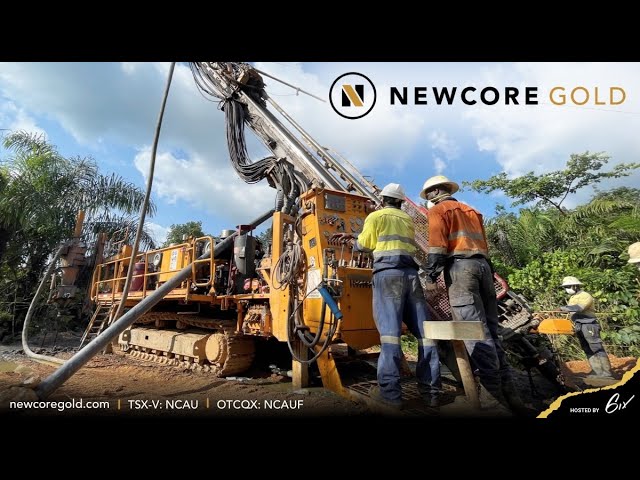
23:45 population across our project. It's primarily subsistence cacao farming that you see across the project. Lots of low-lying hills. So again, very easy for us to get the rigs around to the different drill locations. So very fortunate from that perspective. This is one of our drill rigs here. This is our RC rig. It is a very large drill rig, so we are able to push our holes with the RC down to 250,300 meters. Big compressor here, which obviously allows it to be much more powerful than than other other rigs that you might see out there.
24:24 I'll let Greg take you through the the 3D model and and kind of highlight what our focus has been at Boeing but it does sit about about 4 kilometers away from CU so very nicely located in terms of being able to have a central heat bleach pad. And that's what we outlined in the PEA in between the 2 largest deposits that we've got on our project. Over to you, Greg.
24:48 All right. Thanks, Luke. Yeah, so I've just sort of highlighted this is SEUM that we were just looking at. So again, our largest deposit, Boeing sits here. It's our second largest deposit. So yeah, you know, the bulk of our resources certainly sitting in a close geographic area, and as Luke mentioned, that's very helpful from a standpoint of planning in terms of trucking this material and having shared infrastructure. So sits currently over 500,000 ounces here.
25:15 Boyne is a great example of, you know, we've talked a lot about the structurally controlled nature of these deposits, and when you spin them around and take a look here, you can really see that it's one of these splays that are coming off here, pretty straight line. Now, there's some variability, obviously, and we continue to expand these zones, but really you can see that it's these splays, and Luke highlighted them really well in that geophysical image as well. You can see them there that control the bulk of the gold mineralization. So
25:46 relatively straightforward to follow along those, a long strike. So this is the drilling that we've completed in 2021. I'll just highlight a couple of things here. So we've expanded the zone to the north about 400 meters, actually expanded it over a kilometer to the south, so very significant step outs there. And then you'll see, again, as is the case in all of the zones we've drilled deeper and again, started filling in some of these zones. So similar to what I was talking about at SEUM in terms of the
26:18 3 main sort of target areas. And again, this is the same image with the existing, the current block model. You can see that good drilling here in the south, not currently in the block model, but certainly that'll be part of the next resource update that we do. In terms of Boeing, again, number of positive advancements here. This is a great example of where we had, some previous drilling on multiple parallel structures, but relatively narrow zones, 6 meters, 10 meters, But we hadn't completed any
26:50 drilling here on what we call the up dip portion of the zone, so into the oxide area. And that would have resulted in the block model of not having a lot of grade assigned to that area. But we've now completed some drilling here, got some really nice wide zones again in the oxides. That's certainly what we're focusing in on. We've mentioned previously that at Boyne, we've actually intersected the highest grade mineralization we've seen on the project yet to date. So 95 grams over 2 meters there, but again adjacent to it, some really nice wide zones. So you see here cumulatively in a new hole that we put in here, our C-hole
27:28 276, 40 plus 12 plus 103. So, you know, well over 150 meters of mineralization there. And then again, the third theme, which is the diamond drill holes that we're drilling below the oxide area and going a little bit deeper. Again, some really nice intersects here. So 1.3 grams over 74 meters. And then
27:50 within that, some really nice, potentially underground mineable grades over really good widths. And again, this is what is extending the zone for us to depth. And we'll continue to continue that with the diamond drill and the RC drill that we have on site. Next zone we'll look at is the third deposit is NIAM.
28:13 So NIAM is our third largest deposit. This again is a good example of what you'll see across our property is this subsistence cacao farming. So what we've got is we've got an agreement, it's actually a government
28:32 initiative that for every cacao plant we knock down for drill pads, we pay the local farmers. So we've got a very good relationship, working relationship with any of the farmers who are operating across our property. And again, this is a very good example of the type of drill roads that we've got running throughout our overall project, as well as, you know, we see it here at NIAM and again across our overall project is we've got these, you know, alluvial operations, which the locals are basically, you know, collecting the gold dust out of the dirt through through sluice boxes on the on the project.
29:06 The NIAM deposit does sit to the north of Seum, so our current PEA obviously contemplates trucking the material down to the central leach pad, which Greg highlighted, sits in between Boeing and Sium, our 2 largest deposits. I will hand it back over to Greg to run us through the 3D model.
29:31 All right, thanks, Luke. And yeah, just I'll mention quickly while we're on this one as well, we'll talk about NIAM now, but the next area we'll talk about is Kwetsi Krum. And these 2 areas, you know, we continue to do work in here. And certainly our plan is that this will be our third area that grows into a significant resource. And then again, we'll get lots of synergies then with all of this material coming to a central facility. So we'll get into the block model here.
30:02 Sorry, just hit the wrong button. And there it is. So again, like the other deposits, again, structurally controlled here, nice straight line. Within that, we've got some cross structures, we've got some jogs in the structure that sort of give us some of the higher grades and wider widths, but good control to the mineralization. And we continue to follow these things again, like the other zones, testing some of these internal areas, testing them along strike and then to depth. So currently 129,000
30:33 ounces in the resource here at NIAM, but as we pointed out, definitely open for expansion. One of the really positive aspects we've seen At NIAM, again, we've done some of this up dip drilling. So again, these were areas where there wasn't quite enough drilling to drive the block model to surface. And in this case, we've got one of our better intercepts here. Recently released
30:59 RC hole 75 here at NIAM, over 2 grams per ton, over 35 meters. So real nice intercept within the oxides and we're pairing that now with some really nice success deeper down so this again is an Rc sorry a diamond hole that we've just recently released in our last news release. 4.5 grams over 13 meters, so really nice grades over nice wide widths. This includes 7.5 grams over almost 8 meters, so real meaningful undergrad grades and widths. And again, this is sitting underneath some really nice oxide and transition material that's been proven up on surface. So
31:40 our third largest deposit at this time, but all of these are sea holes, all of these diamond holes not currently included in the resource and we certainly look to to see NIAM growing in our next iteration. So the last of the 4 deposit areas is Quacheecroom and I'll pass it back to Luke. Yeah so Quacheecroom is part of our as part of our updated
32:06 resource that we put out at the beginning of June. We did put a maiden resource out at Kwachi Krum. So excited to add 0.25 resource area to our overall project. And that's one of the things we're continuing to look to do with some of the additional targets that we're focused on as part of this drill program is to continue to bring resource areas into our overall
32:30 resource and add ounces that way. Again, throughout the entire project, you get these alluvial operations, which speak to the large gold system that we've got sitting here at our Enchi project. Couple of drill pads here, and Again, very good access through all these dirt and gravel roads throughout our project. I'll hand it back over to Greg and he can take us through the 3D model on this one as well. All right, thanks, Luke. So yeah, again, just quickly, as I mentioned, this Niam that we just talked about, KwaTZiKrum is here now. We, again, believe it's the same structure. We've actually released some holes that extended Niam to the south. We've done some drilling at KwaTZiKrum, basically filling in what is a 2 and 1 1-kilometer long gap there.
33:18 This next image will sort of highlight that. So again, big, straight lines. These are the structures coming off the Bibiani shear that control the gold mineralization. Again, some cross structures or some jogs in the structures. That's where you get the better gold values. Like I say, we've extended NIAM now to the south. We've completed some drilling here that we're just waiting on the final assays for. But we believe in the end, this will all be, again, a much larger zone than what it is currently modeled at. So excited about the potential here. Again, modest resource currently at KwaChiKrum, 56,000 ounces, but all of that's really only about 400,500 meters of strike length. We believe we've got kilometers of strike length to follow up on here. So lots of good targets.
34:05 Quexcrum is a nice zone, again, with good continuity in the oxides, good widths, 24 meters, 17 meters, 26 meters. And then starting to see some decent grade over good mineable widths as we get a little bit deeper. This is one of the southernmost cross-sections that we have. You can see it's right at the edge of the pit here. So again, definitely open to the south. And again, some good grades over very significant widths here in the oxides, you know, 0.8 grams over 53 meters. So quite excited to continue to expand on KwaChiKrum and again basically fill in that gap between the NIAM and Quachikrum deposit. So all of that does sort of get back to what I sort of touched on earlier on one of the slides, which, again, is the overall exploration strategy to continue to expand on all of the deposit areas, continue to bring these drill tested areas like we did with Quachicroom into the deposit category. So we've done drilling at all of these areas, Cojina Hill, Errati, Siem Extension.
35:15 And then again, from an exploration standpoint, very excited to be testing for the first time what are some of the largest anomalies on the project here at SEUM South, centrally located here at Tocosea and Quanta as well, where we're currently doing an extensive trenching program. And then we've got the geologists out there looking at again what are a couple of dozen different zones that stretch the full 40 kilometer length of the project. So very excited to be testing these zones. And again, the strategy will be continue to move these up the pyramids, you know to get to where we want to go we will need a number of additional deposits, we'll need to expand the deposits that we have and again one of those areas that we worked on is here at Arati.
36:02 Yeah so Arati sits up at the northern edge of our of our property. It had 10 historical drill holes in it. We've completed an additional 13 holes. We'll look to get those results out to the market in in Q3 but again you can see lots of artisanal activity up here with them digging the dirt and and looking putting it through through sluice boxes and you know that's something that's a focus for us in terms of continuing to drill at Arati. Siyoum South, as Greg mentioned, it's one of our largest anomalies, 3.5 by 2.5 kilometers in size. We completed a 3 kilometer trench program, which was in the hills, identified a number of different targets through that trench program. You can actually see one of the trenches which is sitting here in this image and then we've completed 30 drill holes here at CUM South and we'll look to get those results out in Q1 of next year and look to make some new discoveries. So again, very excited to have some new areas for us to be drilling for the first time ever.
37:13 Greg's touched on it with some of the higher grade opportunity that and results that we've had in 2021. And this is something that we're very excited about. We think we've kind of started to identify where some of these high grade feeder zones sit on our ENCHI project. And What we're looking at here on this slide is we've got a long section of our Enchi project and we're comparing that to Kinross's Tirano mine 50 kilometers to the north of us. What we see at Tirano, Bibiani, Ahafo, other greenstone-hosted deposits along trend from us is that typically where you see the increase in grade and grow in size is as you start to drill deeper. What we've done here is we've superimposed the depth of the oxides.
37:59 Again about 85% of our current resource sits above that level, which means it lends itself to a heap leach project. We outlined the robust economics in our PEA for that type of a project, but we're very excited for the first time ever as part of this 90,000 meter drill program to be drilling below 150 meters. Historically, the deepest hole was only down to 150 meters. And as Greg's highlighted, we've started to have some very positive results from that perspective. Those 3D models that Greg was showing you, the average vertical depth of those pits was only down to 63 meters. So again, I think that's another way of highlighting that we've really still just scratched the surface from an exploration perspective. When we now compare that to Kinross' Toronto mine, we superimpose that same depth of the oxides and it's pretty clear to see that once you've identified where some of these feeder zones are, you really start to get into those higher grades and grow the overall size of the resource.
39:01 Just to recap and I think we've touched on a couple of these but back over at NIAM looking at this cross-section as Greg highlighted very good heat bleach material near surface But in this hole number 45 as we got down to 175 meters, which is the deepest drilled at NIAM when we put these results out, we hit 5.4g over 9m, 1.6g over 40m. Sitting only 100m away in this hole number 47, Again, really nice heap leach material near surface, but as we got down to that same level, we've hit 5.8 grams over 7 metres. So these are the kind of high grades that would lend themselves to an underground mining. As you can see here, we've actually just updated this 3D model to include some of the more recent diamond drilling that we've done. And again, our view is that we've started to, you know, identify where a couple of these higher grade chutes ultimately sit. And that's important in terms of being able to show that there is underground potential here as well as obviously the very good heat bleach material that we've got near surface. So really excited with the results that we've been seeing at NIAM from that perspective.
40:25 Moving back over to Boeing, again, Greg talked about this hole number 250. I mean, these are the kind of grades, obviously this is the highest ever grade encountered on our project, but it points again to the opportunity at depth, including, you know, in this hole number 276, 4 grams over 5 meters, 3 grams over 1 meter. So those are the kind of high grades that we'll obviously be following up on. We will not lose focus on the opportunity as Greg highlighted to continue to expand the near surface oxide resource. Those are very valuable ounces. They will increase the overall size and scale of the project. But if we can then show this high grade opportunity that we've got at depth as well, and show that over time we'll be able to go underground and start to mine that material, we think that that will add another element to the overall story and to Nucor as a company.
41:23 So just to recap, again, very strong management team and board with a proven track record of making shareholders money, truly aligned with shareholders through our 27% ownership in the business. Very good support from the capital markets and institutional investors. As I mentioned, we've grown our institutional ownership from 0 to about 40% over the last year and a half. These are mining, precious metal focused investors who recognize the district scale opportunity that we've got our ANCHI project. Again, Ghana is a tier 1 jurisdiction. We've got a district scale opportunity, which we're very excited about. I've highlighted the PEA economics. So we truly are fundamentally underpinned with that PEA, but where we're gonna create value for shareholders from here is obviously by completing the 90,000-meter drill program and getting an updated resource done.
42:24 With that, I think we'll probably turn it over to questions. Yeah, over to you, Mal. Thanks, Flavik and Greg, for a very detailed presentation. I think it's great to give our investors and potential investors an idea of the landscape. So let's kick things off with a question around metallurgy. So We have a question on seeing some of the details of the column leach test work so I think if you guys can comment on just the metallurgical work that's been done and what is to be done I think that'd be very helpful. Greg do you want to touch on the on the metallurgy in terms of what we've done and some of the results that we put out in 2021? Yeah, absolutely. Thanks, Luke. So yeah, we've released a number of tests.
43:11 Basically, we've done 2 types of tests. We did about 100 bottle rolls, again, primarily on the oxide and transition material, and we had good results there. Most of the work we did there was at the 2 main deposits, BOIN and SEUM, and we'll continue to focus on those. So basically, you're taking then the material from the drill holes that we're testing, you put them literally in a bottle and you roll it around for, in this case, a number of days with the cyanide solution and that looks to then define the recoveries that you get from the cyanide and we had sort of plus 90% recoveries from those bottle rolls. Now you do need to factor those a little bit to see what your recoveries from a heat leach operation would be. Probably more appropriate were the column tests that we did. So these are larger scale tests. We put 15 kilograms of material into a column, again, with the cyanide solution going in there to determine the amount of gold that can be recovered in that case and that's a little bit more akin to what actually happens in a heat bleach scenario and again we're looking at you know plus 85 percent recoveries there so- certainly in the- for the- the oxides in the transition material and for us there. They're they're they're really quite similar in some cases actually slightly better. Recoveries from the transition material I think that's important to note because there are deposits out there, different ones than ours,
44:43 where the transitional material can be very problematic but for us it's actually in most cases a benefit and it really is very similar to the oxide material so we released those bottle rolls we released a set of column tests from Boyne and Sihum and our metallurgical work is ongoing in particular now transitioning into the sulfide material as we've got these deeper diamond holes, we've now got material that we can test in the sulfide horizon. But so far, very positive, both from a heat bleach standpoint and then potentially from any sort of milling scenario as well. Great and like maybe you can comment on some of the work that we're going to be doing in 2022 on the MET side. Yeah, so in 2022 We're continuing to do bottle roll tests across all of our different deposits.
45:34 We're also continuing to do a number of column tests. So as we identify new areas, as we grow the overall size and scale of our project, obviously metallurgy is something that's very important. We're extremely happy with the results that we've been receiving so far. Those obviously fed into the positive economics of our PEA, but it is something we'll continue to focus on as we grow the overall size and scale of the project as we'll continue to do column tests and bottle roll tests across all of our deposits. Perfect, thanks. So another question around more on the technical side. So what is the deepest part of the open pit and the strip ratio? So if you look at our PEA, the overall strip ratio for the project is 2.1 to 1. If you look at CUM, it's our largest deposit. The strip drops to about 1 to 1 at Cium, so ranging from 3 to 1 to 1, which gives us that average of about 2.1 to 1. So that is again one of the things that really helps drive the economics of this project is the low strip ratio that we've got at the project.
46:52 Is there a second question there, Mal? Just around strip ratio, I think you answered it. Yeah, okay. Yeah, sorry. Yeah, so That's where we land on the stripping ratio front. Greg, do you want to talk about the depth of the pits and kind of deepest and then maybe some of the average depths that we see as well? Yeah, sure. So, and it kind of ties in with What you were just talking about there, obviously, the stripping ratio, right? That's a big part of the economics, as important as grade and metallurgy and everything else. And it's what allows the pits to go relatively deep in a couple of areas, and again, at the main deposits, at Sioum and at Boyne. And there's 2 main factors there.
47:38 If you look at the northern part of the Sioum deposit, it's actually a series of subparallel structures such that we have mineralization over a width of almost half a kilometer. So a really wide zone in there, most of it being mineralized, and that allows these pits to go a little bit deeper. And combine that with the fact that, again, at our 2 largest deposits, it's also our deepest oxidation. So you combine the fact that we've got the widest zone there in Sioum with one of our deepest levels of oxidation, which is about 75 or 80 meters vertically, And that's allowed the pit in a portion of that deposit to go to about 120 meters vertically. And likewise, at Boyne, the deepest part of the one, the tip, if you will, of the inverted pyramid would be about 120 meters vertically below surface.
48:33 But as you've mentioned, overall, the average is about 0.5 that so about 60 m vertically and again, that's reflective of the width of the structures, multiple sub parallel structures at Boeing and reflective of the fact that again, at its deepest, our vertical depth of oxidation gets to, well, sometimes it gets to over 100 meters, but regularly to 70 to 80 meters, and again, would average about 60 meters vertically. One of the other things I think we've been extremely busy with in 2021 is obviously on the on the marketing side of the business as a public company obviously it's very important to be out there meeting with shareholders both institutional retail as we talked about we've grown our institutional ownership from 0 to 40%.
49:20 But I might, you know, ask Mal to kind of highlight, you know, what we've been doing on the marketing side of the business. We've, you know, in terms of social media, YouTube channels, those kind of things. So Mal, can you kind of highlight some of the stuff in 2021 that we've been active on and what our plans are for 2022 to make sure that we remain engaged with the market, both institutionally as well as on the retail side? Yes, of course. Thanks, Luke, for the question. So I think it's incredibly important to stay in front of you guys, our shareholders, our potential investors. So these webinars, you know, having these on a regular basis, especially on the back of specific catalysts. So, you know, we had a webinar on the back of a PA. When we do a resource update next year, that would be a critical time for us to be doing webinars.
50:08 We're also out on social media. And I think if you aren't following us, I highly suggest that you do because we just got back from site last month. It was my first time to site, which was great. And I have a ton of content, you know, short more videos from site photos to share with everybody that we'll be rolling out over the next several months. But of course, you know, in, in the current landscape of things, we try to stay in front of investors through conferences on social media as well as these webinars and of course if you ever have any questions please don't hesitate to reach out I did put my email in in the chat as well so you know we are here and we're always happy to do 1 on 1 meetings if somebody wants a an update or has more specific questions. But back to the questions because there are a lot of questions actually to get to. So just one more question on the metallurgy side, a question about which third party is doing the column test work for the company?
51:00 So the the column work test we're using Intertek, They're a global firm and they're based just outside of Tarquah. One of the real advantages again of being in Ghana and it being the largest gold producer in Africa with 5 million ounces of production is there's a huge amount of mining services in country. So we've used InterTech, they've done a great job for us, but there's also an SGS lab sitting 4 hour drive away from us that we also use from time to time. Great. And I think that was one of my key takeaways from going to say it was really the infrastructure and the proximity to our project I think is a huge benefit when it comes to turnaround time. So we do have a question on inflation and inflation pressure. So we are hearing a lot more about inflation pressure being reported industry-wide.
51:52 Question is, have you been watching input cost pressures since the PEA, and if so, are you factoring in more CapEx? Yeah, so from an inflation perspective, we haven't seen anything directly impact us thus far. I think, again, one of the advantages of being in Ghana is it does act as a regional hub for all of West Africa. So what we've seen is a lot of the mining service companies that are operating in Ghana that we work with, we've had a long-term working relationship with a number of them, and they're very keen to be able to provide services and drill rigs to us given we're in country and relatively close by.
52:39 So I think that's one of the reasons why we haven't seen significant pressure from an inflation perspective. Greg, I don't know if you had anything you wanted to add on that, but yeah, that's what we're seeing so far. No, the same. Again, I think the competitive nature helps. As you know, when we, you know, beginning of this year, we went to get an extra diamond rig on site. We had 7 companies bid for that and you know they were all very competitive price wise and again you've mentioned the 2 assay labs. There's some other smaller ones that are available there as well. So just the fact that you've got a number of options, I think, has kept the sort of inflationary pressures down and we're very fortunate. Some of our contractors are, you know, we've got the same prices that we did back in 2017 and 2018. So, and I, you know, I'll roll that into, again, the availability of equipment. Some people are waiting months and months to get a drill rig and the fact that we can work all year round it on the project and as well the assay labs are doing a great job for us getting us a turnaround that's around a month or even less most of the time. And again, we've all heard the horror stories of having to wait 6 or 7 months for your assay. So we're able to get our assays back in a matter of weeks and in many cases then pivot and be able to follow up on some of these better results. So, both from an inflationary standpoint and an availability standpoint, Ghana is a great place.
54:09 Following on the theme of Ghana, the question is, do you foresee any potential political issues in the jurisdiction over the next year? And if so, how do you plan to deal with them? I think from a political standpoint, I mean, there was an election about a year ago. I mean, again, if you look at all the international watchdogs who monitor elections around the world, It was another free and fair election without any violence. And Ghana has a history of being very stable from a political perspective. And I think one of the things that I always highlight is, you know, don't listen to me as the CEO of a single asset company in Ghana, but look at what the major companies are doing in country. Again, you know, highlighted by Newmont, who's currently at 14% of their global production. They're putting another 750 to $850 million into the country.
55:05 That will bring their exposure to Ghana to 20% of global production. After Nevada, that's the largest area that they're producing from. So again, I think that speaks to the stability from a political perspective, but also from a security perspective. Whenever we're in Ghana, we just drive around like you would in North America without any concerns about security or safety. So that ties into the discussions we've been having about mining services companies and the reasons why we're able to attract such high quality geologists and so on and so forth. So all of those things really benefit us at Nucor. Yeah that was one of my key takeaways from being at site was really just how safe it was throughout the entire visit.
55:56 You know I think that is one of the things that makes Ghana stand out in Africa. We do have a question that kind of follows on the country theme and some of the highlights that Leith you showed when we were looking at the 360s of site. So what are the biggest challenges the project is facing with the activities of artisanal miners that are close to our site? So in terms of artisanal miners close to our site and potential issues, I mean, relatively speaking, compared to other projects that you see around the world. We don't have a lot of artisanal mining happening on our site. Obviously, some of those images that I show you, it looks like lots of activity, big swaths of land, but really it's the process that's used to, you know, run that dirt through the sluice boxes that creates those big areas, but you've probably only got 3 or 4 people kind of operating in one of those different areas. We've got a very good relationship with all the local chiefs and anytime we're working in an area, we obviously offer jobs to all the locals first.
57:11 And often, these artisans would prefer to come and work for us to help with casual labor than to obviously be out there trying to pan for gold. So we've been able to manage that. I think one of the real advantages we've got is that because we've been working on this project directly, Dan Wilson, our country manager, as well as a number of the others on the team have very good relationships. We haven't had any issues from that perspective. Yeah, and I would reiterate that being on site, there was not very much in terms of large, like I didn't see any large scale activity. It was all very, very small and a handful. In terms of our site visit, I do think it would be great to hear from both of you on key highlights or takeaways from that trip.
58:00 So key highlights, takeaways from the site visit. I'll kick things off and then you can jump in, Greg. I mean, one of the things that always stands out for me, and I think I've mentioned it anytime I go to Ghana, first is how safe it is in terms of moving around the country. I mean, we were probably in the car driving across the country for 12 hours and then back. And, you know, again, never felt unsafe. And then really the quality of the team that we've got on the ground in Ghana, I think is the other thing that really always stands out for me. I mean, Dan Wilson, he's worked on this project. He's our country manager on and off for the past 25 years. He's worked all over Africa. He's been back directly with the ENCHI project for the past 10 years. We've been able to attract 3 very high quality senior geologists on our project. They've worked up and down the belt. They've worked at Toronto, Bibiani, AHAFO. They've also worked at other projects all around Africa.
59:03 They wanna be in Ghana, they wanna be working on the Enchi project and all of that knowledge from the work they've done at a number of the other project obviously really helps Greg and the rest of the team in terms of the geological understanding of the project. So the team that we've got in Ghana is probably the thing that always, you know, stands out for me whenever I'm there and able to spend, you know, multiple days with the team. Greg was just there for a month, so I'll kind of let him comment on some of the highlights from his recent visit. Yeah, no, and that is first and foremost. You know, you head over there, and again, twice this year I was over there for a month at a time and make an effort to, you know, not just do sort of 3, 4 day visits. You need that extra time to be with the guys.
59:53 And I think what came out of this was, you know, as you've mentioned, they've got lots of experience working on some of these other larger projects and active mines. And what comes out is their enthusiasm for this project. You know, they're really excited, again, to be expanding on these resources, excited to go into these new areas and drill the first ever drill hole at Siyum South or at some of these other targets and you know it's it can be a long day and a tough day sometimes as an exploration geologist so you really really have to like what you're doing and as you mentioned we've got a great core group there and they've built people around them who assist them in doing all of the trenching programs and those sorts of things.
1:00:39 Again, you've mentioned that we've got senior people that have been on the project now for over 20 years, a number of which were born in Enchi, so they're local people. And that's very important as well. As we, when we were at our busiest, probably had 200 employees and by far and away, the vast majority of them were all from the local town or even the local communities that we're working in. And our guys do a really good job at safety, at community relations, and they realized that that's really important. And I'll sort of roll that back into the, one of the other things you were talking about in terms of the artisanal mining. I think it's important to reiterate that that activity that does go on there is by the local landowners and farmers and those sorts of things. So it's not a big influx of people from outside of the areas. And again, that helps us work with the hereditary chiefs and the local governments and stuff and make sure that the people that are working there are wanted and again we've got a great relationship both with the artisanal miners and the local communities and obviously with our employees who again as I mentioned are really enthusiastic about the project.
1:01:52 Thank you both and I'll just throw in a couple of comments given that it was my first time at site as well. You know we touched on security but also just the infrastructure you know you're on a paved highway a large highway right out of Accra. It doesn't go all the way to the site, but the road systems were great in terms of the fact that you can drive straight to site. The fact that we stopped at one of our contractors drilling facilities where that is their primary facility in West Africa. It's a four-hour drive from our project. The scale of our project when you're driving around it, you know, I spent 5 days at site. I probably could have spent 10 easily. It's just, it's a very, very large property. And then, you know, one of my key takeaways is just how proud I am to be part of a team that is so focused on safety. That safety culture at site really shone through for me by being there.
1:02:41 And the team you know it's one of the points that Luke had made is the importance of team when you're building out a company and you know a successful company and its team and the guys at site, the girls and guys at site are really you know a lot of them have worked together for quite some time and in this area on this belt and so they know it extremely well and they enjoy working together And it's great when you can build that sort of culture because that also then reinforces safety as well. So just a couple more questions before we wrap things up. We have a question here on, I love the tight stock structure, given that there are no warrants within our capital structure. How will this evolve needing more funding in the future? Give us your thoughts please. Yeah so we're from a capital structure perspective obviously 120 million shares out and no warrants So good tight structure from that perspective.
1:03:33 We are fully funded to complete our 90,000 meter drill program. As well as the way we laid out our budget is we wanted to be able to get an updated resource done, as well as have enough cash to take us right through to the end of 2022. So that's kind of how we've budgeted the company but obviously we're an exploration company so at some point we'll need to look to raise additional capital to be able to you know add additional drill meters but again one of the real advantages we've got is we are very strongly institutionally supported by groups who recognize that, you know, it takes multiple rounds of funding to be able to get to the kind of 3 to 5 million ounce resource that we're ultimately looking to grow this to. So to have that support is obviously helpful from that perspective. But the short answer is we're fully funded right through to the end of 2022.
1:04:30 Thanks, Luke. And then I will wrap things up with one final question around 2022 and I think catalysts and what people can expect. But what are you most excited for in 2022? And I'll just kick things off by saying that I think the pace of development and advancement of our project, I think, you know, the fact that we have news out at least once a month and the pace of drilling has been really exciting to see this project evolve at a more rapid pace than I think most have the ability to advance their assets. So over to you, Luke. Yeah, in terms of what I'm most excited for 2022, and then Greg, you get the enviable, you know, last spot to answer the question once Mel and I have already answered everything. So I guess I'm most excited to continue to grow the overall value and build on what we've done in 2021.
1:05:22 Obviously we've outlined a very robust project with that updated PEA that we released in June of 2021. But all of this additional drilling that we've done and the drilling that will complete in 2022, my view is that we're gonna create a much larger, more robust project, as well as make some new discoveries. So those are the things that I'm most excited about for 2022. Yeah, so, well, obviously, following up on that, as Luke said, essentially everything's been said, but I'll go back to the exploration side of things and talk about how excited we are. And again, the guys are to be putting the very first drill holes into some of these kilometer scale anomalies. And that also is what needs to happen to get this project to where it's going to go. You know, we've been very fortunate, very successful at expanding the existing resources. We've got 2 of them now that are over 500,000 ounces, but as Luke mentioned, to get to where we want to go, we're going to have to have more success and that's going to have to include some new discoveries and every exploration geology likes to make new discoveries. So again the guys on site are excited about testing these zones and and I'm excited to be working with them.
1:06:45 Great well thanks guys and thank you everyone for joining us today and thank you to 6 for hosting us. We are out of time but please do reach out if you have any further questions and I encourage you all to visit our website and check us out on our Verify platform. You can take that virtual tour yourself and also get into those 3D models if you want, which have just been updated. And also give us a follow, as mentioned, lots of great content coming, given that we did just spend time on site. So some great snapshots from site videos and some photos, and you'll hear from more of the team that's at site as well. So give us a follow so you can stay up to date on our developments. And so with that, thank you for taking the time to get a refresh and a review of all our success in 2021. We wanna wish everyone a great holiday season And we look forward to continuing to update you with further results and developments in 2022.
1:07:36 Thanks. Thank you very much. Enjoy the holidays. ♪♪ ♪♪ ♪♪