Transcript
Automated transcript · Written by software from the replay's audio. It can mishear names and figures; the replay is the record.
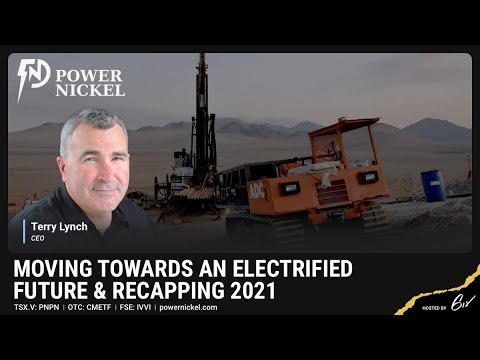
0:07 Hello everyone and welcome to Power Nichols live investment summit today hosted by 6 I'm pleased to introduce our speaker for today Power Nichols CEO president and director Terry Lynch. Terry's going to walk us through a company presentation and after we'll be taking questions live. Remember that you can submit your questions using the Q&A panel found on the right hand side of your screen at any point during today's presentation. And as always this event is being recorded and will be available to watch afterwards on six.com in the coming days. Without further ado, Terry, I'm going to kick things over to you to get us started. Ken, thanks so much for having us here.
0:40 Always appreciate getting an opportunity to speak to our interested shareholders and interested parties that are looking at Power Nickel at this point in time. You couldn't be looking at Power Nickel at a better time. In my perspective, I think this thing's about to really take off and I think that will be awesome. So Without further ado, let's walk you through a bit of an update here and how we're positioning the company now and going forward. We like to say we're Canada's newest battery metal company. Obviously, we historically were Chilean metals, but now we're power nickel and we'll walk you through why we've made that change. The standard disclaimers, it's always important to do your own due diligence on these things. We're not going to be misrepresenting anything. We're going to tell you what we believe to be true, but it's always a practical consideration to do that for yourself.
1:33 Why invest now? We'll touch on some sort of broad themes here and then we'll sort of cover it in more detail in the presentation. First and foremost, there's commodity bull market going on and particularly in the battery metal sector. So anything to do with lithium, cobalt, copper, nickel, palladium, all that is going to be doing very well for the next several years. We're lucky in that we were able to acquire the high-grade nickel copper cobalt project called NISQ. So it's got them all. And we'll get into some deep detail on that. Best of all, as an investor, we're trading at a deep discount to our comparable peers. It's good in that we're cheap and that should make you want to buy the stock if you don't have it and buy more if you already have it.
2:25 I think probably positively you'll see why it's not going to stay that way. I think that's more relevant because anybody who owns a stock wants to know why is it going to go up and I think we're going to give you some real good reasons why we think that's going to happen. We're rebranding as Power Nickel. Obviously, historically as Chilean metals, being a major nickel player just doesn't make sense. Chile's not known for nickel. So, it made sense for us to basically package that into a spin-off, which is going to become a bonus for you. We had hoped to do it last year. It was a little more complicated and then there became some capital considerations to doing it this year. So that's why it's happening this year instead of last, but it'll be a major bonus and a very big plus for you. And then finally, we're going to talk about our drilling that we did at NISQ in Q4, November, December, just finished really. And we're pending the assays. In fact, I'd hope we'd be speaking about the assays today.
3:23 And perhaps if we did this on Friday, we'd be speaking about the assays. It's that close, folks. They're really in the shoot here now. But I won't be able to speak in detail about the assays, but we'll give some guidance that we've already given about that and that'll be relevant. And then the other point would be, as soon as the assays are in, we'll update our 43-101. And I would say from an investing perspective in junior mining, what you want to do is you want to be investing when the company's drilling or about to report drilling results or about to report a update of 43-101. So we're right in that zone right now. So that's a great plus. You mentioned why we think now is a good time to be looking at the commodity sector. This is a neat chart. It basically overlays the TSXV, which is a proxy for metals and mining over the S&P. And if you can look back in the timeline, in the last bull market in commodities is probably 2006 or so, and there it got as high as almost 3, and now it's about 0.25.
4:28 So almost like a factor of order of magnitude shift is expected to happen. So, I mean, that is likely to be a good thing for almost everyone in the sector. And that's, as an investor, I like to come in when the rising tide is raising all boats. The other thing that could help us is I started a company called, a advocacy program called Save Canadian Mining. And I started it and I had some very good partners along the way with people like Eric Sprott and Sean Rosen and Keith Neumeier and others. You know, I've had a lot of people supporting this across the sector. And the reason why they came on to support was the chart on the lower left. So on the lower left, you see a, a, basically a TSXV metals and mining index overlaid with a basically a commodity price index between split between the precious metals and the industrial metals. Historically, you know, the, the, the red line, which is the TSXV metals mining index would be above the blue line, which is commodity index sort of trading at or above, which makes sense. It's a commodity business. We should trade in line with the commodities. But since the tick test was taken out and that sort of allowed predatory short selling to come in in a big way, and this has created this major discrepancy.
5:47 So now, you know, metals mining index is down at like 35%, should be at around 100%. So it almost has to triple to get back to normal. So that that has been noticed, we make we've pounded the table with the Ontario Securities Commission and the Ontario government and at the various, they've got sort of like a Royal Commission on Ontario on this. And there's some very strong possibilities that this spring there'll be some new legislation brought forward in 2 particular areas. We were hopeful in 1, they were looking to basically prohibit you from short selling or covering a short sale in a private placement. That happens all the time in our market. The second thing would be the, right now the transaction is settle in period.
6:32 If you buy a stock, you basically have to settle in 2 days, but there's a, in Canada, a bonus 10 days, which is really crazy, but, and what happens for the, these predatory short guys, they basically are offshore hedge funds, they don't even declare a short, they just, they don't cover, And then on the ninth day, they flip it to the next number of company and they just keep on going. That's what happens as you see stock charts that impact this, like you see in this lower left. And so the rule change that could fix that is they're advocating for a T plus 2 plus 4 settlement. So in other words, you're supposed to settle in 2 days still, but you can go a maximum 4 days beyond that. And at the end of the fourth day, you'll either deliver the stock that you're supposed to, you'll have to have a contract to borrow. So not a think I can borrow, but an actual contract and or you'll be bought in. And so that would go a long ways to stopping this problem and helping to shrink that gap.
7:31 And that would be a good thing for all stocks. So that's sort of the macro picture. Let's get into the micro and why we're excited about our micro picture at Power Nickel. So in about, I guess, 15 months ago, we made a deal to acquire NISQ. NISQ was an advanced stage nickel sulfate project that was located in effectively just south of James Bay in Quebec. And it was owned by Critical elements, a very fine lithium company, a company that I'm an investor in and I had a good relationship with management there. And I didn't even know it existed on their books really until another investor of ours sort of said, hey, Terry, I think you should buy this. And I looked at it and ultimately had to agree with them. I mean, it was a very exciting project in a great area. Nickel's a very hot commodity and it's rare to get a project that's 30% of the way to being a mine and you can acquire it. So we made the acquisition basically and we got this project which is effectively a little over 3 million tons of what is, you know, the math is about 2% nickel EQ. So it's a little bit, you know, a little bit greater than 1% Nickel, but it's got a big chunk of Copper too, about 0.55, Copper about 0.07, 0.08 Cobalt and about 1.1g of Palladium. So it's a very multi-metallic
9:01 mix and that's great from an economic perspective, but 2% nickel EQ is a very tasty number, very high grade. So we're able to acquire that.
9:15 Before we made the acquisitions, one of the things we did just to verify that this was a good move for us was we looked at companies like Talon Metals, which is if you were to say, Terry, what do you want to be when you grow up? As a company, I'd say I'd like to be Talametals because they've got like a 10 million ton PEA, a 2% nickel EQ, very similar grades to ours. And they're trading around 500 million in value and we're trading around 15, 14. So, you know, When I say we're undervalued, I mean, we're seriously undervalued, but now that we're gonna start to show people that this is not a historic resource, that we can make it a current resource and that we can expand this, things are gonna change. But when we looked at the comparable of power nickel versus ourselves in the Platinum 1, another nickel sulfate project, basically one of the things we did was we said, hey, how much drilling did they do to make this discovery and what is the in-situ value of the material worth? So we did this last March. Numbers may change slightly, but the order magnitude wouldn't probably change much.
10:19 So Talon Nickels was discovering material at the rate of 41,000, 42,000 per metre. Palladium won about 70,000 and we're about 94. So what it means relatively prospectively, we were very highly prospective. So that really sort of cemented the reason for us to go ahead with the acquisition, and we did. So a little backdrop on why nickel is so hot and likely to get a lot hotter. So nickel is generally, there's 2 major drivers to the nickel market. Nickel number 1 driver is urbanization. So as people get more urbanized and have pots and pans and stoves and kitchens and cars and all those things use stainless steel. And nickel is a big piece of stainless steel. And that's what drives the overall market in a big way. The that's more forecastable.
11:10 It's almost like you can, you can predict that, that, and, and. It's been growing steadily as of course, you know, China, India, Pakistan and South America and Africa are getting more urbanized. Obviously this has been bullish for stainless and bullish for nickel. The other big driver though is electrification. So, you know, everyone's, you know, the whole ESG movement is all about moving away from fossil fuels, moving towards a more electric society. So that is very positive for nickel. I'll show you here in the car battery alone, you know, in 2016 it was about 39%, 2025 expect to be 58%. And the reason why that is, is pretty simple. Nickel is by pound the cheapest price of any material in a battery. So if you can, from a chemistry perspective, maintain charges and do what you need to do on the charge side of things and reduce lithium, reduce cobalt, reduce manganese and substitute for nickel. Well, then you're making your batteries cheaper and that's just better economics for a car manufacturer.
12:14 So that's what's happening. That's why nickel's been so strong. The other thing that's interesting on the nickel side of things is that not all nickels create an equal. So nickel laterites, which are the biggest deposits in the world of nickel, and recycled nickel, which is quite big as well, generally are not pure enough with a lot of expensive additional processing to use for battery metals, for battery technologies. So generally speaking, the nickel sulfates are about 25% of the market and they're in high demand for the battery manufacturers. That's why these nickel sulfate projects are very attractive and even though we're at early stages, we have people that are in the nickel industry very interested in Power Nickel.
13:03 Where are we located? We're located in a really great area. It's called Northern Quebec, just south of James Bay. We're literally just off a major four-lane highway, right across from a major Hydro-Quebec substation. That's great for a number of reasons. 1, obviously, with a major Hydro-Quebec substation there and lots of workers, it's maintained 24-7,365. And the second is that ultimately, as we look to develop this project or sell it to somebody that will develop it, it will make it very easy to make this one of the greenest Nickel projects in the history of the world. So all powered by green energy. So that's a very important selling feature, I think, to our project. The local community is becoming more and more dependent on mine development.
13:49 We've got just down the road, the Damascus lithium mine is being commissioned and being put in production. So that's just about to sort of turn just up the road. Here is where we, Critical Elements, who we acquired the NIST deposit from, they've just received their federal government approval, just waiting on the provincial approval, and then that'll become, they'll start building there, then Galaxy's just over here, another Lithium mine. So this has become sort of Lithium central and battery central, obviously, with the Nickel project being part of it. Major airport here, there's a railway over here to the left and the port obviously in Montreal just south. It's a great area to develop and the other benefit about Northern Quebec is it qualifies for super flow through so you can get 150% in tax deduction by investing in mining in this area.
14:43 We've used that to our advantage when we did our last financing, it was interesting, that stock I think was 17 cents today and we raised money in last May at 25 cents and 40 cents. So the flow through was 60% premium to what we issued stock at. So that's one of the pluses, so it'll mean less dilution in the future. But obviously for investors right now, they're buying at a discount to that, and obviously what a time to be buying. This is what gave us a lot of confidence in the project, was we could see that it was open at depth and a long strike. So this little black dot here represents the resource area. And yet, even though we've had nickel shows up and down this curve, this is where the resource was. And so that was quite encouraging.
15:36 We, what we did was we went out and we found a really great 3D modeling company called 3DGEO. They've done a bunch of projects in the area. So they have some domain expertise, literally in the, in the terrain that we're working in. And we have asked them to model our deposit, gave them all the data. And they're actually going to do the updated 43-101 for us. So that's good, because that means we'll very quickly, once we give them the assays over the next couple of weeks, we can expect to get our update at 43-101 out very quickly. So they put together, you know, an interesting exploration program for us, generally focused on NISC Maine. Our objective in this exploration program wasn't so much as to expand the resource as to prove that the historic resource was accurate and yes to show there's growth.
16:25 So that was the number 1 and 2 objectives and I believe we're going to show with these assays and the updated 43-101 that we indeed did achieve that. You can look at these intercepts, pretty exciting. Basically, you're seeing stuff like 20 meters of 1.35% nickel, 18 meters of 1.25% nickel, 5 meters of 2% nickel. I mean, these are exciting intercepts. And what's interesting is that while we obviously would have liked to have the assays to discuss with you today, and that's why we scheduled another conference for, I think, in a week's time that we'll hope to update you on at that point. What we can say and what we have said, so it's not telling tales of the school, is we have said that we were targeting the black peridite rock, which carries the nickel grade. And basically this rock was, I think we did 8 holes.
17:27 1 hit a fault and we stopped drilling. The other 7 hit the black peridite rock. And these were step outs 25, 50 meters from these known intercepts. So we're not expecting you know major differences in grade, we're expecting something similar and widths of the intersections were the same or greater than what we are posting here. So, bottom line, we're expecting bullish results on our assays and we'll see them shortly. The drill holes, that just sort of shows you what the overall drill program was and the actual execution of it. And Again, what this program will end up showing, we believe, is that these pods, if you look at it from a topographical viewpoint, this main is where we're focused on now and that's where the resource is. We probably, we feel we could probably get to you know, 8 million tons, 10 million tons there, 8 for sure, possibly 10. At 10, in our mind, you're definitely a commercial mine to be.
18:31 The interesting thing with these nickel sulfate deposits worldwide is they typically come in multiple pods. That's sort of how Mother Earth divvies it up. It's not usually 1 pod. There's usually multiple ones. And so we can see with NISQ West already having nickel intercepts that there's very likely some interesting nickel to be had down there. And then there's 2 other Wildcat targets that we did not explore at this point. Obviously just with economics and trying to justify the transition from trillions metals to power nickel, we need to spend our money sort of verifying what we have. And then that I think will lead to a revaluation of the stock and that will allow us to have a more aggressive exploration budget which we'll get into in the second half of this year. The other point I would make just on the reasons why we love NISQ, the optionality of this thing is really incredible.
19:25 I mean, basically, you got this 1 NISQ main, which probably is going to be big enough to make it commercial, we think. But there's the potential for multiple pods. So these nickel sulfate, high grade nickel sulfate deposits tend to be sort of 10 to 50 million tons. And you're looking at, I mean, $250 rock. It's very valuable rock per ton. So it's pretty exciting. The other thing that happens is mostly this was done at fairly shallow depth. So most of the existing resource, historic resource, was within 100 meters of surface. So that is excellent because it means you're open pittable, probably, to start this thing off.
20:16 That has certain cost benefits for sure. The other thing that happens is you've got 1 level of this nickel river running through it and this black periodite rock. It's possible and historically around the world it happens like this where you can get stack systems so you have more than 1 level. The other thing that happens again, not all the time, but does happen, and again, this is a free option that we get, is sometimes these deposits exist as halos above the VMS, much bigger deposit. So again, I'm not promising that, but the neat thing is you got that upside. NISQ main becoming a mine would be a huge win for us, but we've got upside beyond that, which is really fantastic. So in terms of how we're delivering that, we're basically, The first thing we did was the 3D model. It had never been 3D modelled before, so that allowed us to get a really good look at how we might bring this thing forward.
21:12 The first wave of drilling was done to be low-risk, step out so that we could sort of get rid of this historical resource and become a full bonafide 43-101 and show that there is expansion potential within that, which we think we're going to be able to do. So We drilled about 3,000m less, I think, actually, in the final analysis because some of the drilling stopped because of the fault and such. The technical report probably is going to be ready end of Q1, early Q2, I would say early Q2 is probably the best way to sort of look at it. And then our feeling is we'll get the assays out, we think in the next week. I mean, they're in process now.
22:00 And then there might be a couple of stages of the assays and then they'll enable our engineering firm to update and put out the new 43-101 in, we think, early Q2. Subsequent to that, we would expect there'd be somewhere between now and then there's going to be I think revaluation of the company just because it's so dramatically undervalued relative to our peers and that would enable us to raise some additional capital. Probably we'll have that come in through our Warren exercises and to expand a new drill program on NISQ after breakup and early Q2.
22:43 So that's NISQ. Let's talk about the other half of Power Nickel. It's interesting. We were a Chilling Metals before and we were a Copper Gold company and we had some pretty advanced projects. Now it doesn't make sense to have your major project being a Nickel project in 1 trillion metals because the connotation, the marketing, the branding is just not right. So that's why we changed the name and that's why we're spinning out our Copper Gold assets into a new co-call consolidated Gold and Copper. This will be subject to shareholder approval, of course. But generally speaking, there'll be for every 25 shares of Power Nickel, you'll get 1 share of the new co. And we'll keep the balance inside Power Nickel. And that's just to maintain discipline so that you get fair valuation for the spin co.
23:31 And we'd expect, we planned to do it last year, but you know, the paid up capital calculations took a lot of time and some of the data we had to get from microfiches that were very difficult to find. Anyway, Long story short, it became more economic to do it this year and given the Gold market wasn't rocking at the time, we thought we're not really losing anything. Now the Gold market looks like it's ready to sort of maybe catch fire. So it could be great timing for us. We think you'll probably get this approved at the annual meeting in Q2 and look to finalize the deal in Q3 with the plan of arrangement. So what will go in is basically our projects in BC and in Chile. So in BC, we have a really interesting project called the Golden Ivan. It's in the heart of the Golden Triangle. The Golden Triangle is probably one of the more prolific geological areas in Canada.
24:25 Something like 130Moz of Gold, 800Moz of Silver and 40Boz of copper have been discovered there. So it's multiple mines here in production and more coming. So we're literally at the town of Stewart. We're the mountain that overlooks the town of Stewart. So what I like about that is it means it's much more likely to be able to be commercially developable. We're this little yellow area in here, and we're between 2 companies called Scotty Resources in the red, StrikePoint here in the blue, and this is Ascot. So when we acquired this from a colleague of mine, a lawyer in BC who is going to become a board member of the new spin co called Ubedin. He basically, he really liked our company and our assets and wanted a big stake in it and this is how we got it by trading this land package in for it. Before we had acquired it, Ascot hadn't been going for a mine. So now this is becoming a mine. So that's always enhances value. So it's sort of like people say, well, Terry, what is that worth? And I said, I don't honestly know, but I know it's worth a lot more than we're worth right now. So this was a report we just pushed out maybe a week or 10 days ago. This was a sort of a consolidation of our summer work program. So we had hoped to get in drilling, but in the Golden Triangle, it usually takes a year or so to get permits. So we'll be fine for next summer.
25:48 But right now, we consolidated this information. And then we made a couple of new discoveries of some pretty serious gold sampling. We basically had 2 samples that were greater than basically 0.5 ounce of gold per ton, that's amazing. So that's a really trophy material. So very exciting. So this project's never been drilled. So you get that type of surface work. Over here where my cursor is, is called Silverado. That's the strike points, probably their highest grade results, as right on our border. So it's pretty encouraging. We're pretty bullish about this area. I think it could be a very exciting program to drill on this summer. So That'll be the sort of the main liner in the consolidation gold and copper.
26:36 As I mentioned, what would that be worth? We don't know. I mean, StrikePoint's worth about 25 million now, Scotty about 35. That changes day to day because it goes up by a couple of pennies and this is 40. I mean, they were both 40 million just a couple of months ago and higher. So all of these things have been reduced, but the markets are starting to turn a bit now. So, you know, we're not sure what the valuation will be, but in our mind, it could easily be in this range. So when I say to people that you're getting something for free in power nickel right now, either you're getting the Gold and Copper resources for free or you're getting the nickel asset for free. Something is wonky here. But shortly, I think as we get these assays out and the update in 43-101 and formalize the spin-out plan, these things will start to shape up.
27:26 Chile, we've obviously historically been a Chilean-focused company. We've got some great assets in Chile. These are all, you know, Zulima, Palo Negro, TDO, several thousand hectare projects. The only thing that we're a little bit, you know, and they're, and they're drill ready. I mean, we've, we've got, we spent, you know, some millions of dollars over the years getting them there. And we've had some interesting exploration, you know, work done. We've had some, I would say we hit some posts. We never, never, never buried the puck in the net, never had the one hole that says, aha, we've got something, but we've been close. So, you know, these are big projects and probably need more exploration dollars. The challenge right now is for Chile is that there's a constitutional debate going on in the country. They're going to resolve it in August, and that will probably lead to some new rules. We don't think it will be manifestly different for exploration, but it doesn't make sense for us to take any more of our risk capital and put it in Chile other than maintaining it.
28:27 And we're also in far more discussions with some majors on some stuff and obviously we could do that. But we're just given our such great projects in Canada to work on. We're not putting exploration dollars in Chile at the moment, but we expect that'll change come August. The only other asset that just to remind you that we have in the company that we is a royalty. We have a 3% royalty on a project we sold to Tech for $3 million. At the time when we sold it, we thought they would be using it for QB1. QB1 was their first project that Tech had. And then obviously with the, you know, sort of difficult pathway over the last number of years for junior mining, Tech basically chose to mothball QB1 and use its components in QB2 to make better economics there. And so that sort of derailed our immediate production plans. And probably what happens on this asset is that ultimately will become another mine.
29:28 This has got 200 million tons of basically ore grade copper right now, like a 0.4 equivalent copper EQ. But in the super gene has not been discovered there yet. So this is big boy country. So you need major exploration dollars to make that work. And we expect tech will make that happen, possibly in partnership with Xstrata, who they've had discussions on about QB3 as a possible next mine. So this will become a major asset for us. It's not there now. People have tried to steal it from us for 1 million bucks or so, and we're just not gonna sell it for anything close to that. So we'll keep it, and at some point, that'll be a major win for us. The team, basically, you know, myself, Obviously, I've been around the Horn a bit and doing a lot of startup activity. Obviously, I did save Canadian mining.
30:22 I've got fairly good connections in the space and in the financial community. Greg McKenzie was an ex-MD at Haywood. A bright guy, runs a silver mining company. Peter Kent is our chairman, very distinguished, retired lawyer, but brings that mindset to the table that's so critical. Les is a very successful businessman from Nova Scotia. And Jimena is running our Chilean operations. So we're quite lean and, you know, we've tried to keep our money, put it in the ground because that's the only way you create value in this space. Total shares issued about 84 million and change, about fully diluted about 111 million, about 20 million or so warrants, about two thirds of those are at 15 cents and the balance at 45. We think our 52 week high is 55 cents. We think with this news, there should be every reason for it to go through that. And that will basically compel the warrants to come in and that'll boost the treasury. We have around $1M or so in the bank right now and we're pretty much done our winter work program.
31:35 Let's talk about why invest now. We think we did some major acquisitions which reshaped and revalued and repositioned Power Nickel. We raised our money, so we're not raising money at these levels. The NISQ acquisition had great potential for expansion and we're going to show it in the near term with the results of the assays and the update of 43-101. That sector, battery metals is extremely hot. Nickel, Copper, Cobalt and TGE and NISQ has them all. I think we've shown you that the spin-off potential has some amazing possibilities, and especially in a hotter gold market. This leadership team was able to pull that off because We've got deep connections in the industry and we're able to make things happen. From an investing time perspective, you can't get a better time to invest in a company than when it's about to publish its results and update its 43-101s.
32:30 That's when you want to get into these deals, especially if we're trading at a low valuation relative peers, which we are, and which is understandable because up until now, we really haven't done a ton of IRR because we needed to have the proof that we were, you know, that this was actually a real deal and that proof is coming. So we think this will be the reason why we can expect it to change from this point on. And then finally, future financings and dilutions, the fact that we're in jurisdictions, both BC and Quebec, where we have 150% tax deduction, that'll reduce our cost of dilution going forward. So it's shaping up to be a pretty exciting time to be a PowerNickel shareholder. So that's the, as you recall, the elevator pitch and the update.
33:17 We will hope to update you the next week or 10 days on the actual assays, but pretty exciting times and happy to answer some questions. I see there's some questions coming in, Cam, so I'll turn it back over to you and we'll take it from there. Absolutely. Thank you, Terry. Indeed, we have a number of questions, so we're going to want to launch right into it. But just before we do so, I'd like to remind, of course, everyone in attendance that if you'd like to participate in the Q&A, time allowing, ask questions using the Q&A tab found on the right-hand side of your screen. Let's get started. So, first question comes from Dennis. What's the situation with the unpaid taxes in Chile? Can we, or should we be retaining the properties? So, I mean, yeah, great, great question. It always looks bad on our balance sheet with these unpaid taxes, but taxes in Chile are quite different than taxes in Canada.
34:07 So we can walk at any time and obligation is gone. So most of those unpaid taxes are projects that we would be walking from in any event, but there's no incentive for us to walk right now. So, and sometimes you get, you get, you know, you get a freebie, somebody calls and says, hey, we want to acquire this and there you have it. So, but on our core stuff, you know, if our tax burden is X, probably 15% of it is actual, the real burden, you know, and they, you typically have, you know, an auction that happens in Chile, and you have about a 4 to 6 month notice period before you have to sort of step up and pay the taxes. So that hasn't happened yet. So we're in a position where we're not gonna spend any money on that until certainly until the, you know, the constitutional issues are sort of handled. And I think the government knows that, and that's why there's no options happening right now. So yeah, so generally speaking, the balance sheet taxes in Chile are, you know, stuff we could walk from without any liability at all. And we would do so if we needed to.
35:25 But now it makes sense to retain them because it doesn't cost us anything and it's practical and maybe useful in the future. Great, thanks. Question from David, will the company be hiring an in-house geologist or continue to use an external consulting group? So we'll eventually hire in-house geologists. We think probably for NIST and probably for, the new co will probably hire somebody for BC. It made sense at this time, because of our relationship with critical elements, that we're able to effectively commence this drill program and prove up the opportunity in a low risk way without having massive overheads.
36:11 So we did so. And that's one of the benefits of having critical as a partner. We're able to, we hired a very, a great consulting engineering firm that has deep ties in the community and understands the area and certainly has advanced relationships that we could never hope to replicate. So, yeah, we'll hire definitely with staff up as we go forward, as this becomes, as we move this down the pathway to PEA and PFA, which is where we'll end up ultimately selling NISC, we'll definitely need to staff up, but we'll do so on the heels of a much different price of a share and a much different capital structure. Fair enough, thank you. Regarding the 3D geological model currently being used to generate targets for the exploration program, what percentage of your land package does it cover?
37:07 We focused that pretty much on NISC Maine, so that was and I think there's the NISC West somewhat as well, So I would say probably maybe only 20% of the land package, something in that order of magnitude. OK. Another question from David, who is the closed nickel producer in the NISQ asset? Probably Inco. Glencore has the Raglan mine, which is north of us in northern Quebec. But I think Inco is probably closer. Sudbury is probably closer. Okay. Has any metallurgy work been done? Yeah, there's been metallurgy work done early days back in 2006.
37:56 And they had like 70% recoverable, something in that order of magnitude. So stuff that you would, you know, obviously want to improve on going forward, but still encouraging and metallurgy results have come a long way since then there's been a lot of advances and You only have to look at talametals as an example just to see You know where they've gone from where they started with their metallurgy to where they're at now. So there's a lot of really good work done in that area. So we're comfortable that, I mean, obviously that's stuff that will need to be done as we go forward, but there is historic stuff that has been done that shows encouraging results. And we think technology is there to bring that forward and make it. We don't think metallurgy will be a problem for this project. Right, thanks Terry.
38:42 Is the expectation to develop the NISQ asset or just to find a large high-grade asset that a major company is going to develop? Yeah, I mean, our mission in life is to prove up and de-risk this project as much as possible and then sell it. We're not gonna build the project. We're not built to be builders. We're built to be explorers and discoverers. So I would see us moving the thing through the PEA stage, through possibly pre-feasibility stage, and probably selling it somewhere in between those stages. And Our objective would be, let's find as much resource as we can cost-effectively and then let's show that the metallurgy works and start the environmental processes and just start expediting the thing. But ultimately, we're not a mine builder. That's not our expertise, certainly not mine.
39:36 And we wouldn't look to start it, invent a whole team. We'd look to sell. And we've already had numerous inquiries. So I don't think there'll be any shortage of suitors for that. Fair enough. There's actually a great fall question to that. How much drilling is going to be required to define an asset large enough to attract the attention of the major and how long do you expect that to take? So here we are, we're starting off with hopefully we're going to confirm this existing 3 million tons, maybe move it towards 4. I think we could do a fairly major work program this summer. But now, This year we spent maybe 1 million, maybe this summer we could spend several million, like a major work program.
40:21 So, and then obviously, you're getting into what happens and so forth, but you might, you're definitely gonna have to, if you look and say, hey, we did 14,000 meters to get to 3 million tons, so you gotta get to at least triple that, right? So there's another 28,000 meters, not maybe we've done 3. So we're gonna be drilling another 25,000 meters to get to 10 million tons. I mean, that's probably the reality of it. So, But the next program we do could be 15,000 meters. So it can get there fairly quickly. We think we can push through a lot of this over the next 12 months.
41:11 Right. David in the audience says, PowerNickel has a 3% royalty on the Copacquai Copper Mali deposit held by Tech Resources in Chile. When are they expected to begin commercial production? So we touched on that a little bit in the presentation. Basically, when we sold the project 5 years ago or so, we had thought by now it would probably be going in production. The understanding was that they were going to use it to probably keep QB1 running. Just to give you an order of magnitude, at lower prices than copper is right now, QB1 was producing like 700,800 million in sales. And our ore body would have been the ore body for that mine. So it would have produced a royalty of, even though it's 3%, they have the right to buy back 1% for 3 million. So it's best to think of it as 2% plus 3 million.
42:04 So 2% of 800 million would be 16 million a year. So that would be, our market cap is not even 16 million. So it would be an enormous plus, but obviously that didn't happen. So now we're looking at, okay, it's probably going to become a, you know, it would have to become another mine in my mind. And so that's probably, you know, 5 years plus out. So but as, as these things become more certain, i.e. If tech said, hey, you know, we're, you know, we've done some drilling or do some drilling over the next couple of years, and now we've got 400 million tons and we're going to build a mine, then all of a sudden, that thing's worth a lot more money. At that point, we'd probably get a fair number from a royalty company and saw it. But right now, it's an asset that we'll just keep in the books and wait for it to come because we know it's coming.
42:55 Well, fair enough. Thank you. When is consolidation gold and copper going to be spun out to shareholders? So basically in Q2, we'll have a shareholder meeting to approve the transaction, and then it will go to a court, you know, through the plan of reorg and we expect the timeline that will be Q3. So I would expect this will be a Q3 transaction where our shareholders will get the actual paper and shares as a bonus. I think you've gone over this next question but Klaus in the audience wants to know if you have any drilling results. You know we had partial drilling results you know and you know it's one of those weird things. The assays are obviously, I think, globally a challenge for everyone.
43:53 And so our assays are being done in Quebec and also Mexico, same company doing both. And so we've got 1 package in and the other package is in process like in the next couple of days. So what we expect we'll have this out early next week we're thinking is probably more practical. And the guidance we've given folks is that, you know, from a rock type perspective, you know, the black periodite rock that we're searching for, that we model for, we found in all of our target holes in the same thickness or greater thickness than we have historically. So we're expecting, we've said we expect to get positive assay results and that's what all I can say right now is that we, we maintain that, that feeling.
44:41 Awesome. Okay. So David wants to know how big is PowerNickel's land package And what percentage of that land package has there been no exploration done to? You know what? That's funny. I think it's, I'm not gonna give you an answer on that cause I honestly, I would say it's probably around 4,000 hectares, but I'm going to get back and give you a better number of that. I'll send it out to the shareholders. In terms of the actual percentage of the work that's been done on, I would say certainly no more than 15% has been explored. So there's a lot of land that's been unexplored and that's one of the things we're looking forward to. And the nature of this project is that these pods, historically around the world, come in multiple pods. So right now we're working on pod 1, which is NISQ main.
45:42 NISQ west looks like it could be pod 2 because it's already had some initial drilling, showed some good nickel results and obviously we need to get more active there. And then there are 2 wildcat targets, basically have had no drilling, but the geophysics look really good, look very identical to what we had. So that could be a pod 3 and 4. So, the thing that we liked a lot when we bought the project was the optionality. And I sort of went through that. You know, we think you've got 1 pod NISQ main, which could become a mining of itself, but the potential for multiple pods. Then there's the potential for multiple streams, i.e. It could be stacked systems, so you've got multiple zones. And then, you know, in the Holy Grail scenario, these pods are actually exist over a halo of a VMS. Again, I'm not promising a VMS because that would be, you know, mega billions and, you know, there's no guarantee on that. But the neat part is we're going to be able to test that and explore that without, you know, we don't have to pay for it. You know, it'll be very cheap to do that and the potential could be enormous.
46:46 So those are the bets you love to take in junior mining. Oh, fair enough. Dennis wants to know when shareholders will be able to know if NISQ is a mine. When will they know all the details that they can about it, especially in regards to it going up on your website? Yeah, so I mean, so you know, 43-101s are really great instruments that way. So I think the next update on that will be a really, you know, a seminal piece for us. We think that'll show, you know, growth in a lot of detail. And then, the stages in mine development are basically, you have your technical resource, okay? And then your next probable stage is preliminary economic assessment. So that would be, which is For example, Talon Metals, they put out their PEA maybe a year ago, 10 million tons, 2% nickel EQ, and now they're, I think they went from 200 million to 500 million or 600 million on that news. So that would probably be the next big one for us. That would be the next step.
47:48 And obviously as you're making each of these steps, you're providing more data and more, you know, substance which de-risks the mine, the metallurgy, et cetera. So those are the sort of tried and proven steps that miners take to de-risk mines for investors. And we will be taking the very same steps and doing it as time as we could. But I mean, the first step will probably be the first 43-101, the technical report that will come out, we think, in early Q2. And then the next one will probably be the PTA, which will be, we think in the next 12 months following that. Okay, great. David wants to know, how did the NISC nickel grades compare to your peers, such as Canada Nickel Corp in the Timmins area? Are your grades considered high?
48:33 And really, what quartile are the nickel grades? Where do they reside? Yeah, so we'd be in the top quartile, probably the top. I would say the only other one that's sort of like us, Talon Metals, has actually got a higher nickel grade than us, but relatively comparable nickel EQs. We've got more cobalt and copper and palladium than they do. So that gets us to a sort of a similar economic package. So Canada nickel is a different animal. It's a bigger deposit, lower grade. I mean, it's a fine-looking deposit. I like it. But it's going to take a lot of money to develop and that's sort of the downside. And until the mindset's changed in that, I think eventually it will get developed. And I like the project a lot, but it's, it's, it's maybe 0.25% nickel.
49:22 We're, you know, almost, you know, 8 to 10 times that. So, that's nickel EQ. So, so, but we're much smaller. So our types of deposits historically around the world are sort of 8 to 50 million tons. And that can of nickel might be, I don't know, maybe 200 or 300 million tons, you know, maybe more, you know, so it's a different animal. Right. Okay. Dennis has a great question. How are you going to spend the next million dollars? The next million dollars would be basically spent on prepping the next programs at NISK and the Golden Ivan and doing the spin out work for Golden Ivan so we can actually get those shares in the hands of our shareholders and create that new entity. So that'll cost us a couple hundred thousand dollars to do that, but it'll be money well spent.
50:22 But probably the drilling beyond that, we'll be spending the money on the drilling of NISK stage 2 and on Goldeneye in stage 1. Okay. What sort of depth are you drilling at? And what does that mean for companies like Power Nickel? So most of the drilling has been done, you know, sort of like 100 meters or so. We started in this round, I think our deepest hole was on a true depth was about 250. And we'll probably do some deeper holes going forward, but obviously for now that was, you know, that it made sense for the, with the limited dollars we had to spend. The big benefit to having a resource, shallow resource like at 100 meters is it means that you can do, certainly probably get the thing going with an open pit mine.
51:14 And that has enormous early payback, potential opportunities for mine economics. So mine developers will really like that aspect of the project. Okay. Brian in the audience wants to know if you could walk the audience through a timeline along with milestones from now until a sales ready product is created? I can give you some broader brush ones. I mean, basically, so the first milestone, Next 1 up, major milestone, I would say, is our inaugural Power Nickel 43-101 report, which we'd expect in early Q1, okay? Early Q2. And then what We think, you know, I mean, you always have to think positively towards these things, otherwise you'd never get to bed in the morning. So we assume that people will do the math and compare us against the other nickel projects that they could look at investing in and say, hey, these guys are way cheaper than these guys. And they look like they got the hood spot to make it. So I'm going to make 10 times the money by investing in power nickel instead of 2 times the money by investing over here. So I'm going to buy a power nickel. So there's going to be, you have to think there's going to be revaluation of the power nickel stock. Otherwise you're not going to be able to raise the capital you need to grow. So we have to assume that we're going to, stocks are going to go up. We're going to be able to raise the capital you need to grow. So we have to assume that we're gonna, stocks are gonna go up, we're gonna be able to raise the capital we need to grow. So if we raise the capital we need to grow, the next thing we would do is, obviously we need to get this from, you know, 3, 4 million tons
52:44 to 10 million tons. So that means we need to do more drilling. So probably in the order of 25,000, 30,000 meters of drilling to probably get us there. So we would do that as quickly as we could, assuming, you know, like we've got a pretty good feel for how this deposit lays out. We've got the right exploration teams on the program so we can do that. Obviously, drilling in Quebec is a very tribe-driven thing, so this is a very easy place to explore. We would spend probably the next year drilling and doing that. At the same time, we will start to do metallurgy work. So we'll basically commence some metallurgical studies to prove that the ore that we're finding is processable and then ordinary scope of how these things would get processed.
53:37 So that basically we would hopefully be in a position within 12 months of our 43-101 being posted of being able to do a preliminary economic assessment. Which would be generally say, hey, it's not feasibility study, but it's, hey, this thing looks like it's got real merit and could deliver a very good economic return. And obviously now you have to maybe do more infill drilling and you have to do more detailed engineering, and that gets you into the pre-feasibility study. So that would probably take pre-feasibility after a PEA probably is 18 months, something like that. And then once you get there, you're probably another 18 months to final feasibility, you know, 12, maybe 12, something like that. So, and then, then at final feasibility, you're, you know, somewhere, like I would say probably our objective is we would probably sell this business between PEA and PFA. That's typically when explorer companies like Howard Nickels do that. Because developers have their own slant and how they want to build things, their own processes and protocols. And so they would get into it.
54:50 So I would never see us actually see delivering a finished nickel product. And I don't think any junior really gets there. That's very, very rare because different skill sets are required. And everyone gets paid to do what they do well. So the techs and coming goes and Incos and valets and Glencore's of the world, they're great at, you know, identifying, you know, economic projects and, and, and, and then putting them into minds and then operating them efficiently and selling it efficiently. And so that's what they do well. And that's what would happen. So, I don't know if that, you know, it's not a complete timeline, but that's probably the timeline is as far as, as their interest as shareholders would be concerned is probably you get this thing to pre-feasibility study, and you're getting 30% to 40% IRRs, which we think are highly likely, then this thing's gonna be modified and acquired by some nickel, battery metal, you know, developer, you know, whether it be a, you know, an actual industry guy like, you know, an Inco or Valet or Glencore, or you're gonna see investments from the actual Volkswagens and Teslas, and that's the real difference maker in this space relative to say, the gold and copper space
56:21 is that this nickel sulfate stuff is so rare that industry guys are going to move much quicker on this than ever before. And that's what's going to allow us, you know, people are saying, well, you know, how's your stock going to go up so rapidly? You know, why is it going to change? You know, People will look and say, you could have bought it for 17 cents. Why would I pay 50? Well, you're gonna pay 50 because the industry guy is gonna pay 50 or more. And that's what's gonna really, I think, be the difference maker in the battery metals complex is you've got industry that's going to drive pricing. And that's what's going to make it possible to get, I think, attractive returns for our shareholders. Well, fair enough. Listen, Terry, there are a couple more questions left, but we are really running short on time at this point. So I'd like to thank you, of course, for coming on today, as well as for everyone that asked questions. It's been a great Q&A session, I believe.
57:13 I want to make sure that if you didn't get a chance to get your question answered, or if you think of 1 after the summit, you can find today's presentation in the handouts tab on the right-hand side of your screen and it includes contact information you can see currently on your screen. You can reach out directly to the team at Power Nickel that way and follow up on the questions you've asked. You can of course also find more information on Power Nickel's website, powernickel.com. But with that, Terry, I'm going to hand things back to you for some closing remarks before we truly wrap up for the day. Well, listen, I wanted to thank you for the great questions and some stuff I got to get back on there from some of you. It's good to give the update. I think it's a tremendous time to keep a watch on us. Check out the assays, they'll be out shortly. I think you'll be very encouraged with what you'll see. And then, you know, check out our comparable companies. I think you'll find that we're in really good shape and it could be an exciting time to be a power nickel shareholder. We look forward to bringing the football into the end zone for you and to talking to you next time. Until then, Ciao for now.