William Dawes
Co-Founder & CEO at Mkango Resources
Replay available
Join us for a great event!
Automated transcript · Written by software from the replay's audio. It can mishear names and figures; the replay is the record.
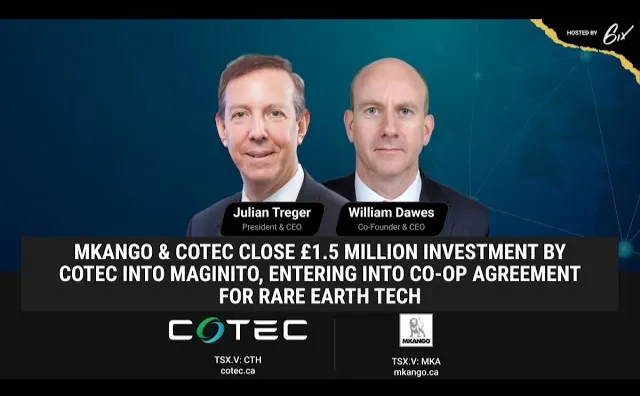
0:08 Hello, everyone. Welcome to Kotech Holdings Live Investment Summit today, hosted by 6. I am pleased to introduce the President, CEO, and Director of Kotech, Julian Traeger, as well as the CEO and co-founder of Mekango Resources, William Dawes. Julian and Will are going to be discussing the latest news and answering the questions that you submit live. As a reminder, you can submit your questions using the Q&A chat on the right-hand side of your screen at any time during today's presentation. And as another reminder, you can always get in touch with the KOTAK team by following up and filling out the survey that's linked at the top of the chat. We'll also be directing you to that survey after the event, but if you'd wanna get in contact with their team, feel free to submit and fill out that survey. As always, this event is being recorded and is gonna be available on six.com. So look out for this if you wanna refresh in the coming days. Without further ado, Julian, I wanna pass things over to you so you can get started.
0:58 Great, well, thank you, Cam. And thank you all of those of you who are joining this podcast. I'm very excited to be here with William Dawes. We've been working on this transaction for some time and pleased that we have finally consummated it. And I think it's a great partnership that we've now developed for both of our companies. The investment into HyperMag and Magneto is totally consistent with the strategy that Cotech is pursuing. It's a really interesting, super green, disruptive technology.
1:45 It's something which can be scaled. We are delighted with the quality of the management of Mekango, who we rate highly. And we think that it will create enormous opportunities for Kotech to become a leading player in the recycling of the rare earths in North America and indeed possibly in other parts of the world as well So we think that this will create a rapid path to revenues in the coming years. And the recycling space is very much in our sweet spot. It allows us to, in a green way, deliver the commodities that the world and particularly the West, in this instance, require in a much shorter period than traditional mining.
2:43 And that is one of the ways in which we are going to be able to meet the carbon targets the world has required in short order and will answer where the question as to where the commodities that are required will come from. In this particular case, of course, there are also major strategic benefits for the West. It's very timely to be entering into this business when international relations are somewhat precarious and commodity supply has been weaponized. To be able to be a champion of green recycling of rare earths in the West and for the West, I think will position Kotec and Mekango in a very good place.
3:37 And therefore, without further ado, I'll hand over to Will to talk a little bit about the technology and the opportunities and run through a presentation. Will. Great, thank you, Julian. To say from our perspective, we're very excited to be working with Kotech and Julian and team. We see a fantastic future for the business. And I think this transaction, it creates the platform to scale up and really roll out into the US and create a very substantial vehicle with critical mass in this sector. So I'm just going to share my screen. So just in summary, on Magneto, so we as Mekanga, we set up Magneto some time ago, really to focus on green technologies in the rare earth space. We saw an opportunity there and really with Kotex investment, as I said earlier, this really creates a fantastic platform to further develop these technologies.
4:47 And that's really underpinned by investments that Magneto has made in HyperMag in the UK, in Germany. We also set up a subsidiary to look at the sort of chemical processing. But really, the core sort of asset of the business is an interest in hypermag and access to a very exciting green technology that has been developed over many years at the University of Birmingham and the HyperMag has exclusively licensed that technology. And that creates a number of competitive advantages in the recycling sector. First of all, access to this technology.
5:35 It's very difficult to extract a rare earth magnet that is embedded in an assembly. What this technology does is using hydrogen, it enables the extraction and liberation of that magnet in a very energy efficient way using hydrogen. What this group also brings to the table is very strong technical expertise and a lot of industry experience. Founding directors of HyperMag, for example, one of them is the co-founder of Less Common Metals, Alan Walton. He runs the magnetic materials group at the University of Birmingham. John Spade, you know, a huge amount of industry experience, very strong network of partners involved in various sort of grant funded projects to scale up this technology.
6:30 GKN, Jaguar, Land Rover, EMR, Unipart, Bentley. And that really sort of lends credibility and I think to the quality of the team and to the technology. So this, the HVMS technology called hydrogen process of magnet scrap, it really addresses 2 key issues for, and barriers for recycling of magnets. Clearly, if you have something very magnetic embedded in an assembly, it's very difficult to get that out in an energy efficient way. So hydrogen reacts with a magnet, it demagnetizes it and it forms a powder. So very usefully that enables you to extract that powder.
7:17 The product, you can either send that powder to, you can remake a magnet with that powder, which is the most, the shortest loop recycling process. It's the most energy efficient process. If it's not suitable for that, you can you can remelt it to make an alloy or you can send it for chemical processing. However, this short-loop process is a lot more energy efficient than a lot of what our competitors are using in the conventional method for recycling, which is via a chemical process. The other major competitive advantage within the group is the ability to make rare earth magnets. Now in this case, it's to make rare earth magnets using recycled raw materials which would give 88% less energy than conventional mine to magnet but that capability is very rare outside China. There's very limited expertise So we will be producing something that end users actually buy. We're not going to be producing rare earth oxides. We're going to be producing magnets, which would go into wind turbines, hard disk drives, electronics and electric vehicles.
8:34 So what we have now with Magneto is really just the start. We have a very good platform to scale up, to roll out internationally, in particular into the US. There's already production bases being developed in the UK and Germany. So really, this is the start of growth for the company. So just a bit about the market, the rare earth market, the key growth areas at the moment is really in clean energy. That's wind turbines, direct drive, offshore wind turbines. We use, you know, a large amount of rare earth magnets, electric vehicles. Again, we're just at the beginning of that growth. 90% of electric vehicles use rare earth permanent magnets.
9:21 Those that don't, there's generally disadvantages. There's weight disadvantages. And certainly for some niche applications, niche sort of vehicles, you might have a non rare earth permanent magnet. But generally, a rare earth permanent magnet is the best way to drive an electric vehicle. It means you can optimize the size of the battery, i.e. The smaller the better, which lowers the cost. So what this demand and this growth means is that over the next few years, demand for the rare earths used in magnets, so that's neodymium, praseodymium, dysprosium and termium will triple, And production will only double from primary supply.
10:06 So that will lead to shortages of rare earths and the requirement for increased production and for increased recycling. And recycling is a huge opportunity in the rare earth sector. At the moment, less than 5% of rare earths are recycled for end of life products, which is a pretty small proportion given that in other sectors such as, you know, the PGM sector where, you where around 30% or more of PGMs are supplied from recycled sources. That market, the platinum group metal market, saw very significant growth in recycled material over 10, 20 years.
10:51 We anticipate seeing similar growth in the rare earth sector. So what's the size of the market? Effectively, you've got an estimated 200,000 tons neodymium iron boron, i.e. Rare earth magnet material, that's reaching end of life in, say, 2035. And that's, you know, that's around 10 billion dollars if you take a sort of, you know, around a, say, 50 dollars a kilogram. So that's a big market we can capture. And clearly that's geographically split up. And even if we were to capture a small part of that market, that implies significant potential to create value. So taking the that material, say in 2030.
11:38 So in 2030, the estimate here, and this is from a Darwin's intelligence, intelligence is for around 99,000 tons of NDFEB rare earth magnets reaching end of life. A lot of that is in sort of automotive sensors, e-bikes, et cetera, consumer electronics, you know, some consumer appliances, fairly modest amount in EVs, and then also for wind turbine magnets. And then this is 2035, so doubling of this material. And you see here the EV material start to come in. So where HyperMAG's technology is particularly suited is for liberating this sort of material here.
12:25 So this is what really what the technology has been developed off. And then at the same time, we're researching and developing processes to recycle magnets from EVs and from wind turbine magnets, because this is where a lot of the growth is going to come from in the future. So the HyperMag technology enables us to unlock this rare earth magnets from this material here, embedded scrap. So We're planning to ramp up production in the near term. So there's various projects often funded by through grant funding underway at the moment.
13:13 HyperMag itself is developing together with the University of Birmingham a demonstration scale plant at Towsley Energy Park just outside Birmingham. That's building on a pilot facility that is already up and running at the university. That'll be around 100 tonnes per year. It's a modular facility so that can be scaled up as scrap supply increases. This is 100% funded by Driving the Electric Revolution and that will be commissioned later this year. Then HyperMag Germany, again looking at a similar scale to the UK facility, 60% funded by the EU and the local ministry, commissioning targeted for 2024.
14:01 Then Mekango UK developing a sort of complementary chemical process in the UK. That'll be, that's going to be piloted, commissioning targeted this year. And then the collaboration and joint venture with Kotec. We're looking to accelerate the rollout into the US. We're already looking at sites. We're already completing scoping studies to look at what the scope might look like for the developments. Clearly, there's a very good basis for those scoping studies because those facilities are already being installed in Europe and in the UK. And so we're looking at recycling, we're looking at chemical processing, we're also looking at magnet making as well. So a lot of grant funded support.
14:48 This technology, the HPMS technology licensed by HyperMag from the University of Birmingham is really underpinned by many years of R&D. A lot of funding has gone into that. And we're now at the sort of commercialization stage. So just a few of these projects, SUSMAGPRO, major European project, many partners across the supply chain, the RARE project, that's with Bentley, that is a magnet to magnet product, so the end product from that will be magnets produced from recycled material. The REAP project magnets from speakers remade into in a short-lived process that is with EMR, European Metal Recycling, biggest automotive recycler in the UK.
15:38 And then the SCREAM project looking at maximising the flexibility of processing different scrap sources to produce different products. And that's with Jaguar, Land Rover, GKN, EMR, and Bowers & Wilkins. So fantastic set of partners. Also Resilience looking at integration of primary and secondary supply in the European supply chain. And then the IZWW grant, which is funding the development in Germany. So, great set of partners, a lot of government support, and we expect the momentum with that map to continue. So, just a bit about some of the challenges of recycling. Why only 5% of rare earth magnets are recycled from end of life material. So if you take a hard disk drive, you have a magnet that's embedded in the corner just there.
16:37 And normally that would be shredded. And this is what happens, you basically lose the magnet. So what HyperMAG has developed with its partners is a process to automatically remove this magnet in a pre-processing step and then that can go into high stream processing and then the balance can be go for some data destruction. Again, with a rotor, if you shred that, you basically lose the magnet. So what these technologies that have been developed can do is avoid a magnet going into that shredding process, which means you can recover it. And this is what happens when hydrogen, which is the basis for the technology, reacts with that magnet. So it forms a powder and it demagnetizes.
17:32 This is from a voice call assembly from a hard disk drive. And this here, you can see the hydrogen reacting with that voice call magnet. You can see it forming a powder, demagnetizes, and then you collect that powder. There is some post-processing, but basically what you have is the raw material for a magnet. So you've cut out all the mining, you've cut out the processing, the separation, the metal making, the alloy making, and you've really gone straight to a powder that can go back into magnet making, or depending on the purity, further back into supply chain.
18:17 But it's very energy efficient and really has the potential to unlock this whole supply recycling supply chain. So this is the first reactor that was used at the university. It's a small scale. This is actually a washing machine drum. So that was ideal for this stage. But really, this is the early days of development. You can see the corners of the hard disk drives in there. And really this formed the basis for the early development work. But this has been substantially scaled up and de-risked now.
19:04 And this is the pilot facility that has been installed at the University of Birmingham. So the capacity for this is 50 to 100 kilograms per batch that has been commissioned at the University of Birmingham and that itself will form the basis for the demonstration plant funded by Driving the Electric Revolution which will be commissioned at Tyse Energy Park later on this year. That'll be 400 kilograms per batch of NDFEB, which is equivalent to about 100 tons per year. And then similarly, HyperMag GmbH, a German subsidiary, will be scaling up and developing in Germany. That'll be based on the developments at Thorsen and the university.
19:57 So it'll be a sort of a learning experience, a scaling up process. And really, these sort of facilities are modular, so they can be scaled up as scrap supply comes online. But just to give a sense of potential revenue generation of these, we're producing a capacity to obviously subject to quality, etc. You know, this this would be, you know, a few million dollars.
20:24 If you take a low price of say, 40 to 70 dollars a kilogram, that's the sort of range. And those are some numbers we're looking at. And given that we're cutting out a lot of the steps that lead to conventional magnet making, i.e. We're cutting out the mining, the processing, the alloy making, we would look to be very competitive on a sort of cost basis as well.
20:56 OK, and this is where really we're positioned in that supply chain. So Mekango Resources is which which is developing the sort of primary side of production. So we have a project in Malawi at the feasibility stage, we've completed a feasibility study, we've completed the environmental social health impact assessment that was approved in January. So the project is in an advanced stage so we as Mekango are positioned at this stage. So we are also working in Poland. We have a project to separate rare earths, and that is at the pre feasibility stage.
21:43 So that's Mekango. And then at the other end of supply chain, we obviously have our interest via Magneto in HyperMag, which has the ability to for short loop magnet recycling. And really that is taking those magnets from components and producing magnets or remelting them to make alloys. What we also have is through Makango UK is the ability to take those magnets and chemically process them. There is going to be some scrap material if it's impurities or it's too oxidized, we may want to send it back to the chemical route. What this basically means is that we will have the ability to process any type of scrap. We'll have that flexibility And we'll also have the flexibility to be able to produce primary material as well for blending with recycled material.
22:41 Also, by developing magnet making capacity, we would also, those magnet making facilities not only can make recycled magnets, but they could also make magnets sourced from primary material as well. So really this really sort of maximises our flexibility and as a group enables us to sort of capture those synergies. So this is where the technology will be scaled up in the UK. This is a site just east of Birmingham. It's an industrial site that's been redeveloped by Webster & Horsfall. Some very exciting developments on this site. You know, this fuel cell bus is being fueled by hydrogen.
23:29 There is an energy innovation center funded by the University of Birmingham. State-of-the-art lab facilities there. And this is where the disassembly line is going to be put in place and HyperMag will scale up the HPMS process. So then just moving on to the development timeline. So this is what we're looking to do in the near term. You know that the pilot facility for the technology is being commissioned, it's commissioned last year at the University of Birmingham. The Driving the Electric Revolution funded demonstration plant will be commissioned later this year. We'll also commission a pilot plant for the chemical processing, which gives us that sort of flexibility.
24:19 And then in Germany, we'll be commissioning that facility in 2024. And then in parallel with that, we are looking to fast track development in the US. So we'll be on the ground, you know, in due course, We're completing scoping studies at the moment, and we're looking to accelerate that development, working closely with our partners in the US, Kotech. So I think that's it from me. Okay. Well, thank you, Will. That was really a useful introduction. And what I took away, but correct me if I'm wrong, is that if the market's roughly in balance now, demand's going to triple, but production from traditional sources is only going to double, ultimately
25:04 recycling will have to supply a third of the market for rare earths. And I think that you have the real chance, particularly because your process is so green, to therefore become a major rare earth supplier globally for the West over the coming decade. And to be part of that from COTEX perspective will be very exciting. And just to remind those who've tuned in, Kotex currently has just over 10% of the technology, but we do have the option, at our option to convert into another 10% of our shares in Mekango. And then we have a 50-50 joint venture with the US. So our economic interest before we get diluted, if we get diluted because of the funding requirements, on a look-through basis would be 60% of the value that we can jointly create in the US. So we see this as a very important strategic step for our business and we are keen to accelerate the execution of these plants in North America on a timely basis. And because we have the benefit of these pilot plants that already are operating in Europe, this is way beyond the laboratory stage. It will be a great window
26:35 for us to demonstrate to the potential partners and customers in the US the way in which this is a reality and is being scaled already in Europe with the funding from the UK government and from the EU who see the potential for this. And in fact, I understand in the recent, I don't know if it was leaked, but I don't know if it's been published, the EU
27:00 strategic minerals report had a major section on magnet recycling. So I think they see that as a real central platform for the way in which they're going to get the materials that are required for the green revolution and for electric vehicles in the coming decade. So with that, perhaps we should turn over to Cam to see if we have any questions. I'm sure there'll be more directed to Will than myself, but we're very happy both of us to answer any queries anybody may have. Cam. Absolutely. Thank you, Julian, for that. Thank you, Will, for the great presentation. We do have some questions that have already been submitted, but just as a reminder to everyone in the audience, if you haven't submitted a question and you'd like to, please access the Q&A chat found on the right-hand side of your screen, you can submit it there. First question's from Emily.
27:58 How will Magneto benefit from development of primary rare earth production in Malawi and Poland. She says that she saw it in the press release, but just doesn't understand. Yeah, sure. So when it comes, I mean, I think that there's 2 real, 2 sort of areas. When in producing a rare earth magnet, it may be the case in certain circumstances where you need to blend in primary material and or rare earth oxides or rare earth metals. And that means you can sort of tailor the composition of the alloy that goes into the magnet making. So by having these developments in Malawi and Poland that gives the group as a whole the flexibility to be able to do that and similarly potentially you know with the chemical processing of magnet waste as well, that could also flow back into that sort of chain. I think there's also benefits in terms of, you know, development of the customer base.
29:07 So, you know, where you may have end users who are not only interested in primary they're interested in recycling. I would say that the majority of groups we are talking to now have a very keen interest to increase the proportion of their recyclable materials. So I think, you know, it means that, you know, we have the capability to fill capacity with primary or recycled production. So there's tangible benefits such as blending, and then there's more intangible benefits around marketing and flexibility, you know, being able to supply both recycled and primary production.
29:58 Okay, great. Thanks. Fair enough, Will. Camille wants to know, can Meganedo benefit from any of the US critical mineral funding? That is certainly something we're gonna be very focused on. I don't know if Julian, if you... Yeah, I think it certainly can. I mean, we are at the early stages of developing the granular strategy for North America, and partly the geographic location will unlock as well more local funding. So we would both look at the federal level and at the state level, but the initial responses we've had when we've raised the process and the opportunity with people in Washington has been as you would imagine, super excited.
30:59 And they're keen, as keen as we are to get this show on the road ASAP and to start production. So I think from a strategic perspective, there's a lot of interest and we'll be exploring that in the coming months. All right, great. Andy wants to know, is there enough easily accessible feedstock for the recycling plants? So I think with where we are at the moment is we are being offered material. So and we have the ability to liberate material. So I think one of the benefits of the sort of modular scale of the facilities is that we can start off at a fairly modest scale, albeit at a scale that can generate significant revenue.
31:50 But, you know, we don't need to start out with a very significant scale plant. We can start off with units of 100 tons per year. And that gives us the flexibility to sort of scale up as scrap supply comes on stream. One of the big competitive advantages we have is that the HPMS technology enables us to liberate magnets from embedded material, i.e. Electronic waste, for example. And that is where the bulk of recycled, you know, that's where the bulk of, you know, magnet material in end-of-life is currently located.
32:37 So that gives us a particular competitive advantage to liberate that type of material. And as you saw from that sort of split of end of life material earlier on in the presentation, that is where most of it is. So, you know, I'm confident, you know, that the scrap availability is there. I'm confident we'll be able to capture a growing proportion of the market. Right. But obviously, a major part of the expansion into the US will be to identify where's optimal in terms of the feed and which partners to collaborate with who are already involved in consumer recycling. But I think we can add a lot to their existing processes and make it easier for them.
33:23 Fair enough. Cynthia wants to know, is Kotech making any other major investments in the first half of this year? Well, it's still, we're not at the end of the first quarter. We certainly would intend to make a further investment in the next quarter. You know, we're excited about this technology that we're now investing in. It's the second technology under the COTECH strategy. We would hope to do a third one before mid-year, but we're also focusing increasingly not on new technology investments, but actually taking the technologies and applying them to hard assets.
34:14 And the transition to hard assets is 1 which shareholders will see more and more in the coming months as we start to scale the business and create a technology driven green competitive traditional miners. And the expansion of the Magneto technology into the US is a great opportunity to both profitably put money to work, but to demonstrate the strategy. And we would hope that in North America there'll be a number of plants ultimately doing this recycling just given the embedded enormous industrial base of the US and the embedded number of magnets which must be coming to the end of their lives, not going to be recycled.
35:07 Okay, fair enough. Andy has a second question and it's just how did the Kotech visit to Japan go? Our visit to Japan went very well and there's certainly interest from Japanese trading houses. They are obviously in Japan also affected by the Chinese monopoly on rare earths and rare earth processing. And so it was an initial good response. And now we're going to be exploring further where this leads to. Okay, great. Paul has a question about how far along project and tech development is Kotech willing to proceed? Well I think that, I mean, Kotech are there to take technologies which are beyond lab scale, so ideally in pilot plant, and take them all the way.
36:03 I mean, we're super interested in finding technologies which have already proven themselves, as indeed Magneto has done, which have major strategic supporters in the form of governments and blue chip corporations, and then to really scale those businesses with plants. So we want to take them from beyond laboratory stage to full-scale production in multiple locations. And we are prepared and willing and desiring to fund that trajectory, obviously both with finance, but with also strategic advice and strategic partners. All right, great. Another question from Andy, what timelines are we looking at to get to profitability?
36:54 Well, I think, Will, do you want to discuss that? I think realistically, it will be a number of years, but it's much, much quicker than conventional mining. But well, yeah, I think it's, I think we're looking to, I mean, just just where we are at the moment. You know, a demonstration plant will be commissioned later this year. And clearly there'll be a period of time of ramp up and growth. But I'd say, you know, we're looking to, looking at sort of a near term opportunity. But it's difficult to, you know, I can't put a definitive forecast at the moment, but it's a near term opportunity, I'd say.
37:46 All right. Well, William, Julian, I want to thank you both for coming on today. That looks like all the questions that we received. So before I wrap up and send things over to you for any closing remarks, I just want to remind the audience so that if they'd like to get in contact with the KOTAK team, they can of course fill out the survey that's linked at the top of the chat and you'll be redirected at the end of the summit as well. But William, Julian, do you have any closing remarks for the audience? Well, I hope that those viewing can see from this presentation that Will gave and my sentiments that we are super excited about this. We think this collaboration has enormous potential. We've worked well over the past couple of months in negotiating the transaction. And I think there's a lot of complementary skill sets within both organizations.
38:34 And, you know, we look forward to providing more updates in the coming months as to how we plan to bring the super exciting technology to the US and to North America at a time when it's strategically critical. And so I think it's very much a case of being in the right place when the market really needs it. And the recycling area is going to be the one which plugs the gap which the West is going to have in terms of its requirements. And Kotec and Magneto can be major players in that sphere. But I'll hand over to Will to give his views as well.
39:21 No, thanks Julian. And just to say we're very much looking forward to working with Julian and team. I think we've got a fantastic opportunity now And we've created a platform which is very well positioned in this space. And it's going to be an exciting few months with news on how that develops. All right, gentlemen. Well, I want to thank you again, and of course, to everyone in the audience that joined us. But with that, we are wrapping up for the day. So I hope you have a good rest of the week. Cheers. Thank you, Cam. Thank you. Thank you. Thank you. You're welcome.
Follow CoTec Holdings Corp into a list and get an email when it puts out news.
Co-Founder & CEO at Mkango Resources