Satish Girduh
Chief Executive Officer at Medi Assist Healthcare Services
Replay available
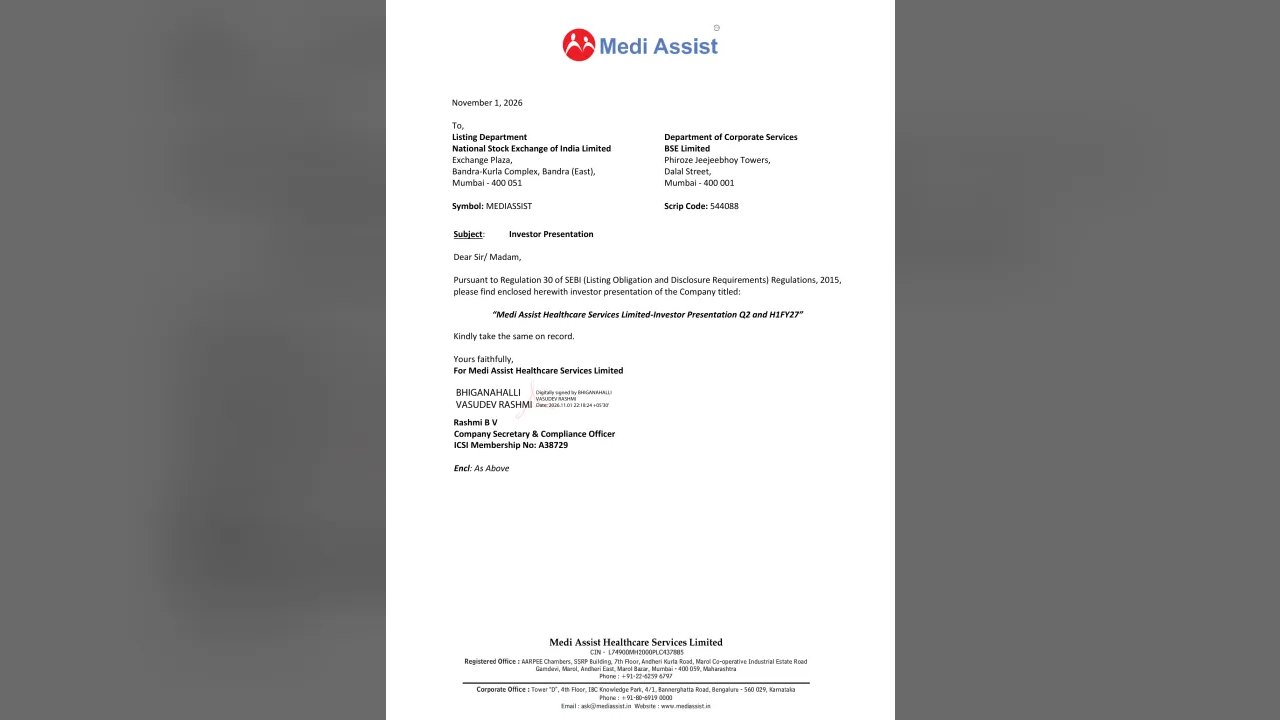
Medi Assist Healthcare Services (NSE:MEDIASSIST) Q2 2027 earnings call, held 2026-11-02. Watch the replay and read the transcript on 6ix.
On 6ix: 6ix.com/event/medi-assist-healthcare-services-limited-mediassist-q2-2027-earnings-call
Automated transcript · Written by software from the replay's audio. It can mishear names and figures; the replay is the record.
0:00 Ladies and gentlemen, good day, and welcome to Medi Assist Healthcare Services Limited q two and h one f y twenty seven earnings conference call. As a reminder, all management lines will be in the listen only mode, and there will be an opportunity for you to ask questions after the presentation concludes. Please note that this conference is being recorded. I now hand the conference over to Mr. Shashank from Ernst and Young. Thank you, and over to you, Shashank. Thank you very much. Good morning to all the participants on the call. Before we proceed to the call, let me remind you that the discussion may contain forward looking statements that may involve known or unknown risks, uncertainties and other factors. Therefore, it must be viewed in conjunction with the business risks that could cause further results, performance or achievements that differ from what is expressed or implied by such statements.
0:55 To take us through the results and answer your questions today, we have the senior management of Medi Assist Healthcare Services, represented by Mr. Satish Girduh, Chief Executive Officer and Mr. Sandeep Raghur, Chief Financial Officer. We'll start the call with a brief overview of the past quarter by the management, followed by a Q and A session. We would appreciate your cooperation in restricting yourselves to two questions to allow participants an opportunity to interact. If you have any further questions, you may join the queue and we will be happy to respond to them if time permits. With that, I would like to hand over the call to the management. Over to you, sir. Thank you, Shashank. Good morning, esteemed investors, analysts and all participants joining us from India and around the world. Thank you for taking the time to join us today as we review MEDIASSIST's performance for Q2 and FY 'twenty seven.
1:44 MEDIASSIST enters the second half of the year with a stronger and more profitable platform. Q2 is our first like to like quarter since the Paramount acquisition with integration now complete and all Paramount claims running on Matrix. Our India PPA franchisee continues to generate robust cash flows while our tech platform is scaling rapidly in China and Mayfair is expanding its international footprint. We're funding these growth initiatives internally, while maintaining a strong debt free balance sheet. Starting FY 2027, our capital allocation framework envisages returning about 50 of cumulative adjusted free cash flow to shareholders over rolling five year periods through dividends and buybacks.
2:33 Sorry. Yes, sir. Sir. I'm just going to repeat two sentences because I wasn't sure where we got disconnected. Sorry for that. As I stated, we entered the second half of the year with a stronger and more profitable platform. And for the first time, we are presenting a like to like quarter since the Paramount acquisition. As noted earlier, the Paramount acquisition is now complete and all Paramount claims are running on Matrix. We continue to generate robust cash flows. Tech platform is expanding rapidly and Mayfair is expanding its international footprint. And we're funding these growth initiatives internally, while maintaining a strong debt free balance sheet. Starting up by '27, our capital allocation framework in Ustad is returning about 50% of cumulative adjusted free cash flow to shareholders over rolling five year periods through dividends and buybacks.
3:19 In line with this framework, the Board has approved a buyback of INR49.3 crore at INR425 per share, funded from internal accruals. Today, I'm joined by our CFO, Mr. Sandeep Dagar. But before I hand over the call to him for the financial results, I will quickly walk you through some of the operational highlights for Q2 and H1 FY twenty twenty seven. We spoke about how the India business is a stable platform and how two growth engines, which is the tech tech business and the international business are helping us accelerate both growth and margin accretion. And we introduced this over the last few quarters. We started disclosing some of these numbers very specifically since the last quarter.
4:05 So continuing on that trend today, most of the presentation that we've uploaded tries to present our business along the three dimensions, which is our India TPA and platform and health benefit administrative and the international business. The consolidated income grew 13.8% in H1 to INR492 crores. Our EBITDA grew 19% to INR97.2 crores and our reported PAT at a 60% growth and went up to INR49.2 crores. Our EBITDA margin for H1 was 20.3% and the reported PAT margin has reached back to the double digits at 10% with a two eighty nine basis points year on year growth.
4:53 And all three dimensions of our business, the India PPA and if you noted in the presentation, this is where we run it in India. The platform and HVA, the payers and the customers run it on their own, but on our technology platform and the international business, again, we run it worldwide. Along with three dimensions today, the India TPA clocked crores of revenues in H1, 11.9% year on year growth and contributed about 91.5% of revenues in H1. And the premiums that we managed as a TPA were about INR 15,104 crores with an 18.8% growth year on year.
5:44 Our platform and HPA business dropped INR 19.8 crore in revenues with a growth of nearly 70% year on year and contributed over 4.2% of the consolidated revenues. On the platform model, we've managed premiums worth about INR 9,648 crores, which is a growth of 24.8% year on year. Lastly, on the international side, we clocked the revenue of 20.7 crores, a modest 1.1% year on year growth. But with all of the initiatives that we put in place and where the membership is already added and the revenues is catching up to it, it's already a 4.3% of our revenues. And to give you a sense of the size, beyond the premiums, we actually processed claims from 141 countries across 21,000 providers just within this half year.
6:41 Collectively, the consolidated operating revenue was INR478 crores in H1 with a growth of 13%. And if you combine the premiums that we had access to both between the TPA market and the HPA market and platform on the HPA market, nearly a third of India's health insurance premiums today are being served by the platform. On the margin front, we've continued to improve our margins as Paramount integration has reached an end. All of the group customers have been fully migrated through the MEDIASSIST platform and all of the trains are running on our MATRIX platform today. The Q2 FY twenty twenty seven clocked at 20.4% consolidated EBITDA margin.
7:30 And if you went back to Q1 FY twenty twenty six, that was just before the Paramount acquisition, we were INR190 odd crores revenue per quarter business. Today, we are at INR241.5 crores of revenue and got back to a 20.4% EBITDA margin. And with this, conclude that the Paramount acquisition integration is fully complete and we continue to generate robust cash flows that we are deploying back in growing our growth businesses. In the interest of time, I'm not going to go into each of the business segments and we can answer that in the Q and A section, but I would like to take a couple of minutes to talk about three key things. One is our group business.
8:18 The group business revenues were in H1 were INR 334.7 crores, which is a 13.7% growth year on year. The premiums that we managed for the industry grew by 21.8% year on year. Marginal increase in the life from INR4.54 crores to INR4.75 crores and we continue to deliver outcomes to insurer partners and corporates through our fraud savings, which again moved up by almost 53%. Group is still our mainstay at about 70% revenue share, and our market share continued to improve to 34.1. And that was one of the questions that we answered last time and we continue to look at is our retention rates in group and the same store growth and the organic growth in the group business.
9:13 Our retention held strong in H1, about 90.5, marginally improving quarter on quarter. And as discussed in the previous quarter earnings call, The retention drop down was partly due to the churn in the portfolio that we have integrated from Paramount. And the same store growth, which used to be about 8% or 9% earlier, we're still seeing about a 78% same store growth on the retail business. Given the way we account for premiums, especially the installment premiums across multiple quarters, the depressed retention rate is likely to show up in the numbers for the next two to three quarters.
10:07 In three to four quarters from now, we expect our retention rates to go back to what they were historically to 93% to 94%. Today, we serve about 11,000 plus corporates and across 25 plus sectors and fairly secular presence across multiple sectors today, also allowing us to capture India's growth in sectors where the headcounts are improving. And in retail, we continue to see the shift to a hybrid model where part of the work is done in the CPM model and part of the work is done in the platform model. The premiums managed through the CPM model was about crores, while the platform premiums were almost INR9648 crores.
10:53 And we also have contracted from an H1 basis of the insurers that we contracted about INR7508 crores of incremental premiums with four of those insurers going live in this quarter. Today, if you looked at both the TPA and the platform models, our retail market shares is about 34.1% from a premium taxes perspective. Of course, the fundamental difference here is that in the TPA model, the fee is already fixed at a certain percentage, whereas in the platform model, it is about deploying more and more services and delivering more and more value to the insurers and continuously improving our revenue outcomes within the premiums that we serve. On the whole, and that leads us to the technology business.
11:43 Tech business revenue share has substantially improved. And as a platform, today process over 7,000,000 claims in the first half of this year. And for those of you who are keen on understanding what kind of issues insurers today are looking at us to solve and how we are solving them like at scale, The Page 15 on the investor presentation talks about some of the core issues that the industry has today and how our AI powered platforms today are managing or helping insurers address some of these issues at scale. And this is no longer a platform that's in a pilot phase or an experimental phase.
12:30 It's a platform that's touching over 1,000,000 claims a month and delivering outcomes with a fairly fair sense of explainability, supervision and grounded and fair in all to those AI outcomes. Lastly, this brings us to the international business. We've been adding more books. We've been adding more membership. We've grown our group membership. We've added more travel premiums in India. The Indian insurer contribution in the international business is substantially high with more and more of the insurance working with us both on the IPMI products, the group business outside India and also retail, especially around the travel business outside India.
13:16 And we've tried to give you a sense of the kind of opportunities that are emerging in the international business. While in group and marine world, the largest contributors, you can now see that the retail and travel are taking a substantial portion and the technology leasing outside India beginning to show up in the revenue numbers today. And the platform is today live in Southeast Asia. And lastly, before I hand over the call to Sandeep for a quick review of the financials, we have a capital allocation policy in place. So starting the current financial year, the company, Medi Assist plans to return about 50% of its cumulative adjusted free cash flows to shareholders for rolling five year periods using dividends, which could be ordinary year especially, and share buybacks.
14:11 And the 50% ensures and the way we look at the adjusted cash flows ensures that we first invest in where we need to invest, we grow where we can compound the platform and ensure that our balance sheet remains strong and then return the surplus cash. So the first step today, we've announced a share buyback of up to INR49.3 crores at INR425 per share. With that, I'll hand over the call to Sandeep for a quick review of the financials. Thank you, Satish. Good morning and a warm welcome to all the participants. I'm pleased to take you through the financial highlights for quarter two and H1 of FY twenty twenty seven.
14:58 Starting with the revenue profile, the total income for Q2 was 245.4 crore with a Y o Y growth of 4.5 percentage. The total income for H1 was INR 492.4 crore, a growth of 13.8 percentage. The operating revenue, which we call it as revenue from contracts with customers and excluding other income was INR 241.5 crore during Q2, which was higher by 3.9 percentage year on year and INR $4.78 crore in H1, higher by 13.0 percentage year on year. Due to the split of line of business for the operating revenue, starting with the Indian PPA business, the revenue for this cohort was crore in quarter two, a growth of 1.2 percentage year on year and INR437 crore in H1, a growth of 11.9 percentage.
16:01 This contributed to 91 percentage of our consolidated quarter two operating revenue and 91.5 percentage for H1 operating revenue. Within the TPA revenue, the government business, the H1 revenue was INR 57.3 crore, which was up 14 percentage year on year. As Satish mentioned, the group business generated h '1 revenue of 334.7 crore, which was up 13.7 percentage while retained revenue was 45.5 crore, down 1.8 percentage from previous year corresponding period. Coming to platform and the HP revenue was 11.2 crore during q two, up 94.3 percentage year on year and 19.8 crore in h one, up 70 percentage... 69.8 percentage year on year.
16:58 This cohort contributed roughly around 4.6 percentage of the revenue during Q2 and 4.2 percentage of the H1 operating revenue. The international revenue was 10.7 crore during q two, up 7.7 percentage year on year and 20.7 crore in h one, up 1.1 percentage. This contributed to 4.4 percentage of the quarter two operating revenue and 4.3 percentage of H1 operating revenue. Moving on to the margin profile. EBITDA for quarter two was INR49.2 crore. In absolute value, there was a growth of 23.9 percentage year on year. For H1, the corresponding number for EBITDA was 97.2 crore, which was up 19 percentage year on year.
17:48 The margin percentage during Q2 was 24.4 percentage, which expanded by 331 basis points year on year, whereas the H1 EBITDA margin profile was 20.3 percentage, an improvement of 102 bps year on year. The improvement reflects the completion of the Paramount integration, lower people cost and the rationalization and the deployment of the AI tools for the Paramount plan. With the completion of the three aspects, we recovered almost 330 bps of the margin during the last four quarters. For context, EBITDA margin moved from 22.1 percentage in quarter one last year before fair amount before acquisition of the fair amount.
18:40 It moved to 17.1 percentage in quarter two immediately after the acquisition and since then recovered to 20.4 percentage in quarter two this year on a much larger revenue base. Reported PAT for quarter two was INR 21.6 crore, a growth of 167 percentage year on year. Reported PAT for h one this year was 49.22, which was up 60.2 percentage. The underlying path for h one twenty seven, excluding the onetime derivative gain on the call put options, which was classified as exception last quarter was 46.12.
19:25 This compared to INR 30.7 crore during H1 of last year. Moving on to the key balance sheet and the operating metrics as of end of H1. The cash and the cash equivalent as on September 26 was INR 268.3 crore compared with $2.60.5 crore at the end of FY '26. Net worth was $8.86.8 crore compared with $8.52.4 crore at the end of FY '26. The contract liability was INR 321.7 crore versus INR 280.2 crore at the end of FY twenty six. The company continues to have a strong and a zero debt balance sheet. The revenue per average headcount excluding government business headcount was 13.7 lakhs on an annualized basis compared to 3.1 percentage in f y twenty six, up 4.5 percentage.
20:24 With this, I hand over the call back to Satish. Thank you. Thank you, Sandeep. Moderator, we can open up for questions now. Thank you very much, sir. Ladies and gentlemen, we will now begin with the question and answer session. Anyone who wishes to ask questions may please press 1 on the touch tone phone. If you wish to withdraw yourself from the question queue, you may press 2. Participants are requested to use only handsets while asking a question. We'll wait for a moment while the question queue ascends. You may please press star and 1 to ask questions on your touch tone phone. The first question is from the line of Naved Virani from Bastion Research. Please go ahead.
21:12 Hello. Am I audible? Naved. Yes. Yeah. Yeah. Hi, team. Good morning, thank you for the opportunity. My first question is regarding the organic growth or the like to like growth. So I think since the last few quarters, we are seeing that this is something which has, you know not been up to the mark or you know in line with our expectations. So what I want to understand is can you give us a sense of how in this particular period the industry has performed in terms of the premium growth and how we as MEDIASSIST have, you know, performed life to life. That's one. And then a test question to that is, you know, now given this particular scenario right now, how are we positioning ourselves to grow, you know, at rates which are at least in the low double digits as far as the organic growth is concerned?
22:12 So these are my two questions. Thank you. Thank you, Naved. Just as a refresher, just to get some of the terminology aligned. Our growth typically comes from one is the minus the churn on what is retail that is the same store growth. And I'm assuming that's what you are referring to. Historically, were 93%, 94% retention business and for reasons that I've explained in the previous quarter and now, there's been a marginal drop in the retention percentage, which we expect to get back in the next three to four quarters. As the Paramount integration is complete, there is no standalone Paramount account that is left. All group are now migrated to MEDIASSIST.
23:00 So that's the new base on which we are operating. The second is for the retained accounts, typically because these are annual renewals, there is an inflation premium. We've seen over the last three years from a steady state same store growth of about 13%, 14%. We are currently running close to say 8% to 9% as an industry as well, down the employer employee segment. And when the industry reports group business, the group includes employer employee, bank assurance and multiple other product lines. We are at this point very fairly heavily predicated on the employer and employee segment when we report our PPA business. But the split is not available at the industry level. But if you look at the overall GI CONCER numbers for H1, the group premiums in the industry grew at about 15.8% and we grew over 21% between the acquisitions and our own growth. So we continue to grow ahead of the industry premium growth rates in the group business.
24:02 Now coming back to same store growth. Historically about half of the same store growth came from live expansion, which is the underlying employee and the dividend headcount moving up. And the other half was sort of equally split between the inflation adjustment for medical inflation and some kind of benefits expansion. Right now, we see a substantial amount of growth coming from benefit expansion and the inflation adjustments. Clearly, the IT, ITS industry is not a net contributor to employee headcount growth in the country today. Having said that, in the last two years, we have substantially expanded our presence into multiple other sectors.
24:50 We today serve over 11,000 corporates across 25 secondtors. So we continue to see additional employees in manufacturing, continue to see additional employees in consumer goods, we continue to see in say oil and gas and some of the other sectors. However, the IT ITS is a very large contributor to employee account in the country today. So there is going to be a timing lag for the other industries to catch up in terms of the contribution from a headcount perspective. So we expect that same store growth will probably continue in the range to 9% range with our retention rates going back to 93%, 94% in the next three to four quarters. Now the last piece in the group business is where we don't currently do much, which is typically the product platforms like Bank Assurance or any other products that have historically been done in an in house template.
25:49 Without that platform deployments, like we spoke about the hybrid as a model in retail, And we expect to be able to capture that part of the group market through our platform and the hybrid approach. These are early days, but this should sort of summarize where we are on the group business. And at the same time, we're also growing other lines of business at a fairly rapid pace, both between the technology business and the international business, so that the overall growth rates continue to be healthy. Thank you. Thank you for the sorry, sir, please go ahead. No, I think that was it, Naved.
26:36 Okay. Okay. So sir, thank you for that detailed clarity because from the outside, looks like that, you know, in the group business, which is the largest part of our business, we have kind of saturated. Retail is something where, you know, there is not enough happening and technology and the international piece, which are sort of growing really fast are not, you know, you know, large enough currently to create an impact. So that is that is the kind of view that we are getting from the outside. So can you, you know, help me understand if this view is correct or, you know, is there another way to look at it? No. Group obviously is our mainstay. That's what brought us to where we are today. And clearly improving retention, ensuring that we improve our economics and we don't have control on employment growth in the country.
27:35 However, what we have control on are the retention and the value adds that we are able to deliver and how we capture the non employer employee segment within the group business, because we present our market share as a percentage of the overall group business in the country without excluding any that we don't operate. And as you have noticed, we have always grown faster than the market for many years now in the group business and we'll continue to take substantial market share in the group business. And we also expect that there could be further expansion of benefits in the group business on account of the recent GSE related announcements, where the corporates will get the input tax credit benefit even on the group business, while the GST is not going away, we give it an ITC on the GST spends.
28:33 And with substantial amount of increase in benefits, we expect the same store gross to continue to 9% to 10%. Thank you for answering all my questions, and wish you all the best. Thank you. Thank you. The next question is from the line of Vikas Shardar from NT Asset Management. Please go ahead. Satish, could you just talk about the Q2 revenue growth, let's say, for India TPA? Because that looks like to be in low single digits, 2%, 3%. So how does the industry growth and your premium growth translates into revenue growth for this particular quarter? Because Q1 including had the paramount acquisition benefit. So Q2 like to like comparison would be more useful.
29:23 Thanks, Vikash, for that question. So you are aware that we book and report on a one by three sixty five basis. So all losses in Q1 and then their corresponding, say, installment premiums, their corresponding revenues in the quarter continue to have an impact in the way we report like our numbers. But to give you some comfort, we were able to replace about 80% of the retention losses through new business additions, except that we have a timing challenge in the way we recognize our revenues. So they will catch up and hence our guidance on the numbers sort of normalizing over the next three to four quarters, both from a retention perspective and revenue growth perspective.
30:14 But if you've seen the premium growth, for example, we still continue to grow faster than the market among premium growth perspective. So that's the accounting revenue translation will typically lag by two to three quarters. And you should see that in the numbers going forward. Okay. And why have the retention rates gone down? Who have you lost the business to? So we spoke about this in detail in Q1. The reasons remain the same. One, an extremely large book of corporates from Paramount and there was a churn in the tail end, not in the core constituency that Medi Assist has always been strong in. The second, the cyber incident in the Paramount systems last year December also had an impact in some of the renewals in January through April in the Ursula Paramount book. Of course, we're beginning to see the accounts actually come back.
31:16 And we're fairly confident that in the new base that we are sitting on and we will get back to our retention rates, like I said, in the next three to four quarters. Okay. So then what would be your growth expectations of revenues, let's say, for the second half and next year FY 'twenty eight? Because we don't provide specific guidance. And I think on the TPA business, we've always mentioned that we will grow at half or faster than the market from a premium share perspective, depending on the timing, it will accrue into revenues, right? So if you look at Q1 of last year to Q2 of this year, our monthly revenues have gone up by nearly crores from a size perspective.
32:07 And if you look at the contract liability that I think has gone up, which is the annual revenue equivalent down to INR40 INR50 crores from just like March till September. So now those are contacts that have already won that we're servicing, and the revenue is just not in the P and L yet. Alright. Thank you. I'll come back for any follow ups. Sure. Thanks,. Thank you. A reminder to all the participants that you may please press star and 1 to ask questions. The next question is from the line of Pritvish Upal from. Please go ahead. Hi. Yeah. Hi, sir. Am I audible? Yes. Yes. You are. Okay. Great. So just a couple... Few questions from my side. So first is, you know, on Paramount integration. So you... Though you highlighted some parts on the retention dropping, you said that over the next few quarters, this will sort of normalize.
33:02 So is... So just if you can help us understand how that will sort of play through, you know, what are the steps to help your retentions move back to around, say, the 93, 94 odd percent that we were running. So that was the first question. The second is just a sort of follow-up on that is around the PSU allocation. So have we lost some share there as well, which is... Which would probably have some explanation in terms of the overall retention dropping, or is it just a few sort of clients that have sort of, you know, moved out for us? And third would be on the EOM of that, you know, ID has come out with the consultation paper for insurers. So any early discussions or signs where insurers probably face EM pressures and any signs in terms of pricing discussions here?
33:59 And just lastly, on the Paramount post integration, the margin is now about 20.4% odd. So any more levers left here or this should be probably the kind of margin expectation that we should sort of expect going forward from here? So these are my questions. All right, Patricia. I'll do my best to answer, but may not be necessary in the same sequence. So I think you spoke about the reasons for retention drops in the previous question. What are we doing to get it back? It's always a challenge to run two extremely large systems into extremely large processes in any integration. So like I mentioned, the cyber instance in the Paramount system set us back by the quarter in our integrations. But as of early part of this quarter, 100% of the corporates are self supplied Medi Assist now and 100% of the claims are running in metrics and our claim system. So the systems, processes, call centers, people, offices, all of them stand fully integrated.
35:07 And there is just one organization that is that's delivering in the same model. And clearly, as we acquire some other companies, they have very different operating models and that was obvious from say the first major of employee benefits cost on revenues, which were a lot more people driven. So today, I think from the numbers that we presented as headcounts from say three just at the time of Paramount acquisition and Paramount came in as is. So now we are probably about 800 plus people lower in headcount today. So clearly, the whole integration and consolidation and presenting a united front and having a common tech platform, are in place and that's what gives us the absolute confidence that we will get back to retention percentages. Secondly, it's not just about consolidation, it's also about the continuous innovation that we are bringing to group customers. Group is under pressure for various reasons, very complex benefits, expansion benefits, very significant changes in the network pricing, inflation, fraud.
36:20 We are absolutely improving our right to win in the group business. Clearly as the leaders in the group market with over 34% of India's group premiums, right, without even excluding bank assurance and other products are managed by us today. So clearly, the second part of why we are very brummable about the group business is how we are continuously investing and improving our right to win, right, whether it is letting employees and their dependents walk out of the hospitals even without a bill or giving them absolute financial certainty before they walk in. We're doing a whole lot of things just to improve the way the group is actually serviced. And the group business really is not dependent on any reallocation between at an insurer level.
37:09 The group is largely one based on the employer having a view on whether our service levels are okay or not okay. There's a substantial amount of group employers influencing the choice of the PPA as per the regulation. They have a right to do so and they actually exercise their right exceptionally well. And which leads us to say the margin question. So today, know we're about 20.4% at a quarterly level. And as mentioned, we're also growing two lines of business. We're growing the tech business, we're growing the international business. There are overlapping costs as we have moved our international business leadership and the operating structure and we have onboarding customers. We've onboarded new corporates and sorry, new insurers onto our platform business. Revenues are yet to kick in, but the implementations are in progress.
38:01 So we haven't presented any of those adjustments today. So today, what you're seeing as the EBITDA margin for Q2 absorbs all of these initiatives and all of the investments and then that's where we are at. But we still sort of stand by that our steady state margins are 22%, 23% in the core business and that continues to be a focus area to get back there at the earliest. And lastly, on the EOM paper, I think in some ways, the retail industry has already gone through changes like this over the years. You've seen our yields decline. You've seen insurers and the regulator, especially through the previous Masters of the holders accountable for service delivery, outcomes and reducing customer grievances.
38:53 And I think we are in a good place from a service perspective. And our view is that irrespective of how the rationalization happens and eventually the final results come out. The core issues that the insurers need to solve are going to remain the same. They will need better quality claims, they need better claims control, they need better customer experience. And there is hope possibly there is some inefficiency in their existing cost structures that are related the servicing side of claims, which we strongly believe we're in a better place to support insurers and probably take on more of the work than we currently do. We are while the numbers are not in the public domain, we are fairly constant that at our blended 2.7%, the fee on group and retail is an exceptional value for money from an insurer perspective.
39:52 And we intend to be able to engage with each of the insurers, understand how we can help better in their journey to the top the expenses management ratios. And more detailed questions, can take yes, Satish, go ahead. Yes, Satish, as I understand, you see that the can also be an opportunity from, let's say, outsourcing from in house for at least on the retail side, the cost benefit that probably you offer at about 2.7% is is better than what insurers are are sort of doing in terms of the entire processing function in house. So that can be an opportunity for you or, you know, if as another sort of way to look at the EUM?
40:41 No. I think there's two parts to it, right, unlike the the other costs. So today, the policyholder knows the TPA fee. The TPS fee is transparent with the policyholder. In fact, the premiums are grossed up to collect the TPS fees today. So we are sort of very loosely, we have lot of premiums and not expenses, right, because of the policyholder actually crossing up the premiums and then paying us the TPS fee, right. So it's disclosed, it's transparent, there's a choice and there are expectations in SLAs, right. So from that perspective, I'm not specifically concerned about what changes happen. All I'm stating is that there are two levers that the insurers have.
41:28 One is the operating cost, which potentially may or may not be as efficient in certain areas, especially just in the pure operations side where we can step in either through our platform model or through the TPA model and hopefully we can deliver more value to our insurer partners in certain areas where we have not been working with them, right. And second, I think the bigger challenge for insurers is what do you do with the sales control and while balancing the customer experience, right. And I think that's where a lot of work we've done in the last four to six quarters in building our AI to solve for the right things from a claims control perspective while improving customer satisfaction. We believe, I think these are the two levers that we've built that potentially of interest to insurers in the new regime.
42:19 Okay. So understood. And so you had mentioned on the international side of large part of the... But if we should, would it be okay if we took questions from the others in Yes. Compassion, Thank you. We'll take the next question from the line of Dheeraj Kaswan from Ingrahab. Please go ahead. Hello? Am I audible? Yes. Hello, sir. Congratulations on the Q2 result. Can we start with, like, the technology segment that, you know, we are giving more and more information every quarter about it? And as a retail business is now, you know, we are losing further. I think our main focus is just increasing our technology revenue and gaining share with the retail segment there.
43:11 So, like, we are increasing our revenues every quarter there, and we have onboarded three clients already, four are going to be onboarded in the h two. So can you, like, give the scope? Like, how many claims do these seven insurers control, like, administer every year, like, among the entire industry? Is... Are the volumes going to be almost like 30, 40% or any kind of things like that? So, Giles, without going into specific guidance, I'll take a step back and see where is this whole hybrid approach, you know, working for us. Right? One, of course, the only but to let's say, less than two years ago, the only model that we could offer to our insurer partners was you hand over the customer to us and we manage everything end to end. That was the TPA model, right? I think from there today, and for various reasons, right or wrong is debatable, there are portfolios, there are cohorts where insurers said, no, we want to be the customer facing entity, we want to own the customer, we want to own the customer experience, right? So I think we didn't have an answer on how to make that happen. So today, I think we have enough solutions that are available where the insurer can continue to front end and differentiate from a customer experience perspective.
44:35 And while not having to do everything on their own, and I think that's a solution we've been able to create. And these typically are those four, five segments that they actually detailed out on one of the areas that the insurers, what are the typical challenges that exist in the health insurance business and how we are helping solve some of those issues today, right? And it was on Page number 15, whether it is intelligently adjudicating claims, understanding who see, understanding context or handling the complexity of policy terms and benefits and maintaining our system of records in audit trail in a manner that it is explainable to the member and it meets all of the regulatory bars that exist today or how claims are adjudicated or fighting fraud based in abuse or simply just delivering fast, superior experience to members, especially at admissions and discharges.
45:30 We today have solutions that work independent of RTPA offering, right? I think that was a step one. And most of the revenues we are currently reporting are pure platform SaaS revenues, which is just a claim passing through the platform, which is just enforcing policies and tariffs. Much of the revenues related to our other value adding bundles, whether it is intelligent claims certification or network as a service or fraud based abuse are still not in the revenue numbers right now. But there are contracts that are kicking in and slowly sort of inching up. And these contracts potentially from per claim revenue perspective could be anywhere from say five to 10 times the current revenue per claim construct, which is the like SaaS platform, right. And that's the opportunity we see. Of course, we focused on retail first.
46:30 And like I mentioned, we even within the group business, we see an opportunity to work on the hybrid model for the non employer and employee models. And as we I think there will be value to more and more of these cohorts and hopefully that will translate directly into our revenues and growth in the technology business. Okay. Just a quick follow-up on that. Like in our technology segment, is that like 100% of the revenue from our teams, like from the metrics software only? Or are there other revenues included too? Other revenues are contracted, Dheeraj, but bulk of the revenues that we are reporting today are only from the pure SaaS platform. So the other revenues are add ons on top of it. And hopefully, the coming quarters, you will see them accruing.
47:22 Okay, sure. My second question would be that regarding the group segment. So like Q1, we reported a very high market share, like almost 37% of the group segment. But q two, we saw that there was... Like, q two is, of course, very... The the biggest quarter when it comes to the, you know, premiums. But still, saw kind of a degrowth there. The industry has grown 15, 17%, and our premiums management manage has increased by around 12%. And then also, revenue has not increased on the same part at 12%. It has just been increased by 4%. So can you give some reason for this, like, as I went take rate compression due to the clients that have left from the fair amount book?
48:10 And like what is the guidance going forward for the group, the group premium? I think, I addressed some of these in the previous three questions, but I'll quickly summarize it. We'll obviously provide a revenue guidance at this point in time. But we've always said that we will do as far as possible in the market. And I think from an H1 to H1 perspective, leave the Q2 out because we've got our own seasonality in the business. And second, industry reports including bank assurance and other areas, which is not currently a cohort that we process. We are purely employee in our group reporting today. Having said that, we've talked about the reasons for the attrition or the losses, higher churn rates on migrating some of the tail end from Paramount and then the cyber instance of Paramount leading to some issues in April renewals.
49:09 And many of the large corporates, let's say, that have an installment premium. We also recognize that installment in Q2 as a loss in Q2. The revenues, of course, of customers that are lost on April 1 continue to be in the reported numbers for the next three sixty five days because we report our revenues on a one by three sixty five basis. And we've replaced between 75% to 80% of the premiums that were lost this year through our new corporate addition. And again, it has its own timing of how the revenue accrues over three sixty five days. And hence our sort of overall guidance on two things that we'll get back to historical retention rates in the next three to four quarters as reported numbers.
49:57 Okay. Just a final quick question. Like in the past five quarters, our expenses have been kind of at the same place. It has been kind of flat. And going forward, is that current impact is, like, the current employees, everything we have? Is it... Like, are they going to be... To stay content in this stage? Like, of course, other expenses will increase a bit. But other than that, can we manage higher revenues from the same base as more and more, you know, now there's going to be growth for both the group segment and the technology segment? Rajesh, it is very hard to follow the question. My apologies. But is it okay if you take this offline and just get the other questions? Yeah. Sure. Definitely. Yeah. Thank you. Thank you so much.
50:43 Thanks. The next question is from the line of Mihish Shah from Emeritus Capital. Please go ahead. Hi, Satish. Am I audible? Yes, ma'am. So thanks for taking my question. One question that I had is given all of the investments you all are making in technology, cashless, fraud based abuse, why does that not show up in a group retention rate higher than, say, 93%, 94%? That's a great question, Nayush. And I think in an ideal world, it should be 100%. Right? So today, couple of disclaimers, right. One is we don't do any adjustments in the way we present our attention. For example, there are small companies that just fall away, right.
51:35 They don't even exist the second year or their companies are shut down their premiums or because of wage code maybe some of the factories have more and more people to the ESIC covers and not the premium cover or some companies have like merged and then become new, right? So today we don't we just look at whether there was an entity and the certain team in the previous reporting period and then whether that entity is traceable in this period and it's a fairly stringent bar that we set for ourselves on how we report our premiums, right. So that's one of the main reasons why so we could actually go into each account and then potentially just the explanation alone will move up by 100 bps to 100 bps, right. But that's one part of the retention. And second is, we also have a responsibility towards picking up accretive accounts and accounts that make sense.
52:30 So some of our churn in April also included a small portion where we could say since this is commercially not viable, right? And sometimes it is also important to take that stance. And again, we don't split that number, but there is a second big reason is the commercial liability, right? The third is we are not perfect, right? And there will always be a small percentage of clients who have their expectations and our focus may or may not align. Often we can resolve that, that results in higher retention rates, by the way 93%, 94% I think is well, it's relatively low for what we do. But in absolute terms, I think it's fairly high from an industry perspective, because most EPS that we acquired.
53:19 The highest was about 82%, 83%. And that's in fact how we've improved our market share. But if you go back to my answer three, four questions ago, we are absolutely focused on improving our right to win and improving the desire for corporates continue to stay with us from a service perspective. And we have a good sense of what we need to focus on from a group business, especially in the way in the changing cloud market, changing priorities, changing globalization from a headcount perspective. I think we have a reasonable game plan and on Mihir and hence the confidence in three to four quarters on such a large and consolidated basis that we will get back to our retention rates.
54:08 Then we will aim for something higher. Thanks a lot, Satish. The other question I had was, obviously, retail is an underpenetrated opportunity and, you know, depending on how things play out, could could could be a leg of growth. There, if we look at your share of premium process, it's obviously low. But if we include the platform business, your share is is quite high, you know, or or much higher. So how should we think about your journey in the retail business? Do you see it largely as a as a platform as a platform play on the retail side versus, say, the group side? And if so, you know, how should we look at the monetization journey on the on the platform side, whether it is number of products, penetration, ultimately then pricing as a percent of, you know, the claims volume that you're processing is how we look at it on the group side, but how should we really look at it on the retail side?
55:13 So, very fair question here. So, like I said, we didn't have an answer unless somebody hired us as a TPA, so now we have an answer. And we've layered the answers in a manner that we understand are the key areas of concern for an insurer, right, which is just while we underestimate the value of it sometimes, just a system of records, your ability to configure a policy and all of the nuances of the terms and conditions and post past history, adjudication, right, being able to explain why they did what they did to a customer and to the regulator and all the other stakeholders. It helps is a big challenge, right? And that's where our Matrix platform comes in, which like I said in the previous conversations, think of it as a $100 $120 a claim like a base just for the claim to go through the system of records, right?
56:07 Bulk of our revenues that we are reporting today point to the platform capabilities alone, right. Now there are other things that the insurers need, which is the fraud based interviews or auto adjudication or intelligent adjudication, managing cash flows and network, managing member experiences. We have those bundles. Different bundles are in different levels of activation and contracting. We expect those and we do have contracts, right. The contracts will actually cover these bundles. Hopefully, as insurers use more and more of those, those will be incremental revenues from each of these existing customers who are on the platform. The third thing we did was that we decoupled the bundles from Matrix.
56:52 So to now we're enabling insurers to use the bundles on their own core systems without having to migrate to Matrix. And we have one such sign up now, right, where they continue to use their core system, but they're saying, I will use your intelligence bundle on top of my core system. And that sort of becomes like one more opportunity. And going back to the EON questions that came up a few minutes ago, We also think that there'll be a little bit of a rethink from the cost that insurers wants to keep or want to optimize or want to change. And I think hopefully that will improve our ability to go engage with them deeper and then find better solutions. In summary, I think the way to look at it is within each account, how much more can you do within retail. It's not about just how many more pieces of payments you can access.
57:52 Thank you, sir, for answering those questions. Ladies and gentlemen, we'll take that as the last question for today. I would now like to hand the conference over to the management for closing comments. Sankar, over to you. With that, we would like to conclude the q two earnings call. Thank you to all the participants who are joined. You may disconnect your lines. Thank Thank you, members of the management. Thank you. Ladies and gentlemen thank you, sir. Ladies and gentlemen, on behalf of MEDIASSIST Healthcare Services, that concludes this conference. We thank you for joining us, and you may now disconnect your lines. Thank you.
Follow Medi Assist Healthcare Services Limited into a list and get an email when it puts out news.
Chief Executive Officer at Medi Assist Healthcare Services
Chief Financial Officer at Medi Assist Healthcare Services
CFO
at Bastion Research
at NT Asset Management
at Ingrahab
at Emeritus Capital